Winter Stories Along the Water’s Edge
Winter settles softly over Onslow County. The marshes turn the color of worn rope, the New River flows like cold steel between its banks, and the wind carries the sharp scent of salt and pine. December is the quiet season — the estuary’s heartbeat slows, nights stretch longer than tides, and the imagination grows louder than the surf.
This is also when stories rise like mist from the water. Coastal families have passed down tales of mysterious shapes in winter surf, glowing wakes following skiffs, and ghostly sounds echoing across moonlit water. These legends don’t appear in ship logs or lighthouse reports — they survive instead in memories, dockside conversations, and the long tradition of storytelling that has shaped coastal community identity for generations (Cecelski, 2001; Carmichael, 2018).
Yet behind every winter myth lies a real creature — moving, feeding, navigating the season’s challenges. The line between wonder and wildlife is thin along North Carolina’s coast. These are the marine myths under the mistletoe — stories rooted in an enchanted and scientifically alive winter sea.
Mermaids of the Winter Shoals
The shimmering ghosts of the inlet
The Legend
Stories collected from coastal residents sometimes describe pale forms just beyond the surf — long shapes rising from green water, a head here, an arm-like movement there, then gone. In fog or dusk, when horizon and water dissolve into the same dull light, figures appear closer to humans than animals.
The Science — Manatees and Mirage Tricks
Although uncommon, West Indian manatees (Trichechus manatus) occasionally visit North Carolina waters during warmer periods or anomalous Gulf Stream intrusions (Deutsche et al., 2003). Through Fata Morgana, a mirage formed when warm water meets cold air, large mammals in the water can look elongated or upright — a trick that has sparked mermaid sightings worldwide (Pinney, 2018).
Reduced daylight, fatigue at sea, and the human brain’s pattern-seeking instincts complete the illusion.
A legend, yes — but one that begins with a real, gentle giant in cold coastal waters.

The Kraken of Cape Lookout
Monsters in the storm-worn deep
The Legend
When Atlantic gales hammered the coast, some fishermen believed immense tentacled beasts rose from deeper waters and brushed their vessels — massive, silent shapes that existed more in feeling than sight. Winter storms made the ocean seem alive with things too large to name.
The Science — Giant Squid and Deep-Sea Drifters
Off Cape Lookout, the continental shelf plunges sharply into canyon habitats that host large cephalopods. Giant squid (Architeuthis dux), while rarely seen alive, have been recorded washing ashore along the U.S. East Coast and retrieved from research and commercial nets in the broader Northwest Atlantic (Guerra et al., 2011; Roper et al., 2015; Roper & Boss, 1982).
Winter nor’easters can dislodge deep-sea life, delivering strange shapes to shoals or leaving long white arms tangled in wrack.
What was once interpreted as a monster was instead a rarely seen animal from the dark beneath winter waves.

The Ghost Lights of Bogue Banks
Blue sparks swirling under December stars
The Legend
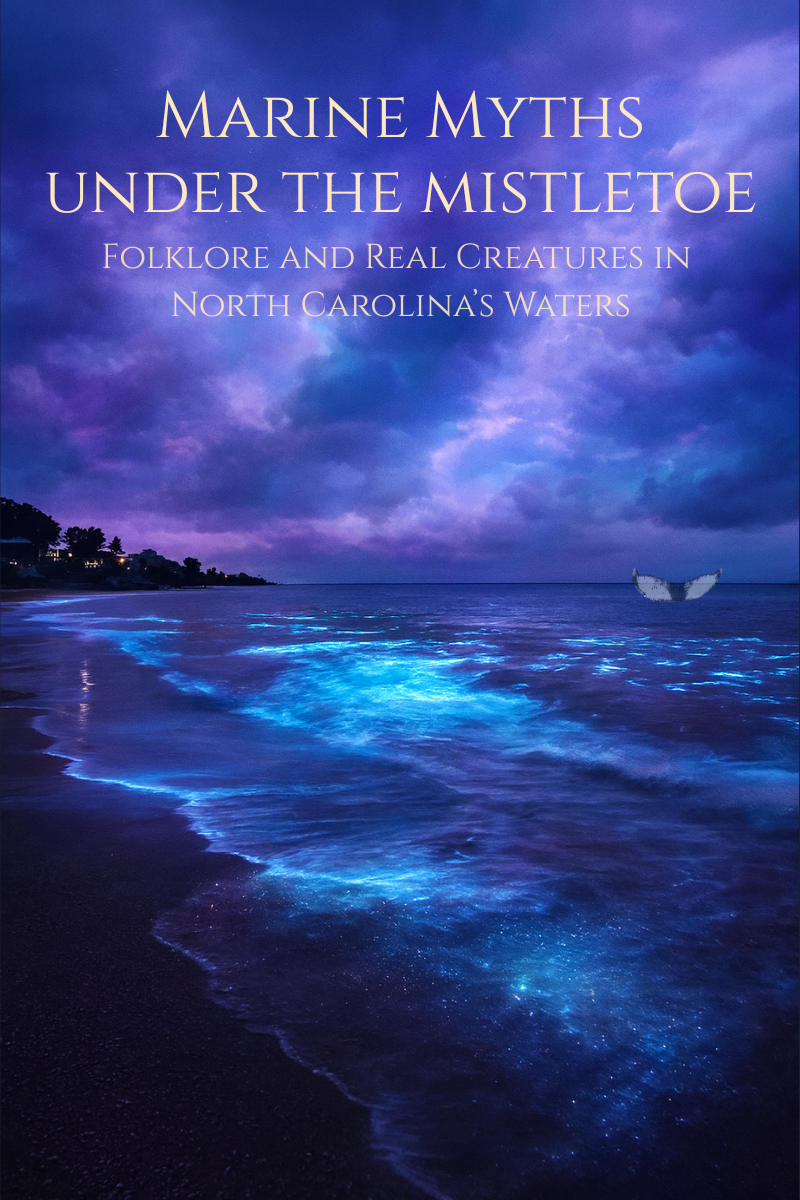
Local night fishermen describe glowing water that erupts into blue light when a net drops or a school passes below — a phenomenon that feels supernatural under a new moon in the stillness.
The Science — Bioluminescent Dinoflagellates
The glow comes from dinoflagellates, such as Noctiluca scintillans, which emit bright light when disturbed. Warmer months, calmer seas and reduced sediment can make these flashes stand out like underwater meteors (Haddock, Moline & Case., 2010; Johnson & Allen, 2005).
A natural process — but dazzling enough to inspire talk of spirits beneath the tide.

The Siren of the Shoals
Voices carried by cold seas
The Legend
Some boaters recall hearing a sound — a long moan or rising wail — seeming unmistakably like a human voice drifting over calm winter water. One sound can feel like a warning. Another, like grief.
The Science — Migrating Whales and Phantom Songs
Every winter, North Atlantic right whales (Eubalaena glacialis) migrate through waters off North Carolina, including Onslow Bay (Keller et al., 2012). Their massive bodies, seen at dusk, can resemble the curves of a human torso rising unexpectedly from the deep.
But the haunting songs that travel tens of kilometers belong to humpback whales (Megaptera novaeangliae) farther offshore (Dunlop, Cato & Noad, 2008; Handel, Todd & Zoidis, 2012). Sound refracts through cold, dense winter water — bending, echoing, transforming — until a distant whale becomes a mysterious voice in the marsh.
A ghost in the story.
A whale in the science.
A song carried home by the sea.

The Marsh Giant
A slow breath in frozen reeds
The Legend
In winter stillness, some describe hearing something large moving in marsh grass — heavy, careful steps that push aside reeds, a dark back slipping between creek holes. Too cold for gators, they say — so what else could it be?
The Science — North Carolina’s Cold-Tolerant Alligators
The American alligator (Alligator mississippiensis) reaches its northernmost range in coastal North Carolina. Even in winter, they can surface and move during brief warm spells — and they maintain openings in ice by pushing upward with their snouts (Brisban, Standora & Vargo, 1982).
Slow movement in a hushed marsh can feel enormous.
The “giant” is real — scaled and silent in the cold.

Where Myth and Marsh Converge
Winter strips the coast to its bones. Sound travels farther. Shapes blur quicker. The familiar becomes unfamiliar beneath cold air and low light.
And so legends rise.
Behind them:
- a manatee distorted by mirage
- a giant squid arm pushed ashore by storms
- living lanterns beneath December water
- whale voices refracted through the sea
- an alligator surfacing to breathe through ice
Folklore and biology share the same tides — wonder and curiosity driving us to explain what the winter coast reveals only in glimpses.
Even in the quietest months, the estuary is alive with mystery that create marine myths under the mistletoe.
Learn more about winter estuary ecology here.
References
Brisbin, I. L., Standora, E. A., & Vargo, M. J. (1982). Body temperatures and behavior of American alligators during cold winter weather. American Midland Naturalist, 107(2), 209. https://doi.org/10.2307/2425371
Carmichael, S. (2018). Mysterious tales of coastal North Carolina. Arcadia Publishing.
Cecelski, D. S. (2001). The waterman’s song: Slavery and freedom in maritime North Carolina.
Deutsch, C. J., Reid, J. P., Bonde, R. K., Easton, D. E., Kochman, H. I., & O’Shea, T. J. (2003). Seasonal Movements, Migratory Behavior, and Site Fidelity of West Indian Manatees along the Atlantic Coast of the United States. Journal of Wildlife Management, 67(1), 1-77. https://www.jstor.org/stable/3830830
Dunlop, R. A., Cato, D. H., & Noad, M. J. (2008). Non‐song acoustic communication in migrating humpback whales (Megaptera novaeangliae). Marine Mammal Science, 24(3), 613-629. https://doi.org/10.1111/j.1748-7692.2008.00208.x
Guerra, Á., González, Á. F., Pascual, S., & Dawe, E. G. (2011). The giant squid Architeuthis: An emblematic invertebrate that can represent concern for the conservation of marine biodiversity. Biological Conservation, 144(7), 1989-1997. https://doi.org/10.1016/j.biocon.2011.04.021
Haddock, S. H., Moline, M. A., & Case, J. F. (2010). Bioluminescence in the Sea. Annual Review of Marine Science, 2(2010), 443-493. https://www.annualreviews.org/content/journals/10.1146/annurev-marine-120308-081028
Handel, S., Todd, S. K., & Zoidis, A. M. (2012). Hierarchical and rhythmic organization in the songs of humpback whales (Megaptera novaeangliae). Bioacoustics, 21(2), 141-156. https://www.tandfonline.com/doi/abs/10.1080/09524622.2012.668324
Johnson, W. S., & Allen, D. M. (2005). Zooplankton of the Atlantic and Gulf coasts: A guide to their identification and ecology. JHU Press.
Keller, C., Garrison, L., Baumstark, R., Ward-Geiger, L., & Hines, E. (2012). Application of a habitat model to define calving habitat of the North Atlantic right whale in the southeastern United States. Endangered Species Research, 18(1), 73-87. https://doi.org/10.3354/esr00413
Pinney, C. (2018). The waterless sea: A curious history of mirages. Reaktion Books.
Roper, C. F., & Boss, K. J. (1982, April). The Giant Squid. Scientific American, a division of Nature America, Inc, 246(4), 96-105. https://www.jstor.org/stable/24966572
Roper, C. F., Judkins, H., Voss, N. A., Shea, E., Dawe, E., Ingrao, D., Rothman, P. L., & Roper, I. H. (2015). A compilation of recent records of the giant Squid, Architeuthis dux (Steenstrup, 1857) (Cephalopoda) from the western North Atlantic Ocean, Newfoundland to the Gulf of Mexico. American Malacological Bulletin, 33(1), 78-88. https://doi.org/10.4003/006.033.0116