
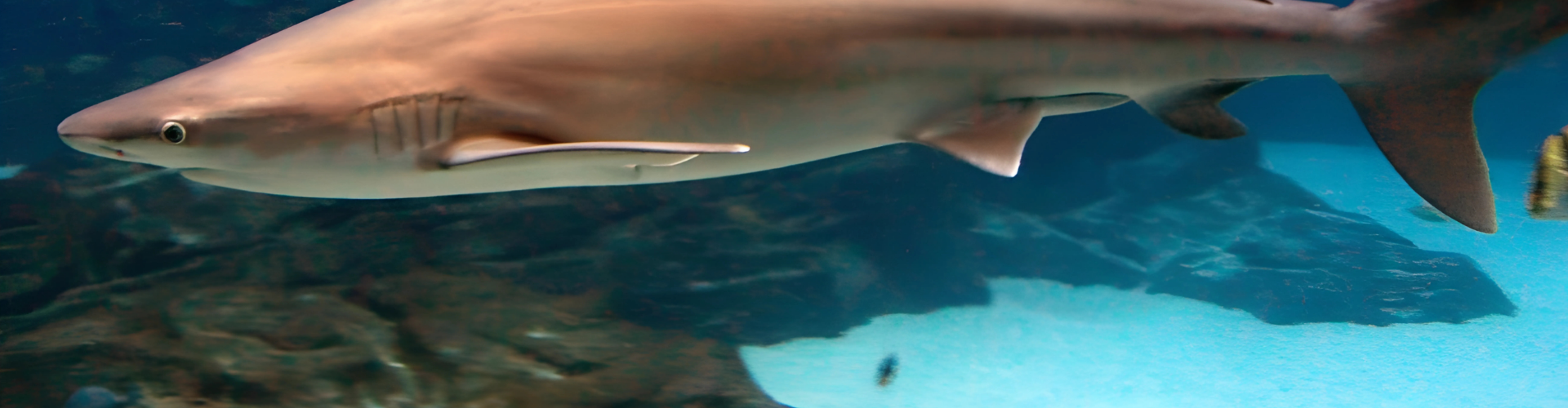
Taxonomy & Biology
Taxonomy
Common Name(s): Sandbar shark, brown shark, queriman shark, thickskin shark
Scientific Name: Carcharias plumbeus
Classification
- Kingdom: Animalia
- Subkingdom: Bilateria
- Infrakingdom: Deuterostomia
- Phylum: Chordata
- Subphylum: Vertebrata
- Infraphylum: Gnathostomata
- Class: Chondrichthyes
- Subclass: Elasmobranchii
- Superorder: Euselachii
- Order: Carcharhiniformes
- Family: Carcharhinidae
- Genus: Carcharhinus
- Species: plumbeus
Biology
Population
Sandbar sharks are a coastal-pelagic species that inhabits temperate and tropical waters. They are considered the most abundant shark in the Western Atlantic. They tend to be bottom-dwellers that prefer continental shelves, oceanic banks and island terraces at depths between 60-200 feet deep and move deeper during migration (Knickle, 2025). They can be found at the mouths of bays and rivers, harbors, and estuaries in shallow turbid water. They prefer smooth subtrates and will avoid rough-bottom areas and coral reefs.
Sandbar sharks are a prohibited species for recreational harvest or possession in North Carolina (NOAA Fisheries, 2025). If they are caught, they must be released immediately, without removing from the water, and with minimal injury. Catching sharks recreationally in North Carolina is restricted to using rod and reel or handlines. Only a very small number of vessels in the United States are special permitted to fish, land, and sell sandbar sharks under the shark research fishery.
There are few studies about the sandbar shark.
Body Size
Size at maturity of male sandbar sharks is 71 inches total length; females are 72 inches total length (Sminkey & Musick, 1995). Juveniles measure about 2 feet at birth (NOAA Fisheries, 2025).
They are closely related to the dusky, bignose, and bull shark.
Feeding & Diet
The sandbar shark is an opportunistic bottom feeder. They prey on small bony fishes, skates, rays, eels, Atlantic spiny dogfish, octopus, squid, molluscs, bivalves, shrimp, and crabs (Knickle, 2025). They feed during the day but become active at night. Their large livers contain a high percentage of oil and vitamins that suggest a regular, successful feeding strategy compared to other species in their genus.
Position in the Food Web
Sandbar sharks are considered apex predators. Juvenile sharks may fall prey to bull sharks.
A parasitic copepod, Albeion lobatus, is often found on this shark (Knickle, 2025).
Reproduction
Sandbar sharks mate from late October to January that corresponds with a warmer summer season. The male will follow a female, occasionally biting her between the dorsal fins that reflect permanent scarring (Knickle, 2025).
Gestation lasts 8 to 12 months, but will vary by each region. In the Western Atlantic, young are carried for 9 months. They are gravid every other year with a resting year after birth.
Embryos are nourished by placental sac (viviparous). Pups are born June through August in the Western Atlantic. Litter size can vary by region and size of the mother (larger sharks bear larger litters) between 6 and 13 pups. Litters reflect a 1:1 ratio of male and female sharks.
Partruition occurs in shallow water habitats of bays and estuaries that protected from larger sharks, such as adult bull sharks. They will remain in the shallows until late fall when they will form schools and migrate between the shallows and warmer, deeper waters for a period of up to 5 years.
Natural Mortality
It is believed that sandbar sharks can live longer than 20 years old, up to 24 years for males and 26 years for females (Hale & Baremore, 2013).
Biodiversity
As an apex predator, sandbar sharks help maintain prey populations and support biodiversity.
Migratory Pattern
Sanbar sharks undergo seasonal migrations that are influenced by temperature and ocean currents (Knickle, 2025). Adults will move as far north as Cape Cod in the warmer, summer months and return as far south as South Carolina at the onset of cooler weather. Males will migrate in congregations and large schools earlier in deeper waters than females who prefer solitary migrations.
Danger to Humans
Sandbar sharks have a preference for small prey. They tend to avoid beaches and surface water. They pose little threat to humans, though their size can make them potentially dangerous (Knickle, 2025).
Fishing Regulations
As of June 2025, in North Carolina, sandbar sharks are not allowed to be harvested as they are a protected and prohibited species for any size (Rawls, 2024). Due to their protections, they cannot be retained or landed, and, if caught, they are to be released immediately without removal from the water with minimal injury.
Please Note: The fishing regulations and information provided on this website are for general information purposes only. While we strive to ensure the accuracy and timeliness of the content, fishing laws and regulations can change frequently and vary by location. It is the responsibility of each angler to verify the current local, state, and federal fishing laws before fishing. Always consult the official website or contact the appropriate wildlife and fisheries agency for the most up-to-date rules and regulations.
We are not liable for any penalties, fines, or legal issues that may arise from the use or misuse of the information on this site.
References
Hale, L. F., & Baremore, I. E. (2013). Age and growth of the Sandbar shark (Carcharhinus plumbeus) from the northern Gulf of Mexico and the western North Atlantic Ocean. Gulf of Mexico Science, 31(1). https://doi.org/10.18785/goms.3101.03
Heist, E. J., Graves, J. E., & Musick, J. A. (1995). Population genetics of the Sandbar shark (Carcharhinus plumbeus) in the Gulf of Mexico and Mid-Atlantic bight. Copeia, 1995(3), 555. https://doi.org/10.2307/1446752
Knickle, C. (2025, February 3). Sandbar shark. Discover Fishes. https://www.floridamuseum.ufl.edu/discover-fish/species-profiles/sandbar-shark/
NOAA Fisheries. (2025, May 13). Sandbar shark. Retrieved June 26, 2025, from https://www.fisheries.noaa.gov/species/sandbar-shark
Rawls, K. (2024). Proclamation Re: Shark – Commercial and Recreational – Opening Date and Harvest Restrictions (FF-2-2024). NC Division of Marine Fisheries. https://files.nc.gov/deq/documents/2023-12/FF-2-2024_Shark_Opening.pdf?VersionId=ojmPIaCH.7VqI6F8cf_GTAY1fy80NCYY#:~:text=H.,Isurus%20oxyrinchus)%20for%20recreational%20purposes
Sminkey, T. R., & Musick, J. A. (1995). Age and growth of the Sandbar shark, Carcharhinus plumbeus, before and after population depletion. Copeia, 1995(4), 871. https://doi.org/10.2307/1447035