This post comes from a reader’s question sent in as our season has shifted toward winter: Can you tell me more about cookiecutter sharks—their life history, diet, and range—and do we have any evidence of them connected to our area? It’s a winter question, shaped by migration and distance. Cookiecutter sharks are not animals we expect to see off the beach or inside our estuaries. But their story does brush our coast—quietly and indirectly—on the bodies of animals that move past North Carolina each year.
Cookiecutter sharks are small, elusive, and rarely observed alive. Yet their marks travel widely, carried northward along offshore pathways that tighten in winter, when the Gulf Stream draws migratory lives closer to our horizon.
A small shark with a global range
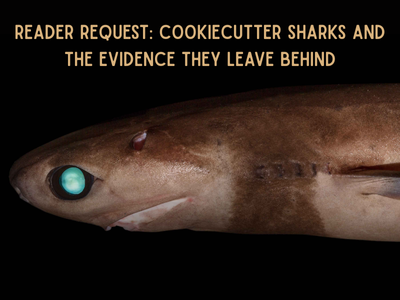
Cookiecutter sharks belong to the genus Isistius, with Isistius brasiliensis the most widely documented species in the Atlantic. Adults are typically 40–60 cm (15.7-23.6 in) long, with a compact, cylindrical body and proportionally large eyes adapted for low-light conditions (Compagno, 1984). Despite their size, their distribution is vast. They occur circumglobally in tropical and subtropical oceans and are strongly associated with pelagic, offshore environments rather than continental shelves or coastal waters (Compagno, 1984; Papastamatiou et al., 2010).
Most of a cookiecutter shark’s life unfolds far from shore and largely out of sight. This is one reason they remain poorly known to the public, even as their ecological footprint spans entire ocean basins.
Morphology built for taking a piece
The cookiecutter shark’s reputation comes from a feeding strategy unlike that of any other shark. Thick, muscular lips create a suction seal against prey, while the lower jaw carries a single row of large, triangular teeth fused into a continuous cutting blade. These lower teeth are shed as a single unit, maintaining an efficient cutting edge throughout the shark’s life (Compagno, 1984).
During feeding, the shark attaches briefly, anchors with its upper teeth, and rotates its body to excise a plug of tissue. The result is a circular or oval wound with clean margins—so precise it can look manufactured rather than bitten (Papastamatiou et al., 2010). This strategy allows a small shark to feed on animals far larger than itself without prolonged pursuit or lethal force.

Diet and trophic role in the open ocean
Cookiecutter sharks feed across a wide range of pelagic organisms. Documented prey include tunas, swordfish, other large teleost fishes, squids, dolphins, and large whales (Muñoz-Chápuli et al., 1988; Niella et al., 2018; Best et al., 2016). Rather than functioning as apex predators, they act as ectoparasitic predators—removing tissue while leaving prey alive. Chemical tracer and stable isotope analyses place Isistius species at relatively high trophic positions despite their small size, integrating energy from multiple pelagic food webs (Carlisle et al., 2021). Their influence is subtle but widespread, written not in dramatic predation events but in repeated, measurable interactions across the open ocean.
Life in the vertical: behavior and movement
Cookiecutter sharks are closely associated with diel vertical migration. During daylight hours, they occupy deeper mesopelagic waters; at night, they ascend toward the surface as fishes and marine mammals rise to feed (Papastamatiou et al., 2010). This nightly overlap increases encounter rates with large, fast-moving prey under low-light conditions.
This behavior explains both their effectiveness and their invisibility. Cookiecutter sharks rarely interact directly with humans, and most evidence of their presence comes not from sightings, but from the wounds they leave behind.

Light in the dark: photophores and deception
Cookiecutter sharks are not only adapted for darkness—they produce it. Embedded within their skin are photophores, specialized light-emitting organs that allow the shark to generate bioluminescence. Detailed anatomical and biochemical analyses show that these photophores are distributed across much of the ventral surface, creating a soft glow that closely matches downwelling light from the surface at night (Delroisse et al., 2014).
This light is not decorative. It functions as counterillumination, a camouflage strategy common among midwater organisms, in which emitted light reduces the shark’s silhouette when viewed from below. Against the faint glow of the night surface, the shark effectively erases its outline. Only one area remains dark: the region beneath the jaw. That shadowed patch may act as a visual lure, resembling a small fish when seen from a distance—drawing larger predators close enough for the cookiecutter to strike (Delroisse et al., 2014).
The photogenic skin of Isistius brasiliensis is also chemically complex. Enzymatic studies reveal multiple biochemical pathways involved in light production (bioluminescence), suggesting fine control over luminescence intensity and distribution (Delroisse et al., 2014). In the open ocean at night, where contrast matters more than size, this combination of light and shadow allows a small shark to manipulate perception—remaining unseen until it is already attached.
This ability to move invisibly through the pelagic night helps explain both the cookiecutter shark’s success and its absence from human observation. Like its scars, its light is part of an ecology that works best when it goes unnoticed.

Do cookiecutter sharks occur off North Carolina?
There are no records of resident cookiecutter sharks in nearshore North Carolina waters, and none would be expected. However, the western North Atlantic—including waters influenced by the Gulf Stream—falls well within the documented range of Isistius brasiliensis (Compagno, 1984).
While the sharks themselves remain far offshore, the animals that pass our coast often arrive bearing quiet records of where they have already traveled—small, circular marks that hint at warm pelagic waters well beyond our horizon.
Many species that migrate past North Carolina seasonally—swordfish, tunas, offshore dolphins, and large whales—spend portions of their annual cycle in oceanic regions where cookiecutter sharks are active. When those animals move northward or closer to the continental shelf, they may carry visible evidence of those offshore encounters.
Scars as evidence: how cookiecutter sharks touch our region

Some of the clearest evidence for cookiecutter sharks in the Atlantic comes from the scars themselves. Circular crater wounds on swordfish have been used to infer the distribution and biogeography of Isistius brasiliensis in the North Atlantic (Muñoz-Chápuli et al., 1988). Similar bite marks have been documented on multiple tuna species, confirming repeated interactions between cookiecutter sharks and highly migratory pelagic fishes (Niella et al., 2018).
Large whales tell the same story. Studies have documented characteristic cookiecutter scars across multiple whale species, often accumulated during time spent in warmer offshore waters and retained as animals migrate into higher latitudes (Best et al., 2016). In the Gulf of Mexico, cookiecutter bite wounds have been recorded on several cetacean species, reinforcing the consistency of this interaction across the western Atlantic (Grace et al., 2018).
In this way, a scar becomes more than an injury; it functions as a trace of movement, carried northward by the same currents that shape our winter seas, like a passport stamp of their journey.
What a cookiecutter scar looks like
Cookiecutter scars are often described as “punched out.” In the scientific literature, they are characterized by:
- Circular or oval crater-shaped wounds
- Clean, well-defined edges
- Relatively consistent size
- Often multiple scars on a single individual
When these features occur together—particularly on pelagic fishes or marine mammals—they are widely attributed to Isistius species (Best et al., 2016; Niella et al., 2018).

Closing: marks of a longer journey
Cookiecutter sharks remind us that our coastal waters are shaped by lives lived far beyond the horizon. In winter, when migrations tighten along the Gulf Stream, animals pass our shore carrying the quiet evidence of where they have already been. Those circular scars are not just wounds; they are records—impressions left by warm nights, deep water, and encounters that happened far offshore.
Long after the shark itself has disappeared into the pelagic dark, its mark remains. A small, precise circle becomes a trace of movement, a reminder that the animals we see here arrive with histories written on their bodies. In that way, cookiecutter scars function like a biological travel log—proof that our local waters are connected to distant places, and that the ocean keeps track of its travelers even when we do not.
References
Best, P. B., & Photopoulou, T. (2016). Identifying the “demon whale-biter”: Patterns of scarring on large whales attributed to a cookie-Cutter shark Isistius Sp. PLOS ONE, 11(4), e0152643. https://doi.org/10.1371/journal.pone.0152643
Carlisle, A. B., Allan, E. A., Kim, S. L., Meyer, L., Port, J., Scherrer, S., & O’Sullivan, J. (2021). Integrating multiple chemical tracers to elucidate the diet and habitat of Cookiecutter sharks. Scientific Reports, 11(1). https://doi.org/10.1038/s41598-021-89903-z
Compagno, L. J. (1984). FAO species catalogue, Vol. 4: Sharks of the world, Part 1 – Hexanchiformes to Lamniformes (125). FAO Fisheries Synopsis.
Delroisse, J., Duchatelet, L., Flammang, P., & Mallefet, J. (2021). Photophore distribution and enzymatic diversity within the photogenic integument of the Cookie-Cutter shark Isistius brasiliensis (Chondrichthyes: Dalatiidae). Frontiers in Marine Science, 8. https://doi.org/10.3389/fmars.2021.627045
Grace, M. A., Dias, L. A., Maze-Foley, K., Sinclair, C., Mullin, K. D., Garrison, L., & Noble, L. (2018). Cookiecutter shark bite wounds on cetaceans of the Gulf of Mexico. Aquatic Mammals, 43(5), 491-499. https://doi.org/10.1578/am.44.5.2018.491
Muñoz-Chápuli, R., Salgado, J. C., & Serna, J. M. (1988). Biogeography of Isistius brasiliensis in the north-eastern Atlantic, inferred from crater wounds on swordfish (<i>Xiphias gladius</i>). Journal of the Marine Biological Association of the United Kingdom, 68(2), 315-321. https://doi.org/10.1017/s0025315400052218
Niella, Y. V., Duarte, L. A., Bandeira, V. R., Crespo, O., Beare, D., & Hazin, F. H. (2018). Cookie‐Cutter shark Isistius spp. predation upon different tuna species from the south‐western Atlantic Ocean. Journal of Fish Biology, 92(4), 1082-1089. https://doi.org/10.1111/jfb.13569
Papastamatiou, Y. P., Wetherbee, B. M., O’Sullivan, J., Goodmanlowe, G. D., & Lowe, C. G. (2010). Foraging ecology of Cookiecutter sharks (Isistius brasiliensis) on pelagic fishes in Hawaii, inferred from prey bite wounds. Environmental Biology of Fishes, 88(4), 361-368. https://doi.org/10.1007/s10641-010-9649-2