How seagrasses and marsh grasses—and the animals within them—build the marshes of Onslow County
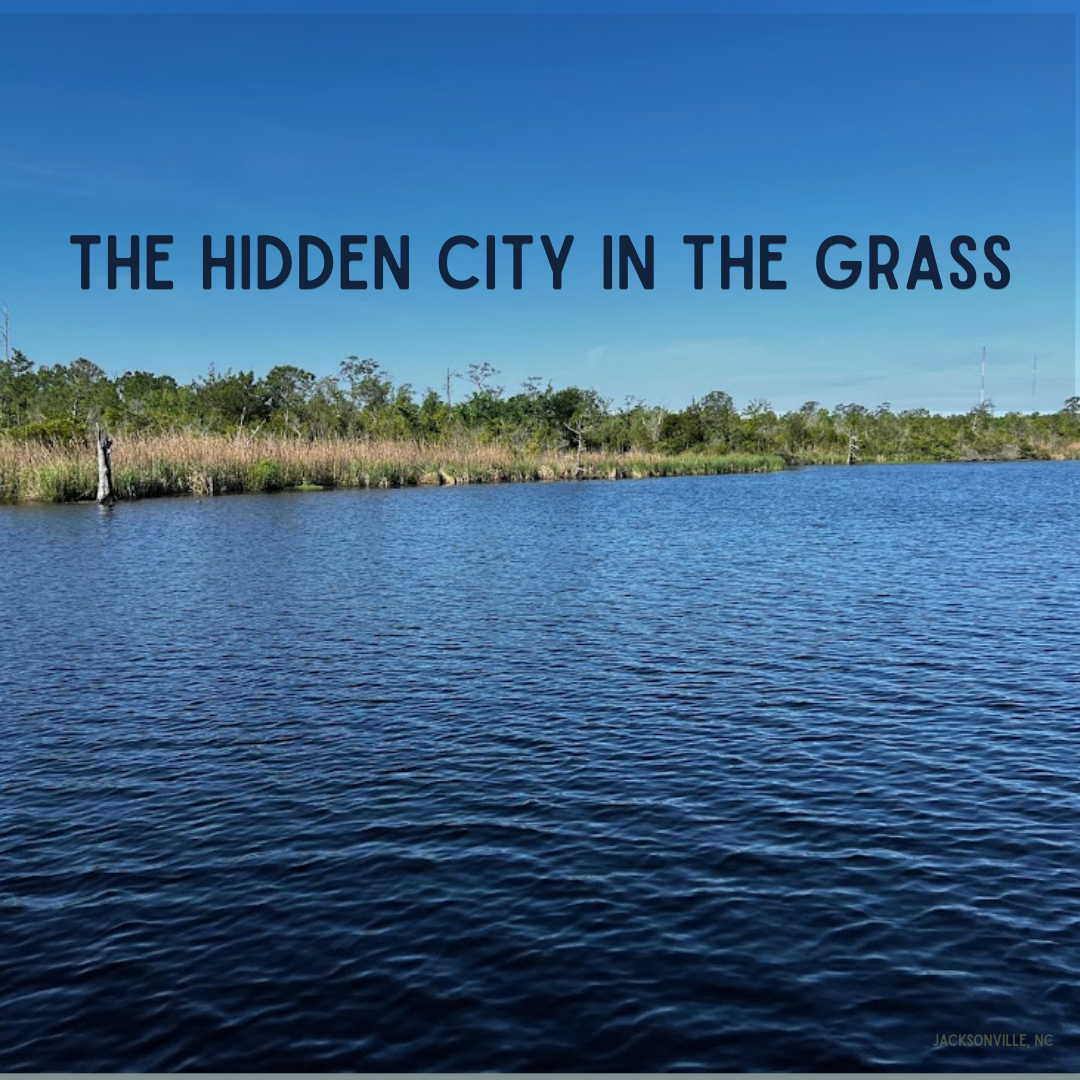
In Onslow County’s estuarine marshes, the best time to understand how the landscape works is when the water pulls back. As tides drain from creeks and shallow flats, patterns begin to emerge—where water lingers, where it moves easily, and where it hesitates. These patterns are not random. They reflect the combined influence of plants, animals, and sediments continually reshaping the boundary between land and sea.
Like the microscopic shells of foraminifera preserved in sediment, marsh and seagrass communities record environmental conditions. But unlike the past locked in mud, these systems are alive, constantly negotiated by plants, grazers, predators, and microbes.
From permanently submerged seagrass beds to the highest marsh edge, each elevation zone in Onslow County is maintained not just by vegetation, but by species that actively regulate growth, chemistry, and water flow.
Subtidal shallows: seagrass beds maintained by grazers
In the shallow, light-penetrated waters of the New River Estuary and protected soundside areas, seagrass beds form underwater meadows that stabilize sediments and provide nursery habitat for fish and invertebrates. Species present or expected in Onslow County waters include eelgrass (Zostera marina), shoalgrass (Halodule wrightii), and widgeongrass (Ruppia maritima) (Mallin, 2000; Orth, 1984).
Seagrass blades rapidly accumulate epiphytic algae and microbial films. Without constant grazing, this layer can block light and suppress photosynthesis. Amphipods, isopods, and small gastropods act as continuous maintenance crews, grazing epiphytes and preventing them from overwhelming the plants themselves (Orth & van Montfrans, 1984; Valentine & Duffy, 2006).
Experimental studies show that when these grazers are removed, seagrass condition declines even under favorable light conditions, demonstrating that plant survival depends as much on animal activity as on physical environment (Duffy et al., 2015). Beneath the canopy, burrowing worms and bivalves recycle nutrients and oxygenate sediments, preventing organic matter from accumulating around roots (Orth, 1984).
In this zone, seagrass persists because grazers keep blades clean and sediments breathable—a cooperative system built on constant biological upkeep.

The low marsh edge: cordgrass shaped by snails and crabs
At the daily-flooded edge of the marsh, smooth cordgrass (Spartina alterniflora) dominates. This narrow fringe marks the boundary between open water and marsh interior, where erosion pressure is highest and stability matters most.


Cordgrass growth here is tightly regulated by the marsh periwinkle snail (Littoraria irrorata). These snails climb grass stems to avoid inundation and graze directly on living tissue, often intensifying damage by facilitating fungal infection. At high densities, periwinkle grazing can dramatically reduce cordgrass height and biomass, effectively mowing the marsh edge (Silliman & Zieman, 2001).

Unchecked grazing can destabilize the marsh platform—but periwinkles themselves are regulated by crabs, including blue crabs (Callinectes sapidus), fiddler crabs (Genus Uca), purple marsh crabs (Sesarma reticulatum), hermit crabs and other burrowing species. Crabs prey on snails, limiting grazing pressure and indirectly protecting cordgrass (Silliman et al., 2005).
Crabs also function as ecosystem engineers. Their burrows aerate sediments, relieve sulfide stress around plant roots, and improve tidal water movement through compacted soils (Bertness, 1985; Thomas & Blum, 2010). Where crabs are abundant, cordgrass grows taller and denser; where they are lost, marsh die-off can occur rapidly.
This zone persists through a trophic cascade: grass builds land, snails limit grass, and crabs keep the system in balance.
Mid-marsh: mussels and detritus processors reinforce the platform
Just upslope, where flooding becomes less frequent, plant communities shift toward mixtures that often include saltmeadow cordgrass (Spartina patens). Here, the ribbed mussel (Geukensia demissa) emerges as a key stabilizing force.

Ribbed mussels form dense clusters at the base of marsh vegetation, binding sediments with byssal threads and physically reinforcing marsh soils against erosion (Bertness, 1984). As filter-feeders, they concentrate nutrients by removing organic matter from tidal waters and depositing nitrogen-rich biodeposits directly into marsh sediments (Jordan & Valiela, 1982).

Grasses growing near mussel aggregations exhibit higher productivity than those without mussels, demonstrating a strong facilitative relationship between animals and plants (Bertness, 1984). As vegetation senesces, detritivorous worms, insects, and microbial decomposers break down dead plant material, converting standing biomass into detritus that fuels food webs throughout the estuary (Mann, 1988).
The mid-marsh functions as a processing zone, reinforcing marsh structure while converting plant matter into usable energy.
High marsh: microbes that manage chemical stress
In the high marsh, dominated by black needlerush (Juncus roemerianus) and saltmeadow cordgrass (Spartina patens), flooding is limited to spring tides and storms. Prolonged exposure to air creates harsh soil conditions, including elevated salinity and sulfide accumulation.

Here, microbial communities play a central role. Sulfate-reducing and sulfur-oxidizing bacteria regulate sulfide concentrations that would otherwise become toxic to plant roots, while microbial decomposition controls nutrient availability under fluctuating oxygen conditions (Howarth & Giblin, 1983).

Small soil invertebrates maintain pore spaces that allow brief pulses of oxygenated water to penetrate during flooding. Unlike the visibly engineered low marsh, the high marsh is stabilized largely through biogeochemical regulation rather than grazing or predation.
This zone endures because microbes quietly buffer plants against chemical extremes.

The marsh–upland transition: keeping the boundary intact
At the uppermost margin of the marsh, tidal influence becomes intermittent and environmental stress shifts from salinity to erosion and freshwater input. Burrowing invertebrates increase soil permeability, allowing stormwater and tidal surges to infiltrate rather than scour the surface (Thomas & Blum, 2010).

Vegetation root networks stabilize soils exposed to drying and wave action, while animal burrows act as pressure-release pathways during extreme events. When these biological processes are disrupted—by shoreline hardening or vegetation removal—the marsh edge often collapses abruptly rather than adjusting gradually.
This boundary holds only as long as water can move through it.

A marsh built by interactions
Across all elevations in Onslow County marshes, the pattern is consistent:
Plants define the zones—but animals and microbes determine whether those zones endure.

From grazers that keep seagrass blades clean, to crabs that hold the marsh edge together, to microbes that manage invisible chemical stress, the marsh is sustained by small organisms with outsized influence. Together, these interactions determine not just what lives in the marsh, but whether the marsh itself endures.

References
Abbott, K. M., Quirk, T., & Fultz, L. M. (2022). Soil microbial community development across a 32-year coastal wetland restoration time series and the relative importance of environmental factors. Science of The Total Environment, 821, 153359. https://doi.org/10.1016/j.scitotenv.2022.153359
Bertness, M. D. (1984). Ribbed mussels and Spartina Alterniflora production in a New England salt marsh. Ecology, 65(6), 1794-1807. https://doi.org/10.2307/1937776
Bertness, M. D. (1985). Fiddler crab regulation of Spartina alterniflora production on a New England salt marsh. Ecology, 66(3), 1042-1055. https://doi.org/10.2307/1940564
Duffy, J. E., Reynolds, P. L., Boström, C., Coyer, J. A., Cusson, M., Donadi, S., Douglass, J. G., Eklöf, J. S., Engelen, A. H., Eriksson, B. K., Fredriksen, S., Gamfeldt, L., Gustafsson, C., Hoarau, G., Hori, M., Hovel, K., Iken, K., Lefcheck, J. S., Moksnes, P., … Stachowicz, J. J. (2015). Biodiversity mediates top–down control in eelgrass ecosystems: A global comparative‐experimental approach. Ecology Letters, 18(7), 696-705. https://doi.org/10.1111/ele.12448
Howarth, R. W., & Giblin, A. (1983). Sulfate reduction in the salt marshes at Sapelo island, Georgia. Limnology and Oceanography, 28(1), 70-82. https://doi.org/10.4319/lo.1983.28.1.0070
Hyman, A. C., Chiu, G. S., Seebo, M. S., Smith, A., Saluta, G. G., Knick, K. E., & Lipcius, R. N. (2023). Model-based evaluation of critical nursery habitats for juvenile blue crabs through ontogeny: Abundance and survival in seagrass, salt marsh, and unstructured bottom. https://doi.org/10.1101/2023.07.20.549877
Jordan, T. E., & Valiela, I. (1982). A nitrogen budget of the ribbed mussel, Geukensia demissa, and its significance in nitrogen flow in a New England salt marsh. Limnology and Oceanography, 27(1), 75-90. https://doi.org/10.4319/lo.1982.27.1.0075
Mallin, M. A., Burkholder, J. M., Cahoon, L. B., & Posey, M. H. (2000). North and South Carolina coasts. Marine Pollution Bulletin, 41(1-6), 56-75. https://doi.org/10.1016/s0025-326x(00)00102-8
Mann, K. H. (1988). Production and use of detritus in various freshwater, estuarine, and coastal marine ecosystems. Limnology and Oceanography, 33(4part2), 910-930. https://doi.org/10.4319/lo.1988.33.4part2.0910
Orth, R. J., Heck, K. L., & Van Montfrans, J. (1984). Faunal communities in seagrass beds: A review of the influence of plant structure and prey characteristics on predator: Prey relationships. Estuaries, 7(4), 339. https://doi.org/10.2307/1351618
Orth, R. J., & Van Montfrans, J. (1984). Epiphyte-seagrass relationships with an emphasis on the role of micrograzing: A review. Aquatic Botany, 18(1-2), 43-69. https://doi.org/10.1016/0304-3770(84)90080-9
Silliman, B. R., Van de Koppel, J., Bertness, M. D., Stanton, L. E., & Mendelssohn, I. A. (2005). Drought, snails, and large-scale die-off of southern U.S. salt marshes. Science, 310(5755), 1803-1806. https://doi.org/10.1126/science.1118229
Silliman, B. R., & Zieman, J. C. (2001). Top-down control of Spartina alterniflora production by periwinkle grazing in a Virginia salt marsh. Ecology, 82(10), 2830. https://doi.org/10.2307/2679964
Thomas, C., & Blum, L. (2010). Importance of the fiddler crab Uca pugnax to salt marsh soil organic matter accumulation. Marine Ecology Progress Series, 414, 167-177. https://doi.org/10.3354/meps08708
Valentine, J. F., & Duffy, J. E. (n.d.). The central role of grazing in seagrass ecology. Seagrasses: Biology, Ecology and Conservation, 463-501. https://doi.org/10.1007/1-4020-2983-7_20
Zhang, G., Bai, J., Jia, J., Wang, W., Wang, D., Zhao, Q., Wang, C., & Chen, G. (2023). Soil microbial communities regulate the threshold effect of salinity stress on SOM decomposition in coastal salt marshes. Fundamental Research, 3(6), 868-879. https://doi.org/10.1016/j.fmre.2023.02.024