Category: Spinner shark

  • Riding Out the Storm: Sharks and Hurricanes in North Carolina

    Riding Out the Storm: Sharks and Hurricanes in North Carolina

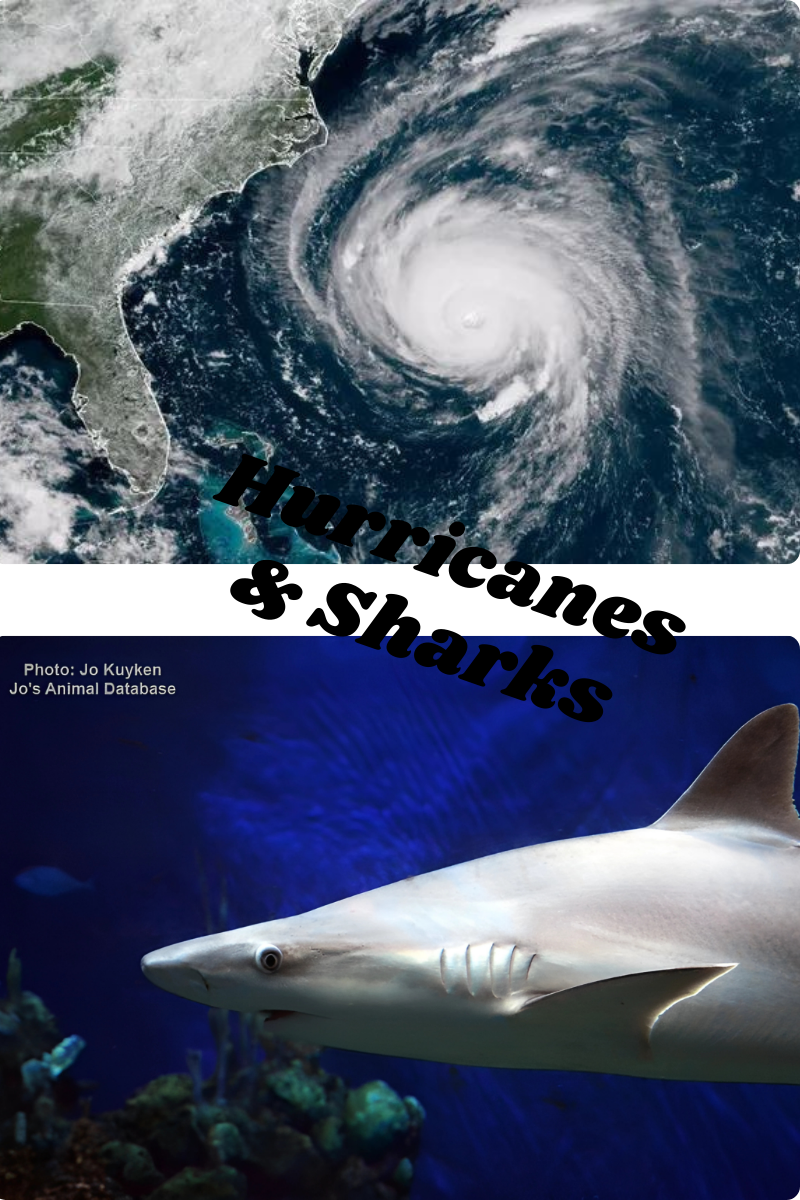
    When a hurricane or tropical storm barrels toward eastern North Carolina, humans board up windows and evacuate—but what do sharks do? Thanks to acoustic tagging and long-term monitoring, we now know that sharks don’t just passively endure storms. They have strategies for survival, and some are surprisingly sophisticated.

    Sensing the Storm: Barometric Pressure

    Sharks, especially coastal species like blacktips and bulls, appear to respond less to wind and waves than to rapid drops in barometric pressure. Research shows that blacktip juveniles in Florida left shallow nursery bays when pressure plummeted during Tropical Storm Gabrielle (2001). They returned after the storm once pressure stabilized. This suggests sharks aren’t reacting to turbulence itself but to the atmospheric signal that precedes it (Heupel et al., 2003). For blacktips, studies suggest that a drop of ~10 millibars in less than 24 hours is enough to trigger evacuation. Bulls show similar patterns, though individual responses vary (Boucek et al., 2019). In general, it’s not an exact “preferred” pressure number but rather the rate of change that matters.

    Shark Species and Storm Behavior

    Blacktip Sharks (Carcharhinus limbatus)

    • Known responders to pressure drops. Juveniles flee shallow estuaries and head for deeper water as storms approach.
    • Return quickly. They often reappear in their nurseries within a day or two after conditions settle.
    • Key study: Blacktip sharks respond to falling barometric pressure associated with Tropical Storm Gabrielle. (Heupel et al., 2003).

    Bull Sharks (Carcharhinus leucas)

    • Juveniles in Florida’s Everglades left estuaries before Hurricane Irma (2017). Some moved out days ahead of landfall, suggesting pressure cues were critical.
    • More variability. Some left immediately, others lingered, highlighting differences in individual thresholds. 
    • Key study: Ecological responses of estuarine organisms to Hurricane Irma. (Boucek et al. 2019).

    Sandbar Sharks (Carcharhinus plumbeus)

    • Nursery dependence. Juveniles use very shallow nurseries in Chesapeake Bay and Pamlico Sound (Grubbs et al., 2007).
    • Storm strategy (inferred). While direct hurricane data are lacking, their reliance on shallow estuaries suggests they likely mirror blacktip behavior—seeking deeper channels when pressure plummets.

    Spinner Sharks (Carcharhinus brevipinna)

    • Less direct data. Telemetry studies document their presence on the Mid-Atlantic shelf (NOAA, 2019), but no hurricane-event tracking exists yet.
    • Probable pattern. Like their blacktip relatives, they are expected to move offshore or deeper in response to rapid barometric drops.

    Eastern North Carolina: Local Implications

    NC Marine & Estuary Map

    NC Marine and Estuary Map | Credit: ESRI

    • Pamlico Sound Bull Shark Nursery. Since 2011, juveniles have been recorded here each summer, tracked with acousti: c tags. Seasonal exits toward deeper water (Cape Lookout to Hatteras, even Cape Canaveral in winter) suggest a built-in escape route when storms loom (Bangley et al., 2018).
    • Sandbars off Cape Hatteras. Juveniles overwinter just offshore in <20 m depths—safer refuge during storm surge compared to shallow estuaries (Musick & Colvocoresses, 1988).
    • Barrier Islands & Inlets. When storms surge into the sounds, sharks likely use inlets to escape into the continental shelf’s deeper, more stable waters.

    Why This Matters

    Hurricanes don’t just rearrange coastlines—they reshape the ecology of estuaries and nurseries. Storm-driven freshening of Pamlico Sound (as seen after Hurricanes Dennis, Floyd, and Irene) can cause hypoxia (low dissolved oxygen levels that make it difficult for aquatic life to breathe) and prey shifts (Paerl et al., 2001). For sharks, evacuating shallow water isn’t just about avoiding turbulence—it’s survival against collapsing water quality.

    Key Takeaways for NC Shark Ecology

    • Sharks sense storms primarily via barometric pressure drops, not turbulence.
    • Blacktips: textbook responders; evacuate at ~10 mb drops in 24 hrs.
    • Bulls: similar, but with more individual variation.
    • Sandbars & Spinners: less direct data, but likely respond in kind.
    • Eastern NC: Pamlico Sound, Core/Bogue, and Chesapeake Bay nurseries mean juvenile sharks face real storm risks—and escaping to the shelf is a proven strategy.

    Sharks and Storms: A Take-Home Message

    Next time a hurricane approaches Topsail, Surf City, or anywhere along our NC coastline, remember: the sharks know it’s coming too. Long before the first raindrops fall, many have already slipped into deeper waters, riding out the storm in safety—only to return once the skies clear and the estuaries calm.

    References

    Bangley, C. W., Paramore, L., Shiffman, D. S., & Rulifson, R. A. (2018). Increased abundance and nursery habitat use of the bull shark (Carcharhinus leucas) in Pamlico Sound, North Carolina. Ecology and Evolution, 8(11), 5195–5205. https://doi.org/10.1002/ece3.3760

    Boucek, R. E., Rehage, J. S., Adams, A. J., Santos, R., Blewett, D. A., & Lowerre-Barbieri, S. K. (2019). Ecological responses of estuarine organisms to Hurricane Irma. Ecology and Evolution, 9(21), 11979–11991. https://doi.org/10.1002/ece3.5209

    Grubbs, R. D., Musick, J. A., Conrath, C. L., & Romine, J. G. (2007). Long-term movements, habitat fidelity, and seasonal occurrence of juvenile sandbar sharks in the Chesapeake Bay region. Marine Ecology Progress Series, 333, 287–301. https://doi.org/10.3354/meps333287

    Heupel, M. R., Simpfendorfer, C. A., & Hueter, R. E. (2003). Running before the storm: Blacktip sharks respond to falling barometric pressure associated with Tropical Storm Gabrielle. Fisheries Research, 63(2), 193–196. https://doi.org/10.1016/S0165-7836(02)00211-7

    Musick, J. A., & Colvocoresses, J. A. (1988). Distribution and abundance of sharks from the central U.S. Atlantic continental shelf. Transactions of the American Fisheries Society, 117(1), 44–55. https://doi.org/10.1577/1548-8659(1988)117<0044:DOOS>2.3.CO;2

    National Oceanic and Atmospheric Administration. (2019). Spinner shark (Carcharhinus brevipinna) presence in Mid-Atlantic waters. NOAA Technical Report. https://repository.library.noaa.gov/view/noaa/22487

    Paerl, H. W., Bales, J. D., Ausley, L. W., Buzzelli, C. P., Crowder, L. B., Eby, L. A., Fear, J. M., Go, M., Peierls, B. L., Richardson, T. L., & Ramus, J. S. (2001). Ecosystem impacts of three sequential hurricanes (Dennis, Floyd, and Irene) on the United States’ largest lagoonal estuary, Pamlico Sound, NC. Proceedings of the National Academy of Sciences, 98(10), 5655–5660. https://doi.org/10.1073/pnas.171093598
  • Think You Know Your Sharks? The 3 Most Misidentified

    Think You Know Your Sharks? The 3 Most Misidentified

    Many sharks have similar appearances in body shape and colorations, especially when viewed from above. Juvenile sharks can be difficult to identify because their markings and proportions are not developed to fully resemble adults. The ability to obtain clear, prolonged views of sharks underwater can be difficult due to shark movement and water clarity. Not all people that encounter sharks have the specialized knowledge required for accurate identification.

    But which sharks are often misidentified in North Carolina, and why? It’s often like a game of “can you spot the differences?” when trying to identify similar species. Let’s review the top 3 misidentified sharks in NC.

    ? Who are the Top 3 Misidentified Shark

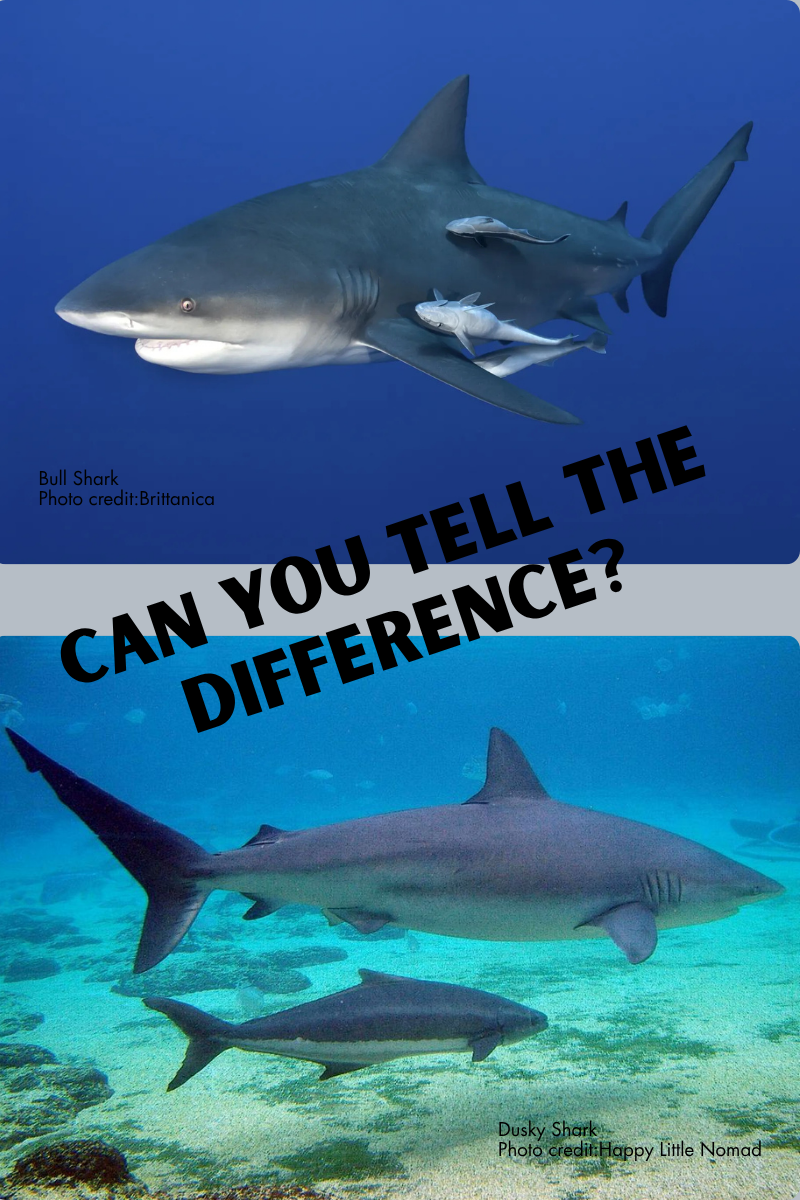
    1. Sandbar shark (Carcharhinus plumbeus) vs dusky shark (Carcharhinus obscurus)

    Why They Are Confused

    Both sharks can grow to large sizes with a bulky appearance with overlapping habitats. Both have a brown to bronze upper body that fades into a white belly. They look similar because they are members of the same shark genus, Carcharhinus or Requiem sharks, that share some of the same qualities such as, slender to stout bodies, their first dorsal fin is larger than their second dorsal fin, have a long upper tail lobe, and single-cusped blade-shaped teeth.

    Key Differences

    • Sandbar shark: Large, tall dorsal fin with its leading edge located ahead of its pectoral fins
    • Dusky shark: Slightly less bulky than the sandbar shark with a shorter dorsal fin that originates behind its narrower pectoral fins, and a snout length that is equal to or shorter than its mouth width making it appear more pointy. Side note: dusky sharks prefer cooler water temperatures, between 66 and 82 degrees fahrenheit, so they may not be seen frequently in warm summer waters.

    2. Blacktip shark (Carcharhinus limbatus) vs spinner shark (Carcharhinus brevipinna)

    Why They Are Confused

    Both sharks leap from the water and spin during feeding. They look similar because they are members of the same shark genus, Carcharhinus or Requiem sharks, that share some of the same qualities such as, slender to stout bodies, their first dorsal fin is larger than their second dorsal fin, have a long upper tail lobe, and single-cusped blade-shaped teeth.

    Key Differences

    • Spinner shark: More slender, all fins (except the anal fin) are often black-tipped, spins more during breaching
    • Blacktip shark: Heavier body than the spinner shark, only dorsal and pectoral fins have black tips, and the anal fin has a white tip.

    3. Atlantic sharpnose shark (Rhizoprionodon terraenovae) vs juvenile blacktip shark (Carcharhinus limbatus)

    Why They Are Confused

    The juvenile blacktip shark has not fully developed into its final adult stage, so it lacks markings and definition that can distinguish it better from Atlantic sharpnose shark. The blacktip, in its adult stage, can reach up to 6 feet, while the Atlantic sharpnose shark only reaches a maximum length of 3.5 that makes it a similar size to a juvenile blacktip shark. Both forage in shallower waters and share the same habitat.

    Key Differences

    • Juvenile blacktip sharks: Have black tips on their fins, and a white tipped anal fin. Gray to gray-brown coloration with a white underside.Wedge-shaped line or Z-shaped line along its sides.
    • Atlantic sharpnose sharks: Have white spots along its side, second dorsal fin, blacktipped, originating over or behind its anal fin. This will be the only black tipped fin on this species.

    Safety Note: Are They Dangerous?

    Most sharks seen nearshore in Onslow County are not aggressive toward humans and play a crucial role in ocean health. Most sightings are brief and harmless. That said, avoid swimming near fishing piers or schools of baitfish, especially at dawn or dusk, and between fishers casting from the shore.

    Why It Matters

    Correct species identification helps:

    • Local fishermen adhere to fishing regulations
    • Researchers track species populations
    • Beachgoers feel informed and safe
    • Conservationists protect nurseries and feeding grounds

    Want to Help?

    Have you seen a shark? I am looking for information on locations of juvenile sharks. You can report sightings or photos to support my independent research by posting on my social media channels or email. Please follow our Instagram and Facebook pages to stay informed, ask questions, or post your pictures!

  • Shark Watch: Meet the Seasonal Visitors to Onslow County’s Coast

    Atlantic blacktip sharks | Credit: iStock

    North Carolina’s coastline is home to a surprisingly rich and dynamic marine ecosystem — and sharks are among its most vital (and misunderstood) residents. In Onslow County, from the inlets around Sneads Ferry to the open waters off Topsail Island, over a dozen species of sharks migrate, feed, or even give birth throughout the year.

    But which sharks are here, and when? Let’s dive in.

    Why Sharks Visit Onslow County

    The waters off Onslow County are part of a critical marine highway where warm Gulf Stream currents mix with nutrient-rich coastal waters. This convergence creates a perfect buffet for migrating predators like sharks, especially in spring through early fall.

    The area also includes estuaries, inlets, and sandbars — ideal habitats for young sharks and mothers giving birth. Some species pass through, while others stay for an entire season.

    Seasonal Visitors: A Month-by-Month Guide

    SeasonCommon Shark SpeciesNotes
    Spring (March-May)Blacktip, spinner, Atlantic sharpnoseBlacktips often arrive first. Spinner sharks can be seen leaping nearshore.
    Summer (June-August)Sandbar, bull, dusky, hammerhead, tigerHigh diversity and activity. Shark pupping peaks in estuarine waters.
    Fall (September-November)Blacktip, scalloped hammerhead, sand tigerJuveniles migrate out, adults fatten up before heading south.
    Winter (December-February)Occasional Sandbar or Atlantic sping dogfishMost large sharks migrate south or deeper offshore.

    Shark Spotlights

    • Blacktip sharks – Fast and social (in packs), often seen inshore during spring and fall around large schools of fish.
    • Sandbar sharks – One of the most common summer sharks, easily misidentified as a dusky shark, sand tiger shark or bull shark.
    • Scalloped hammerheads – Occasionally observed near deeper channels and wrecks.
    • Atlantic spiny dogfish – A cold-season visitor, small and harmless mesopredator.

    Safety Note: Are They Dangerous?

    Sharks in Onslow County are not aggressive toward humans and play a crucial role in ocean health. Most sightings are brief and harmless. That said, avoid swimming near fishing piers or schools of baitfish, especially at dawn or dusk, and between fishers casting from the shore..

    Why It Matters

    Understanding seasonal shark activity helps:

    • Local fishermen avoid bycatch
    • Researchers track species health and migration
    • Beachgoers feel informed and safeResearchers track species health and migration
    • Conservationists protect nurseries and feeding grounds

    Want to Help?

    Have you seen a shark or need help with identification? You can report sightings or photos by posting or emailing me with your questions and to support my independent research. Follow our Instagram and Facebook pages to stay informed, ask questions, or learn how to participate in future citizen science efforts.