Category: Bioturbation

  • When the Bottom Moves: Rays in the Shallows of Onslow County

    When the Bottom Moves: Rays in the Shallows of Onslow County

    What People Are Seeing

    In the last few weeks, the water along the edges of Onslow County has felt different.

    Not because the water itself has changed—but because something beneath it has become harder to ignore.

    Schools of cownose ray (Rhinoptera bonasus) move just below the surface nearshore, their wingbeats lifting faint clouds from the bottom as they pass. In the soundside shallows, where the water thins over sand and mud, Atlantic stingray (Hypanus sabinus) settle into the substrate, half-buried and nearly invisible until a step comes too close and the outline breaks.

    People are seeing them more often now—but they’re also reacting to them.

    A pause mid-step in shallow water.
    A quick shift backward when something moves.
    Fishermen lifting a line and stopping for a second longer than usual—not what they expected to find.

    There is awe in it.

    And sometimes hesitation.

    Because the same thing that makes them easy to notice now also makes them easy to miss.

    The question follows quickly:

    Are there more of them this year?

    Maybe.

    But that question lingers longer than the answer.

    Cownose rays migrating in Swansboro, NC. | Image credit: Pogie’s Academy
    Cownose rays migrating in Swansboro, NC. | Image credit: Pogie’s Academy

    What Brings Them Here

    As spring settles in along the North Carolina coast, the system begins to reorganize.

    Water temperatures rise, and with that rise comes a shift in metabolism. Rays—like many coastal species—become more active as conditions move into a narrower range that supports feeding and movement (Smith & Merriner, 1987; Schwartz & Dahlberg, 1978).

    For cownose rays, this seasonal transition includes a northward migration along the Atlantic coast, bringing large groups into nearshore and estuarine waters (Smith & Merriner, 1987).

    Large groups of cownose rays like these move north along our coast each season, arriving together in shallow water. | Image credit: Vidyacharan A. Alchi
    Large groups of cownose rays like these move north along our coast each season, arriving together in shallow water. | Image credit: Vidyacharan A. Alchi

    But movement alone does not explain what people are seeing.

    What matters is where that movement meets the structure of the environment.

    The water does not always look the same—some days it is flat and clear enough to see straight to the bottom, and other days the slightest movement turns it cloudy, changing what can be seen and what remains hidden (Peterson et al., 2001).

    And beneath all of it is food.

    Cownose rays move through the shallows, sweeping across the bottom and disrupting what lies beneath them, crushing clams, oysters, and other shelled invertebrates with broad, flattened tooth plates (Collins et al., 2007; Fisher, 2010).

    Atlantic stingrays hold low against the bottom, burying into the sand as they feed and working within the sediment itself—not moving across it—uncovering and drawing in small invertebrates hidden below (Snelson et al., 1988; Schwartz & Dahlberg, 1978).

    Atlantic stingrays hold close to the bottom, often blending in until something shifts and gives them away. | Image credit: Andy Murch
    Atlantic stingrays hold close to the bottom, often blending in until something shifts and gives them away. | Image credit: Andy Murch

    Where prey is accessible, rays follow.

    Where prey is concentrated in shallow, warming water, rays do not just pass through—they stay, turn, feed, and linger.

    And in doing so, they cross into the same narrow band of space where people enter the water (Bangley et al., 2018).

    They are not simply “here more.”

    They are here in ways—and in places—that make them visible.

    What Happens When They Feed

    When a ray feeds, the bottom does not remain the same.

    A cownose ray moving across a flat is not just searching—it is actively restructuring the surface beneath it. As it passes, the bottom is turned over behind it, patches of sand and mud disturbed where clams and other buried life have just been uncovered and crushed (Peterson et al., 2001; Smith & Merriner, 1985).

    Feeding pits left behind by rays. Easy to mistake for crab holes at first—until you start to recognize the pattern and what’s actually shaping the bottom. | Image credit: Giaroli et al., 2024
    Feeding pits left behind by rays. Easy to mistake for crab holes at first—until you start to recognize the pattern and what’s actually shaping the bottom. | Image credit: Giaroli et al., 2024

    Atlantic stingrays leave a different kind of trace. Where they settle, the surface shifts more subtly—small depressions, softened patches, places where the sediment has been worked rather than overturned, as buried invertebrates are uncovered and drawn in (Snelson et al., 1988; Schwartz & Dahlberg, 1978).

    This is bioturbation—the bottom being reworked by the animals moving through it and within it (Thrush & Dayton, 2002).

    As they feed, the bottom lifts into the water—fine particles rising and hanging there, turning clear water slightly cloudy (Thrush & Dayton, 2002).

    The water does not stay still—the bottom here is constantly shifting, the way much of this coastline does, even when it appears unchanged.

    And neither does the system.

    Oysters and clams quietly filter the water as they feed, and when their numbers shift—even in small areas—the water and everything moving through it begins to change with them (Newell, 2004; zu Ermgassen et al., 2013).

    In places where rays have been feeding, those filtering communities can be reduced or redistributed (Peterson et al., 2001).

    Not removed entirely—but changed.

    And that change does not stay in one place.

    It moves outward, carried in the way the water looks, the way it settles, and what it can hold.

    Layers of the Food Web

    Rays do not sit at the top of the system, and they are not at the bottom of it.

    As mesopredators, they feed on what is buried in the sediment, but they are also available to what moves through the water above. That position—between—links parts of the system that do not often meet directly (Myers et al., 2007; Heithaus et al., 2008).

    What they do in that space matters.

    As cownose rays move through andAtlantic stingrays work within the bottom, they are not just feeding—they are shaping what persists there. Clams, oysters, and other invertebrates do not simply accumulate unchecked. Their numbers are reduced, redistributed, and in some places kept from becoming dominant (Peterson et al., 2001).

    Movement like this doesn’t stay in one place for long.

    That pressure shapes the bottom itself.

    Bivalves filter the water. Invertebrates stabilize sediment. When their abundance shifts, the system responds—sometimes toward clearer water, sometimes toward more suspended material, depending on what remains and where (Newell, 2004; zu Ermgassen et al., 2013).

    Rays do not create those conditions alone—but they influence which direction the system moves.

    At the same time, they carry that energy upward.

    Juvenile sharks moving through these shallow waters encounter not just prey, but a system already in motion—areas where the bottom has been disturbed, where feeding has recently occurred, where something has been uncovered or displaced (Bangley et al., 2018).

    And in some cases, the rays themselves become part of that exchange.

    This is what it means to sit in the middle.

    Not just connecting layers—but regulating how energy and movement pass between them.

    If that middle shifts, the balance does not disappear.

    It changes direction.

    Why It Feels Sudden

    There is a moment, standing in shallow water, when the bottom stops feeling like something you can trust.

    What looked like sand shifts.
    What felt still is no longer still.

    Sometimes you notice it in time—a shape lifting away, a shadow moving just beneath the surface. A plume of fine sediment rising to the surface under a paddleboard with a trail following it.

    The moment when the bottom stops looking empty. | Image credit: iStock
    The moment when the bottom stops looking empty. | Image credit: iStock

    Sometimes you don’t.

    A step comes down where something is already settled.
    Hidden in the sand.
    Working within it.

    The reaction is immediate.
    Surprise first. Then pain. Then the realization of what was there all along.

    It is easy, in that moment, to think something unexpected has happened—the same kind of sudden awareness that comes when something just beneath the surface reveals itself.

    But what you are stepping into is not a single event.

    It is a convergence.

    Water temperatures have risen, bringing rays into the shallows as they feed and move through these systems (Smith & Merriner, 1987; Schwartz & Dahlberg, 1978).

    Tides narrow the space, concentrating movement into a thinner band of water.

    The bottom has already been worked—turned by cownose rays moving through, disturbed by Atlantic stingrays holding within it.

    And at the same time, people have returned to the water.

    For a brief window, all of it overlaps.

    Not more.
    But more visible.

    It feels sudden because you are standing at the point where all of these things meet.

    And for a moment, the system lets you see it.

    References

    Bangley, C. W., Paramore, L., Dedman, S., & Rulifson, R. A. (2018). Delineation and mapping of coastal shark habitat within a shallow lagoonal Estuary. PLOS ONE, 13(4), e0195221. https://doi.org/10.1371/journal.pone.0195221

    Giaroli, M. L., Byrne, I., Gilby, B. L., Taylor, M., Chargulaf, C. A., & Tibbetts, I. R. (2024). The distribution and significance of stingray feeding pits in Quandamooka (Moreton Bay), Australia. Marine and Freshwater Research, 75(18). https://doi.org/10.1071/mf23247

    Heithaus, M. R., Frid, A., Wirsing, A. J., & Worm, B. (2008). Predicting ecological consequences of marine top predator declines. Trends in Ecology & Evolution, 23(4), 202-210. https://doi.org/10.1016/j.tree.2008.01.003

    Kolmann, M. A., Huber, D. R., Motta, P. J., & Grubbs, R. D. (2015). Feeding biomechanics of the cownose ray, Rhinoptera bonasus, over ontogeny. Journal of Anatomy, 227(3), 341-351. https://onlinelibrary.wiley.com/doi/full/10.1111/joa.12342

    Myers, R. A., Baum, J. K., Shepherd, T. D., Powers, S. P., & Peterson, C. H. (2007). Cascading effects of the loss of APEX predatory sharks from a coastal ocean. Science, 315(5820), 1846-1850. https://doi.org/10.1126/science.1138657

    Newell, R. I. (2004). Ecosystem influences of natural and cultivated populations of suspension-feeding bivalve molluscs: A review. 23(1), 51–61. Journal of Shellfish Research, 23(1), 51-61. https://go.gale.com/ps/i.do?id=GALE%7CA118543914

    Peterson, C. H., Fodrie, J. F., Summerson, H. C., & Powers, S. P. (2001). Site-specific and density-dependent extinction of prey by schooling rays: generation of a population sink in top-quality habitat for bay scallops. Oecologia, 129, 349-356. https://link.springer.com/article/10.1007/s004420100742

    Schwartz, F. J., & Dahlberg, M. D. (1978). Biology and ecology of the Atlantic Stingray, Dasyatis Sabina (Pisces: Dasyatidae) in North Carolina and Georgia. Northeast Gulf Science, 2(1). https://doi.org/10.18785/negs.0201.01

    Smith, J. W., & Merriner, J. V. (1985). Food habits and feeding behavior of the Cownose ray, Rhinoptera bonasus, in lower Chesapeake Bay. Estuaries, 8(3), 305. https://doi.org/10.2307/1351491

    Smith, J. W., & Merriner, J. V. (1987). Age and growth, movements and distribution of the Cownose ray, Rhinoptera bonasus, in Chesapeake Bay. Estuaries, 10(2), 153. https://doi.org/10.2307/1352180

    Snelson, F. F., Williams-Hooper, S. E., & Schmid, T. H. (1988). Reproduction and ecology of the Atlantic Stingray, Dasyatis Sabina, in Florida coastal lagoons. Copeia, 1988(3), 729. https://doi.org/10.2307/1445395

    Thrush, S. F., & Dayton, P. K. (2002). Disturbance to marine benthic habitats by trawling and dredging: Implications for marine biodiversity. Annual Review of Ecology and Systematics, 33(1), 449-473. https://doi.org/10.1146/annurev.ecolsys.33.010802.150515

    Zu Ermgassen, P. S., Spalding, M. D., Blake, B., Coen, L. D., Dumbauld, B., Geiger, S., Grabowski, J. H., Grizzle, R., Luckenbach, M., McGraw, K., Rodney, W., Ruesink, J. L., Powers, S. P., & Brumbaugh, R. (2012). Historical ecology with real numbers: Past and present extent and biomass of an imperilled estuarine habitat. Proceedings of the Royal Society B: Biological Sciences, 279(1742), 3393-3400. https://doi.org/10.1098/rspb.2012.0313
  • Winter at the Exposed Marsh

    Winter at the Exposed Marsh

    The surface that appears

    At low tide in winter the creek mouths behind Topsail Island widen into ground that is usually concealed, and the exposed marsh does not appear emptied so much as translated into another state where water has thinned into channels narrow enough to reveal the structure it normally masks. The flats emerge as a textured plane stitched by the remains of Spartina alterniflora, each stem cluster surrounded by a faint collar of darker mud where drainage lags by seconds, and the surface separates into alternating bands that hold or soften depending on how recently porewater escaped. This firmness reflects sediment consolidation, the gradual compression of mud as water drains between tides, tightening elevated shelves first and leaving adjacent troughs saturated, so the exposed ground becomes a map of load-bearing ridges that anticipates where larger animals will move once the marsh opens (Christiansen et al., 2000; Morris et al., 2002).

    Close to the surface, winter resolves into finer evidence that the marsh is neither dormant nor still. Fiddler crab chimneys crumble into damp grains that expose darker sediment beneath a thin crust, while hoofprints from the previous tide hold shallow mirrors rimmed with frost where a faint olive sheen gathers as diatoms trap warmth and moisture (Underwood & Kromkamp, 1999). Beside the prints, spirals of fine sediment rise like coiled handwriting, polychaete casts lifted from below and dried into granular ridges that record upward movement from buried layers. Every centimeter of mud registers exchange between subsurface metabolism and cold air, and the exposed flats behave less like the absence of water than a temporary reorganization of it, one that prepares a surface already structured for the next set of crossings.

    Clusters of crab burrow openings mark the marsh surface, each hole a vertical conduit linking oxygen, water, and nutrients to the sediment below. | Photo credit: M. Mitchell, 2026
    Clusters of crab burrow openings mark the marsh surface, each hole a vertical conduit linking oxygen, water, and nutrients to the sediment below. | Photo credit: M. Mitchell, 2026

    Where winter concentrates energy

    The winter low tide exposes more than terrain, because the withdrawal of water aligns accessibility with abundance in a way that concentrates food at the surface for a brief interval. Spartina rhizomes lie just beneath the crust, their pale ends visible where deer have bitten through the mud, and detached stems gather in wrack lines where microbial films soften fibrous blades into digestible pulp. Small bivalves remain gaping in shallow pools where temperature lingers above the surrounding flats, and worm casts cluster where organic matter has settled densely enough to support continuous feeding below. This alignment functions as a resource pulse, a moment when energy stored in buried plant tissue and invertebrate biomass becomes reachable simultaneously.

    Winter at the exposed marsh coastal salt marsh
    Wrack concentrated by winter tides stores organic energy in dense bands, drawing shorebirds to feed where nutrients accumulate along the marsh edge. | Photo credit: American Birding Association

    Deer enter the marsh along consolidated ridges that hold their weight, yet the crossings do not run straight through these zones of exposure but instead loop and return around feeding sites where sediment has been churned darker than its surroundings. The mud at these points holds fragments of torn rhizomes pressed into its surface and shredded plant fibers mixed into the crust, while overlapping tracks form shallow basins that later fill with water and preserve the geometry of the feeding circuit. Raccoon prints braid across the same lines, Canada goose droppings mark cropped stems, and dunlin and greater yellowlegs settle repeatedly where the surface softens under pressure, their bills puncturing the crust in arcs that echo the paths carved by hooves. Exposure redistributes energy upward, and movement gathers along the same ridges that consolidation established, tying feeding to structure without separating the two processes.

    The skin that reforms

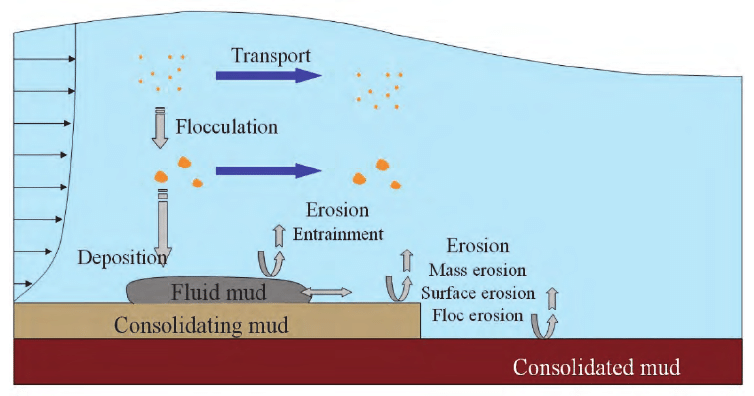
    Cross-section of marsh sediment showing deposition, erosion, and consolidation, the shifting layers that form and reform the exposed winter surface. | Graphic credit: G. S. Sylvain, 2011
    Cross-section of marsh sediment showing deposition, erosion, and consolidation, the shifting layers that form and reform the exposed winter surface. | Graphic credit: G. S. Sylvain, 2011

    Between exposures, slack water leaves a thin veneer that dries into a continuous surface film through sediment sealing, a layer fine enough to slow the exchange of gases between air and mud (Christiansen et al., 2000). When intact, the flats dull into a flexible sheet that bends faintly under weight, and breaking it releases a muted sulfur odor that signals redox cycling, the shift between oxygenated and oxygen-poor states driven by microbial respiration in buried sediment (Howarth & Teal, 1979; Mendelssohn et al., 1981). Color reveals the chemistry more reliably than smell. Black veins branch through exposed mud where iron binds sulfide, while pale halos surround Spartina roots where oxygen leaks downward along living tissues.

    Each footprint becomes an aperture in this membrane, allowing oxygen to enter and reduced compounds to rise, so the breach brightens temporarily before darkening again as metabolism rebalances. Feeding animals convert chemical gradients into visible patterns, and the flats accumulate a shifting mosaic of sealed and reopened zones that migrate with every tide, ensuring that the next exposure inherits the chemical memory of the previous one.

    Tracks fracture the sealed winter crust, revealing darker sediment where oxygen re-enters and the surface begins to reform. | Photo Credit: M. Gold, 2023
    Tracks fracture the sealed winter crust, revealing darker sediment where oxygen re-enters and the surface begins to reform. | Photo Credit: M. Gold, 2023

    The ground below the ground

    Beneath the crust, the sediment continues to reorganize through bioturbation, the mixing of mud by infaunal animals whose activity does not cease with falling temperature. Polychaete worms thread galleries through the upper layers, lifting sediment to the surface in tight spirals while their burrows act as ventilation shafts through burrow ventilation, drawing oxygen downward and leaking reduced porewater upward (Kristensen, 2000; Aller, 1982). Small bivalves pump water through siphons that leave paired pinholes scattered across the flats, and amphipods graze biofilms coating the worm casts, linking subsurface feeding to surface texture.

    Each round of burrowing lifts buried debris and nutrients toward the surface, making crab tunnels pathways that continually rebuild the marsh from below. | Graphic credit: Wang et al., 2010
    Each round of burrowing lifts buried debris and nutrients toward the surface, making crab tunnels pathways that continually rebuild the marsh from below. | Graphic credit: Wang et al., 2010

    Where deer cross and feed, hooves collapse some tunnels while sealing others, producing prints that darken unevenly because subsurface architecture differs from step to step. The feeding circuits therefore overlay hidden engineering that maintains permeability and redistributes nutrients, ensuring that exposure, grazing, and burrowing operate as one continuous process rather than as isolated events separated by layers of mud.

    Smell in shallow water

    Disturbed sediment releases dissolved compounds that spread through shallow pools as porewater plumes, chemical gradients that extend beyond the visible cloud of suspended mud. Killifish and juvenile mullet navigate these gradients through chemoreception, keeping their snouts close to the surface while pivoting toward intensifying scent (Kneib, 1997; Kristensen, 2000). Their feeding loosens additional sediment and amplifies the plume before particles settle again, creating a moving field of chemical information that overlaps with the physical contours of the flats.

    What appears from above as a brief swirl becomes a signal that attracts birds, and dunlin and yellowlegs converge on fresh pits where worms remain exposed. Each crater fills with water and darkens as sulfide seeps upward, and feeding layers stack in sequence so that invertebrate disturbance leads to fish excavation, which leads to avian probing, all anchored to the same exposure that first drew deer into the marsh. Leaning close reveals faint popping as methane and carbon dioxide escape through gas ebullition, ticking upward from saturated sediment while animals feed across the surface. The marsh ventilates audibly, and the sound marks exchange continuing beneath apparent stillness.

    As the tide withdraws, exposed mud concentrates scent and invertebrates near the surface, guiding shorebirds to feeding zones written into the sediment. | Photo credit: Ron Watts
    As the tide withdraws, exposed mud concentrates scent and invertebrates near the surface, guiding shorebirds to feeding zones written into the sediment. | Photo credit: Ron Watts

    Memory in the surface

    Winter tides and storms deposit sediment that raises the marsh through vertical accretion, stacking particles in increments small enough to disappear into the surface unless read over time (Morris et al., 2002). Hurricane overwash leaves thin sand sheets that redirect drainage for months, oyster clusters trap suspended grains in their lee (Newell et al., 2005), and worm burrows stabilize some deposits while loosening others (Kirwan & Megonigal, 2013). Feeding compresses ridges and excavation softens troughs, embedding each disturbance into the next layer so that the flats carry a structural memory of their own use.

    Returning after weeks reveals crossings shifted, wrack lines buried, and worm casts clustered in new zones, evidence that the marsh does not reset between exposures but accumulates the imprint of repeated winter engineering.

    Winters that change

    Warmer temperatures extend microbial activity through temperature-driven metabolic acceleration, thinning the interval between sealing and decay and allowing chemical gradients to persist longer at the surface (Bridgham et al., 2006). Rising water levels narrow exposure windows, stronger storms redistribute sediment in thicker pulses, and shifting coastal currents alter nutrient delivery and larval supply, influencing which species occupy the winter flats (Kirwan & Megonigal, 2013). The marsh continues to open, yet the rhythm of exposure recalibrates, and feeding circuits migrate toward higher shelves where consolidation still holds.

    Chemical plumes stretch farther in warmer water, grazing concentrates into narrower bands, and the same negotiations between structure and feeding repeat under altered timing, ensuring that winter engineering continues without preserving its previous schedule.

    Seasonal temperature outlook showing shifting winter probabilities across the southeastern United States, a regional signal that filters down to marsh-level processes. | NOAA - National Weather Service, 2026
    Seasonal temperature outlook showing shifting winter probabilities across the southeastern United States, a regional signal that filters down to marsh-level processes. | NOAA – National Weather Service, 2026

    The surface in motion

    The creek mouth appears quiet until attention lowers to the scale of sediment. Frost melts along print rims before surrounding crust warms, gas ticks upward through worm tubes, fish pits refill, and diatoms bloom where warmth collects. Each tide writes another layer into a system held in dynamic equilibrium, continuous adjustment that maintains form while never remaining fixed (Morris et al., 2002). Exposure leads to feeding, feeding reshapes structure, and structure governs the next exposure as the marsh opens again.

    The same ridges that hold a deer’s weight will soften again when the tide returns, and the feeding circuits traced across them will dissolve into channels that redistribute the next layer of sediment. Worm burrows will reopen where hooves sealed them, chemical plumes will reassemble in newly flooded pools, and the surface will carry forward the imprint of this exposure into the next one. Winter does not suspend the marsh. It recalculates it at a slower tempo, redistributing energy across the same structures that will support spring growth and summer density, so that even in the coldest intervals the creek mouth continues its quiet accounting of exchange, preparing another surface that will open and be read again.

    Deer cross the marsh to reach winter feeding exposed by the tide, moving along corridors that appear only when the surface opens. | Photo credit: L. W. Hamilton, 2025
    Deer cross the marsh to reach winter feeding exposed by the tide, moving along corridors that appear only when the surface opens. | Photo credit: L. W. Hamilton, 2025

    References

    Aller, R. C. (1982). The effects of Macrobenthos on chemical properties of marine sediment and overlying water. Topics in Geobiology, 53-102. https://doi.org/10.1007/978-1-4757-1317-6_2

    Bridgham, S. D., Megonigal, J. P., Keller, J. K., Bliss, N. B., & Trettin, C. (2006). The carbon balance of North American wetlands. Wetlands, 26(4), 889-916. https://doi.org/10.1672/0277-5212(2006)26[889:tcbona]2.0.co;2

    Christiansen, T., Wiberg, P., & Milligan, T. (2000). Flow and sediment transport on a tidal salt marsh surface. Estuarine, Coastal and Shelf Science, 50(3), 315-331. https://doi.org/10.1006/ecss.2000.0548

    Howarth, R. W., & Teal, J. M. (1979). Sulfate reduction in a New England salt marsh1. Limnology and Oceanography, 24(6), 999-1013. https://doi.org/10.4319/lo.1979.24.6.0999

    Kirwan, M. L., & Megonigal, J. P. (2013). Tidal wetland stability in the face of human impacts and sea-level rise. Nature, 504(7478), 53-60. https://doi.org/10.1038/nature12856

    Kneib, R. T. (1997). The role of tidal marshes in the ecology of estuarine nekton. Oceanography And Marine Biology, 35(35), 159-216. https://doi.org/10.1201/b12590-5

    Kristensen, E. (2000). Organic matter diagenesis at the oxic/anoxic interface in coastal marine sediments, with emphasis on the role of burrowing animals. Hydrobiologia, 426(1), 1-24. https://doi.org/10.1023/a:1003980226194

    Mendelssohn, I. A., McKee, K. L., & Patrick, W. H. (1981). Oxygen deficiency in Spartina alterniflora roots: Metabolic adaptation to anoxia. Science, 214(4519), 439-441. https://doi.org/10.1126/science.214.4519.439

    Morris, J. T., Sundareshwar, P. V., Nietch, C. T., Kjerfve, B., & Cahoon, D. R. (2002). Responses of coastal wetlands to rising sea level. Ecology, 83(10), 2869. https://doi.org/10.2307/3072022

    Newell, R. I., Fisher, T. R., Holyoke, R. R., & Cornwell, J. C. (2005). Influence of eastern oysters on nitrogen and phosphorus regeneration in Chesapeake Bay, USA. NATO Science Series IV: Earth and Environmental Series, 282, 93-120. https://doi.org/10.1007/1-4020-3030-4_6

    Underwood, G., & Kromkamp, J. (1999). Primary production by phytoplankton and Microphytobenthos in estuaries. Advances in Ecological Research, 29, 93-153. https://doi.org/10.1016/s0065-2504(08)60192-0