In the last few weeks, the water along the edges of Onslow County has felt different.
Not because the water itself has changed—but because something beneath it has become harder to ignore.
Schools of cownose ray (Rhinoptera bonasus) move just below the surface nearshore, their wingbeats lifting faint clouds from the bottom as they pass. In the soundside shallows, where the water thins over sand and mud, Atlantic stingray (Hypanus sabinus) settle into the substrate, half-buried and nearly invisible until a step comes too close and the outline breaks.
People are seeing them more often now—but they’re also reacting to them.
A pause mid-step in shallow water. A quick shift backward when something moves. Fishermen lifting a line and stopping for a second longer than usual—not what they expected to find.
There is awe in it.
And sometimes hesitation.
Because the same thing that makes them easy to notice now also makes them easy to miss.
The question follows quickly:
Are there more of them this year?
Maybe.
But that question lingers longer than the answer.
Cownose rays migrating in Swansboro, NC. | Image credit: Pogie’s Academy
What Brings Them Here
As spring settles in along the North Carolina coast, the system begins to reorganize.
Water temperatures rise, and with that rise comes a shift in metabolism. Rays—like many coastal species—become more active as conditions move into a narrower range that supports feeding and movement (Smith & Merriner, 1987; Schwartz & Dahlberg, 1978).
For cownose rays, this seasonal transition includes a northward migration along the Atlantic coast, bringing large groups into nearshore and estuarine waters (Smith & Merriner, 1987).
Large groups of cownose rays like these move north along our coast each season, arriving together in shallow water. | Image credit: Vidyacharan A. Alchi
But movement alone does not explain what people are seeing.
What matters is where that movement meets the structure of the environment.
The water does not always look the same—some days it is flat and clear enough to see straight to the bottom, and other days the slightest movement turns it cloudy, changing what can be seen and what remains hidden (Peterson et al., 2001).
And beneath all of it is food.
Cownose rays move through the shallows, sweeping across the bottom and disrupting what lies beneath them, crushing clams, oysters, and other shelled invertebrates with broad, flattened tooth plates (Collins et al., 2007; Fisher, 2010).
Atlantic stingrays hold low against the bottom, burying into the sand as they feed and working within the sediment itself—not moving across it—uncovering and drawing in small invertebrates hidden below (Snelson et al., 1988; Schwartz & Dahlberg, 1978).
Atlantic stingrays hold close to the bottom, often blending in until something shifts and gives them away. | Image credit: Andy Murch
Where prey is accessible, rays follow.
Where prey is concentrated in shallow, warming water, rays do not just pass through—they stay, turn, feed, and linger.
And in doing so, they cross into the same narrow band of space where people enter the water (Bangley et al., 2018).
They are not simply “here more.”
They are here in ways—and in places—that make them visible.
What Happens When They Feed
When a ray feeds, the bottom does not remain the same.
A cownose ray moving across a flat is not just searching—it is actively restructuring the surface beneath it. As it passes, the bottom is turned over behind it, patches of sand and mud disturbed where clams and other buried life have just been uncovered and crushed (Peterson et al., 2001; Smith & Merriner, 1985).
Feeding pits left behind by rays. Easy to mistake for crab holes at first—until you start to recognize the pattern and what’s actually shaping the bottom. | Image credit: Giaroli et al., 2024
Atlantic stingrays leave a different kind of trace. Where they settle, the surface shifts more subtly—small depressions, softened patches, places where the sediment has been worked rather than overturned, as buried invertebrates are uncovered and drawn in (Snelson et al., 1988; Schwartz & Dahlberg, 1978).
This is bioturbation—the bottom being reworked by the animals moving through it and within it (Thrush & Dayton, 2002).
As they feed, the bottom lifts into the water—fine particles rising and hanging there, turning clear water slightly cloudy (Thrush & Dayton, 2002).
Oysters and clams quietly filter the water as they feed, and when their numbers shift—even in small areas—the water and everything moving through it begins to change with them (Newell, 2004; zu Ermgassen et al., 2013).
In places where rays have been feeding, those filtering communities can be reduced or redistributed (Peterson et al., 2001).
Not removed entirely—but changed.
And that change does not stay in one place.
It moves outward, carried in the way the water looks, the way it settles, and what it can hold.
Layers of the Food Web
Rays do not sit at the top of the system, and they are not at the bottom of it.
As mesopredators, they feed on what is buried in the sediment, but they are also available to what moves through the water above. That position—between—links parts of the system that do not often meet directly (Myers et al., 2007; Heithaus et al., 2008).
What they do in that space matters.
As cownose rays move through andAtlantic stingrays work within the bottom, they are not just feeding—they are shaping what persists there. Clams, oysters, and other invertebrates do not simply accumulate unchecked. Their numbers are reduced, redistributed, and in some places kept from becoming dominant (Peterson et al., 2001).
Movement like this doesn’t stay in one place for long.
That pressure shapes the bottom itself.
Bivalves filter the water. Invertebrates stabilize sediment. When their abundance shifts, the system responds—sometimes toward clearer water, sometimes toward more suspended material, depending on what remains and where (Newell, 2004; zu Ermgassen et al., 2013).
Rays do not create those conditions alone—but they influence which direction the system moves.
At the same time, they carry that energy upward.
Juvenile sharks moving through these shallow waters encounter not just prey, but a system already in motion—areas where the bottom has been disturbed, where feeding has recently occurred, where something has been uncovered or displaced (Bangley et al., 2018).
And in some cases, the rays themselves become part of that exchange.
This is what it means to sit in the middle.
Not just connecting layers—but regulating how energy and movement pass between them.
If that middle shifts, the balance does not disappear.
It changes direction.
Why It Feels Sudden
There is a moment, standing in shallow water, when the bottom stops feeling like something you can trust.
What looked like sand shifts. What felt still is no longer still.
Sometimes you notice it in time—a shape lifting away, a shadow moving just beneath the surface. A plume of fine sediment rising to the surface under a paddleboard with a trail following it.
The moment when the bottom stops looking empty. | Image credit: iStock
Sometimes you don’t.
A step comes down where something is already settled. Hidden in the sand. Working within it.
The reaction is immediate. Surprise first. Then pain. Then the realization of what was there all along.
But what you are stepping into is not a single event.
It is a convergence.
Water temperatures have risen, bringing rays into the shallows as they feed and move through these systems (Smith & Merriner, 1987; Schwartz & Dahlberg, 1978).
Tides narrow the space, concentrating movement into a thinner band of water.
The bottom has already been worked—turned by cownose rays moving through, disturbed by Atlantic stingrays holding within it.
And at the same time, people have returned to the water.
For a brief window, all of it overlaps.
Not more. But more visible.
It feels sudden because you are standing at the point where all of these things meet.
And for a moment, the system lets you see it.
References
Bangley, C. W., Paramore, L., Dedman, S., & Rulifson, R. A. (2018). Delineation and mapping of coastal shark habitat within a shallow lagoonal Estuary. PLOS ONE, 13(4), e0195221. https://doi.org/10.1371/journal.pone.0195221
Giaroli, M. L., Byrne, I., Gilby, B. L., Taylor, M., Chargulaf, C. A., & Tibbetts, I. R. (2024). The distribution and significance of stingray feeding pits in Quandamooka (Moreton Bay), Australia. Marine and Freshwater Research, 75(18). https://doi.org/10.1071/mf23247
Heithaus, M. R., Frid, A., Wirsing, A. J., & Worm, B. (2008). Predicting ecological consequences of marine top predator declines. Trends in Ecology & Evolution, 23(4), 202-210. https://doi.org/10.1016/j.tree.2008.01.003
Kolmann, M. A., Huber, D. R., Motta, P. J., & Grubbs, R. D. (2015). Feeding biomechanics of the cownose ray, Rhinoptera bonasus, over ontogeny. Journal of Anatomy, 227(3), 341-351. https://onlinelibrary.wiley.com/doi/full/10.1111/joa.12342
Myers, R. A., Baum, J. K., Shepherd, T. D., Powers, S. P., & Peterson, C. H. (2007). Cascading effects of the loss of APEX predatory sharks from a coastal ocean. Science, 315(5820), 1846-1850. https://doi.org/10.1126/science.1138657
Newell, R. I. (2004). Ecosystem influences of natural and cultivated populations of suspension-feeding bivalve molluscs: A review. 23(1), 51–61. Journal of Shellfish Research, 23(1), 51-61. https://go.gale.com/ps/i.do?id=GALE%7CA118543914
Peterson, C. H., Fodrie, J. F., Summerson, H. C., & Powers, S. P. (2001). Site-specific and density-dependent extinction of prey by schooling rays: generation of a population sink in top-quality habitat for bay scallops. Oecologia, 129, 349-356. https://link.springer.com/article/10.1007/s004420100742
Schwartz, F. J., & Dahlberg, M. D. (1978). Biology and ecology of the Atlantic Stingray, Dasyatis Sabina (Pisces: Dasyatidae) in North Carolina and Georgia. Northeast Gulf Science, 2(1). https://doi.org/10.18785/negs.0201.01
Smith, J. W., & Merriner, J. V. (1985). Food habits and feeding behavior of the Cownose ray, Rhinoptera bonasus, in lower Chesapeake Bay. Estuaries, 8(3), 305. https://doi.org/10.2307/1351491
Smith, J. W., & Merriner, J. V. (1987). Age and growth, movements and distribution of the Cownose ray, Rhinoptera bonasus, in Chesapeake Bay. Estuaries, 10(2), 153. https://doi.org/10.2307/1352180
Snelson, F. F., Williams-Hooper, S. E., & Schmid, T. H. (1988). Reproduction and ecology of the Atlantic Stingray, Dasyatis Sabina, in Florida coastal lagoons. Copeia, 1988(3), 729. https://doi.org/10.2307/1445395
Thrush, S. F., & Dayton, P. K. (2002). Disturbance to marine benthic habitats by trawling and dredging: Implications for marine biodiversity. Annual Review of Ecology and Systematics, 33(1), 449-473. https://doi.org/10.1146/annurev.ecolsys.33.010802.150515
Zu Ermgassen, P. S., Spalding, M. D., Blake, B., Coen, L. D., Dumbauld, B., Geiger, S., Grabowski, J. H., Grizzle, R., Luckenbach, M., McGraw, K., Rodney, W., Ruesink, J. L., Powers, S. P., & Brumbaugh, R. (2012). Historical ecology with real numbers: Past and present extent and biomass of an imperilled estuarine habitat. Proceedings of the Royal Society B: Biological Sciences, 279(1742), 3393-3400. https://doi.org/10.1098/rspb.2012.0313
There are mornings along the edges of the water in Onslow County when the surface looks still enough to trust.
The marsh grass has not yet reached its summer height. What stands there leaves more water exposed between the stems, and without sustained wind, the surface holds its shape. You can see farther into it now than you will in a few weeks, before suspended sediment and constant movement return it to opacity. The water carries less of the season, and because of that, more of what moves beneath it becomes visible—if you are willing to wait long enough to see the difference between movement and reflection.
This is when people begin to notice them again.
Not all at once. Not everywhere. Just a change that does not follow wind or tide. A line that holds where the rest of the surface releases. Something that holds its position in a system that is always adjusting.
An alligator does not arrive in that moment.
It becomes visible.
Alligator emerging from the mud. | Photo credit: Gilbert Grant, iNaturalist
Seasonal Absence Is Not Absence
Through winter, they remain within these same creeks, marsh edges, and quieter channels. What changes is not location, but how they occupy it. As temperatures fall, activity narrows. Movement slows, and the need for it slows with it. Energy is conserved, not spent. And the surface carries fewer signs of what lies beneath it. Individuals hold in deeper water or along softer margins where mud retains heat longer than the surrounding water column, remaining within conditions that allow them to persist without constant movement (Nifong et al., 2014; Rosenblatt & Heithaus, 2011).
The same stretch of water that in spring will hold a visible form can pass through winter without interruption, its stillness mistaken for absence.
But the system does not empty.
It compresses.
The System Wakes in Layers
By early spring, that compression begins to release—not all at once, but in layers that build on each other before they are recognized. Shallow water warms first, taking in solar heat more quickly than deeper channels. Along these edges, fish begin to hold longer. Movements that in winter passed through quickly begin to extend into areas that had remained quiet. Invertebrates return to the sediment surface, and the water column begins to carry more suspended life, even before it becomes visible as turbidity.
Birds respond to this before most other changes are noticed. Their movements tighten. Landings become more frequent, departures more abrupt. What they are tracking is not random. It is the redistribution of energy into places where it can be accessed.
The alligator moves within that shift.
Not as a trigger. Not as something layered on top. But as part of a system reorganizing itself across temperature, light, and movement at the same time.
Great blue heron and alligator are part of an interconnected system. | Photo credit: Audubon North Carolina
Reading What It Is Responding To
When one becomes visible along the edge of a creek or marsh, it is easy to reduce that moment to temperature alone. Warmer water allows for more activity.
But what draws it into that position is more specific than warmth.
It is the arrangement of prey.
Along the margins where water meets land, movement compresses. Fish traveling with the tide encounter shallow gradients that limit how long they can remain. Small mammals moving between marsh and upland must cross exposed edges. Birds landing to feed do so in places where depth and access align for only short intervals.
These are not isolated events. They are recurring patterns shaped by tidal cycles, substrate, and seasonal change.
The alligator positions itself within those patterns.
Its diet reflects that flexibility, spanning invertebrates, fish, birds, reptiles, and mammals depending on size and availability (Nifong, 2016). But the diet alone does not explain its placement. What matters is where energy becomes concentrated, even briefly.
That concentration is not constant. It forms and dissolves with tide, with light, with movement.
And the predator tracks that.
And what appears as a single movement—a fish turning, a bird lifting, something crossing the edge of the marsh—is part of a larger structure that holds only briefly before dissolving again.
The alligator does not respond to the individual movement.
It responds to the pattern that produces it.
Where Freshwater Meets Salt
These are not just places where water mixes.
They are places where movement is forced—and where that movement becomes available to something waiting at the top of it.
There are places along this coastline where those changes concentrate.
At the mouths of creeks, along the edges of the Intracoastal Waterway, and near the shifting bars of New River Inlet, the water does not settle into a single condition. Freshwater moves outward with tide and rainfall, meeting saltwater pressing back in with tidal exchange. The result is not a fixed boundary, but a gradient that shifts continuously—sometimes visible as a faint line, sometimes only detectable in how the surface moves differently from one side to the other.
This is where alligators are most often encountered—because this is where the system compresses into something they can use.
They are not marine animals. They do not possess the specialized salt glands that allow for extended life in high salinity environments. Over time, saltwater carries a physiological cost, requiring a return to freshwater to restore balance (Rosenblatt & Heithaus, 2011; Fujisaki et al., 2014).
But that limitation does not exclude them.
It defines how they move through them.
In these mixing zones, salinity is not constant. It rises and falls with tide, with rainfall, with wind direction. A location that carries higher salinity at one stage may shift toward fresher conditions hours later. What appears to be a boundary is, in practice, a moving field.
Within that field, movement compresses.
Fish traveling with the tide are funneled into narrower pathways. Shallow gradients limit how long they can remain in deeper water. Schools tighten. Individuals encounter edges that restrict escape. The system concentrates energy into space.
The predator does not need to range widely in these conditions.
It needs to hold where movement is forced.
And so it does.
An alligator near the tall grass near Marine Corps Air Station New River | Photo credit: Martin Egnash
At the Edge of the Open Water
There are moments when that pattern extends beyond the mixing zones, into places that appear, at first, outside of where an alligator belongs.
Along the shoreline, in the breaking waves where the ocean meets sand, one will sometimes appear—rising and falling with the swell, holding position just beyond where the water turns over onto the beach. It looks misplaced, as though it has moved beyond the system that defines it.
It has not.
The surf zone is one of the most compressed environments along the coast. Waves reduce depth, disrupt orientation, and concentrate movement into a narrow band where escape is limited. Fish pushed into breaking water lose some ability to maintain direction. Schools fragment. Individuals become briefly exposed in ways that do not occur in deeper, more stable water.
For a predator capable of stillness followed by short bursts of movement, that compression creates opportunity.
But the cost is higher.
Salinity is elevated. The water is in constant motion. There is no stable refuge within immediate reach. Time in this environment cannot be extended indefinitely.
And so it does not.
Movements into higher salinity water tend to be brief—extensions outward, followed by a return to freshwater or lower salinity conditions where balance can be restored (Nifong et al., 2014).
What appears as an anomaly is part of a larger pattern.
The predator crosses the boundary not to remain, but to use it, moving where the system briefly offers more than it costs.
The same forces that shape the marsh edge—compression, constraint, and brief exposure—are recreated here, just for a moment, in a different place.
An alligator rests at the ocean’s edge in North Topsail. | Photo credit: Fox8 Digital Desk
What Its Presence Changes
Most of what that presence changes cannot be seen when it is observed.
Long before any direct interaction occurs, it is already altering how other organisms use space.
Fish moving along the edge do not simply pass through. They adjust their depth, their speed, the amount of time they remain exposed. Birds land with shorter intervals between contact and departure. Mammals approaching the water shift their paths or their timing. These changes are not dramatic in isolation. But they are continuous.
Over time, they accumulate into structure—the kind that determines who feeds, where they feed, and how long they remain.
The influence of a predator at this level extends beyond what it consumes. It shapes behavior across multiple species, redistributing where and how energy moves through the system. The possibility of predation—present even when not observed—alters interactions in ways that regulate access to habitat and resources (Heithaus et al., 2008; Ripple et al., 2014; Estes et al., 2011).
What holds the system in place is not removal alone.
It is pressure.
What is being shaped is not just movement, but access—and access is what determines how energy moves through the system.
More Than Predation
The influence of the alligator does not end with what it hunts, but extends beyond those interactions.
As it moves through shallow systems, it disturbs sediment, creating depressions and pathways that alter how water is retained and how nutrients are redistributed. These small changes in physical structure create conditions that other species use—temporary refuges, feeding areas, and zones where organic material accumulates (Eversole et al., 2018; Subalusky et al., 2009).
In wetland systems, these disturbances have been linked to broader effects, including nutrient cycling and carbon storage, where the presence of large predators contributes to the retention of organic material within the system rather than its export (Murray et al., 2025; Atwood et al., 2015).
These processes do not occur in isolation.
They intersect with the same patterns of movement, feeding, and behavior that define the system at larger scales.
Seeing the Surface, Reading the System
When one becomes visible along the surface, it is easy to treat the moment as singular.
A sighting. An encounter. Something separate from everything around it.
But that form at the surface is supported by layers extending beyond what can be seen.
It reflects water temperatures crossing into ranges that support sustained activity. It reflects prey moving into positions where access becomes possible. It reflects a system where behavior is still shaped by the presence of something at the top.
The alligator is not an interruption to that system.
It is an expression of it.
What Becomes Visible
Seeing one does not indicate that something has entered the water.
It indicates that enough beneath the surface is functioning to hold it.
Not in a static sense. Not as balance in the way it is often described. But as a set of interactions that remain connected—movement, response, pressure—each shaping the others even when they are not directly observed.
What becomes visible at the surface is only a fraction of that structure.
But it is enough to know that the rest is still in place.
An alligator in Onslow County sits at the edge of the saltmarsh. |Photo credit: Gilbert Grant, iNaturalist
When That Pressure Is Reduced
If that pressure is reduced, the system does not leave an obvious gap.
It shifts.
Movements that were once constrained begin to extend. Species that passed quickly through exposed areas begin to remain longer. Edges that functioned as transition zones become used differently—not because the physical environment has changed, but because the conditions that shaped behavior within it have relaxed.
Mid-level predators expand their activity under these conditions, increasing their access to prey and space when not constrained from above (Nifong et al., 2013).
The change is subtle.
It appears in how long something stays. In how often it returns. In where it lingers. In how quietly the structure of behavior begins to loosen.
The food web and trophic cascade of the American alligator in the Florida Everglades.
A System Written Into Temperature
There is another layer to this that does not show itself at the surface.
The structure of that presence is set years earlier, in a place that can be overlooked when standing at the water’s edge. Along the margins of marsh and wetland, slightly above the reach of regular water movement, nests are built from vegetation and sediment, forming mounds that hold heat as they decompose.
Within those mounds, temperature determines something that will not be visible for much later.
Sex is not fixed at fertilization. It emerges during incubation, shaped by the thermal conditions held within the nest. A difference of only a few degrees is enough to shift the outcome, producing more males or more females depending on where within that range the nest remains (Lang & Andrews, 1994; Janzen, 1994).
Under variable conditions—differences in shading, rainfall, timing, and placement—those outcomes are distributed across the landscape. Some nests produce more females, others more males. That variability holds the population in a form that can sustain itself over time.
When conditions become more consistent, that variation narrows.
Warmer nights hold heat longer within the nest. Seasonal transitions extend. The range of outcomes compresses. What was once distributed begins to align.
And that alignment carries forward into the structure of the population—into how individuals occupy space, into how pressure is applied across the system, into what will eventually be visible at the surface.
Alligator eggs hatch after 65 days of incubation in the fall. The babies will chirp to alert their mom, who then digs out the nest while the babies use their egg tooth to hatch from their eggs. Their mom will then safely carry them to the water.
Where the Next Generation Is Set
The placement of those nests depends on something even more constrained.
A narrow band of land that remains above water just long enough to hold them.
That band is not fixed.
It shifts with tide, with rainfall, with the gradual reworking of shoreline that occurs across seasons and years. With rising sea levels, water reaches farther into areas that once remained above it. Flooding becomes more frequent, not always through singular events, but through repeated intrusions that saturate and destabilize what had previously held (Joanen & McNease, 1989; Sweet et al., 2022).
Human alteration compresses this space further.
Hardened shorelines, dredging, and development reduce the gradual transition between land and water. Where there was once a slope capable of holding multiple elevations, there becomes a defined edge. That edge does not provide the same range of conditions required for successful nesting.
The number of suitable sites decreases.
More importantly, the variability between them narrows.
And with that, the system loses one of the mechanisms that allowed it to absorb change.
Alligator on her nest that can hold up to 60 eggs. | Photo credit: National Park Service (NPS)
What Its Presence Means
When an alligator becomes visible along the surface, it reflects conditions that have aligned across multiple layers.
Temperature has reached a range that supports activity. Prey has moved into positions where access becomes possible. Behavioral pressure remains in place across the system. Reproduction has held across enough years, in enough suitable places, to sustain what is now present.
What is seen at the surface is not separate from them.
It is supported by them.
Seeing one does not signal that something has entered the water.
It signals that enough of what lies beneath it—movement, pressure, response, and continuity—remains intact.
And that—even when most of it is not visible—the system is still holding together.
And that is what becomes visible—just long enough to be seen, before the system closes back over it again.
The system does not end at the water’s edge.
Epilogue: Chicken Nugget
We came across him along the New River, near the courthouse in Jacksonville.
We were there to clear what had been left behind—fishing line caught along the walkways, hooks, and the overflow from a trash can that had spilled out onto the edge. Fast food containers, grocery store chicken trays, scattered along the bank. The signs were clear enough. People had been there for a while—crabbing, fishing, eating, leaving what remained.
He was directly below us.
Small enough to miss at first. Still enough to blend into the water until you stopped looking for movement and started noticing what held its position.
A juvenile alligator, watching.
He stayed there while we worked, then slipped beneath the surface and crossed the small bay. On the opposite side, someone tossed a piece of food into the water. He surfaced almost immediately, took it, and remained.
Waiting.
I came back later and stayed longer.
The pattern repeated. He would disappear until footsteps approached, then return to the same place along the edge. Holding position. Watching. Waiting for something to fall.
No fishermen or crabbers passed through while I was there, but the behavior was consistent with what happens when food becomes predictable. Bait, catch, scraps—anything that can be taken without the cost of searching or pursuing.
Energy, without effort.
It is easy to see something like that and respond to what it looks like in that moment. A small animal. Still. Attentive. Something that feels close enough to interact with.
But what is being shaped there is not just a single interaction.
It is behavior.
A shift away from the conditions that formed it—toward something more efficient, more immediate, and less stable over time. The system that once required movement, patience, and response begins to narrow into expectation.
And expectation changes how an animal uses space.
What happens when that animal is no longer small is not a separate question.
It is the continuation of the same pattern.
Alligators do not forget where food has been easy to obtain. They return to it. They hold in those places. They begin to associate presence—human presence—with opportunity.
What begins as something that feels harmless becomes something that alters how the system functions around it.
Not just for the animal, but for everything that responds to it.
There are instincts at work here that were shaped long before any walkway, any dock, any place where food might be dropped from above. Those instincts are not just about survival in isolation. They are part of how pressure is applied, how movement is shaped, how the system holds.
When those instincts are replaced with something easier, the effect does not remain contained.
It carries outward.
He stayed there while I watched. Returning to the same place. Holding the same position. Waiting for something to fall.
There is a kind of kindness in wanting to give something to an animal like that.
But there is another kind in leaving it as it is.
Not interrupting the conditions that shape it. Not narrowing what it has learned to expect. Not replacing a system built on movement and response with one built on waiting.
Let it remember the water as it is.
And you, only as something that passed through it.
We affectionately named this juvenile alligator in the New River in Jacksonville, NC “Chicken Nugget” for all of the chicken nugget boxes left behind on the walkway from an overflowing trash can. | Photo credit: A. Mitchell
References
Atwood, T. B., Connolly, R. M., Ritchie, E. G., Lovelock, C. E., Heithaus, M. R., Hays, G. C., Fourqurean, J. W., & Macreadie, P. I. (2015). Predators help protect carbon stocks in blue carbon ecosystems. Nature Climate Change, 5(12), 1038-1045. https://doi.org/10.1038/nclimate2763
Estes, J. A., Terbough, J., Brashares, J. S., Power, M. E., Berger, J., Bond, W. J., Carpenter, S. R., Essington, T. E., Holt, R. D., & Wardle, D. A. (2011). Trophic Downgrading of Planet Earth. Science, 333(604), 301-306. https://www.science.org/doi/abs/10.1126/science.1205106
Fujisaki, I., Hart, K. M., Mazzotti, F. J., Cherkiss, M. S., Sartain, A. R., Jeffery, B. M., Beauchamp, J. S., & Denton, M. (2014). Home range and movements of American alligators (Alligator mississippiensis) in an Estuary habitat. Animal Biotelemetry, 2(1), 8. https://doi.org/10.1186/2050-3385-2-8
Heithaus, M. R., Frid, A., Wirsing, A. J., & Worm, B. (2008). Predicting ecological consequences of marine top predator declines. Trends in Ecology & Evolution, 23(4), 202-210. https://doi.org/10.1016/j.tree.2008.01.003
Janzen, F. J. (1994). Climate change and temperature-dependent sex determination in reptiles. PNAS, 91(16), 7487-7490. https://doi.org/10.1073/pnas.91.16.7487
Joanen, T., & McNease, L. L. (1989). Ecology and physiology of nesting and early development of the American alligator. American Zoologist, 29(3), 987-998. https://doi.org/10.1093/icb/29.3.987
Lang, J. W., & Andrews, H. V. (1994). Temperature‐dependent sex determination in crocodilians. Journal of Experimental Zoology, 270(1), 28-44. https://doi.org/10.1002/jez.1402700105
Nifong, J. C. (2016). Living on the edge: Trophic ecology of alligator mississippiensis (American alligator) with access to a shallow estuarine impoundment. Bulletin of the Florida Museum of Natural History, 54(2), 13-49. https://doi.org/10.58782/flmnh.xkdw7119
Nifong, J. C., Nifong, R. L., Silliman, B. R., Lowers, R. H., Guillette, L. J., Ferguson, J. M., Welsh, M., Abernathy, K., & Marshall, G. (2014). Animal-borne imaging reveals novel insights into the foraging behaviors and Diel activity of a large-bodied APEX predator, the American alligator (Alligator mississippiensis). PLoS ONE, 9(1), e83953. https://doi.org/10.1371/journal.pone.0083953
Nifong, J. C., & Silliman, B. R. (2013). Impacts of a large-bodied, APEX predator (Alligator mississippiensis Daudin 1801) on salt marsh food webs. Journal of Experimental Marine Biology and Ecology, 440, 185-191. https://doi.org/10.1016/j.jembe.2013.01.002
Ripple, W. J., Estes, J. A., Beschta, R. L., Wilmers, C. C., Ritchie, E. G., Hebblewhite, M., Berger, J., Elmhagen, B., Letnic, M., Nelson, M. P., Schmitz, O. J., Smith, D. W., Wallach, A. D., & Wirsing, A. J. (2014). Status and ecological effects of the world’s largest carnivores. Science, 343(6167). https://doi.org/10.1126/science.1241484
Rosenblatt, A. E., & Heithaus, M. R. (2011). Does variation in movement tactics and trophic interactions among American alligators create habitat linkages? Journal of Animal Ecology, 80(4), 786-798. https://doi.org/10.1111/j.1365-2656.2011.01830.x
Sweet, W. V., Hamlington, B. D., Kopp, R. E., Weaver, C. P., Barnard, P. L., Bekaert, D., Brooks, W., Craghan, M., Dusek, G., Frederickse, T., Garner, G., Genz, A. S., Krasting, J. P., Larour, E., Marcy, D., Marra, J. J., Obeysekera, J., Osler, M., Pendleton, M., … Zuzak, C. (2022). Global and regional sea level rise scenarios for the United States: Updated mean projections and extreme water level probabilities along U.S. coastlines (Technical Report NOS 01). National Oceanic and Atmospheric Administration, National Ocean Service. https://earth.gov/sealevel/us/internal_resources/756/noaa-nos-techrpt01-global-regional-SLR-scenarios-US.pdf
How seagrasses and marsh grasses—and the animals within them—build the marshes of Onslow County
In Onslow County’s estuarine marshes, the best time to understand how the landscape works is when the water pulls back. As tides drain from creeks and shallow flats, patterns begin to emerge—where water lingers, where it moves easily, and where it hesitates. These patterns are not random. They reflect the combined influence of plants, animals, and sediments continually reshaping the boundary between land and sea.
Like the microscopic shells of foraminifera preserved in sediment, marsh and seagrass communities record environmental conditions. But unlike the past locked in mud, these systems are alive, constantly negotiated by plants, grazers, predators, and microbes.
From permanently submerged seagrass beds to the highest marsh edge, each elevation zone in Onslow County is maintained not just by vegetation, but by species that actively regulate growth, chemistry, and water flow.
Subtidal shallows: seagrass beds maintained by grazers
In the shallow, light-penetrated waters of the New River Estuary and protected soundside areas, seagrass beds form underwater meadows that stabilize sediments and provide nursery habitat for fish and invertebrates. Species present or expected in Onslow County waters include eelgrass (Zostera marina), shoalgrass (Halodule wrightii), and widgeongrass (Ruppia maritima) (Mallin, 2000; Orth, 1984).
Seagrass blades rapidly accumulate epiphytic algae and microbial films. Without constant grazing, this layer can block light and suppress photosynthesis. Amphipods, isopods, and small gastropods act as continuous maintenance crews, grazing epiphytes and preventing them from overwhelming the plants themselves (Orth & van Montfrans, 1984; Valentine & Duffy, 2006).
Experimental studies show that when these grazers are removed, seagrass condition declines even under favorable light conditions, demonstrating that plant survival depends as much on animal activity as on physical environment (Duffy et al., 2015). Beneath the canopy, burrowing worms and bivalves recycle nutrients and oxygenate sediments, preventing organic matter from accumulating around roots (Orth, 1984).
In this zone, seagrass persists because grazers keep blades clean and sediments breathable—a cooperative system built on constant biological upkeep.
Gammarus mucronatus, a common amphipod grazer on eelgrass | Photo credit: E. A. Lazo-Wasem, Yale Peabody Museum, 2013.
The low marsh edge: cordgrass shaped by snails and crabs
At the daily-flooded edge of the marsh, smooth cordgrass (Spartina alterniflora) dominates. This narrow fringe marks the boundary between open water and marsh interior, where erosion pressure is highest and stability matters most.
Left: Healthy smooth cordgrass (Spartina alterniflora) line the estuary edge in Surf City, NC. | Photo credit: A. Mitchell, 2022.Right: Salt marsh die-off from grazing stress by marsh periwinkle snails and reduced predation by crabs, such as blue crabs, can create bare mudflats. | Photo credit: By Esuglia at English Wikipedia, CC BY-SA 3.0, https://commons.wikimedia.org/w/index.php?curid=65794096
Cordgrass growth here is tightly regulated by the marsh periwinkle snail (Littoraria irrorata). These snails climb grass stems to avoid inundation and graze directly on living tissue, often intensifying damage by facilitating fungal infection. At high densities, periwinkle grazing can dramatically reduce cordgrass height and biomass, effectively mowing the marsh edge (Silliman & Zieman, 2001).
Marsh periwinkle snails (Littoraria irrorata) are a common sight on cordgrass (Spartina alterniflora) in North Carolina | Photo credit: North Carolina Aquarium at Roanoke Island, 2018.
Unchecked grazing can destabilize the marsh platform—but periwinkles themselves are regulated by crabs, including blue crabs (Callinectes sapidus),fiddler crabs (Genus Uca), purple marsh crabs (Sesarma reticulatum), hermit crabs and other burrowing species. Crabs prey on snails, limiting grazing pressure and indirectly protecting cordgrass (Silliman et al., 2005).
Crabs also function as ecosystem engineers. Their burrows aerate sediments, relieve sulfide stress around plant roots, and improve tidal water movement through compacted soils (Bertness, 1985; Thomas & Blum, 2010). Where crabs are abundant, cordgrass grows taller and denser; where they are lost, marsh die-off can occur rapidly.
This zone persists through a trophic cascade: grass builds land, snails limit grass, and crabs keep the system in balance.
Mid-marsh: mussels and detritus processors reinforce the platform
Just upslope, where flooding becomes less frequent, plant communities shift toward mixtures that often include saltmeadow cordgrass (Spartina patens). Here, the ribbed mussel (Geukensia demissa) emerges as a key stabilizing force.
Saltmeadow cordgrass (Spartina patens) is an important marsh stabilizer that has higher productivity when it grows near ribbed mussel aggregations | Photo credit: Kristie Gianopulos
Ribbed mussels form dense clusters at the base of marsh vegetation, binding sediments with byssal threads and physically reinforcing marsh soils against erosion (Bertness, 1984). As filter-feeders, they concentrate nutrients by removing organic matter from tidal waters and depositing nitrogen-rich biodeposits directly into marsh sediments (Jordan & Valiela, 1982).
Ribbed mussels (Geukensia demissa) at the base of marsh vegetation | Photo credit: R. Bachand
Grasses growing near mussel aggregations exhibit higher productivity than those without mussels, demonstrating a strong facilitative relationship between animals and plants (Bertness, 1984). As vegetation senesces, detritivorous worms, insects, and microbial decomposers break down dead plant material, converting standing biomass into detritus that fuels food webs throughout the estuary (Mann, 1988).
The mid-marsh functions as a processing zone, reinforcing marsh structure while converting plant matter into usable energy.
High marsh: microbes that manage chemical stress
In the high marsh, dominated by black needlerush (Juncus roemerianus) and saltmeadow cordgrass (Spartina patens), flooding is limited to spring tides and storms. Prolonged exposure to air creates harsh soil conditions, including elevated salinity and sulfide accumulation.
Here, microbial communities play a central role. Sulfate-reducing and sulfur-oxidizing bacteria regulate sulfide concentrations that would otherwise become toxic to plant roots, while microbial decomposition controls nutrient availability under fluctuating oxygen conditions (Howarth & Giblin, 1983).
Beneath the marsh surface, soil microbes regulate decomposition, carbon exchange, and chemical stress. Changes in salinity and flooding reshape microbial communities, influencing how marsh soils process organic matter and support vegetation across tidal elevations. | Image credit: Zhang et al., 2023.
Small soil invertebrates maintain pore spaces that allow brief pulses of oxygenated water to penetrate during flooding. Unlike the visibly engineered low marsh, the high marsh is stabilized largely through biogeochemical regulation rather than grazing or predation.
This zone endures because microbes quietly buffer plants against chemical extremes.
From microbes in the soil to grasses at the surface, biological interactions drive marsh formation. Microbial processes govern decomposition and organic matter buildup, helping determine whether marsh platforms gain elevation, remain stable, or collapse | Image credit: Abbot, Quirk & Fultz, 2022.
The marsh–upland transition: keeping the boundary intact
At the uppermost margin of the marsh, tidal influence becomes intermittent and environmental stress shifts from salinity to erosion and freshwater input. Burrowing invertebrates increase soil permeability, allowing stormwater and tidal surges to infiltrate rather than scour the surface (Thomas & Blum, 2010).
A profile illustration . depicting the recommended transition of plant types from the edge of the salt marsh to the upland buffer. | Image credit: Massachusetts Office of Coastal Zone Management
Vegetation root networks stabilize soils exposed to drying and wave action, while animal burrows act as pressure-release pathways during extreme events. When these biological processes are disrupted—by shoreline hardening or vegetation removal—the marsh edge often collapses abruptly rather than adjusting gradually.
This boundary holds only as long as water can move through it.
Black, organic-rich peat exposed after storms marks the remains of an ancient salt marsh once buried beneath barrier sands. Its reappearance along North Topsail Beach records long-term shoreline change and marsh migration. Photo credit: Bill Tresnan, 2024.
A marsh built by interactions
Across all elevations in Onslow County marshes, the pattern is consistent:
Plants define the zones—but animals and microbes determine whether those zones endure.
Conceptual diagram of revised juvenile blue crab ontogenetic habitat shifts. Arrows depict transitions between habitats with increases in size. Arrow widths denote abundance contributions of individuals between habitats. | Image credit: Hyman et al., 2023
From grazers that keep seagrass blades clean, to crabs that hold the marsh edge together, to microbes that manage invisible chemical stress, the marsh is sustained by small organisms with outsized influence. Together, these interactions determine not just what lives in the marsh, but whether the marsh itself endures.
Purple marsh crabs (Sesarma reticulatum) moving together along the marsh edge on South Topsail Island, North Carolina. Their collective movement and feeding activity illustrate how small organisms play outsized roles in maintaining marsh structure. Photo credit: A. Mitchell, 2025.
References
Abbott, K. M., Quirk, T., & Fultz, L. M. (2022). Soil microbial community development across a 32-year coastal wetland restoration time series and the relative importance of environmental factors. Science of The Total Environment, 821, 153359. https://doi.org/10.1016/j.scitotenv.2022.153359
Bertness, M. D. (1984). Ribbed mussels and Spartina Alterniflora production in a New England salt marsh. Ecology, 65(6), 1794-1807. https://doi.org/10.2307/1937776
Bertness, M. D. (1985). Fiddler crab regulation of Spartina alterniflora production on a New England salt marsh. Ecology, 66(3), 1042-1055. https://doi.org/10.2307/1940564
Duffy, J. E., Reynolds, P. L., Boström, C., Coyer, J. A., Cusson, M., Donadi, S., Douglass, J. G., Eklöf, J. S., Engelen, A. H., Eriksson, B. K., Fredriksen, S., Gamfeldt, L., Gustafsson, C., Hoarau, G., Hori, M., Hovel, K., Iken, K., Lefcheck, J. S., Moksnes, P., … Stachowicz, J. J. (2015). Biodiversity mediates top–down control in eelgrass ecosystems: A global comparative‐experimental approach. Ecology Letters, 18(7), 696-705. https://doi.org/10.1111/ele.12448
Howarth, R. W., & Giblin, A. (1983). Sulfate reduction in the salt marshes at Sapelo island, Georgia. Limnology and Oceanography, 28(1), 70-82. https://doi.org/10.4319/lo.1983.28.1.0070
Hyman, A. C., Chiu, G. S., Seebo, M. S., Smith, A., Saluta, G. G., Knick, K. E., & Lipcius, R. N. (2023). Model-based evaluation of critical nursery habitats for juvenile blue crabs through ontogeny: Abundance and survival in seagrass, salt marsh, and unstructured bottom. https://doi.org/10.1101/2023.07.20.549877
Jordan, T. E., & Valiela, I. (1982). A nitrogen budget of the ribbed mussel, Geukensia demissa, and its significance in nitrogen flow in a New England salt marsh. Limnology and Oceanography, 27(1), 75-90. https://doi.org/10.4319/lo.1982.27.1.0075
Mallin, M. A., Burkholder, J. M., Cahoon, L. B., & Posey, M. H. (2000). North and South Carolina coasts. Marine Pollution Bulletin, 41(1-6), 56-75. https://doi.org/10.1016/s0025-326x(00)00102-8
Mann, K. H. (1988). Production and use of detritus in various freshwater, estuarine, and coastal marine ecosystems. Limnology and Oceanography, 33(4part2), 910-930. https://doi.org/10.4319/lo.1988.33.4part2.0910
Orth, R. J., Heck, K. L., & Van Montfrans, J. (1984). Faunal communities in seagrass beds: A review of the influence of plant structure and prey characteristics on predator: Prey relationships. Estuaries, 7(4), 339. https://doi.org/10.2307/1351618
Orth, R. J., & Van Montfrans, J. (1984). Epiphyte-seagrass relationships with an emphasis on the role of micrograzing: A review. Aquatic Botany, 18(1-2), 43-69. https://doi.org/10.1016/0304-3770(84)90080-9
Silliman, B. R., Van de Koppel, J., Bertness, M. D., Stanton, L. E., & Mendelssohn, I. A. (2005). Drought, snails, and large-scale die-off of southern U.S. salt marshes. Science, 310(5755), 1803-1806. https://doi.org/10.1126/science.1118229
Silliman, B. R., & Zieman, J. C. (2001). Top-down control of Spartina alterniflora production by periwinkle grazing in a Virginia salt marsh. Ecology, 82(10), 2830. https://doi.org/10.2307/2679964
Thomas, C., & Blum, L. (2010). Importance of the fiddler crab Uca pugnax to salt marsh soil organic matter accumulation. Marine Ecology Progress Series, 414, 167-177. https://doi.org/10.3354/meps08708
Valentine, J. F., & Duffy, J. E. (n.d.). The central role of grazing in seagrass ecology. Seagrasses: Biology, Ecology and Conservation, 463-501. https://doi.org/10.1007/1-4020-2983-7_20
Zhang, G., Bai, J., Jia, J., Wang, W., Wang, D., Zhao, Q., Wang, C., & Chen, G. (2023). Soil microbial communities regulate the threshold effect of salinity stress on SOM decomposition in coastal salt marshes. Fundamental Research, 3(6), 868-879. https://doi.org/10.1016/j.fmre.2023.02.024
When the red drum, flounder, and summer sharks follow the cooling tides offshore, Onslow County’s estuaries fall quiet. The flashy chases fade, and the splashes that once rippled through the creeks give way to stillness. But the story doesn’t end. Beneath November’s calm water, the estuary begins to rewrite itself.
The absence of its top hunters leaves behind both energy and opportunity — a banquet for the small and the overlooked. The currents no longer echo with the heavy pulse of pursuit. Instead, what remains is a more deliberate rhythm — a slow exchange between detritus, crabs, and the smaller fish that endure the cold months ahead.
Winter in the New River Estuary: The Vacancy in the Food Web
Every migration leaves an ecological vacancy. When red drum and southern flounder depart, they take with them both predatory pressure and nutrient export. The estuary briefly relaxes its guard. Prey fish, shrimp, and crabs experience a momentary release from predation from top predator populations that cause a cascade that momentarily alters predation pressure on lower-level prey (Clark et al., 2003).
In this lull, energy that once fueled apex biomass lingers in the system, stored in crustaceans and schooling fish that escaped the hunt (Baird et al., 1998). The estuary, ever adaptive, redistributes that energy downward. Blue crabs (Callinectes sapidus) and juvenile spot (Leiostomus xanthurus) surge in number, exploiting the leftovers of summer’s feast (Allen et al., 2024). The marsh becomes a recycling ground — energy looping through smaller players instead of flowing outward to the sea.
Late-fall estuarine food web diagram showing energy flow from detritus to shrimp, fish, and mesopredators.
The Winter Guardians
But not all predators have gone. When the warm-water hunters leave, colder visitors arrive. Along the inlets and nearshore waters of Onslow Bay, Atlantic spiny dogfish (Squalus acanthias) drift in with the falling temperatures. They are the quiet inheritors of the season — small sharks with silver eyes and slate-gray backs, moving in disciplined schools just offshore.
Atlantic spiny dogfish (Squalus acanthius) — the “winter guardians” — patrol coastal waters when larger predators have departed, sustaining the rhythm of predation. | Photo credit: Andy Murch
Where the big sharks of summer — sandbars, blacktips, and bulls — have vanished southward or deeper, the dogfish remain. Their bodies are built for cold water, thriving where others slow (Carlson et al., 2014). And while their size may not inspire awe, their purpose is no less vital: they fill the empty seats at the top of the table.
Dogfish are mesopredators, but in winter they act as temporary apex hunters, patrolling the inlet and inner shelf where menhaden, herring, and squid still linger (Carlson et al., 2014). Their presence keeps the ecosystem in motion. They thin out the schools that might otherwise explode in number, preventing imbalance and decay. Like patient custodians, they maintain the continuity of predation, ensuring that energy continues to flow up and down the food web even in the cold months (Prugh et al., 2009).
In their absence, the estuary might collapse inward — prey would overgraze, detritus would pile, and oxygen would vanish from the mud. But the dogfish, efficient and tireless, keep the waters breathing.
Crabs and Killifish Take the Stage
Blue crabs roam the winter marsh, feeding on detritus and benthic invertebrates. Their slow foraging helps recycle nutrients and sustain the estuary’s energy balance through the cold season.
Within the estuary itself, the smaller actors continue their work. By December, the New River’s mudflats and marsh creeks host a quieter cast — mummichogs (Fundulus heteroclitus), sheepshead minnows (Cyprinodon variegatus), and grass shrimp (Palaemonetes pugio). These resident species, often unnoticed, now carry the estuary’s metabolism on their backs.
They thrive on detritus and microbial mats, converting decay into new life (Kneib, 2015). Blue crabs roam like slow-moving janitors, shifting through sediment to feed on worms and organic matter (Kennedy & Cronin, 2007). Each movement releases trapped nutrients, fueling microbial blooms that will later nourish the first plankton of spring.
While the spiny dogfish patrol the edges of the continental shelf, these smaller species sustain the inner heart of the estuary. Their labor keeps the water alive long after the glamour of migration fades.
Nutrient Loops and Winter Stability
Without large predators, the estuary depends on microbial and detrital loops to keep its energy cycling. Up to 70% of carbon transfer between November and February occurs through benthic detritivory and microbial remineralization rather than direct predation (Friedrichs & Perry, 2001).
This invisible economy sustains the overwintering fish and crustaceans — the leftovers that, in time, will become the first meal of spring’s returning predators. It’s the estuary’s savings account: energy stored as biomass and sediment, ready to be withdrawn when the tides warm again.
When winter quiets the hunt, the estuary turns inward. Instead of predators driving the cycle, nutrients move through the mud itself — microbes and detritivores recycling what’s left behind. This unseen flow keeps the New River alive until spring’s return (adapted from Erler et al., 2020).
A Resilient Feast
By January, the estuary seems dormant to the casual eye, but beneath its glassy surface, life reorganizes with quiet precision. Crabs clean the table. Dogfish patrol the edge. Minnows and shrimp sift through the silt for remnants of summer.
The New River continues to breathe — slower, deeper, deliberate. When the big fish return with the first warm tides, the table is set once more, and the energy once left behind has been transformed — recycled through countless small mouths and patient currents into the promise of another season’s chase.
References
Allen, D. M., Govoni, J. J., Able, K. W., Buckel, J. A., Hale, E. A., Hilton, E. J., Kellison, G. T., Targett, T. E., Taylor, J. C., & Walsh, H. J. (2024). Long-term dynamics of larval and early juvenile spot (Leiostomus xanthurus) off the U.S. East Coast: Relating ocean origins, estuarine Ingress, and changing environmental conditions. Fishery Bulletin, 122(4), 162-185. https://doi.org/10.7755/fb.122.4.3
Baird, D., Luczkovich, J., & Christian, R. (1998). Assessment of spatial and temporal variability in ecosystem attributes of the St marks national wildlife refuge, Apalachee Bay, Florida. Estuarine, Coastal and Shelf Science, 47(3), 329-349. https://doi.org/10.1006/ecss.1998.0360
Carlson, A. E., Hoffmayer, E. R., Tribuzio, C. A., & Sulikowski, J. A. (2014). The use of satellite tags to redefine movement patterns of spiny dogfish (Squalus acanthias) along the U.S. East Coast: Implications for fisheries management. PLoS ONE, 9(7), e103384. https://doi.org/10.1371/journal.pone.0103384
Clark, K. L., Ruiz, G. M., & Hines, A. H. (2003). Diel variation in predator abundance, predation risk and prey distribution in shallow-water estuarine habitats. Journal of Experimental Marine Biology and Ecology, 287(1), 37-55. https://doi.org/10.1016/s0022-0981(02)00439-2
Foster, S. Q., & Fulweiler, R. W. (2014). Spatial and historic variability of benthic nitrogen cycling in an anthropogenically impacted Estuary. Frontiers in Marine Science, 1. https://doi.org/10.3389/fmars.2014.00056
Friedrichs, C. T., & Perry, J. E. (2001). Tidal Salt Marsh Morphodynamics: A Synthesis. Journal of Coastal Research, (27), 7-37. https://www.jstor.org/stable/25736162
Kennedy, V. S., & Cronin, L. E. (2007). The blue crab: Callinectes Sapidus. Maryland Sea Grant College University of Maryland.
Kneib, R. T. (1986). The role of Fundulus heteroclitus in salt marsh trophic dynamics. American Zoologist, 26(1), 259-269. https://doi.org/10.1093/icb/26.1.259
Prugh, L. R., Stoner, C. J., Epps, C. W., Bean, W. T., Ripple, W. J., Laliberte, A. S., & Brashares, J. S. (2009). The rise of the Mesopredator. BioScience, 59(9), 779-791. https://doi.org/10.1525/bio.2009.59.9.9
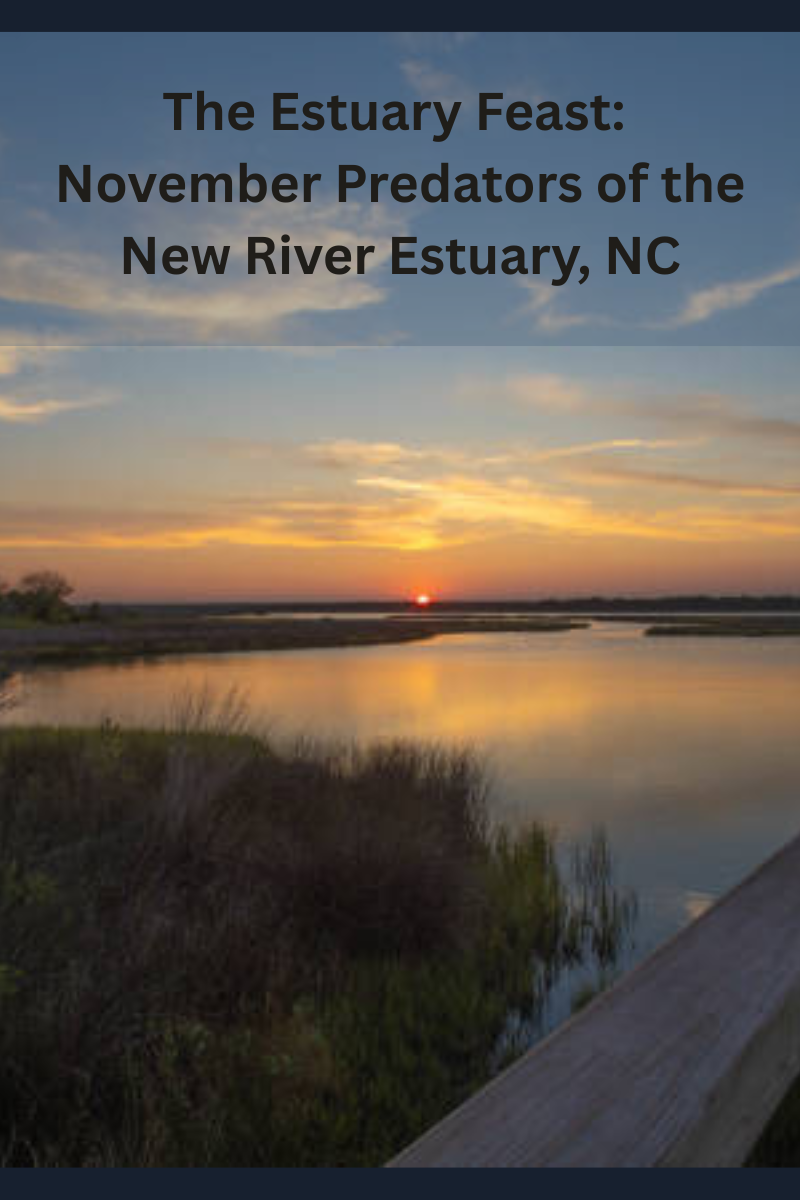
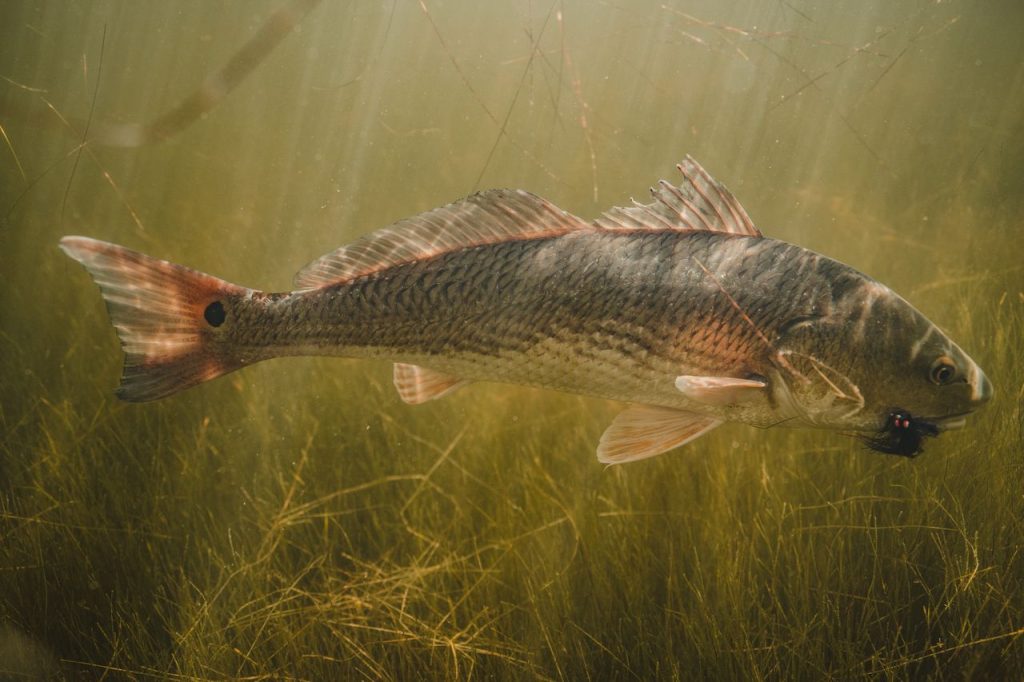
Each November, as the hardwoods fade to rust and the air over Onslow County turns crisp, the New River estuary begins its quiet transformation. Beneath the calm surface, baitfish, shrimp, and crabs gather in the creeks and channels like guests arriving early to dinner. Cooling waters, shifting salinity, and autumn tides all cue a feeding frenzy among the river’s top hunters – red drum (Sciaenops ocellatus), southern flounder (Paralichthys lethostigma), and spotted seatrout (Cynoscion nebulosus).
To the casual observer, it’s just another turn of the season. But for these predators, November is the defining moment of survival – the “estuary feast” that powers them through the winter ahead.
The Science Behind the Feast
As water temperatures drop, oxygen and prey shift. Shrimp slow, mullet school tightly, and predators move into perfect feeding conditions. In November, the estuary’s food web compresses – a short, fierce burst of activity before winter quiets the water.
Autumn brings an ecological reshuffling. As air temperatures drop, water density increases, pushing oxygen-rich layers deeper into the estuary. Cooler water slows the metabolism of small prey, but keeps predators in their metabolic sweet spot – a narrow temperature window where they can feed efficiently (Facendola & Scharf, 2012).
In the New River, this dynamic compresses the food web: prey such as mullet, menhaden, and shrimp concentrate in fewer, warmer microhabitats, and predators follow. Southern flounder and red drum migrate from the upper estuary toward the inlet, using the last strong tides of the season to feed before moving offshore to spawn (Midway et al., 2024).
At the same time, spotted seatrout remain nearshore longer than most species, prowling deep bends and channel edges for sluggish crustaceans and cold-stunned baitfish (Bortone, 2003; TinHan et al., 2018; Whaley et al., 2023). This makes November one of the few months when all three predators share overlapping hunting grounds – a temporary “banquet hall” of intersecting habits and appetites.
Predators at the Table
Red Drum
Known locally as “channel bass”, red drum rely heavily on macro-crustaceans and juvenile fishes during the late fall surge (Facendola & Scharf, 2012). In the New River estuary, they patrol marsh edges and oyster-reef margins where baitfish funnel out with the ebbing tide. These habitats not only provide prey but also structure – a three-dimensional refuge network that concentrates food in predictable corridors.
Red drum are particularly sensitive to dissolved oxygen and salinity changes; they exploit the higher oxygen zones along shell hash and sandy bottoms where shrimp and crabs are most active.
Southern Flounder
Flat, camouflage, and opportunistic, southern flounder are the ambush specialists of November. As they stage for ocean migration, they feed voraciously along the lower estuary and inlet shoals, striking from beneath the sand when shrimp or menhaden schools pass overhead.
Telemetry data show that most adult flounder exit the estuary between mid-October and mid-November (Midway et al., 2024), making this their final feeding push before winter. The energy stored in liver and muscle tissue during this period directly fuels their offshore spawning.
Spotted Seatrout
The spotted seatrout, or “speckled trout”, represents a different strategy: persistence.Unlike flounder or drum, they remain within the estuary for much of the winter. Their adaptive physiology lets them remain active in cooler water, hunting shrimp and small schooling fish even below 15℃, or 59℉ (Bortone, 2003; TinHan et al., 2018; Whaley et al., 2023).
This endurance gives them a late-season advantage – fewer competitors and concentrated prey. In Onslow County’s deeper channels, dock lights and tidal flows create perfect feeding grounds long after other predators have departed.
Prey and Energy Flow
From marsh to mouth: The energy of the estuary: Energy flows up the ladder – detritus -> shrimp -> baitfish -> predator. This seasonal burst fuels migrations and maintains balance in Onslow County’s estuary ecosystem. But when prey species are overfished, that balance falters.
Every feast depends on abundance. In the New River system, fall prey peaks come from several sources:
Penaeid shrimp (brown, pink and white shrimp) and blue crabs provide high-calorie meals critical to red drum and flounder growth (Facendola & Scharf, 2012).
Striped mullet (Mugil cephalus) migrate seaward in vast schools during November, offering short bursts of energy-rich prey (NCDMF, 2022).
Juvenile fishes – menhaden, spot, croaker – linger in the brackish middle reaches, serving as transitional prey before exiting the estuary.
As predators consume these resources, energy moves up the trophic ladder. That transfer of biomass – from detritus to shrimp to fish to apex predator – defines the estuary’s productivity and resilience (Bortone, 2003; TinHan et al., 2018; Whaley et al., 2023).
Beyond the Feast: Ecological Balance
The estuary’s “Thanksgiving” is not just a seasonal event. It’s a reset of the entire system. By removing weaker or late-season prey, predators help balance populations and redistribute nutrients through excretion and predation scars. Their feeding activity also stirs sediments and oxygenates bottom layers, improving microbial decomposition that recycles organic matter for the next year’s growth.
But this rhythm is vulnerable. Habitat loss, water-quality decline, and overfishing can all truncate the feast. Striped mullet, a keystone prey species, remains overfished statewide (NCDMF, 2022), while southern flounder face chronic recruitment declines. (Recruitment is the process of small, young fish transitioning into their older, larger lifestage.) Each missing link reduces the estuary’s resilience – and the energy pulse that sustains these predators through winter.
Climate Notes: A Shifting Season
Recent NOAA data suggests that fall water temperatures in coastal North Carolina are trending 1°-2℃, or 1.8°-3.6℉, warmer than historical averages. Warmer autumns can delay predator migrations, alter prey timing, and extend disease risks for estuarine fish (Bortone, 2003; TinHan et al., 2018; Whaley et al., 2023; Llansó et al., 1998). For Onslow County, this means the “feast” could increasingly occur later, or not at all, in some years. Tracking these shifts can help monitor how climate variability reshapes local predator cycles.
Conclusion
In the quiet weeks before winter, the New River estuary hosts its grandest ritual: a final surge of life and energy. Flounder lie in wait beneath the sand; red drum sweep through oyster channels; speckled trout strike in the moonlit current. Together they embody the estuary’s cyclical resilience – a natural Thanksgiving built on balance, adaptation, and timing.
For those who walk the riverbanks or wade the flats in November, the story unfolding beneath the surface is as rich and meaningful as any holiday tradition: a reminder that even in cooling waters, the rhythm of life continues, fierce and beautiful.
References
Bortone, S. A. (2002). Biology of the spotted Seatrout. CRC Press.
Facendola, J. J., & Scharf, F. S. (2012). Seasonal and ontogenetic variation in the diet and daily ration of estuarine red drum as derived from field-based estimates of gastric evacuation and consumption. Marine and Coastal Fisheries, 4(1), 546-559. https://doi.org/10.1080/19425120.2012.699018
Llansó, R. J., Bell, S. S., Vose, F. E., & Llanso, R. J. (1998). Food habits of red drum and spotted Seatrout in a restored mangrove impoundment. Estuaries, 21(2), 294. https://doi.org/10.2307/1352476
Midway, S. R., Scharf, F. S., Dance, M. A., Brown-Peterson, N. J., Ballenger, J. C., Beeken, N. S., Borski, R. J., Darden, T. L., Erickson, K. A., Farmer, T. M., Fincannon, A., Godwin, J., Graham, P. M., Green, J. L., Hershey, H., Kiene, D., Lee, L. M., Loeffler, M. S., Markwith, A., & McGarigal, C. (2024). Southern Flounder: Major Milestones and Remaining Knowledge Gaps in Their Biology, Ecology, and Fishery Management. Reviews in Fisheries Science & Aquaculture, 32(3), 450-478. https://www.stevemidway.com/publication/midway2024rfsa/midway2024RFSA.pdf
TinHan, T. C., Mohan, J. A., Dumesnil, M., DeAngelis, B. M., & Wells, R. J. (2018). Linking habitat use and trophic ecology of spotted Seatrout (Cynoscion nebulosus) on a restored oyster reef in a subtropical Estuary. Estuaries and Coasts, 41(6), 1793-1805. https://doi.org/10.1007/s12237-018-0391-x
Whaley, S. D., Shea, C. P., Santi, E. C., & Gandy, D. A. (2023). The influence of freshwater inflow and seascape context on occurrence of juvenile spotted seatrout Cynoscion nebulosus across a temperate Estuary. PLOS ONE, 18(11), e0294178.