Category: Marine Ecology

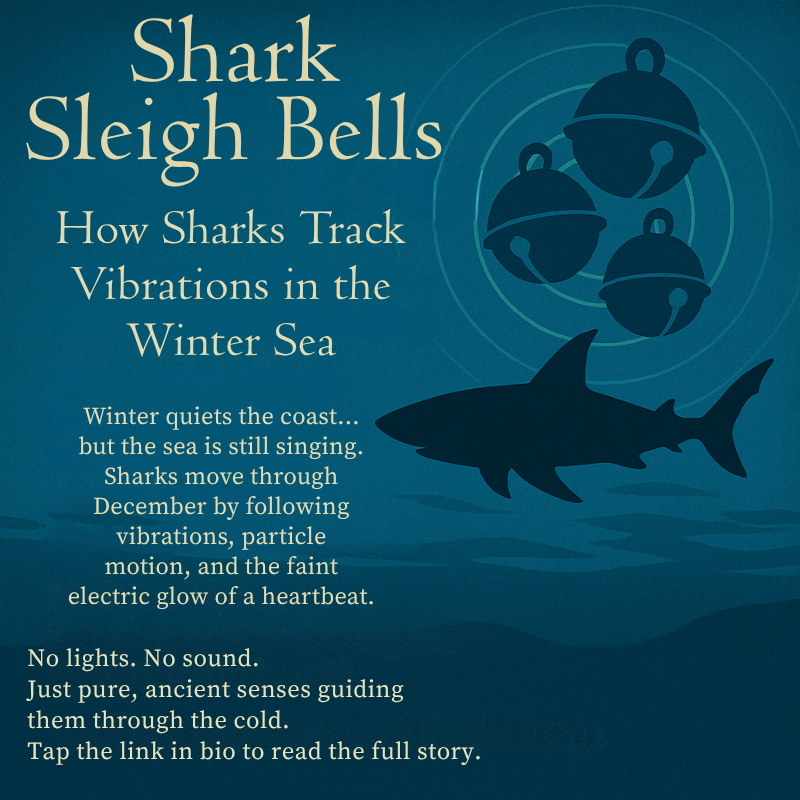
  • Shark Sleigh Bells: How Sharks Track Vibrations in the Winter Sea

    Shark Sleigh Bells: How Sharks Track Vibrations in the Winter Sea

    Winter’s Quiet Chorus

    December hushes the coastline of Onslow County. The marshgrass stiffens in the cold, the surf stills between storms, and the New River Inlet carries the metallic stillness of early winter. Yet beneath that calm, the water hums with motion — tiny pulses, ripples, and vibrations that weave a hidden holiday soundtrack, a kind of underwater sleigh bells rung in pressure waves.

    Sharks, lingering along the nearshore troughs or cruising the outer edge of the estuary, sense these disturbances with remarkable clarity. Every mullet tail-beat, crab scuttle, and sediment shift radiates through the water as a low-frequency pressure wave. In the quiet of December, these signals travel farther and cleaner, strengthened by winter’s denser water, slower prey, and reduced turbidity (Mickle & Higgs, 2021; Mogdans, 2019).

    To sharks, these vibrations form a map, a three-dimensional winter soundscape that reveals direction, distance, and urgency (Montgomery, Baker & Carton, 2000; Montgomery et al., 2000). And layered beneath these hydrodynamic cues, the faint electric fields produced by the heartbeat and muscle activity of nearby prey glow through the water, detectable at nanovolt precision (Anderson et al., 2017; England et al., 2021).

    This “music” is not metaphor — it is the sensory world sharks inhabit, sharpened by the very conditions winter imposes.

    The Winter Sea as a Soundscape

    Illustration showing how different animals create underwater vibrations detectable by sharks. A school of fish at the top produces wide, rolling displacement waves. A crab on the sandy seafloor generates small, intermittent pulse rings. Two individual fish create subtle fin-flick ripple patterns. Concentric circles radiate from each animal to visually represent hydrodynamic cues in the water.
    Sharks detect a wide range of underwater vibrations—from the rolling displacement waves of schooling fish to the intermittent pulses of crabs and the subtle fin flicks of solitary prey—using their highly sensitive mechanosensory systems.

    Cold water shifts the physics of survival. As temperatures fall, prey metabolism slows, creating weaker and more irregular movement patterns — the exact low-frequency signatures sharks detect most easily (Sisneros & Rogers, 2016). Reduced plankton and sediment yield a clearer path for particle motion, allowing hydrodynamic cues to propagate farther through the winter water column (Mogdans, 2019).

    This turns the estuary into a rich field of vibrations. Fish schooling tightly create rolling displacement waves. Crabs shifting beneath the sand produce intermittent pulses. Even subtle fin flicks produce particle motion detectable by sharks’ sensory systems (Maruska, 2001).

    Winter looks barren to us.
    To sharks, it resonates.

    Hydrodynamic “Bells”: The Lateral Line

    A scientific-style illustration explaining how a shark’s lateral line detects underwater vibrations. A sandbar shark is shown with a highlighted lateral line running along its body and head. Concentric rings radiate from a struggling fish, a crustacean on the seafloor, and a distant object to demonstrate low-frequency hydrodynamic signals. Icons represent cold water, low light, prey movement, and inlet geometry as factors that enhance vibration transmission in winter. Text describes neuromasts encoding direction and amplitude to create a spatial map of nearby activity.
    Sharks use their lateral line to “feel” tiny vibrations in the water. Winter makes these signals even easier to detect, helping sharks follow the movement of fish, crabs, and other prey in low-light conditions.

    The shark’s lateral line is a mechanosensory canal system tuned to detect water displacement in the exact frequency range produced by struggling fish and crustaceans (Montgomery, Baker & Carton, 2000). Neuromasts within the canal encode both direction and amplitude, transforming low-frequency motion into a spatial map of nearby activity (Mogdans, 2019).

    In December, this system excels:

    • cold water enhances transmission of pressure waves,
    • prey move more predictably and more weakly,
    • low-light conditions reduce visual noise,
    • and inlet geometry funnels vibrations along natural corridors.

    Even acoustic cues — particle motion at frequencies under ~300 Hz — become part of this integration. Sharks are most sensitive to these low-frequency bands, enabling discrimination of movement types in murky or dark winter water (Poppelier et al., 2022).

    To a shark, each pulse is information.
    Each ripple is direction.
    Each vibration is a bell rung underwater.

    Watch how sharks use their lateral line system to sense ripples and vibrations long before they see their prey. | Video courtesy of National Aquarium – “Sharks Lateral Line”

    Closer Than Sight: The Ampullae of Lorenzini

    When a shark closes the final distance, tracking transitions from vibration to electricity. The Ampullae of Lorenzini detect microvolt-scale electric fields emitted by the body of every living animal. Sensitivity thresholds fall into the tens of nanovolts per centimeter — among the most refined biological detection limits known (Anderson et al., 2017; Newton, Gill & Kajiura, 2019; England et al., 2021).

    Electroreception enables sharks to:

    • locate prey buried beneath sand,
    • perceive fish hidden in silt clouds,
    • detect immobile or slow-moving animals,
    • and navigate complex, low-light environments.

    Classic electroreception work demonstrated these capacities decades ago, and modern experimental studies in hammerheads confirm high-resolution electro-sensitivity during close-range hunting (Kajiura & Holland, 2002; Kalmijn, 2000).

    In winter, when storms churn the sediment and twilight comes early, this sense becomes even more essential.

    Sharks do not need light — they follow electricity.

    Video courtesy of PBS Deep Look, illustrating how sharks use electroreception to locate prey invisible to sight or sound.

    A December Hunt at the New River Mouth

    Illustration of a juvenile Atlantic sharpnose shark approaching a partially buried mullet in shallow winter water. Orange concentric lines show the mullet’s electric field and the shark’s detection of hydrodynamic and electrical cues through its lateral line and Ampullae of Lorenzini.
    A juvenile Atlantic sharpnose shark follows the faint hydrodynamic pulse of a cold-slowed mullet, then locks onto its electric field—an underwater hunt guided by vibration and microvolts.

    Picture a December evening at the New River Inlet. The ebb tide pulls cold water from the sound toward the ocean. A juvenile Atlantic sharpnose shark glides along a shallow bar, guided not by sight, but by the underwater vibrations pulsing through its lateral line.

    A faint, uneven pressure wave reaches the shark — the hydrodynamic signature of a mullet slowed by the cold (Montgomery et al., 2000). The shark turns. Another pulse follows, the rhythm revealing both direction and weakness.

    Within a few body lengths, electric cues rise above the hydrodynamic noise. The Ampullae of Lorenzini detect microvolt-scale oscillations from the mullet’s buried body (Newton, Gill & Kajiura, 2019; England et al., 2021). One quick strike completes the hunt.

    This is winter’s choreography:
    vibrations at a distance,
    electricity up close,
    all woven seamlessly through still December water.

    The Importance of Winter Hunting

    four-panel educational graphic titled “Winter Survival: How Sharks Thrive When Other Animals Slow Down.” The top panels show a shark pursuing a slow-moving fish labeled “Winter Energy Reserves” and a shark navigating an inlet with arrows labeled “Predictable Movement Corridors.” The bottom panels show a shark approaching a weakened fish with vibration rings labeled “Removing Weakened Individuals” and a shark outlined by sensory icons—spiral wave, lightning bolt, and low-light symbol—labeled “Low Visibility Navigation.” The artwork illustrates how sharks use sensory advantages to hunt effectively during winter.
    Even as the season quiets the coast, sharks thrive—reading vibrations, following winter corridors, finding weakened prey, and navigating the dim water with senses far beyond our own.

    Although prey slow in winter, sharks must continue to feed. Their dual sensory systems allow efficient predation in the season that challenges most marine animals. These abilities help sharks:

    • build winter energy reserves,
    • exploit predictable movement corridors,
    • maintain population stability by removing weakened individuals (Tricas & McCosker, 1984),
    • and navigate cold, low-visibility environments effectively (Mickle & Higgs, 2021).

    Even as water temperatures drop, species like Atlantic sharpnose sharks, bonnetheads, and offshore Atlantic spiny dogfish remain active, relying heavily on the interplay of hydrodynamic and electroreceptive cues (Maruska, 2001).

    Winter is not lifeless.
    It is a sensory masterclass.

    Bells That Never Stop Ringing

    While we celebrate the holidays with sleigh bells, carols, and glowing lights, the Atlantic hums with its own winter rhythms. Sharks navigate December through vibrations, particle motion, and faint electrical fields — signals older than any tradition and tuned to the pulse of life beneath the cold.

    Their bells are not made of metal.
    They are made of motion.
    Of electricity.
    Of the quiet echoes of survival beneath the tide. These are the Shark Sleigh Bells, ringing softly beneath Onslow County’s winter waters.

    References

    Anderson, J. M., Clegg, T. M., Véras, L. V., & Holland, K. N. (2017). Insight into shark magnetic field perception from empirical observations. Scientific Reports, 7(1). https://doi.org/10.1038/s41598-017-11459-8

    England, S. J., & Robert, D. (2021). The ecology of electricity and electroreception. Biological Reviews, 97(1), 383-413. https://doi.org/10.1111/brv.12804

    Kajiura, S. M., & Holland, K. N. (2002). Electroreception in juvenile scalloped hammerhead and sandbar sharks. Journal of Experimental Biology, 205(23), 3609-3621. https://doi.org/10.1242/jeb.205.23.3609

    Kalmijn, A. J. (2000). Detection and processing of electromagnetic and near–field acoustic signals in elasmobranch fishes. Philosophical Transactions of the Royal Society of London. Series B: Biological Sciences, 355(1401), 1135-1141. https://doi.org/10.1098/rstb.2000.0654

    Maruska, K. P. (2001). Morphology of the Mechanosensory lateral line system in elasmobranch fishes: Ecological and behavioral considerations. Environmental Biology of Fishes, 60(1-3), 47-75. https://doi.org/10.1023/a:1007647924559

    Mickle, M. F., & Higgs, D. M. (2021). Towards a new understanding of elasmobranch hearing. Marine Biology, 169(1). https://doi.org/10.1007/s00227-021-03996-8

    Mogdans, J. (2019). Sensory ecology of The Fish lateral‐line system: Morphological and physiological adaptations for the perception of hydrodynamic stimuli. Journal of Fish Biology, 95(1), 53-72. https://doi.org/10.1111/jfb.13966

    Montgomery, J., Carton, G., Voigt, R., Baker, C., & Diebel, C. (2000). Sensory processing of water currents by fishes. Philosophical Transactions of the Royal Society of London. Series B: Biological Sciences, 355(1401), 1325-1327. https://doi.org/10.1098/rstb.2000.0693

    Montgomery, J. C., Baker, C. F., & Carton, A. G. (1997). The lateral line can mediate rheotaxis in fish. Nature, 389(6654), 960-963. https://doi.org/10.1038/40135

    Newton, K. C., Gill, A. B., & Kajiura, S. M. (2019). Electroreception in marine fishes: Chondrichthyans. Journal of Fish Biology, 95(1), 135-154. https://doi.org/10.1111/jfb.14068

    Poppelier, T., Bonsberger, J., Berkhout, B. W., Pollmanns, R., & Schluessel, V. (2022). Acoustic discrimination in the grey bamboo shark Chiloscyllium griseum. Scientific Reports, 12(1). https://doi.org/10.1038/s41598-022-10257-1

    Tricas, T. C., & McCosker, J. E. (1984). Predatory behavior of the white shark (Carcharodon carcharias) and other large sharks. Proceedings of the California Academy of Sciences, 43(14), 221-238. https://ia801302.us.archive.org/16/items/biostor-78396/biostor-78396.pdf 

  • The Leftovers: What Happens to Summer’s Prey When the Big Fish Leave?

    The Leftovers: What Happens to Summer’s Prey When the Big Fish Leave?

    The Quiet Season Begins

    When the red drum, flounder, and summer sharks follow the cooling tides offshore, Onslow County’s estuaries fall quiet. The flashy chases fade, and the splashes that once rippled through the creeks give way to stillness. But the story doesn’t end. Beneath November’s calm water, the estuary begins to rewrite itself.

    The absence of its top hunters leaves behind both energy and opportunity — a banquet for the small and the overlooked. The currents no longer echo with the heavy pulse of pursuit. Instead, what remains is a more deliberate rhythm — a slow exchange between detritus, crabs, and the smaller fish that endure the cold months ahead.

    Winter in the New River Estuary: The Vacancy in the Food Web

    Every migration leaves an ecological vacancy. When red drum and southern flounder depart, they take with them both predatory pressure and nutrient export. The estuary briefly relaxes its guard. Prey fish, shrimp, and crabs experience a momentary release from predation from top predator populations that cause a cascade that momentarily alters predation pressure on lower-level prey (Clark et al., 2003).

    In this lull, energy that once fueled apex biomass lingers in the system, stored in crustaceans and schooling fish that escaped the hunt (Baird et al., 1998). The estuary, ever adaptive, redistributes that energy downward. Blue crabs (Callinectes sapidus) and juvenile spot (Leiostomus xanthurus) surge in number, exploiting the leftovers of summer’s feast (Allen et al., 2024). The marsh becomes a recycling ground — energy looping through smaller players instead of flowing outward to the sea.

    Late-Fall Estuarine Food Web
    Late-fall estuarine food web diagram showing energy flow from detritus to shrimp, fish, and mesopredators.

    The Winter Guardians

    But not all predators have gone. When the warm-water hunters leave, colder visitors arrive. Along the inlets and nearshore waters of Onslow Bay, Atlantic spiny dogfish (Squalus acanthias) drift in with the falling temperatures. They are the quiet inheritors of the season — small sharks with silver eyes and slate-gray backs, moving in disciplined schools just offshore.

    Atlantic spiny dogfish school by Andy Murch
    Atlantic spiny dogfish (Squalus acanthius) — the “winter guardians” — patrol coastal waters when larger predators have departed, sustaining the rhythm of predation. | Photo credit: Andy Murch

    Where the big sharks of summer — sandbars, blacktips, and bulls — have vanished southward or deeper, the dogfish remain. Their bodies are built for cold water, thriving where others slow (Carlson et al., 2014). And while their size may not inspire awe, their purpose is no less vital: they fill the empty seats at the top of the table.

    Dogfish are mesopredators, but in winter they act as temporary apex hunters, patrolling the inlet and inner shelf where menhaden, herring, and squid still linger (Carlson et al., 2014). Their presence keeps the ecosystem in motion. They thin out the schools that might otherwise explode in number, preventing imbalance and decay. Like patient custodians, they maintain the continuity of predation, ensuring that energy continues to flow up and down the food web even in the cold months (Prugh et al., 2009).

    In their absence, the estuary might collapse inward — prey would overgraze, detritus would pile, and oxygen would vanish from the mud. But the dogfish, efficient and tireless, keep the waters breathing.

    Crabs and Killifish Take the Stage

    Blue crab foraging in estuary
    Blue crabs roam the winter marsh, feeding on detritus and benthic invertebrates. Their slow foraging helps recycle nutrients and sustain the estuary’s energy balance through the cold season.

    Within the estuary itself, the smaller actors continue their work. By December, the New River’s mudflats and marsh creeks host a quieter cast — mummichogs (Fundulus heteroclitus), sheepshead minnows (Cyprinodon variegatus), and grass shrimp (Palaemonetes pugio). These resident species, often unnoticed, now carry the estuary’s metabolism on their backs.

    They thrive on detritus and microbial mats, converting decay into new life (Kneib, 2015). Blue crabs roam like slow-moving janitors, shifting through sediment to feed on worms and organic matter (Kennedy & Cronin, 2007). Each movement releases trapped nutrients, fueling microbial blooms that will later nourish the first plankton of spring.

    While the spiny dogfish patrol the edges of the continental shelf, these smaller species sustain the inner heart of the estuary. Their labor keeps the water alive long after the glamour of migration fades.

    Nutrient Loops and Winter Stability

    Without large predators, the estuary depends on microbial and detrital loops to keep its energy cycling. Up to 70% of carbon transfer between November and February occurs through benthic detritivory and microbial remineralization rather than direct predation (Friedrichs & Perry, 2001).

    This invisible economy sustains the overwintering fish and crustaceans — the leftovers that, in time, will become the first meal of spring’s returning predators. It’s the estuary’s savings account: energy stored as biomass and sediment, ready to be withdrawn when the tides warm again.

    Graphical abstract of dentrification in a coastal lagoon from https://doi.org/10.1016/j.scitotenv.2020.140169
    When winter quiets the hunt, the estuary turns inward. Instead of predators driving the cycle, nutrients move through the mud itself — microbes and detritivores recycling what’s left behind. This unseen flow keeps the New River alive until spring’s return (adapted from Erler et al., 2020).

    A Resilient Feast

    By January, the estuary seems dormant to the casual eye, but beneath its glassy surface, life reorganizes with quiet precision. Crabs clean the table. Dogfish patrol the edge. Minnows and shrimp sift through the silt for remnants of summer.

    The New River continues to breathe — slower, deeper, deliberate.
    When the big fish return with the first warm tides, the table is set once more, and the energy once left behind has been transformed — recycled through countless small mouths and patient currents into the promise of another season’s chase.

    References

    Allen, D. M., Govoni, J. J., Able, K. W., Buckel, J. A., Hale, E. A., Hilton, E. J., Kellison, G. T., Targett, T. E., Taylor, J. C., & Walsh, H. J. (2024). Long-term dynamics of larval and early juvenile spot (Leiostomus xanthurus) off the U.S. East Coast: Relating ocean origins, estuarine Ingress, and changing environmental conditions. Fishery Bulletin, 122(4), 162-185. https://doi.org/10.7755/fb.122.4.3  

    Baird, D., Luczkovich, J., & Christian, R. (1998). Assessment of spatial and temporal variability in ecosystem attributes of the St marks national wildlife refuge, Apalachee Bay, Florida. Estuarine, Coastal and Shelf Science, 47(3), 329-349. https://doi.org/10.1006/ecss.1998.0360

    Carlson, A. E., Hoffmayer, E. R., Tribuzio, C. A., & Sulikowski, J. A. (2014). The use of satellite tags to redefine movement patterns of spiny dogfish (Squalus acanthias) along the U.S. East Coast: Implications for fisheries management. PLoS ONE, 9(7), e103384. https://doi.org/10.1371/journal.pone.0103384

    Clark, K. L., Ruiz, G. M., & Hines, A. H. (2003). Diel variation in predator abundance, predation risk and prey distribution in shallow-water estuarine habitats. Journal of Experimental Marine Biology and Ecology, 287(1), 37-55. https://doi.org/10.1016/s0022-0981(02)00439-2

    Foster, S. Q., & Fulweiler, R. W. (2014). Spatial and historic variability of benthic nitrogen cycling in an anthropogenically impacted Estuary. Frontiers in Marine Science, 1. https://doi.org/10.3389/fmars.2014.00056

    Friedrichs, C. T., & Perry, J. E. (2001). Tidal Salt Marsh Morphodynamics: A Synthesis. Journal of Coastal Research, (27), 7-37. https://www.jstor.org/stable/25736162

    Kennedy, V. S., & Cronin, L. E. (2007). The blue crab: Callinectes Sapidus. Maryland Sea Grant College University of Maryland.

    Kneib, R. T. (1986). The role of Fundulus heteroclitus in salt marsh trophic dynamics. American Zoologist, 26(1), 259-269. https://doi.org/10.1093/icb/26.1.259

    Prugh, L. R., Stoner, C. J., Epps, C. W., Bean, W. T., Ripple, W. J., Laliberte, A. S., & Brashares, J. S. (2009). The rise of the Mesopredator. BioScience, 59(9), 779-791. https://doi.org/10.1525/bio.2009.59.9.9 

  • The Estuary Feast: November Predators of the New River Estuary, NC

    The Estuary Feast: November Predators of the New River Estuary, NC

    Each November, as the hardwoods fade to rust and the air over Onslow County turns crisp, the New River estuary begins its quiet transformation. Beneath the calm surface, baitfish, shrimp, and crabs gather in the creeks and channels like guests arriving early to dinner. Cooling waters, shifting salinity, and autumn tides all cue a feeding frenzy among the river’s top hunters – red drum (Sciaenops ocellatus), southern flounder (Paralichthys lethostigma), and spotted seatrout (Cynoscion nebulosus).

    To the casual observer, it’s just another turn of the season. But for these predators, November is the defining moment of survival – the “estuary feast” that powers them through the winter ahead.

    The Science Behind the Feast

    The science: cool water, hot action
    As water temperatures drop, oxygen and prey shift. Shrimp slow, mullet school tightly, and predators move into perfect feeding conditions. In November, the estuary’s food web compresses – a short, fierce burst of activity before winter quiets the water.

    Autumn brings an ecological reshuffling. As air temperatures drop, water density increases, pushing oxygen-rich layers deeper into the estuary. Cooler water slows the metabolism of small prey, but keeps predators in their metabolic sweet spot – a narrow temperature window where they can feed efficiently (Facendola & Scharf, 2012).

    In the New River, this dynamic compresses the food web: prey such as mullet, menhaden, and shrimp concentrate in fewer, warmer microhabitats, and predators follow. Southern flounder and red drum migrate from the upper estuary toward the inlet, using the last strong tides of the season to feed before moving offshore to spawn (Midway et al., 2024).

    At the same time, spotted seatrout remain nearshore longer than most species, prowling deep bends and channel edges for sluggish crustaceans and cold-stunned baitfish (Bortone, 2003; TinHan et al., 2018; Whaley et al., 2023). This makes November one of the few months when all three predators share overlapping hunting grounds – a temporary “banquet hall” of intersecting habits and appetites.

    Predators at the Table

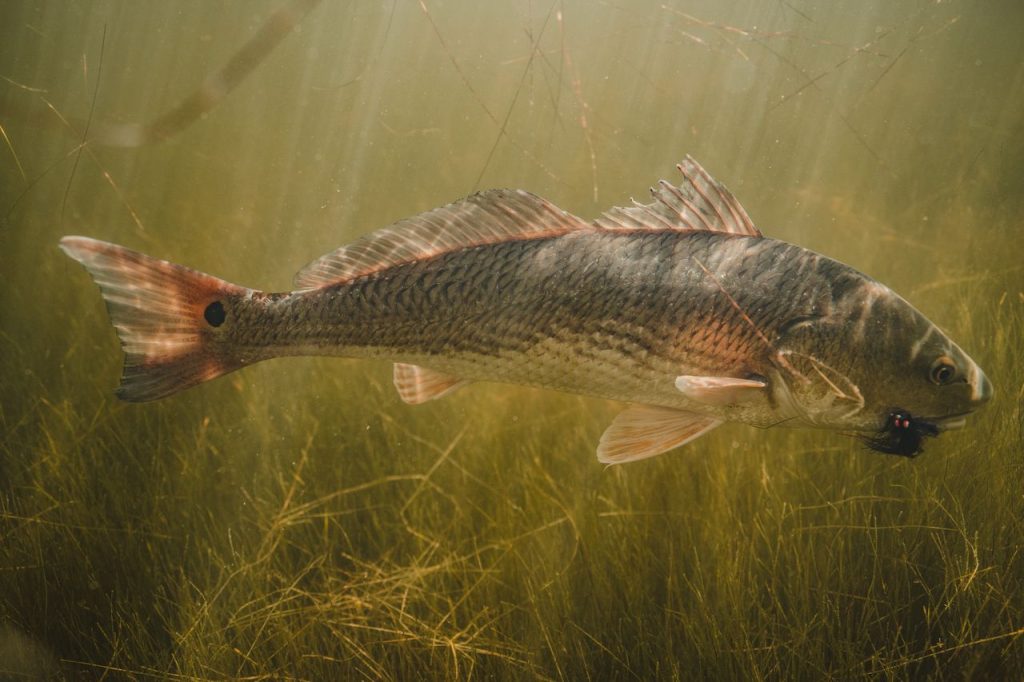
    Red Drum

    Known locally as “channel bass”, red drum rely heavily on macro-crustaceans and juvenile fishes during the late fall surge (Facendola & Scharf, 2012). In the New River estuary, they patrol marsh edges and oyster-reef margins where baitfish funnel out with the ebbing tide. These habitats not only provide prey but also structure – a three-dimensional refuge network that concentrates food in predictable corridors.

    Red drum are particularly sensitive to dissolved oxygen and salinity changes; they exploit the higher oxygen zones along shell hash and sandy bottoms where shrimp and crabs are most active.

    Southern Flounder

    Flat, camouflage, and opportunistic, southern flounder are the ambush specialists of November. As they stage for ocean migration, they feed voraciously along the lower estuary and inlet shoals, striking from beneath the sand when shrimp or menhaden schools pass overhead.

    Telemetry data show that most adult flounder exit the estuary between mid-October and mid-November (Midway et al., 2024), making this their final feeding push before winter. The energy stored in liver and muscle tissue during this period directly fuels their offshore spawning.

    Spotted Seatrout

    The spotted seatrout, or “speckled trout”, represents a different strategy: persistence.Unlike flounder or drum, they remain within the estuary for much of the winter. Their adaptive physiology lets them remain active in cooler water, hunting shrimp and small schooling fish even below 15℃, or 59℉ (Bortone, 2003; TinHan et al., 2018; Whaley et al., 2023).

    This endurance gives them a late-season advantage – fewer competitors and concentrated prey. In Onslow County’s deeper channels, dock lights and tidal flows create perfect feeding grounds long after other predators have departed.

    Prey and Energy Flow

    From marsh to mouth: The energy of the estuary: Energy flows up the ladder - detritus -> shrimp -> baitfish -> predator. This seasonal burst fuels migrations and maintains balance in Onslow County's estuary ecosystem. But when prey species are overfished, that balance falters.
    From marsh to mouth: The energy of the estuary: Energy flows up the ladder – detritus -> shrimp -> baitfish -> predator. This seasonal burst fuels migrations and maintains balance in Onslow County’s estuary ecosystem. But when prey species are overfished, that balance falters.

    Every feast depends on abundance. In the New River system, fall prey peaks come from several sources:

    • Penaeid shrimp (brown, pink and white shrimp) and blue crabs provide high-calorie meals critical to red drum and flounder growth (Facendola & Scharf, 2012).
    • Striped mullet (Mugil cephalus) migrate seaward in vast schools during November, offering short bursts of energy-rich prey (NCDMF, 2022). 
    • Juvenile fishes – menhaden, spot, croaker – linger in the brackish middle reaches, serving as transitional prey before exiting the estuary.

    As predators consume these resources, energy moves up the trophic ladder. That transfer of biomass – from detritus to shrimp to fish to apex predator – defines the estuary’s productivity and resilience (Bortone, 2003; TinHan et al., 2018; Whaley et al., 2023).

    Beyond the Feast: Ecological Balance

    The estuary’s “Thanksgiving” is not just a seasonal event. It’s a reset of the entire system. By removing weaker or late-season prey, predators help balance populations and redistribute nutrients through excretion and predation scars. Their feeding activity also stirs sediments and oxygenates bottom layers, improving microbial decomposition that recycles organic matter for the next year’s growth.

    But this rhythm is vulnerable. Habitat loss, water-quality decline, and overfishing can all truncate the feast. Striped mullet, a keystone prey species, remains overfished statewide (NCDMF, 2022), while southern flounder face chronic recruitment declines. (Recruitment is the process of small, young fish transitioning into their older, larger lifestage.) Each missing link reduces the estuary’s resilience – and the energy pulse that sustains these predators through winter.

    Climate Notes: A Shifting Season

    Recent NOAA data suggests that fall water temperatures in coastal North Carolina are trending 1°-2℃, or 1.8°-3.6℉, warmer than historical averages. Warmer autumns can delay predator migrations, alter prey timing, and extend disease risks for estuarine fish (Bortone, 2003; TinHan et al., 2018; Whaley et al., 2023; Llansó et al., 1998). For Onslow County, this means the “feast” could increasingly occur later, or not at all, in some years. Tracking these shifts can help monitor how climate variability reshapes local predator cycles.

    Conclusion

    In the quiet weeks before winter, the New River estuary hosts its grandest ritual: a final surge of life and energy. Flounder lie in wait beneath the sand; red drum sweep through oyster channels; speckled trout strike in the moonlit current. Together they embody the estuary’s cyclical resilience – a natural Thanksgiving built on balance, adaptation, and timing.

    For those who walk the riverbanks or wade the flats in November, the story unfolding beneath the surface is as rich and meaningful as any holiday tradition: a reminder that even in cooling waters, the rhythm of life continues, fierce and beautiful.

    References

    Bortone, S. A. (2002). Biology of the spotted Seatrout. CRC Press.

    Facendola, J. J., & Scharf, F. S. (2012). Seasonal and ontogenetic variation in the diet and daily ration of estuarine red drum as derived from field-based estimates of gastric evacuation and consumption. Marine and Coastal Fisheries, 4(1), 546-559. https://doi.org/10.1080/19425120.2012.699018

    Llansó, R. J., Bell, S. S., Vose, F. E., & Llanso, R. J. (1998). Food habits of red drum and spotted Seatrout in a restored mangrove impoundment. Estuaries, 21(2), 294. https://doi.org/10.2307/1352476

    Midway, S. R., Scharf, F. S., Dance, M. A., Brown-Peterson, N. J., Ballenger, J. C., Beeken, N. S., Borski, R. J., Darden, T. L., Erickson, K. A., Farmer, T. M., Fincannon, A., Godwin, J., Graham, P. M., Green, J. L., Hershey, H., Kiene, D., Lee, L. M., Loeffler, M. S., Markwith, A., & McGarigal, C. (2024). Southern Flounder: Major Milestones and Remaining Knowledge Gaps in Their Biology, Ecology, and Fishery Management. Reviews in Fisheries Science & Aquaculture, 32(3), 450-478. https://www.stevemidway.com/publication/midway2024rfsa/midway2024RFSA.pdf

    North Carolina Division of Marine Fisheries (NCDMF). (2022, August). Fishery Management Plan Update Striped Mullet. NC Dept. of Environmental Quality (NCDEQ). https://www.deq.nc.gov/marine-fisheries/fisheries-management/annual-fmp-review/2023/2023-striped-mullet-fmp-review/open

    TinHan, T. C., Mohan, J. A., Dumesnil, M., DeAngelis, B. M., & Wells, R. J. (2018). Linking habitat use and trophic ecology of spotted Seatrout (Cynoscion nebulosus) on a restored oyster reef in a subtropical Estuary. Estuaries and Coasts, 41(6), 1793-1805. https://doi.org/10.1007/s12237-018-0391-x

    Whaley, S. D., Shea, C. P., Santi, E. C., & Gandy, D. A. (2023). The influence of freshwater inflow and seascape context on occurrence of juvenile spotted seatrout Cynoscion nebulosus across a temperate Estuary. PLOS ONE, 18(11), e0294178.