
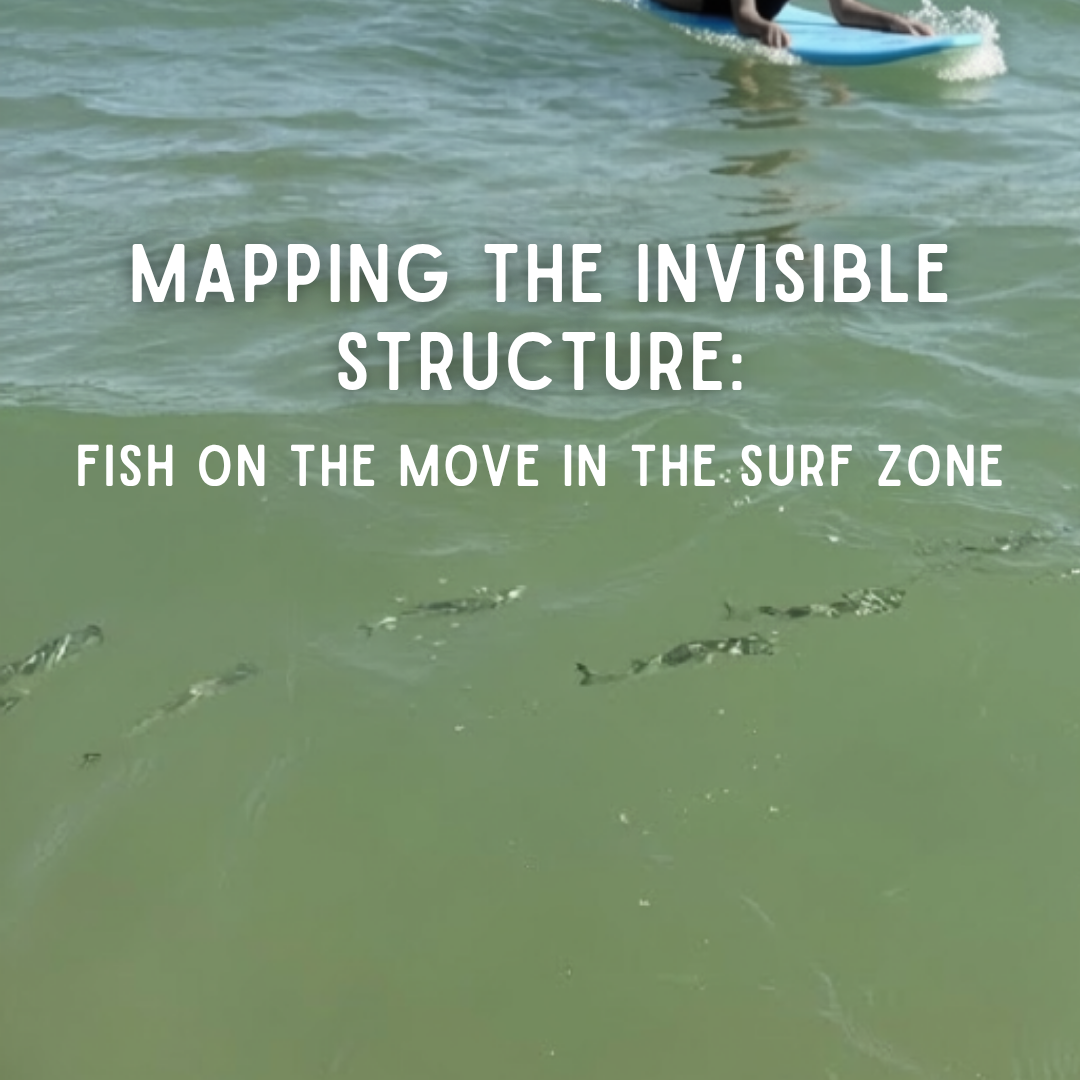
Somewhere between watching my daughter catch waves and standing in the surf zone waiting for the next decent one to come through, I noticed the fish.
They were small—anchovy-like from where I stood, although the glare on the water and the constant movement made identification nearly impossible. What caught my attention wasn’t what they were. It was the fish on the move beside us, all traveling in the same narrow line for almost four hours.
They were moving parallel to the beach in a line perhaps four inches wide, almost exactly where the waves were breaking.
A wave would come through hard enough to knock us backward. Water rushed toward shore and then pulled against our legs as it returned. My daughter and I moved with it.
The fish didn’t seem to.
The line continued.
A little farther offshore was another line of larger fish. They were less tightly packed, but moving along the same general stretch of coast. Beyond them, one or two long, slender fish held near my daughter’s board. We couldn’t identify them with certainty, although their shape was consistent with one of our larger needlefishes, possibly a houndfish. They didn’t appear to be simply passing through. They would dart toward the smaller fish, take one, and return.
Farther still, just beyond the breakers, something much larger came partly out of the water while apparently feeding. It happened too quickly to tell whether it was a shark, large fish, or something else.
Then the line of little fishes passing in front of me suddenly broke.
Fish scattered and began leaping from the water, fleeing something I couldn’t see. Almost immediately, there seemed to be another pursuit underway.
That seemed like a good time for us to take a short break on the beach.
We had been in the water for nearly four hours by then, and those little fish had been passing us for much of it.
It was only after watching them for so long that the strange part became obvious.
The water looked like one place. We had been watching fish on the move through the surf zone all afternoon.
The fish were behaving as though it wasn’t.
The Line That Didn’t End
Standing in the surf, it is easy to think of the shallow water as a temporary place.
Waves arrive. Water runs up the beach and retreats. Sand shifts beneath your feet. A few yards offshore, another wave rises over a bar and breaks. Everything seems to be moving too much for anything resembling a pathway to exist.
To a fish, however, that same water contains structure.
Even water only a few inches or a foot deep can hold its own patterns. Small runnels form behind sandbars, wave energy changes as water crosses them, and fishes can move parallel to shore through these shallow strips rather than spreading evenly across the surf. The exact species may change from beach to beach, but the pattern is not unusual: fishes sort themselves through very small differences in shallow-water habitat (Layman, 2000).

Late summer can make those patterns especially noticeable. Along our part of the coast, both the number of fish and the variety of species using the surf climb through the warm months, reaching their highest levels from June through August (North Carolina Sea Grant, 2019).
So the little fish moving past our legs weren’t occupying empty water between the beach and the ocean.
They were inside habitat. And habitat has shape.
Mapping the Invisible Structure
Most of that shape disappears when we look across the water from shore.
We can see the obvious pieces. Waves often reveal where a sandbar rises toward the surface. Darker water may hint at a trough. A break in the waves can sometimes betray a deeper channel. Farther out, the water deepens into another shade.
For a small fish, those changes don’t have to be dramatic to matter.
A few inches of depth can change how quickly the water moves, how much wave energy reaches a spot, what food passes through and which animals can follow. Temperature and wave conditions add another layer. Together, they turn what looks like one open stretch of surf into a collection of much smaller usable spaces (Olds et al., 2018).
The difference between standing here and standing three feet farther out may barely register to us.
To a fish only a few inches long, it can mean different water.
That becomes easier to picture when we pull back and look at the coast beneath us.
Off Onslow County, the continental shelf doesn’t plunge quickly into deep water. It stretches gradually away from shore across a broad, shallow part of Onslow Bay. Near the beach, the bottom is mostly sand, with shell fragments and coarser material mixed through some areas. Closer to shore, that otherwise gentle slope is interrupted again and again by the smaller features we actually feel beneath our feet—bars, dips, troughs and runnels that waves and currents continually reshape (North Carolina Coastal Resources Commission Science Panel, 2026; Tyler & Kowalewski, 2018).

To us, one of those dips may simply feel like the water suddenly came a little higher on our bodies.
For a fish only a few inches tall, it can be a different piece of the landscape.
That doesn’t mean the little school we watched was tracing a particular underwater trough. We couldn’t see the bottom well enough to know that.
But their persistence was revealing something.
Waves repeatedly pushed us out of position while fish continued moving through approximately the same narrow part of the surf. Whatever they were responding to—depth, current, food, protection, or some combination—the fish could perceive differences in that water that we couldn’t.
Their movement made some of the invisible structure visible.
Why the Smallest Fish Remain Close to Shore
There is something counterintuitive about watching tiny fish choose the place where waves are breaking. It doesn’t look protected.
For us, it was the part of the water most likely to knock us over.
But safety underwater doesn’t necessarily look like calm water.
For a small fish, extremely shallow water can make life more difficult for some of the animals trying to catch it. A larger predator may still enter—and plenty do—but depth, turbulence and room to maneuver change as the water shoals toward the beach. Juvenile fishes can shift into different depths as they balance the food available there against the risk of being eaten, so sometimes moving only a little shallower can change the odds (Layman, 2000; Miltner et al., 1995; Munsch et al., 2016).

And there is plenty to eat.
During summer, some of the smallest schooling fishes—including bay anchovies, striped anchovies and Atlantic silversides—feed largely on plankton carried through the surf. Summer zooplankton can include copepods, mysids, crab larvae and other tiny animals whose numbers shift with tides and time of day (DeLancey, 1987, 1989). Other fishes take food from the sand itself, including mole crabs, passing energy from animals buried beneath the beach into fishes farther up the food web. Surveys of southeastern surf zones have found dozens of species of fish and swimming invertebrates moving through these waters over the seasons (Anderson et al., 1977).
Even some of the food at the very bottom of that web is being produced right there. The phytoplankton growing in southeastern North Carolina’s surf can make these shallow waters considerably more productive than the coastal ocean just offshore, although not as productive as our estuaries (Cahoon et al., 2017).
There is something else happening in all that breaking white water too.
Warm water cannot hold as much oxygen as cooler water. But every time a wave breaks, it churns air into the water. On a hot August day, the same foam and bubbles tossing us around are also helping oxygen move between the air and the shallows (Deike, 2022).
That doesn’t mean the fish were following an oxygen-rich pathway. We couldn’t know that from what we saw. It is simply another reminder that the breaking surf is not just rougher water. Physically and chemically, things are happening there that are different from the calmer water only a short distance away.
The water washing around our ankles is therefore not simply the edge of somewhere more biologically important. It produces food, carries food, exchanges gases with the air—and fishes use it.
That makes the shallow surf something more complicated than a hiding place. A young fish may be balancing several things at once: finding enough food, spending as little energy as possible to get it, and remaining somewhere its chances of becoming food are lower. Different species solve that problem differently.
Juvenile Florida pompano and gulf kingfish offer a good example. Rather than constantly traveling along the coastline, some can remain surprisingly attached to particular stretches of surf-zone nursery habitat for weeks (Ross & Lancaster, 2002).
So even a fish that appears to be traveling may still be working within a familiar piece of shoreline—feeding through it, shifting with the tide, or repeatedly using the same shallow habitat.
The scale of movement matters as much as the movement itself.
The Edge Is Where Dinner Waits
Where prey gather predictably, predators gain an advantage too.
That made the behavior we saw especially interesting. Houndfish, one possible match for those long fish, are large needlefishes built to take other fish, and the ones near us seemed less interested in charging through the entire school than in picking off individuals. They waited, darted toward the passing fish, took one, then returned to approximately the same area. Meanwhile, the line of small fishes carried on like nothing had occurred.
Farther out, where the water had changed to deep green, something much larger appeared to be doing its own version of the same thing. Whatever the animal was, we saw it break the surface more than once in approximately the same area while fish were there.
A predator doesn’t have to search every yard of open water equally.

Schooling fishes gather where conditions favor them, and those concentrations can be shaped by depth, temperature, currents and other physical features. When prey collect in one place instead of being scattered widely, feeding opportunities become concentrated there too (Goetsch et al., 2023; Olds et al., 2018).
Surf fishermen have been reading that relationship from above the water for generations. A trough, a cut through a sandbar or a sudden concentration of bait can be a clue not only to where the smaller fish are gathering, but to where something larger may come looking for them (Ward, n.d.).
What looked from our perspective like separate layers of fish may therefore have been something more dynamic.
The smallest fish were using conditions that suited them. Their concentration, in turn, created an opportunity for a predator capable of working alongside that concentration. What gave one animal access to plankton or a little more protection could simultaneously make it easier for another animal to find dinner.

It wasn’t simply a food chain conveniently lined up from smallest fish near shore to largest predator offshore. Each animal was using the same physical landscape differently, and one animal’s useful habitat could become another animal’s hunting ground.
The structure beneath the water wasn’t just organizing where fish could move.
It was helping organize where encounters between them could happen.
When the Line Breaks
The fish themselves add another layer.
Once individuals gather into a school, they begin responding not only to the water and predators around them, but to one another.
“Safety in numbers” captures only part of what that accomplishes. A fish in a school has neighbors watching in many directions, and information about danger can move rapidly through the group. Individuals continually adjust their spacing and direction in response to nearby fish, habitat and perceived threats, so a school can tighten, turn or reorganize without every fish having to detect the predator independently (Munsch et al., 2016).
There are tradeoffs. A large school may be easier to notice than a lone fish, and crowding means sharing food and space. But once a predator attacks, the group can make choosing and isolating a single target much harder. Instead of one fish moving through open water, the predator encounters many similar bodies changing direction almost at once.
And all of that coordination has to happen while the water beneath them is moving too.
A school in the shallow surf isn’t reacting to a predator against a blank background. Depth is changing. Waves are passing through. Currents are pushing alongshore and back toward the sea. The fish have to stay together while continuously adjusting to the landscape around them.
Then an attack can rearrange everything in seconds.
A school may compress, turn sharply, split apart, or scatter as the threat moves through it. Sometimes the quickest route away is upward, and baitfish begin breaking the surface.

From above, that sudden spray of little bodies can look almost disconnected from what caused it. The predator may never become visible at all. What we see is the response moving through the school—the orderly shape breaking apart and reforming as hundreds of tiny decisions happen at once.
The line, in other words, was never simply a line.
It was a coordinated group whose shape could change almost instantly when the balance between traveling, feeding and surviving changed.
Just Beyond the Breakers
The surf zone doesn’t end at a precise biological boundary where the last wave breaks.
The water on either side of that breaker is connected, but the conditions are changing. Depth increases. The bottom falls farther away. Wave energy changes. Animals that can move comfortably through one part of that gradient may use another part differently, and fishes can cross between them as their needs change (Olds et al., 2018).

That makes the surf less like a row of separate habitats and more like a transition.
On the landward side are the shallow runnels and troughs used by small fishes. Farther out, those waters connect with the open nearshore ocean. Along the beach, the same surf runs toward inlets, and beyond those inlets lie estuaries and nursery habitats. For a fish, these aren’t necessarily separate places encountered one at a time. They can be connected parts of its life.
That connection becomes particularly important for young fishes.
Some species arrive in shallow coastal waters during early life stages. Others move between estuarine nurseries and the ocean as they grow. Still others use the surf primarily to feed or travel. The importance of any one patch of shallow water therefore depends partly on what it connects to (Olds et al., 2018; Ross & Lancaster, 2002).
Predators cross those connections as well. As prey move into deeper water, toward an inlet or along the shoreline, they become available to a different mix of animals. Conversely, a predator following prey does not need to remain on one side of a line humans call “the breakers.”
The larger animal we glimpsed offshore isn’t evidence of a particular cross-shore food chain. We don’t know what it was, what it caught, or why it was feeding there.
What its presence does illustrate is that the ecological landscape continues beyond what we can easily see from knee- or waist-deep water.
The surf is an edge, but it is also a bridge.
Movement Within Movement
Follow that bridge along the North Carolina coast and the scale changes again.
Our long stretches of open beach are repeatedly interrupted by inlets, and behind those inlets lie sounds, tidal creeks, marshes and estuaries. To us, those places often have separate names and boundaries. To a fish moving through them, they are connected pieces of habitat used at different times and for different reasons.
The surf itself can be both a place to feed and a route between those places (Olds et al., 2018). A juvenile using shallow water may later move deeper, follow the coast toward an inlet, or leave a nursery area as it grows. Another fish may do almost the opposite and remain surprisingly local. Juvenile Florida pompano and gulf kingfish tagged along southeastern North Carolina beaches, for example, could remain faithful to relatively small areas of surf for extended periods (Ross & Lancaster, 2002).
A few feet with the tide, weeks along one beach, a journey between estuary and ocean, or a seasonal movement along hundreds of miles of coastline can therefore all belong to the same animal at different times in its life.

Those aren’t separate stories.
They fit inside one another.
That is what makes a shallow stretch of surf important even when it is not a final destination. It may be feeding ground, nursery habitat, temporary refuge, travel corridor—or simply the connective piece that allows a fish to reach the next habitat it needs.
The coastline is not only habitat made of places.
It is habitat made of connections between them.
The Late-Summer Coast
By August, many of those connections are busy.
The surf fills with its greatest abundance and variety of fishes during the warm months from June through August (North Carolina Sea Grant, 2019). The shallowest surf holds its greatest abundance and diversity during this part of the year (Layman, 2000).
For someone walking into warm August water, that means the crowd beneath the surface can be very different from the one occupying the same beach in winter.

Some of the year’s young fishes have had months to grow. Seasonal changes in plankton and animals living on and beneath the sand alter the food available to them, while water temperature, tides, waves and each species’ own life cycle influence which fishes are present and where they spend their time (Anderson et al., 1977; DeLancey, 1987, 1989; Olds et al., 2018; Wickliffe et al., 2019).
Those changes ripple upward. Small fishes link plankton and other tiny prey with larger predatory fishes, and dense gatherings of forage fish can create concentrated feeding opportunities for predators higher in the food web (Goetsch et al., 2023).
But even “late summer” doesn’t describe one fixed community.
The tide can rearrange the shallow habitat over the course of hours. More species enter the very shallow surf at high tide than at low tide, and the community changes again after dark as adult predators move into water they use differently during the day (Layman, 2000).
Temperature, tide, light and life stage change it.
All of those cycles overlap along a coastline where animals are also arriving, leaving, feeding, growing and moving between habitats.
The shoreline may stay in the same place on our map.
Ecologically, it is never quite the same place twice.
Looking at the Water Differently
What began as an odd little line of fish turned out to be a glimpse of several things happening at once.
The shallow surf had physical structure even where we couldn’t clearly see it. That structure could change where food collected, where small fishes found useful habitat, and where predators encountered prey. The schools themselves added another layer, responding not only to the water around them but to one another. Beyond them, the surf connected outward toward deeper water and alongshore toward inlets, estuaries and larger movements taking place along the coast.
None of that requires every fish we saw to have been following a migration route.
In some ways, that makes the afternoon more interesting.
Movement in the ocean doesn’t begin with the thousand-mile journey of a shark or a sea turtle. It can begin with an animal responding to a few inches of depth, a shifting tide, a patch of food or the sudden arrival of a predator. Those small decisions accumulate across schools, habitats, seasons and coastlines until they become some of the larger patterns we recognize.
None of those animals needed the boundaries to be visible to us.
The fish were already responding to depth, water movement, food, risk, season and one another. Their paths crossed a landscape hidden beneath waves and glare.
Maybe that is one of the easiest things to miss when we stand at the edge of the ocean.
We look out and see water.
Sometimes, if we stay there long enough, the animals begin drawing the map.

References
Allen, L. G., & Pondella II, D. J. (2006). Surf zone, coastal pelagic zone and harbors. In The Ecology of Marine Fishes: California and Adjacent Waters (pp. 149-166). University of California Press.
Anderson, W. D., Dias, J. K., Dias, R. K., Cupka, D. M., & Chamberlain, N. A. (1977). The Macrofauna of the surf zone off folly beach, South Carolina (NMFS SSRF-704). NOAA. https://books.google.com/books?hl=en&lr=&id=EKM2rRmrBEYC&oi=fnd&pg=PA1&dq=+fish+behavior+in+the+surf+zone+north+carolina&ots=ZzlY5Ddul_&sig=bBAuFw1u6Pi4TS-fb2fJhId2cSk#v=onepage&q&f=false
Cahoon, L. B., Bugica, K., Wooster, M. K., & Dickens, A. K. (2017). Factors affecting surf zone phytoplankton production in southeastern North Carolina, USA. Estuarine, Coastal and Shelf Science, 196, 269-275. https://doi.org/10.1016/j.ecss.2017.07.012
Deike, L. (2022). Mass transfer at the ocean–atmosphere interface: The role of wave breaking, droplets, and bubbles. Annual Review of Fluid Mechanics, 54(1), 191-224. https://doi.org/10.1146/annurev-fluid-030121-014132
DeLancey, L. B. (1987). The summer zooplankton of the surf zone at Folly Beach, South Carolina. Journal of Coastal Research, 3(2). https://journals.flvc.org/jcr/article/view/77561
DeLancey, L. B. (1989). Trophic relationship in the surf zone during the summer at Folly Beach, South Carolina. Journal of Coastal Research, 5(3). https://journals.flvc.org/jcr/article/view/78162
Goetsch, C., Gulka, J., Friedland, K., Winship, A., Clerc, J., Gilbert, A., Goyert, H., Stenhouse, I., Williams, K., Willmott, J., Rekdahl, M., Rosenbaum, H., & Adams, E. (2023). Surface and subsurface oceanographic features drive forage fish distributions and aggregations: Implications for prey availability to top predators in the US Northeast shelf ecosystem. Ecology and Evolution, 13(7), e10226. https://doi.org/10.22541/au.167163077.72855489/v1
Harris, S. (2024, September 19). Finding fish in lots of water. Coastwatch. https://ncseagrant.ncsu.edu/coastwatch/finding-fish-in-lots-of-water
Koval, G. N., Dugan, J. E., & Hamilton, S. L. (2025). Seasonal variation and response of surf zone fish assemblages to environmental variables in the Northeast Pacific. Continental Shelf Research, 293, 105526. https://doi.org/10.1016/j.csr.2025.105526
Layman, C. (2000). Fish assemblage structure of the shallow ocean surf-zone on the Eastern Shore of Virginia barrier islands. Estuarine, Coastal and Shelf Science, 51(2), 201-213. https://doi.org/10.1006/ecss.2000.0636
Miltner, R. J., Ross, S. W., & Posey, M. H. (1995). Influence of food and predation on the depth distribution of juvenile spot (Leiostomus xanthurus) in tidal nurseries. Canadian Journal of Fisheries and Aquatic Sciences, 52(5), 971-982. https://doi.org/10.1139/f95-096
Munsch, S., Cordell, J., & Toft, J. (2016). Fine-scale habitat use and behavior of a nearshore fish community: Nursery functions, predation avoidance, and spatiotemporal habitat partitioning. Marine Ecology Progress Series, 557, 1-15. https://doi.org/10.3354/meps11862
N.C. Coastal Resources Commission Science Panel. (2026). Effects of Hard Structures on Sandy, Open-Ocean Coastlines. N.C. Department of Environmental Quality, Division of Coastal Management. https://www.deq.nc.gov/coastal-management/draft-science-panel-report-effects-hard-structures-june-15-2026-v3
North Carolina Sea Grant. (2023, July 27). What fish species live in the surf zone? Hook, Line and Science. https://ncseagrant.ncsu.edu/hooklinescience/what-fish-species-live-in-the-surf-zone
Olds, A. D., Vargas‐Fonseca, E., Connolly, R. M., Gilby, B. L., Huijbers, C. M., Hyndes, G. A., Layman, C. A., Whitfield, A. K., & Schlacher, T. A. (2017). The ecology of fish in the surf zones of ocean beaches: A global review. Fish and Fisheries, 19(1), 78-89. https://doi.org/10.1111/faf.12237
Parker, R., & Ross, S. W. (1986). Observing reef fishes from submersibles off North Carolina. Northeast Gulf Science, 8(1). https://doi.org/10.18785/negs.0801.03
Ross, S. W., & Lancaster, J. E. (2002). Movements and site fidelity of two juvenile fish species using surf zone nursery habitats along the southeastern North Carolina coast. Environmental Biology of Fishes, 63(2), 161-172. https://doi.org/10.1023/a:1014287917297
Tyler, C. L., & Kowalewski, M. (2018). Regional surveys of macrobenthic shelf invertebrate communities in Onslow Bay, North Carolina, U.S.A. Scientific Data, 5(1). https://doi.org/10.1038/sdata.2018.54
Ulanski, S. (2011). Fishing North Carolina’s Outer Banks: The complete guide to catching more fish from surf, pier, sound, and ocean. University of North Carolina Press.
Wickliffe, L. C., Rhode, F. C., Riley, K. L., & Morris, Jr., J. A. (2019). An assessment of fisheries species to inform time-of-year restrictions for North Carolina and South Carolina (NOS NCCOS 263). NOAA Technical Memorandum. https://coastalscience.noaa.gov/data_reports/an-assessment-of-fisheries-species-to-inform-time-of-year-restrictions-for-north-carolina-and-south-carolina/
Wilber, D., Clarke, D., Ray, G., & Burlas, M. (2003). Response of surf zone fish to beach nourishment operations on the northern coast of New Jersey, USA. Marine Ecology Progress Series, 250, 231-246. https://doi.org/10.3354/meps250231