Category: Bufflehead

  • Threshold Species at the Year’s Turn

    Threshold Species at the Year’s Turn

    Winter birds and hidden skates in a changing coastal system

    Late December along the coast does not announce itself loudly. The holidays have passed, the shoreline empties, and the light—almost imperceptibly—begins to return. The winter solstice marks the shortest day of the year, but its ecological counterpart is quieter. The water does not reset. It settles.

    This is the moment when the coastal ecosystem stops negotiating with the season and begins to accept it. That acceptance is visible, if you know where to look—above the waterline in the form of a small diving duck, and below the surface in the stillness of a benthic predator that does not announce its presence at all.

    In our region, ecologists recognize certain animals as threshold species: species whose presence, or subtle change in behavior, signals that the system has crossed a seasonal threshold in energy, behavior, and stability — moving from late year into what comes next.

    Above the Water: When Winter Is No Longer a Question

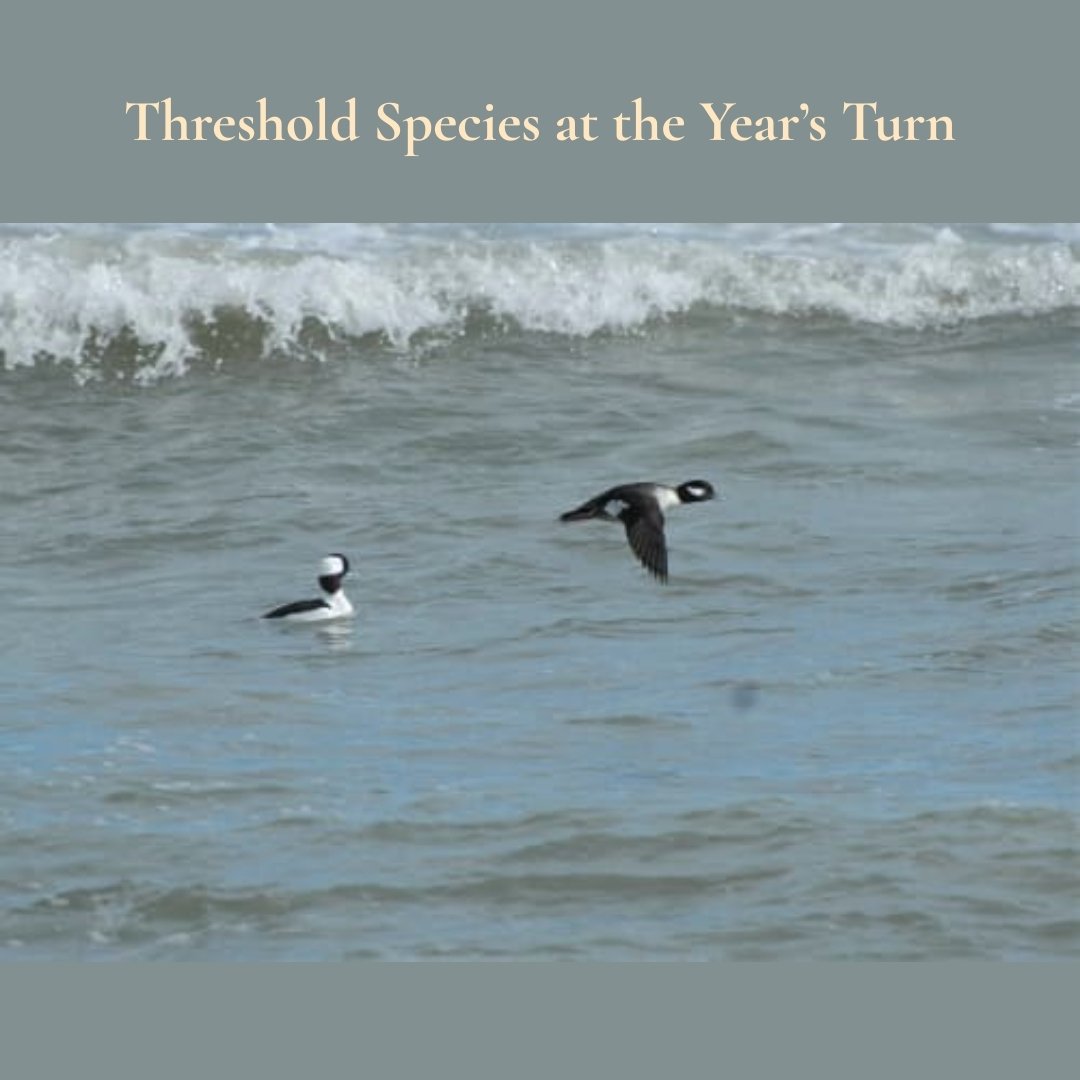
    Male (left) and female (right) Bufflehead ducks enjoying a winter swim | Photo credit: Judy Gallagher, iNaturalist

    By late December, one species begins to appear with quiet regularity across protected sounds and estuaries: the Bufflehead (Bucephala albeola).

    Buffleheads are not early winter arrivals. They do not surge in during the first cold fronts of autumn, nor do they linger indecisively during seasonal transition. Instead, their presence reflects commitment. By the time buffleheads settle into coastal waters, water temperatures have stabilized at winter lows, turbulence has eased in protected areas, and benthic prey communities—particularly small crustaceans and mollusks—have shifted into predictable winter distributions (Eadie et al., 2000; Goudie et al., 1994).

    Ecologically, buffleheads are specialists. They forage by diving, relying on clear water and reliable prey patches. Their winter distribution is shaped not by calendar dates but by energy economics: cold water increases metabolic demands, and winter habitats must reliably repay that cost (Eadie & Kehoe, 2022). Where buffleheads remain, the system has crossed a threshold from fluctuation to stability.

    In this way, they function less as migrants and more as indicators. Their presence signals that the coastal year has finished rearranging itself. Winter has arrived—not dramatically, but decisively.

    Below the Water: When Stillness Makes Life Visible

    Clearnose skate in winter waters | Photo credit: NOAA Fisheries

    Below the surface, the signal is subtler.

    Skates do not arrive in winter with the clarity of birds overhead. Species such as the Clearnose skate (Rostroraja eglanteria) are present along the southeastern U.S. coast throughout much of the year. What changes in late December is not their location, but their visibility.

    As water temperatures drop, skates reduce activity, conserving energy through decreased movement and prolonged periods of resting on the seafloor (Di Santo & Bennett, 2011). This metabolic slowdown coincides with seasonal increases in water clarity driven by reduced biological productivity, lower sediment resuspension, and diminished boat traffic (Cloern et al., 2014). The result is a paradox: winter reveals what summer conceals.

    In these conditions, skates become easier to observe—not because they have increased in number, but because the system itself has slowed enough to make persistence visible. Their flattened bodies blend seamlessly into sandy or muddy substrates, a strategy optimized for ambush predation and energy conservation rather than movement (Carrier et al., 2012).

    If buffleheads announce that winter has settled, skates confirm it. They represent endurance over motion, patience over migration.

    The Ecological Hinge Between Years

    Neither of these species marks a beginning. Neither signals renewal or arrival in the way spring migrants do. Instead, they occupy the hinge between years—the moment when the ecosystem accepts the constraints of winter and reorganizes around them.

    Late December is not biologically empty. It is a period of recalibration. Energy budgets tighten. Movements become deliberate. Survival depends less on abundance than on efficiency.

    Above the water, buffleheads gather where the math works. Below it, skates persist by minimizing expenditure altogether. One is easily seen, the other almost never. Together, they reveal the same truth: the system has crossed a line.

    After the Turn

    January will bring its own changes. Cold will deepen, or ease. Migratory patterns will sharpen. New signals will emerge. But the moment just after the solstice—just after the holidays—is different. It is when the coast pauses, holds, and commits.

    The year does not turn loudly here.
    It settles, and then it holds.

    References

    Carrier, J. C., Musick, J. A., & Heithaus, M. R. (2012). Biology of sharks and their relatives (2nd ed.). CRC Press. https://doi.org/10.1201/b11867 

    Cloern, J. E., Foster, S. Q., & Kleckner, A. E. (2014). Phytoplankton primary production in the world’s estuarine–coastal ecosystems. Biogeosciences, 11(9), 2477–2501. https://doi.org/10.5194/bg-11-2477-2014 

    Di Santo, V., & Bennett, W. A. (2011). Is post-feeding thermotaxis advantageous in elasmobranch fishes? Journal of Fish Biology, 78(7), 1950–1965. https://doi.org/10.1111/j.1095-8649.2011.02976.x 

    Eadie, J. M., & Kehoe, F. P. (2022). Energetics and foraging ecology of diving ducks. In P. G. Rodewald (Ed.), The birds of North America. Cornell Lab of Ornithology.
    https://doi.org/10.2173/bna 

    Eadie, J. M., Savard, J. P. L., & Mallory, M. L. (2000). Barrow’s Goldeneye (Bucephala islandica) and Bufflehead (Bucephala albeola). In A. Poole & F. Gill (Eds.), The birds of North America. Cornell Lab of Ornithology. https://doi.org/10.2173/bna.548 

    Goudie, R. I., Brault, S., Conant, B., Kondratyev, A. V., Petersen, M. R., & Vermeer, K. (1994). The status of sea ducks in the North Pacific Rim: Toward their conservation. Transactions of the North American Wildlife and Natural Resources Conference, 59, 27–49. https://pubs.usgs.gov/publication/70187692
  • The 12 Days of Estuary Christmas | New River Estuary

    The 12 Days of Estuary Christmas | New River Estuary

    In the season of chilly tides and twinkling pier lights, the New River estuary doesn’t quiet down — it parties in its own salty way. So grab your cocoa, bundle up, and join us for a winter countdown of festive fins, feathers, and the ecological magic beneath the misty surface.

    (Sing along if you dare — apologies in advance.)

    Day 12: Twelve Dolphins Dancing

    12 dolphins dancing

    Bottlenose dolphins along the mid-Atlantic coast shift into cooperative foraging teams in the cooler months — synchronized movements that feel almost choreographed (Torres & Read, 2009). Their leaping, circling, and flipper-flicking tactics help herd fish just like dancers driving the story across a winter stage.

    Cue underwater Nutcracker ballet.

    Day 11: Eleven Stripers Schooling

    11 stripers schooling

    Atlantic striped bass move into estuarine channels when the water cools, fueling popular winter fisheries (Boyd, 2011).

    Cold water? Hot bite.

    Day 10: Ten Blue Crabs Burrowing

    Ten Blue Crabs Burrowing

    Blue crabs overwinter right here — burrowed into sediment, metabolism slowed, waiting for spring, or when water temperatures rise above 9℃ (Glandon, Kilborn & Miller, 2019).

    The ultimate cozy blanket fort.

    Day 9: Nine Oysters Filtering

    Nine Oysters Filtering

    Oysters continue filtering water through the winter, though more slowly — still improving water quality and boosting biodiversity (Grabowski & Peterson, 2007).

    Nature’s tiny elves never clock out.

    Day 8: Eight Croakers Drumming

    Eight Croakers Drumming

    Atlantic croaker remain common in NC coastal waters during cooler months, shifting to deeper estuarine areas (Miller et al., 2003).

    Rumble, rumble — underwater holiday percussion.

    Day 7: Seven Specks Still Striking

    Seven Specks Still Striking

    Speckled seatrout stay active in winter, especially in deeper holes and marsh channels where prey concentrates and water temperatures remain above 7℃ (Ellis, Buckle & Hightower, 2017).

    Even cold-blooded fish love a good holiday snack.

    Day 6: Six Sharks Snow-Birding

    Six Sharks Snow-Birding

    Juvenile coastal sharks like sandbars and sharpnose depart estuaries in late fall, migrating offshore and southward (Bangley et al., 2018).

    “See you after the thaw!”

    Day 5: FIVE… OYS-TER REEFS!

    Five oyster reefs

    Oyster reefs provide the essential winter housing market — structured refuge for juvenile fish, crustaceans, and invertebrates (Coen et al., 2007).

    Deck the reefs with beds and breakfasts..

    Day 4: Four Buffleheads Diving

    Four Buffleheads Diving

    These small sea ducks, buffleheads, arrive from the Arctic and forage in our coastal waters all winter long (Gauthier, 2014).

    Feathered travelers escaping the Arctic freeze.

    Day 3: Three Terrapins Burrowed

    Three Terrapins Burrowed

    Diamondback terrapins overwinter in marsh sediments, lowering heart rate and waiting out the cold (Harden, Midway & Willard, 2015).

    A brumation vacation.

    Day 2: Two Menhaden Shoals

    Two Menhaden Shoals

    Atlantic menhaden form huge winter schools offshore and near inlet mouths, fueling predator energy budgets (Orth, 2023).

    The estuary’s holiday punch bowl.

    Day 1: And a Red Drum in the Mar-sh-Tree

    And a Red Drum in the Mar-sh-Tree

    Red drum remain year-round, feeding in creeks and marsh edges even in winter low-temp slow-motion (Bacheler et al., 2009).

    Our coastal Christmas (and state) mascot.

    The Estuary Never Sleeps

    Even as we wrap gifts and check lists twice, life beneath the cold surface hustles on — feeding, moving, filtering, and keeping the New River ecosystem healthy through the darkest season.

    So here’s to the citizens of our winter waters —
    May your tides be merry and bright!

    References

    Bacheler, N., Paramore, L., Buckel, J., & Hightower, J. (2009). Abiotic and biotic factors influence the habitat use of an estuarine fish. Marine Ecology Progress Series, 377, 263-277. https://doi.org/10.3354/meps07805

    Bangley, C. W., Paramore, L., Dedman, S., & Rulifson, R. A. (2018). Delineation and mapping of coastal shark habitat within a shallow lagoonal Estuary. PLOS ONE, 13(4), e0195221. https://doi.org/10.1371/journal.pone.0195221

    Boyd, J. B. (2011). Maturation, fecundity, and spawning frequency of the Albemarle/Roanoke striped bass stock (2011. 1510474) [Doctoral dissertation]. ProQuest Dissertations and Theses Global.

    Coen, L., Brumbaugh, R., Bushek, D., Grizzle, R., Luckenbach, M., Posey, M., Powers, S., & Tolley, S. (2007). Ecosystem services related to oyster restoration. Marine Ecology Progress Series, 341, 303-307. https://doi.org/10.3354/meps341303

    Ellis, T., Buckel, J., & Hightower, J. (2017). Winter severity influences spotted seatrout mortality in a southeast US estuarine system. Marine Ecology Progress Series, 564, 145-161. https://doi.org/10.3354/meps11985

    Gauthier, G. (2014, July 14). Bufflehead – Bucephala albeola. Birds of the World – Cornell Lab of Ornithology. Retrieved November 29, 2025, from https://birdsoftheworld.org/bow/historic/bna/buffle/2.0/introduction

    Glandon, H. L., Kilbourne, K. H., & Miller, T. J. (2019). Winter is (not) coming: Warming temperatures will affect the overwinter behavior and survival of blue crab. PLOS ONE, 14(7), e0219555. https://doi.org/10.1371/journal.pone.0219555

    Grabowski, J. H., & Peterson, C. H. (2007). Restoring oyster reefs to recover ecosystem services. Theoretical Ecology Series, 281-298. https://doi.org/10.1016/s1875-306x(07)80017-7

    Harden, L. A., Midway, S. R., & Williard, A. S. (2015). The blood biochemistry of overwintering diamondback terrapins (Malaclemys terrapin). Journal of Experimental Marine Biology and Ecology, 466, 34-41. https://doi.org/10.1016/j.jembe.2015.01.017

    Mead, J. G., & Potter, C. W. (1995). Recognizing two populations off the bottlenose dolphin (Tursiops Truncatus) of the Atlantic coast of North America-Morphologic and Ecologic Considerations. https://repository.si.edu/server/api/core/bitstreams/9c563919-2b27-4ac4-bba1-92e7d090fd72/content

    Orth, D. J. (2023). Fish, fishing and conservation. Blacksburg: Virginia Tech Department of Fish and Wildlife Conservation.Torres, L. G., & Read, A. J. (2009). Where to catch a fish? The influence of foraging tactics on the ecology of bottlenose dolphins (Tursiops truncatus) in Florida Bay, Florida. Marine Mammal Science, 25(4), 797-815. https://doi.org/10.1111/j.1748-7692.2009.00297.x