Category: Blue crab

  • The Hidden City in the Grass

    The Hidden City in the Grass

    How seagrasses and marsh grasses—and the animals within them—build the marshes of Onslow County

    In Onslow County’s estuarine marshes, the best time to understand how the landscape works is when the water pulls back. As tides drain from creeks and shallow flats, patterns begin to emerge—where water lingers, where it moves easily, and where it hesitates. These patterns are not random. They reflect the combined influence of plants, animals, and sediments continually reshaping the boundary between land and sea.

    Like the microscopic shells of foraminifera preserved in sediment, marsh and seagrass communities record environmental conditions. But unlike the past locked in mud, these systems are alive, constantly negotiated by plants, grazers, predators, and microbes.

    From permanently submerged seagrass beds to the highest marsh edge, each elevation zone in Onslow County is maintained not just by vegetation, but by species that actively regulate growth, chemistry, and water flow.

    Subtidal shallows: seagrass beds maintained by grazers

    In the shallow, light-penetrated waters of the New River Estuary and protected soundside areas, seagrass beds form underwater meadows that stabilize sediments and provide nursery habitat for fish and invertebrates. Species present or expected in Onslow County waters include eelgrass (Zostera marina), shoalgrass (Halodule wrightii), and widgeongrass (Ruppia maritima) (Mallin, 2000; Orth, 1984).

    Seagrass blades rapidly accumulate epiphytic algae and microbial films. Without constant grazing, this layer can block light and suppress photosynthesis. Amphipods, isopods, and small gastropods act as continuous maintenance crews, grazing epiphytes and preventing them from overwhelming the plants themselves (Orth & van Montfrans, 1984; Valentine & Duffy, 2006).

    Experimental studies show that when these grazers are removed, seagrass condition declines even under favorable light conditions, demonstrating that plant survival depends as much on animal activity as on physical environment (Duffy et al., 2015). Beneath the canopy, burrowing worms and bivalves recycle nutrients and oxygenate sediments, preventing organic matter from accumulating around roots (Orth, 1984).

    In this zone, seagrass persists because grazers keep blades clean and sediments breathable—a cooperative system built on constant biological upkeep.

    Gammarus mucronatus, a common amphipod grazer on eelgrass | Photo credit: E. A. Lazo-Wasem, Yale Peabody Museum, 2013
    Gammarus mucronatus, a common amphipod grazer on eelgrass | Photo credit: E. A. Lazo-Wasem, Yale Peabody Museum, 2013.

    The low marsh edge: cordgrass shaped by snails and crabs

    At the daily-flooded edge of the marsh, smooth cordgrass (Spartina alterniflora) dominates. This narrow fringe marks the boundary between open water and marsh interior, where erosion pressure is highest and stability matters most.

    Smooth cordgrass (Spartina alterniflora) line the estuary edge in Surf City, NC. | Photo credit: A. Mitchell, 2022.Salt marsh die-off from grazing stress by marsh periwinkle snails and reduced predation by crabs, such as blue crabs, can create bare mudflats. | Photo credit: By Esuglia at English Wikipedia, CC BY-SA 3.0, https://commons.wikimedia.org/w/index.php?curid=65794096
    Left: Healthy smooth cordgrass (Spartina alterniflora) line the estuary edge in Surf City, NC. | Photo credit: A. Mitchell, 2022. Right: Salt marsh die-off from grazing stress by marsh periwinkle snails and reduced predation by crabs, such as blue crabs, can create bare mudflats. | Photo credit: By Esuglia at English Wikipedia, CC BY-SA 3.0, https://commons.wikimedia.org/w/index.php?curid=65794096

    Cordgrass growth here is tightly regulated by the marsh periwinkle snail (Littoraria irrorata). These snails climb grass stems to avoid inundation and graze directly on living tissue, often intensifying damage by facilitating fungal infection. At high densities, periwinkle grazing can dramatically reduce cordgrass height and biomass, effectively mowing the marsh edge (Silliman & Zieman, 2001).

    Marsh periwinkle snails (Littoraria irrorata) are a common sight on cordgrass (Spartina alterniflora) in North Carolina - part of the Hidden city in the grass | Photo credit: North Carolina Aquarium at Roanoke Island, 2018
    Marsh periwinkle snails (Littoraria irrorata) are a common sight on cordgrass (Spartina alterniflora) in North Carolina | Photo credit: North Carolina Aquarium at Roanoke Island, 2018.

    Unchecked grazing can destabilize the marsh platform—but periwinkles themselves are regulated by crabs, including blue crabs (Callinectes sapidus), fiddler crabs (Genus Uca), purple marsh crabs (Sesarma reticulatum), hermit crabs and other burrowing species. Crabs prey on snails, limiting grazing pressure and indirectly protecting cordgrass (Silliman et al., 2005).

    Crabs also function as ecosystem engineers. Their burrows aerate sediments, relieve sulfide stress around plant roots, and improve tidal water movement through compacted soils (Bertness, 1985; Thomas & Blum, 2010). Where crabs are abundant, cordgrass grows taller and denser; where they are lost, marsh die-off can occur rapidly.

    This zone persists through a trophic cascade: grass builds land, snails limit grass, and crabs keep the system in balance.

    Mid-marsh: mussels and detritus processors reinforce the platform

    Just upslope, where flooding becomes less frequent, plant communities shift toward mixtures that often include saltmeadow cordgrass (Spartina patens). Here, the ribbed mussel (Geukensia demissa) emerges as a key stabilizing force.

    Saltmeadow cordgrass (Spartina patens) is an important marsh stabilizer that has higher productivity when it grows near ribbed mussel aggregations | Photo credit: Kristie Gianopulos
    Saltmeadow cordgrass (Spartina patens) is an important marsh stabilizer that has higher productivity when it grows near ribbed mussel aggregations | Photo credit: Kristie Gianopulos

    Ribbed mussels form dense clusters at the base of marsh vegetation, binding sediments with byssal threads and physically reinforcing marsh soils against erosion (Bertness, 1984). As filter-feeders, they concentrate nutrients by removing organic matter from tidal waters and depositing nitrogen-rich biodeposits directly into marsh sediments (Jordan & Valiela, 1982).

    Ribbed mussels (Geukensia demissa) at the base of marsh vegetation | Photo credit: R. Bachand
    Ribbed mussels (Geukensia demissa) at the base of marsh vegetation | Photo credit: R. Bachand

    Grasses growing near mussel aggregations exhibit higher productivity than those without mussels, demonstrating a strong facilitative relationship between animals and plants (Bertness, 1984). As vegetation senesces, detritivorous worms, insects, and microbial decomposers break down dead plant material, converting standing biomass into detritus that fuels food webs throughout the estuary (Mann, 1988).

    The mid-marsh functions as a processing zone, reinforcing marsh structure while converting plant matter into usable energy.

    High marsh: microbes that manage chemical stress

    In the high marsh, dominated by black needlerush (Juncus roemerianus) and saltmeadow cordgrass (Spartina patens), flooding is limited to spring tides and storms. Prolonged exposure to air creates harsh soil conditions, including elevated salinity and sulfide accumulation.

    Black needlerush grass (Juncus roemerianus) dominates the high marsh | Photo credit: ©Andy Newman
    Black needlerush grass (Juncus roemerianus) dominates the high marsh | Photo credit: ©Andy Newman

    Here, microbial communities play a central role. Sulfate-reducing and sulfur-oxidizing bacteria regulate sulfide concentrations that would otherwise become toxic to plant roots, while microbial decomposition controls nutrient availability under fluctuating oxygen conditions (Howarth & Giblin, 1983).

    Beneath the marsh surface, soil microbes regulate decomposition, carbon exchange, and chemical stress. Changes in salinity and flooding reshape microbial communities, influencing how marsh soils process organic matter and support vegetation across tidal elevations. | Image credit: Zhang et al., 2023
    Beneath the marsh surface, soil microbes regulate decomposition, carbon exchange, and chemical stress. Changes in salinity and flooding reshape microbial communities, influencing how marsh soils process organic matter and support vegetation across tidal elevations. | Image credit: Zhang et al., 2023.

    Small soil invertebrates maintain pore spaces that allow brief pulses of oxygenated water to penetrate during flooding. Unlike the visibly engineered low marsh, the high marsh is stabilized largely through biogeochemical regulation rather than grazing or predation.

    This zone endures because microbes quietly buffer plants against chemical extremes.

    From microbes in the soil to grasses at the surface, biological interactions drive marsh formation. Microbial processes govern decomposition and organic matter buildup, helping determine whether marsh platforms gain elevation, remain stable, or collapse | Image credit: Abbot, Quirk & Fultz, 2022.
    From microbes in the soil to grasses at the surface, biological interactions drive marsh formation. Microbial processes govern decomposition and organic matter buildup, helping determine whether marsh platforms gain elevation, remain stable, or collapse | Image credit: Abbot, Quirk & Fultz, 2022.

    The marsh–upland transition: keeping the boundary intact

    At the uppermost margin of the marsh, tidal influence becomes intermittent and environmental stress shifts from salinity to erosion and freshwater input. Burrowing invertebrates increase soil permeability, allowing stormwater and tidal surges to infiltrate rather than scour the surface (Thomas & Blum, 2010).

    A profile illustration . depicting the recommended transition of plant types from the edge of the salt marsh to the upland buffer. | Image credit: Massachusetts Office of Coastal Zone Management
    A profile illustration . depicting the recommended transition of plant types from the edge of the salt marsh to the upland buffer. | Image credit: Massachusetts Office of Coastal Zone Management

    Vegetation root networks stabilize soils exposed to drying and wave action, while animal burrows act as pressure-release pathways during extreme events. When these biological processes are disrupted—by shoreline hardening or vegetation removal—the marsh edge often collapses abruptly rather than adjusting gradually.

    This boundary holds only as long as water can move through it.

    Black, organic-rich peat exposed after storms marks the remains of an ancient salt marsh once buried beneath barrier sands. Its reappearance along North Topsail Beach records long-term shoreline change and marsh migration. Photo credit: Bill Tresnan, 2024
    Black, organic-rich peat exposed after storms marks the remains of an ancient salt marsh once buried beneath barrier sands. Its reappearance along North Topsail Beach records long-term shoreline change and marsh migration. Photo credit: Bill Tresnan, 2024.

    A marsh built by interactions

    Across all elevations in Onslow County marshes, the pattern is consistent:

    Plants define the zones—but animals and microbes determine whether those zones endure.

    Conceptual diagram of revised juvenile blue crab ontogenetic habitat shifts. Arrows depict transitions between habitats with increases in size. Arrow widths denote abundance contributions of individuals between habitats. | Image credit: Hyman et al., 2023

    From grazers that keep seagrass blades clean, to crabs that hold the marsh edge together, to microbes that manage invisible chemical stress, the marsh is sustained by small organisms with outsized influence. Together, these interactions determine not just what lives in the marsh, but whether the marsh itself endures.

    Purple marsh crabs (Sesarma reticulatum) moving together along the marsh edge on South Topsail Island, North Carolina. Their collective movement and feeding activity illustrate how small organisms play outsized roles in maintaining marsh structure. Photo credit: A. Mitchell, 2025.
    Purple marsh crabs (Sesarma reticulatum) moving together along the marsh edge on South Topsail Island, North Carolina. Their collective movement and feeding activity illustrate how small organisms play outsized roles in maintaining marsh structure. Photo credit: A. Mitchell, 2025.

    References

    Abbott, K. M., Quirk, T., & Fultz, L. M. (2022). Soil microbial community development across a 32-year coastal wetland restoration time series and the relative importance of environmental factors. Science of The Total Environment, 821, 153359. https://doi.org/10.1016/j.scitotenv.2022.153359

    Bertness, M. D. (1984). Ribbed mussels and Spartina Alterniflora production in a New England salt marsh. Ecology, 65(6), 1794-1807. https://doi.org/10.2307/1937776

    Bertness, M. D. (1985). Fiddler crab regulation of Spartina alterniflora production on a New England salt marsh. Ecology, 66(3), 1042-1055. https://doi.org/10.2307/1940564

    Duffy, J. E., Reynolds, P. L., Boström, C., Coyer, J. A., Cusson, M., Donadi, S., Douglass, J. G., Eklöf, J. S., Engelen, A. H., Eriksson, B. K., Fredriksen, S., Gamfeldt, L., Gustafsson, C., Hoarau, G., Hori, M., Hovel, K., Iken, K., Lefcheck, J. S., Moksnes, P., … Stachowicz, J. J. (2015). Biodiversity mediates top–down control in eelgrass ecosystems: A global comparative‐experimental approach. Ecology Letters, 18(7), 696-705. https://doi.org/10.1111/ele.12448

    Howarth, R. W., & Giblin, A. (1983). Sulfate reduction in the salt marshes at Sapelo island, Georgia. Limnology and Oceanography, 28(1), 70-82. https://doi.org/10.4319/lo.1983.28.1.0070

    Hyman, A. C., Chiu, G. S., Seebo, M. S., Smith, A., Saluta, G. G., Knick, K. E., & Lipcius, R. N. (2023). Model-based evaluation of critical nursery habitats for juvenile blue crabs through ontogeny: Abundance and survival in seagrass, salt marsh, and unstructured bottom. https://doi.org/10.1101/2023.07.20.549877

    Jordan, T. E., & Valiela, I. (1982). A nitrogen budget of the ribbed mussel, Geukensia demissa, and its significance in nitrogen flow in a New England salt marsh. Limnology and Oceanography, 27(1), 75-90. https://doi.org/10.4319/lo.1982.27.1.0075

    Mallin, M. A., Burkholder, J. M., Cahoon, L. B., & Posey, M. H. (2000). North and South Carolina coasts. Marine Pollution Bulletin, 41(1-6), 56-75. https://doi.org/10.1016/s0025-326x(00)00102-8

    Mann, K. H. (1988). Production and use of detritus in various freshwater, estuarine, and coastal marine ecosystems. Limnology and Oceanography, 33(4part2), 910-930. https://doi.org/10.4319/lo.1988.33.4part2.0910

    Orth, R. J., Heck, K. L., & Van Montfrans, J. (1984). Faunal communities in seagrass beds: A review of the influence of plant structure and prey characteristics on predator: Prey relationships. Estuaries, 7(4), 339. https://doi.org/10.2307/1351618

    Orth, R. J., & Van Montfrans, J. (1984). Epiphyte-seagrass relationships with an emphasis on the role of micrograzing: A review. Aquatic Botany, 18(1-2), 43-69. https://doi.org/10.1016/0304-3770(84)90080-9

    Silliman, B. R., Van de Koppel, J., Bertness, M. D., Stanton, L. E., & Mendelssohn, I. A. (2005). Drought, snails, and large-scale die-off of southern U.S. salt marshes. Science, 310(5755), 1803-1806. https://doi.org/10.1126/science.1118229

    Silliman, B. R., & Zieman, J. C. (2001). Top-down control of Spartina alterniflora production by periwinkle grazing in a Virginia salt marsh. Ecology, 82(10), 2830. https://doi.org/10.2307/2679964

    Thomas, C., & Blum, L. (2010). Importance of the fiddler crab Uca pugnax to salt marsh soil organic matter accumulation. Marine Ecology Progress Series, 414, 167-177. https://doi.org/10.3354/meps08708

    Valentine, J. F., & Duffy, J. E. (n.d.). The central role of grazing in seagrass ecology. Seagrasses: Biology, Ecology and Conservation, 463-501. https://doi.org/10.1007/1-4020-2983-7_20

    Zhang, G., Bai, J., Jia, J., Wang, W., Wang, D., Zhao, Q., Wang, C., & Chen, G. (2023). Soil microbial communities regulate the threshold effect of salinity stress on SOM decomposition in coastal salt marshes. Fundamental Research, 3(6), 868-879. https://doi.org/10.1016/j.fmre.2023.02.024
  • The 12 Days of Estuary Christmas | New River Estuary

    The 12 Days of Estuary Christmas | New River Estuary

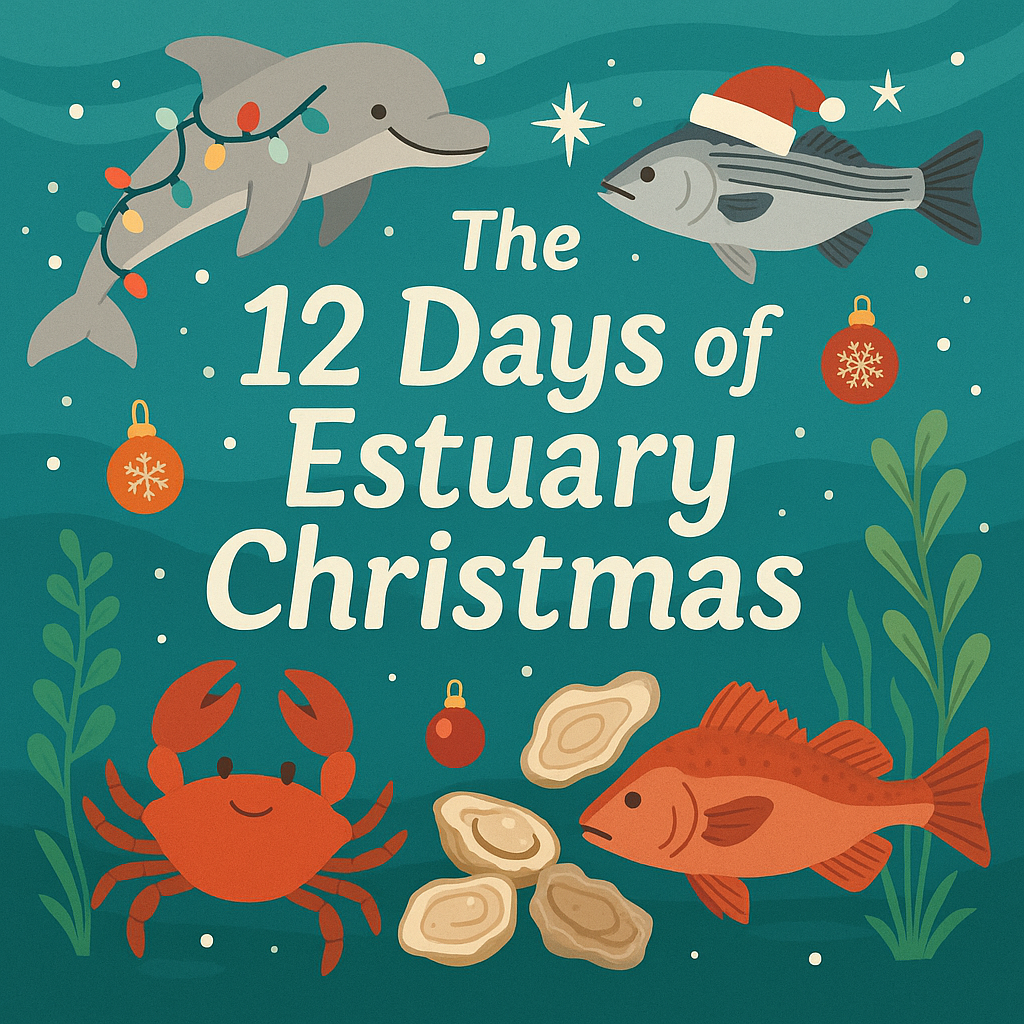
    In the season of chilly tides and twinkling pier lights, the New River estuary doesn’t quiet down — it parties in its own salty way. So grab your cocoa, bundle up, and join us for a winter countdown of festive fins, feathers, and the ecological magic beneath the misty surface.

    (Sing along if you dare — apologies in advance.)

    Day 12: Twelve Dolphins Dancing

    12 dolphins dancing

    Bottlenose dolphins along the mid-Atlantic coast shift into cooperative foraging teams in the cooler months — synchronized movements that feel almost choreographed (Torres & Read, 2009). Their leaping, circling, and flipper-flicking tactics help herd fish just like dancers driving the story across a winter stage.

    Cue underwater Nutcracker ballet.

    Day 11: Eleven Stripers Schooling

    11 stripers schooling

    Atlantic striped bass move into estuarine channels when the water cools, fueling popular winter fisheries (Boyd, 2011).

    Cold water? Hot bite.

    Day 10: Ten Blue Crabs Burrowing

    Ten Blue Crabs Burrowing

    Blue crabs overwinter right here — burrowed into sediment, metabolism slowed, waiting for spring, or when water temperatures rise above 9℃ (Glandon, Kilborn & Miller, 2019).

    The ultimate cozy blanket fort.

    Day 9: Nine Oysters Filtering

    Nine Oysters Filtering

    Oysters continue filtering water through the winter, though more slowly — still improving water quality and boosting biodiversity (Grabowski & Peterson, 2007).

    Nature’s tiny elves never clock out.

    Day 8: Eight Croakers Drumming

    Eight Croakers Drumming

    Atlantic croaker remain common in NC coastal waters during cooler months, shifting to deeper estuarine areas (Miller et al., 2003).

    Rumble, rumble — underwater holiday percussion.

    Day 7: Seven Specks Still Striking

    Seven Specks Still Striking

    Speckled seatrout stay active in winter, especially in deeper holes and marsh channels where prey concentrates and water temperatures remain above 7℃ (Ellis, Buckle & Hightower, 2017).

    Even cold-blooded fish love a good holiday snack.

    Day 6: Six Sharks Snow-Birding

    Six Sharks Snow-Birding

    Juvenile coastal sharks like sandbars and sharpnose depart estuaries in late fall, migrating offshore and southward (Bangley et al., 2018).

    “See you after the thaw!”

    Day 5: FIVE… OYS-TER REEFS!

    Five oyster reefs

    Oyster reefs provide the essential winter housing market — structured refuge for juvenile fish, crustaceans, and invertebrates (Coen et al., 2007).

    Deck the reefs with beds and breakfasts..

    Day 4: Four Buffleheads Diving

    Four Buffleheads Diving

    These small sea ducks, buffleheads, arrive from the Arctic and forage in our coastal waters all winter long (Gauthier, 2014).

    Feathered travelers escaping the Arctic freeze.

    Day 3: Three Terrapins Burrowed

    Three Terrapins Burrowed

    Diamondback terrapins overwinter in marsh sediments, lowering heart rate and waiting out the cold (Harden, Midway & Willard, 2015).

    A brumation vacation.

    Day 2: Two Menhaden Shoals

    Two Menhaden Shoals

    Atlantic menhaden form huge winter schools offshore and near inlet mouths, fueling predator energy budgets (Orth, 2023).

    The estuary’s holiday punch bowl.

    Day 1: And a Red Drum in the Mar-sh-Tree

    And a Red Drum in the Mar-sh-Tree

    Red drum remain year-round, feeding in creeks and marsh edges even in winter low-temp slow-motion (Bacheler et al., 2009).

    Our coastal Christmas (and state) mascot.

    The Estuary Never Sleeps

    Even as we wrap gifts and check lists twice, life beneath the cold surface hustles on — feeding, moving, filtering, and keeping the New River ecosystem healthy through the darkest season.

    So here’s to the citizens of our winter waters —
    May your tides be merry and bright!

    References

    Bacheler, N., Paramore, L., Buckel, J., & Hightower, J. (2009). Abiotic and biotic factors influence the habitat use of an estuarine fish. Marine Ecology Progress Series, 377, 263-277. https://doi.org/10.3354/meps07805

    Bangley, C. W., Paramore, L., Dedman, S., & Rulifson, R. A. (2018). Delineation and mapping of coastal shark habitat within a shallow lagoonal Estuary. PLOS ONE, 13(4), e0195221. https://doi.org/10.1371/journal.pone.0195221

    Boyd, J. B. (2011). Maturation, fecundity, and spawning frequency of the Albemarle/Roanoke striped bass stock (2011. 1510474) [Doctoral dissertation]. ProQuest Dissertations and Theses Global.

    Coen, L., Brumbaugh, R., Bushek, D., Grizzle, R., Luckenbach, M., Posey, M., Powers, S., & Tolley, S. (2007). Ecosystem services related to oyster restoration. Marine Ecology Progress Series, 341, 303-307. https://doi.org/10.3354/meps341303

    Ellis, T., Buckel, J., & Hightower, J. (2017). Winter severity influences spotted seatrout mortality in a southeast US estuarine system. Marine Ecology Progress Series, 564, 145-161. https://doi.org/10.3354/meps11985

    Gauthier, G. (2014, July 14). Bufflehead – Bucephala albeola. Birds of the World – Cornell Lab of Ornithology. Retrieved November 29, 2025, from https://birdsoftheworld.org/bow/historic/bna/buffle/2.0/introduction

    Glandon, H. L., Kilbourne, K. H., & Miller, T. J. (2019). Winter is (not) coming: Warming temperatures will affect the overwinter behavior and survival of blue crab. PLOS ONE, 14(7), e0219555. https://doi.org/10.1371/journal.pone.0219555

    Grabowski, J. H., & Peterson, C. H. (2007). Restoring oyster reefs to recover ecosystem services. Theoretical Ecology Series, 281-298. https://doi.org/10.1016/s1875-306x(07)80017-7

    Harden, L. A., Midway, S. R., & Williard, A. S. (2015). The blood biochemistry of overwintering diamondback terrapins (Malaclemys terrapin). Journal of Experimental Marine Biology and Ecology, 466, 34-41. https://doi.org/10.1016/j.jembe.2015.01.017

    Mead, J. G., & Potter, C. W. (1995). Recognizing two populations off the bottlenose dolphin (Tursiops Truncatus) of the Atlantic coast of North America-Morphologic and Ecologic Considerations. https://repository.si.edu/server/api/core/bitstreams/9c563919-2b27-4ac4-bba1-92e7d090fd72/content

    Orth, D. J. (2023). Fish, fishing and conservation. Blacksburg: Virginia Tech Department of Fish and Wildlife Conservation.Torres, L. G., & Read, A. J. (2009). Where to catch a fish? The influence of foraging tactics on the ecology of bottlenose dolphins (Tursiops truncatus) in Florida Bay, Florida. Marine Mammal Science, 25(4), 797-815. https://doi.org/10.1111/j.1748-7692.2009.00297.x

  • The Leftovers: What Happens to Summer’s Prey When the Big Fish Leave?

    The Leftovers: What Happens to Summer’s Prey When the Big Fish Leave?

    The Quiet Season Begins

    When the red drum, flounder, and summer sharks follow the cooling tides offshore, Onslow County’s estuaries fall quiet. The flashy chases fade, and the splashes that once rippled through the creeks give way to stillness. But the story doesn’t end. Beneath November’s calm water, the estuary begins to rewrite itself.

    The absence of its top hunters leaves behind both energy and opportunity — a banquet for the small and the overlooked. The currents no longer echo with the heavy pulse of pursuit. Instead, what remains is a more deliberate rhythm — a slow exchange between detritus, crabs, and the smaller fish that endure the cold months ahead.

    Winter in the New River Estuary: The Vacancy in the Food Web

    Every migration leaves an ecological vacancy. When red drum and southern flounder depart, they take with them both predatory pressure and nutrient export. The estuary briefly relaxes its guard. Prey fish, shrimp, and crabs experience a momentary release from predation from top predator populations that cause a cascade that momentarily alters predation pressure on lower-level prey (Clark et al., 2003).

    In this lull, energy that once fueled apex biomass lingers in the system, stored in crustaceans and schooling fish that escaped the hunt (Baird et al., 1998). The estuary, ever adaptive, redistributes that energy downward. Blue crabs (Callinectes sapidus) and juvenile spot (Leiostomus xanthurus) surge in number, exploiting the leftovers of summer’s feast (Allen et al., 2024). The marsh becomes a recycling ground — energy looping through smaller players instead of flowing outward to the sea.

    Late-Fall Estuarine Food Web
    Late-fall estuarine food web diagram showing energy flow from detritus to shrimp, fish, and mesopredators.

    The Winter Guardians

    But not all predators have gone. When the warm-water hunters leave, colder visitors arrive. Along the inlets and nearshore waters of Onslow Bay, Atlantic spiny dogfish (Squalus acanthias) drift in with the falling temperatures. They are the quiet inheritors of the season — small sharks with silver eyes and slate-gray backs, moving in disciplined schools just offshore.

    Atlantic spiny dogfish school by Andy Murch
    Atlantic spiny dogfish (Squalus acanthius) — the “winter guardians” — patrol coastal waters when larger predators have departed, sustaining the rhythm of predation. | Photo credit: Andy Murch

    Where the big sharks of summer — sandbars, blacktips, and bulls — have vanished southward or deeper, the dogfish remain. Their bodies are built for cold water, thriving where others slow (Carlson et al., 2014). And while their size may not inspire awe, their purpose is no less vital: they fill the empty seats at the top of the table.

    Dogfish are mesopredators, but in winter they act as temporary apex hunters, patrolling the inlet and inner shelf where menhaden, herring, and squid still linger (Carlson et al., 2014). Their presence keeps the ecosystem in motion. They thin out the schools that might otherwise explode in number, preventing imbalance and decay. Like patient custodians, they maintain the continuity of predation, ensuring that energy continues to flow up and down the food web even in the cold months (Prugh et al., 2009).

    In their absence, the estuary might collapse inward — prey would overgraze, detritus would pile, and oxygen would vanish from the mud. But the dogfish, efficient and tireless, keep the waters breathing.

    Crabs and Killifish Take the Stage

    Blue crab foraging in estuary
    Blue crabs roam the winter marsh, feeding on detritus and benthic invertebrates. Their slow foraging helps recycle nutrients and sustain the estuary’s energy balance through the cold season.

    Within the estuary itself, the smaller actors continue their work. By December, the New River’s mudflats and marsh creeks host a quieter cast — mummichogs (Fundulus heteroclitus), sheepshead minnows (Cyprinodon variegatus), and grass shrimp (Palaemonetes pugio). These resident species, often unnoticed, now carry the estuary’s metabolism on their backs.

    They thrive on detritus and microbial mats, converting decay into new life (Kneib, 2015). Blue crabs roam like slow-moving janitors, shifting through sediment to feed on worms and organic matter (Kennedy & Cronin, 2007). Each movement releases trapped nutrients, fueling microbial blooms that will later nourish the first plankton of spring.

    While the spiny dogfish patrol the edges of the continental shelf, these smaller species sustain the inner heart of the estuary. Their labor keeps the water alive long after the glamour of migration fades.

    Nutrient Loops and Winter Stability

    Without large predators, the estuary depends on microbial and detrital loops to keep its energy cycling. Up to 70% of carbon transfer between November and February occurs through benthic detritivory and microbial remineralization rather than direct predation (Friedrichs & Perry, 2001).

    This invisible economy sustains the overwintering fish and crustaceans — the leftovers that, in time, will become the first meal of spring’s returning predators. It’s the estuary’s savings account: energy stored as biomass and sediment, ready to be withdrawn when the tides warm again.

    Graphical abstract of dentrification in a coastal lagoon from https://doi.org/10.1016/j.scitotenv.2020.140169
    When winter quiets the hunt, the estuary turns inward. Instead of predators driving the cycle, nutrients move through the mud itself — microbes and detritivores recycling what’s left behind. This unseen flow keeps the New River alive until spring’s return (adapted from Erler et al., 2020).

    A Resilient Feast

    By January, the estuary seems dormant to the casual eye, but beneath its glassy surface, life reorganizes with quiet precision. Crabs clean the table. Dogfish patrol the edge. Minnows and shrimp sift through the silt for remnants of summer.

    The New River continues to breathe — slower, deeper, deliberate.
    When the big fish return with the first warm tides, the table is set once more, and the energy once left behind has been transformed — recycled through countless small mouths and patient currents into the promise of another season’s chase.

    References

    Allen, D. M., Govoni, J. J., Able, K. W., Buckel, J. A., Hale, E. A., Hilton, E. J., Kellison, G. T., Targett, T. E., Taylor, J. C., & Walsh, H. J. (2024). Long-term dynamics of larval and early juvenile spot (Leiostomus xanthurus) off the U.S. East Coast: Relating ocean origins, estuarine Ingress, and changing environmental conditions. Fishery Bulletin, 122(4), 162-185. https://doi.org/10.7755/fb.122.4.3  

    Baird, D., Luczkovich, J., & Christian, R. (1998). Assessment of spatial and temporal variability in ecosystem attributes of the St marks national wildlife refuge, Apalachee Bay, Florida. Estuarine, Coastal and Shelf Science, 47(3), 329-349. https://doi.org/10.1006/ecss.1998.0360

    Carlson, A. E., Hoffmayer, E. R., Tribuzio, C. A., & Sulikowski, J. A. (2014). The use of satellite tags to redefine movement patterns of spiny dogfish (Squalus acanthias) along the U.S. East Coast: Implications for fisheries management. PLoS ONE, 9(7), e103384. https://doi.org/10.1371/journal.pone.0103384

    Clark, K. L., Ruiz, G. M., & Hines, A. H. (2003). Diel variation in predator abundance, predation risk and prey distribution in shallow-water estuarine habitats. Journal of Experimental Marine Biology and Ecology, 287(1), 37-55. https://doi.org/10.1016/s0022-0981(02)00439-2

    Foster, S. Q., & Fulweiler, R. W. (2014). Spatial and historic variability of benthic nitrogen cycling in an anthropogenically impacted Estuary. Frontiers in Marine Science, 1. https://doi.org/10.3389/fmars.2014.00056

    Friedrichs, C. T., & Perry, J. E. (2001). Tidal Salt Marsh Morphodynamics: A Synthesis. Journal of Coastal Research, (27), 7-37. https://www.jstor.org/stable/25736162

    Kennedy, V. S., & Cronin, L. E. (2007). The blue crab: Callinectes Sapidus. Maryland Sea Grant College University of Maryland.

    Kneib, R. T. (1986). The role of Fundulus heteroclitus in salt marsh trophic dynamics. American Zoologist, 26(1), 259-269. https://doi.org/10.1093/icb/26.1.259

    Prugh, L. R., Stoner, C. J., Epps, C. W., Bean, W. T., Ripple, W. J., Laliberte, A. S., & Brashares, J. S. (2009). The rise of the Mesopredator. BioScience, 59(9), 779-791. https://doi.org/10.1525/bio.2009.59.9.9