Category: Menhaden

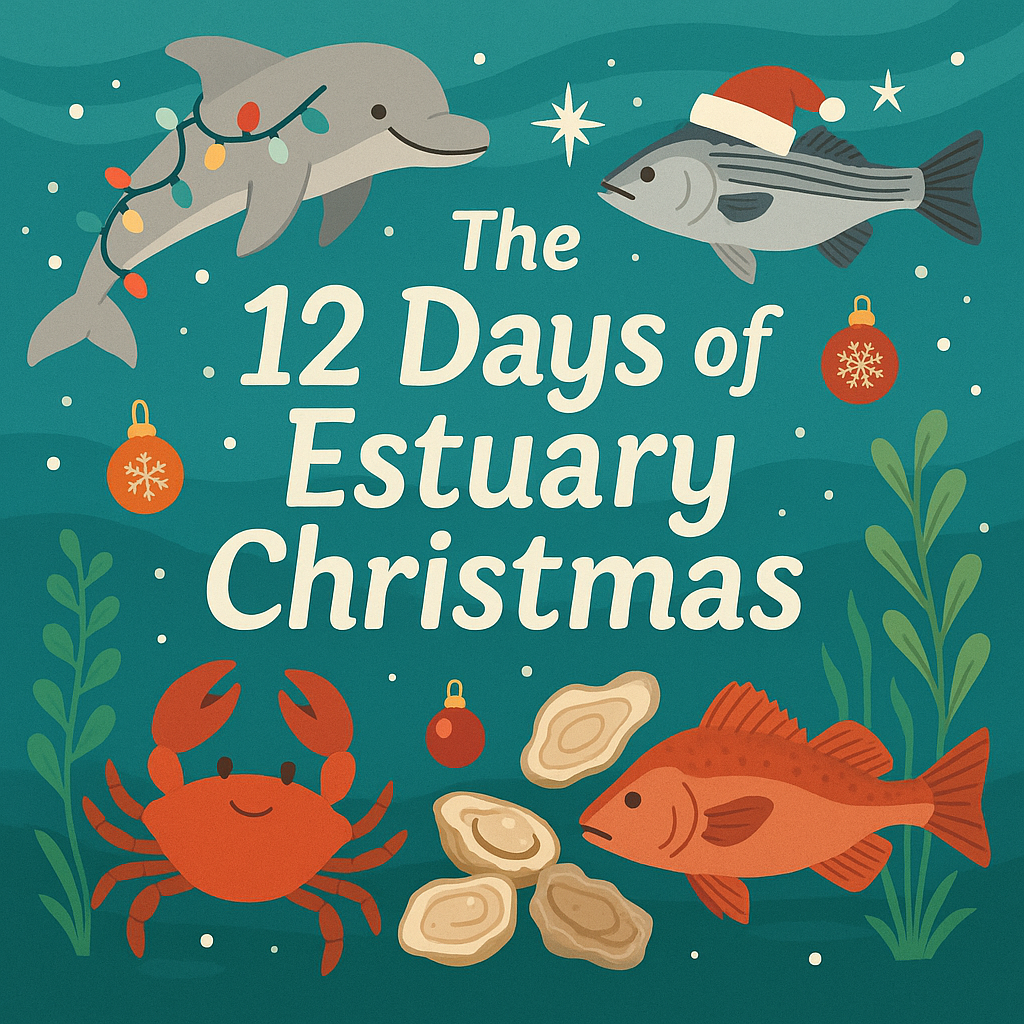
  • The 12 Days of Estuary Christmas | New River Estuary

    The 12 Days of Estuary Christmas | New River Estuary

    In the season of chilly tides and twinkling pier lights, the New River estuary doesn’t quiet down — it parties in its own salty way. So grab your cocoa, bundle up, and join us for a winter countdown of festive fins, feathers, and the ecological magic beneath the misty surface.

    (Sing along if you dare — apologies in advance.)

    Day 12: Twelve Dolphins Dancing

    12 dolphins dancing

    Bottlenose dolphins along the mid-Atlantic coast shift into cooperative foraging teams in the cooler months — synchronized movements that feel almost choreographed (Torres & Read, 2009). Their leaping, circling, and flipper-flicking tactics help herd fish just like dancers driving the story across a winter stage.

    Cue underwater Nutcracker ballet.

    Day 11: Eleven Stripers Schooling

    11 stripers schooling

    Atlantic striped bass move into estuarine channels when the water cools, fueling popular winter fisheries (Boyd, 2011).

    Cold water? Hot bite.

    Day 10: Ten Blue Crabs Burrowing

    Ten Blue Crabs Burrowing

    Blue crabs overwinter right here — burrowed into sediment, metabolism slowed, waiting for spring, or when water temperatures rise above 9℃ (Glandon, Kilborn & Miller, 2019).

    The ultimate cozy blanket fort.

    Day 9: Nine Oysters Filtering

    Nine Oysters Filtering

    Oysters continue filtering water through the winter, though more slowly — still improving water quality and boosting biodiversity (Grabowski & Peterson, 2007).

    Nature’s tiny elves never clock out.

    Day 8: Eight Croakers Drumming

    Eight Croakers Drumming

    Atlantic croaker remain common in NC coastal waters during cooler months, shifting to deeper estuarine areas (Miller et al., 2003).

    Rumble, rumble — underwater holiday percussion.

    Day 7: Seven Specks Still Striking

    Seven Specks Still Striking

    Speckled seatrout stay active in winter, especially in deeper holes and marsh channels where prey concentrates and water temperatures remain above 7℃ (Ellis, Buckle & Hightower, 2017).

    Even cold-blooded fish love a good holiday snack.

    Day 6: Six Sharks Snow-Birding

    Six Sharks Snow-Birding

    Juvenile coastal sharks like sandbars and sharpnose depart estuaries in late fall, migrating offshore and southward (Bangley et al., 2018).

    “See you after the thaw!”

    Day 5: FIVE… OYS-TER REEFS!

    Five oyster reefs

    Oyster reefs provide the essential winter housing market — structured refuge for juvenile fish, crustaceans, and invertebrates (Coen et al., 2007).

    Deck the reefs with beds and breakfasts..

    Day 4: Four Buffleheads Diving

    Four Buffleheads Diving

    These small sea ducks, buffleheads, arrive from the Arctic and forage in our coastal waters all winter long (Gauthier, 2014).

    Feathered travelers escaping the Arctic freeze.

    Day 3: Three Terrapins Burrowed

    Three Terrapins Burrowed

    Diamondback terrapins overwinter in marsh sediments, lowering heart rate and waiting out the cold (Harden, Midway & Willard, 2015).

    A brumation vacation.

    Day 2: Two Menhaden Shoals

    Two Menhaden Shoals

    Atlantic menhaden form huge winter schools offshore and near inlet mouths, fueling predator energy budgets (Orth, 2023).

    The estuary’s holiday punch bowl.

    Day 1: And a Red Drum in the Mar-sh-Tree

    And a Red Drum in the Mar-sh-Tree

    Red drum remain year-round, feeding in creeks and marsh edges even in winter low-temp slow-motion (Bacheler et al., 2009).

    Our coastal Christmas (and state) mascot.

    The Estuary Never Sleeps

    Even as we wrap gifts and check lists twice, life beneath the cold surface hustles on — feeding, moving, filtering, and keeping the New River ecosystem healthy through the darkest season.

    So here’s to the citizens of our winter waters —
    May your tides be merry and bright!

    References

    Bacheler, N., Paramore, L., Buckel, J., & Hightower, J. (2009). Abiotic and biotic factors influence the habitat use of an estuarine fish. Marine Ecology Progress Series, 377, 263-277. https://doi.org/10.3354/meps07805

    Bangley, C. W., Paramore, L., Dedman, S., & Rulifson, R. A. (2018). Delineation and mapping of coastal shark habitat within a shallow lagoonal Estuary. PLOS ONE, 13(4), e0195221. https://doi.org/10.1371/journal.pone.0195221

    Boyd, J. B. (2011). Maturation, fecundity, and spawning frequency of the Albemarle/Roanoke striped bass stock (2011. 1510474) [Doctoral dissertation]. ProQuest Dissertations and Theses Global.

    Coen, L., Brumbaugh, R., Bushek, D., Grizzle, R., Luckenbach, M., Posey, M., Powers, S., & Tolley, S. (2007). Ecosystem services related to oyster restoration. Marine Ecology Progress Series, 341, 303-307. https://doi.org/10.3354/meps341303

    Ellis, T., Buckel, J., & Hightower, J. (2017). Winter severity influences spotted seatrout mortality in a southeast US estuarine system. Marine Ecology Progress Series, 564, 145-161. https://doi.org/10.3354/meps11985

    Gauthier, G. (2014, July 14). Bufflehead – Bucephala albeola. Birds of the World – Cornell Lab of Ornithology. Retrieved November 29, 2025, from https://birdsoftheworld.org/bow/historic/bna/buffle/2.0/introduction

    Glandon, H. L., Kilbourne, K. H., & Miller, T. J. (2019). Winter is (not) coming: Warming temperatures will affect the overwinter behavior and survival of blue crab. PLOS ONE, 14(7), e0219555. https://doi.org/10.1371/journal.pone.0219555

    Grabowski, J. H., & Peterson, C. H. (2007). Restoring oyster reefs to recover ecosystem services. Theoretical Ecology Series, 281-298. https://doi.org/10.1016/s1875-306x(07)80017-7

    Harden, L. A., Midway, S. R., & Williard, A. S. (2015). The blood biochemistry of overwintering diamondback terrapins (Malaclemys terrapin). Journal of Experimental Marine Biology and Ecology, 466, 34-41. https://doi.org/10.1016/j.jembe.2015.01.017

    Mead, J. G., & Potter, C. W. (1995). Recognizing two populations off the bottlenose dolphin (Tursiops Truncatus) of the Atlantic coast of North America-Morphologic and Ecologic Considerations. https://repository.si.edu/server/api/core/bitstreams/9c563919-2b27-4ac4-bba1-92e7d090fd72/content

    Orth, D. J. (2023). Fish, fishing and conservation. Blacksburg: Virginia Tech Department of Fish and Wildlife Conservation.Torres, L. G., & Read, A. J. (2009). Where to catch a fish? The influence of foraging tactics on the ecology of bottlenose dolphins (Tursiops truncatus) in Florida Bay, Florida. Marine Mammal Science, 25(4), 797-815. https://doi.org/10.1111/j.1748-7692.2009.00297.x
  • Thanksgiving Tides: New River Inlet Fish Migration in Fall

    Thanksgiving Tides: New River Inlet Fish Migration in Fall

    A Different Kind of Thanksgiving Journey

    Each November, when highways fill with travelers heading home for Thanksgiving, the waters of Onslow County’s New River Estuary host a quieter kind of migration. Beneath the surface, schools of silvery menhaden, golden spot, croaker, and even small sharks begin the New River Inlet fish migration, drawn by instincts older than any holiday tradition. The tides quicken. Water cools. Marsh grasses brown and whisper in the wind. And with every falling tide, the river seems to breathe outward, carrying its pilgrims toward the sea.

    The Gate Between River and Sea

    New River Inlet is not simply a passage between Sneads Ferry and North Topsail Beach—it is a living threshold.

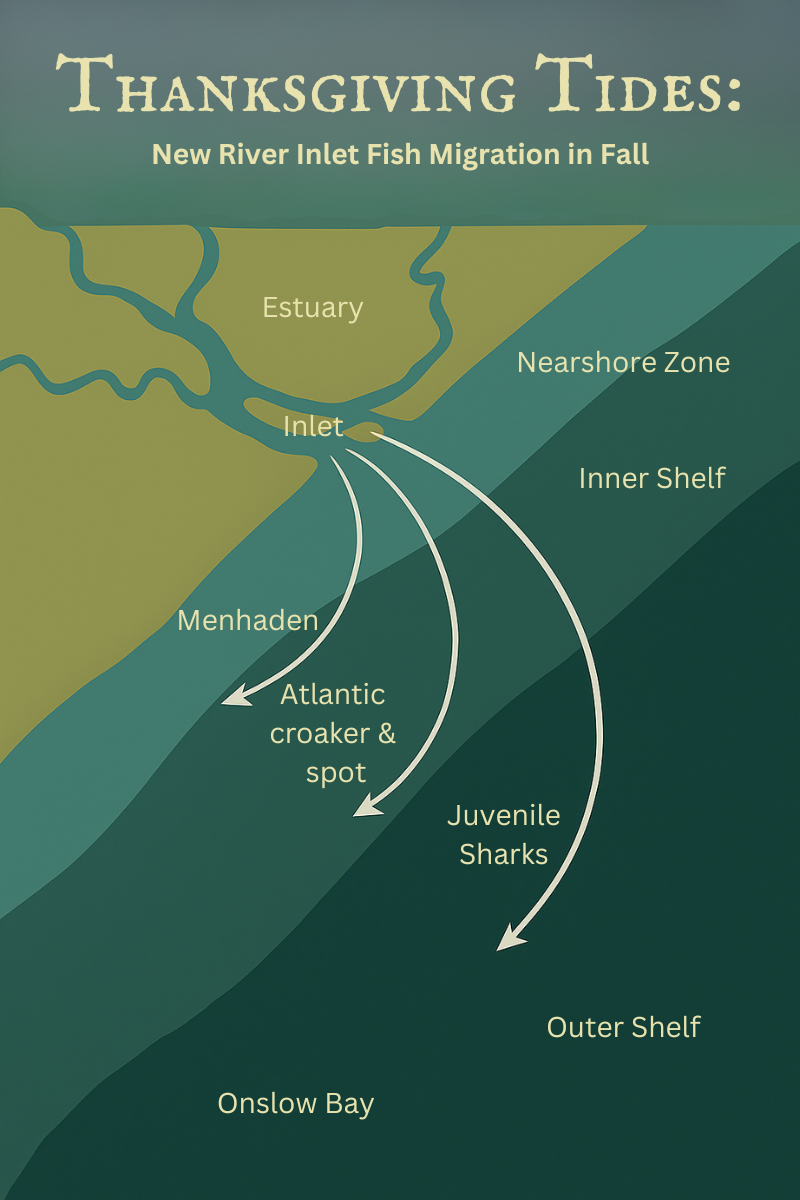
    Winter migration path new river inlet to ocean
    The New River winds toward its inlet, where marsh channels, sandbars, and tidal creeks converge into a single hydrodynamic corridor — the living gateway between Onslow County’s estuary and the open Atlantic.


    As autumn advances, the estuary’s chemistry shifts: cooler water holds more oxygen, salinity rises with lower rainfall, and winds begin steering surface currents southward. These changes open a corridor that hundreds of thousands of fish follow instinctively from the creeks to the ocean shelf.

    For species like spot (Leiostomus xanthurus) and Atlantic croaker (Micropogonias undulatus), this downstream journey completes the first half of a circular life cycle. After spending spring and summer feeding in the calm nurseries of the estuary, they now join the coastal current to overwinter in deeper, warmer water—traveling the same path their parents once took (Odell et al., 2017).

    This path is more than instinct. It follows the physical architecture of the river itself—the deep, tidally flushed channels that connect Stones Bay and the main river to the inlet’s thalweg. When autumn winds push water seaward, these channels become a hydrodynamic migration corridor, a natural conveyor that funnels fish from the upper river toward the mouth (Odell et al., 2017).

    The inlet becomes a moving parade: ripples flashing silver, gulls diving, and every outgoing tide pulling another wave of life toward the horizon.

    Menhaden: The Silver Procession

    School of atlantic menhaden
    A vast school of Atlantic menhaden (Brevoortia tyrannus) moves as one body near the surface — a living current of silver that links the New River Estuary to the open Atlantic each fall.

    Among the first to leave are Atlantic menhaden (Brevoortia tyrannus), the shimmering filter-feeders that fuel much of the coastal food web. Juveniles spend the warmer months feeding in the upper river, turning sunlight and plankton into pure energy. When the water dips below 18 °C, they form tight schools and funnel through the inlet, their bodies reflecting the low winter sun like coins scattered across the tide.

    Studies of otolith chemistry show that these migrants come from multiple estuarine nurseries along the Atlantic seaboard, each contributing recruits to the coast-wide population (Anstead et al., 2016). Their exodus through the New River Inlet is not just a local event—it’s part of a continental rhythm that keeps the Atlantic alive.

    Beyond the inlet, menhaden rarely swim straight into the deep. Instead, they travel through the nearshore transition zone, staying within roughly 10 kilometers of the coast, guided by southward longshore currents driven by seasonal winds (Lozano et al., 2013). Here they join massive coastal schools that drift toward Cape Fear and beyond, remaining within waters of 12–18 °C—their preferred thermal band. Each year, these moving rivers of fish carry the New River’s energy down the Atlantic coast like a living current of light.

    Spot and Croaker: The Drummers of the Migration

    Spot and Atlantic croaker
    Spot (Leiostomus xanthurus) and Atlantic croaker (Micropogonias undulatus) — schooling estuarine “drummers” whose late-fall migration carries the New River’s summer energy seaward through New River Inlet.

    Close behind move the “drums”—spot (Leiostomus xanthurus) and Atlantic croaker (Micropogonias undulatus)—so named for the sound they make vibrating muscles against their swim bladders. By late autumn, they too feel the pull of the current. Their bodies, now heavy from a summer of estuarine abundance, drift downstream in schools that seem to hum with the low percussion of their name.

    In coastal surveys, researchers have traced these migrations from estuarine creeks to the continental shelf, where the fish spend the winter in relative warmth before returning north in spring (Odell et al., 2017). In ecological terms, it’s an energy transfer: the nutrients once locked in the mud and detritus of the New River now exported to the open sea.

    Once through the inlet, spot and croaker follow two primary routes—some hugging the coast within the surf zone, others settling on the inner continental shelf at 15–35 meters depth. They drift southward along the Carolina Coastal Current, a steady, wind-driven flow that connects Onslow Bay to warmer waters off South Carolina and Georgia. Beneath the surface, these fish form vast, undulating layers—millions of tiny drummers keeping rhythm with the season.

    Juvenile Sharks: The Shadow Pilgrims

    Sandbar shark pups
    Juvenile coastal sharks glide over a sandy inlet floor — quiet travelers of the New River system, following ancient tidal cues that guide them from sheltered estuaries to the open Atlantic.

    Following the smaller fish come the quiet shadows—juvenile coastal sharks moving through the inlet on their own pilgrimage. Tagging studies across North Carolina reveal that blacktip, sandbar, and bull sharks use shallow estuarine margins as summer nurseries before shifting offshore in late fall when the water cools (Bangley et al., 2018; Rulifson & Bangley, 2015).

    In the turbid water at the inlet’s mouth, these young predators trace invisible highways along sandbars and channels, following the scent of prey schools that have already departed. Many continue to ride the same southward current as the drum and menhaden but at greater depth—sometimes reaching the outer continental shelf (30–80 meters) where the water remains above 18 °C. For a few short weeks, river and sea mingle in one shared migration—prey, predator, and current moving together through the same watery passage.

    The Importance of the Journey

    The departure is not random. Temperature, daylight, and shifting prey availability synchronize this movement. When shrimp and plankton thin in the creeks, the fish follow the energy gradient seaward. In doing so, they maintain the seasonal connectivity that defines an estuary’s health: nutrients exported from the marsh become the foundation of offshore food webs, feeding mackerel, tuna, and seabirds far beyond the New River’s mouth (Lozano et al., 2013).

    The Ekman Transport
    Alongshore winds along the North Carolina coast generate offshore surface flow through Ekman transport. This movement is balanced by deeper onshore currents and localized upwelling, circulating nutrients and carrying estuarine water and organisms seaward. Adapted from Job Dronkers (2025), Coastal Wiki.

    This corridor of movement also depends on the forces of wind and tide. During late fall, northwest winds push surface waters offshore through Ekman transport, enhancing the ebb flow that draws fish outward. Each tide functions as a breath of the estuary—an exhalation of life—carrying energy from the marshes to the sea (Odell et al., 2017).

    This is the river’s gift to the ocean—the annual offering that ensures what leaves the estuary returns as new life months later.

    A Thanksgiving of Currents

    N Topsail Beach NC at Sunset by David Ogorman
    North Topsail Beach at sunset | Photo Credit: David Ogorman

    If seen from above, the late-autumn water resembles a conveyor of light: streaks of silver menhaden, bronze drum, and dark shark fins blending into the green-blue inlet plume. Each species is a pilgrim, carried by tides instead of highways, guided by magnetic fields instead of maps. Their departure is as old as the coastline itself—a Thanksgiving procession written in currents and instincts rather than calendars. For those standing on the dunes at North Topsail Beach, the scene feels both ancient and immediate: the hush of wind, the roll of the tide, and somewhere beneath, the silent travelers heading home.

    References

    Anstead, K. A., Schaffler, J. J., & Jones, C. M. (2016). Coast-wide nursery contribution of new recruits to the population of Atlantic menhaden. Transactions of the American Fisheries Society, 145(3), 627–636. https://doi.org/10.1080/00028487.2016.1150345

    Bangley, C. W., Paramore, L., Dedman, S., & Rulifson, R. A. (2018). Delineation and mapping of coastal shark habitat within a shallow lagoonal estuary. PLOS ONE, 13(4), e0195221. https://doi.org/10.1371/journal.pone.0195221

    Lozano, C. J., Houde, E. D., & Severin, K. P. (2013). Factors contributing to variability in larval ingress of Atlantic menhaden (Brevoortia tyrannus) to Chesapeake Bay. Estuarine, Coastal and Shelf Science, 118, 1–10. https://doi.org/10.1016/j.ecss.2012.12.018

    Odell, J., Adams, D. H., Boutin, B., Collier, W., Deary, A., Havel, L. N., Johnson, J. A. Jr., Midway, S. R., Murray, J., Smith, K., Wilke, K. M., & Yuen, M. W. (2017). Atlantic Sciaenid habitats: A review of utilization, threats, and recommendations for conservation, management, and research (Habitat Management Series No. 14). Atlantic States Marine Fisheries Commission. https://asmfc.org/wp-content/uploads/2024/12/HMS14_AtlanticSciaenidHabitats_Winter2017.pdf

    Rulifson, R. A., & Bangley, C. W. (2015). Quantifying estuarine habitat use by multiple coastal shark species (NOAA Technical Report). NOAA Institutional Repository. https://repository.library.noaa.gov/view/noaa/46115