Category: Spot

  • The Leftovers: What Happens to Summer’s Prey When the Big Fish Leave?

    The Leftovers: What Happens to Summer’s Prey When the Big Fish Leave?

    The Quiet Season Begins

    When the red drum, flounder, and summer sharks follow the cooling tides offshore, Onslow County’s estuaries fall quiet. The flashy chases fade, and the splashes that once rippled through the creeks give way to stillness. But the story doesn’t end. Beneath November’s calm water, the estuary begins to rewrite itself.

    The absence of its top hunters leaves behind both energy and opportunity — a banquet for the small and the overlooked. The currents no longer echo with the heavy pulse of pursuit. Instead, what remains is a more deliberate rhythm — a slow exchange between detritus, crabs, and the smaller fish that endure the cold months ahead.

    Winter in the New River Estuary: The Vacancy in the Food Web

    Every migration leaves an ecological vacancy. When red drum and southern flounder depart, they take with them both predatory pressure and nutrient export. The estuary briefly relaxes its guard. Prey fish, shrimp, and crabs experience a momentary release from predation from top predator populations that cause a cascade that momentarily alters predation pressure on lower-level prey (Clark et al., 2003).

    In this lull, energy that once fueled apex biomass lingers in the system, stored in crustaceans and schooling fish that escaped the hunt (Baird et al., 1998). The estuary, ever adaptive, redistributes that energy downward. Blue crabs (Callinectes sapidus) and juvenile spot (Leiostomus xanthurus) surge in number, exploiting the leftovers of summer’s feast (Allen et al., 2024). The marsh becomes a recycling ground — energy looping through smaller players instead of flowing outward to the sea.

    Late-Fall Estuarine Food Web
    Late-fall estuarine food web diagram showing energy flow from detritus to shrimp, fish, and mesopredators.

    The Winter Guardians

    But not all predators have gone. When the warm-water hunters leave, colder visitors arrive. Along the inlets and nearshore waters of Onslow Bay, Atlantic spiny dogfish (Squalus acanthias) drift in with the falling temperatures. They are the quiet inheritors of the season — small sharks with silver eyes and slate-gray backs, moving in disciplined schools just offshore.

    Atlantic spiny dogfish school by Andy Murch
    Atlantic spiny dogfish (Squalus acanthius) — the “winter guardians” — patrol coastal waters when larger predators have departed, sustaining the rhythm of predation. | Photo credit: Andy Murch

    Where the big sharks of summer — sandbars, blacktips, and bulls — have vanished southward or deeper, the dogfish remain. Their bodies are built for cold water, thriving where others slow (Carlson et al., 2014). And while their size may not inspire awe, their purpose is no less vital: they fill the empty seats at the top of the table.

    Dogfish are mesopredators, but in winter they act as temporary apex hunters, patrolling the inlet and inner shelf where menhaden, herring, and squid still linger (Carlson et al., 2014). Their presence keeps the ecosystem in motion. They thin out the schools that might otherwise explode in number, preventing imbalance and decay. Like patient custodians, they maintain the continuity of predation, ensuring that energy continues to flow up and down the food web even in the cold months (Prugh et al., 2009).

    In their absence, the estuary might collapse inward — prey would overgraze, detritus would pile, and oxygen would vanish from the mud. But the dogfish, efficient and tireless, keep the waters breathing.

    Crabs and Killifish Take the Stage

    Blue crab foraging in estuary
    Blue crabs roam the winter marsh, feeding on detritus and benthic invertebrates. Their slow foraging helps recycle nutrients and sustain the estuary’s energy balance through the cold season.

    Within the estuary itself, the smaller actors continue their work. By December, the New River’s mudflats and marsh creeks host a quieter cast — mummichogs (Fundulus heteroclitus), sheepshead minnows (Cyprinodon variegatus), and grass shrimp (Palaemonetes pugio). These resident species, often unnoticed, now carry the estuary’s metabolism on their backs.

    They thrive on detritus and microbial mats, converting decay into new life (Kneib, 2015). Blue crabs roam like slow-moving janitors, shifting through sediment to feed on worms and organic matter (Kennedy & Cronin, 2007). Each movement releases trapped nutrients, fueling microbial blooms that will later nourish the first plankton of spring.

    While the spiny dogfish patrol the edges of the continental shelf, these smaller species sustain the inner heart of the estuary. Their labor keeps the water alive long after the glamour of migration fades.

    Nutrient Loops and Winter Stability

    Without large predators, the estuary depends on microbial and detrital loops to keep its energy cycling. Up to 70% of carbon transfer between November and February occurs through benthic detritivory and microbial remineralization rather than direct predation (Friedrichs & Perry, 2001).

    This invisible economy sustains the overwintering fish and crustaceans — the leftovers that, in time, will become the first meal of spring’s returning predators. It’s the estuary’s savings account: energy stored as biomass and sediment, ready to be withdrawn when the tides warm again.

    Graphical abstract of dentrification in a coastal lagoon from https://doi.org/10.1016/j.scitotenv.2020.140169
    When winter quiets the hunt, the estuary turns inward. Instead of predators driving the cycle, nutrients move through the mud itself — microbes and detritivores recycling what’s left behind. This unseen flow keeps the New River alive until spring’s return (adapted from Erler et al., 2020).

    A Resilient Feast

    By January, the estuary seems dormant to the casual eye, but beneath its glassy surface, life reorganizes with quiet precision. Crabs clean the table. Dogfish patrol the edge. Minnows and shrimp sift through the silt for remnants of summer.

    The New River continues to breathe — slower, deeper, deliberate.
    When the big fish return with the first warm tides, the table is set once more, and the energy once left behind has been transformed — recycled through countless small mouths and patient currents into the promise of another season’s chase.

    References

    Allen, D. M., Govoni, J. J., Able, K. W., Buckel, J. A., Hale, E. A., Hilton, E. J., Kellison, G. T., Targett, T. E., Taylor, J. C., & Walsh, H. J. (2024). Long-term dynamics of larval and early juvenile spot (Leiostomus xanthurus) off the U.S. East Coast: Relating ocean origins, estuarine Ingress, and changing environmental conditions. Fishery Bulletin, 122(4), 162-185. https://doi.org/10.7755/fb.122.4.3  

    Baird, D., Luczkovich, J., & Christian, R. (1998). Assessment of spatial and temporal variability in ecosystem attributes of the St marks national wildlife refuge, Apalachee Bay, Florida. Estuarine, Coastal and Shelf Science, 47(3), 329-349. https://doi.org/10.1006/ecss.1998.0360

    Carlson, A. E., Hoffmayer, E. R., Tribuzio, C. A., & Sulikowski, J. A. (2014). The use of satellite tags to redefine movement patterns of spiny dogfish (Squalus acanthias) along the U.S. East Coast: Implications for fisheries management. PLoS ONE, 9(7), e103384. https://doi.org/10.1371/journal.pone.0103384

    Clark, K. L., Ruiz, G. M., & Hines, A. H. (2003). Diel variation in predator abundance, predation risk and prey distribution in shallow-water estuarine habitats. Journal of Experimental Marine Biology and Ecology, 287(1), 37-55. https://doi.org/10.1016/s0022-0981(02)00439-2

    Foster, S. Q., & Fulweiler, R. W. (2014). Spatial and historic variability of benthic nitrogen cycling in an anthropogenically impacted Estuary. Frontiers in Marine Science, 1. https://doi.org/10.3389/fmars.2014.00056

    Friedrichs, C. T., & Perry, J. E. (2001). Tidal Salt Marsh Morphodynamics: A Synthesis. Journal of Coastal Research, (27), 7-37. https://www.jstor.org/stable/25736162

    Kennedy, V. S., & Cronin, L. E. (2007). The blue crab: Callinectes Sapidus. Maryland Sea Grant College University of Maryland.

    Kneib, R. T. (1986). The role of Fundulus heteroclitus in salt marsh trophic dynamics. American Zoologist, 26(1), 259-269. https://doi.org/10.1093/icb/26.1.259

    Prugh, L. R., Stoner, C. J., Epps, C. W., Bean, W. T., Ripple, W. J., Laliberte, A. S., & Brashares, J. S. (2009). The rise of the Mesopredator. BioScience, 59(9), 779-791. https://doi.org/10.1525/bio.2009.59.9.9 
  • Thanksgiving Tides: New River Inlet Fish Migration in Fall

    Thanksgiving Tides: New River Inlet Fish Migration in Fall

    A Different Kind of Thanksgiving Journey

    Each November, when highways fill with travelers heading home for Thanksgiving, the waters of Onslow County’s New River Estuary host a quieter kind of migration. Beneath the surface, schools of silvery menhaden, golden spot, croaker, and even small sharks begin the New River Inlet fish migration, drawn by instincts older than any holiday tradition. The tides quicken. Water cools. Marsh grasses brown and whisper in the wind. And with every falling tide, the river seems to breathe outward, carrying its pilgrims toward the sea.

    The Gate Between River and Sea

    New River Inlet is not simply a passage between Sneads Ferry and North Topsail Beach—it is a living threshold.

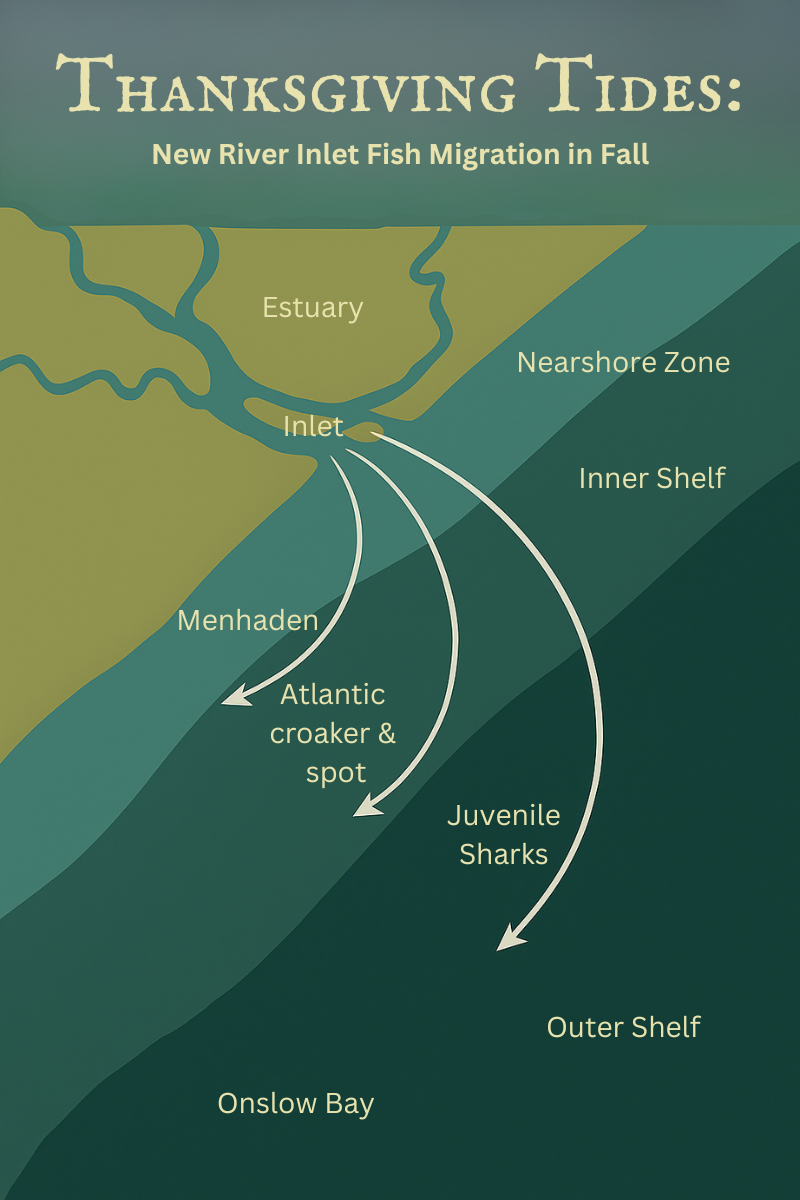
    Winter migration path new river inlet to ocean
    The New River winds toward its inlet, where marsh channels, sandbars, and tidal creeks converge into a single hydrodynamic corridor — the living gateway between Onslow County’s estuary and the open Atlantic.


    As autumn advances, the estuary’s chemistry shifts: cooler water holds more oxygen, salinity rises with lower rainfall, and winds begin steering surface currents southward. These changes open a corridor that hundreds of thousands of fish follow instinctively from the creeks to the ocean shelf.

    For species like spot (Leiostomus xanthurus) and Atlantic croaker (Micropogonias undulatus), this downstream journey completes the first half of a circular life cycle. After spending spring and summer feeding in the calm nurseries of the estuary, they now join the coastal current to overwinter in deeper, warmer water—traveling the same path their parents once took (Odell et al., 2017).

    This path is more than instinct. It follows the physical architecture of the river itself—the deep, tidally flushed channels that connect Stones Bay and the main river to the inlet’s thalweg. When autumn winds push water seaward, these channels become a hydrodynamic migration corridor, a natural conveyor that funnels fish from the upper river toward the mouth (Odell et al., 2017).

    The inlet becomes a moving parade: ripples flashing silver, gulls diving, and every outgoing tide pulling another wave of life toward the horizon.

    Menhaden: The Silver Procession

    School of atlantic menhaden
    A vast school of Atlantic menhaden (Brevoortia tyrannus) moves as one body near the surface — a living current of silver that links the New River Estuary to the open Atlantic each fall.

    Among the first to leave are Atlantic menhaden (Brevoortia tyrannus), the shimmering filter-feeders that fuel much of the coastal food web. Juveniles spend the warmer months feeding in the upper river, turning sunlight and plankton into pure energy. When the water dips below 18 °C, they form tight schools and funnel through the inlet, their bodies reflecting the low winter sun like coins scattered across the tide.

    Studies of otolith chemistry show that these migrants come from multiple estuarine nurseries along the Atlantic seaboard, each contributing recruits to the coast-wide population (Anstead et al., 2016). Their exodus through the New River Inlet is not just a local event—it’s part of a continental rhythm that keeps the Atlantic alive.

    Beyond the inlet, menhaden rarely swim straight into the deep. Instead, they travel through the nearshore transition zone, staying within roughly 10 kilometers of the coast, guided by southward longshore currents driven by seasonal winds (Lozano et al., 2013). Here they join massive coastal schools that drift toward Cape Fear and beyond, remaining within waters of 12–18 °C—their preferred thermal band. Each year, these moving rivers of fish carry the New River’s energy down the Atlantic coast like a living current of light.

    Spot and Croaker: The Drummers of the Migration

    Spot and Atlantic croaker
    Spot (Leiostomus xanthurus) and Atlantic croaker (Micropogonias undulatus) — schooling estuarine “drummers” whose late-fall migration carries the New River’s summer energy seaward through New River Inlet.

    Close behind move the “drums”—spot (Leiostomus xanthurus) and Atlantic croaker (Micropogonias undulatus)—so named for the sound they make vibrating muscles against their swim bladders. By late autumn, they too feel the pull of the current. Their bodies, now heavy from a summer of estuarine abundance, drift downstream in schools that seem to hum with the low percussion of their name.

    In coastal surveys, researchers have traced these migrations from estuarine creeks to the continental shelf, where the fish spend the winter in relative warmth before returning north in spring (Odell et al., 2017). In ecological terms, it’s an energy transfer: the nutrients once locked in the mud and detritus of the New River now exported to the open sea.

    Once through the inlet, spot and croaker follow two primary routes—some hugging the coast within the surf zone, others settling on the inner continental shelf at 15–35 meters depth. They drift southward along the Carolina Coastal Current, a steady, wind-driven flow that connects Onslow Bay to warmer waters off South Carolina and Georgia. Beneath the surface, these fish form vast, undulating layers—millions of tiny drummers keeping rhythm with the season.

    Juvenile Sharks: The Shadow Pilgrims

    Sandbar shark pups
    Juvenile coastal sharks glide over a sandy inlet floor — quiet travelers of the New River system, following ancient tidal cues that guide them from sheltered estuaries to the open Atlantic.

    Following the smaller fish come the quiet shadows—juvenile coastal sharks moving through the inlet on their own pilgrimage. Tagging studies across North Carolina reveal that blacktip, sandbar, and bull sharks use shallow estuarine margins as summer nurseries before shifting offshore in late fall when the water cools (Bangley et al., 2018; Rulifson & Bangley, 2015).

    In the turbid water at the inlet’s mouth, these young predators trace invisible highways along sandbars and channels, following the scent of prey schools that have already departed. Many continue to ride the same southward current as the drum and menhaden but at greater depth—sometimes reaching the outer continental shelf (30–80 meters) where the water remains above 18 °C. For a few short weeks, river and sea mingle in one shared migration—prey, predator, and current moving together through the same watery passage.

    The Importance of the Journey

    The departure is not random. Temperature, daylight, and shifting prey availability synchronize this movement. When shrimp and plankton thin in the creeks, the fish follow the energy gradient seaward. In doing so, they maintain the seasonal connectivity that defines an estuary’s health: nutrients exported from the marsh become the foundation of offshore food webs, feeding mackerel, tuna, and seabirds far beyond the New River’s mouth (Lozano et al., 2013).

    The Ekman Transport
    Alongshore winds along the North Carolina coast generate offshore surface flow through Ekman transport. This movement is balanced by deeper onshore currents and localized upwelling, circulating nutrients and carrying estuarine water and organisms seaward. Adapted from Job Dronkers (2025), Coastal Wiki.

    This corridor of movement also depends on the forces of wind and tide. During late fall, northwest winds push surface waters offshore through Ekman transport, enhancing the ebb flow that draws fish outward. Each tide functions as a breath of the estuary—an exhalation of life—carrying energy from the marshes to the sea (Odell et al., 2017).

    This is the river’s gift to the ocean—the annual offering that ensures what leaves the estuary returns as new life months later.

    A Thanksgiving of Currents

    N Topsail Beach NC at Sunset by David Ogorman
    North Topsail Beach at sunset | Photo Credit: David Ogorman

    If seen from above, the late-autumn water resembles a conveyor of light: streaks of silver menhaden, bronze drum, and dark shark fins blending into the green-blue inlet plume. Each species is a pilgrim, carried by tides instead of highways, guided by magnetic fields instead of maps. Their departure is as old as the coastline itself—a Thanksgiving procession written in currents and instincts rather than calendars. For those standing on the dunes at North Topsail Beach, the scene feels both ancient and immediate: the hush of wind, the roll of the tide, and somewhere beneath, the silent travelers heading home.

    References

    Anstead, K. A., Schaffler, J. J., & Jones, C. M. (2016). Coast-wide nursery contribution of new recruits to the population of Atlantic menhaden. Transactions of the American Fisheries Society, 145(3), 627–636. https://doi.org/10.1080/00028487.2016.1150345

    Bangley, C. W., Paramore, L., Dedman, S., & Rulifson, R. A. (2018). Delineation and mapping of coastal shark habitat within a shallow lagoonal estuary. PLOS ONE, 13(4), e0195221. https://doi.org/10.1371/journal.pone.0195221

    Lozano, C. J., Houde, E. D., & Severin, K. P. (2013). Factors contributing to variability in larval ingress of Atlantic menhaden (Brevoortia tyrannus) to Chesapeake Bay. Estuarine, Coastal and Shelf Science, 118, 1–10. https://doi.org/10.1016/j.ecss.2012.12.018

    Odell, J., Adams, D. H., Boutin, B., Collier, W., Deary, A., Havel, L. N., Johnson, J. A. Jr., Midway, S. R., Murray, J., Smith, K., Wilke, K. M., & Yuen, M. W. (2017). Atlantic Sciaenid habitats: A review of utilization, threats, and recommendations for conservation, management, and research (Habitat Management Series No. 14). Atlantic States Marine Fisheries Commission. https://asmfc.org/wp-content/uploads/2024/12/HMS14_AtlanticSciaenidHabitats_Winter2017.pdf

    Rulifson, R. A., & Bangley, C. W. (2015). Quantifying estuarine habitat use by multiple coastal shark species (NOAA Technical Report). NOAA Institutional Repository. https://repository.library.noaa.gov/view/noaa/46115