Category: Spotted seatrout

  • The 12 Days of Estuary Christmas | New River Estuary

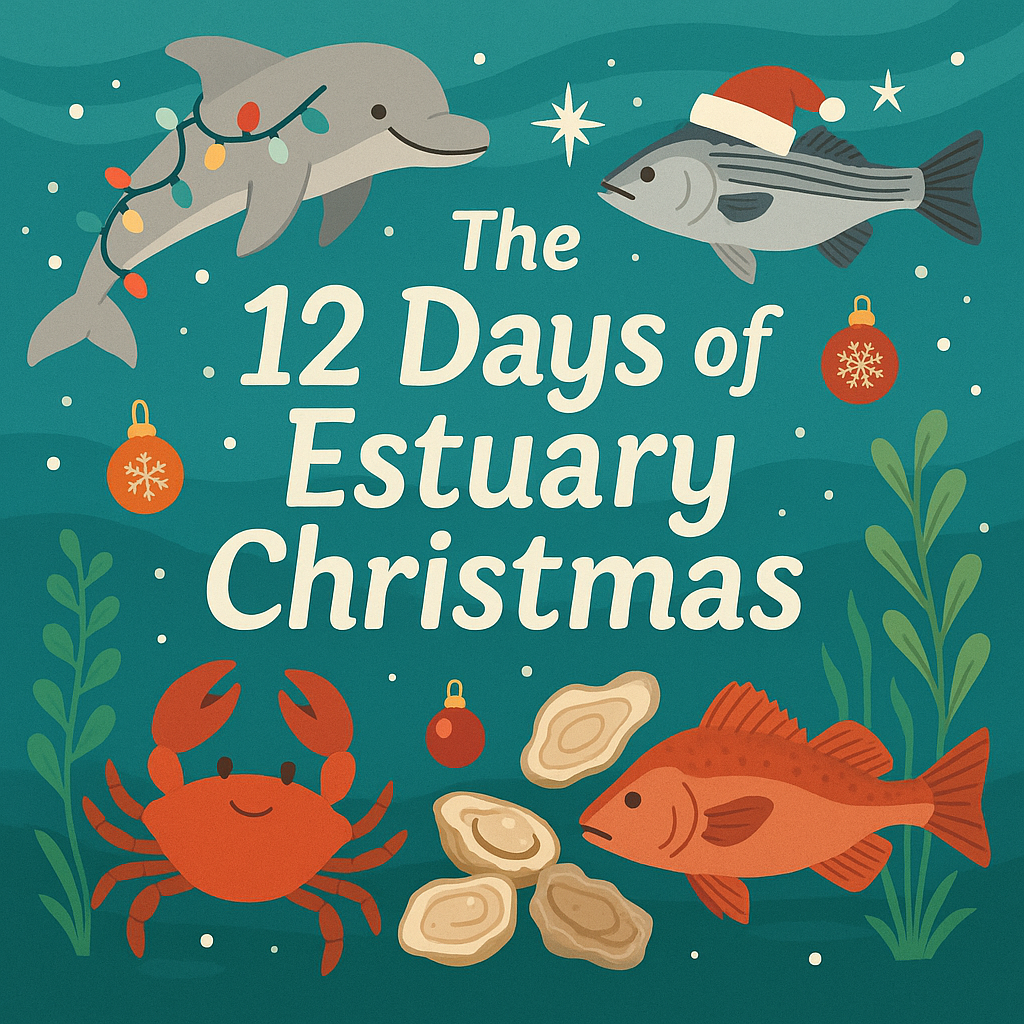
    The 12 Days of Estuary Christmas | New River Estuary

    In the season of chilly tides and twinkling pier lights, the New River estuary doesn’t quiet down — it parties in its own salty way. So grab your cocoa, bundle up, and join us for a winter countdown of festive fins, feathers, and the ecological magic beneath the misty surface.

    (Sing along if you dare — apologies in advance.)

    Day 12: Twelve Dolphins Dancing

    12 dolphins dancing

    Bottlenose dolphins along the mid-Atlantic coast shift into cooperative foraging teams in the cooler months — synchronized movements that feel almost choreographed (Torres & Read, 2009). Their leaping, circling, and flipper-flicking tactics help herd fish just like dancers driving the story across a winter stage.

    Cue underwater Nutcracker ballet.

    Day 11: Eleven Stripers Schooling

    11 stripers schooling

    Atlantic striped bass move into estuarine channels when the water cools, fueling popular winter fisheries (Boyd, 2011).

    Cold water? Hot bite.

    Day 10: Ten Blue Crabs Burrowing

    Ten Blue Crabs Burrowing

    Blue crabs overwinter right here — burrowed into sediment, metabolism slowed, waiting for spring, or when water temperatures rise above 9℃ (Glandon, Kilborn & Miller, 2019).

    The ultimate cozy blanket fort.

    Day 9: Nine Oysters Filtering

    Nine Oysters Filtering

    Oysters continue filtering water through the winter, though more slowly — still improving water quality and boosting biodiversity (Grabowski & Peterson, 2007).

    Nature’s tiny elves never clock out.

    Day 8: Eight Croakers Drumming

    Eight Croakers Drumming

    Atlantic croaker remain common in NC coastal waters during cooler months, shifting to deeper estuarine areas (Miller et al., 2003).

    Rumble, rumble — underwater holiday percussion.

    Day 7: Seven Specks Still Striking

    Seven Specks Still Striking

    Speckled seatrout stay active in winter, especially in deeper holes and marsh channels where prey concentrates and water temperatures remain above 7℃ (Ellis, Buckle & Hightower, 2017).

    Even cold-blooded fish love a good holiday snack.

    Day 6: Six Sharks Snow-Birding

    Six Sharks Snow-Birding

    Juvenile coastal sharks like sandbars and sharpnose depart estuaries in late fall, migrating offshore and southward (Bangley et al., 2018).

    “See you after the thaw!”

    Day 5: FIVE… OYS-TER REEFS!

    Five oyster reefs

    Oyster reefs provide the essential winter housing market — structured refuge for juvenile fish, crustaceans, and invertebrates (Coen et al., 2007).

    Deck the reefs with beds and breakfasts..

    Day 4: Four Buffleheads Diving

    Four Buffleheads Diving

    These small sea ducks, buffleheads, arrive from the Arctic and forage in our coastal waters all winter long (Gauthier, 2014).

    Feathered travelers escaping the Arctic freeze.

    Day 3: Three Terrapins Burrowed

    Three Terrapins Burrowed

    Diamondback terrapins overwinter in marsh sediments, lowering heart rate and waiting out the cold (Harden, Midway & Willard, 2015).

    A brumation vacation.

    Day 2: Two Menhaden Shoals

    Two Menhaden Shoals

    Atlantic menhaden form huge winter schools offshore and near inlet mouths, fueling predator energy budgets (Orth, 2023).

    The estuary’s holiday punch bowl.

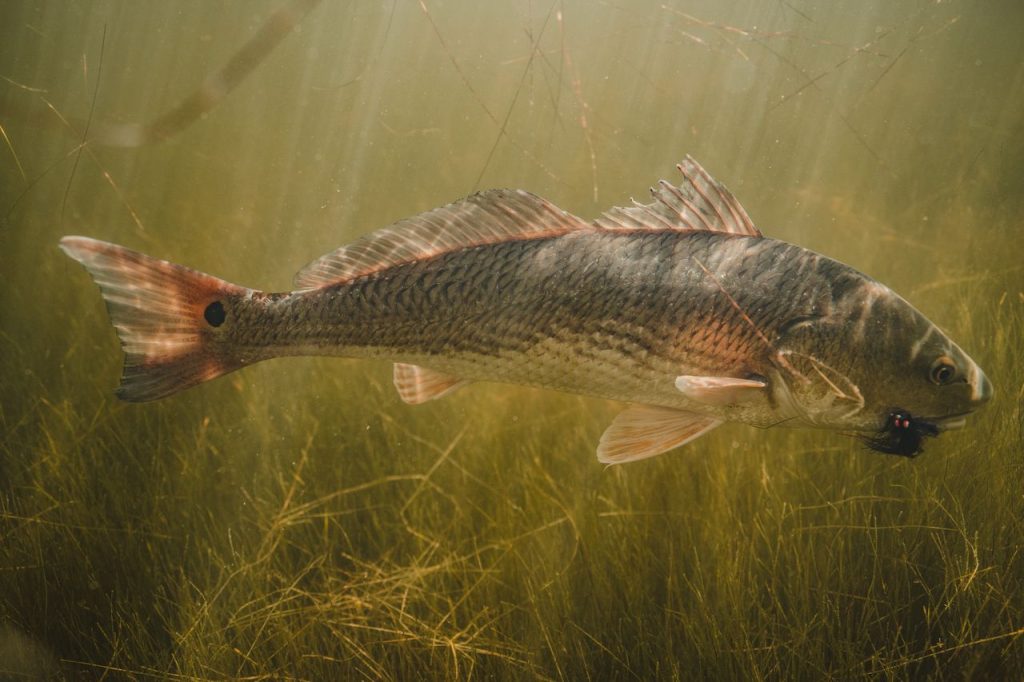
    Day 1: And a Red Drum in the Mar-sh-Tree

    And a Red Drum in the Mar-sh-Tree

    Red drum remain year-round, feeding in creeks and marsh edges even in winter low-temp slow-motion (Bacheler et al., 2009).

    Our coastal Christmas (and state) mascot.

    The Estuary Never Sleeps

    Even as we wrap gifts and check lists twice, life beneath the cold surface hustles on — feeding, moving, filtering, and keeping the New River ecosystem healthy through the darkest season.

    So here’s to the citizens of our winter waters —
    May your tides be merry and bright!

    References

    Bacheler, N., Paramore, L., Buckel, J., & Hightower, J. (2009). Abiotic and biotic factors influence the habitat use of an estuarine fish. Marine Ecology Progress Series, 377, 263-277. https://doi.org/10.3354/meps07805

    Bangley, C. W., Paramore, L., Dedman, S., & Rulifson, R. A. (2018). Delineation and mapping of coastal shark habitat within a shallow lagoonal Estuary. PLOS ONE, 13(4), e0195221. https://doi.org/10.1371/journal.pone.0195221

    Boyd, J. B. (2011). Maturation, fecundity, and spawning frequency of the Albemarle/Roanoke striped bass stock (2011. 1510474) [Doctoral dissertation]. ProQuest Dissertations and Theses Global.

    Coen, L., Brumbaugh, R., Bushek, D., Grizzle, R., Luckenbach, M., Posey, M., Powers, S., & Tolley, S. (2007). Ecosystem services related to oyster restoration. Marine Ecology Progress Series, 341, 303-307. https://doi.org/10.3354/meps341303

    Ellis, T., Buckel, J., & Hightower, J. (2017). Winter severity influences spotted seatrout mortality in a southeast US estuarine system. Marine Ecology Progress Series, 564, 145-161. https://doi.org/10.3354/meps11985

    Gauthier, G. (2014, July 14). Bufflehead – Bucephala albeola. Birds of the World – Cornell Lab of Ornithology. Retrieved November 29, 2025, from https://birdsoftheworld.org/bow/historic/bna/buffle/2.0/introduction

    Glandon, H. L., Kilbourne, K. H., & Miller, T. J. (2019). Winter is (not) coming: Warming temperatures will affect the overwinter behavior and survival of blue crab. PLOS ONE, 14(7), e0219555. https://doi.org/10.1371/journal.pone.0219555

    Grabowski, J. H., & Peterson, C. H. (2007). Restoring oyster reefs to recover ecosystem services. Theoretical Ecology Series, 281-298. https://doi.org/10.1016/s1875-306x(07)80017-7

    Harden, L. A., Midway, S. R., & Williard, A. S. (2015). The blood biochemistry of overwintering diamondback terrapins (Malaclemys terrapin). Journal of Experimental Marine Biology and Ecology, 466, 34-41. https://doi.org/10.1016/j.jembe.2015.01.017

    Mead, J. G., & Potter, C. W. (1995). Recognizing two populations off the bottlenose dolphin (Tursiops Truncatus) of the Atlantic coast of North America-Morphologic and Ecologic Considerations. https://repository.si.edu/server/api/core/bitstreams/9c563919-2b27-4ac4-bba1-92e7d090fd72/content

    Orth, D. J. (2023). Fish, fishing and conservation. Blacksburg: Virginia Tech Department of Fish and Wildlife Conservation.Torres, L. G., & Read, A. J. (2009). Where to catch a fish? The influence of foraging tactics on the ecology of bottlenose dolphins (Tursiops truncatus) in Florida Bay, Florida. Marine Mammal Science, 25(4), 797-815. https://doi.org/10.1111/j.1748-7692.2009.00297.x
  • The Estuary Feast: November Predators of the New River Estuary, NC

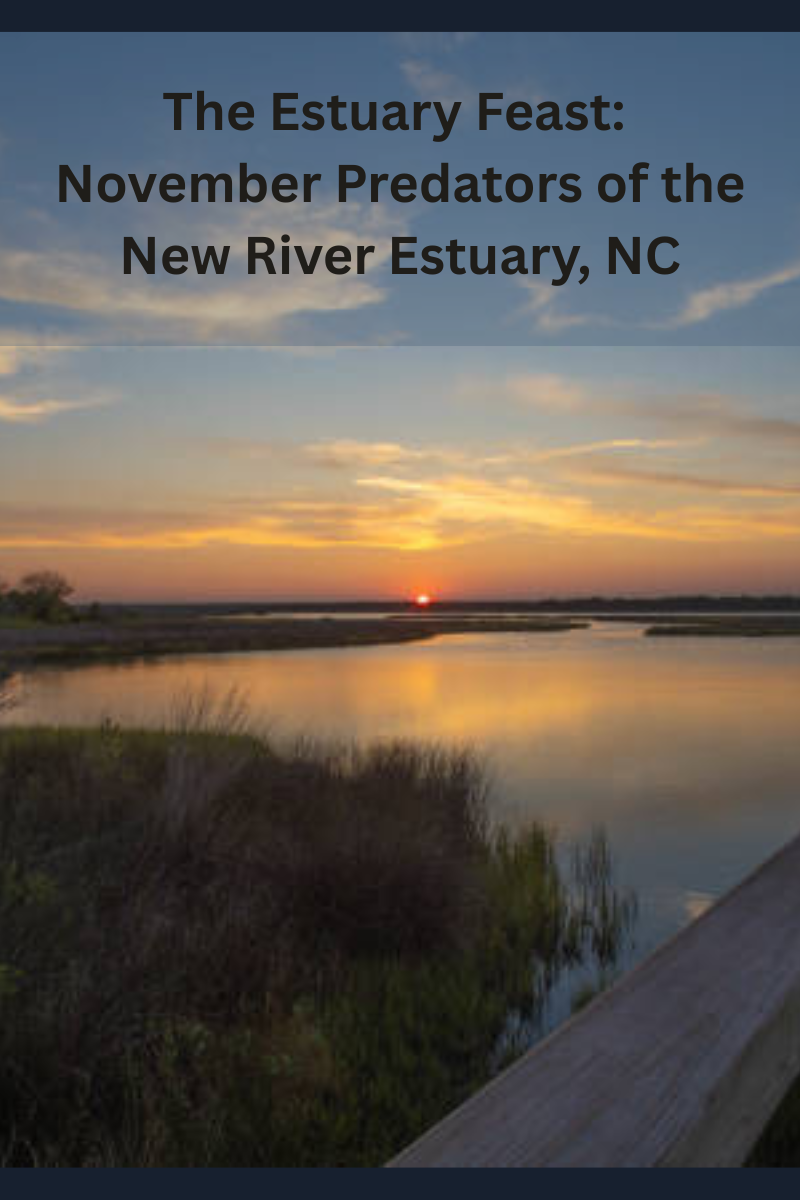
    The Estuary Feast: November Predators of the New River Estuary, NC

    Each November, as the hardwoods fade to rust and the air over Onslow County turns crisp, the New River estuary begins its quiet transformation. Beneath the calm surface, baitfish, shrimp, and crabs gather in the creeks and channels like guests arriving early to dinner. Cooling waters, shifting salinity, and autumn tides all cue a feeding frenzy among the river’s top hunters – red drum (Sciaenops ocellatus), southern flounder (Paralichthys lethostigma), and spotted seatrout (Cynoscion nebulosus).

    To the casual observer, it’s just another turn of the season. But for these predators, November is the defining moment of survival – the “estuary feast” that powers them through the winter ahead.

    The Science Behind the Feast

    The science: cool water, hot action
    As water temperatures drop, oxygen and prey shift. Shrimp slow, mullet school tightly, and predators move into perfect feeding conditions. In November, the estuary’s food web compresses – a short, fierce burst of activity before winter quiets the water.

    Autumn brings an ecological reshuffling. As air temperatures drop, water density increases, pushing oxygen-rich layers deeper into the estuary. Cooler water slows the metabolism of small prey, but keeps predators in their metabolic sweet spot – a narrow temperature window where they can feed efficiently (Facendola & Scharf, 2012).

    In the New River, this dynamic compresses the food web: prey such as mullet, menhaden, and shrimp concentrate in fewer, warmer microhabitats, and predators follow. Southern flounder and red drum migrate from the upper estuary toward the inlet, using the last strong tides of the season to feed before moving offshore to spawn (Midway et al., 2024).

    At the same time, spotted seatrout remain nearshore longer than most species, prowling deep bends and channel edges for sluggish crustaceans and cold-stunned baitfish (Bortone, 2003; TinHan et al., 2018; Whaley et al., 2023). This makes November one of the few months when all three predators share overlapping hunting grounds – a temporary “banquet hall” of intersecting habits and appetites.

    Predators at the Table

    Red Drum

    Known locally as “channel bass”, red drum rely heavily on macro-crustaceans and juvenile fishes during the late fall surge (Facendola & Scharf, 2012). In the New River estuary, they patrol marsh edges and oyster-reef margins where baitfish funnel out with the ebbing tide. These habitats not only provide prey but also structure – a three-dimensional refuge network that concentrates food in predictable corridors.

    Red drum are particularly sensitive to dissolved oxygen and salinity changes; they exploit the higher oxygen zones along shell hash and sandy bottoms where shrimp and crabs are most active.

    Southern Flounder

    Flat, camouflage, and opportunistic, southern flounder are the ambush specialists of November. As they stage for ocean migration, they feed voraciously along the lower estuary and inlet shoals, striking from beneath the sand when shrimp or menhaden schools pass overhead.

    Telemetry data show that most adult flounder exit the estuary between mid-October and mid-November (Midway et al., 2024), making this their final feeding push before winter. The energy stored in liver and muscle tissue during this period directly fuels their offshore spawning.

    Spotted Seatrout

    The spotted seatrout, or “speckled trout”, represents a different strategy: persistence.Unlike flounder or drum, they remain within the estuary for much of the winter. Their adaptive physiology lets them remain active in cooler water, hunting shrimp and small schooling fish even below 15℃, or 59℉ (Bortone, 2003; TinHan et al., 2018; Whaley et al., 2023).

    This endurance gives them a late-season advantage – fewer competitors and concentrated prey. In Onslow County’s deeper channels, dock lights and tidal flows create perfect feeding grounds long after other predators have departed.

    Prey and Energy Flow

    From marsh to mouth: The energy of the estuary: Energy flows up the ladder - detritus -> shrimp -> baitfish -> predator. This seasonal burst fuels migrations and maintains balance in Onslow County's estuary ecosystem. But when prey species are overfished, that balance falters.
    From marsh to mouth: The energy of the estuary: Energy flows up the ladder – detritus -> shrimp -> baitfish -> predator. This seasonal burst fuels migrations and maintains balance in Onslow County’s estuary ecosystem. But when prey species are overfished, that balance falters.

    Every feast depends on abundance. In the New River system, fall prey peaks come from several sources:

    • Penaeid shrimp (brown, pink and white shrimp) and blue crabs provide high-calorie meals critical to red drum and flounder growth (Facendola & Scharf, 2012).
    • Striped mullet (Mugil cephalus) migrate seaward in vast schools during November, offering short bursts of energy-rich prey (NCDMF, 2022). 
    • Juvenile fishes – menhaden, spot, croaker – linger in the brackish middle reaches, serving as transitional prey before exiting the estuary.

    As predators consume these resources, energy moves up the trophic ladder. That transfer of biomass – from detritus to shrimp to fish to apex predator – defines the estuary’s productivity and resilience (Bortone, 2003; TinHan et al., 2018; Whaley et al., 2023).

    Beyond the Feast: Ecological Balance

    The estuary’s “Thanksgiving” is not just a seasonal event. It’s a reset of the entire system. By removing weaker or late-season prey, predators help balance populations and redistribute nutrients through excretion and predation scars. Their feeding activity also stirs sediments and oxygenates bottom layers, improving microbial decomposition that recycles organic matter for the next year’s growth.

    But this rhythm is vulnerable. Habitat loss, water-quality decline, and overfishing can all truncate the feast. Striped mullet, a keystone prey species, remains overfished statewide (NCDMF, 2022), while southern flounder face chronic recruitment declines. (Recruitment is the process of small, young fish transitioning into their older, larger lifestage.) Each missing link reduces the estuary’s resilience – and the energy pulse that sustains these predators through winter.

    Climate Notes: A Shifting Season

    Recent NOAA data suggests that fall water temperatures in coastal North Carolina are trending 1°-2℃, or 1.8°-3.6℉, warmer than historical averages. Warmer autumns can delay predator migrations, alter prey timing, and extend disease risks for estuarine fish (Bortone, 2003; TinHan et al., 2018; Whaley et al., 2023; Llansó et al., 1998). For Onslow County, this means the “feast” could increasingly occur later, or not at all, in some years. Tracking these shifts can help monitor how climate variability reshapes local predator cycles.

    Conclusion

    In the quiet weeks before winter, the New River estuary hosts its grandest ritual: a final surge of life and energy. Flounder lie in wait beneath the sand; red drum sweep through oyster channels; speckled trout strike in the moonlit current. Together they embody the estuary’s cyclical resilience – a natural Thanksgiving built on balance, adaptation, and timing.

    For those who walk the riverbanks or wade the flats in November, the story unfolding beneath the surface is as rich and meaningful as any holiday tradition: a reminder that even in cooling waters, the rhythm of life continues, fierce and beautiful.

    References

    Bortone, S. A. (2002). Biology of the spotted Seatrout. CRC Press.

    Facendola, J. J., & Scharf, F. S. (2012). Seasonal and ontogenetic variation in the diet and daily ration of estuarine red drum as derived from field-based estimates of gastric evacuation and consumption. Marine and Coastal Fisheries, 4(1), 546-559. https://doi.org/10.1080/19425120.2012.699018

    Llansó, R. J., Bell, S. S., Vose, F. E., & Llanso, R. J. (1998). Food habits of red drum and spotted Seatrout in a restored mangrove impoundment. Estuaries, 21(2), 294. https://doi.org/10.2307/1352476

    Midway, S. R., Scharf, F. S., Dance, M. A., Brown-Peterson, N. J., Ballenger, J. C., Beeken, N. S., Borski, R. J., Darden, T. L., Erickson, K. A., Farmer, T. M., Fincannon, A., Godwin, J., Graham, P. M., Green, J. L., Hershey, H., Kiene, D., Lee, L. M., Loeffler, M. S., Markwith, A., & McGarigal, C. (2024). Southern Flounder: Major Milestones and Remaining Knowledge Gaps in Their Biology, Ecology, and Fishery Management. Reviews in Fisheries Science & Aquaculture, 32(3), 450-478. https://www.stevemidway.com/publication/midway2024rfsa/midway2024RFSA.pdf

    North Carolina Division of Marine Fisheries (NCDMF). (2022, August). Fishery Management Plan Update Striped Mullet. NC Dept. of Environmental Quality (NCDEQ). https://www.deq.nc.gov/marine-fisheries/fisheries-management/annual-fmp-review/2023/2023-striped-mullet-fmp-review/open

    TinHan, T. C., Mohan, J. A., Dumesnil, M., DeAngelis, B. M., & Wells, R. J. (2018). Linking habitat use and trophic ecology of spotted Seatrout (Cynoscion nebulosus) on a restored oyster reef in a subtropical Estuary. Estuaries and Coasts, 41(6), 1793-1805. https://doi.org/10.1007/s12237-018-0391-x

    Whaley, S. D., Shea, C. P., Santi, E. C., & Gandy, D. A. (2023). The influence of freshwater inflow and seascape context on occurrence of juvenile spotted seatrout Cynoscion nebulosus across a temperate Estuary. PLOS ONE, 18(11), e0294178.