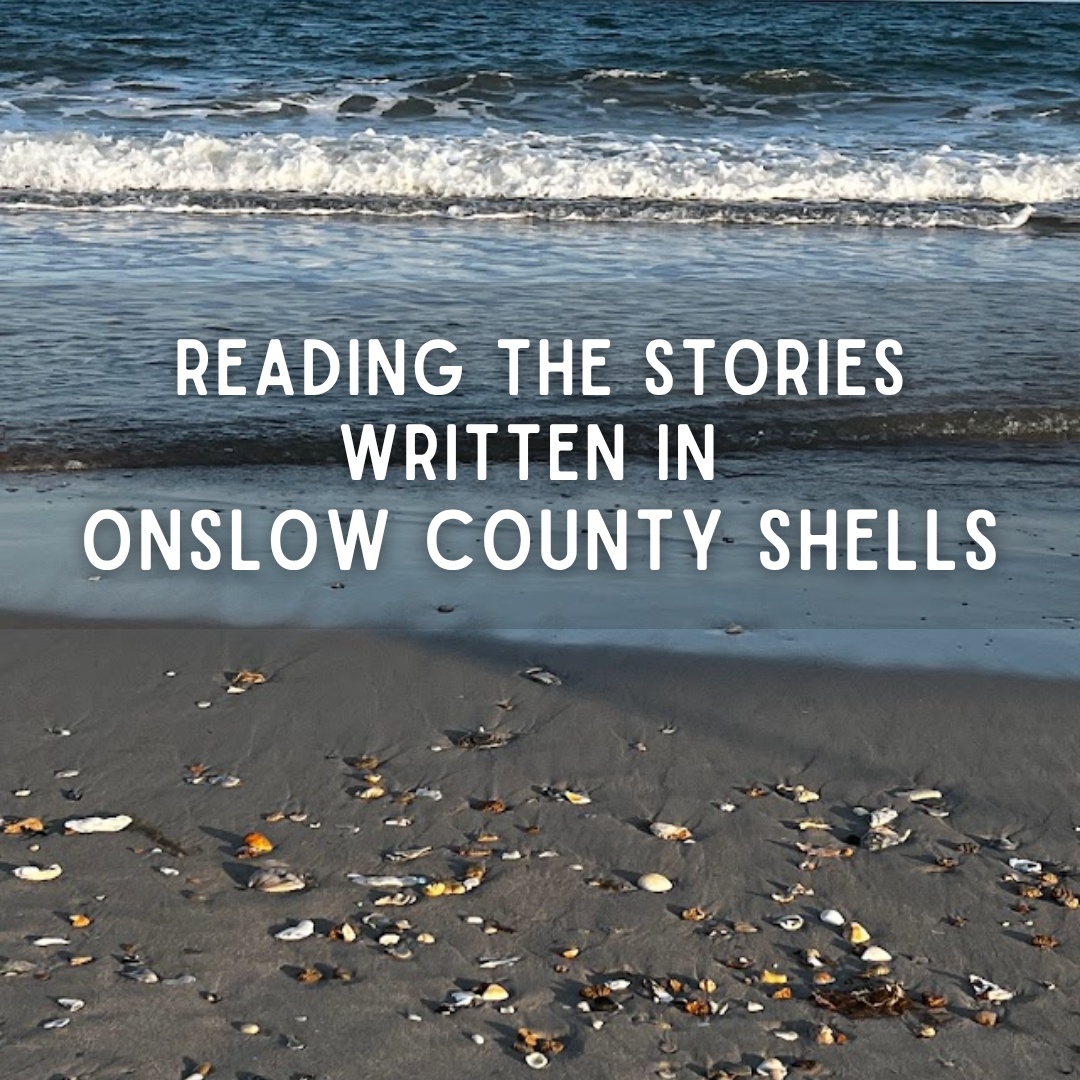
Walk almost any beach in Onslow County after the tide has gone out, and before long you’ll find yourself looking down.
A tiny orange shell catches your eye. Just inches away lies another, almost perfectly white. Nearby, a third carries shades of lavender and gray. An old, thick oblong shell rests beside them. A smooth round shell glistens in the afternoon sun while the heavy spiral of another waits half buried in the sand.
It feels like someone scattered an artist’s palette of Onslow County shells across the beach.
You notice how they are all so different and wonder why there are so many different colors.
It’s a simple question, but the answer reaches far beyond color.
Every shell on this beach is the product of millions of years of evolution solving the challenges of this particular coastline. Their colors, shapes, textures, thickness, and even the places we find them are all clues left behind by the animals that built them (Vermeij, 1974).
The shell isn’t simply something an animal lived in.
It is a record of how it survived.
And long after the animal is gone, the coast continues adding to that story.
The First Author
Every shell begins with a living animal.

Hidden just beneath the edge of the shell is a thin layer of tissue called the mantle. If the shell were a book, the mantle would be its author. Throughout the animal’s life, it slowly writes the shell, depositing layer upon layer of calcium carbonate, proteins, pigments, and minerals (Marin, 2012; Lowenstam & Weiner, 1989). As the animal grows, the shell grows with it.

The process is remarkably slow. The process is remarkably slow. A shell is never built all at once. Instead, it is written over days, months, and often years. Growth may speed up when food is plentiful, slow during winter or periods of stress, and even record repairs after surviving an attack from a predator (Marin, 2012). Every new layer becomes part of the shell’s permanent record.
Those layers preserve more than the shell itself. In many species, they preserve part of the animal’s history. While shells do not record age as neatly as the annual rings of a tree, scientists can often read growth bands to estimate an animal’s age, identify periods of environmental stress, and even reconstruct past water temperatures, salinity, and other environmental conditions from the chemistry locked inside the shell (Caudle et al., 1981).
Those orange, purple, yellow, white, and brown colors are not painted onto the shell after it forms.
The mantle creates them.

As it deposits each new layer of shell, it also deposits tiny amounts of pigments. Different species produce different pigments, while genetics determine much of the pattern. Nutrition, water chemistry, and the environment can influence exactly how those colors are expressed, making every shell as individual as the life that built it. Before the shell ever reaches the beach, much of its color has already been written into its structure (Marin, 2012).
Sometimes the shell also records when conditions are less than ideal. Pollution, disease, and changing ocean chemistry can all influence how well a mollusk builds its shell. Ocean acidification, for example, can make it more difficult for some species to produce thick, durable shells, leaving behind thinner walls or irregular growth. The shell becomes more than protection. It preserves clues about the world the animal experienced while it was alive (Marin, 2012).
But color is only one chapter of the story.
The shell’s shape, thickness, texture, strength, and even the way it grows reveal something even more important.
They reveal the problems the animal had to solve.
Different Coastlines Ask Different Questions
At first glance, shells seem wonderfully diverse.
Look a little closer, and a pattern begins to emerge.
No two coastlines ask life to survive in exactly the same way.
A rocky Pacific shoreline presents different challenges than a tropical coral reef. The cold waters of New England ask different questions than the warm Gulf of Mexico. Even along the Atlantic Coast, the barrier islands, estuaries, marshes, and surf zones of coastal North Carolina create conditions unlike almost anywhere else (Riggs et al., 1995).


Different predators.
Different sediments.
Different tides.
Different temperatures.
Different food.
Different problems.
Over millions of years, evolution answered those questions with different shells.
What washes onto our beaches is not random.
It is the collection of species whose solutions worked here (Vermeij, 1974).
Those questions have not remained the same. Over the past 66 million years, North Carolina’s shoreline has advanced and retreated countless times as sea levels rose and fell, rivers shifted course, climates warmed and cooled, and ancient oceans repeatedly flooded what is now dry land (Moslow & Heron, 1981; Riggs et al., 1995). Some shell designs disappeared as habitats changed. Others changed surprisingly little because the solutions they evolved continued to work.
Many of the shells we collect today belong to lineages that stretch back millions of years. Although the species themselves may have changed, the challenges of burrowing into sand, clinging to hard surfaces, escaping predators, or hunting beneath the seafloor have remained remarkably familiar. Every shell scattered across our beaches represents another evolutionary solution that succeeded on this coastline (Vermeij, 1974).
One Mineral. Many Solutions.
Every shell you’ll find on our beaches begins with the same basic building material: calcium carbonate.
It is one of the most common minerals used by living organisms, and yet from this single material evolution has produced an astonishing variety of designs (Lowenstam & Weiner, 1989; Marin, 2012).

Some shells become thick fortresses.
Others become lightweight burrowing tools.
Some protected animals that never move more than a few inches in their lives.
Others belong to predators that spent their days hunting beneath the sand.
The mineral stayed the same.
The problems did not.
Each shell scattered across our beaches represents a different solution to surviving along the Carolina coast.
Oysters
Few animals have shaped North Carolina’s coast more than the eastern oyster (Crassostrea virginica).
An oyster’s greatest challenge is that it cannot run.
Once it settles as a young larva, it cements itself permanently to a hard surface. Every predator, every storm, every changing tide must be faced exactly where it stands. Escape is no longer an option (Grabowski & Peterson, 2007).
Its solution was to build.
Layer upon layer, the mantle produces an irregular shell that grows thicker and stronger over time. Those rough edges, deep ridges, and uneven shapes are not imperfections. They strengthen the shell and help neighboring oysters lock together into reefs far stronger than any one oyster could build alone (Marin, 2012).
That reef becomes one of the most important habitats along our coast. Small fish hide among the crevices. Juvenile shrimp and crabs find shelter between the shells. Countless worms, anemones, barnacles, and other invertebrates settle on its surface, creating an entire community built upon generations of oysters (Beck et al., 2011; Grabowski & Peterson, 2007).

People often describe oysters as filtering the water.
They do.
But filtering water is simply how an oyster feeds itself.
The reef—the ecosystem we admire—is what emerges from millions of oysters solving the same survival problem together (Grabowski & Peterson, 2007).
The shell reflects that strategy.
Not speed.
Not camouflage.
Permanence.
Coquina Clams
Walk a few hundred yards toward the surf, and the questions change.
Here the sand never stops moving.
Every incoming wave buries.
Every outgoing wave uncovers.
An oyster’s strategy would fail here.
The coquina clam (Donax variabilis) answered a different problem.
Its shell is small, smooth, lightweight, and remarkably varied in color. Instead of resisting the waves, it moves with them, burrowing into wet sand almost as quickly as each wave retreats. The same shifting surf that would bury many animals has become the rhythm that guides its entire life (Baird, 1960; Manning, 2003).
Those endless combinations of oranges, whites, yellows, purples, grays, and intricate patterns are among the most colorful shells found on our beaches. While their exact patterns are largely determined by genetics, that incredible variety may also help break up the outline of individual clams against the constantly changing mosaic of wet sand, shell fragments, and reflected sunlight.

Coquinas don’t build habitat the way oysters do.
Instead, they move energy through the surf.
They filter microscopic algae and organic matter from the water before becoming food for fish, cownose rays, ghost crabs, gulls, and the flocks of sanderlings that race along the edge of the waves. During migration, entire flocks may depend on these tiny clams to fuel journeys spanning thousands of miles (Baird, 1960; Manning, 2003).
The shell reflects that role. Light enough to move with the surf. Strong enough to survive being tumbled by waves. Small enough to disappear beneath the sand in seconds.
Not because evolution intended to feed birds.
But because surviving here required an entirely different solution.
Moon Snails
Not every shell on our beaches belonged to prey.
Some belonged to hunters.
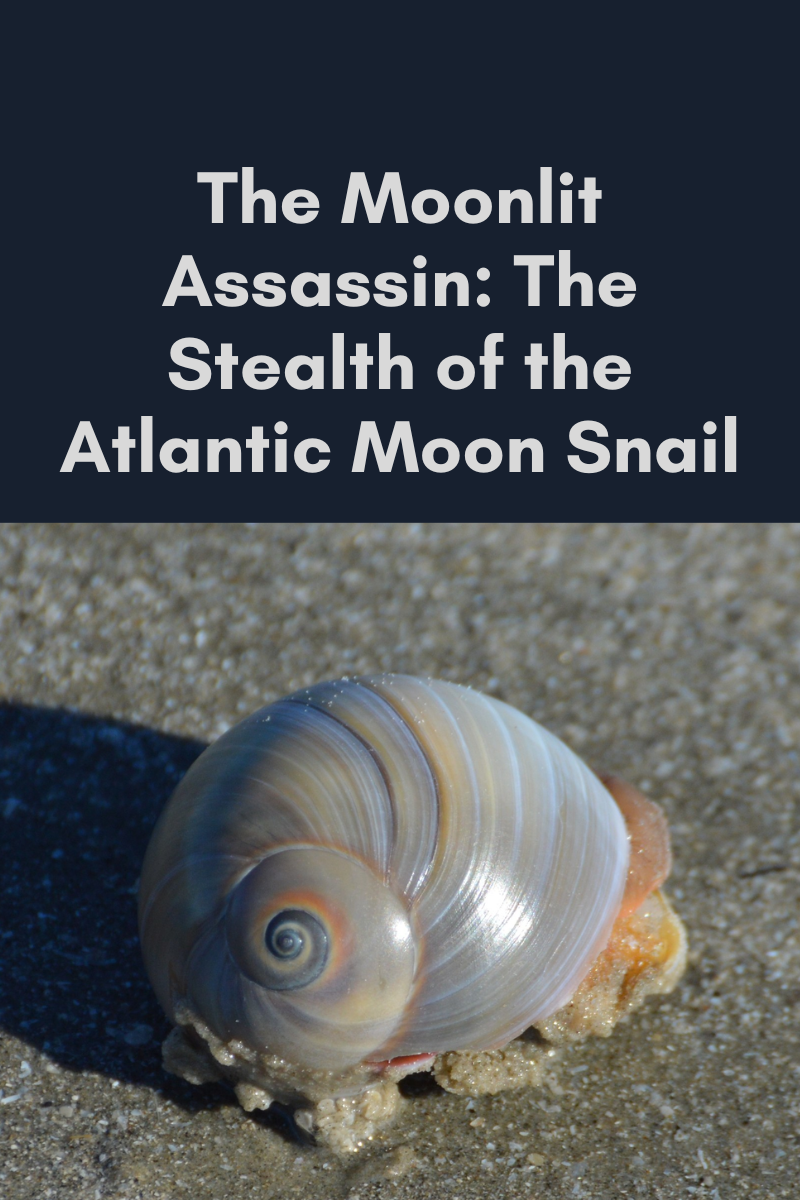
Moon snails (Neverita duplicata) spend much of their lives hidden beneath the sand, slowly searching for buried clams and other shellfish. Their large, muscular foot does most of the digging while their smooth, rounded shell slips easily through loose sediment without catching on sand or shell fragments (Grant, 2024; Witherington & Witherington, 2011).

Finding prey is only half the challenge.
Opening another shell is the difficult part.
Rather than smashing their prey, moon snails use a remarkable combination of chemistry and patience. Holding the shell securely with their foot, they slowly rasp away the calcium carbonate with a rough tongue called a radula while releasing acidic secretions that soften the shell beneath. Hours later, all that remains is a nearly perfect circular hole (Grant, 2024).
Beachcombers often find these drilled shells without realizing they are looking at the evidence of one mollusk successfully hunting another.
The shell reflects that hidden lifestyle. Rounded instead of angular. Smooth instead of heavily sculptured.
Built not for resisting crashing waves, but for quietly moving through the sand in search of its next meal.
Whelks and Conchs
Some shells tell the story of animals that stayed in one place.
Others belonged to animals that never stopped moving.
Whelks and conchs are active travelers, spending much of their lives crawling across sandy bottoms, oyster reefs, and shallow estuaries in search of food. Their heavy spiral shells protect a surprisingly muscular animal capable of covering far more ground than most people realize (Magalhaes, 1948; Walker et al., 2008).

For many whelks, the challenge isn’t finding food.
It’s getting through another shell.
Using a long, extendable feeding tube called a proboscis, many species pry apart or drill into clams, oysters, and other shellfish. Others scavenge animals that have already died, recycling nutrients that would otherwise remain locked away on the seafloor. Along the way, they become prey themselves for larger fish, rays, sea turtles, and even other whelks (Magalhaes, 1948; Askin et al., 2022).
Their shells reflect that roaming lifestyle. Thick walls help defend against predators while the long spiral provides room for a muscular body that can withdraw deeply into the shell when threatened. Even the wide opening allows that powerful foot to extend far enough for steady movement across shifting bottoms.
The shell isn’t simply a home.
It is armor carried wherever the animal goes.
Scotch Bonnet
North Carolina’s state shell rarely washes ashore as often as oysters or coquinas, making each discovery feel a little more special.
The Scotch bonnet (Phalium granulatum) spends much of its life offshore on sandy bottoms where waves are gentler than those crashing onto the beach. There, it hunts worms and other small invertebrates hidden beneath the sediment (Grant, 2024; Witherington & Witherington, 2011).
Its shell reflects a different set of priorities.
Instead of thick ridges or heavy armor, the Scotch bonnet carries a smooth, rounded shell with delicate markings that blend surprisingly well among sand, shell fragments, and scattered gravel. The shell protects the animal while remaining compact enough for a life spent moving slowly across the seafloor (Grant, 2024; Witherington & Witherington, 2011).

For many beachcombers, finding a Scotch bonnet feels like finding a rare treasure.
For the animal that built it, the shell was simply another successful solution to living in a quieter part of North Carolina’s coastal waters. One lived beyond the breakers where survival depends less on enduring crashing surf and more on navigating a different world beneath the waves.
Scallops
Not every shell relies on strength.
Some rely on surprise.
Unlike oysters, scallops – the Atlantic bay scallop (Argopecten irradians), Atlantic calico scallop (Argopecten gibbus), and the Atlantic sea scallop (Placopecten magellanicus) – never permanently attach themselves to the bottom. Although they often rest quietly on the seafloor, they can escape danger by doing something few other shellfish can.
They swim (Grant, 2024).
When threatened by sea stars, crabs, or other predators, a scallop rapidly opens and snaps its shell shut. Each clap forces a jet of water from the hinge, propelling the animal through the water in a series of short bursts (Grant, 2024).
The broad, fan-shaped shell makes this possible. Strong muscles close the shell with remarkable force while the evenly shaped valves help direct each burst of water.

Scallops also possess dozens of tiny blue eyes along the edge of their mantle. Individually, each eye forms only a simple image, but together they help detect movement and approaching predators long before contact is made (Grant, 2024; Palmer et al., 2017).
Their shell reflects a life balanced between resting quietly on the bottom and escaping at precisely the right moment.
Sometimes survival isn’t about building thicker armor.
It’s about knowing when to leave.
Augers
Some predators chase.
Others wait.
Eastern augers (Neoterebra dislocata) spend much of their lives buried beneath the sand with only a small portion of their bodies exposed. From this hidden position they search for marine worms moving through the sediment (Grant, 2024; Witherington & Witherington, 2011).
Their shells are long, narrow, and remarkably slender. That shape isn’t simply beautiful.

It allows the animal to slip easily into the sand while occupying very little space as it burrows. Instead of pushing aside large amounts of sediment, the shell moves through it with surprisingly little resistance (Grant, 2024; Witherington & Witherington, 2011).
Many augers also possess venom that helps subdue their prey before swallowing it whole. Their role is quiet and rarely seen, yet they help regulate populations of worms living beneath the surface while becoming prey for larger animals in turn (Grant, 2024; Witherington & Witherington, 2011).
Like so many shells on our beaches, the auger’s design reflects an animal most people never realize is there.
Hard Clams (Quahogs)
Not every shell has to choose between staying still and constantly moving.
Hard clams, or quahogs (Mercenaria mercenaria), do both.
Most of their lives are spent buried beneath the estuary bottom with only their siphons reaching the surface. Hidden beneath the sand, they filter microscopic algae and organic matter from the surrounding water while remaining safely out of sight of many predators. But if conditions change, they can slowly pull themselves through the sediment in search of a better place to live (MacKenzie & Tarnowski, 2018).
Their shell reflects that balance.

Unlike the thin shell of a coquina built for speed or the irregular fortress of an oyster reef, a hard clam carries a thick, rounded shell designed to withstand pressure from above. Crabs, rays, and whelks all present different dangers, and the clam’s tightly closing valves provide its best defense against them (MacKenzie & Tarnowski, 2018).
That shell also records an unusually long life. Some North Carolina hard clams live for decades, adding new growth each year as the mantle slowly deposits another layer of shell. Scientists can often estimate a clam’s age by studying those growth bands, much as foresters study the rings of a tree, although the story written in a shell is often more complicated than counting one band for every year (Caudle et al., 1981).
Like oysters, hard clams improve water quality simply by feeding.
Their shell reflects patience.
Rather than escaping danger, it protects an animal that survives by remaining hidden beneath the bottom.
Cockles
Some shells solve a different problem altogether.
Instead of burrowing deeply and staying put, cockles, like the giant Atlantic cockle (Dinocardium robustum), live much closer to the surface where waves, shifting sand, and hungry predators are constant challenges (Grant, 2024; Douglass, 1989).
Their answer is written in a shell unlike almost any other.

Strong, radiating ribs run from the hinge to the shell’s edge, strengthening the shell without making it excessively heavy. Those ridges act much like the folds pressed into a piece of cardboard, adding remarkable strength while using relatively little additional material. The rounded shape also helps distribute pressure from predators trying to crush the shell (Grant, 2024; Douglass, 1989).
Although cockles can burrow, many rely on quick movements near the sediment surface, even using their muscular foot to hop short distances when threatened.
The shell reflects that lifestyle. Not as smooth as a coquina. Not as heavy as a hard clam.
Instead, it balances strength with mobility in the constantly changing surf and shallow subtidal sands (Grant, 2024; Douglass, 1989).
Lion’s Paw Scallop
Few shells stop beachcombers in their tracks quite like a lion’s paw scallop (Nodipecten nodosus).
With its brilliant orange, red, or deep coral colors and bold knobby ribs, it hardly resembles the quieter shells scattered around it.

Its appearance reflects where it lives.
Unlike bay scallops that spend much of their lives on relatively shallow bottoms, lion’s paws are usually found farther offshore in deeper water where they rest among shell bottom, reefs, and hard substrates. Their heavy ribs strengthen the shell while making it more difficult for predators to crush (Rupp et al., 2005).
Like other scallops, lion’s paws can swim by rapidly clapping their shells together, jetting water from the hinge to escape danger. But unlike the delicate bay scallop, the lion’s paw invests more heavily in protection than speed, reflecting the different challenges of life in deeper coastal waters (Grant, 2024; Rupp et al., 2005).
Finding one washed onto an Onslow County beach usually means the ocean has done some of the traveling for it. Storms, strong currents, and changing tides occasionally carry these offshore shells landward, where they become one of the most treasured discoveries a beachcomber can make (Grant, 2024; Rupp et al., 2005).
The shell reflects both rarity and resilience.
Not because the animal evolved to become a collector’s prize.
But because its offshore home demanded a different solution than the shells living closer to shore.
The Coast Becomes the Second Author
The mantle stops writing the moment the animal dies.
The Carolina coast does not.
What remains is no longer simply a shell. It becomes part of an entirely different story, one written by waves, tides, storms, sunlight, other living organisms, and time itself (Kidwell & Bosence, 1991).
In many ways, the shell begins a second life.
Every tide carries it somewhere new. It may tumble through the surf for years before finally washing ashore. It may become buried beneath shifting sand, exposed again by the next storm, or carried into an estuary where the water, chemistry, and even the color of the bottom are entirely different from where the animal once lived (Kidwell & Bosence, 1991).
The shell that catches your eye today may have traveled miles from the habitat where it was first written.
When the Coast Changes the Color
Not every color you see was created by the animal.
Many are added later.
A bright shell left exposed on the open beach gradually fades as sunlight breaks down the pigments once produced by the mantle. Over time, oranges soften, purples become pale, and richly patterned shells may bleach almost completely white (Kidwell & Bosence, 1991).
Carry that same shell into a quiet salt marsh, and the story changes.
The dark mud beneath the marsh is rich in decaying plant material, bacteria, and low-oxygen sediments. As shells rest there, they often become stained shades of gray, brown, or nearly black. Beachcombers are sometimes surprised to find black shells scattered along an estuary, but the color usually comes from the marsh itself rather than the animal that built the shell.
Elsewhere, iron-rich sediments may leave rusty orange stains. Thin films of algae can tint shells green, while mineral deposits and other chemical reactions slowly alter their appearance over months or years (Kidwell & Bosence, 1991).

Sometimes those changes tell us almost as much as the shell itself.
A bright, colorful shell may have spent little time exposed after the animal died.
A heavily bleached shell may have rolled through the surf for years.
A blackened shell may have rested quietly in marsh mud before tides carried it back onto the beach.
The coast has been editing the story.
Every Scar Has a Story
Color is only one way the coastline leaves its mark.
Look closely and you’ll often find scars, chips, holes, and rough edges that formed long after the animal was gone.
Rolling waves grind shells against sand and one another, slowly rounding sharp edges until they become smooth enough to fit comfortably in the palm of your hand. Storms break larger shells into fragments before carrying them into entirely different habitats (Kidwell & Bosence, 1991).
Barnacles cement themselves onto abandoned shells. Bryozoans spread across their surfaces like delicate lace. Boring sponges and marine worms slowly tunnel through the calcium carbonate, creating tiny chambers where other organisms eventually move in (Kidwell & Bosence, 1991).
Even after death, the shell continues providing shelter. Some become homes for hermit crabs. Others become attachment sites for young oysters beginning reefs of their own. Small fish hide among broken shell piles while countless microscopic organisms colonize every available surface (Kidwell & Bosence, 1991) .

The shell no longer protects the animal that built it.
Instead, it begins supporting an entirely new community.
Eventually, Even Shells Become the Beach
The Carolina coast wastes very little.
As shells continue breaking apart, the fragments become smaller and smaller until many are no longer recognizable as shells at all.
They become part of the sand (Moslow & Heron, 1981; Riggs et al., 1995).
On many North Carolina beaches, tiny pieces of shell are mixed with quartz grains carried from the Appalachian Mountains by rivers over millions of years. Every handful of sand is a mixture of geology and biology, mountains and oceans, living animals and ancient rock (Moslow & Heron, 1981; Riggs et al., 1995).

Even after the shell disappears, it remains part of the coastline.
Its story simply changes again.
Every Shell Has Two Authors
We often collect shells because they are beautiful.
Beauty is usually the first thing we notice. But it is rarely the most interesting thing they have to offer.
Every shell begins with a living animal whose mantle slowly writes a record of its life—its growth, its habitat, its challenges, and the evolutionary solution that allowed it to survive.
After the animal dies, the Carolina coast picks up the story.
Sunlight softens the colors. Marshes stain them. Waves polish them. Other animals bore through them, build upon them, and make them part of their own lives.
What you hold in your hand is no longer simply the remains of a mollusk.
It is a story with two authors.
One wrote the shell. The other never stopped editing it.
The next time you find a shell along the beaches of Onslow County, look beyond its color.
Notice the thickness. The curves. The ridges. The scars. The stains. The tiny holes.
Each one is a clue.
Each one is another sentence in a story that began with a living animal and continues with every tide that reaches our shore.

References
Askin, S. E., Fisher, R. A., Biesack, E. E., Robins, R., & McDowell, J. R. (2022). Population genetic structure in channeled whelk Busycotypus canaliculatus along the U.S. Atlantic coast. Transactions of the American Fisheries Society, 151(5), 543-558. https://doi.org/10.1002/tafs.10374
Baird, D. (1960). Observations on Donax variabilis Say from the Beaufort, North Carolina, region with notes on Donax fossor Say [Unpublished master’s thesis]. Ohio State University.
Beck, M. W., Brumbaugh, R. D., Airoldi, L., Carranza, A., Coen, L. D., Crawford, C., Defeo, O., Edgar, G. J., Hancock, B., Kay, M. C., Lenihan, H. S., Luckenbach, M. W., Toropova, C. L., Zhang, G., & Guo, X. (2011). Oyster reefs at risk and recommendations for conservation, restoration, and management. BioScience, 61(2), 107-116. https://doi.org/10.1525/bio.2011.61.2.5
Caudle, N., Hart, K., & Griffin, C. (1981). Reading a clam’s life in the rings of its shell. NC Sea Grant. https://ncseagrant.ncsu.edu/ncseagrant_docs/cw/1981/cw_1981_04_April.pdf
Douglass, J. L. (1989). Peterson first guide to shells of North America. Turtleback.
Grabowski, J. H., & Peterson, C. H. (2007). Restoring oyster reefs to recover ecosystem services. Theoretical Ecology Series, 281-298. https://doi.org/10.1016/s1875-306x(07)80017-7
Grant, N. C. (2024). Seashells of North Carolina, revised and expanded edition. UNC Press Books.
Kidwell, S. M., & Bosence, D. W. (1991). Taphonomy and time-averaging of marine Shelly faunas. Topics in Geobiology, 115-209. https://doi.org/10.1007/978-1-4899-5034-5_4
Lowenstam, H. A., & Weiner, S. (1989). Biomineralization processes. On Biomineralization. https://doi.org/10.1093/oso/9780195049770.003.0005
MacKenzie, Jr., C. L., & Tarnowski, M. (2018). Large shifts in commercial landings of estuarine and Bay bivalve mollusks in northeastern United States after 1980 with assessment of causes. Marine Fisheries Review, 80(1), 1-28. https://doi.org/10.7755/mfr.80.1.1
Magalhaes, H. (1948). An ecological study of snails of the genus Busycon at Beaufort, North Carolina. Ecological Monographs, 18(3), 377-409. https://doi.org/10.2307/1948577
Manning, L. M. (2003). Ecology of ocean beaches: The importance of human disturbance and complex biological interactions within a physically rigorous environment [Unpublished doctoral dissertation]. University of North Carolina, Chapel Hill.
Marin, F. (2012). The formation and mineralization of mollusk shell. Frontiers in Bioscience, S4(3), 1099-1125. https://doi.org/10.2741/s321
Moslow, T. F., & Heron, S. (1981). Holocene depositional history of a microtidal cuspate foreland cape: Cape lookout, North Carolina. Marine Geology, 41(3-4), 251-270. https://doi.org/10.1016/0025-3227(81)90084-0
Palmer, B. A., Taylor, G. J., Brumfeld, V., Gur, D., Shemesh, M., Elad, N., Osherov, A., Oron, D., Weiner, S., & Addadi, L. (2017). The image-forming mirror in the eye of the scallop. Science, 358(6367), 1172-1175. https://www.science.org/doi/abs/10.1126/science.aam9506
Riggs, S. R., Cleary, W. J., & Snyder, S. W. (1995). Influence of inherited geologic framework on barrier shoreface morphology and dynamics. Marine Geology, 126(1-4), 213-234. https://doi.org/10.1016/0025-3227(95)00079-e
Rupp, G. S., Parsons, G. J., Thompson, R. J., & De Bem, M. M. (2005). Influence of environmental factors, season and size at deployment on growth and retrieval of postlarval lion’s paw scallop Nodipecten nodosus (Linnaeus, 1758) from a subtropical environment. Aquaculture, 243(1-4), 195-216. https://doi.org/10.1016/j.aquaculture.2004.10.007
Vermeij, G. J. (1974). Marine faunal dominance and molluscan shell form. Evolution, 28(4), 656. https://doi.org/10.2307/2407289
Walker, R., Power, A., Sweeney-Reeves, M., Covington, E., & Recicar, T. (2008). Growth, migration, population structure and sex ratio of four whelk species (Family Melongenidae) within Wassaw Sound, Georgia (Vol 1, 2008). NOAA Sea Grant. https://repository.library.noaa.gov/view/noaa/35156
Williams, A. B., & Porter, H. J. (1971). A ten-year study of Meroplankton in North Carolina estuaries: Occurrence of Postmetamorphal bivalves. Chesapeake Science, 12(1), 26. https://doi.org/10.2307/1350499
Witherington, B., & Witherington, D. (2011). Seashells of Georgia and the Carolinas. Pineapple Press.