What microscopic shells along Topsail and Surf City tell us about ancient seas, living marshes, and the future coastline
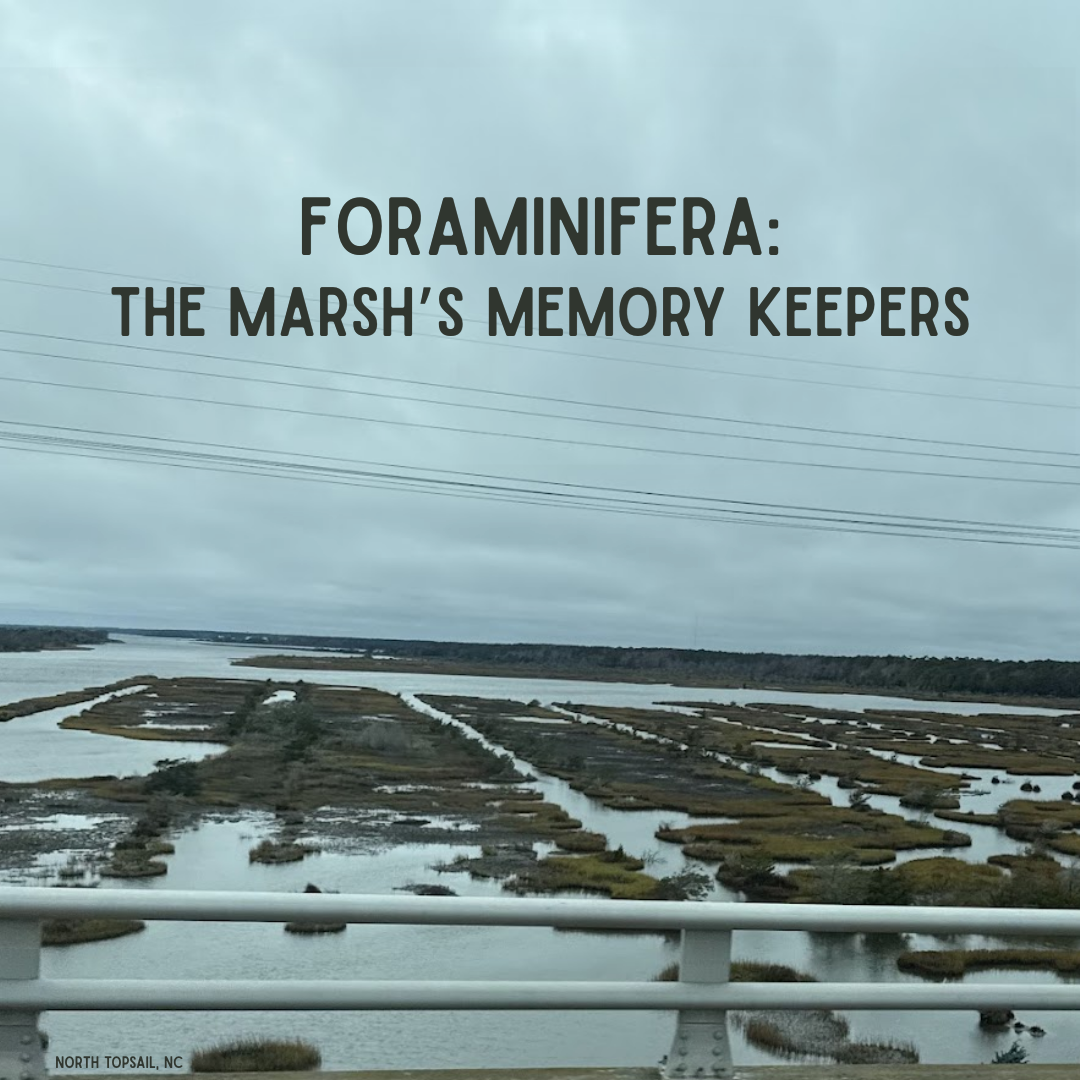
On a winter walk along the marsh edge in Topsail or Surf City, the landscape feels quiet. Cordgrass has faded to straw, tidal creeks run clear, and storm tides have pulled back layers of sediment that were hidden just months ago. Winter slows the marsh, but it also reveals it. Along exposed creek banks and tidal flats, the smallest residents of these ecosystems leave behind subtle traces — grains, spirals, and pin-sized shells that most people would mistake for sand.
These are the remains of foraminifera, key marsh indicators, and they carry a record far older than the marsh itself (Murray, 2006; Scott et al., 2001).
What Are Foraminifera?
Foraminifera, often called forams, are single-celled marine organisms — not animals, but protists — that live in oceans, estuaries, and salt marshes around the world (Murray, 2006). Despite their microscopic size, most foraminifera build protective shells, known as tests, made either from calcium carbonate or from tiny grains of sediment cemented together (Scott et al., 2001; Debenay & Guillou, 2002).
Different species occupy very specific zones within a marsh. Some live high in the intertidal, others closer to open water. Their distribution reflects precise environmental conditions such as salinity, tidal elevation, oxygen availability, and sediment type (Edwards et al., 2004; Culver & Horton, 2005). Because of this tight ecological coupling, foraminifera respond quickly when conditions change (Debenay & Guillou, 2002).

Why Winter Reveals the Record
In summer, marsh surfaces are busy and obscured. Dense vegetation, algae, burrowing organisms, and constant sediment mixing make it difficult to see what lies beneath. In winter, vegetation thins, biological activity slows, and storm tides rework creek edges and tidal flats. Fine sediments are redistributed, exposing layers that formed years, decades, or even centuries earlier (Scott et al., 2001; Gehrels, 1994).
Winter does not create this record — it simply makes it visible (Murray, 2006).
Size, Stability, and Ancient Seas
Some fossil foraminifera grew to the size of coins, while most living forms today are no larger than grains of sand (Murray, 2006). This contrast reflects the environments they evolved within. In ancient shallow seas, conditions were often warm, stable, and chemically consistent for long periods of time. Temperature, salinity, and carbonate availability changed slowly, allowing foraminifera to grow over many years, build thick and complex shells, and, in some cases, form partnerships with symbiotic algae — similar to the relationship between corals and the algae that live within their tissues — which provided an additional energy source through photosynthesis (Hallock, 1981; Murray, 2006). These systems favored persistence and size.
Over time, coastlines shifted and sea levels changed, giving rise to the highly dynamic estuaries and marshes we see today. In these modern environments, conditions can fluctuate over hours or seasons. Salinity rises and falls, oxygen levels vary, sediments are rearranged, and water chemistry responds quickly to storms and freshwater input (Debenay & Guillou, 2002; Culver & Horton, 2005). Under such variability, smaller foraminifera that grow rapidly and tolerate change are more likely to survive. Because foraminifera respond directly to these environmental conditions, even subtle shifts can reorganize their communities, altering shell size, composition, and diversity in ways that can persist in sediments long after the initial change has occurred (Edwards et al., 2004; Kemp et al., 2013).
Tiny Shells, Deep Time: How Marshes Remember
Foraminifera are among the most powerful tools scientists use to reconstruct ancient coastal ecosystems because the conditions they live in are permanently recorded in their shells. Individual species occupy narrow ecological ranges defined by salinity, tidal elevation, oxygen availability, temperature, and sediment type. Because of this specificity, the particular mix of foraminifera preserved in a layer of marsh sediment reflects the environmental conditions present when that layer formed.
When scientists extract sediment cores from marshes, they are not looking for isolated snapshots in time, but for transitions. As layers accumulate, changes in species composition, shifts between calcium-based shells and sediment-built shells, and variations in diversity reveal how marsh conditions evolved. These biological signals can indicate changes in flooding frequency, sediment stability, freshwater influence, and tidal reach — often aligning with known shifts in sea level or shoreline position.
What makes foraminifera especially valuable is that they record change continuously. Each generation reflects the conditions it experienced, leaving behind a layered biological archive that links past marshes to present ones — comparable to how sedimentary layers exposed in the Grand Canyon record changing environments over deep time.This continuity allows scientists to distinguish gradual environmental adjustment from more abrupt change and to assess whether modern conditions resemble states marshes have previously endured — or represent departures from historical patterns.


What Lives in a Handful of Marsh Sand
If you scoop a small handful of sand or mud from a North Carolina marsh and let it dry, it looks ordinary—grains, bits of plant matter, flecks of shell. Where sediment cores reveal depth at the scale of decades and centuries, living marsh surfaces show that same pattern compressed into just a few centimeters. But research from the Outer Banks suggests that even this unremarkable material holds a surprisingly rich living community.

In a detailed study of marsh sediments along the North Carolina coast, scientists examined not just which foraminifera were present, but which ones were alive at the time of sampling. What they found was not a thin layer of life resting at the surface, but a vertically structured community extending down into the sediment itself (Culver, 2005).
Some foraminifera lived right at the surface, where tides regularly wash over the marsh. Others occupied sediments a centimeter or more below, in darker, less oxygenated layers. In total, more than twenty species were documented living within marsh sediments, their distributions shaped by subtle differences in tidal flooding, salinity, and marsh elevation (Culver, 2005).
Not all species were equally widespread. A few, including Jadammina macrescens and Tiphotrocha comprimata, appeared across multiple sites and depths, suggesting a tolerance for changing marsh conditions. Many others were more selective, occurring only in certain zones or at particular depths. This means that even small changes in where you stand—closer to a tidal creek or higher on the marsh platform—can correspond to a different microscopic community beneath your feet (Culver, 2005).

Lower image: Tiphotrocha comprimata under microscope | Image credit: Hesemann, M., The Foraminifera.eu Database (2026). Accessed at http://www.foraminifera.eu.
https://doi.org/10.13140/RG.2.2.22727.11680/1.
As these organisms die, their shells remain. Layer by layer, those shells become part of the sediment, preserving a record of where tides reached, how often flooding occurred, and how stable the marsh surface was at that moment in time (Scott et al., 2001). What begins as a living community quietly becomes part of the marsh’s long-term record.
Although the Outer Banks are not identical to the marshes behind Topsail and Surf City, the pattern holds across North Carolina’s coast: foraminifera respond to local conditions at very small scales. Their presence, abundance, and depth within the sediment shift from place to place, reflecting the marsh’s relationship with water, salt, and time (Edwards et al., 2004; Culver & Horton, 2005).

For someone walking the marsh in winter, this means that the sand exposed along a creek bank carries more than the imprint of the last storm. It carries traces of countless tides before it—each one leaving behind shells small enough to escape notice, yet durable enough to remember.
What Changes in Foraminifera Mean for the Ecosystem

Foraminifera do not exist in isolation. They are part of the marsh food web, contributing to the transfer of energy and nutrients from microscopic primary producers to larger organisms (Murray, 2006). Many small invertebrates consume foraminifera directly, while others rely on the microbial communities and organic matter associated with their shells (Debenay & Guillou, 2002). In turn, these invertebrates support fish, crabs, and birds that depend on marsh productivity (Scott et al., 2001).
When foraminiferal communities shift, the effects can ripple outward. A decline in diversity or a move toward stress-tolerant species often reflects changes in sediment stability, oxygen availability, or salinity — conditions that also influence marsh plants, benthic invertebrates, and juvenile fish habitat (Culver & Horton, 2005; Edwards et al., 2004). In this way, changes in foraminifera can foreshadow broader ecological adjustments, even when the marsh surface still appears healthy (Debenay & Guillou, 2002).
Because foraminifera respond quickly to environmental change, they often register these shifts before larger organisms do. Their shells capture early signals of altered flooding patterns, reduced sediment input, or changing water chemistry (Gehrels, 1994; Kemp et al., 2013). What follows may be changes in plant community structure, altered nutrient cycling, or shifts in the species that use marshes as nursery grounds. Foraminifera do not cause these changes, but they reveal when the system’s internal balance begins to shift (Scott et al., 2001).
Reading Change in Living Marshes
Salt marshes are dynamic systems by nature. They grow, erode, migrate, and rebuild as sediment moves and sea level changes (Kemp et al., 2013). The challenge for scientists is distinguishing normal variability from directional change — shifts that push marshes beyond the conditions they have historically been able to tolerate. Foraminifera are especially useful in making that distinction because they respond quickly and directly to their surroundings (Debenay & Guillou, 2002).
When marsh conditions move outside typical ranges — whether through altered hydrology, changes in sediment supply, or shifts in salinity — foraminiferal communities reorganize. Species diversity may decline, stress-tolerant forms can become dominant, and assemblages tied to specific tidal elevations may disappear (Culver & Horton, 2005). These changes often occur before larger, more visible signs of stress appear, such as widespread plant die-off or shoreline erosion (Edwards et al., 2004). In this sense, foraminifera act as early responders, recording change while the marsh still appears intact at the surface (Scott et al., 2001).
Along the marshes behind Topsail and Surf City, this sensitivity gives foraminifera particular importance. They help establish local baselines for what healthy marsh conditions look like, provide context for interpreting present-day shifts, and preserve a record of the conditions that supported marsh stability in the past (Culver & Horton, 2005; Kemp et al., 2013). By linking modern observations to sedimentary records, foraminifera allow scientists to ask not only what is changing, but how quickly change is occurring and whether it remains within the range marshes have previously endured. Understanding marsh resilience in this way is not abstract or theoretical — it is grounded in the specific history and behavior of this coastline.

Closing
Standing at the marsh edge in winter, it is easy to miss the smallest details. Yet beneath the quiet surface, microscopic shells record centuries of change — how water moved, how shorelines shifted, and how marshes adapted (Murray, 2006). Foraminifera remind us that long before satellites or tide gauges, coastlines were already keeping their own records. All we have to do is learn how to read them.
References
Culver, S. J. (2005). Infaunal marsh foraminifera from the Outer Banks, North Carolina, U.S.A. The Journal of Foraminiferal Research, 35(2), 148-170. https://doi.org/10.2113/35.2.148
Debenay, J., & Guillou, J. (2002). Ecological transitions indicated by foraminiferal assemblages in paralic environments. Estuaries, 25(6), 1107-1120. https://doi.org/10.1007/bf02692208
Edwards, R., Wright, A., & Van de Plassche, O. (2004). Surface distributions of salt-marsh foraminifera from Connecticut, USA: Modern analogues for high-resolution sea level studies. Marine Micropaleontology, 51(1-2), 1-21. https://doi.org/10.1016/j.marmicro.2003.08.002
Gehrels, W. R., & Kemp, A. C. (2021). Salt marsh sediments as recorders of Holocene relative sea-level change. Salt Marshes, 225-256. https://doi.org/10.1017/9781316888933.011
Hallock, P. (1981). Algal symbiosis: A mathematical analysis. Marine Biology, 62(4), 249-255. https://doi.org/10.1007/bf00397691
Kemp, A. C., Horton, B. P., Vane, C. H., Berhhardt, C. E., Corbett, D. R., Engelhart, S. E., Anisfeld, S. C., Parnell, A. C., & Cahill, N. (2013). Sea-level change during the last 2500 years in New Jersey, USA. Quaternary Science Reviews, 81(2013), 90-104. https://www.whoi.edu/cms/files/Kemp2013QSR_170144.pdf
Murray, J. W. (2006). Ecology and applications of benthic foraminifera. Cambridge University Press.
Schnitker, D. (1971). Distribution of Foraminifera on the North Carolina Continental Shelf. Tulane Studies in Geology and Paleontology, 8(4), 169-215. https://journals.tulane.edu/tsgp/article/view/560
Scott, D. B., Medioli, F. S., & Schafer, C. T. (2001). Monitoring in coastal environments using foraminifera and Thecamoebian indicators. Cambridge University Press.