Category: Cownose ray

  • When the Bottom Moves: Rays in the Shallows of Onslow County

    When the Bottom Moves: Rays in the Shallows of Onslow County

    What People Are Seeing

    In the last few weeks, the water along the edges of Onslow County has felt different.

    Not because the water itself has changed—but because something beneath it has become harder to ignore.

    Schools of cownose ray (Rhinoptera bonasus) move just below the surface nearshore, their wingbeats lifting faint clouds from the bottom as they pass. In the soundside shallows, where the water thins over sand and mud, Atlantic stingray (Hypanus sabinus) settle into the substrate, half-buried and nearly invisible until a step comes too close and the outline breaks.

    People are seeing them more often now—but they’re also reacting to them.

    A pause mid-step in shallow water.
    A quick shift backward when something moves.
    Fishermen lifting a line and stopping for a second longer than usual—not what they expected to find.

    There is awe in it.

    And sometimes hesitation.

    Because the same thing that makes them easy to notice now also makes them easy to miss.

    The question follows quickly:

    Are there more of them this year?

    Maybe.

    But that question lingers longer than the answer.

    Cownose rays migrating in Swansboro, NC. | Image credit: Pogie’s Academy
    Cownose rays migrating in Swansboro, NC. | Image credit: Pogie’s Academy

    What Brings Them Here

    As spring settles in along the North Carolina coast, the system begins to reorganize.

    Water temperatures rise, and with that rise comes a shift in metabolism. Rays—like many coastal species—become more active as conditions move into a narrower range that supports feeding and movement (Smith & Merriner, 1987; Schwartz & Dahlberg, 1978).

    For cownose rays, this seasonal transition includes a northward migration along the Atlantic coast, bringing large groups into nearshore and estuarine waters (Smith & Merriner, 1987).

    Large groups of cownose rays like these move north along our coast each season, arriving together in shallow water. | Image credit: Vidyacharan A. Alchi
    Large groups of cownose rays like these move north along our coast each season, arriving together in shallow water. | Image credit: Vidyacharan A. Alchi

    But movement alone does not explain what people are seeing.

    What matters is where that movement meets the structure of the environment.

    The water does not always look the same—some days it is flat and clear enough to see straight to the bottom, and other days the slightest movement turns it cloudy, changing what can be seen and what remains hidden (Peterson et al., 2001).

    And beneath all of it is food.

    Cownose rays move through the shallows, sweeping across the bottom and disrupting what lies beneath them, crushing clams, oysters, and other shelled invertebrates with broad, flattened tooth plates (Collins et al., 2007; Fisher, 2010).

    Atlantic stingrays hold low against the bottom, burying into the sand as they feed and working within the sediment itself—not moving across it—uncovering and drawing in small invertebrates hidden below (Snelson et al., 1988; Schwartz & Dahlberg, 1978).

    Atlantic stingrays hold close to the bottom, often blending in until something shifts and gives them away. | Image credit: Andy Murch
    Atlantic stingrays hold close to the bottom, often blending in until something shifts and gives them away. | Image credit: Andy Murch

    Where prey is accessible, rays follow.

    Where prey is concentrated in shallow, warming water, rays do not just pass through—they stay, turn, feed, and linger.

    And in doing so, they cross into the same narrow band of space where people enter the water (Bangley et al., 2018).

    They are not simply “here more.”

    They are here in ways—and in places—that make them visible.

    What Happens When They Feed

    When a ray feeds, the bottom does not remain the same.

    A cownose ray moving across a flat is not just searching—it is actively restructuring the surface beneath it. As it passes, the bottom is turned over behind it, patches of sand and mud disturbed where clams and other buried life have just been uncovered and crushed (Peterson et al., 2001; Smith & Merriner, 1985).

    Feeding pits left behind by rays. Easy to mistake for crab holes at first—until you start to recognize the pattern and what’s actually shaping the bottom. | Image credit: Giaroli et al., 2024
    Feeding pits left behind by rays. Easy to mistake for crab holes at first—until you start to recognize the pattern and what’s actually shaping the bottom. | Image credit: Giaroli et al., 2024

    Atlantic stingrays leave a different kind of trace. Where they settle, the surface shifts more subtly—small depressions, softened patches, places where the sediment has been worked rather than overturned, as buried invertebrates are uncovered and drawn in (Snelson et al., 1988; Schwartz & Dahlberg, 1978).

    This is bioturbation—the bottom being reworked by the animals moving through it and within it (Thrush & Dayton, 2002).

    As they feed, the bottom lifts into the water—fine particles rising and hanging there, turning clear water slightly cloudy (Thrush & Dayton, 2002).

    The water does not stay still—the bottom here is constantly shifting, the way much of this coastline does, even when it appears unchanged.

    And neither does the system.

    Oysters and clams quietly filter the water as they feed, and when their numbers shift—even in small areas—the water and everything moving through it begins to change with them (Newell, 2004; zu Ermgassen et al., 2013).

    In places where rays have been feeding, those filtering communities can be reduced or redistributed (Peterson et al., 2001).

    Not removed entirely—but changed.

    And that change does not stay in one place.

    It moves outward, carried in the way the water looks, the way it settles, and what it can hold.

    Layers of the Food Web

    Rays do not sit at the top of the system, and they are not at the bottom of it.

    As mesopredators, they feed on what is buried in the sediment, but they are also available to what moves through the water above. That position—between—links parts of the system that do not often meet directly (Myers et al., 2007; Heithaus et al., 2008).

    What they do in that space matters.

    As cownose rays move through andAtlantic stingrays work within the bottom, they are not just feeding—they are shaping what persists there. Clams, oysters, and other invertebrates do not simply accumulate unchecked. Their numbers are reduced, redistributed, and in some places kept from becoming dominant (Peterson et al., 2001).

    Movement like this doesn’t stay in one place for long.

    That pressure shapes the bottom itself.

    Bivalves filter the water. Invertebrates stabilize sediment. When their abundance shifts, the system responds—sometimes toward clearer water, sometimes toward more suspended material, depending on what remains and where (Newell, 2004; zu Ermgassen et al., 2013).

    Rays do not create those conditions alone—but they influence which direction the system moves.

    At the same time, they carry that energy upward.

    Juvenile sharks moving through these shallow waters encounter not just prey, but a system already in motion—areas where the bottom has been disturbed, where feeding has recently occurred, where something has been uncovered or displaced (Bangley et al., 2018).

    And in some cases, the rays themselves become part of that exchange.

    This is what it means to sit in the middle.

    Not just connecting layers—but regulating how energy and movement pass between them.

    If that middle shifts, the balance does not disappear.

    It changes direction.

    Why It Feels Sudden

    There is a moment, standing in shallow water, when the bottom stops feeling like something you can trust.

    What looked like sand shifts.
    What felt still is no longer still.

    Sometimes you notice it in time—a shape lifting away, a shadow moving just beneath the surface. A plume of fine sediment rising to the surface under a paddleboard with a trail following it.

    The moment when the bottom stops looking empty. | Image credit: iStock
    The moment when the bottom stops looking empty. | Image credit: iStock

    Sometimes you don’t.

    A step comes down where something is already settled.
    Hidden in the sand.
    Working within it.

    The reaction is immediate.
    Surprise first. Then pain. Then the realization of what was there all along.

    It is easy, in that moment, to think something unexpected has happened—the same kind of sudden awareness that comes when something just beneath the surface reveals itself.

    But what you are stepping into is not a single event.

    It is a convergence.

    Water temperatures have risen, bringing rays into the shallows as they feed and move through these systems (Smith & Merriner, 1987; Schwartz & Dahlberg, 1978).

    Tides narrow the space, concentrating movement into a thinner band of water.

    The bottom has already been worked—turned by cownose rays moving through, disturbed by Atlantic stingrays holding within it.

    And at the same time, people have returned to the water.

    For a brief window, all of it overlaps.

    Not more.
    But more visible.

    It feels sudden because you are standing at the point where all of these things meet.

    And for a moment, the system lets you see it.

    References

    Bangley, C. W., Paramore, L., Dedman, S., & Rulifson, R. A. (2018). Delineation and mapping of coastal shark habitat within a shallow lagoonal Estuary. PLOS ONE, 13(4), e0195221. https://doi.org/10.1371/journal.pone.0195221

    Giaroli, M. L., Byrne, I., Gilby, B. L., Taylor, M., Chargulaf, C. A., & Tibbetts, I. R. (2024). The distribution and significance of stingray feeding pits in Quandamooka (Moreton Bay), Australia. Marine and Freshwater Research, 75(18). https://doi.org/10.1071/mf23247

    Heithaus, M. R., Frid, A., Wirsing, A. J., & Worm, B. (2008). Predicting ecological consequences of marine top predator declines. Trends in Ecology & Evolution, 23(4), 202-210. https://doi.org/10.1016/j.tree.2008.01.003

    Kolmann, M. A., Huber, D. R., Motta, P. J., & Grubbs, R. D. (2015). Feeding biomechanics of the cownose ray, Rhinoptera bonasus, over ontogeny. Journal of Anatomy, 227(3), 341-351. https://onlinelibrary.wiley.com/doi/full/10.1111/joa.12342

    Myers, R. A., Baum, J. K., Shepherd, T. D., Powers, S. P., & Peterson, C. H. (2007). Cascading effects of the loss of APEX predatory sharks from a coastal ocean. Science, 315(5820), 1846-1850. https://doi.org/10.1126/science.1138657

    Newell, R. I. (2004). Ecosystem influences of natural and cultivated populations of suspension-feeding bivalve molluscs: A review. 23(1), 51–61. Journal of Shellfish Research, 23(1), 51-61. https://go.gale.com/ps/i.do?id=GALE%7CA118543914

    Peterson, C. H., Fodrie, J. F., Summerson, H. C., & Powers, S. P. (2001). Site-specific and density-dependent extinction of prey by schooling rays: generation of a population sink in top-quality habitat for bay scallops. Oecologia, 129, 349-356. https://link.springer.com/article/10.1007/s004420100742

    Schwartz, F. J., & Dahlberg, M. D. (1978). Biology and ecology of the Atlantic Stingray, Dasyatis Sabina (Pisces: Dasyatidae) in North Carolina and Georgia. Northeast Gulf Science, 2(1). https://doi.org/10.18785/negs.0201.01

    Smith, J. W., & Merriner, J. V. (1985). Food habits and feeding behavior of the Cownose ray, Rhinoptera bonasus, in lower Chesapeake Bay. Estuaries, 8(3), 305. https://doi.org/10.2307/1351491

    Smith, J. W., & Merriner, J. V. (1987). Age and growth, movements and distribution of the Cownose ray, Rhinoptera bonasus, in Chesapeake Bay. Estuaries, 10(2), 153. https://doi.org/10.2307/1352180

    Snelson, F. F., Williams-Hooper, S. E., & Schmid, T. H. (1988). Reproduction and ecology of the Atlantic Stingray, Dasyatis Sabina, in Florida coastal lagoons. Copeia, 1988(3), 729. https://doi.org/10.2307/1445395

    Thrush, S. F., & Dayton, P. K. (2002). Disturbance to marine benthic habitats by trawling and dredging: Implications for marine biodiversity. Annual Review of Ecology and Systematics, 33(1), 449-473. https://doi.org/10.1146/annurev.ecolsys.33.010802.150515

    Zu Ermgassen, P. S., Spalding, M. D., Blake, B., Coen, L. D., Dumbauld, B., Geiger, S., Grabowski, J. H., Grizzle, R., Luckenbach, M., McGraw, K., Rodney, W., Ruesink, J. L., Powers, S. P., & Brumbaugh, R. (2012). Historical ecology with real numbers: Past and present extent and biomass of an imperilled estuarine habitat. Proceedings of the Royal Society B: Biological Sciences, 279(1742), 3393-3400. https://doi.org/10.1098/rspb.2012.0313
  • Flat-Finned Neighbors: Rays and Skates Along Topsail & New River

    Flat-Finned Neighbors: Rays and Skates Along Topsail & New River

    If you love watching for fins in Onslow County, remember: not every fin belongs to a shark. Sharks, rays, skates, and sawfishes are all elasmobranchs—cartilaginous fishes with skeletons of flexible cartilage instead of bone. Along our beaches and in the New River estuary, you’ll most often meet rays and skates, the sharks’ closest cousins. Below are the species you’re most likely to spot, when they show up, what they eat, who eats them, their environmental preferences, and their conservation status.

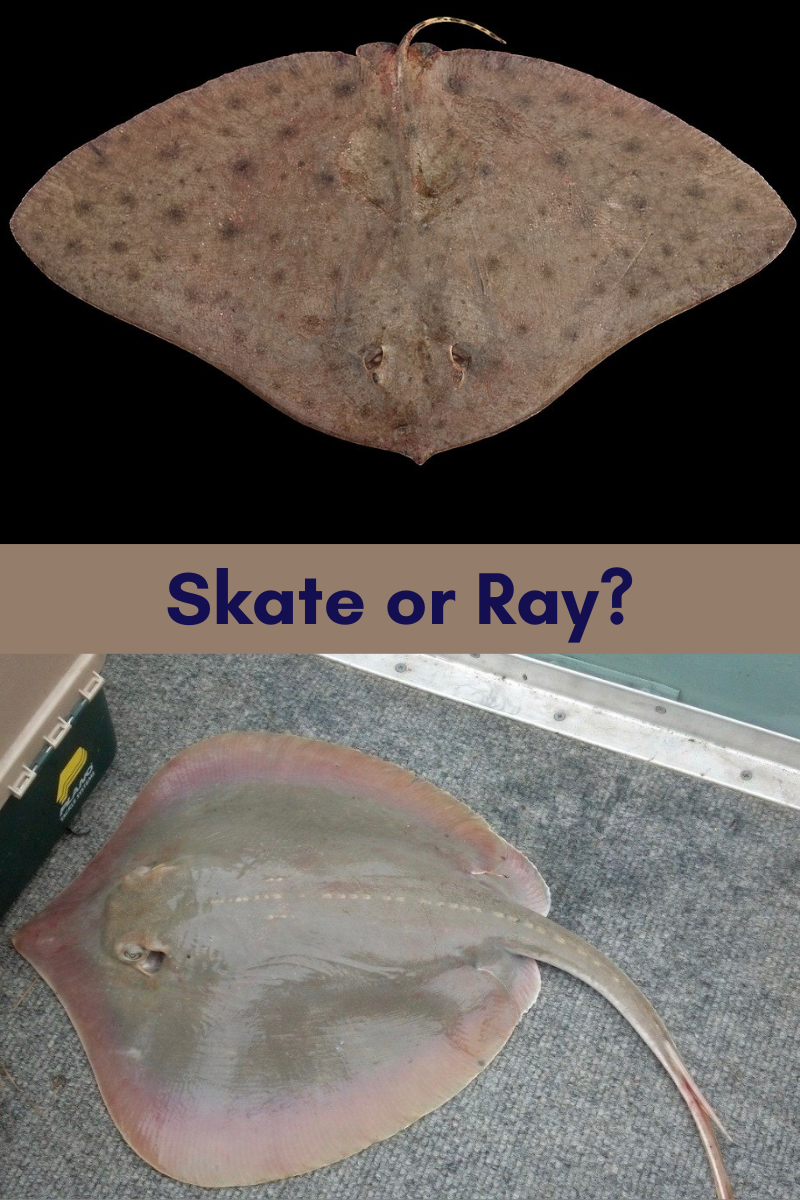
    Quick ID: Ray vs. Skate

    • Rays generally have a whip-like tail; many (not all) have a venomous spine.
    • Skates lack a stinging spine and often have small dorsal fins near the tail tip.
    • Both glide over sand flats, sounds, and estuary mouths where they vacuum up clams, crabs, and small fishes.
    skates and ray anatomical differences
    Credit: Florida Museum

    Atlantic Stingray (Hypanus sabinus) — Our year-round neighbor in the estuary

    Small, spade-shaped, and sand-colored, the Atlantic stingray frequents shallow, warm, and often brackish waters, including the lower New River and surf zones off Topsail. It’s one of the most euryhaline elasmobranchs (tolerant of a wide salinity range), which is why folks see them from tidal creeks to nearshore surf (Johnson & Snelson, 1996).

    When to look: Late spring through fall in very shallow water on warm days (watch for “flying” jumps as they evade predators or parasites).

    Give them space: Shuffle your feet in the shallows to avoid accidental tail-spine contact.

    Diet (Prey): Worms, amphipods, small crustaceans, and mollusks, dug up from the sandy bottom.
    Predators: Large sharks (bull, hammerhead), some large fish (groupers, snappers), and wading birds preying on juveniles.

    Conservation status:

    • IUCN: Least Concern.
    • U.S. Status: Not protected under ESA or CITES; not managed in fisheries.
      Note: Stable populations, though freshwater groups sometimes show reproductive decline tied to water quality.
    hypanus sabinus

    Cownose Ray (Rhinoptera bonasus) — The bronze “wings” of summer

    Bronze-backed and wing-tipped, cownose rays cruise past Topsail in late spring and summer, sometimes in tight schools. Large multi-year telemetry studies show cownose rays migrate seasonally along the Atlantic coast, using mid-Atlantic estuaries for pupping and mating, then overwintering off central Florida (Ogburn et al., 2018).

    Local note: Schools moving along Onslow County beaches are most common mid- to late summer, especially on calm, clear mornings.

    Diet (Prey): Hard-shelled bivalves (clams, oysters, scallops) and crabs, crushed with strong dental plates.
    Predators: Large sharks such as sandbar, bull, and tiger sharks.

    Conservation status:

    • IUCN: Vulnerable.
    • U.S. Status: Not federally protected; some states (e.g., Maryland) have moratoria on killing contests.

    Note: At risk due to low reproductive rates, heavy schooling, and targeted culling in parts of its range.

    Rhinoptera bonasus

    Butterfly Ray (Genus Gymnura) — Rare, paper-thin glider

    Two butterfly rays—smooth butterfly ray and spiny butterfly ray—occur only sporadically here, near the northern edge of their ranges. Long-term sampling in Onslow Bay recorded both species mostly April–November, usually as young individuals (Schwartz, 2011).

    Where to look: Quiet sandy flats adjacent to inlets during warm months—rare sightings, treat them as a bonus.

    Diet (Prey): Small benthic fishes, shrimp, and crabs.
    Predators: Large sharks, particularly sandbar and hammerhead.

    Conservation status:

    • IUCN: Endangered (spiny butterfly ray).
    • U.S. Status: Not listed under ESA or CITES.

    Note: Populations declining globally; extremely rare in NC, where records are incidental.

    Gymnura species

    Clearnose Skate (Raja eglanteria) — The subtle, spotted skate

    Clearnose skates favor our nearshore sandy bottom habitats and show up all year, with peak catches outside the hottest months. In a recent year-round analysis of the North Carolina nearshore elasmobranch community, clearnose skates were among the most abundant species and were often juveniles, highlighting how our inner shelf provides important habitat (Roskar et al., 2024).

    Local tip: Anglers bottom-fishing near the bar or just off the beach encounter skates more often in the cooler seasons.

    Diet (Prey): Worms, amphipods, squid, and small fishes suctioned from the sand.
    Predators: Large sharks (sandbar, sand tiger, smooth dogfish) and occasionally other large rays or skates.

    Conservation status:

    • IUCN: Least Concern.
    • U.S. Status: Not protected individually, but included in the Northeast Skate Complex Fishery Management Plan, from Maine to Cape Hatteras, NC.

    Note: Common, often caught as bycatch; no special protections beyond fishery quotas.

    Raja eglanteria

    Mermaid’s Purses & Season Guide

    Elasmobranch egg cases—often called “mermaid’s purses”—sometimes wash up on our beaches in Onslow County. They are protective capsules laid by skates (relatives of sharks and rays). Each capsule once held a developing embryo. If you find one, it will most likely be an egg casing of a clearnose skate.

    Rays and stingrays (Atlantic stingray, cownose ray, butterfly rays) give birth to live pups—so their egg cases will never be found.
    Skates (like clearnose skate) are oviparous and the main source of egg cases on our shores.

    Clearnose skate egg casing or mermaid's purse

    Seasonal Timing in Onslow County

    SpeciesEgg Case SeasonWhat to Expect on Beaches
    Clearnose SkateSpring–Summer (Apr–Jul)Freshly laid egg cases in spring; more likely to wash ashore in late spring/early summer.
    Little Skate (rare in Onslow)Spring (Apr–May) & Fall (Oct–Dec)Occasionally reported; smaller cases than clearnose.
    Atlantic Stingray, Cownose Ray, Butterfly RaysNoneLive-bearers (no egg cases).

    Environmental Preferences: Temperature & Salinity

    The presence of rays and skates in Onslow County shifts with water temperature and salinity. These factors determine when species move inshore, offshore, or migrate seasonally.

    SpeciesTemperature PreferenceSalinity ToleranceSeasonal Pattern in Onslow Co.
    Atlantic Stingray15–30 °C (59–86 °F); prefers warm shallowsFreshwater → marine (highly euryhaline)Common spring–fall in estuary & surf
    Cownose Ray20–30 °C (68–86 °F)Marine & brackish; avoids freshwaterPeaks summer (Jun–Sep) in schools
    Butterfly Rays20–30 °C (68–86 °F)Marine & estuarineRare, Apr–Nov in warm surf/inlets
    Clearnose Skate10–25 °C (50–77 °F); cooler monthsMostly marine; avoids low salinityMost common fall–spring nearshore
    Smalltooth Sawfish>20 °C (68 °F); cold-sensitiveMarine & brackish estuariesHistorically summer visitor; now extirpated locally

    A seasonal cast: What rotates through Onslow waters and when?

    Multiple studies show our coast hosts a seasonally shifting elasmobranch assemblage—from warm-season rays nearshore to cool-season species on the inner shelf—driven largely by temperature. While many surveys historically emphasized sharks, batoids (rays & skates) make up a large fraction of biomass on our continental shelf, and Onslow’s inner shelf and estuary mouths act as corridors and nurseries through the year (Roskar et al., 2024).

    What about sawfish?

    Smalltooth sawfish (Pristis pectinata)—a ray with a chainsaw-like rostrum—is the most likely sawfish historically near NC, with a U.S. range that once extended to North Carolina. Today, it’s critically endangered and largely restricted to Florida, with only rare Northern reports (Brame et al., 2019).

    Diet (Prey): Small schooling fishes (mullets, herrings) and crustaceans, stunned or stirred up with its saw-like snout.
    Predators: Juveniles preyed on by large sharks; adults have few natural predators.If you ever encounter one, do not handle—it is federally protected.

    Pristis pectinata

    Conservation & Ecology Summary Table

    SpeciesIUCN StatusU.S. StatusPrey (Diet)Predators
    Atlantic Stingray (H. sabinus)Least ConcernNot protectedWorms, crustaceans, mollusksSharks, large fish, birds (juveniles)
    Cownose Ray (R. bonasus)VulnerableNot federally listedClams, oysters, scallops, crabsSharks (bull, tiger, sandbar)
    Clearnose Skate (R. eglanteria)Least ConcernManaged in Northeast Skate FMPWorms, amphipods, squid, small fishSharks, rays, humans (bycatch)
    Spiny Butterfly Ray (G. altavela)EndangeredNo U.S. federal listingSmall fish, shrimp, crabsSharks
    Smalltooth Sawfish (P. pectinata)Critically EndangeredESA Endangered; CITES Appendix ISmall fishes, crustaceansSharks (juveniles); few as adults

    How our community can help

    • Observe & report: Photograph rays, skates, or egg cases (from a safe distance) and note date, location, water conditions.
    • Respect nursery areas: Summer shallows often host juveniles; avoid disturbing resting rays.
    • Support clean water projects: Healthy estuary bottoms = healthy benthic prey = healthier ray & skate populations.

    References

    Brame, A. B., Wiley, T., Carlson, J., Fordham, S., Musick, J., & Grubbs, R. D. (2019). Biology, ecology, and status of the smalltooth sawfish Pristis pectinata in the USA. Endangered Species Research, 39, 9–23. https://doi.org/10.3354/esr00947

    Johnson, M. R., & Snelson, F. F., Jr. (1996). Reproductive life history of the Atlantic stingray, Dasyatis sabina (Pisces, Dasyatidae), in the freshwater St. Johns River, Florida. Bulletin of Marine Science, 59(1), 74–88.

    Ogburn, M. B., Bangley, C. W., Aguilar, R., Fisher, R. A., Curran, M. C., Webb, S. F., & Hines, A. H. (2018). Migratory connectivity and philopatry of cownose rays Rhinoptera bonasus along the Atlantic coast, USA. Marine Ecology Progress Series, 602, 197–211. https://doi.org/10.3354/meps12686

    Roskar, G., Morley, J. W., & Buckel, J. A. (2024). Seasonality and relative abundance within an elasmobranch assemblage near a major biogeographic divide. PLOS ONE, 19(6), e0300697. https://doi.org/10.1371/journal.pone.0300697

    Schwartz, F. J. (2011). Butterfly rays (Gymnuridae) of North Carolina. Journal of the North Carolina Academy of Science, 127(4), 275–284.

    Sulikowski, J. A., Williams, L. J., Kneebone, J., & Tsang, P. C. W. (2022). Rangewide population structure of the clearnose skate Raja eglanteria. Transactions of the American Fisheries Society, 151(2), 143–155. https://doi.org/10.1002/tafs.10351

    NOAA Fisheries. (n.d.). Smalltooth Sawfish (Pristis pectinata). Retrieved 2025, from https://www.fisheries.noaa.gov/species/smalltooth-sawfish