
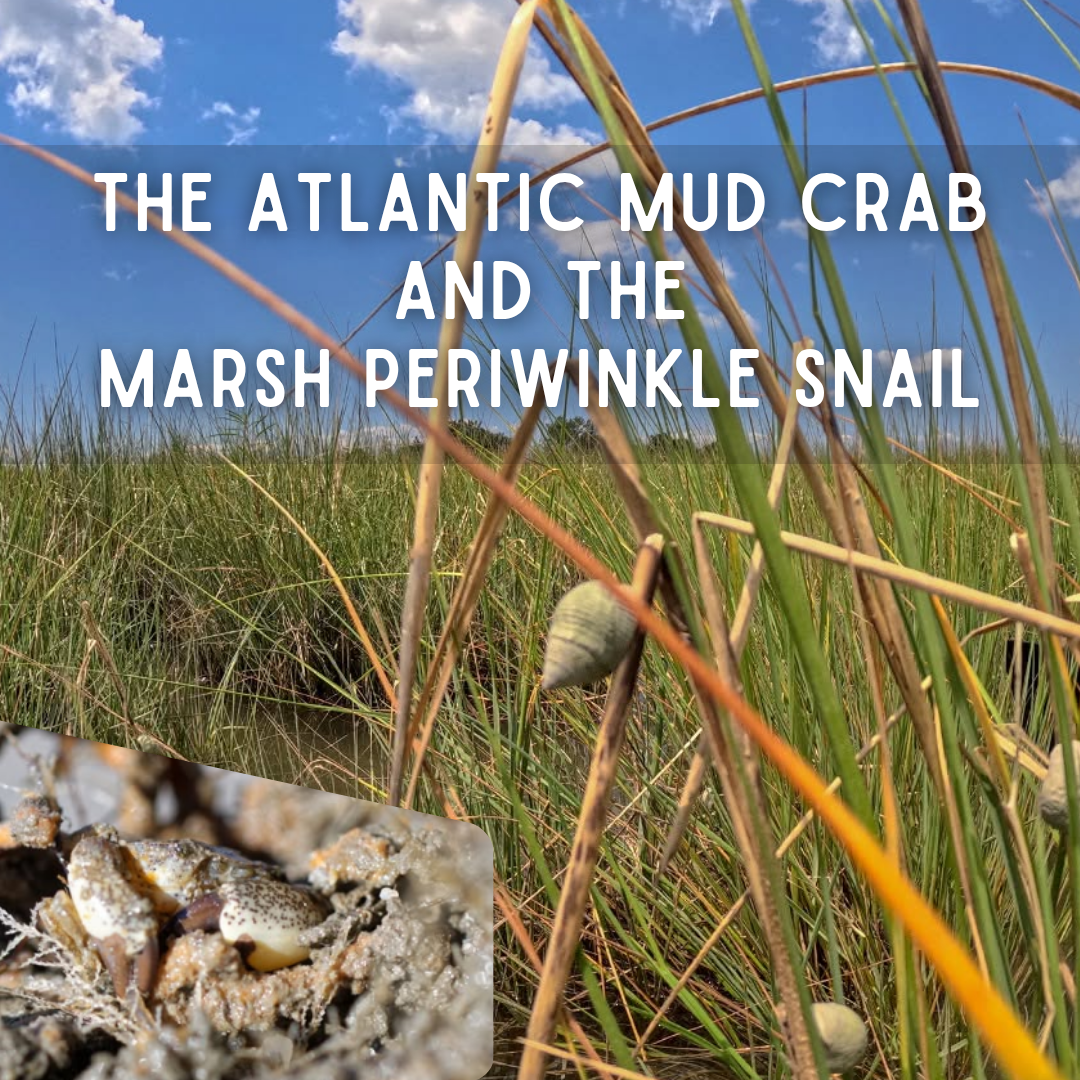
Along the edge of a North Carolina salt marsh, some of the easiest animals to find are also among the easiest to overlook.
Small spiral shells cling to smooth cordgrass, sometimes only inches above the mud and sometimes surprisingly high along the stems. These are marsh periwinkles, Littoraria irrorata, and where they sit changes as the tide moves beneath them. Nearby, oyster shells collect along creek edges and among the vegetation. Beneath one of them may be an Atlantic mud crab, Panopeus herbstii, tucked into a space barely larger than its body.
Neither seems capable of influencing much beyond the few inches it occupies.
Yet the relationship between these two small animals reaches into the grass around them, the sediment beneath them, and eventually the ability of a salt marsh to maintain itself as water levels change.
Both are also indicator species. Their abundance, where they occur, and how they respond to the conditions around them can offer clues about the health of the marsh they share (Fowler & Kingsley-Smith, 2015; Rietl et al., 2018).
For someone walking a boardwalk, paddling a tidal creek, or looking across the marsh on the way to the beach, that makes them particularly interesting. Much of what keeps a salt marsh functioning happens underground, underwater, or so gradually that we never see it happening.
These two animals give us something we can actually watch.
The Snails on the Grass
The marsh periwinkle spends much of its life following the tide up and down the cordgrass.

At lower tides, the snails move down the stems and closer to the marsh surface to feed. When the tide comes back in, fish, crabs, and other aquatic predators come with it. The periwinkles respond by climbing higher on the grass, putting distance between themselves and the hunters now swimming below.
So when you see dozens of little snails perched high on the cordgrass beside a flooded marsh, they did not simply choose a nice place to sit.
They have moved upstairs.

That daily trip between the lower grass and the safety of the upper stems is shaped partly by predators. Where those predators are more common, periwinkles change where they spend their time and may even develop differently under that continued pressure (Rietl et al., 2018).
When the water falls again, the little climbers come back down.

And this is where their job in the marsh becomes especially interesting.
Periwinkles graze across the surface of smooth cordgrass, Spartina alterniflora. One easy way to picture them is as tiny lawnmowers moving through the marsh. They do not clip every blade equally, though. They often favor older, yellowing, or dead cordgrass, helping work through plant material that is already on its way out (Klinges et al., 2025).
But their feeding is not as simple as taking a bite from a blade of grass.
Those scrapes leave small wounds on the cordgrass where fungi can grow. The snails later return to those areas and feed again, consuming the fungal growth along with plant material. When snail numbers and grazing become unusually high, those repeated wounds can contribute to heavier fungal growth and increasing damage to the cordgrass (Silliman & Newell, 2003).
Like a lawn, the important part is not whether the grass is ever cut.
It is how much.
Enough grazing is part of a functioning marsh. Periwinkles belong here, and their feeding is one of many interactions helping shape the plant community. But put too many little lawnmowers in the same patch and they can begin cutting faster than the grass can recover. Cordgrass becomes shorter and thinner, more plant tissue is wounded, and eventually patches can begin to disappear.
Studies in southeastern salt marshes have shown just how far that change can go when predators are removed and periwinkles become unusually abundant. Heavy grazing can contribute to substantial losses of Spartina rather than simply keeping its growth in check (Altieri et al., 2012).
Fewer snails are not automatically better, either. Grazers are part of the balance of the marsh, just as predators are. What matters is that no single part of the relationship overwhelms the others.
And one of the animals helping keep these little lawnmowers in check is usually not up on the grass at all.
It is waiting below.
Beneath the Shell
Atlantic mud crabs, Panopeus herbstii, are much easier to miss.

If you have ever looked among oyster shells at the lower edge of a marsh creek, you have looked directly into the kind of neighborhood they prefer. Mud crabs tuck beneath shell and stones, move over muddy bottoms, and use shallow burrows along marsh edges. They live in estuaries where the water is never quite the same from one day to the next—saltier during some periods, fresher after heavy rain, warmer through summer and cooler through winter. Atlantic mud crabs are remarkably good at living within those changing conditions (Fowler & Kingsley-Smith, 2015).
Before any of that, however, a mud crab begins life somewhere very different.
A newly hatched crab does not look like the crab hiding beneath an oyster shell. It begins as a tiny larva drifting in the water, carried through the estuary while it develops. Eventually it must leave that drifting life behind and settle somewhere suitable.

Finding that place is not entirely luck.
Young mud crabs can respond to signals in the environment that tell them they have reached the kind of habitat where adult crabs live. Oyster shell, rocks, other organisms, and even the thin films of microorganisms coating submerged surfaces can provide chemical and physical clues that encourage the larva to settle and begin the next stage of life (Andrews et al., 2001; Rodriguez & Epifanio, 2000).
Think about what that means for something small enough to drift with the current.
It does not have a map of the marsh.
Instead, the place itself begins to smell and feel right.
Once settled, the crab eventually becomes one of the predators moving through that habitat. Atlantic mud crabs eat oysters, clams, worms, small crustaceans, snails, and whatever other suitable prey they can capture.
And beneath those oyster shells, researchers have found evidence of one meal again and again.
Periwinkles.
In North Carolina salt marshes, researchers found about 80 percent of the Atlantic mud crab lairs they examined beneath live oyster shells. When they looked at prey remains associated with those lairs, marsh periwinkle shells were among the most common finds (Silliman et al., 2004).
Above the shell, the snail moves along the cordgrass.
Below it, the crab waits.
When Predator Meets Grazer
This is where two small animals begin influencing something much larger.
Periwinkles spend part of each tidal cycle higher on the cordgrass, away from aquatic predators. When the water drops and they move lower to feed, they become more accessible to the mud crabs below.
The crabs do not need to climb the grass and chase them.
They simply need to be there when the snails come back down.
Research has shown that Atlantic mud crabs can keep periwinkle numbers lower, and that mud crab predation increases when more periwinkles are available (Silliman et al., 2004). In practical terms, the predator helps keep all of those little lawnmowers from becoming too numerous.
That matters because the crab is indirectly influencing grass it never eats.
More mud-crab predation can mean fewer periwinkles grazing on the cordgrass. Fewer grazers can mean less pressure on the grass. When predators disappear and periwinkles become too abundant, the opposite can happen.
That chain reaction has a scientific name: a trophic cascade.
A change involving a predator works its way through the animals it eats and eventually affects something farther down the food web. In this case, the path is easy to follow:
mud crab → periwinkle → cordgrass.
Studies elsewhere in southeastern salt marshes have shown how dramatic that cascade can become. Where intensive recreational fishing reduced predator numbers, periwinkles became more abundant, grazing increased, and large areas of marsh vegetation were eventually lost (Altieri et al., 2012).
The Atlantic mud crab never takes a bite from the cordgrass.
Yet by eating an animal that does, it helps influence how much grass remains standing.
And keeping that grass standing turns out to matter far beyond the snail and crab.

What the Grass Holds
A salt marsh has to maintain more than vegetation.
It has to maintain ground.
Smooth cordgrass helps slow the water as each tide moves across the marsh. When the water slows, tiny bits of sand, mud, and other material it was carrying can drop out and settle around the grass. Below the surface, the roots and underground stems help hold that ground together, while old plant material breaks down and becomes part of the marsh soil. Little by little, those layers add up and help the marsh keep its height above the water (Reed, 1995; Elsey-Quirk et al., 2011).
That elevation determines how long and how often the marsh floods.
A difference of only a few inches can change the amount of time vegetation spends underwater, the salinity it experiences, and which plants and animals can occupy a particular part of the marsh.
For a marsh facing rising relative sea level, maintaining elevation becomes increasingly important. If sediment deposition and organic-matter accumulation equal or exceed the rate at which the marsh is becoming submerged, vegetation may persist. If elevation cannot keep pace, flooding increases and vegetation can eventually be lost (Reed, 1995).
A salt marsh has a few ways to keep up as water levels rise. It can build upward as new sediment settles among the grass and as roots and other plant material become part of the soil. It can also slowly shift farther inland onto slightly higher ground—if that ground is still available. How well a marsh can do either depends on the place itself: how much sediment reaches it, how well the vegetation is growing, how strong the tides are, how much erosion is occurring, and how quickly local water levels are rising (Kirwan & Mudd, 2012; Fagherazzi et al., 2020).
The important point is that the biological and physical marsh are not separate systems.
The grass affects sediment.
The sediment affects elevation.
Elevation affects flooding.
Flooding affects the plants and animals.
And among the animals affecting that grass are a snail climbing its stems and a crab waiting below.
When the Water Rises Faster
Sea-level rise can feel abstract when we describe it as a number measured in millimeters or as a line on a map showing where water might be decades from now.
A salt marsh makes it easier to understand.
Marsh plants already live with water coming and going every day. They are built for it. But being covered during part of a normal tide is very different from spending more and more time underwater as the average water level rises.
The marsh has two important ways to respond.
It can build upward as sediment and plant material accumulate. Just up the New River at Camp Lejeune, that struggle to maintain marsh elevation can be seen on the ground.
And, where higher undeveloped ground remains beside it, the marsh can gradually move inland.
That second option matters enormously along a developed coastline.
If rising water makes the lowest edge of a marsh increasingly difficult for cordgrass to occupy, suitable marsh vegetation can begin establishing slightly farther inland. Over time, the position of the marsh shifts.
Unless something is already there.
A road does not move uphill for the marsh.
Neither does a house, parking lot, bulkhead, or other hardened shoreline.
When development occupies the higher ground immediately behind a marsh, rising water can begin pressing from one side while development prevents the marsh from moving on the other. Its room to adjust becomes smaller.
What can eventually disappear is not simply an undeveloped patch of grass that might otherwise have held another building.
NOAA’s Sea Level Rise Viewer lets you watch that landward movement—and where it can become constrained—as water levels change.
The marsh was already working.
Salt marshes provide nursery habitat for fishes and crustaceans, trap sediment, store carbon, help stabilize shorelines, and reduce some of the energy moving through shallow coastal water. Their ability to keep doing those things depends upon the marsh itself remaining high enough, vegetated enough, and connected enough to continue functioning (Fagherazzi et al., 2020).
That is one reason decisions about where and how we build along the coast matter beyond the property line.
A marsh does not have to contain a building to have a purpose.
And Then a Storm Arrives
Sea-level rise changes a marsh gradually.
A storm can rearrange parts of it in a day.
Anyone who lives along the North Carolina coast has seen what heavy rainfall alone can do to local water. Creeks swell. Freshwater pours into sounds and estuaries. Salinity drops. A tropical storm or hurricane can add storm surge, waves, erosion, and enough moving water to carry shell, sediment, wrack, and pieces of the marsh itself from one place to another.
Mud can be stripped away from one creek bank and deposited somewhere else.
Oyster shells that were buried may suddenly be exposed.
Shell that once provided hiding places may be covered.
Cordgrass can be flattened, torn loose, buried beneath wrack, or left standing in a slightly different landscape once the water recedes.
Estuary sediments can preserve that history. In North Carolina’s Albemarle estuarine system, sediments record both the slow changes occurring over decades and the sudden rearrangements associated with storms and other major events (Corbett et al., 2007).
For the Atlantic mud crab and periwinkle, those changes can rearrange the places where their relationship happens.
The periwinkle needs the cordgrass.
The mud crab relies on suitable water conditions, prey, and places such as oyster shell and shallow burrows for cover.
Change the grass, move the shell, freshen the water, or reshape the creek edge and the animals must respond to the new version of the marsh that remains.
That does not mean a healthy marsh should never change.
Quite the opposite.
Tides, storms, erosion, sediment deposition, rainfall, and shifting salinity have always been part of coastal marshes.
What matters is whether enough of the living and physical system remains intact for the marsh to adjust afterward.
Two Species That Tell a Larger Story
This is what makes the Atlantic mud crab and marsh periwinkle especially useful animals to know.
They are not simply inhabitants of the marsh. Both have been used as indicators of conditions within the ecosystems they occupy because their abundance, distribution, and responses are connected to environmental conditions and ecological relationships around them (Fowler & Kingsley-Smith, 2015; Rietl et al., 2018).
The periwinkle gives us one view.
It lives directly on the vegetation, responds to tidal flooding and predation, and can exert increasing pressure on cordgrass when predator–prey relationships change.
The Atlantic mud crab gives us another.
Its abundance is associated with habitat structure, prey availability, Spartina characteristics, oyster habitat, temperature, and salinity, while its predation helps influence the abundance of grazers such as the periwinkle (Silliman et al., 2004; Fowler & Kingsley-Smith, 2015).
Together, they give us something particularly interesting.
They allow us to see part of a trophic relationship that reaches from predator to grazer to plant and, through the plant, into processes affecting the physical marsh.
That does not mean finding ten snails instead of five provides a diagnosis of marsh health, or that turning over one oyster shell and finding no crab means something is wrong. Scientific monitoring requires repeated observations, measurements, and knowledge of local conditions.
But it does mean that these animals are worth noticing.
They can make processes that otherwise seem abstract visible.

Looking at the Marsh Differently
The next time you are beside the salt marsh along Surf City, look at the grass before you look across it.
Find the little spiral shells.
Notice whether the tide is in or out and where the periwinkles are sitting along the stems. Look lower, toward the mud and oyster shell around the creek edge, at the little spaces where a mud crab might disappear.
Then look at the marsh around them.
Is the cordgrass thick and continuous? Are there areas where the edge is eroding? Has a storm moved wrack or exposed new shell? Where does the water reach at high tide, and where does the ground begin rising toward houses, roads, or other development?
Those observations do not turn a beach walk into a scientific survey.
They do something simpler.
They let us recognize that the marsh is alive with relationships, and that some of the smallest animals in it can help us understand why the larger landscape looks the way it does.
Somewhere in that system, a periwinkle climbs higher as the tide comes in.
Below it, an Atlantic mud crab remains hidden among the shell.
Most people walking toward the beach will pass both without ever knowing they are there.
But once you know what connects them, they become two small signs of something much larger happening beneath your feet.

References
Altieri, A. H., Bertness, M. D., Coverdale, T. C., Herrmann, N. C., & Angelini, C. (2012). A trophic cascade triggers collapse of a salt-marsh ecosystem with intensive recreational fishing. Ecology, 93(6), 1402–1410. https://doi.org/10.1890/11-1314.1
Andrews, W. R., Targett, N. M., & Epifanio, C. E. (2001). Isolation and characterization of the metamorphic inducer of the common mud crab, Panopeus herbstii. Journal of Experimental Marine Biology and Ecology, 261(1), 121–134. https://doi.org/10.1016/S0022-0981(01)00268-4
Corbett, D. R., Vance, D., Letrick, E., Mallinson, D., & Culver, S. J. (2007). Decadal-scale sediment dynamics and environmental change in the Albemarle estuarine system, North Carolina. Estuarine, Coastal and Shelf Science, 71(3–4), 717–729. https://doi.org/10.1016/j.ecss.2006.09.024
Elsey-Quirk, T., Seliskar, D. M., Sommerfield, C. K., & Gallagher, J. L. (2011). Salt marsh carbon pool distribution in a Mid-Atlantic lagoon, USA: Sea level rise implications. Wetlands, 31(1), 87–99. https://doi.org/10.1007/s13157-010-0139-2
Fagherazzi, S., Mariotti, G., Leonardi, N., Canestrelli, A., Nardin, W., & Kearney, W. S. (2020). Salt marsh dynamics in a period of accelerated sea level rise. Journal of Geophysical Research: Earth Surface, 125(8). https://doi.org/10.1029/2019JF005200
Fowler, A., & Kingsley-Smith, P. (2015). Atlantic mud crab, Panopeus herbstii (H. Milne Edwards 1834). Supplemental Volume: Species of Special Conservation Concern, South Carolina State Wildlife Action Plan.
Kirwan, M. L., & Mudd, S. M. (2012). Response of salt-marsh carbon accumulation to climate change. Nature, 489(7417), 550–553. https://doi.org/10.1038/nature11440
Klinges, D. H., Martin, C. W., & Roberts, B. J. (2025). Ecological associations of the coastal marsh periwinkle snail Littoraria irrorata: Field and laboratory evidence of vegetation habitat preferences. PeerJ, 13, e19071. https://doi.org/10.7717/peerj.19071
Reed, D. J. (1995). The response of coastal marshes to sea-level rise: Survival or submergence? Earth Surface Processes and Landforms, 20(1), 39–48. https://doi.org/10.1002/esp.3290200105
Rietl, A. J., Sorrentino, M. G., & Roberts, B. J. (2018). Spatial distribution and morphological responses to predation in the salt marsh periwinkle. Ecosphere, 9(6), e02316. https://doi.org/10.1002/ecs2.2316
Rodriguez, R., & Epifanio, C. E. (2000). Multiple cues for induction of metamorphosis in larvae of the common mud crab, Panopeus herbstii. Marine Ecology Progress Series, 195, 221–229. https://doi.org/10.3354/meps195221
Silliman, B. R., Layman, C. A., Geyer, K., & Zieman, J. C. (2004). Predation by the black-clawed mud crab, Panopeus herbstii, in Mid-Atlantic salt marshes: Further evidence for top-down control of marsh grass production. Estuaries, 27(2), 188–196. https://doi.org/10.1007/BF02803375