
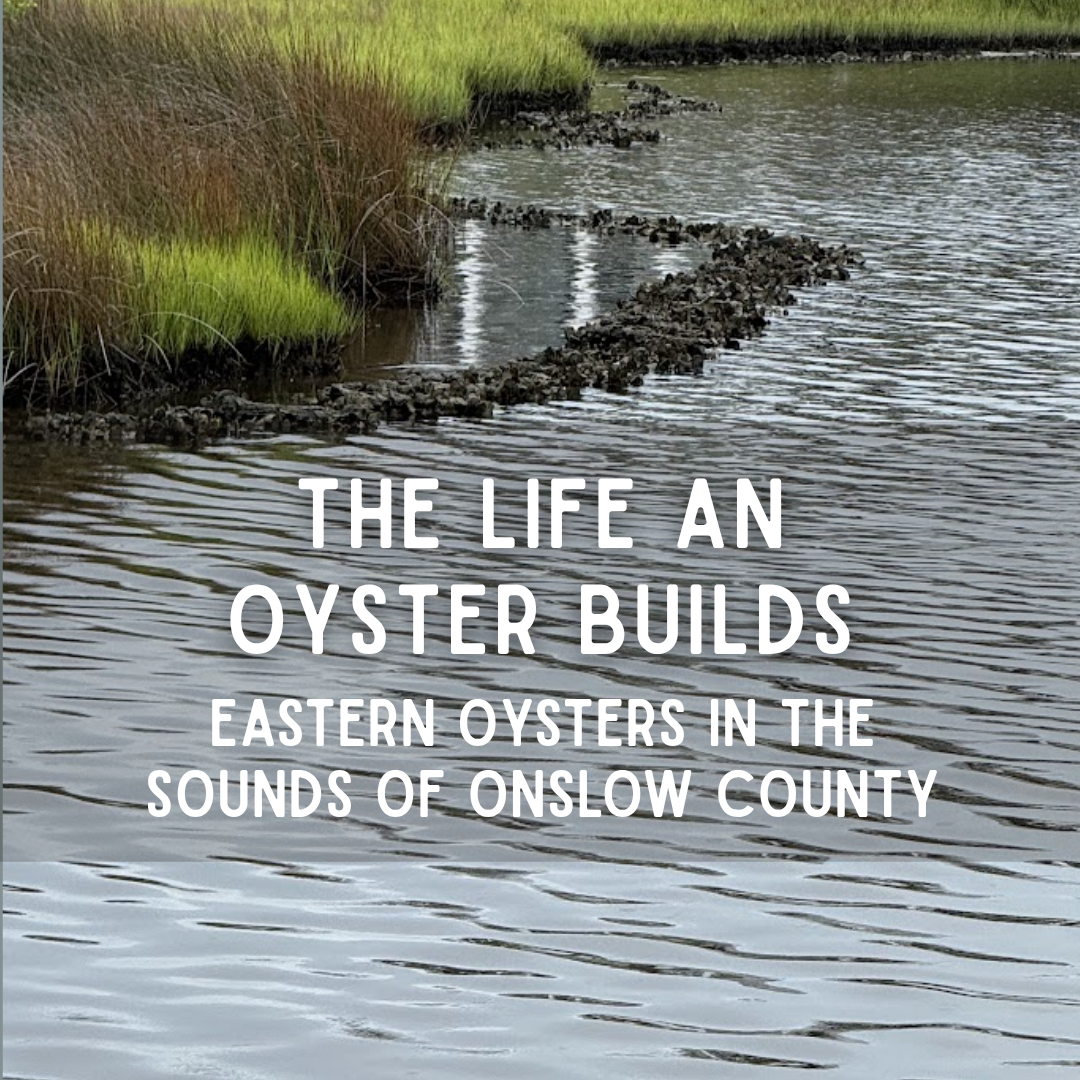
At low tide, an oyster reef can look like the remains of something rather than the beginning of it.
Gray shells rise unevenly from the mud. Some are tightly closed, their animals hidden inside. Others have been opened by predators, weakened by sponges, broken by waves, or left behind by oysters that died years before. Barnacles spread across their ridges. Mud crabs retreat into the narrow spaces between them. Small fish hold near the edges until the falling water carries them toward deeper channels.
Nothing about the reef appears to be moving.
Yet movement is what brought every oyster there.
The eastern oyster, Crassostrea virginica, begins life drifting through the water, small enough to travel wherever tides, winds, and currents carry it. For its first few weeks, it has no permanent place in the sound and no guarantee that it will ever find one.
Then, if it survives long enough, it must stop.
Once an oyster attaches, it will remain in that exact place through changing tides, heavy rain, summer heat, predators, disease, sediment, harvest, and whatever else the sound sends across its gills.
It cannot search for better water.
It cannot climb away from the mud.
It cannot leave when the season changes.
Its life depends upon finding the right place once—and upon what earlier oysters left there before it arrived.
Before the Oyster Has a Shell We Recognize
During the warmer months, adult oysters release eggs and sperm directly into the surrounding water. Fertilization takes place outside the shell, producing microscopic embryos that soon become part of the plankton.
They do not yet resemble the oysters exposed along a low-tide reef.
They are small, mobile, and carried almost entirely by the water around them.

| Image credit: NOAA Fisheries
Over the next two to three weeks, the larvae pass through several stages while tides move them through the estuary. A larva may be carried from a reef into a creek, pushed toward a marsh edge by wind, or swept farther downriver as freshwater moves through the system. Some remain close to the place where they were spawned. Others may settle in another part of the sound entirely (Hillman & Galtsoff, 1965; Kennedy, 1996).
Most never reach that point.
They are eaten by other plankton-feeding animals. They arrive in water they cannot tolerate. They sink onto soft mud where no hard surface remains exposed. They may reach the bottom only to be buried before they can attach.
An adult female may release millions of eggs during a spawning season (Kennedy, 1996).
That number does not describe how easily oysters survive.
It reveals how many beginnings the estuary loses.
Near the end of its drifting life, the larva develops a temporary foot and begins testing the surfaces below it. It is searching for something firm enough to hold it above the mud.
Stone, concrete, marl or limestone may work. But old oyster shell offers something more familiar: a hard surface already shaped by the reef and positioned where another oyster once managed to survive (Theuerkauf et al., 2015).
When the larva finds that surface, it cements itself permanently in place. Its drifting life ends, and it becomes a juvenile oyster called spat.
This arrival of a new generation is called recruitment (Kennedy, 1996).
But spawning alone does not create recruitment. Larvae must survive the water, find a surface, attach, and remain alive after settlement.
The difference between a river filled with oyster larvae and a river rebuilding an oyster reef lies in what those larvae find when they are finally ready to stop.
The Place Where It Stops
Once attached, the young oyster becomes part of a world that moves around an animal that cannot.
Water enters between its two valves and passes across the gills. Microscopic cilia guide suspended particles toward the mouth, where the oyster sorts what has arrived. Some particles become food. Others are bound in mucus and rejected.
Eastern oysters feed largely on phytoplankton—microscopic algae suspended within the water—although they may also consume bacteria, protozoans, organic material, and other particles small enough to use (Hillman & Galtsoff, 1965; Kennedy et al., 1996).
This is the process we describe when we say an oyster filters water.
The oyster is not cleaning the sound as a separate service.
It is trying to eat.
The oyster therefore lives within a constant exchange between opportunity and risk. The same tide that carries food may bring saltier water, predators, larvae, sediment, or disease. Rainfall may lower salinity enough to offer relief from some marine organisms while forcing the oyster to remain closed. Warmer water may support rapid growth while increasing the demands placed upon the animal.

None of those conditions remains fixed.
New River does not carry the same water after several dry weeks that it carries after days of heavy rain. Stump Sound does not behave the same near an inlet as it does within a quieter creek. Wind may hold water against one shoreline, while the tide pulls it away from another.
A few feet of elevation within the reef can matter as well.
An oyster growing near the upper surface receives more moving water and remains farther above accumulating sediment. Another only inches lower may be repeatedly coated with mud.
To us, both oysters appear to occupy the same reef. To the oysters, they may inhabit very different places (Kinsella, 2019; Kennedy et al., 1996).
Growing Where It Landed
A newly settled oyster begins with a thin shell and almost no control over what happens next.
Mud crabs can crush it. Small predators can peel it from the surface. Barnacles, mussels, tunicates, algae, and neighboring oysters compete for the same exposed space. A layer of sediment thin enough to overlook from above may bury an oyster that has only recently become visible (Theuerkauf et al., 2015).
If it survives, its shell begins to thicken.
The oyster does not grow into the smooth, symmetrical form we might expect from something sold on ice. Wild oysters take the shape their surroundings allow. They grow around one another, into narrow openings, across old shell, and toward whatever space remains exposed to the water (Theuerkauf et al., 2015).
Those ridges and uneven curves are not mistakes. They are the record of a life lived without moving.
As neighboring oysters grow together, their shells begin to lock into a larger structure. Spaces open among them. Mud crabs disappear into the crevices. Blennies, gobies, worms, shrimp, barnacles, and anemones occupy surfaces the oysters created simply by surviving in the same place (Theuerkauf et al., 2015).
The reef is not built according to a plan. It emerges from generation after generation solving the same problem together: stay above the mud, remain exposed to moving water, and leave another hard surface behind.
In North Carolina, an oyster may reach the legal market size of three inches in approximately two to three years, although the actual rate varies greatly among locations and between wild and cultivated oysters (North Carolina Division of Marine Fisheries, 2022).
A farmed oyster may be raised above the bottom, protected within bags or cages, cleaned of fouling organisms, and tumbled to create a deeper, more uniform shell. A wild oyster receives no such adjustment. It grows wherever its larval journey ended. That difference helps shape the shell, but the water still shapes both (Kinsella, 2019).
Neither escapes the sound.
When an Oyster Becomes Part of a Place
An oyster growing in New River is the same species as one growing elsewhere along the Atlantic Coast.
But place leaves a mark.
The water moving through the river, the sediment beneath the reef, the distance from the inlet, and the crowded shells around it all influence how an oyster grows. Over time, those conditions can produce oysters recognized not only by species, but by where they came from.
By the beginning of the twentieth century, people were speaking of the New River oyster as something distinctive.
At a fisheries convention held in New Bern in 1911, speakers described New River oysters as unusually large and desirable. The largest were called “whoppers,” and one account placed them among the finest oysters produced along the Atlantic Coast (North Carolina Geological and Economic Survey, 1911).

The description carried some salesmanship. The convention was intended partly to persuade state leaders that North Carolina’s fisheries needed attention and reform. Still, the language reveals something important.
People believed New River produced an oyster worth naming.
The largest were being packed and shipped to markets in Washington, Baltimore, Philadelphia, and New York. Meanwhile, oysters sold closer to the river were sometimes mixed with smaller harvests brought from Myrtle Grove and Stump sounds (North Carolina Geological and Economic Survey, 1911).
The oysters that had come to represent New River were leaving it, and their size made that loss more important than it first appeared.

Eastern oysters do not always remain permanently male or female. Many begin reproductive life as males and later function as females, although individuals may change more than once. Size, age, energy reserves, and surrounding conditions all influence that development (Kennedy, 1996).
Larger females can produce far more eggs than smaller oysters. Older oysters have also survived enough seasons to reproduce repeatedly, add height to the reef, and build shells larger than those they inherited (Kennedy, 1996).
Every whopper removed from New River was therefore more than a large meal.
It was a potential parent, part of the reef’s living height, and one more shell that might eventually have given another oyster somewhere to stop (Kinsella, 2019).
The Reefs People Returned To
The New River oyster had acquired a modern name, but the relationship between people and these reefs was already ancient.
Archaeological sites along the coast preserve part of that relationship. Some contain shell middens—places where oyster and clam shells accumulated alongside fish bones, tools, ceramics, charcoal, hearth remains, and other traces of daily life. A midden may appear at first to be little more than a pile of discarded shell (Claassen-MacClelland, 1979).

It is also evidence of repeated return.
People harvested oysters from particular waters, carried them away from the reef, prepared them near homes or gathering places, and left the shells behind. Layer upon layer, those remains show that shellfish were not an occasional food gathered at the edge of an otherwise land-based life. They were part of how people lived beside the estuary.
The shells may also preserve clues about the waters in which the oysters grew. Their size, shape, growth, chemistry, and attached organisms can reflect earlier environmental conditions (Mouchi et al., 2025).
But a midden is not a direct picture of an ancient reef. People selected the oysters they wanted, harvested some places more often than others, and transported shell away from the water. Erosion, development, soil chemistry, and the uneven reach of archaeological surveys further shaped what remained available to find (Claassen-MacClelland, 1979).
The record cannot tell us exactly how many oysters lived in New River at any one time. It tells us that oysters were abundant enough, reliable enough, and important enough for people to return to them across generations.
By the late nineteenth century, those familiar oyster grounds were also becoming mapped resources.
During the 1880s, Lieutenant Francis Winslow’s surveys began translating North Carolina’s naturally productive oyster bottom into measured boundaries, distinguishing public oyster rocks from areas that might be opened to private cultivation (North Carolina Geological Survey, 1887).

Winslow’s most extensive work focused on the large sounds of northeastern North Carolina, but the surveys reflected a broader change along the coast. Reefs known through experience and repeated use were being placed within lines that could determine where oysters were harvested, cultivated, leased, or protected.
Decades later, federal surveyors mapped oyster reefs in New River for another reason.
In 1933, the U.S. Coast and Geodetic Survey charted the river and its tributaries from the inlet toward Jacksonville. Its surveyors recorded channels, shoreline features, depths, and anything a vessel might encounter.
Some oyster reefs rose high enough to matter.

Features shown with the symbol commonly used for rocks awash were identified in the survey records as oyster rocks exposed or washed over at normal low water (U.S. Coast and Geodetic Survey, 1933).
These were not isolated shells scattered across the bottom. They were reefs substantial enough to interrupt navigation and become part of the charted river.
The charts cannot tell us how many living oysters occupied each reef, whether the reefs were still growing, or how much had already been lost to harvest and shell removal. They show what remained visible enough to measure.
At low tide, generations of oysters became geography.

What Was Taken With the Oyster
The living oysters were not the only useful part of the reef.
Their shells could be burned into lime, spread onto agricultural land, crushed into roads, or used in construction. Once carried away from the sound, however, those shells could no longer become part of another oyster generation (Carter et al., 2006).
The reef was harvested twice.
First came the oyster.
Then came the place where its descendants might have settled.
This was the deeper loss behind the warnings raised at the 1911 fisheries convention. Participants were not only concerned that large New River oysters were disappearing from local markets. They also discussed the importance of leaving or returning shell to the water.
One proposal called for shell to be replaced according to the number of oysters removed (North Carolina Geological and Economic Survey, 1911).
The larva explains why.
A high reef keeps much of its shell exposed above the soft bottom. Water moves through the spaces between oysters. Young spat settle onto hard surfaces rather than disappearing into mud. Crabs and fish occupy openings that persist even after the animals that formed them die (North Carolina Division of Marine Fisheries, 2022; Theuerkauf et al., 2015).
Fewer oysters leave less shell. Less shell gives fewer larvae somewhere to stop (North Carolina Division of Marine Fisheries, 2022; Theuerkauf et al., 2015).
The reef does not simply lose its occupants. It loses the architecture required to replace them.
Returning What the Larva Needed
By 1911, fisheries representatives were warning that New River’s celebrated oysters were disappearing and that the shell removed with them needed to be returned to the water. Four years later, North Carolina began formally planting cultch onto oyster grounds (Daniel, 2015; North Carolina Geological and Economic Survey, 1911).
The reasoning was simple. Oyster larvae could still drift through the estuary, but without exposed hard surface, many had nowhere to settle.
At first, the material returned was largely oyster shell. It had already supported one oyster above the bottom, and its rough surface could support another. Shell recycling continues that same exchange by returning to the water what might otherwise leave the estuary as waste.
But replacing shell does not automatically rebuild a reef.
Loose shell may sink into soft sediment, scatter during storms, or become coated with mud before larvae arrive. Even after settlement, young oysters remain vulnerable to predators, boring sponges, poor water quality, burial, and the changing bottom beneath them (Daniel, 2015; Theuerkauf et al., 2015).
As those limits became clearer—and as clean shell became less available—restoration expanded to include marl, limestone, concrete, and manufactured structures. These materials do not replace oyster shell in every way, but their weight and shape may help them remain exposed where loose shell would sink or shift (Daniel, 2015; Theuerkauf et al., 2015).
Protected reefs and sanctuaries address a different loss. They give oysters time to grow, reproduce, die, and leave their shells where they settled. Over multiple generations, living oysters and empty shell can accumulate into the height and complexity that a newly planted surface does not yet possess (North Carolina Division of Marine Fisheries, 2022).
Aquaculture creates another kind of oyster landscape. Farms may raise oysters above the bottom in bags or cages, reducing some risks from burial and bottom-dwelling predators while producing a marketable crop. The oysters remain connected to the surrounding sound, but the structure is managed around growth and harvest rather than the long accumulation of shell within a natural reef (Kinsella, 2019).
The oysters grown there may be diploid, triploid, or selectively bred for traits such as faster growth, improved shell shape, summer body condition, or resistance to particular diseases. Those choices influence more than the oysters eventually harvested.

Triploids devote far less energy to reproduction and usually contribute fewer larvae to surrounding waters. That can reduce the movement of farm-selected genetics into wild populations, but it also means that a farm containing many living oysters may contribute relatively little to the next generation settling beyond its cages. Selective breeding creates a different tradeoff. By choosing which oysters become broodstock, hatcheries repeatedly reproduce some traits while others present in the broader population are not carried forward in that line (Matt et al., 2025). If those cultured oysters are fertile, their larvae may mix with nearby wild populations and influence the genetic makeup of later generations (Varney et al., 2018).
A trait useful on a farm is not necessarily useful under every condition outside it. An oyster selected for rapid growth, shell shape, or survival against one disease may not be equally suited to burial, predators, storms, low salinity, or another disease on unmanaged bottom. Selection can strengthen a desired trait without preserving every form of variation that helps a wild population respond to an uncertain estuary (Matt et al., 2025).
A restored reef, a sanctuary, and an oyster farm may all place or protect oysters within the same estuary. They are not identical structures, and they do not ask oysters to serve the same purpose.
Cultch returns a place to settle. Heavier material helps that place remain exposed. Sanctuaries provide time for oysters and shell to accumulate. Recycling keeps old shell within the cycle. Aquaculture raises oysters above some hazards while supporting a working fishery.
Each approach returns something.
None returns everything an old reef contained.

A Coast That Does Not Hold Still
New River and Stump Sound have never been stationary places.
The same barrier-island processes that shape them today—shifting inlets, storms, tides, freshwater flow, erosion, and moving sediment—also surrounded the reefs that once produced New River’s “whopper” oysters. Channels changed, shell was buried and exposed, and salinity rose and fell long before oyster restoration began.
Yet those earlier reefs persisted.
Their stability did not come from an unchanging coast. It came from abundance. Large numbers of oysters spawned into the water, while generations of living and dead shell held parts of the reef above the mud. Losses in one season could be followed by settlement in another. A storm might damage one portion of a reef while exposing shell elsewhere. Enough adults, larvae, and hard surface remained for the structure to continue rebuilding itself.
That capacity changes as reefs become smaller, lower, or more widely separated.
A reduced reef produces fewer larvae and offers less exposed shell when those larvae are ready to settle. A newly planted reef may provide hard surface, but it does not immediately contain the height, age structure, reproductive adults, or accumulated generations of shell found in an older reef. It must develop those qualities while the estuary continues to move around it (North Carolina Division of Marine Fisheries, 2022; Theuerkauf et al., 2015).
Restoration does not begin after that movement has ended.
It happens inside it.
A successful settlement may be followed by storm-driven burial. Repeated rainfall may lower salinity, while drought can allow disease and saltwater predators to move farther upriver. Dredging or a shifting channel may alter the current carrying food and larvae across the reef. A sanctuary can prevent harvest, and heavier material may resist sinking, but neither can supply suitable water or guarantee that enough oysters will survive and reproduce (Ben-Horin et al., 2024; Ford & Tripp, 1996; Kinsella, 2019).

This is why restoration does not move in a straight line from damaged to rebuilt. Its outcome depends not only on whether shell or another material was placed in the water, but on what develops there afterward: how many larvae arrive, which oysters reproduce, how much shell remains exposed, and whether the reef can begin replacing its own losses (North Carolina Division of Marine Fisheries, 2022; Theuerkauf et al., 2015).
At low tide, an old reef and a newly restored one may both appear to be fixed patches of shell.
The difference lies in what each can carry forward when the coast moves again.

What the Shell Cannot Tell Us
An oyster growing along the edge of a creek does not look different when the water around it closes to harvest.
Its shell may remain tightly shut at low tide. It may continue feeding when the water returns, adding new growth along its edge and sharing the reef with oysters that appear equally healthy. Nothing visible in the animal tells us whether the surrounding water is approved for harvest, temporarily closed after heavy rain, part of a private lease, or prohibited from direct harvest altogether.
Those distinctions exist on maps rather than shells.

Shellfish-growing classifications reflect what may enter the water from the land around it: runoff, wastewater systems, marinas, shoreline development, rainfall, currents, and freshwater moving through the estuary. Some areas remain generally open. Others may be harvested only while certain conditions are met, and some remain closed because the risk of contamination is too great (Coulliette & Noble, 2008).
The oyster experiences the water itself, not the line drawn around it.
It may continue to grow in water from which people cannot safely gather it. Contaminants and naturally occurring bacteria do not always change its appearance, smell, or taste. A reef can therefore look alive and productive while the oysters growing there are not legally—or safely—available for someone walking past at low tide.
The old advice to eat oysters only during months containing the letter “R” cannot reveal those conditions either.
The saying reaches back to a time when cool weather made harvested oysters easier to store and transport before reliable refrigeration (Purvis, 2025). It also follows the seasonal life of wild diploid oysters, which use much of their stored energy for reproduction during warmer months and may become thinner or more watery after spawning. Triploid farmed oysters reproduce far less and may retain fuller bodies through summer (Bodenstein et al., 2023).
But the spelling of the month does not tell us where an oyster grew or what happened after it left the water.
Warm conditions increase concerns from naturally occurring Vibrio bacteria (Froelich & Noble, 2016), while heavy rainfall, wastewater failures, harmful algal blooms, and other contamination can affect shellfish waters in any season (Coulliette & Noble, 2008; Rolton et al., 2022). A legally harvested oyster from monitored water may be sold during a month without an “R.” An oyster gathered from closed water in January may still be unsafe (Coulliette & Noble, 2008; Purvis, 2025).

Image credit: Northwest Fisheries Science Center
What matters is less visible: where the oyster was harvested, whether that water was open at the time, the tag identifying the shellfish lot, and how quickly the oysters were cooled and handled (U.S. Food and Drug Administration, 2023).
A drifting larva cannot see any of those boundaries or classifications. It encounters water, sediment, predators, and whatever hard surface remains exposed when it is ready to settle.
Only later do people draw lines around the place where it stopped.
What the Reef Keeps
Eventually, the oyster dies.
Its soft body may be eaten or disappear after a predator opens the shell. The shell remains longer. Barnacles spread across it. A mud crab settles beneath one edge, while a small fish slips into the space between it and the next shell.
Waves may break it. Sediment may bury it. A storm may expose it again years later. It may leave the sound with a harvested oyster, return as recycled cultch, or remain where the animal spent its entire attached life.
If it stays within the reef, death changes the oyster’s role without ending it.
The living animal once fed, reproduced, and added new shell along its growing edge. The empty shell now helps hold the reef above the bottom, preserves shelter for other animals, and offers hard surface to larvae still drifting through the sound.
This is what connects the old New River oyster rocks, the shells carried away, the cultch returned, and the reefs still being restored and protected today. The modern oyster landscape has changed, but the next generation still depends upon the same inheritance.
A larva begins with nowhere to belong.
After weeks carried through water it cannot control, it reaches the reef and touches shell. The surface may belong to an oyster that died the previous summer. Beneath it may lie another shell worn by years of tides, and beneath that, fragments left by generations no one saw alive.
The larva cannot know how the reef began or what people have done to preserve it.
It only knows that the surface holds.
The drifting ends, and another life becomes fixed to the history beneath it.
At low tide, the reef may still look like the remains of something. Look closer, and there is no clean line between an ending and a beginning.
What one generation leaves changes what the next can become.

References
Ben-Horin, T., Ciesielski, M., Lucas, J., Noble, R. T., & Wilbur, A. (2024). Pathology associated with summer oyster mortality in North Carolina. Aquaculture Reports, 34, 101901. https://doi.org/10.1016/j.aqrep.2023.101901
Bodenstein, S., Casas, S. M., Tiersch, T. R., & La Peyre, J. F. (2023). Energetic budget of diploid and triploid eastern oysters during a summer die-off. Frontiers in Marine Science, 10. https://doi.org/10.3389/fmars.2023.1194296
Carter, K., Stevenson, Jr., G., & Stick, D. (2006). Shellfish. NCpedia. https://www.ncpedia.org/shellfish
Claassen-MacClelland, C. P. (1979, November). Prehistoric occupation on the central and southern coast of North Carolina: Two hypotheses [Paper presentation]. Annual Meeting of the Southeastern Archaeological Conference, Atlanta, GA.
Coker, R. E. (1907). Experiments in oyster culture in Pamlico sound, North Carolina (Bulletin No. 15). North Carolina Geological and Economic Survey. https://files.nc.gov/ncdeq/Energy%20Mineral%20and%20Land%20Resources/Geological%20Survey/Bulletins_NCGS/NCGS_Bulletin_15_Oyster_Culture_in_Pamlico_Sound.pdf
Coulliette, A. D., & Noble, R. T. (2008). Impacts of rainfall on the water quality of the Newport river Estuary (Eastern North Carolina, USA). Journal of Water and Health, 6(4), 473-482. https://doi.org/10.2166/wh.2008.136
Daniel, L. B. (2015, March). The N.C. experience: The history of oyster management over the past century [Paper presentation]. North Carolina Oyster Summit, North Carolina Coastal Federation, Raleigh, NC.
Ford, S. E., & Tripp, M. R. (1996). Diseases and defense mechanisms. In V. S. Kennedy, R. I. E. Newell, & A. F. Eble (Eds.), The eastern oyster: Crassostrea virginica (pp. 581-660). Maryland Sea Grant College.
Froelich, B. A., & Noble, R. T. (2016). Vibrio bacteria in raw oysters: Managing risks to human health. Philosophical Transactions of the Royal Society B: Biological Sciences, 371(1689), 20150209. https://doi.org/10.1098/rstb.2015.0209
Gerard, P. (2016, May 11). History: The great oyster war. Our State. https://www.ourstate.com/history-great-oyster-war/
Hillman, R. E., & Galtsoff, P. S. (1965). The American oyster, Crassostrea virginica Gmelin. Chesapeake Science, 6(3), 199. https://doi.org/10.2307/1350854
Kennedy, V. S. (1996). Biology of larvae and spat. In V. S. Kennedy, R. I. E. Newell, & A. F. Eble (Eds.), The eastern oyster: Crassostrea virginica (pp. 371-421). Maryland Sea Grant College.
Kennedy, V. S., E. Newell, R. I., & Eble, A. F. (1996). The eastern oyster: Crassostrea virginica. Maryland Sea Grant College.
Kinsella, J. D. (2019). Environmental effects on cultured oyster Crassostrea virginica: Implications for filtration capacity and production [Unpublished master’s thesis]. University of North Carolina Wilmington.
Matt, J. L., Small, J. M., Kube, P. D., & Allen, S. K. (2025). Quantitative genetic analysis of late spring mortality in triploid Crassostrea virginica. Genetics Selection Evolution, 57(1). https://doi.org/10.1186/s12711-025-00965-3
Mouchi, V., Andrus, C. F., Checa, A. G., Elliot, M., Griesshaber, E., Hausmann, N., Huyghe, D., Lartaud, F., Peharda, M., & De Winter, N. J. (2025). Oyster shells as archives of present and past environmental variability and life history traits: A multi‐disciplinary review of sclerochronology methods and applications. Limnology and Oceanography Letters, 10(2), 179-199. https://doi.org/10.1002/lol2.10461
North Carolina Department of Environmental Quality. (n.d.). Artificial reefs. NC Dept. of Environmental Quality. Retrieved August 1, 2026, from https://www.deq.nc.gov/about/divisions/marine-fisheries/public-information-and-education/coastal-fishing-information/artificial-reefs
North Carolina Division of Marine Fisheries. (2022). Eastern oyster fishery management plan: Amendment 4. North Carolina Department of Environmental Quality. https://www.deq.nc.gov/marine-fisheries/fisheries-management/annual-fmp-review/2022/eastern-oyster/open
North Carolina Geological and Economic Survey. (1911). Report of the fisheries convention held at New Bern, North Carolina, December 13, 1911. Edwards & Broughton Printing Company. https://digital.lib.ecu.edu/16832
North Carolina Geological Survey. (1887). Report on the waters of North Carolina, with reference to their possibilities for oyster culture. State of North Carolina. https://doi.org/10.5962/bhl.title.49874
Puckett, B. (2025). Collaborative development of Uncrewed aerial system approaches to assess intertidal oyster reefs to inform management and restoration. NCCOS – National Centers for Coastal Ocean Science. https://coastalscience.noaa.gov/project/collaborative-development-of-uncrewed-aerial-system-approaches-to-assess-intertidal-oyster-reefs-to-inform-management-and-restoration/
Purvis, K. (2025, July 21). ‘R’ you ready to eat oysters all year long? The Assembly NC. https://www.theassemblync.com/news/culture/food/oysters-year-round-north-carolina/
Rolton, A., Rhodes, L., Hutson, K. S., Biessy, L., Bui, T., MacKenzie, L., Symonds, J. E., & Smith, K. F. (2022). Effects of harmful algal blooms on fish and shellfish species: A case study of New Zealand in a changing environment. Toxins, 14(5), 341. https://doi.org/10.3390/toxins14050341
Smith, S., Ciesielski, M., Clerkin, T., Ben-Horin, T., & Noble, R. T. (2025). Farmed oyster mortality follows consistent vibrio community reorganization. mSystems, 10(10). https://doi.org/10.1128/msystems.01078-25
Theuerkauf, S. J., Burke, R. P., & Lipcius, R. N. (2015). Settlement, growth, and survival of eastern oysters on alternative reef substrates. Journal of Shellfish Research, 34(2), 241-250. https://doi.org/10.2983/035.034.0205
U.S. Coast and Geodetic Survey. (1933). Descriptive report: Topographic survey sheets 4721–4725, New River, North Carolina (HT-113). U.S. Department of Commerce. https://www.ngs.noaa.gov/desc_reports/T04721.pdf
U.S. Food and Drug Administration. (2023). National Shellfish Sanitation Program (NSSP) Guide for the Control of Molluscan Shellfish 2023 Revision. https://www.fda.gov/media/181370/download
Varney, R. L., Watts, J. C., & Wilbur, A. E. (2018). Genetic impacts of a commercial aquaculture lease on adjacent oyster populations. Aquaculture, 491, 310-320. https://doi.org/10.1016/j.aquaculture.2018.03.060
Winslow, F. (1885). Report of the Waters of North Carolina with reference to their Possibilities for Oyster Culture. P. M. Hale.