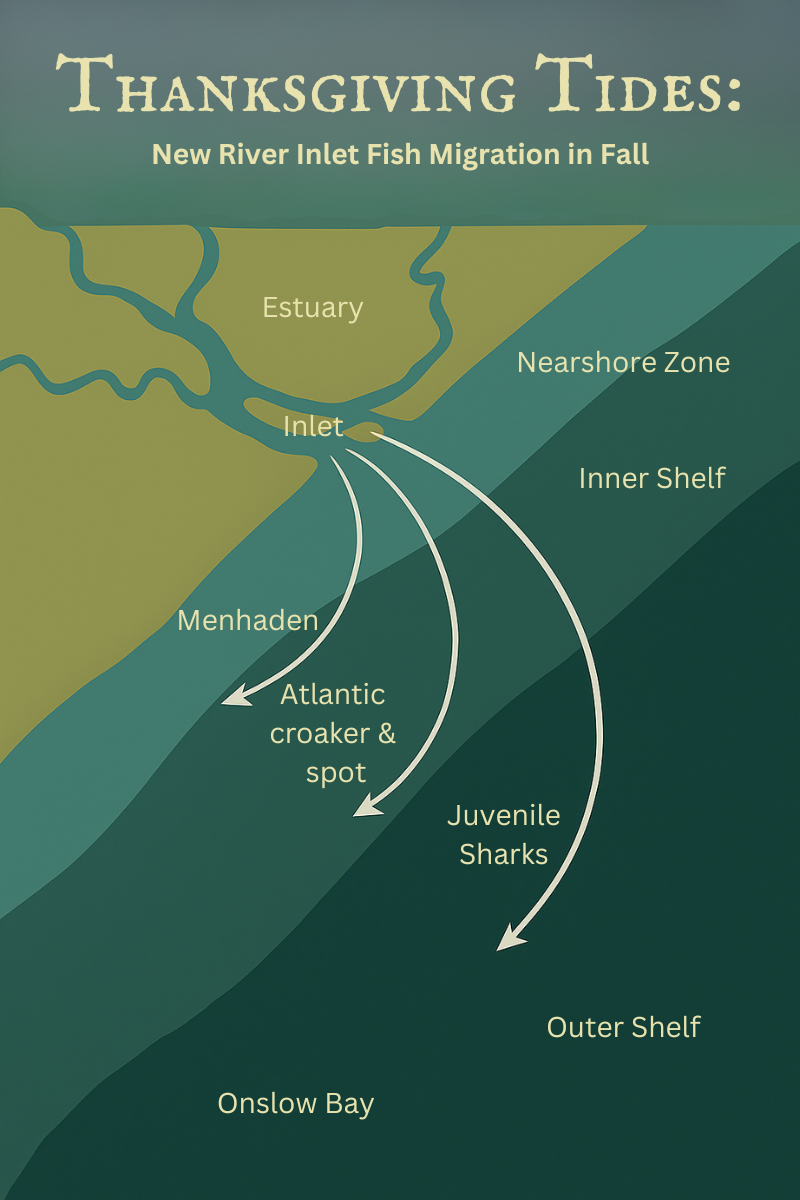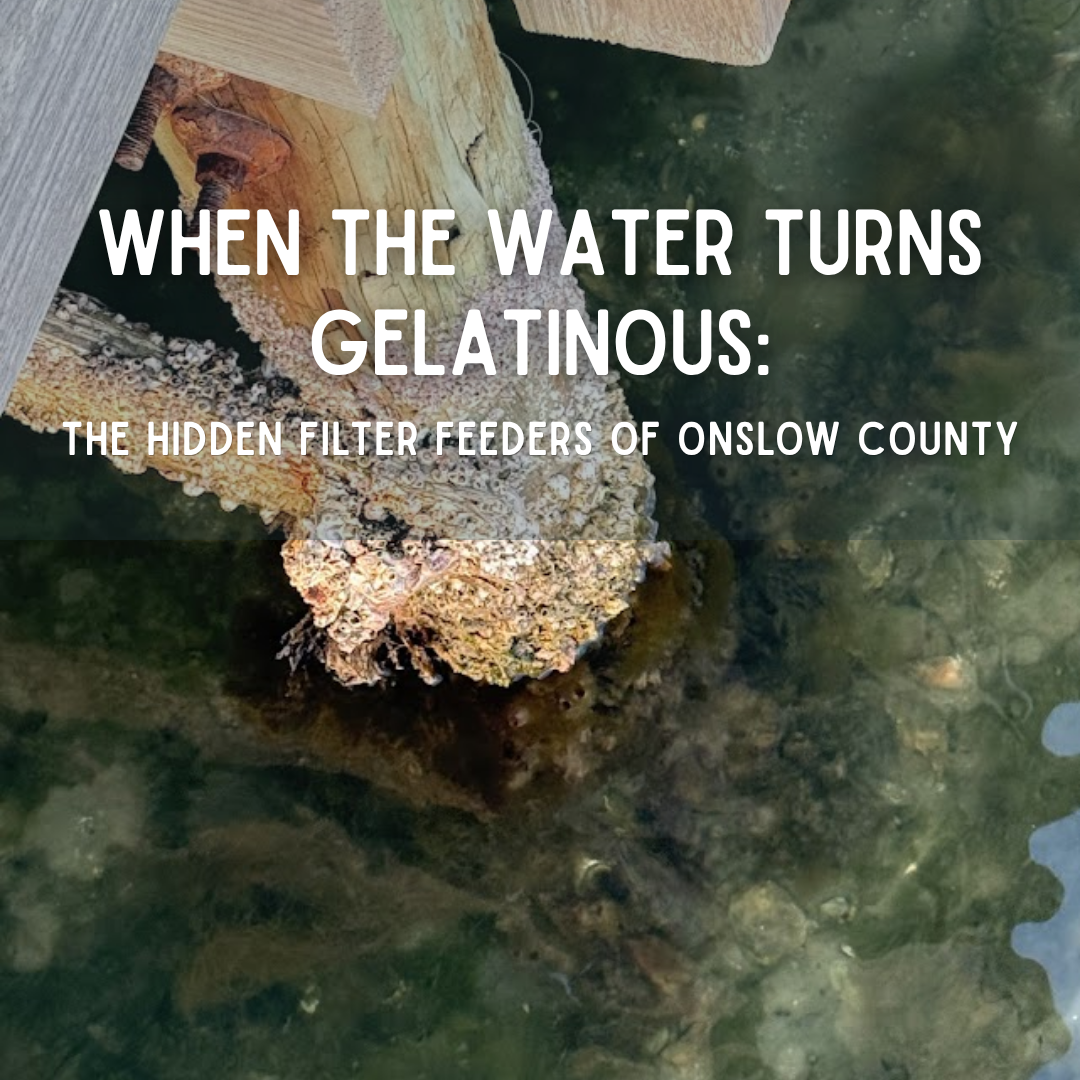
Sometimes the estuary changes before people notice why.
The water may look normal from shore, but drifting just beneath the surface are long ribbons of translucent gelatin — soft strands that gather along marsh edges, collect in eddies, or drift through the current like mucus suspended in the tide. In Surf City this week, people described them as “whale snot.”

They are more likely colonial tunicates or salps, gelatinous filter-feeders that can appear suddenly when conditions in the water favor rapid plankton growth (Bone, 1998; Madin & Deibel, 1998).
What matters is not only the organisms themselves, but what their appearance says about the estuary around them.
The drifting forms
These blooms often form when the water column becomes temporarily stable and productive (Madin, 1982). Warmer temperatures, calmer conditions, reduced wave turbulence, and elevated plankton concentrations create an environment where filter-feeding gelatinous organisms can reproduce rapidly. Water moving through the inlets may also transport offshore plankton communities into the estuary, concentrating them in tidal creeks and slower-moving surface water (Bone, 1998; Madin, 1982).
In these calmer stretches, the water column begins separating into layers. Suspended plankton remains concentrated near the surface while weaker turbulence allows fragile gelatinous colonies to persist long enough for blooms to form. What would normally disperse through wave action instead remains suspended within the estuary itself (Madin, 1982).
To most people, they look like debris.
Ecologically, they are processing the estuary in real time.
Salps and colonial tunicates continuously pump water through their bodies, removing suspended phytoplankton, bacteria, and organic particles from the water column. During bloom periods, enormous volumes of water can be filtered each day (Madin, 1982; Sutherland et al., 2010). In effect, the estuary briefly develops a drifting layer of living filtration suspended between the surface and the bottom.
Each colony filters continuously. Thousands moving through a tidal creek or marsh edge at once can collectively filter enormous volumes of suspended material over short periods of time, temporarily altering the clarity and composition of the surrounding water (Riisgård & Larsen, 2010).
That shift affects everything around them.
When these blooms are abundant, water clarity can temporarily improve as suspended particles are removed. Organic material becomes concentrated into mucus-rich waste pellets and decaying gelatinous tissue that sink toward the bottom, transferring energy from the surface into benthic food webs below (Madin & Deibel, 1998). Microbes, worms, crustaceans, and scavengers begin responding almost immediately (Madin, 1982; Madin & Deibel, 1998).
Instead of remaining suspended near the surface, nutrients and organic matter begin settling downward through the water column. What had been dispersed through open water becomes concentrated along the bottom, where deposit-feeding worms, small crustaceans, microbes, and scavengers begin incorporating that material into the estuary below (Madin, 1982).
The bloom itself becomes food.
The drifting masses also create temporary structure within otherwise open water. Small fish gather along their edges. Tiny invertebrates gather within folds and strands of gelatinous tissue. Predators begin responding not only to the bloom itself, but to the concentration of life forming around it (Bone, 1998; Madin & Deibel, 1998).
Small fish and invertebrates feed around the edges of these drifting masses. Juvenile fishes may remain near these drifting masses as food becomes concentrated around them. Sea turtles, some fishes, and other gelatinous predators may increase feeding activity where blooms become dense enough to concentrate prey (Bone, 1998).
But like many ecological events, balance matters.
If too few filter-feeders are present during periods of elevated nutrients, water grows murkier and oxygen conditions become less stable, particularly during heat and nighttime respiration. But filtration at the opposite extreme can also reshape the food web. Too many gelatinous filter-feeders, however, may strip large amounts of plankton from the water column, altering food availability for larval fishes and other plankton-dependent organisms higher in the food web (Petersen & Riisgård, 1992).
Most blooms are temporary.
Currents disperse them. Heat and bacteria break them apart. Waves fragment the colonies into nearly invisible strands that disappear back into the system as quickly as they arrived. Even in collapse, the bloom continues feeding the estuary. Decaying tissue is broken apart by bacteria, consumed by scavengers, and recycled back into the same nutrient pathways that allowed the bloom to form in the first place (Madin, 1982).
But for a short period, the estuary reveals something normally hidden: the water between the marsh and the bottom is not empty space. It is an active habitat, filled with organisms that filter, recycle, transport, and redistribute energy through the coastal ecosystem (Bone, 1998; Madin, 1982).
The attached forms
Not all tunicates remain suspended in the water column. Some attach themselves directly to the surfaces that hold still long enough for life to accumulate—dock pilings, oyster shell, ropes, marsh grass roots, floats, and the shaded undersides of piers where current continues moving but turbulence drops away.
Along the estuaries of Onslow County, these attached forms become part of what looks, at first glance, like simple buildup.
The surfaces beneath docks rarely stay bare for long (Wahl, 1989; Lindeyer & Gittenberger, 2011). Marine scientists often describe these layered growths as fouling communities, but along the estuary they appear simply as the layer of life that forms on anything left in the water long enough. First comes a film too thin to notice, then algae, then colonies of organisms layered over one another until wood, shell, and rope begin carrying part of the estuary itself.

Tunicates are part of that layer.
Along this coast, attached tunicates can include solitary species like the pleated sea squirt (Styela plicata) and the sea grape (Molgula manhattensis), as well as colonial species such as Clavelina oblonga and sea pork (Aplidium stellatum) (Van Name, 1945; Lambert, 2007).
Some grow individually, attached like soft sacs with openings at the top. Others spread as colonial sheets or clustered lobes, sharing a common outer covering while continuously filtering water moving past them. Around pilings and floating docks, entire communities can form this way—sponges beside hydroids, bryozoans layered against tunicates, all responding to current, salinity, temperature, and suspended food moving through the tide (Wahl, 1989).
To most people, these surfaces register as slime.
Ecologically, they are filtration, habitat, and nutrient transfer occurring simultaneously (Wahl, 1989).
Sea squirts
The organisms most people recognize first are usually sea squirts. They appear as rubbery sacs attached beneath docks or clustered along ropes, and shell. Press one accidentally and water jets outward through small siphons near the top of the body, giving rise to the common name.

Species such as the pleated sea squirt (Styela plicata) often develop thick, wrinkled outer coverings ranging from tan and off-white to purple, while the sea grape (Molgula manhattensis) forms smaller rounded bodies attached within the layered communities growing beneath docks and along estuarine structure — what marine scientists often call fouling communities (Van Name, 1945).
What looks like a reaction is actually the visible end of a process already underway.
Sea squirts continuously pull water inward through one siphon, filter out phytoplankton, bacteria, and suspended particles from the water, then expel the filtered water back into the estuary through another opening. The animal does not begin filtering when disturbed. It has been filtering the entire time (Riisgård & Larsen, 2010).
In productive estuarine water, thousands of these organisms may be pumping simultaneously (Riisgård & Larsen, 2010).
That filtration matters.
As suspended particles are removed, nutrients become concentrated into waste and biomass that can be transferred downward into bottom communities. Water clarity may improve locally (Riisgård & Larsen, 2010). Microbial activity shifts around them. Small invertebrates begin using the folds and surfaces their bodies create.
Their presence also signals something about the surrounding water.
Sea squirts tend to cluster where flow remains steady enough to deliver oxygen and suspended food continuously, but not so violent that colonies are torn free. Around tidal creeks, dock edges, and quieter stretches of the Intracoastal Waterway, their abundance often reflects a system carrying enough suspended productivity to sustain constant filtration (Barros, 2009).
Sea pork
Some tunicates take a different form entirely.
One of these is sea pork, commonly associated with colonial tunicates such as Aplidium stellatum, which spread outward as shared gelatinous colonies rather than isolated individuals (Van Name, 1945).

Sea pork spreads across submerged surfaces in thick, rubbery colonies that look less like individual animals and more like flesh-colored mats attached beneath floats and pilings. Depending on the species and age of the colony, the surface may appear muted pink, tan, orange, or almost translucent beneath the waterline.
Most people don’t realize they are looking at colonies made up of thousands of tiny individual filter-feeding bodies embedded together within a shared outer layer.
The colony functions collectively (Van Name, 1945).
Water moves continuously through countless small openings across the surface, carrying suspended plankton and organic particles into the colony while waste and filtered water move back outward into the surrounding estuary (Riisgård & Larsen, 2010).
That structure changes the surface around it.
Sea pork colonies trap sediment and create small protected surfaces where microorganisms and invertebrates begin to accumulate between folds and protected edges. Tiny crustaceans move across them. Worms and microbial films develop within the folds and protected spaces between colonies. What appears smooth from above becomes, at smaller scales, complex terrain (Wahl, 1989).
Like other filter-feeding communities along this coast, sea pork helps transfer suspended energy from the water column into the attached world beneath docks and marsh edges.
And once that layered habitat forms, other organisms begin responding to it—including the nudibranchs moving slowly across its surface.
Nudibranchs
At low tide along the edges of the sound—where pilings hold a thin skin of life and oyster shells stack into uneven ridges—the water sometimes carries color that doesn’t belong to the sand or the grass. It moves slowly, almost deliberately, across surfaces that most people step over without noticing. What looks like a fragment of drifting algae or a soft piece of shell resolves, if you stop long enough, into something alive.
These are nudibranchs.
They are not fish, not worms, not plants. They are marine gastropods—relatives of snails—but without shells (Valdés et al., 2006). Along the coast of Onslow County, they appear in the quiet places: beneath docks in the Intracoastal Waterway, along the edges of Topsail Island marsh creeks, and on the submerged surfaces where current slows just enough for growth to take hold.
Along shallow estuarine structure in this region—beneath docks, across pilings, and within the layered growth attached to ropes and shell—nudibranchs may include species such as the striped nudibranch (Cratena pilata), the Brazilian aeolid sea slug (Spurilla braziliana), the fringeback dondice (Dondice occidentalis), Thecacera pennigera, Berghia rissodominguezi, and the brackish-water species Tenellia adspersa (Marcus, 1972; Valdés et al., 2006).
Most people never see them. But they are there, working through the same system that shapes everything else along this coast.
Built for sensing, not speed
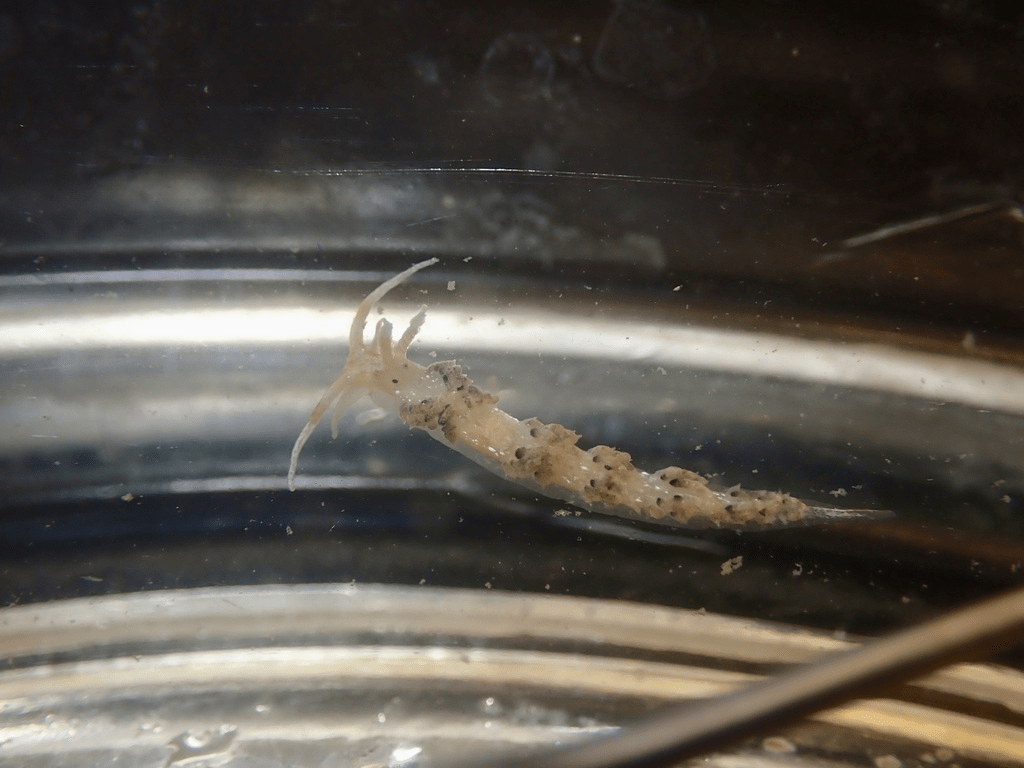
A nudibranch’s body is built for sensing and feeding, not speed. The two structures at the front—rhinophores—sample the water chemically, reading it the way a shoreline bird reads the wind. Along their backs, many species carry cerata, small extensions that look ornamental but function as both respiration and defense.
In aeolid nudibranchs like Spurilla braziliana, Cratena pilata, and Berghia rissodominguezi, these cerata become important sites for both respiration and defensive storage of stinging cells obtained from prey (Goodheart et al., 2018).

They move slowly because they can afford to. Their food doesn’t run.
Sponges, hydroids, bryozoans—these are the surfaces most people would describe as “growth” on docks or shells. To a nudibranch, those surfaces are structure, habitat, and food all at once (Valdés et al., 2006).
The work they do (even when no one’s watching)
Along this coastline, growth is constant. Give any hard surface—an old piling, a piece of shell, a boat hull—enough time in the water and it becomes layered. First a film, then algae, then invertebrates. The system builds upward and outward, creating what scientists call structural complexity, but what you actually see is texture: roughness where there used to be smoothness (Wahl, 1989).

Nudibranchs move through that texture selectively.
Many species feed on a single type of prey. One may specialize in a particular sponge. Another tracks hydroids, those delicate branching animals that resemble tiny underwater ferns. Species such as Dondice occidentalis, Cratena pilata, and Tenellia adspersa are commonly associated with hydroids and other organisms growing across submerged pilings, docks, ropes and shell in shallow coastal environments (Marcus, 1972; Valdés et al., 2006). This selectivity matters more than their size suggests. They are not removing everything. They are removing specific pieces of the system.
That kind of feeding does not flatten the landscape—it shapes it.
Where one organism begins to dominate, nudibranchs can limit its spread. Where surfaces would otherwise become uniform, their grazing introduces variation. Over time, this helps maintain the uneven habitat small fish, shrimp, and juvenile invertebrates depend on (Wahl, 1989).

It’s easy to miss because nothing dramatic happens. There’s no visible clearing, no sudden absence. But the balance of what grows, and where, shifts quietly in response to their presence.
Borrowed defenses, redistributed energy
Some nudibranchs do something that seems improbable until you see it up close: they take the defenses of what they eat and keep them.
Hydroids and certain cnidarians carry stinging cells—nematocysts—that function as protection. When a nudibranch feeds on them, those cells pass through the digestive system intact and are stored within the cerata along its back. The nudibranch doesn’t just consume its prey; it incorporates part of its defense (Goodheart et al., 2018).
This changes how energy moves through the system.
Instead of defenses being lost when prey is consumed, they are transferred upward. The nudibranch becomes both grazer and deterrent, a small organism that is less likely to be eaten because of what it has already eaten.
You can see the result in their coloration. Many are bright, almost out of place against the muted tones of sand and shell. That color is not decoration—it’s a signal (Avila, 1995). Along this coast, where predation pressure is constant, visibility can function as warning rather than risk.
Where they sit in the trophic cascade
They are not apex predators. They don’t regulate fish populations or move through the system in ways that draw attention. But they occupy a position that connects the base of the food web to everything above it.
They feed on organisms that build habitat.
Those organisms—sponges, hydroids, bryozoans—form the living surface that supports small invertebrates and juvenile fish. Those smaller organisms, in turn, become prey for larger fish, which then connect to the predators people are more familiar with along this coast—species like blacktip shark (Carcharhinus limbatus) and Atlantic sharpnose shark (Rhizopriodion terranovae) that move along the breakers and through the sounds.
Remove the visible predators, and people notice quickly.
Remove something like a nudibranch, and what changes is slower, but it moves in the same direction. Surfaces become dominated by fewer species. Habitat becomes more uniform. The small organisms that rely on variation lose space. That change works its way upward, not as a single event, but as a shift in the system’s capacity to support diversity.
Even small organisms attached to pilings and submerged structure become part of much larger coastal food webs. Scientific food-web models show nudibranchs, hydroids, bryozoans, worms, shrimp, and fishes linked together through the transfer of energy across the ecosystem.

Why they stay hidden
There’s a reason most beachgoers never encounter them.
They live where water movement slows just enough to allow growth to accumulate, but not so still that oxygen drops away. Around docks, inside creeks, along the quieter edges of the New River estuary, they remain attached to the surfaces that feed them.
Out in the open surf, where sand shifts constantly and hard structure is buried and exposed with each change in wind and tide, there’s less for them to hold onto and less for them to eat. The breakers are a moving environment (Wahl, 1989). Nudibranchs belong to the places that hold still just long enough for complexity to form.
What changes if they’re gone
Nothing you would notice in a single afternoon at the beach.
But over time, the surfaces beneath the waterline would begin to simplify. One or two fast-growing organisms would spread further, covering space that would otherwise remain shared. The small sheltered spaces used by larval fish, juvenile shrimp, and small crabs would begin to thin out.
That loss doesn’t stay at the bottom.
It moves upward, changing how much life the system can support, and how evenly that life is distributed. By the time it reaches the fish people see from the shore, the cause is no longer visible. But it started here, in the slow movement of something small across a surface most people never look at twice.
Nudibranchs don’t reshape the coastline in ways that draw attention. They don’t mark their presence with absence or disturbance. Instead, they work within what’s already there—adjusting, redistributing, and maintaining the uneven structure that makes this coast function.
If you happen to see one, it won’t be moving fast. It won’t need to.
What they’re feeding on (and why it looks familiar)
Along the docks and pilings of Onslow County, the surfaces most people notice first aren’t fish at all. They’re the things attached to everything.
The branching, plant-like fuzz that brushes your hand when you reach into the water—those are hydroids. The firm, uneven coatings that look like they’re part of the structure itself are often sponges or bryozoans.
It’s easy to group all of it together as buildup. Something slimy, something in the way.
But that “squirt” people laugh about isn’t random. A tunicate pulls water in, filters out plankton and suspended particles, and then expels that water back out. What looks like a reaction is just the visible end of constant filtration. They are processing the water column—removing particles, cycling nutrients, and clarifying the water in small, continuous ways (Riisgård & Larsen, 2010).
Hydroids are doing something different. They are predators at a scale most people don’t consider, capturing microscopic prey drifting past. Sponges filter continuously as well, pulling bacteria and organic matter from the water and converting it into biomass that other organisms can use.
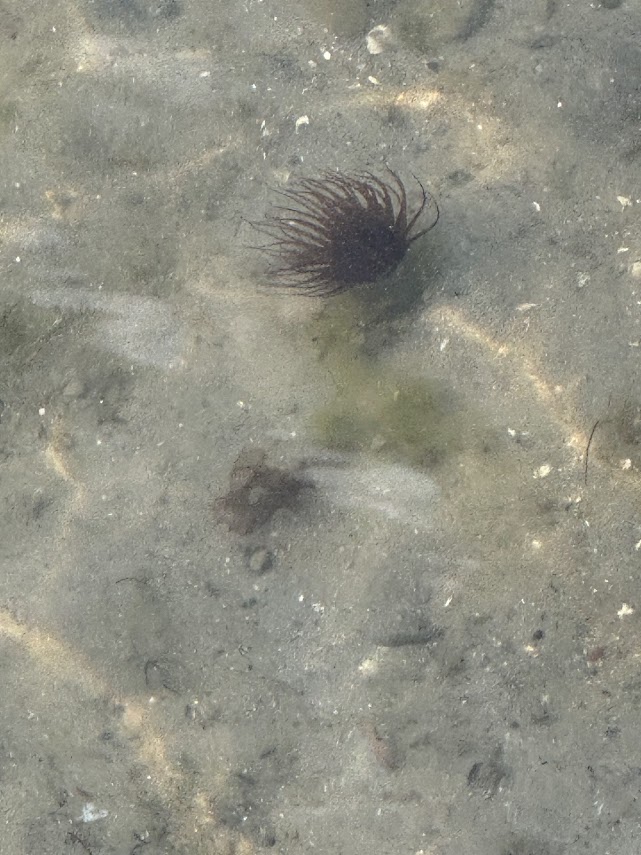
This is the surface layer of the ecosystem.
And it doesn’t stay unchecked.
The ones moving across the surface
Species like the Brazilian aeolid sea slug (Spurilla braziliana) often feed directly on anemones associated with these same submerged communities, while smaller species such as Tenellia adspersa are frequently associated with hydroids in brackish and estuarine waters (Valdés et al., 2006).
The nudibranchs moving across these surfaces are not all the same, and what they eat tells you what role they’re playing.
Some of the small, leaf-like sea slugs in this region—species in the genus Elysia—feed on algae and can even retain the chloroplasts from what they consume, briefly using sunlight as part of their energy system. They blur the line between grazing and something closer to plant-like function (Valdés et al., 2006).
Others, like Cratena pilata and Dondice occidentalis, track hydroids specifically. Where hydroids begin to spread across a piling, these nudibranchs follow, feeding in a way that limits how dense those colonies can become (Marcus, 1972).
Species such as Thecacera pennigera are often associated with the layered communities growing beneath docks and harbor structure, while Berghia rissodominguezi and Spurilla braziliana move through shallow cnidarian-rich habitat where anemones and hydroids provide both food and defensive material (Valdés et al., 2006).
Heavier-bodied nudibranchs—often in groups like Doris—tend to feed on sponges. Not all sponges, and not everywhere, but selectively enough that no single form easily dominates a surface for long.
Even their eggs reflect this connection. The ribbon-like spirals sometimes seen attached to docks are laid directly where food is available. The next generation doesn’t disperse randomly—it begins where the system is already functioning.
Beneath the surface layer
Most of the time, these organisms go unnoticed.
People see the drifting ribbons and call them whale snot. They scrape tunicates from pilings without thinking about what those colonies were filtering from the water. They brush past hydroids and sponges growing beneath docks without realizing those surfaces are part of the estuary’s food web just as much as the fish moving above them.
But the water between the marsh and the bottom is never empty.
It carries suspended plankton, drifting larvae, dissolved nutrients, bacteria, predators, scavengers, and colonies of organisms filtering continuously through the tide. Along the quieter edges of Onslow County—beneath floats, around oyster shells, beside marsh grass roots, and inside the slower water of creeks and sounds—entire communities form within that suspended layer (Wahl, 1989; Lindeyer & Gittenberger, 2011).
Some drift. Some attach. Some graze slowly across the surface consuming the organisms beneath them.
Together, they reshape the estuary constantly.
The gelatinous ribbons appearing this week are not separate from the rest of the system. They are one visible moment in a larger cycle of filtration, growth, decay, grazing, and redistribution that normally happens out of sight (Bone, 1998; Madin, 1982). For a short time, the estuary simply becomes easier to see.

References
Avila, C. (1995). Natural products of opisthobranch molluscs: A biological review. In Oceanography and marine biology: An annual review (33rd ed., pp. 487-559). UCL Press.
Barros, R. (2009). Human-mediated global dispersion of Styela plicata (Tunicata, Ascidiacea). Aquatic Invasions, 4(1), 45-57. https://doi.org/10.3391/ai.2009.4.1.4
Bone, Q. (1998). The biology of pelagic tunicates. Oxford University Press on Demand.
Encarnação, J., Seyer, T., Teodósio, M. A., & Leitão, F. (2020). First record of the nudibranch Tenellia adspersa (Nordmann, 1845) in Portugal, associated with the invasive hydrozoan Cordylophora caspia (Pallas, 1771). Diversity, 12(6), 214. https://doi.org/10.3390/d12060214
Goodheart, J. A., Bleidißel, S., Schillo, D., Strong, E. E., Ayres, D. L., Preisfeld, A., Collins, A. G., Cummings, M. P., & Wägele, H. (2018). Comparative morphology and evolution of the cnidosac in Cladobranchia (Gastropoda: Heterobranchia: Nudibranchia). Frontiers in Zoology, 15(1). https://doi.org/10.1186/s12983-018-0289-2
Korshunova, T., Lundin, K., Malmberg, K., Picton, B., & Martynov, A. (2018). First true brackish-water nudibranch mollusc provides new insights for phylogeny and biogeography and reveals paedomorphosis-driven evolution. PLOS ONE, 13(3), e0192177. https://doi.org/10.1371/journal.pone.0192177
Lambert, G. (2007). Invasive sea squirts: A growing global problem. Journal of Experimental Marine Biology and Ecology, 342(1), 3-4. https://doi.org/10.1016/j.jembe.2006.10.009
Lindeyer, F., & Gittenberger, A. (2011). Ascidians in the succession of marine fouling communities. Aquatic Invasions, 6(4), 421-434. https://doi.org/10.3391/ai.2011.6.4.07
Madin, L. P. (1982). Production, composition and sedimentation of salp fecal pellets in oceanic waters. Marine Biology, 67(1), 39-45. https://doi.org/10.1007/bf00397092
Madin, L. P., & Deibel, D. (1998). Feeding and energetics of Thaliacea. The Biology of Pelagic Tunicates, 81-104. https://doi.org/10.1093/oso/9780198540243.003.0005
Marcus, E. D. (1972). On Some Opisthobranchs from Florida. Bulletin of Marine Science, 22(2), 284-308. https://www.ingentaconnect.com/content/umrsmas/bullmar/1972/00000022/00000002/art00002
Petersen, J., & Riisgard, H. (1992). Filtration capacity of the ascidian Ciona intestinalis and its grazing impact in a shallow fjord. Marine Ecology Progress Series, 88, 9-17. https://doi.org/10.3354/meps088009
Riisgård, H., & Larsen, P. (2010). Particle capture mechanisms in suspension-feeding invertebrates. Marine Ecology Progress Series, 418, 255-293. https://doi.org/10.3354/meps08755
Sutherland, K. R., Madin, L. P., & Stocker, R. (2010). Filtration of submicrometer particles by pelagic tunicates. Proceedings of the National Academy of Sciences, 107(34), 15129-15134. https://doi.org/10.1073/pnas.1003599107
Valdés, Á., Behrens, D. W., & DuPont, A. (2006). Caribbean Sea slugs: A Field guide to the opisthobranch mollusks from the tropical Nortwestern Atlantic. Sea Challengers Natural History Books.
Van Name, W. G. (1945). The North and South American Ascidians. Bulletin of American Museum of Natural History, 84, 1-476. http://hdl.handle.net/2246/1186
Wahl, M. (1989). Marine epibiosis. I. Fouling and antifouling: Some basic aspects. Marine Ecology Progress Series, 58, 175-189. https://doi.org/10.3354/meps058175