Spend enough time walking along a salt marsh and you’ll eventually stop noticing the marsh rabbits.
Not because they’ve disappeared.
Because they’ve become part of the landscape.
They feed quietly along the marsh edge, slipping into the grasses when startled before appearing again somewhere you didn’t expect. Some evenings you may count half a dozen. Other days you wonder if there were ever any there at all.
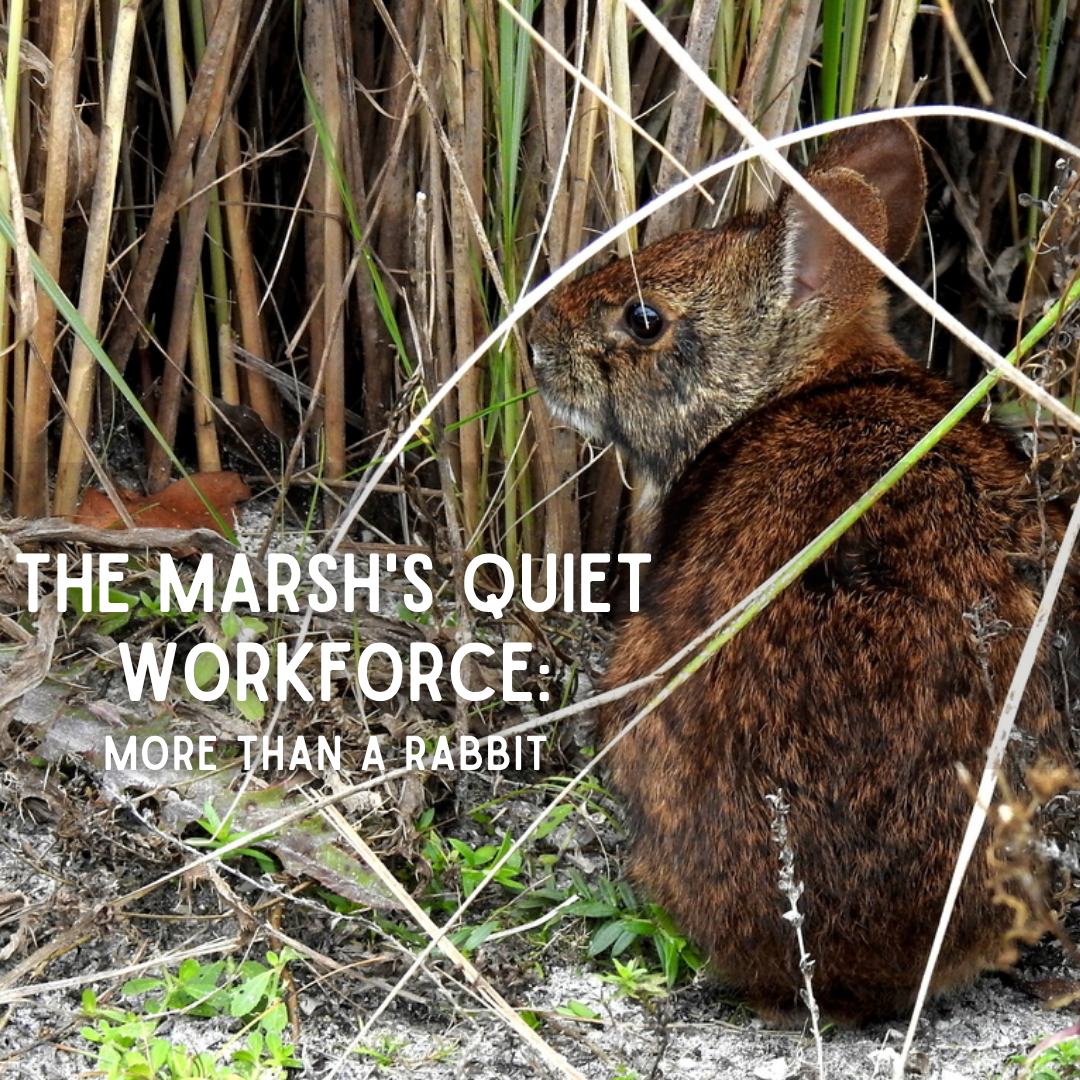
Unlike the brighter cottontails many people are used to seeing, marsh rabbits are darker, with coarse brown to reddish-brown fur, a grayish underside, and a rusty cinnamon patch along the back of the neck. Even the tail gives them away. Instead of flashing bright white, it appears darker and more bluish, one reason marsh rabbits have sometimes been called “bluetails” (Chapman & Trani, 2007; Chapman & Willner, 1981).
Like so much of the marsh, they’re easy to overlook.
A marsh rabbit may look like a familiar backyard visitor, but its role reaches far beyond the grass beneath it. | Image credit: skylarkymalarkey, iNaturalist
For more than a century, naturalists have described marsh rabbits (Sylvilagus palustris) by documenting where they lived, what they looked like, and what they ate (Rhoads & Young, 1897). Those observations gave us our first understanding of the species. Today, ecology invites us to ask a different question.
What happens because marsh rabbits are here?
The answer reaches far beyond the rabbit itself.
We often measure an animal’s importance by how exciting it is to watch.
The marsh doesn’t.
The marsh measures importance by how many lives are connected to one another (Soulé et al., 2003).
Following One Rabbit
If you’ve ever taken a science class, you’ve probably learned the First Law of Conservation of Energy: energy cannot be created or destroyed. It only changes form.
For many of us, that idea remained in a textbook or written across a classroom whiteboard. It became something to memorize rather than something we expected to witness.
Yet every walk beside a salt marsh quietly brings that principle to life.
Standing beside a marsh, it’s easy to underestimate what you’re seeing. From a distance, much of it appears to be little more than grass. Yet every growing season those grasses capture enormous amounts of energy from the sun, making salt marshes among the most productive ecosystems on Earth (Frizzell, 1988).
That productivity, however, cannot remain in the plants.
It has to move.
Imagine following a single marsh rabbit through its life.
Following one marsh rabbit means following the grasses, cover, and hidden pathways that connect it to the larger marsh. | Image credit: jorgenols, iNaturalist
At only about 2.5 to 3.5 pounds, its small body holds energy gathered first by the marsh plants around it (Chapman & Trani, 2007; Chapman & Willner, 1981).The grasses it consumes become muscle, bone, blood, fur, and new life. That rabbit may one day feed a hawk, an owl, a fox, a bobcat, or a snake. Throughout its life it supports parasites. After its death it feeds scavengers, fungi, bacteria, and countless decomposers before eventually returning nutrients to the marsh where another season of growth begins.
Nothing has appeared from nowhere.
Nothing has truly disappeared.
The energy has simply changed form.
Every day, marsh rabbits transform marsh vegetation into something that can support an entirely different community of organisms (Chapman & Trani, 2007; Chapman & Willner, 1981).
The rabbit isn’t the end of the story.
In many ways, it’s where the story begins.
More Than a Meal
Spend a few minutes watching a marsh rabbit and it may not seem particularly busy.
It grazes along the marsh edge, pauses to listen, slips into dense cover, then returns to feeding when the danger seems to have passed. At first glance, it looks like a small animal moving through its day.
But even before a marsh rabbit becomes food for something else, it is already shaping the marsh around it.
Every bite influences which plants are grazed and which continue growing (Conner & Cherry, 2017). As it moves between the marsh edge, nearby cover, and slightly higher ground, the rabbit is also moving through the boundary between habitats most of us see as separate. The same dense vegetation that protects the rabbit also provides shelter for insects, reptiles, amphibians, birds, and countless other small lives moving through the marsh (Canepuccia et al., 2023; Larsen & Gray et al., 2021; Wigley & Lancia, 1998).
A marsh rabbit browses at the edge, where each ordinary bite helps move energy through the landscape. | Image credit: cadecampbell, iNaturalist
This is why the rabbit matters before the hawk ever appears.
Its value is not limited to becoming prey. Its ordinary life helps move energy, shape vegetation, and connect habitats long before that energy travels farther up the food web (Chapman & Trani, 2007; Chapman & Willner, 1981; Conner & Cherry, 2017).
Perhaps that is the quiet work of a marsh rabbit.
Not simply feeding something else.
But helping hold together the conditions that allow so much else to live there.
Why There Are So Many
Sometimes marsh rabbits seem to be everywhere — in yards, along road edges, near parking lots, and wherever the Spartina meets slightly higher ground.
A young marsh rabbit beside an adult shows the visible side of abundance, but reproduction is only part of the story. | Image credit: Wolfgang, iNaturalist
The easy explanation is that rabbits reproduce quickly. They can produce several litters in a year, often three to seven, with roughly 15 to 20 young produced annually under favorable conditions (Holler & Conaway, 1979).
That is true, but it is not the whole story.
Nature rarely invests heavily in something that does not matter. In a marsh, abundance is not waste. It is part of the system.
Marsh rabbits live under constant pressure. Every choice — where to feed, when to move, when to freeze, and when to disappear into the grasses — is shaped by predators, tides, weather, and the daily balance between finding food and becoming food (Hill et al., 2019; Holler & Conaway, 1979).
Predators influence far more than the animals they catch. Their presence can change where prey feed, how long they remain exposed, and how energy moves through the landscape (Suraci et al., 2019). When predator communities shift, those changes can ripple through the food web in ways that affect many other species (Bransford et al., 2024; Jiménez et al., 2019) .
Seen this way, abundant marsh rabbits are not simply evidence of successful reproduction.
They are evidence of how much work this one ordinary species performs.
The Rabbit You Didn’t See
Perhaps this also explains something you’ve probably noticed yourself.
One moment several marsh rabbits are feeding along the marsh edge.
You look away for only a moment.
When you look back, they’re gone.
They haven’t left the marsh.
Unlike many rabbits people are used to seeing, marsh rabbits are strong swimmers. Water is not simply something they avoid; it is part of the landscape they know how to use. In a place shaped by tides, wet ground, and narrow edges of cover, the ability to move through water helps explain how they can vanish so completely without ever leaving the marsh (Chapman & Trani, 2007; Chapman & Willner, 1981).
The same dense vegetation that feeds them also protects them. Slight changes in elevation, the rhythm of the tides, the angle of the evening sun, and generations of natural selection have shaped an animal that survives by knowing exactly when to be seen — and when not to be (Chapman & Willner, 1981; Holler & Conaway, 1979).
The rabbit disappeared from sight.
Its place in the marsh never did.
Looking at the Marsh Differently
The next time you notice a marsh rabbit quietly feeding along the marsh edge, pause before it disappears.
What once looked like an ordinary rabbit is now something entirely different.
Not because the rabbit has changed.
But because you can now see the countless connections passing through it (Soulé et al., 2003).
And once you see those connections, the marsh becomes harder to overlook.
A marsh rabbit slips back into the edge, leaving only a glimpse of the connections still moving through the marsh. | Image credit: maxnel, iNaturalist
References
Bransford, T. D., Harris, S. A., & Forys, E. A. (2024). Seasonal variation in mammalian Mesopredator spatiotemporal overlap on a barrier island complex. Animals, 14(16), 2431. https://doi.org/10.3390/ani14162431
Canepuccia, A. D., Fanjul, M. S., & Iribarne, O. O. (2023). Global distribution and richness of terrestrial mammals in tidal marshes. Diversity and Distributions, 29(5), 598-612. https://doi.org/10.1111/ddi.13683
Chapman, B. R., & Trani, M. K. (2007). Marsh Rabbit (Sylvilagus palustris). In The Land Manager’s Guide to Mammals of the South (pp. 247-251). Durham, NC: The Nature Conservancy; Atlanta, GA: U.S. Forest Service.
Conner, L. M., & Cherry, M. J. (2017). Considering Herbivory and Predation in Forest Management. In Ecological Restoration and Management of Longleaf Pine Forests (1st ed., p. 12). CRC Press.
Frizzell, E. K. (1988). Mammals and Wetlands. In The Ecology and Management of Wetlands: Volume 1: Ecology of Wetlands (1st ed., pp. 213-226). Croom Helm Ltd.; Timber Press.
Hill, J. E., DeVault, T. L., & Belant, J. L. (2019). Cause‐specific mortality of the world’s terrestrial vertebrates. Global Ecology and Biogeography, 28(5), 680-689. https://doi.org/10.1111/geb.12881
Holler, N. R., & Conaway, C. H. (1979). Reproduction of the marsh rabbit (Sylvilagus palustris) in South Florida. Journal of Mammalogy, 60(4), 769-777. https://doi.org/10.2307/1380192
Jiménez, J., Nuñez-Arjona, J. C., Mougeot, F., Ferreras, P., González, L. M., García-Domínguez, F., Muñoz-Igualada, J., Palacios, M. J., Pla, S., Rueda, C., Villaespesa, F., Nájera, F., Palomares, F., & López-Bao, J. V. (2019). Restoring APEX predators can reduce mesopredator abundances. Biological Conservation, 238, 108234. https://doi.org/10.1016/j.biocon.2019.108234
Larsen-Gray, A. L., Loeb, S. C., & Kalcounis-Rueppell, M. C. (2021). Rodent population and community responses to experimental, large scale, long-term coarse Woody debris manipulations. Forest Ecology and Management, 496, 119427. https://doi.org/10.1016/j.foreco.2021.119427
Macarthur, R., & Levins, R. (1967). The limiting similarity, convergence, and divergence of coexisting species. The American Naturalist, 101(921), 377-385. https://doi.org/10.1086/282505
Rhoads, S. N., & Young, R. T. (1897). Notes on a Collection of Small Mammals from Northeastern North Carolina. Proceedings of the Academy of Natural Sciences of Philadelphia, 49, 303-312. https://www.jstor.org/stable/4062279?seq=1
Soulé, M. E., Estes, J. A., Berger, J., & Del Rio, C. M. (2003). Ecological effectiveness: Conservation goals for interactive species. Conservation Biology, 17(5), 1238-1250. https://doi.org/10.1046/j.1523-1739.2003.01599.x
Suraci, J. P., Clinchy, M., Zanette, L. Y., & Wilmers, C. C. (2019). Fear of humans as APEX predators has landscape‐scale impacts from mountain lions to mice. Ecology Letters, 22(10), 1578-1586. https://doi.org/10.1111/ele.13344
Wigley, T. B., & Lancia, R. A. (1998). Wildlife Communities. In Southern Forested Wetlands (1st ed., p. 32). Routledge.
A reader recently asked me about five birds he had seen over the sounds of Surf City last weekend. He was convinced they were five different kinds of “sea hawks.”
At first glance, it was an understandable conclusion.
Each bird was large. Each spent time soaring overhead or hesitating up high over the water. Each occupied the same stretch of coastal North Carolina sky.
Yet every photograph and description reflected the same species: an osprey.
Distance has a way of simplifying wildlife. Colors disappear. Markings fade. Details are lost. What remains is a silhouette against the sky.
Most of us learn to recognize birds by their appearance. Raptors are often easier to understand by their behavior.
What is the bird doing?
Is it hovering over the water?
Circling without flapping?
Perched motionless on a fence post?
Drifting above a marsh?
Crossing silently through the trees after sunset?
The answer often reveals more than the feathers.
The skies above Onslow County are shared by a community of predators. Some hunt fish. Some hunt rodents. Some hunt insects. Some hunt other birds. Some hunt only at night. Others serve as nature’s cleanup crew.
At a distance they may look similar.
Spend enough time watching them, however, and the differences become impossible to miss.
Following the Fish
Osprey: The Fisherman
If there is a signature bird of the coast, it may be the osprey (Pandion haliaetus).
You notice one long before you identify it. The bird appears above a creek, river, or stretch of open water, turns into the wind, and suddenly seems to stop moving. For a few seconds it hangs there, suspended above the surface before plunging feet-first toward the water below.
That moment of hesitation is not hesitation at all.
The bird is making a final decision.
Water distorts light. Fish change direction. Wind roughens the surface. What appears obvious from a dock or kayak becomes much more complicated from above. The osprey’s brief hover allows it to judge distance, depth, and movement before committing to the dive (Poole, 1989; Bierregaard et al., 2020).
The splash usually draws everyone’s attention.
The fish often draws the next question.
Watch an osprey leave the water carrying a mullet or menhaden and it is difficult not to wonder how the bird manages to hold onto it. Fish are essentially living bars of soap wrapped in muscle, built to slip through water and escape predators. Osprey solve that problem with feet lined by tiny backward-facing spicules and a reversible outer toe that help secure slippery prey (Poole, 1989; Bierregaard et al., 2020).
Then, almost as soon as the bird becomes airborne, something else happens.
The fish turns.
Within seconds the osprey has repositioned its catch so the fish faces forward. What looks like a small adjustment saves energy over the course of the flight. A fish carried sideways catches air. A fish carried headfirst moves through it. Often the bird gives its catch a vigorous shake as it climbs away from the water, shedding excess water before continuing on its way. Together, these adjustments reduce drag and make transporting a heavy, slippery meal through the air more efficient (Allen et al., 2018; Poole, 1989; Bierregaard et al., 2020).
Around nesting season, however, it is often the noise rather than the fishing that gets people’s attention.
Osprey rarely seem quiet.
Calls echo from nesting platforms, channel markers, dead trees, and utility poles throughout the breeding season. Adults announce arrivals. Mates communicate with one another. Young birds call constantly whenever food appears nearby. What sounds chaotic from a distance is often a family carrying on a conversation (Bierregaard et al., 2020).
By late summer, that family becomes easier to see.
Several birds may gather near a nest, perched along the same stretch of water where they have spent months raising young. Then, without warning, they take to the air together. The younger birds follow the adults across creeks, marshes, and open water, practicing turns, landings, and the flight skills that will eventually carry them south. What appears at first to be a loose gathering of osprey is often a family still learning from one another long after the young birds have left the nest (Poole, 1989; Bierregaard et al., 2020).
To boaters, it is a channel marker in the New River in Jacksonville, NC. To an osprey, it is home. Many coastal nests are rebuilt and expanded year after year, becoming landmarks visible across the water. | Image credit: A. Mitchell
The nests themselves remain long after the birds have departed.
Many osprey return to the same sites year after year, adding sticks, repairing damage, and expanding structures that can eventually become enormous. What begins as a modest nest slowly grows into a landmark visible from hundreds of yards away (Poole, 1989; Bierregaard et al., 2020).
For many coastal residents, those nests become part of the landscape.
And when spring returns, so do the birds that built them.
Bald Eagle: The Opportunist
If you spend enough time around the water, eventually you’ll see it happen.
An osprey leaves the surface carrying a fish. For a few moments, everything appears normal. Then a second bird enters the scene.
Larger.
Heavier.
Built on an entirely different scale.
The bald eagle (Haliaeetus leucocephalus) begins to follow.
What started as a successful fishing trip suddenly becomes a chase.
From below, the interaction can look almost personal. The osprey twists and climbs. The eagle closes the distance. Sometimes the osprey escapes. Sometimes it drops the fish. The eagle wheels downward after the falling meal while the osprey continues on empty-taloned.
Why go through all that trouble?
Because catching a fish requires energy.
An osprey may spend considerable time searching the water, hovering above the surface, adjusting for currents, and committing to a dive before finally securing a meal. An eagle watching from a nearby perch can recognize that success immediately. From the eagle’s perspective, the fish has already been found. The difficult part of the hunt is over (Buehler, 2020).
This often leads people to wonder whether bald eagles are better fishermen than osprey.
The answer depends on how you define fishing.
If the goal is catching fish, the osprey remains the specialist. Nearly every aspect of its anatomy is designed around that task. Its feet grip slippery prey with remarkable efficiency, and its entire hunting strategy revolves around locating fish beneath the water’s surface.
A bald eagle approaches the world differently.
Rather than specializing in a single food source, eagles take advantage of opportunities wherever they find them. Fish remain important, particularly along the New River, Stump Sound, the Intracoastal Waterway, and the countless creeks that thread through coastal marshes. Yet waterfowl, mammals, reptiles, and carrion can also become part of the menu (Buehler, 2020).
A closer look at their feet reveals those differences. Osprey feet are designed to hold fish. Eagle talons are designed to seize and restrain a wider variety of prey. One bird is built around precision. The other is built around versatility (Buehler, 2020).
That versatility helps explain why bald eagles have become increasingly common sights along the Onslow County coast. Open water, abundant prey, expansive marshes, and large trees provide everything they need. Whether soaring above an estuary, perched along a creek, or watching from a pine overlooking the water, eagles occupy a position near the top of the coastal food web (Buehler, 2020).
And every so often, that position allows them to let someone else do the fishing.
The Hunters of Marsh and Forest
Red-shouldered Hawk: The Watcher on the Fence
Not every raptor announces itself from the sky.
Some introduce themselves by showing up in the yard.
You glance out the window and notice a hawk perched on the fence. Hours later it seems to be in exactly the same place. The next morning it is back again.
Eventually curiosity takes over.
What is it watching?
Perched above a yard in Jacksonville, NC, a red-shouldered hawk waits for movement. From elevated vantage points, these woodland hunters watch patiently for opportunities hidden within the landscape below. | Image credit: A. Mitchell
Many people assume the hawk is focused on the house, the dog, or the family moving through the yard.
In reality, the bird is usually paying attention to everything else.
A well-maintained yard often provides excellent hunting habitat. Frogs move through flower beds. Lizards bask along retaining walls. Small snakes hunt beneath shrubs. Mice travel fence lines and wood piles. The red-shouldered hawk watches for movement, waiting for the landscape to reveal itself (Dykstra et al., 2020).
That patient approach reflects the habitats these birds prefer.
Unlike the open-country red-tailed hawk, red-shouldered hawks (Buteo lineatus) are closely tied to places where woods and water meet. Creek corridors, swamp edges, ponds, marshes, and bottomland forests provide the cover and diversity of prey they rely upon (Dykstra et al., 2020).
A red-shouldered hawk feeds on captured prey in a parking lot. While often associated with swamps and wooded wetlands, these adaptable hunters frequently take advantage of opportunities in suburban landscapes. | Image credit: A. Mitchell
Along the coast, those habitats frequently overlap with where people live.
The fence post is simply the best seat in the house.
From there, the hawk can watch an entire ecosystem unfold beneath it.
Red-tailed Hawk: Master of the Open Sky
A red-tailed hawk (Buteo jamaicensis) – and my personal favorite bird – often attracts attention by doing remarkably little.
You notice one circling high above a field.
Several minutes later it is still there.
The wings barely move.
At first, most people wonder how the bird can remain in the air for so long without flapping. The answer lies in the atmosphere itself. As the ground warms, pockets of heated air rise into the sky. Red-tailed hawks locate these invisible thermals and circle within them, gaining altitude while expending very little energy (Kerlinger, 1989; Preston & Beane, 2024).
But staying aloft is only part of the story.
The real question is why the bird wants to be up there in the first place.
The answer becomes clearer when compared to the red-shouldered hawk.
A red-shouldered hawk often hunts by focusing on a particular place. A pond edge. A marsh creek. A backyard. It watches patiently from a perch, waiting for the landscape to reveal movement (Dykstra et al., 2020).
A red-tailed hawk takes the opposite approach.
Rather than concentrating on one corner of the landscape, it climbs high enough to see how all of those pieces connect. Fields blend into hedgerows. Roadsides meet forest edges. Open ground transitions into cover. From above, what appear to be separate places from the ground become a single hunting landscape.
That broader view is the red-tail’s specialty.
What appears to us as an empty field is filled with clues. A rabbit pauses along a fence line. A squirrel breaks from cover. A mouse rustles through the grass. The bird is not searching for a specific animal. It is searching for movement, patterns, and opportunities spread across hundreds of acres (Preston & Beane, 2024).
The thermal keeps the hawk aloft long enough to gather that information. Height becomes an advantage. Distance becomes information.
The bird is not circling because it has nowhere else to be.
It is circling because the sky offers the best view.
And from that vantage point, one movement in the wrong place at the wrong time is often all it takes.
Cooper’s Hawk: The Pursuit Hunter
If you maintain a bird feeder long enough, sooner or later the yard will go silent.
One moment cardinals, doves, and finches are moving between the feeder and nearby trees.
The next, everything disappears.
Then a gray blur streaks through the yard.
The first time you see it happen, it feels almost impossible that a bird that large could move that quickly through such a cluttered space.
Unlike the red-tailed hawk searching from hundreds of feet above the landscape or the red-shouldered hawk watching patiently from a perch, the Cooper’s hawk (Astur cooperii) hunts in motion. It is built for pursuit (Rosenfield et al., 2025).
Its long tail acts like a rudder while relatively short wings allow it to twist, turn, and accelerate through spaces that would seem impossible for most raptors. Branches, fences, shrubs, and backyard obstacles that slow other birds become part of the chase (Rosenfield et al., 2025).
That agility allows the hawk to exploit something many predators cannot.
Confusion.
A flock of birds startled into flight rarely moves in a straight line. Individuals scatter in different directions, darting through vegetation and searching for cover. The Cooper’s hawk follows.
What appears chaotic to us is a hunting opportunity to the hawk.
Yet not every backyard attracts a Cooper’s hawk.
If you’ve ever noticed that these birds seem more common in some neighborhoods than others, the surrounding landscape is often the reason. Cooper’s hawks favor places where trees, forest edges, wooded corridors, and open spaces meet. Those transitions provide both cover and opportunity, allowing the bird to move quickly between concealment and pursuit (Rosenfield et al., 2025).
A bird feeder placed within that landscape can become part of the story, not because the feeder attracts the hawk, but because it concentrates movement. Birds travel between the feeder and nearby cover. The hawk is already watching the area. The feeder simply makes activity easier to find.
Which is why the sudden silence is often the first clue.
Long before most people see the hawk, the birds have already noticed it.
For a few moments, the yard belongs to the fastest hunter in the neighborhood.
The Hunters of the Air
Mississippi Kite: Catching the Wind
At first glance, a Mississippi kite (Ictinia mississippiensis) looks like it should behave like any other hawk.
It drifts overhead with long, pointed wings, barely moving as it rides the summer air. Then it suddenly changes direction, banking sharply, twisting through the sky, and accelerating after something too small for most people to see.
The first time you notice it, the behavior feels strange.
What is that hawk chasing? Is it chasing dragonflies?
The bird banks again, then again, each turn seeming impossibly precise. Whatever it is pursuing appears far too small to interest a raptor. Yet the longer you watch, the clearer the answer becomes.
While many hawks spend their time searching the ground for prey, Mississippi kites have turned the air itself into a hunting ground. Dragonflies, cicadas, beetles, and other flying insects become meals captured directly on the wing. What appears to be effortless wandering is often an active hunt unfolding overhead (Parker, 2020).
That hunting style explains why they seem so different from other raptors.
The red-shouldered hawk watches a particular place. The red-tailed hawk surveys an entire landscape. The Cooper’s hawk chases prey through trees and backyards. The Mississippi kite is hunting somewhere entirely different.
Its long wings and graceful flight allow it to maneuver with remarkable precision, changing direction quickly as insects dart, climb, and shift with the wind (Parker, 2020).
The same warm air currents that help other raptors gain altitude also gather flying insects into concentrated pockets, creating opportunities for a predator adapted to exploit them (Parker, 2020).
The result is a bird that often feels more like a swallow than a hawk.
An osprey may be hunting fish below. A red-tailed hawk may be watching a field nearby. A Cooper’s hawk may be moving along a forest edge. Above them all, a Mississippi kite may be feeding on insects carried by the same air currents that support the rest of the ecosystem.
The bird is not ignoring the landscape beneath it.
It has simply found opportunity in a place most predators never think to look.
For the Mississippi kite, the sky is not a pathway.
It is habitat.
The Cleanup Crew
Turkey Vulture: Death Becomes Renewal
A turkey vulture (Cathartes aura) lands on your roof and suddenly everyone becomes concerned.
To us, it looks like a warning. To the vulture, it is simply another perch from which to read the landscape. | Image credit: A. Mitchell
Some people take it as a bad omen. Others wonder if something nearby has died. Before long, the bird becomes the center of attention despite doing little more than sitting still.
The turkey vulture, meanwhile, is completely unaware of the stories being told about it.
Most of the time, something far less dramatic is happening.
A rooftop provides warmth on a cool morning, a place to dry rain-soaked feathers, or a convenient perch where rising air currents can be reached without much effort. The bird is not predicting death. It is simply taking advantage of the landscape (Kirk & Mossman, 2020).
Yet the association exists for a reason.
Unlike the hawks and eagles we have encountered so far, turkey vultures are searching for something very different. They are not looking for prey. They are looking for what remains after life has already moved on.
A dead fish along the shoreline.
A raccoon hidden in roadside vegetation.
A deer beyond the edge of a forest.
But how do they find it?
Part of the answer can be seen on the bird’s face. If you are fortunate enough to observe a turkey vulture through binoculars or at close range, you may notice something unusual about its nostrils, or nares. Unlike our own noses, the openings pass completely through the beak. In the right light, you can literally see from one side of the nostril to the other (Kirk & Mossman, 2020).
A close comparison of a turkey vulture (top) and black vulture (bottom) reveals one clue to how they read the landscape differently. Turkey vultures use an exceptional sense of smell to locate carrion, while black vultures depend more on vision and the behavior of other vultures. Arrows highlight differences in the nostril openings of the two species. | Image credit: T. Lisney
That adaptation supports one of the most powerful senses of smell in the bird world. While many raptors rely primarily on vision, turkey vultures are able to detect the scent of carrion from remarkable distances, allowing them to locate food sources hidden beneath vegetation and, in some cases, even beneath the soil itself (Grigg et al., 2017; Kirk & Mossman, 2020).
Finding carrion, however, is only part of the challenge.
Consuming it presents an entirely different set of problems.
The turkey vulture’s bald head, which many people find unsettling, is actually an important adaptation. Unlike a feathered head that could trap blood, bacteria, and other organic material, the bare skin can be cleaned much more easily after feeding. What gives the bird its ominous appearance also helps protect it from the very things it eats (Roggenbuck et al., 2018).
The same is true inside the bird.
Turkey vultures possess an extraordinarily acidic digestive system capable of destroying many of the bacteria and pathogens that would make other animals sick. Organisms responsible for diseases such as anthrax, botulism, cholera, and salmonella are often neutralized during digestion, allowing the vulture to safely consume material that would be dangerous for most scavengers (DeVault et al., 2016; Kirk & Mossman, 2020).
Even their hygiene is unusual.
Turkey vultures practice a behavior known as urohidrosis, in which they defecate on their own legs. While it may seem unpleasant from a human perspective, the highly acidic waste helps kill bacteria picked up while walking on carcasses and also provides a cooling effect during hot weather (Arad et al., 1989; Kirk & Mossman, 2020).
Taken together, these adaptations solve a difficult ecological problem. Dead animals can become reservoirs for bacteria, disease, and decay. Turkey vultures have evolved to exploit that resource while avoiding many of the risks associated with it.
Black vultures, which are often seen alongside them, approach the problem differently. Their nostrils are narrower and not open from side to side. Rather than relying so heavily on smell, they depend more on vision and often watch the movements of turkey vultures to help locate food (Buckley et al., 2020).
That relationship creates an interesting partnership. Turkey vultures are often the first to detect a carcass hidden beneath vegetation, while black vultures are quick to notice where the turkey vultures are gathering. One species excels at finding the scent. The other excels at finding the finder (Buckley et al., 2020; Kirk & Mossman, 2020.
Together, the two species accomplish something few other animals can.
They return nutrients to the landscape.
What appears to be an ending becomes the beginning of something else. Energy stored within a fish, a raccoon, or a deer does not simply disappear. Vultures help move those nutrients back into the ecosystem where they become available to countless other organisms (DeVault et al., 2016) .
The bird on your roof is not waiting for something bad to happen.
More often than not, it is part of the reason the landscape remains healthy after it does.
Black Vulture: Following the Leader
A single turkey vulture on a rooftop often attracts attention.
Ten vultures attract concern.
What appears to be a crowd is often an information network. Black vultures frequently roost together, sharing a landscape where opportunities can appear and disappear without warning. | Image credit: jspruill, iNaturalist
Unlike turkey vultures, which are frequently seen soaring alone or in small numbers, black vultures (Coragyps atratus) often seem to arrive as a group, called a committee. One bird becomes five. Five become ten. Before long, an entire rooftop, parking lot, or dead tree appears covered in vultures (Buckley et al., 2020).
The first question is usually the same.
Why are there so many?
Part of the answer lies in how black vultures find food.
While turkey vultures rely heavily on their extraordinary sense of smell, black vultures depend much more on vision and on one another. They watch the landscape, but they also watch other vultures. A turkey vulture dropping toward a hidden carcass can reveal an opportunity that a black vulture might never have discovered on its own (Buckley et al., 2020).
That difference creates an unusual relationship between the two species.
Turkey vultures are often the first to locate carrion concealed beneath vegetation or hidden from view. Black vultures are often the first to notice that the turkey vultures have found something worth investigating (Buckley et al., 2020).
One species excels at finding the scent.
The other excels at finding the finder.
Their social nature extends beyond feeding. Black vultures frequently roost together, travel together, and gather in numbers that can seem surprising to people unfamiliar with them. What appears to be a crowd is often a network of birds sharing information about a landscape filled with unpredictable opportunities (Buckley et al., 2020).
That strategy has served them well.
A dead fish washed onto a shoreline, a raccoon along a roadside, or a deer hidden beyond the edge of a forest represents a resource that appears without warning and disappears quickly. By paying attention to one another, black vultures can exploit those opportunities efficiently.
To most people, the meal is something to avoid. To a black vulture, it is an opportunity. By consuming carrion that would otherwise decay on the landscape, vultures help return nutrients to the ecosystem while reducing the spread of disease. | Image credit: A. Mitchell
Like the turkey vulture, the black vulture plays an important role in returning nutrients to the ecosystem.
It simply approaches the problem differently.
Where the turkey vulture trusts its nose, the black vulture trusts its neighbors.
The Night Shift
As daylight fades, a different group of predators takes over.
The thermals weaken. The soaring hawks settle. Shadows lengthen across marshes and forests.
Then the owls emerge.
Eastern Screech-Owl: Master of Camouflage
Many people have an eastern screech-owl (Megascops asio) living in their neighborhood and never realize it.
Not because the owl is rare.
Because it is exceptionally good at remaining unnoticed.
You might spend years walking past the same tree without ever seeing this small bird tucked inside a cavity or pressed against the bark. Then one evening, just after sunset, a soft trill or whinny drifts through the yard and suddenly you realize there has been an owl nearby the entire time (Gehlbach, 2009; Ritchison et al., 2020).
The discovery often raises an interesting question.
If eastern screech-owls feed on many of the same insects, rodents, reptiles, and amphibians as some daytime raptors, why don’t we see them more often? (Gehlbach, 2009; Ritchison et al., 2020)
Part of the answer is timing.
While hawks spend the day watching fields, marshes, forests, and backyards, the eastern screech-owl waits for darkness. As daylight fades and the daytime hunters settle into roosts, the owl begins its own shift (Ritchison et al., 2020).
But timing alone does not explain its success.
The owl’s real advantage is concealment.
Its mottled gray and brown feathers blend remarkably well with tree bark, allowing it to disappear into the landscape even when it is in plain sight. During the day, many spend hours motionless inside tree cavities or against trunks where they become nearly impossible to detect (Gehlbach, 2009; Ritchison et al., 2020).
That camouflage allows the owl to remain close to people while largely escaping notice.
Neighborhoods, wooded lots, parks, forest edges, and suburban backyards can all provide suitable habitat. The insects drawn to porch lights, the rodents moving along fence lines, and the small reptiles hiding among shrubs create hunting opportunities throughout the night (Gehlbach, 2009; Ritchison et al., 2020).
By the time most people realize an eastern screech-owl is nearby, it has often been there all along.
Its success does not come from being the largest predator in the landscape.
It comes from being the one you never knew was watching.
Barn Owl: Sound Becomes Sight
A pale shape crosses a field at dusk.
For a moment it hardly seems real. The bird appears almost white against the fading light, gliding silently above the grass before disappearing into the darkness beyond.
The first question is often simple.
What did I just see?
For centuries, encounters like that have inspired stories of ghosts, spirits, and things that move through the night unseen. The barn owl’s piercing scream has only reinforced that reputation. Unlike the familiar hoots people associate with owls, barn owls produce calls that can sound startlingly human, often described as shrieks, screams, or cries drifting through the darkness. Heard for the first time from a forest edge or old barn, it is easy to understand how the bird became woven into folklore (Marti et al., 2024).
Yet the call serves a practical purpose.
In darkness, sound becomes one of the most effective ways for Americanbarn owls (Tyto alba pratincola) to communicate with mates, defend territories, and maintain contact with one another. What sounds eerie to us is simply part of life for an owl that spends most of its time hunting when the rest of the landscape is asleep (Marti et al., 2024).
The hunt itself is equally remarkable.
Barn owls are among the most specialized rodent hunters in North America. Their heart-shaped facial disks act like satellite dishes, funneling sound toward asymmetrical ears capable of pinpointing prey with astonishing precision. A mouse rustling through grass can reveal its location long before the owl ever sees it (Payne, 1971; Marti et al., 2024).
That adaptation helps explain another common experience.
Step quietly into an old barn, abandoned building, or large outbuilding and you may discover one or more barn owls perched overhead. They often watch intruders with an intense stare, swaying and bobbing from side to side as they study the unfamiliar visitor below (Marti et al., 2024).
At first glance, the behavior appears nervous or even strange.
In reality, the owl is gathering information. The subtle movements help it judge distance, depth, and position before deciding whether to remain still or slip silently into the darkness.
Fields, agricultural landscapes, marsh edges, and open grasslands provide ideal hunting habitat (Marti et al., 2024). Every mouse captured represents energy transferred from one part of the ecosystem to another, helping regulate populations that might otherwise grow unchecked.
Youtube:
The pale bird crossing the field is not a ghost.
It is one of the most effective hunters the night shift has to offer.
For the barn owl, sound does not simply reveal the landscape.
It becomes a way of seeing it.
Barred Owl: The Voice of the Swamp
“Who cooks for you? Who cooks for you-all?”
Once you hear it, you rarely forget it.
The call drifts through wooded neighborhoods, swamp edges, and forested wetlands after sunset, often carrying much farther than people expect. Many coastal residents know the sound long before they ever see the bird responsible for making it (Bierregaard et al., 2025).
The question naturally follows.
Who is calling from the darkness?
More often than not, it is a barred owl.
Unlike the barn owl crossing open fields or the eastern screech-owl disappearing into a backyard tree, barred owls (Strix varia) are closely tied to forests and wetlands. Swamps, creek corridors, bottomland hardwoods, and wooded neighborhoods provide the cover, water, and diversity of prey they need (Bierregaard et al., 2025).
The call itself serves several purposes. Barred owls use it to communicate with mates, establish territories, and maintain contact across dense forests where visibility is limited. What sounds like a conversation to us is often exactly that (Bierregaard et al., 2025).
Those forests and wetlands provide hunting opportunities throughout the year. Frogs call from wetland edges. Crayfish move through shallow water. Rodents travel beneath fallen leaves. Snakes, insects, and small birds all become potential prey. Rather than specializing in a single food source, barred owls have learned to take advantage of whatever the swamp provides (Bierregaard et al., 2025).
The swamp, however, does not make hunting easy.
Prey hides beneath vegetation, beneath water, and beneath layers of leaf litter. Fallen logs, tangled branches, and dense understory create countless places to disappear.
Barred owls overcome many of those challenges through silence.
The leading edges of their feathers are specially adapted to break up airflow, reducing the sound of flight to nearly nothing. A mouse rustling beneath leaves, a frog moving along a wetland edge, or a crayfish crossing shallow water may never hear the owl approaching (Bachmann & Wagner, 2016).
For prey, the danger often arrives without warning.
By the time a barred owl commits to an attack, silence has already done much of the work.
That ability helps explain why barred owls are among the most successful predators in the region.
It also reveals something many people do not realize.
Hunting is not simply a switch that turns on when a young owl leaves the nest.
Juvenile barred owls must learn. They practice. They miss opportunities. They refine the skills needed to locate, pursue, and capture prey in a complex environment. In wildlife rehabilitation settings, young barred owls that fail to develop those hunting skills cannot be successfully returned to the wild (Watson et al., 2023).
Instinct provides the foundation.
Experience builds the hunter.
Perhaps that is why barred owls have become such a familiar voice in the coastal night. Their success comes not from mastering a single prey species or hunting strategy, but from learning to adapt to whatever the swamp provides.
For the barred owl, the swamp is more than habitat.
It is a hunting ground, a classroom, and a home.
Great Horned Owl: Ruler of the Night
The night can be surprisingly noisy.
A barred owl calls from the swamp.
Tree frogs answer from the wetlands.
Crickets fill the spaces in between.
Then, sometimes, the woods erupt with alarm calls.
Crows mob during the day. Smaller birds call from hidden roosts after sunset. Even other predators seem suddenly aware that something has changed.
What happened?
Often, a great horned owl (Bubo virginianus) has arrived.
While many predators spend their lives worrying about what might hunt them, the great horned owl occupies a different position in the food web. Rabbits, squirrels, rodents, reptiles, birds, and even other predators can become prey. Where great horned owls occur, few animals completely ignore them (Artuso et al., 2020).
That includes other owls.
Barred owls, screech-owls, and other nocturnal hunters may alter their behavior when a great horned owl is nearby (Artuso et al., 2020). The question is not simply what the owl is hunting.
The question is whether anything wants to become its next opportunity.
Part of that success comes from versatility. Great horned owls hunt forests, wetlands, agricultural fields, suburban neighborhoods, and coastal habitats with equal confidence. Rather than specializing in a single prey species, they take advantage of whatever opportunities the landscape provides (Artuso et al., 2020).
Yet versatility alone does not explain why other animals react when one arrives.
Power does.
A great horned owl’s grip rivals that of a bald eagle. The force generated by its talons can exceed 270 newtons, allowing it to seize and control prey with remarkable efficiency (Ward et al., 2002). Those feet are capable of exerting tremendous force once they close around a target (Ward et al., 2002; Lingham-Soliar, 2014).
Combined with a wingspan approaching five feet, the result is a predator that commands attention even before it leaves the ground (Artuso et al., 2020).
Yet perhaps the most remarkable thing about a great horned owl is how quietly all of that power moves through the landscape.
Like other owls, the leading edges of their feathers break up airflow, reducing the sound of flight to nearly nothing. A bird carrying a wingspan wider than many people are tall can pass overhead with little more than a faint rush of air (Bachmann & Wagner, 2016).
Sometimes not even that.
The first indication that a great horned owl is nearby is often the reaction of everything else around it.
That silence becomes even more effective when paired with another adaptation.
Many people believe owls can rotate their heads completely around.
They cannot.
A great horned owl can rotate its head roughly 270 degrees, allowing it to scan much of the landscape without moving its body (Ward et al., 2002). Unlike our eyes, an owl’s eyes are largely fixed within the skull. To change its view, it must move its head (Ward et al., 2002; Lingham-Soliar, 2014).
For an ambush predator, that matters.
Every movement risks revealing its position. The ability to gather information while remaining nearly motionless allows the owl to watch far more than most animals realize.
And that may be the real reason so many creatures react when one arrives.
The great horned owl combines strength, silence, patience, and awareness in a way few predators can. By the time a rabbit, squirrel, snake, or even another owl realizes it is being watched, the great horned owl has often been watching for quite some time.
Perhaps that is why other animals seem to know when one is nearby.
The great horned owl is not simply another hunter in the night.
It is often the hunter watching the hunters.
Reading the Sky
At first glance, they all appear similar.
Large birds.
Broad wings.
Silhouettes against the sky.
Yet an osprey hovering above the water, a red-shouldered hawk watching from a fence post, a Mississippi kite chasing dragonflies, a vulture riding a thermal, and a barred owl moving through the darkness are not performing the same job.
They are reading the landscape in different ways.
The osprey watches the water.
The red-tailed hawk watches entire fields.
The Cooper’s hawk watches movement between trees.
The Mississippi kite watches the air itself.
Even the vultures, often dismissed as scavengers, are searching for clues that most of us never notice.
The next time a large bird catches your attention, resist the urge to identify it immediately.
Instead, watch what it does.
Does it hover?
Circle?
Perch?
Glide?
Disappear into the trees?
The answer often tells you as much as the feathers.
Because the sky is not filled with birds doing the same thing.
It is filled with specialists solving different problems.
And once you begin to notice those differences, the sky becomes a little easier to read.
At a distance, every raptor can seem like little more than a shape against the clouds. Spend enough time watching, however, and the sky becomes easier to read. | Image credit: A. Mitchell
References
Allen, L. L., Morrison, K. L., Scott, W. A., Shinn, S., Haltiner, A. M., & Doherty, M. J. (2018). Differences between stance and foot preference evident in osprey (Pandion haliaetus) fish holding during movement. Brain and Behavior, 8(11). https://doi.org/10.1002/brb3.1126
Arad, Z., Midtgard, U., & Bernstein, M. H. (1989). Thermoregulation in Turkey vultures. Vascular anatomy, arteriovenous heat exchange, and behavior. The Condor, 91(3), 505. https://doi.org/10.2307/1368103
Artuso, C., Houston, C. S., Smith, D. G., & Rohner, C. (2020). Great Horned Owl (Bubo virginianus). In Birds of the World (1.0th ed.). Cornell Lab of Ornithology.
Bierregaard, R. O., Livezey, K. B., Pyle, P., Mazur, K. M., & James, P. C. (2025). Barred Owl (Strix varia). In Birds of the World (2.1st ed.). Cornell Lab of Ornithology.
Bierregaard, R. O., Poole, A. F., Martell, M. S., Pyle, P., & Patten, M. A. (2020). Osprey (Pandion haliaetus). In Birds of the World (1.0th ed.). Cornell Lab of Ornithology.
Buckley, N. J., Kluever, B. M., Driver, R., & Rush, S. A. (2020). Black Vulture (Coragyps atratus). In Birds of the World (2.0th ed.). Cornell Lab of Ornithology.
Buehler, D. A. (2022). Bald Eagle (Haliaeetus leucocephalus). In Birds of the World (2.0th ed.). Cornell Lab of Ornithology.
DeVault, T. L., Beasley, J. C., Olson, Z. H., Moleón, M., Carrete, M., Margalida, A., & Sánchez-Zapata, J. A. (2016). Ecosystem Services Provided by Avian Scavengers. In Why Birds Matter: Avian Ecological Function and Ecosystem Services (pp. 235-270). University of Chicago Press.
Dykstra, C. R., Hays, J. L., & Crocoll, S. T. (2020). Red-shouldered Hawk (Buteo lineatus). In Birds of the World (1.0th ed.). Cornell Lab of Ornithology.
Ferguson-Lees, J., & Christie, D. A. (2001). Raptors of the world. Houghton Mifflin Harcourt.
Gehlbach, F. R. (2009). The eastern screech owl: Life history, ecology, and behavior in the suburbs and countryside. Texas A&M University Press.
Grigg, N. P., Krilow, J. M., Gutierrez-Ibanez, C., Wylie, D. R., Graves, G. R., & Iwaniuk, A. N. (2017). Anatomical evidence for scent guided foraging in the Turkey vulture. Scientific Reports, 7(1). https://doi.org/10.1038/s41598-017-17794-0
Kerlinger, P. (1989). Flight strategies of migrating hawks.
Kirk, D. A., Mossman, M. J., Bildstein, K. L., Naveda-Rodríguez, A., & Mallon, J. M. (2024). Turkey Vulture (Cathartes aura). In Birds of the World (2.0th ed.). Cornell Lab of Ornithology.
Lingham-Soliar, T. (2014). Feather structure, biomechanics and biomimetics: The incredible lightness of being. Journal of Ornithology, 155(2), 323-336. https://doi.org/10.1007/s10336-013-1038-0
Marti, C. D., Poole, A. F., Bevier, L. R., Bruce, M. D., Christie, D., Kirwan, G. M., Marks, J. S., & Pyle, P. (2024). American Barn Owl (Tyto furcata). In Birds of the World (1.1st ed.). Cornell Lab of Ornithology.
Odum, E. P., & Barrett, G. W. (2005). Fundamentals of ecology. Cengage Learning.
Parker, J. W. (2020). Mississippi Kite (Ictinia mississippiensis). In Birds of the World (1.0th ed.). Cornell Lab of Ornithology.
Payne, R. S. (1971). Acoustic location of prey by barn owls (Tyto Alba). Journal of Experimental Biology, 54(3), 535-573. https://doi.org/10.1242/jeb.54.3.535
Poole, A. F. (1989). Ospreys: A natural and unnatural history. Cambridge University Press.
Preston, C. R., & Beane, R. D. (2024). Red-tailed Hawk (Buteo jamaicensis). In Birds of the World (1.0th ed.). Cornell Lab of Ornithology.
Ritchison, G., Gehlbach, F. R., & Patten, M. A. (2020). Eastern Screech-Owl (Megascops asio). In Birds of the World (1.0th ed.). Cornell Lab of Ornithology.
Rosenfield, R. N., Madden, K. K., Bielefeldt, J., & Curtis, O. E. (2025). Cooper’s Hawk (Accipiter cooperii). In Birds of the World (1.2nd ed.). Cornell Lab of Ornithology.
Sarasola, J. H., Grande, J. M., & Negro, J. J. (2018). Birds of prey: Biology and conservation in the XXI century. Springer.
Verheyden, C., & Jouventin, P. (1994). Olfactory behavior of foraging Procellariiforms. The Auk, 111(2), 285-291. https://doi.org/10.2307/4088593
Ward, A. B., Weigl, P. D., & Conroy, R. M. (2002). Functional morphology of raptor Hindlimbs: Implications for resource partitioning. The Auk, 119(4), 1052-1063. https://doi.org/10.1093/auk/119.4.1052
Watson, W. A., Hofstadter, D. F., Jones, G. M., Kramer, H. A., Kryshak, N. F., Zulla, C. J.,
Whitmore, S. A., O’Rourke, V., Keane, J. J., Gutiérrez, R. J., & Peery, M. Z. (2023). Characterizing juvenile dispersal dynamics of invasive barred owls: Implications for management. Ornithological Applications, 126(1). https://doi.org/10.1093/ornithapp/duad061
Most beachgoers look across the shoreline and see a boundary.
The ocean ends. The land begins.
But the strip of sand where waves wash ashore and slide back toward the sea is not really either one. It is a threshold—a place that becomes ocean and land again with every passing wave.
At first glance, this narrow band of wet sand appears empty. There are no marsh grasses, no oyster reefs, and no obvious schools of fish. Yet beneath the surface, the sand is alive with animals digging, filtering, feeding, hunting, and breathing.
This is the swash zone: the constantly shifting seam between ocean and land.
It is one of the most overlooked ecosystems on the North Carolina coast.
The swash zone is the narrow strip of shoreline where waves wash ashore and then retreat back toward the sea. Though it may appear to be little more than wet sand, it supports a diverse community of animals adapted to life between ocean and land. | Image credit: J. Morales
The Beach That Never Stops Moving
Unlike a marsh, oyster reef, or seagrass meadow, the swash zone never stays still.
Each wave pushes seawater into the sand and then pulls it back out again. Water moves through the spaces between sand grains, carrying oxygen, microscopic algae, bacteria, and organic matter. The sand itself acts almost like a living filter, supporting communities of organisms adapted to conditions that change minute by minute (Brown & McLachlan, 2018; McLachlan & Defeo, 2018).
To survive here, animals must tolerate burial, shifting sediments, crashing waves, changing salinity, and predators arriving from both land and sea.
Few species can endure such instability.
Those that do are specialists (Defeo et al., 2009).
The Living Wave Riders: Mole Crabs and Coquina Clams
If you’ve ever noticed the wet sand suddenly shimmer or seem to move as a wave retreats, you’ve likely witnessed two of the swash zone’s most abundant residents.
Atlantic Mole Crabs (Emerita talpoida)
An Atlantic mole crab, in Surf City, NC, briefly exposed at the surface of the swash zone. Within seconds, these specialized crustaceans can bury themselves beneath the sand, where they spend most of their lives filtering food from the surf. | Image credit: johnnybirder, iNaturalist
Known locally as sand fleas, Atlantic mole crabs spend nearly their entire lives buried beneath the surface of the swash zone.
They are not true crabs. Instead, they belong to a group of highly specialized crustaceans adapted for life where waves break on the shore. Their bodies are smooth, streamlined, and shaped almost like a small bean. Using powerful rear legs, they can bury themselves in saturated sand in seconds (Abude et al., 2024).
When waves wash overhead, they extend feathery antennae into the water and filter microscopic plankton and organic particles from the surf (Abude et al., 2024).
Rather than remaining stationary, mole crabs occupy the constantly shifting swash zone, where food and oxygen are delivered by breaking waves. Their abundance makes them one of the most important food sources for shorebirds, fish, and ghost crabs (Abude et al., 2024).
Coquina Clams (Donax variabilis)
Sharing the same habitat is one of the most recognizable shells on Atlantic beaches.
Coquina clams are the tiny, brightly colored shells scattered across the tide line in shades of pink, yellow, purple, blue, orange, and white.
Most people only notice the shells.
The living animal beneath them is remarkably adapted to life in moving sand.
Coquinas live just beneath the surface of the swash zone where they filter microscopic algae and suspended particles from the water. As waves advance and retreat, they repeatedly rebury themselves, using a muscular foot to dig into the sand with astonishing speed (Ellers, 1995).
Like mole crabs, coquinas are adapted to the dynamic conditions of the swash zone. Their abundance provides food for fish, crabs, and shorebirds, making them a critical link between microscopic plankton and larger coastal predators (Wilson, 1999).
Standing at the water’s edge, it is easy to think the beach is motionless.
In reality, thousands of coquinas and mole crabs may be moving beneath your feet with every wave.
The Night Shift: Atlantic Ghost Crabs (Ocypode quadrata)
Higher on the beach, above the reach of most waves, another resident waits.
Atlantic ghost crabs spend daylight hours hidden inside deep burrows excavated into the sand. Their pale coloration blends almost perfectly with the beach, making them difficult to see unless they move.
Atlantic ghost crabs spend daylight hours hidden in burrows above the tide line. Their pale coloration provides excellent camouflage against the sand, making them surprisingly difficult to spot until they move. | Image credit: A. Mitchell
While the swash zone below is dominated by animals filtering food from the surf, ghost crabs are hunters and scavengers.
After sunset, they emerge to patrol the shoreline, feeding on mole crabs, coquina clams, stranded marine organisms, insects, carrion, and whatever other opportunities the beach provides (Wolcott, 1978).
Many beachgoers never see them at all. Instead, they notice the evidence they leave behind. Round burrow openings dot the upper beach. Fresh tracks crisscross the sand overnight and disappear with the next tide. Occasionally, a pale shape darts sideways through the beam of a flashlight before vanishing into darkness.
Those burrows tell a story of their own. Beaches with abundant ghost crab burrows often support richer communities of animals living both above and below the sand, which is why scientists sometimes use ghost crabs as one way of assessing beach condition and disturbance (Schlacher et al., 2016).
The next time you notice a round hole in the upper beach with a pile of freshly excavated sand nearby, you are likely looking at the entrance to a ghost crab burrow—and evidence that the beach is still very much alive after dark.
Between the Grains
The largest residents of the swash zone are only part of the story.
Beneath the surface lies an even larger community that most beachgoers never see. Between individual grains of sand are tiny water-filled spaces that form a hidden habitat known as the interstitial zone. To us, a handful of wet sand looks solid. To these organisms, it is an underwater landscape of tunnels, chambers, and passageways (Higgins & Thiel, 1988).
The beach is layered with hidden communities. From amphipods and ghost crabs higher on the shore to coquina clams and mole crabs at the water’s edge, different species occupy distinct zones shaped by waves, moisture, food availability, and shifting sand. | Image credit: Michel et al., 2016
Amphipods: The Cleanup Crew
The line of seaweed, shells, and debris left behind by the tide may look messy, but it is often one of the busiest places on the beach.
Hidden among the wrack, in the upper intertidal zone, are amphipods, small crustaceans often called Atlantic beach hoppers (Americorchestia longicornis). If you sift through a pile of damp seaweed or drift algae, you may catch a glimpse of them springing away before disappearing back into cover.
Much of what washes ashore eventually becomes food for something else. Amphipods feed on decaying seaweed, dead animals, and other organic material stranded by the tide. In doing so, they help break down material that would otherwise accumulate along the shoreline. They also become food themselves, supporting shorebirds, fish, and other invertebrates that forage along the beach (Dugan et al., 2003).
Polychaete Worms: Engineers Beneath the Sand
Most beachgoers never see the worms living beneath the tide line, but their work is happening constantly beneath the surface.
As polychaete worms burrow through the sand, they create tiny pathways that allow water and oxygen to penetrate deeper into the sediment. In many ways, they perform the same role that earthworms do in a garden, except their garden is the beach itself.
Some species spend their lives feeding on organic material trapped between the sand grains, such as Lugworms (Arenicolidae). Others hunt small crustaceans and worms moving through the sediment such as Bloodworms (Glyceridae) and Paddle Worms / Shimmy Worms (Nephtyidae). As they burrow, feed, and move through the beach, they continually mix the sand and help create conditions that allow countless other organisms to survive there (McLachlan & Defeo, 2018).
Ribbon Worms: Hidden Predators
Not every animal beneath the sand is feeding on algae, bacteria, or decaying material.
Ribbon worms (Nemertea) are predators, though few people ever realize they are there. Hidden beneath the surface, they hunt some of the same tiny animals that share the spaces between the sand grains, including small worms, crustaceans, and other invertebrates moving through the sediment (Thiel & Kruse, 2001).
Many possess a remarkable feeding structure called a proboscis that can be rapidly extended to capture prey (Thiel & Kruse, 2001).
Most beachgoers will never see a ribbon worm, yet they are part of the same hidden food web as the amphipods, copepods, and nematodes surrounding them. Even beneath a seemingly empty stretch of sand, animals are feeding, avoiding predators, and competing for resources every hour of the day.
Nematodes: Life at Microscopic Scale
If you could shrink yourself down and explore a handful of wet sand, the landscape would look very different.
What appears solid to us is actually filled with tiny spaces between the grains. Moving through those water-filled passages are microscopic animals called nematodes (phylum Nematoda).
These tiny roundworms feed on bacteria, algae, fungi, and organic matter coating the sand. Though nearly invisible, they are among the most abundant animals on many beaches and play an important role in breaking down organic material and recycling nutrients throughout the sediment (Coull, 1999; Schratzberger & Ingels, 2018).
Harpacticoid Copepods: Tiny Links in the Food Web
Sharing those same microscopic spaces are harpacticoid copepods (Paraleptastacus wilsoni), tiny crustaceans that spend their lives moving between individual sand grains.
They graze on algae and microbial films coating the sediment, feeding on resources too small for larger animals to use directly. In turn, they become prey for larger invertebrates and juvenile fishes.
Most beachgoers will never see a harpacticoid copepod. Yet every handful of wet sand may contain a community of animals like these, quietly connecting the microscopic world to the larger food web of the beach (Schratzberger & Ingels, 2018).
Individually, these animals are easy to overlook.
Collectively, they form much of the living foundation of the tide line. The coquinas, mole crabs, ghost crabs, fishes, and shorebirds visible along the shoreline all depend, directly or indirectly, on countless small interactions taking place beneath the sand.
Following the Birds
One of the easiest ways to observe this hidden ecosystem is not by looking down.
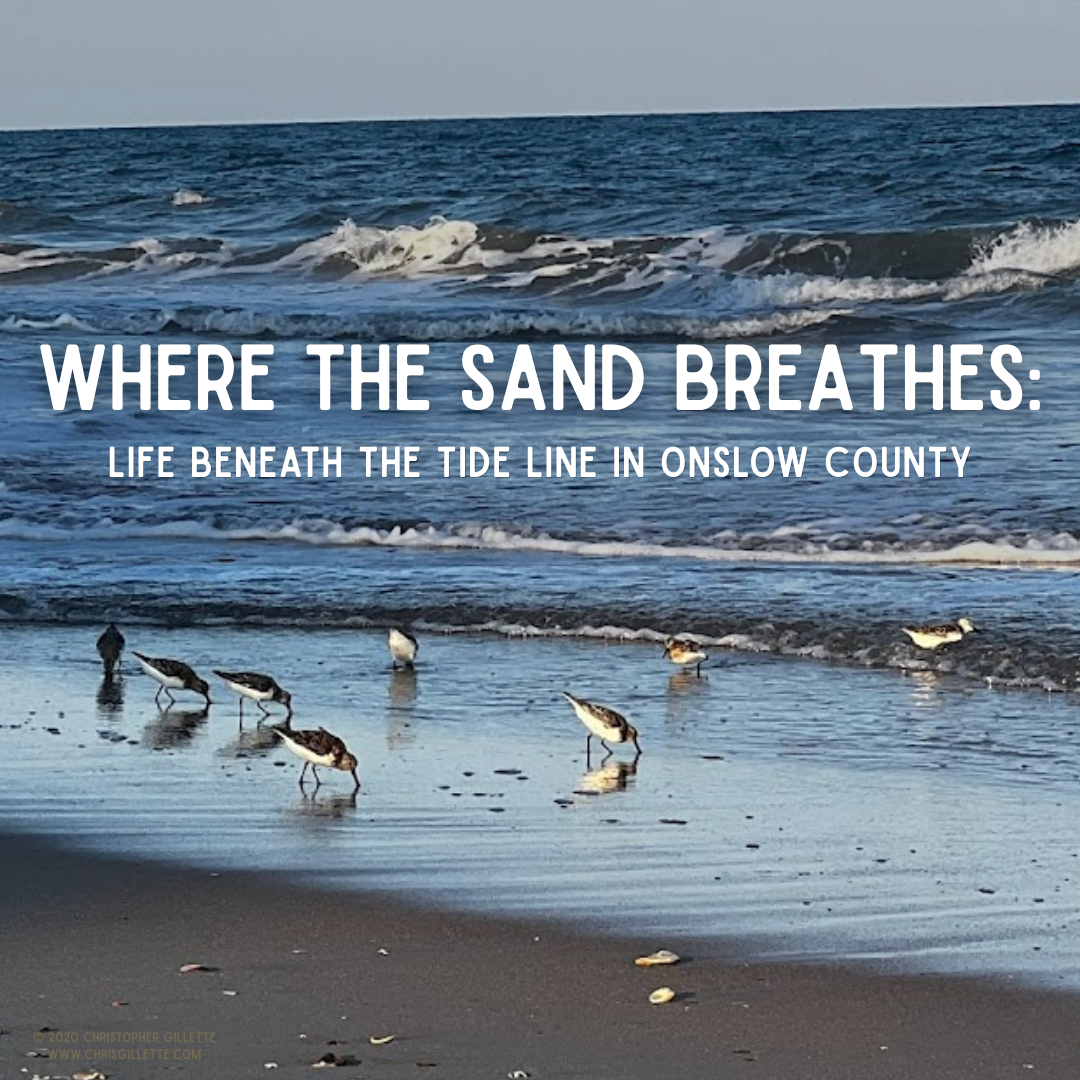
It is by looking up.Anyone who spends time on the beach has likely watched sanderlings (Calidris alba) racing along the edge of the surf. They dart forward as a wave retreats, stop suddenly to probe the sand, and then sprint away from the next incoming wave. A little farther up the beach, ruddy turnstones (Arenaria interpres) pick through wrack lines left behind by the tide. Along the surf edge, Eastern willets (Tringa semipalmata semipalmata) walk deliberately through the shallows, searching for movement beneath the water.
To many beachgoers, they are simply birds feeding along the shoreline.
What they are actually doing is reading the beach.
Each probe into the sand is a search for prey hidden beneath the surface. Mole crabs, small worms, amphipods, coquinas, and other invertebrates living within the tide line provide food for these birds (Dugan et al., 2003; Hubbard & Dugan, 2003).
The birds go where the food is.
When shorebirds gather along a stretch of beach, they are often revealing an ecosystem that would otherwise remain invisible. Their presence tells us that the sand beneath them is alive with prey, even if we cannot see it ourselves.
In many ways, shorebirds act as interpreters of the tide line. By watching where they feed, pause, and congregate, we gain a glimpse into the hidden community supporting them below.
Reading the Beach
From a distance, the tide line can seem almost empty. A narrow strip of wet sand separates the ocean from the rest of the beach. Waves arrive, waves leave, and little appears to change.
Spend a few minutes watching, however, and a different picture begins to emerge.
Shorebirds gather where the surf is most active. Tiny shells appear and disappear with the retreating waves. Fresh ghost crab burrows punctuate the upper beach. Even the wrack line left behind by the tide becomes a gathering place for scavengers and foraging birds.
What first appears to be a simple boundary between land and sea begins to look more like a busy shoreline neighborhood.
At first glance, the tide line can appear almost empty. Look a little longer, however, and the clues begin to emerge—feeding shorebirds, scattered shells, and the constant movement of the surf all hint at the hidden community living beneath the sand. | Image credit: A. Mitchell
The animals living here are responding to the same thing: the constant movement of the tide. Food arrives with the surf, becomes available for a brief moment, and is quickly claimed by whatever creature is best adapted to find it. Some filter it from the water. Some collect it from the sand. Others hunt the animals already feeding there.
Because these organisms live so closely tied to the conditions of the beach, changes in their numbers can provide clues about the habitat itself (Defeo et al., 2009). A shoreline where birds are feeding, ghost crab burrows remain active, and life continues to reveal itself at the edge of the surf is often a sign that this narrow strip of beach is supporting the community that depends upon it.
When those communities decline, the change may not be immediately obvious. Yet over time the beach can begin to feel quieter. Fewer birds stop to feed. Fewer burrows appear in the sand. The signs become harder to find. Those changes can ripple outward through the food web, affecting species both on the beach and beyond it (Peterson et al., 2006).
The Threshold
The next time you stand at the edge of the surf, watch where the waves pause before sliding back toward the sea.
It is easy to see this narrow strip of shoreline as a boundary. Ocean on one side. Land on the other.
But the tide line is not really a dividing line at all.
It is a place where both worlds meet.
With every passing wave, food, oxygen, and life arrive from the ocean. Beneath the sand, animals capture it, consume it, recycle it, and pass it on. Shorebirds search for it. Ghost crabs emerge after dark to hunt it. Countless organisms spend their entire lives within a space that is neither fully ocean nor fully land.
Most people walk across this strip of beach without ever noticing it.
Yet it is one of the busiest places along the coast.
The next time you see shells appearing and disappearing in the surf, a flock of sanderlings racing the tide, or ghost crab burrows scattered across the upper beach, remember that these are not separate observations. They are pieces of the same story.
What appears to be an empty stretch of wet sand is actually a living threshold—a place where ocean and land remain connected through countless interactions happening beneath every step.
And once you see it, it becomes difficult to look at the shoreline the same way again.
The tide line in Surf City, NC may appear to be little more than wet sand. Yet beneath every retreating wave lies a hidden community connecting ocean and land through countless interactions, most of them unseen. | Image credit: A. Mitchell
References
Abude, R. R., Lôbo-Hajdu, G., Moreira, D. A., & Cabrini, T. M. (2024). Sandy beach mole crabs (Decapoda: Hippidae: Emerita): A systematic review of the anthropic impacts, populations density, and conservation strategies. Marine Environmental Research, 202, 106745. https://doi.org/10.1016/j.marenvres.2024.106745
Defeo, O., McLachlan, A., Schoeman, D. S., Schlacher, T. A., Dugan, J., Jones, A., Lastra, M., & Scapini, F. (2009). Threats to sandy beach ecosystems: A review. Estuarine, Coastal and Shelf Science, 81(1), 1-12. https://doi.org/10.1016/j.ecss.2008.09.022
Dugan, J. E., Hubbard, D. M., McCrary, M. D., & Pierson, M. O. (2003). The response of macrofauna communities and shorebirds to macrophyte wrack subsidies on exposed sandy beaches of Southern California. Estuarine, Coastal and Shelf Science, 58, 25-40. https://doi.org/10.1016/s0272-7714(03)00045-3
Ellers, O. (1995). Behavioral control of swash-riding in the clam Donax variabilis. The Biological Bulletin, 189(2), 120-127. https://doi.org/10.2307/1542462
Hubbard, D. M., & Dugan, J. E. (2003). Shorebird use of an exposed sandy beach in Southern California. Estuarine, Coastal and Shelf Science, 58, 41-54. https://doi.org/10.1016/s0272-7714(03)00048-9
McLachlan, A., & Defeo, O. (2018). The ecology of sandy shores (3rd ed.). Academic Press.
P, H. R., & Thiel, H. (1988). Intro study meiofauna. Smithsonian Books (DC).
Peterson, C. H., Bishop, M. J., Johnson, G. A., D’Anna, L. M., & Manning, L. M. (2006). Exploiting beach filling as an unaffordable experiment: Benthic intertidal impacts propagating upwards to shorebirds. Journal of Experimental Marine Biology and Ecology, 338(2), 205-221. https://doi.org/10.1016/j.jembe.2006.06.021
Pilkey, O. H., Rice, T. M., & Neal, W. J. (2014). How to read a North Carolina beach: Bubble holes, Barking sands, and rippled Runnels. UNC Press Books.
Schlacher, T. A., Lucrezi, S., Connolly, R. M., Peterson, C. H., Gilby, B. L., Maslo, B., Olds, A. D., Walker, S. J., Leon, J. X., Huijbers, C. M., Weston, M. A., Turra, A., Hyndes, G. A., Holt, R. A., & Schoeman, D. S. (2016). Human threats to sandy beaches: A meta-analysis of ghost crabs illustrates global anthropogenic impacts. Estuarine, Coastal and Shelf Science, 169, 56-73. https://doi.org/10.1016/j.ecss.2015.11.025
Schratzberger, M., & Ingels, J. (2018). Meiofauna matters: The roles of meiofauna in benthic ecosystems. Journal of Experimental Marine Biology and Ecology, 502, 12-25. https://doi.org/10.1016/j.jembe.2017.01.007
Thiel, M., & Kruse, I. (2001). Status of the nemertea as predators in marine ecosystems. Hydrobiologia, 456(1-3), 21-32. https://doi.org/10.1023/a:1013005814145
Wilson, J. G. (1999). Population dynamics and energy budget for a population of Donax variabilis (Say) on an exposed South Carolina beach. Journal of Experimental Marine Biology and Ecology, 239(1), 61-83. https://doi.org/10.1016/s0022-0981(99)00027-1
Wolcott, T. G. (1978). Ecological role of ghost crabs, Ocypode quadrata (Fabricius) on an ocean beach: Scavengers or predators? Journal of Experimental Marine Biology and Ecology, 31(1), 67-82. https://doi.org/10.1016/0022-0981(78)90137-5
There are mornings along the edges of the water in Onslow County when the surface looks still enough to trust.
The marsh grass has not yet reached its summer height. What stands there leaves more water exposed between the stems, and without sustained wind, the surface holds its shape. You can see farther into it now than you will in a few weeks, before suspended sediment and constant movement return it to opacity. The water carries less of the season, and because of that, more of what moves beneath it becomes visible—if you are willing to wait long enough to see the difference between movement and reflection.
This is when people begin to notice them again.
Not all at once. Not everywhere. Just a change that does not follow wind or tide. A line that holds where the rest of the surface releases. Something that holds its position in a system that is always adjusting.
An alligator does not arrive in that moment.
It becomes visible.
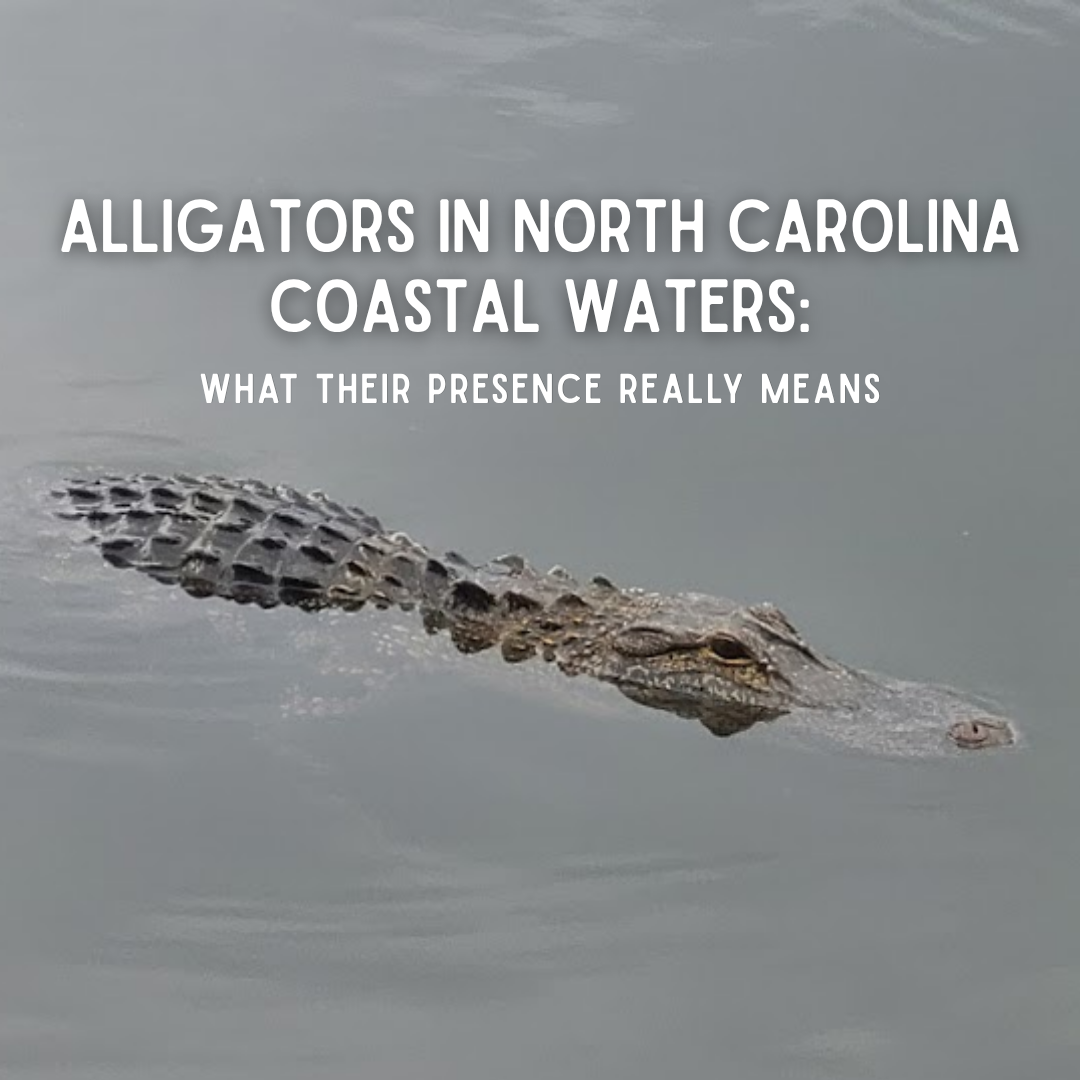
Alligator emerging from the mud. | Photo credit: Gilbert Grant, iNaturalist
Seasonal Absence Is Not Absence
Through winter, they remain within these same creeks, marsh edges, and quieter channels. What changes is not location, but how they occupy it. As temperatures fall, activity narrows. Movement slows, and the need for it slows with it. Energy is conserved, not spent. And the surface carries fewer signs of what lies beneath it. Individuals hold in deeper water or along softer margins where mud retains heat longer than the surrounding water column, remaining within conditions that allow them to persist without constant movement (Nifong et al., 2014; Rosenblatt & Heithaus, 2011).
The same stretch of water that in spring will hold a visible form can pass through winter without interruption, its stillness mistaken for absence.
But the system does not empty.
It compresses.
The System Wakes in Layers
By early spring, that compression begins to release—not all at once, but in layers that build on each other before they are recognized. Shallow water warms first, taking in solar heat more quickly than deeper channels. Along these edges, fish begin to hold longer. Movements that in winter passed through quickly begin to extend into areas that had remained quiet. Invertebrates return to the sediment surface, and the water column begins to carry more suspended life, even before it becomes visible as turbidity.
Birds respond to this before most other changes are noticed. Their movements tighten. Landings become more frequent, departures more abrupt. What they are tracking is not random. It is the redistribution of energy into places where it can be accessed.
The alligator moves within that shift.
Not as a trigger. Not as something layered on top. But as part of a system reorganizing itself across temperature, light, and movement at the same time.
Great blue heron and alligator are part of an interconnected system. | Photo credit: Audubon North Carolina
Reading What It Is Responding To
When one becomes visible along the edge of a creek or marsh, it is easy to reduce that moment to temperature alone. Warmer water allows for more activity.
But what draws it into that position is more specific than warmth.
It is the arrangement of prey.
Along the margins where water meets land, movement compresses. Fish traveling with the tide encounter shallow gradients that limit how long they can remain. Small mammals moving between marsh and upland must cross exposed edges. Birds landing to feed do so in places where depth and access align for only short intervals.
These are not isolated events. They are recurring patterns shaped by tidal cycles, substrate, and seasonal change.
The alligator positions itself within those patterns.
Its diet reflects that flexibility, spanning invertebrates, fish, birds, reptiles, and mammals depending on size and availability (Nifong, 2016). But the diet alone does not explain its placement. What matters is where energy becomes concentrated, even briefly.
That concentration is not constant. It forms and dissolves with tide, with light, with movement.
And the predator tracks that.
And what appears as a single movement—a fish turning, a bird lifting, something crossing the edge of the marsh—is part of a larger structure that holds only briefly before dissolving again.
The alligator does not respond to the individual movement.
It responds to the pattern that produces it.
Where Freshwater Meets Salt
These are not just places where water mixes.
They are places where movement is forced—and where that movement becomes available to something waiting at the top of it.
There are places along this coastline where those changes concentrate.
At the mouths of creeks, along the edges of the Intracoastal Waterway, and near the shifting bars of New River Inlet, the water does not settle into a single condition. Freshwater moves outward with tide and rainfall, meeting saltwater pressing back in with tidal exchange. The result is not a fixed boundary, but a gradient that shifts continuously—sometimes visible as a faint line, sometimes only detectable in how the surface moves differently from one side to the other.
This is where alligators are most often encountered—because this is where the system compresses into something they can use.
They are not marine animals. They do not possess the specialized salt glands that allow for extended life in high salinity environments. Over time, saltwater carries a physiological cost, requiring a return to freshwater to restore balance (Rosenblatt & Heithaus, 2011; Fujisaki et al., 2014).
But that limitation does not exclude them.
It defines how they move through them.
In these mixing zones, salinity is not constant. It rises and falls with tide, with rainfall, with wind direction. A location that carries higher salinity at one stage may shift toward fresher conditions hours later. What appears to be a boundary is, in practice, a moving field.
Within that field, movement compresses.
Fish traveling with the tide are funneled into narrower pathways. Shallow gradients limit how long they can remain in deeper water. Schools tighten. Individuals encounter edges that restrict escape. The system concentrates energy into space.
The predator does not need to range widely in these conditions.
It needs to hold where movement is forced.
And so it does.
An alligator near the tall grass near Marine Corps Air Station New River | Photo credit: Martin Egnash
At the Edge of the Open Water
There are moments when that pattern extends beyond the mixing zones, into places that appear, at first, outside of where an alligator belongs.
Along the shoreline, in the breaking waves where the ocean meets sand, one will sometimes appear—rising and falling with the swell, holding position just beyond where the water turns over onto the beach. It looks misplaced, as though it has moved beyond the system that defines it.
It has not.
The surf zone is one of the most compressed environments along the coast. Waves reduce depth, disrupt orientation, and concentrate movement into a narrow band where escape is limited. Fish pushed into breaking water lose some ability to maintain direction. Schools fragment. Individuals become briefly exposed in ways that do not occur in deeper, more stable water.
For a predator capable of stillness followed by short bursts of movement, that compression creates opportunity.
But the cost is higher.
Salinity is elevated. The water is in constant motion. There is no stable refuge within immediate reach. Time in this environment cannot be extended indefinitely.
And so it does not.
Movements into higher salinity water tend to be brief—extensions outward, followed by a return to freshwater or lower salinity conditions where balance can be restored (Nifong et al., 2014).
What appears as an anomaly is part of a larger pattern.
The predator crosses the boundary not to remain, but to use it, moving where the system briefly offers more than it costs.
The same forces that shape the marsh edge—compression, constraint, and brief exposure—are recreated here, just for a moment, in a different place.
An alligator rests at the ocean’s edge in North Topsail. | Photo credit: Fox8 Digital Desk
What Its Presence Changes
Most of what that presence changes cannot be seen when it is observed.
Long before any direct interaction occurs, it is already altering how other organisms use space.
Fish moving along the edge do not simply pass through. They adjust their depth, their speed, the amount of time they remain exposed. Birds land with shorter intervals between contact and departure. Mammals approaching the water shift their paths or their timing. These changes are not dramatic in isolation. But they are continuous.
Over time, they accumulate into structure—the kind that determines who feeds, where they feed, and how long they remain.
The influence of a predator at this level extends beyond what it consumes. It shapes behavior across multiple species, redistributing where and how energy moves through the system. The possibility of predation—present even when not observed—alters interactions in ways that regulate access to habitat and resources (Heithaus et al., 2008; Ripple et al., 2014; Estes et al., 2011).
What holds the system in place is not removal alone.
It is pressure.
What is being shaped is not just movement, but access—and access is what determines how energy moves through the system.
More Than Predation
The influence of the alligator does not end with what it hunts, but extends beyond those interactions.
As it moves through shallow systems, it disturbs sediment, creating depressions and pathways that alter how water is retained and how nutrients are redistributed. These small changes in physical structure create conditions that other species use—temporary refuges, feeding areas, and zones where organic material accumulates (Eversole et al., 2018; Subalusky et al., 2009).
In wetland systems, these disturbances have been linked to broader effects, including nutrient cycling and carbon storage, where the presence of large predators contributes to the retention of organic material within the system rather than its export (Murray et al., 2025; Atwood et al., 2015).
These processes do not occur in isolation.
They intersect with the same patterns of movement, feeding, and behavior that define the system at larger scales.
Seeing the Surface, Reading the System
When one becomes visible along the surface, it is easy to treat the moment as singular.
A sighting. An encounter. Something separate from everything around it.
But that form at the surface is supported by layers extending beyond what can be seen.
It reflects water temperatures crossing into ranges that support sustained activity. It reflects prey moving into positions where access becomes possible. It reflects a system where behavior is still shaped by the presence of something at the top.
The alligator is not an interruption to that system.
It is an expression of it.
What Becomes Visible
Seeing one does not indicate that something has entered the water.
It indicates that enough beneath the surface is functioning to hold it.
Not in a static sense. Not as balance in the way it is often described. But as a set of interactions that remain connected—movement, response, pressure—each shaping the others even when they are not directly observed.
What becomes visible at the surface is only a fraction of that structure.
But it is enough to know that the rest is still in place.
An alligator in Onslow County sits at the edge of the saltmarsh. |Photo credit: Gilbert Grant, iNaturalist
When That Pressure Is Reduced
If that pressure is reduced, the system does not leave an obvious gap.
It shifts.
Movements that were once constrained begin to extend. Species that passed quickly through exposed areas begin to remain longer. Edges that functioned as transition zones become used differently—not because the physical environment has changed, but because the conditions that shaped behavior within it have relaxed.
Mid-level predators expand their activity under these conditions, increasing their access to prey and space when not constrained from above (Nifong et al., 2013).
The change is subtle.
It appears in how long something stays. In how often it returns. In where it lingers. In how quietly the structure of behavior begins to loosen.
The food web and trophic cascade of the American alligator in the Florida Everglades.
A System Written Into Temperature
There is another layer to this that does not show itself at the surface.
The structure of that presence is set years earlier, in a place that can be overlooked when standing at the water’s edge. Along the margins of marsh and wetland, slightly above the reach of regular water movement, nests are built from vegetation and sediment, forming mounds that hold heat as they decompose.
Within those mounds, temperature determines something that will not be visible for much later.
Sex is not fixed at fertilization. It emerges during incubation, shaped by the thermal conditions held within the nest. A difference of only a few degrees is enough to shift the outcome, producing more males or more females depending on where within that range the nest remains (Lang & Andrews, 1994; Janzen, 1994).
Under variable conditions—differences in shading, rainfall, timing, and placement—those outcomes are distributed across the landscape. Some nests produce more females, others more males. That variability holds the population in a form that can sustain itself over time.
When conditions become more consistent, that variation narrows.
Warmer nights hold heat longer within the nest. Seasonal transitions extend. The range of outcomes compresses. What was once distributed begins to align.
And that alignment carries forward into the structure of the population—into how individuals occupy space, into how pressure is applied across the system, into what will eventually be visible at the surface.
Alligator eggs hatch after 65 days of incubation in the fall. The babies will chirp to alert their mom, who then digs out the nest while the babies use their egg tooth to hatch from their eggs. Their mom will then safely carry them to the water.
Where the Next Generation Is Set
The placement of those nests depends on something even more constrained.
A narrow band of land that remains above water just long enough to hold them.
That band is not fixed.
It shifts with tide, with rainfall, with the gradual reworking of shoreline that occurs across seasons and years. With rising sea levels, water reaches farther into areas that once remained above it. Flooding becomes more frequent, not always through singular events, but through repeated intrusions that saturate and destabilize what had previously held (Joanen & McNease, 1989; Sweet et al., 2022).
Human alteration compresses this space further.
Hardened shorelines, dredging, and development reduce the gradual transition between land and water. Where there was once a slope capable of holding multiple elevations, there becomes a defined edge. That edge does not provide the same range of conditions required for successful nesting.
The number of suitable sites decreases.
More importantly, the variability between them narrows.
And with that, the system loses one of the mechanisms that allowed it to absorb change.
Alligator on her nest that can hold up to 60 eggs. | Photo credit: National Park Service (NPS)
What Its Presence Means
When an alligator becomes visible along the surface, it reflects conditions that have aligned across multiple layers.
Temperature has reached a range that supports activity. Prey has moved into positions where access becomes possible. Behavioral pressure remains in place across the system. Reproduction has held across enough years, in enough suitable places, to sustain what is now present.
What is seen at the surface is not separate from them.
It is supported by them.
Seeing one does not signal that something has entered the water.
It signals that enough of what lies beneath it—movement, pressure, response, and continuity—remains intact.
And that—even when most of it is not visible—the system is still holding together.
And that is what becomes visible—just long enough to be seen, before the system closes back over it again.
The system does not end at the water’s edge.
Epilogue: Chicken Nugget
We came across him along the New River, near the courthouse in Jacksonville.
We were there to clear what had been left behind—fishing line caught along the walkways, hooks, and the overflow from a trash can that had spilled out onto the edge. Fast food containers, grocery store chicken trays, scattered along the bank. The signs were clear enough. People had been there for a while—crabbing, fishing, eating, leaving what remained.
He was directly below us.
Small enough to miss at first. Still enough to blend into the water until you stopped looking for movement and started noticing what held its position.
A juvenile alligator, watching.
He stayed there while we worked, then slipped beneath the surface and crossed the small bay. On the opposite side, someone tossed a piece of food into the water. He surfaced almost immediately, took it, and remained.
Waiting.
I came back later and stayed longer.
The pattern repeated. He would disappear until footsteps approached, then return to the same place along the edge. Holding position. Watching. Waiting for something to fall.
No fishermen or crabbers passed through while I was there, but the behavior was consistent with what happens when food becomes predictable. Bait, catch, scraps—anything that can be taken without the cost of searching or pursuing.
Energy, without effort.
It is easy to see something like that and respond to what it looks like in that moment. A small animal. Still. Attentive. Something that feels close enough to interact with.
But what is being shaped there is not just a single interaction.
It is behavior.
A shift away from the conditions that formed it—toward something more efficient, more immediate, and less stable over time. The system that once required movement, patience, and response begins to narrow into expectation.
And expectation changes how an animal uses space.
What happens when that animal is no longer small is not a separate question.
It is the continuation of the same pattern.
Alligators do not forget where food has been easy to obtain. They return to it. They hold in those places. They begin to associate presence—human presence—with opportunity.
What begins as something that feels harmless becomes something that alters how the system functions around it.
Not just for the animal, but for everything that responds to it.
There are instincts at work here that were shaped long before any walkway, any dock, any place where food might be dropped from above. Those instincts are not just about survival in isolation. They are part of how pressure is applied, how movement is shaped, how the system holds.
When those instincts are replaced with something easier, the effect does not remain contained.
It carries outward.
He stayed there while I watched. Returning to the same place. Holding the same position. Waiting for something to fall.
There is a kind of kindness in wanting to give something to an animal like that.
But there is another kind in leaving it as it is.
Not interrupting the conditions that shape it. Not narrowing what it has learned to expect. Not replacing a system built on movement and response with one built on waiting.
Let it remember the water as it is.
And you, only as something that passed through it.
We affectionately named this juvenile alligator in the New River in Jacksonville, NC “Chicken Nugget” for all of the chicken nugget boxes left behind on the walkway from an overflowing trash can. | Photo credit: A. Mitchell
References
Atwood, T. B., Connolly, R. M., Ritchie, E. G., Lovelock, C. E., Heithaus, M. R., Hays, G. C., Fourqurean, J. W., & Macreadie, P. I. (2015). Predators help protect carbon stocks in blue carbon ecosystems. Nature Climate Change, 5(12), 1038-1045. https://doi.org/10.1038/nclimate2763
Estes, J. A., Terbough, J., Brashares, J. S., Power, M. E., Berger, J., Bond, W. J., Carpenter, S. R., Essington, T. E., Holt, R. D., & Wardle, D. A. (2011). Trophic Downgrading of Planet Earth. Science, 333(604), 301-306. https://www.science.org/doi/abs/10.1126/science.1205106
Fujisaki, I., Hart, K. M., Mazzotti, F. J., Cherkiss, M. S., Sartain, A. R., Jeffery, B. M., Beauchamp, J. S., & Denton, M. (2014). Home range and movements of American alligators (Alligator mississippiensis) in an Estuary habitat. Animal Biotelemetry, 2(1), 8. https://doi.org/10.1186/2050-3385-2-8
Heithaus, M. R., Frid, A., Wirsing, A. J., & Worm, B. (2008). Predicting ecological consequences of marine top predator declines. Trends in Ecology & Evolution, 23(4), 202-210. https://doi.org/10.1016/j.tree.2008.01.003
Janzen, F. J. (1994). Climate change and temperature-dependent sex determination in reptiles. PNAS, 91(16), 7487-7490. https://doi.org/10.1073/pnas.91.16.7487
Joanen, T., & McNease, L. L. (1989). Ecology and physiology of nesting and early development of the American alligator. American Zoologist, 29(3), 987-998. https://doi.org/10.1093/icb/29.3.987
Lang, J. W., & Andrews, H. V. (1994). Temperature‐dependent sex determination in crocodilians. Journal of Experimental Zoology, 270(1), 28-44. https://doi.org/10.1002/jez.1402700105
Nifong, J. C. (2016). Living on the edge: Trophic ecology of alligator mississippiensis (American alligator) with access to a shallow estuarine impoundment. Bulletin of the Florida Museum of Natural History, 54(2), 13-49. https://doi.org/10.58782/flmnh.xkdw7119
Nifong, J. C., Nifong, R. L., Silliman, B. R., Lowers, R. H., Guillette, L. J., Ferguson, J. M., Welsh, M., Abernathy, K., & Marshall, G. (2014). Animal-borne imaging reveals novel insights into the foraging behaviors and Diel activity of a large-bodied APEX predator, the American alligator (Alligator mississippiensis). PLoS ONE, 9(1), e83953. https://doi.org/10.1371/journal.pone.0083953
Nifong, J. C., & Silliman, B. R. (2013). Impacts of a large-bodied, APEX predator (Alligator mississippiensis Daudin 1801) on salt marsh food webs. Journal of Experimental Marine Biology and Ecology, 440, 185-191. https://doi.org/10.1016/j.jembe.2013.01.002
Ripple, W. J., Estes, J. A., Beschta, R. L., Wilmers, C. C., Ritchie, E. G., Hebblewhite, M., Berger, J., Elmhagen, B., Letnic, M., Nelson, M. P., Schmitz, O. J., Smith, D. W., Wallach, A. D., & Wirsing, A. J. (2014). Status and ecological effects of the world’s largest carnivores. Science, 343(6167). https://doi.org/10.1126/science.1241484
Rosenblatt, A. E., & Heithaus, M. R. (2011). Does variation in movement tactics and trophic interactions among American alligators create habitat linkages? Journal of Animal Ecology, 80(4), 786-798. https://doi.org/10.1111/j.1365-2656.2011.01830.x
Sweet, W. V., Hamlington, B. D., Kopp, R. E., Weaver, C. P., Barnard, P. L., Bekaert, D., Brooks, W., Craghan, M., Dusek, G., Frederickse, T., Garner, G., Genz, A. S., Krasting, J. P., Larour, E., Marcy, D., Marra, J. J., Obeysekera, J., Osler, M., Pendleton, M., … Zuzak, C. (2022). Global and regional sea level rise scenarios for the United States: Updated mean projections and extreme water level probabilities along U.S. coastlines (Technical Report NOS 01). National Oceanic and Atmospheric Administration, National Ocean Service. https://earth.gov/sealevel/us/internal_resources/756/noaa-nos-techrpt01-global-regional-SLR-scenarios-US.pdf