Tag: Estuary Ecology

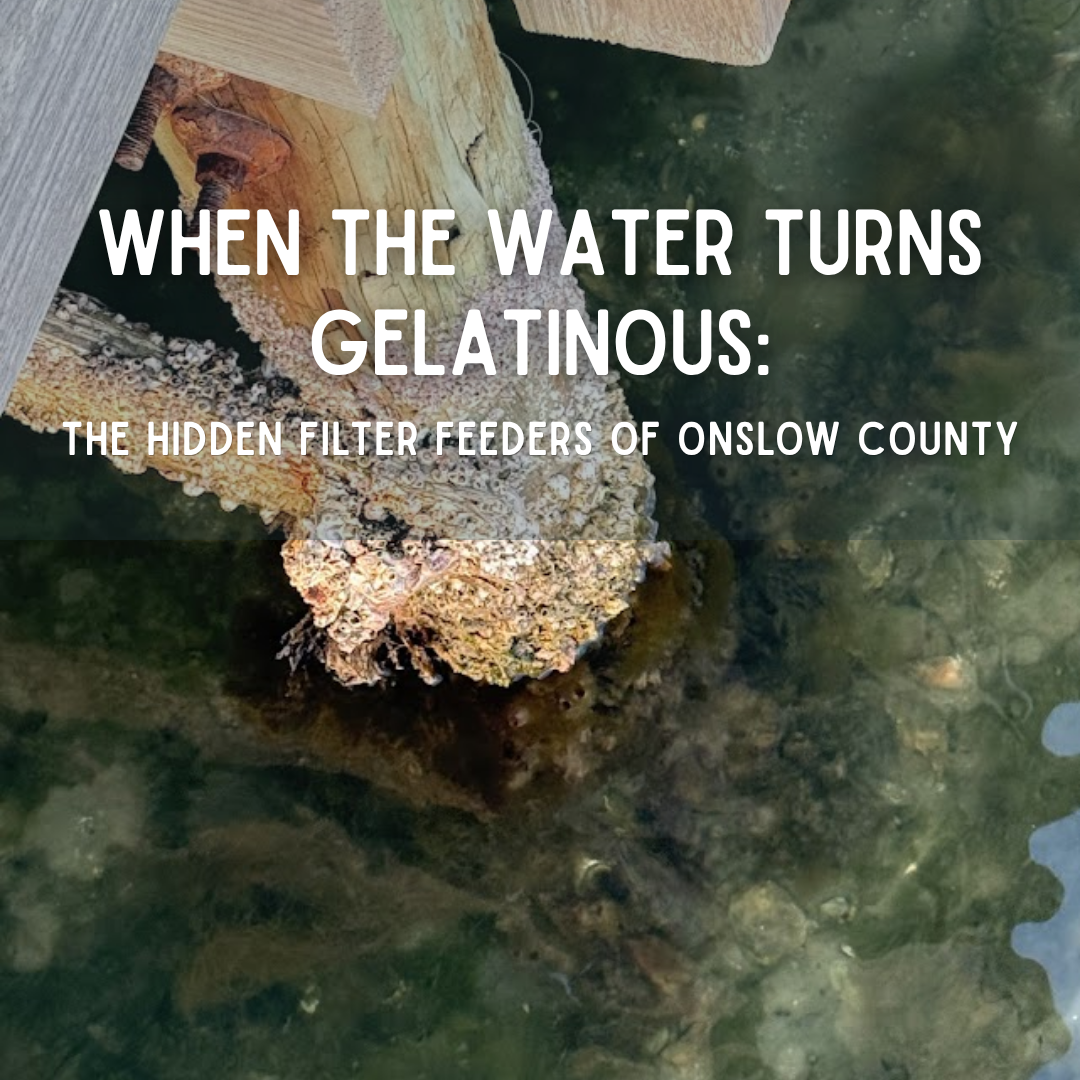
  • When the Water Turns Gelatinous: The Hidden Filter Feeders of Onslow County

    When the Water Turns Gelatinous: The Hidden Filter Feeders of Onslow County

    Sometimes the estuary changes before people notice why.

    The water may look normal from shore, but drifting just beneath the surface are long ribbons of translucent gelatin — soft strands that gather along marsh edges, collect in eddies, or drift through the current like mucus suspended in the tide. In Surf City this week, people described them as “whale snot.”

    Gelatinous material collected from Murrells Inlet, South Carolina at the low tide edge. Such suspended material may include colonial tunicates, salps, mucus-rich plankton aggregates, and other organic matter associated with productive estuarine conditions. | Image credit: J. Mattevi
    Gelatinous material collected from Murrells Inlet, South Carolina at the low tide edge. Such suspended material may include colonial tunicates, salps, mucus-rich plankton aggregates, and other organic matter associated with productive estuarine conditions. | Image credit: J. Mattevi

    They are more likely colonial tunicates or salps, gelatinous filter-feeders that can appear suddenly when conditions in the water favor rapid plankton growth (Bone, 1998; Madin & Deibel, 1998).

    What matters is not only the organisms themselves, but what their appearance says about the estuary around them.

    The drifting forms

    These blooms often form when the water column becomes temporarily stable and productive (Madin, 1982). Warmer temperatures, calmer conditions, reduced wave turbulence, and elevated plankton concentrations create an environment where filter-feeding gelatinous organisms can reproduce rapidly. Water moving through the inlets may also transport offshore plankton communities into the estuary, concentrating them in tidal creeks and slower-moving surface water (Bone, 1998; Madin, 1982).

    In these calmer stretches, the water column begins separating into layers. Suspended plankton remains concentrated near the surface while weaker turbulence allows fragile gelatinous colonies to persist long enough for blooms to form. What would normally disperse through wave action instead remains suspended within the estuary itself (Madin, 1982).

    To most people, they look like debris.

    Ecologically, they are processing the estuary in real time.

    Salps and colonial tunicates continuously pump water through their bodies, removing suspended phytoplankton, bacteria, and organic particles from the water column. During bloom periods, enormous volumes of water can be filtered each day (Madin, 1982; Sutherland et al., 2010). In effect, the estuary briefly develops a drifting layer of living filtration suspended between the surface and the bottom.

    Each colony filters continuously. Thousands moving through a tidal creek or marsh edge at once can collectively filter enormous volumes of suspended material over short periods of time, temporarily altering the clarity and composition of the surrounding water (Riisgård & Larsen, 2010).

    That shift affects everything around them.

    When these blooms are abundant, water clarity can temporarily improve as suspended particles are removed. Organic material becomes concentrated into mucus-rich waste pellets and decaying gelatinous tissue that sink toward the bottom, transferring energy from the surface into benthic food webs below (Madin & Deibel, 1998). Microbes, worms, crustaceans, and scavengers begin responding almost immediately (Madin, 1982; Madin & Deibel, 1998).

    Instead of remaining suspended near the surface, nutrients and organic matter begin settling downward through the water column. What had been dispersed through open water becomes concentrated along the bottom, where deposit-feeding worms, small crustaceans, microbes, and scavengers begin incorporating that material into the estuary below (Madin, 1982).

    The bloom itself becomes food.

    The drifting masses also create temporary structure within otherwise open water. Small fish gather along their edges. Tiny invertebrates gather within folds and strands of gelatinous tissue. Predators begin responding not only to the bloom itself, but to the concentration of life forming around it (Bone, 1998; Madin & Deibel, 1998).

    Small fish and invertebrates feed around the edges of these drifting masses. Juvenile fishes may remain near these drifting masses as food becomes concentrated around them. Sea turtles, some fishes, and other gelatinous predators may increase feeding activity where blooms become dense enough to concentrate prey (Bone, 1998).

    But like many ecological events, balance matters.

    If too few filter-feeders are present during periods of elevated nutrients, water grows murkier and oxygen conditions become less stable, particularly during heat and nighttime respiration. But filtration at the opposite extreme can also reshape the food web. Too many gelatinous filter-feeders, however, may strip large amounts of plankton from the water column, altering food availability for larval fishes and other plankton-dependent organisms higher in the food web (Petersen & Riisgård, 1992).

    Most blooms are temporary. 

    Currents disperse them. Heat and bacteria break them apart. Waves fragment the colonies into nearly invisible strands that disappear back into the system as quickly as they arrived. Even in collapse, the bloom continues feeding the estuary. Decaying tissue is broken apart by bacteria, consumed by scavengers, and recycled back into the same nutrient pathways that allowed the bloom to form in the first place (Madin, 1982).

    But for a short period, the estuary reveals something normally hidden: the water between the marsh and the bottom is not empty space. It is an active habitat, filled with organisms that filter, recycle, transport, and redistribute energy through the coastal ecosystem (Bone, 1998; Madin, 1982).

    The attached forms

    Not all tunicates remain suspended in the water column. Some attach themselves directly to the surfaces that hold still long enough for life to accumulate—dock pilings, oyster shell, ropes, marsh grass roots, floats, and the shaded undersides of piers where current continues moving but turbulence drops away.

    Along the estuaries of Onslow County, these attached forms become part of what looks, at first glance, like simple buildup.

    The surfaces beneath docks rarely stay bare for long (Wahl, 1989; Lindeyer & Gittenberger, 2011). Marine scientists often describe these layered growths as fouling communities, but along the estuary they appear simply as the layer of life that forms on anything left in the water long enough. First comes a film too thin to notice, then algae, then colonies of organisms layered over one another until wood, shell, and rope begin carrying part of the estuary itself.

    Sea squirts and other attached filter-feeders beneath a dock in Surf City, North Carolina. | Image credit: A. Mitchell
    Sea squirts and other attached filter-feeders beneath a dock in Surf City, North Carolina. | Image credit: A. Mitchell

    Tunicates are part of that layer.

    Along this coast, attached tunicates can include solitary species like the pleated sea squirt (Styela plicata) and the sea grape (Molgula manhattensis), as well as colonial species such as Clavelina oblonga and sea pork (Aplidium stellatum) (Van Name, 1945; Lambert, 2007).

    Some grow individually, attached like soft sacs with openings at the top. Others spread as colonial sheets or clustered lobes, sharing a common outer covering while continuously filtering water moving past them. Around pilings and floating docks, entire communities can form this way—sponges beside hydroids, bryozoans layered against tunicates, all responding to current, salinity, temperature, and suspended food moving through the tide (Wahl, 1989).

    To most people, these surfaces register as slime.

    Ecologically, they are filtration, habitat, and nutrient transfer occurring simultaneously (Wahl, 1989).

    Sea squirts

    The organisms most people recognize first are usually sea squirts. They appear as rubbery sacs attached beneath docks or clustered along ropes, and shell. Press one accidentally and water jets outward through small siphons near the top of the body, giving rise to the common name.

    A sea squirt partially coated in algae and sediment beneath shallow estuarine water in Surf City, North Carolina. The two siphon openings are part of the continuous filtration process occurring beneath docks and marsh edges. | Image credit: A. Mitchell
    A sea squirt partially coated in algae and sediment beneath shallow estuarine water in Surf City, North Carolina. The two siphon openings are part of the continuous filtration process occurring beneath docks and marsh edges. | Image credit: A. Mitchell

    Species such as the pleated sea squirt (Styela plicata) often develop thick, wrinkled outer coverings ranging from tan and off-white to purple, while the sea grape (Molgula manhattensis) forms smaller rounded bodies attached within the layered communities growing beneath docks and along estuarine structure — what marine scientists often call fouling communities (Van Name, 1945).

    What looks like a reaction is actually the visible end of a process already underway.

    Sea squirts continuously pull water inward through one siphon, filter out phytoplankton, bacteria, and suspended particles from the water, then expel the filtered water back into the estuary through another opening. The animal does not begin filtering when disturbed. It has been filtering the entire time (Riisgård & Larsen, 2010).

    In productive estuarine water, thousands of these organisms may be pumping simultaneously (Riisgård & Larsen, 2010).

    That filtration matters.

    As suspended particles are removed, nutrients become concentrated into waste and biomass that can be transferred downward into bottom communities. Water clarity may improve locally (Riisgård & Larsen, 2010). Microbial activity shifts around them. Small invertebrates begin using the folds and surfaces their bodies create.

    Their presence also signals something about the surrounding water.

    Sea squirts tend to cluster where flow remains steady enough to deliver oxygen and suspended food continuously, but not so violent that colonies are torn free. Around tidal creeks, dock edges, and quieter stretches of the Intracoastal Waterway, their abundance often reflects a system carrying enough suspended productivity to sustain constant filtration (Barros, 2009).

    Sea pork

    Some tunicates take a different form entirely.

    One of these is sea pork, commonly associated with colonial tunicates such as Aplidium stellatum, which spread outward as shared gelatinous colonies rather than isolated individuals (Van Name, 1945).

    Sea pork, a colonial tunicate, washed ashore along Surf City, North Carolina. Though it appears as a single gelatinous mass, it is made up of thousands of tiny filter-feeding animals embedded within a shared outer layer. | Image credit: D. Miles
    Sea pork, a colonial tunicate, washed ashore along Surf City, North Carolina. Though it appears as a single gelatinous mass, it is made up of thousands of tiny filter-feeding animals embedded within a shared outer layer. | Image credit: D. Miles

    Sea pork spreads across submerged surfaces in thick, rubbery colonies that look less like individual animals and more like flesh-colored mats attached beneath floats and pilings. Depending on the species and age of the colony, the surface may appear muted pink, tan, orange, or almost translucent beneath the waterline.

    Most people don’t realize they are looking at colonies made up of thousands of tiny individual filter-feeding bodies embedded together within a shared outer layer.

    The colony functions collectively (Van Name, 1945).

    Water moves continuously through countless small openings across the surface, carrying suspended plankton and organic particles into the colony while waste and filtered water move back outward into the surrounding estuary (Riisgård & Larsen, 2010).

    That structure changes the surface around it.

    Sea pork colonies trap sediment and create small protected surfaces where microorganisms and invertebrates begin to accumulate between folds and protected edges. Tiny crustaceans move across them. Worms and microbial films develop within the folds and protected spaces between colonies. What appears smooth from above becomes, at smaller scales, complex terrain (Wahl, 1989).

    Like other filter-feeding communities along this coast, sea pork helps transfer suspended energy from the water column into the attached world beneath docks and marsh edges.

    And once that layered habitat forms, other organisms begin responding to it—including the nudibranchs moving slowly across its surface.

    Nudibranchs

    At low tide along the edges of the sound—where pilings hold a thin skin of life and oyster shells stack into uneven ridges—the water sometimes carries color that doesn’t belong to the sand or the grass. It moves slowly, almost deliberately, across surfaces that most people step over without noticing. What looks like a fragment of drifting algae or a soft piece of shell resolves, if you stop long enough, into something alive.

    These are nudibranchs.

    They are not fish, not worms, not plants. They are marine gastropods—relatives of snails—but without shells (Valdés et al., 2006). Along the coast of Onslow County, they appear in the quiet places: beneath docks in the Intracoastal Waterway, along the edges of Topsail Island marsh creeks, and on the submerged surfaces where current slows just enough for growth to take hold.

    Along shallow estuarine structure in this region—beneath docks, across pilings, and within the layered growth attached to ropes and shell—nudibranchs may include species such as the striped nudibranch (Cratena pilata), the Brazilian aeolid sea slug (Spurilla braziliana), the fringeback dondice (Dondice occidentalis), Thecacera pennigera, Berghia rissodominguezi, and the brackish-water species Tenellia adspersa (Marcus, 1972; Valdés et al., 2006). 

    Most people never see them. But they are there, working through the same system that shapes everything else along this coast.
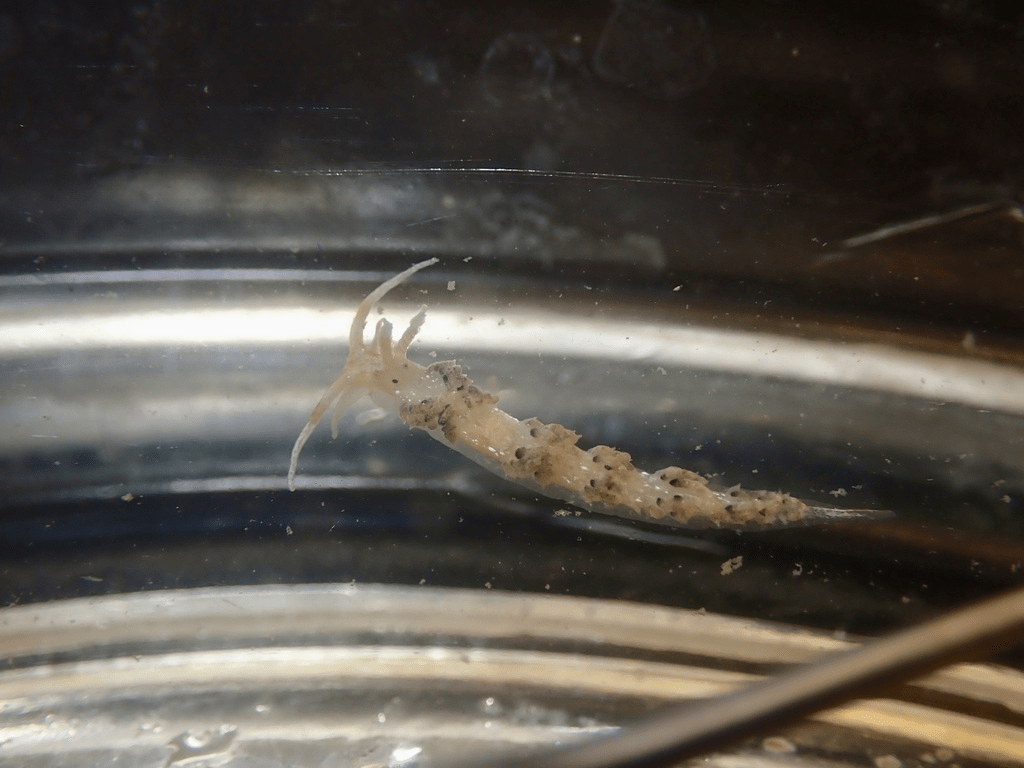
    A nudibranch collected near Morehead City, North Carolina, viewed under magnification. The cerata along its back increase surface area for respiration and, in some species, store defensive stinging cells obtained from prey. | Image credit: marineinvertgirl, iNaturalist
    A nudibranch collected near Morehead City, North Carolina, viewed under magnification. The cerata along its back increase surface area for respiration and, in some species, store defensive stinging cells obtained from prey. | Image credit: marineinvertgirl, iNaturalist

    Built for sensing, not speed

    A nudibranch’s body is built for sensing and feeding, not speed. The two structures at the front—rhinophores—sample the water chemically, reading it the way a shoreline bird reads the wind. Along their backs, many species carry cerata, small extensions that look ornamental but function as both respiration and defense.

    In aeolid nudibranchs like Spurilla braziliana, Cratena pilata, and Berghia rissodominguezi, these cerata become important sites for both respiration and defensive storage of stinging cells obtained from prey (Goodheart et al., 2018).

    The Brazilian aeolid sea slug (Spurilla braziliana) moving across submerged structure near Morehead City, North Carolina. The cerata lining its back function in respiration and can store defensive stinging cells obtained from prey such as anemones and hydroids. | Image credit: wonglab, iNaturalist
    The Brazilian aeolid sea slug (Spurilla braziliana) moving across submerged structure near Morehead City, North Carolina. The cerata lining its back function in respiration and can store defensive stinging cells obtained from prey such as anemones and hydroids. | Image credit: wonglab, iNaturalist

    They move slowly because they can afford to. Their food doesn’t run.

    Sponges, hydroids, bryozoans—these are the surfaces most people would describe as “growth” on docks or shells. To a nudibranch, those surfaces are structure, habitat, and food all at once (Valdés et al., 2006).

    The work they do (even when no one’s watching)

    Along this coastline, growth is constant. Give any hard surface—an old piling, a piece of shell, a boat hull—enough time in the water and it becomes layered. First a film, then algae, then invertebrates. The system builds upward and outward, creating what scientists call structural complexity, but what you actually see is texture: roughness where there used to be smoothness (Wahl, 1989).

    Along shallow estuarine bottoms, algae, shell, and attached growth begin forming the layered habitat that supports juvenile fish, crabs, filter-feeders, and the organisms moving through the estuary food web. | Image credit: A. Mitchell
    Along shallow estuarine bottoms, algae, shell, and attached growth begin forming the layered habitat that supports juvenile fish, crabs, filter-feeders, and the organisms moving through the estuary food web. | Image credit: A. Mitchell

    Nudibranchs move through that texture selectively.

    Many species feed on a single type of prey. One may specialize in a particular sponge. Another tracks hydroids, those delicate branching animals that resemble tiny underwater ferns. Species such as Dondice occidentalis, Cratena pilata, and Tenellia adspersa are commonly associated with hydroids and other organisms growing across submerged pilings, docks, ropes and shell in shallow coastal environments (Marcus, 1972; Valdés et al., 2006). This selectivity matters more than their size suggests. They are not removing everything. They are removing specific pieces of the system.

    That kind of feeding does not flatten the landscape—it shapes it.

    Where one organism begins to dominate, nudibranchs can limit its spread. Where surfaces would otherwise become uniform, their grazing introduces variation. Over time, this helps maintain the uneven habitat small fish, shrimp, and juvenile invertebrates depend on (Wahl, 1989).

    Growth that begins as algae quickly becomes habitat. Along shallow estuarine edges, layered vegetation and attached organisms create shelter for crabs, juvenile fish, shrimp, and other small life moving through the system. | Image credit: A. Mitchell
    Growth that begins as algae quickly becomes habitat. Along shallow estuarine edges, layered vegetation and attached organisms create shelter for crabs, juvenile fish, shrimp, and other small life moving through the system. | Image credit: A. Mitchell

    It’s easy to miss because nothing dramatic happens. There’s no visible clearing, no sudden absence. But the balance of what grows, and where, shifts quietly in response to their presence.

    Borrowed defenses, redistributed energy

    Some nudibranchs do something that seems improbable until you see it up close: they take the defenses of what they eat and keep them.

    Hydroids and certain cnidarians carry stinging cells—nematocysts—that function as protection. When a nudibranch feeds on them, those cells pass through the digestive system intact and are stored within the cerata along its back. The nudibranch doesn’t just consume its prey; it incorporates part of its defense (Goodheart et al., 2018).

    This changes how energy moves through the system.

    Instead of defenses being lost when prey is consumed, they are transferred upward. The nudibranch becomes both grazer and deterrent, a small organism that is less likely to be eaten because of what it has already eaten.

    You can see the result in their coloration. Many are bright, almost out of place against the muted tones of sand and shell. That color is not decoration—it’s a signal (Avila, 1995). Along this coast, where predation pressure is constant, visibility can function as warning rather than risk.

    Where they sit in the trophic cascade

    They are not apex predators. They don’t regulate fish populations or move through the system in ways that draw attention. But they occupy a position that connects the base of the food web to everything above it.

    They feed on organisms that build habitat.

    Those organisms—sponges, hydroids, bryozoans—form the living surface that supports small invertebrates and juvenile fish. Those smaller organisms, in turn, become prey for larger fish, which then connect to the predators people are more familiar with along this coast—species like blacktip shark (Carcharhinus limbatus) and Atlantic sharpnose shark (Rhizopriodion terranovae) that move along the breakers and through the sounds.

    Remove the visible predators, and people notice quickly.

    Remove something like a nudibranch, and what changes is slower, but it moves in the same direction. Surfaces become dominated by fewer species. Habitat becomes more uniform. The small organisms that rely on variation lose space. That change works its way upward, not as a single event, but as a shift in the system’s capacity to support diversity.

    Even small organisms attached to pilings and submerged structure become part of much larger coastal food webs. Scientific food-web models show nudibranchs, hydroids, bryozoans, worms, shrimp, and fishes linked together through the transfer of energy across the ecosystem. 

    Generalized food web showing how organisms associated with sponge and attached invertebrate communities connect upward through coastal ecosystems. Nudibranchs, hydroids, bryozoans, worms, shrimp, and fishes all participate in the transfer of energy through these layered habitats. Adapted from Archer et al. (2020).
    Generalized food web showing how organisms associated with sponge and attached invertebrate communities connect upward through coastal ecosystems. Nudibranchs, hydroids, bryozoans, worms, shrimp, and fishes all participate in the transfer of energy through these layered habitats. Adapted from Archer et al. (2020).

    Why they stay hidden

    There’s a reason most beachgoers never encounter them.

    They live where water movement slows just enough to allow growth to accumulate, but not so still that oxygen drops away. Around docks, inside creeks, along the quieter edges of the New River estuary, they remain attached to the surfaces that feed them.

    Out in the open surf, where sand shifts constantly and hard structure is buried and exposed with each change in wind and tide, there’s less for them to hold onto and less for them to eat. The breakers are a moving environment (Wahl, 1989). Nudibranchs belong to the places that hold still just long enough for complexity to form.

    What changes if they’re gone

    Nothing you would notice in a single afternoon at the beach.

    But over time, the surfaces beneath the waterline would begin to simplify. One or two fast-growing organisms would spread further, covering space that would otherwise remain shared. The small sheltered spaces used by larval fish, juvenile shrimp, and small crabs would begin to thin out.

    That loss doesn’t stay at the bottom.

    It moves upward, changing how much life the system can support, and how evenly that life is distributed. By the time it reaches the fish people see from the shore, the cause is no longer visible. But it started here, in the slow movement of something small across a surface most people never look at twice.

    Nudibranchs don’t reshape the coastline in ways that draw attention. They don’t mark their presence with absence or disturbance. Instead, they work within what’s already there—adjusting, redistributing, and maintaining the uneven structure that makes this coast function.

    If you happen to see one, it won’t be moving fast. It won’t need to.

    What they’re feeding on (and why it looks familiar)

    Along the docks and pilings of Onslow County, the surfaces most people notice first aren’t fish at all. They’re the things attached to everything.

    The branching, plant-like fuzz that brushes your hand when you reach into the water—those are hydroids. The firm, uneven coatings that look like they’re part of the structure itself are often sponges or bryozoans.

    It’s easy to group all of it together as buildup. Something slimy, something in the way.

    But that “squirt” people laugh about isn’t random. A tunicate pulls water in, filters out plankton and suspended particles, and then expels that water back out. What looks like a reaction is just the visible end of constant filtration. They are processing the water column—removing particles, cycling nutrients, and clarifying the water in small, continuous ways (Riisgård & Larsen, 2010).

    Hydroids are doing something different. They are predators at a scale most people don’t consider, capturing microscopic prey drifting past. Sponges filter continuously as well, pulling bacteria and organic matter from the water and converting it into biomass that other organisms can use.
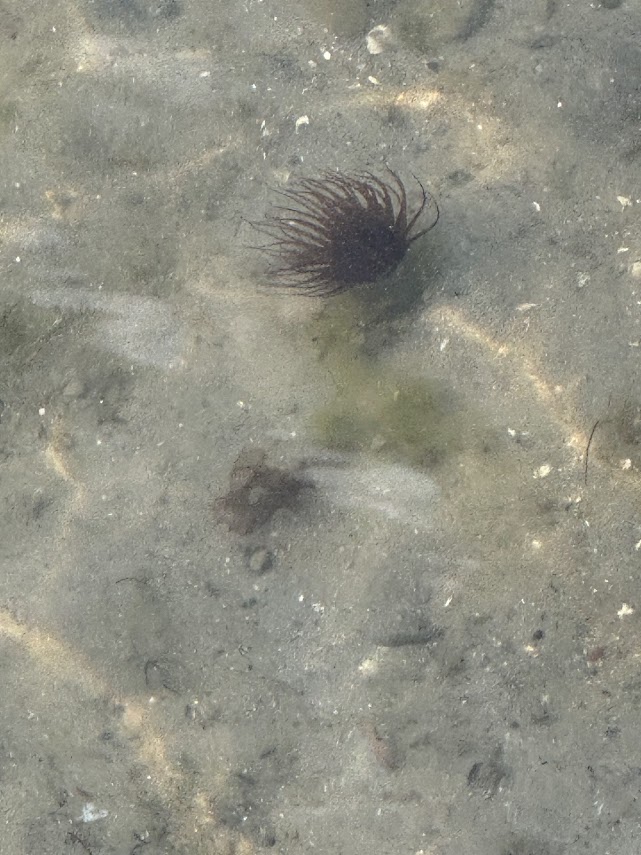
    A sea anemone beneath shallow estuarine water in Surf City, North Carolina. Organisms like these become part of the layered communities that nudibranchs, tunicates, hydroids, and other invertebrates move through beneath the surface. | Image credit: A. Mitchell
    A sea anemone beneath shallow estuarine water in Surf City, North Carolina. Organisms like these become part of the layered communities that nudibranchs, tunicates, hydroids, and other invertebrates move through beneath the surface. | Image credit: A. Mitchell

    This is the surface layer of the ecosystem.
    And it doesn’t stay unchecked.

    The ones moving across the surface

    Species like the Brazilian aeolid sea slug (Spurilla braziliana) often feed directly on anemones associated with these same submerged communities, while smaller species such as Tenellia adspersa are frequently associated with hydroids in brackish and estuarine waters (Valdés et al., 2006). 

    The nudibranchs moving across these surfaces are not all the same, and what they eat tells you what role they’re playing.

    Some of the small, leaf-like sea slugs in this region—species in the genus Elysia—feed on algae and can even retain the chloroplasts from what they consume, briefly using sunlight as part of their energy system. They blur the line between grazing and something closer to plant-like function (Valdés et al., 2006).

    Others, like Cratena pilata and Dondice occidentalis, track hydroids specifically. Where hydroids begin to spread across a piling, these nudibranchs follow, feeding in a way that limits how dense those colonies can become (Marcus, 1972).

    Species such as Thecacera pennigera are often associated with the layered communities growing beneath docks and harbor structure, while Berghia rissodominguezi and Spurilla braziliana move through shallow cnidarian-rich habitat where anemones and hydroids provide both food and defensive material (Valdés et al., 2006).

    Heavier-bodied nudibranchs—often in groups like Doris—tend to feed on sponges. Not all sponges, and not everywhere, but selectively enough that no single form easily dominates a surface for long.

    Even their eggs reflect this connection. The ribbon-like spirals sometimes seen attached to docks are laid directly where food is available. The next generation doesn’t disperse randomly—it begins where the system is already functioning.

    Beneath the surface layer

    Most of the time, these organisms go unnoticed.

    People see the drifting ribbons and call them whale snot. They scrape tunicates from pilings without thinking about what those colonies were filtering from the water. They brush past hydroids and sponges growing beneath docks without realizing those surfaces are part of the estuary’s food web just as much as the fish moving above them.

    But the water between the marsh and the bottom is never empty.

    It carries suspended plankton, drifting larvae, dissolved nutrients, bacteria, predators, scavengers, and colonies of organisms filtering continuously through the tide. Along the quieter edges of Onslow County—beneath floats, around oyster shells, beside marsh grass roots, and inside the slower water of creeks and sounds—entire communities form within that suspended layer (Wahl, 1989; Lindeyer & Gittenberger, 2011).

    Some drift. Some attach. Some graze slowly across the surface consuming the organisms beneath them.

    Together, they reshape the estuary constantly.

    The gelatinous ribbons appearing this week are not separate from the rest of the system. They are one visible moment in a larger cycle of filtration, growth, decay, grazing, and redistribution that normally happens out of sight (Bone, 1998; Madin, 1982). For a short time, the estuary simply becomes easier to see.

    What appears empty from above often contains layered communities of algae, filter-feeders, invertebrates, and microorganisms quietly redistributing energy through the estuary. Surf City, North Carolina. | Image credit: A. Mitchell
    What appears empty from above often contains layered communities of algae, filter-feeders, invertebrates, and microorganisms quietly redistributing energy through the estuary. Surf City, North Carolina. | Image credit: A. Mitchell

    References

    Avila, C. (1995). Natural products of opisthobranch molluscs: A biological review. In Oceanography and marine biology: An annual review (33rd ed., pp. 487-559). UCL Press.

    Barros, R. (2009). Human-mediated global dispersion of Styela plicata (Tunicata, Ascidiacea). Aquatic Invasions, 4(1), 45-57. https://doi.org/10.3391/ai.2009.4.1.4

    Bone, Q. (1998). The biology of pelagic tunicates. Oxford University Press on Demand.

    Encarnação, J., Seyer, T., Teodósio, M. A., & Leitão, F. (2020). First record of the nudibranch Tenellia adspersa (Nordmann, 1845) in Portugal, associated with the invasive hydrozoan Cordylophora caspia (Pallas, 1771). Diversity, 12(6), 214. https://doi.org/10.3390/d12060214

    Goodheart, J. A., Bleidißel, S., Schillo, D., Strong, E. E., Ayres, D. L., Preisfeld, A., Collins, A. G., Cummings, M. P., & Wägele, H. (2018). Comparative morphology and evolution of the cnidosac in Cladobranchia (Gastropoda: Heterobranchia: Nudibranchia). Frontiers in Zoology, 15(1). https://doi.org/10.1186/s12983-018-0289-2

    Korshunova, T., Lundin, K., Malmberg, K., Picton, B., & Martynov, A. (2018). First true brackish-water nudibranch mollusc provides new insights for phylogeny and biogeography and reveals paedomorphosis-driven evolution. PLOS ONE, 13(3), e0192177. https://doi.org/10.1371/journal.pone.0192177

    Lambert, G. (2007). Invasive sea squirts: A growing global problem. Journal of Experimental Marine Biology and Ecology, 342(1), 3-4. https://doi.org/10.1016/j.jembe.2006.10.009

    Lindeyer, F., & Gittenberger, A. (2011). Ascidians in the succession of marine fouling communities. Aquatic Invasions, 6(4), 421-434. https://doi.org/10.3391/ai.2011.6.4.07

    Madin, L. P. (1982). Production, composition and sedimentation of salp fecal pellets in oceanic waters. Marine Biology, 67(1), 39-45. https://doi.org/10.1007/bf00397092

    Madin, L. P., & Deibel, D. (1998). Feeding and energetics of Thaliacea. The Biology of Pelagic Tunicates, 81-104. https://doi.org/10.1093/oso/9780198540243.003.0005

    Marcus, E. D. (1972). On Some Opisthobranchs from Florida. Bulletin of Marine Science, 22(2), 284-308. https://www.ingentaconnect.com/content/umrsmas/bullmar/1972/00000022/00000002/art00002

    Petersen, J., & Riisgard, H. (1992). Filtration capacity of the ascidian Ciona intestinalis and its grazing impact in a shallow fjord. Marine Ecology Progress Series, 88, 9-17. https://doi.org/10.3354/meps088009

    Riisgård, H., & Larsen, P. (2010). Particle capture mechanisms in suspension-feeding invertebrates. Marine Ecology Progress Series, 418, 255-293. https://doi.org/10.3354/meps08755

    Sutherland, K. R., Madin, L. P., & Stocker, R. (2010). Filtration of submicrometer particles by pelagic tunicates. Proceedings of the National Academy of Sciences, 107(34), 15129-15134. https://doi.org/10.1073/pnas.1003599107

    Valdés, Á., Behrens, D. W., & DuPont, A. (2006). Caribbean Sea slugs: A Field guide to the opisthobranch mollusks from the tropical Nortwestern Atlantic. Sea Challengers Natural History Books.

    Van Name, W. G. (1945). The North and South American Ascidians. Bulletin of American Museum of Natural History, 84, 1-476. http://hdl.handle.net/2246/1186

    Wahl, M. (1989). Marine epibiosis. I. Fouling and antifouling: Some basic aspects. Marine Ecology Progress Series, 58, 175-189. https://doi.org/10.3354/meps058175
  • Where Wings Meet Water: Reading Birds Along the Edges of Onslow County

    Where Wings Meet Water: Reading Birds Along the Edges of Onslow County

    At the Line Where Air Meets Water

    On a late spring morning along Surf City, the first movement is often above the water, not within it. Brown pelicans travel low and steady just beyond the breakers, their wingtips nearly touching the surface as they follow a line that seems invisible from shore. Farther out, a group of terns holds in place against the wind, hovering, adjusting, then dropping sharply into the water before rising again. Closer to the sound side of Topsail Island, an osprey circles once, then folds into a dive toward a channel edge that looks, at first glance, no different than the water around it.

    Nothing about these movements is random. They are responses to structure that exists beneath the surface—structure shaped by tide, wind, and the movement of other organisms. What appears as scattered bird activity is, in practice, a map of where the water is concentrating life.

    For someone standing at the edge of it, that movement is one of the most accessible ways to read what cannot be seen directly.

    What Birds Are Following Beneath the Surface

    The birds that move along this stretch of coast are not searching broadly; they are tracking concentration. Along barrier island systems like those in Onslow County, physical processes—tidal exchange through inlets, wind-driven surface currents, and subtle differences in bottom shape—create zones where small fish, shrimp, and other prey accumulate (Peterson & Peterson, 1979; Piersma, 1997).

    When the tide moves through places like New River Inlet, water does not flow evenly across the landscape. It accelerates through constrictions, slows along marsh edges, and bends around sandbars and channels. These shifts in speed and direction compress organisms into tighter spaces, particularly along boundaries where moving water meets something that resists it—an edge, a drop-off, or a change in depth (Wright et al., 1985).

    Small schooling fish respond to that compression by tightening their formation. In doing so, they become more visible and more vulnerable. Larger fish—bluefish, Spanish mackerel, and juvenile coastal sharks—often move in from below, using that same concentration to feed. The pressure from below pushes prey upward, sometimes all the way to the surface.

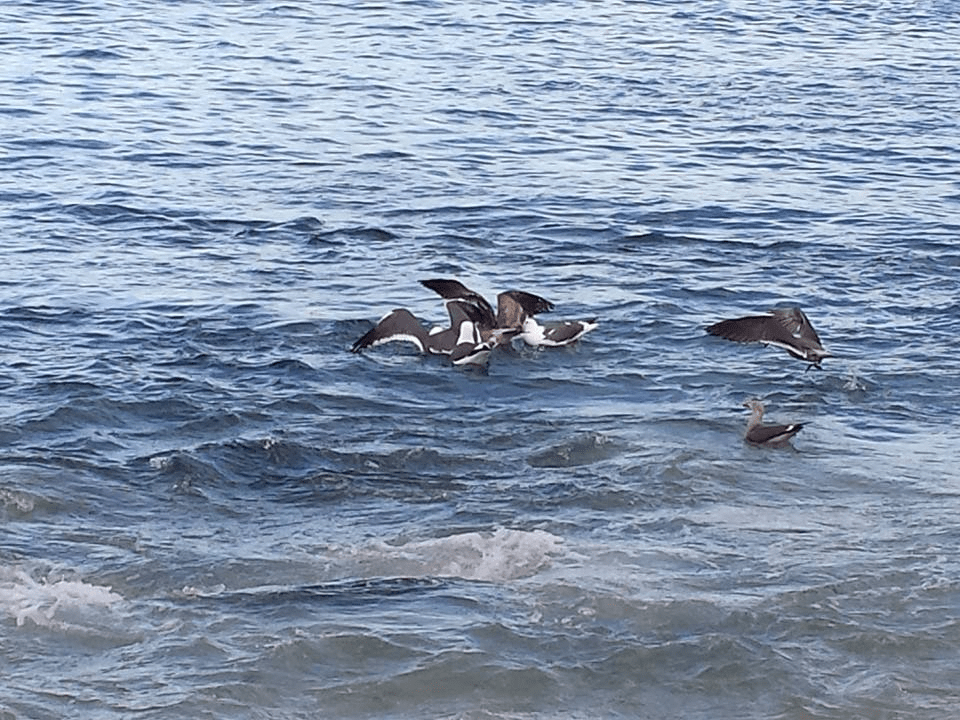
    Coastal birds feeding where prey has been concentrated near the surface along the breakers. | Image credit: A. Mitchell
    Coastal birds feeding where prey has been concentrated near the surface along the breakers. | Image credit: A. Mitchell

    What appears overhead depends on which part of that concentration each species is built to exploit.

    Terns hovering and diving are often responding to prey that has been driven upward by predatory fish (Safina & Burger, 1985). Brown pelicans, which rely on plunge-diving, tend to follow more stable schools of fish that remain near the surface for longer periods (Shields, 2014). Ospreys, in contrast, depend on clear water and individual fish they can visually isolate, which is why their activity often aligns with calmer conditions and defined channel edges (Poole et al., 2002).

    Each species is not simply feeding in the same place; each is reading a different layer of the same system.

    When Surface Activity Signals Pressure Below

    From the shoreline, bird activity can appear as isolated events—one dive, then another, then a sudden shift down the beach. Watched over time, a pattern emerges. A cluster of terns may concentrate in one location for several minutes, then disperse abruptly, reforming farther along the shoreline. Pelicans may align along a narrow band just beyond the breakers, following it as it drifts.

    These shifts often reflect changes in how prey is being compressed and released beneath the surface. When predatory fish move through a bait school, the school tightens, rises, and becomes briefly accessible from above. When that pressure dissipates, the school spreads out again, and the birds move on.

    This movement of energy—from smaller organisms to larger predators, and upward through the water column—is one visible expression of a trophic cascade. The term itself is often used to describe longer chains of ecological influence, but along the coast it can be observed in compressed moments, where the effects of predation become visible within seconds (Heithaus et al., 2008).

    Birds do not initiate this process. They respond to it. Their presence marks where the system has already intensified.

    Indicator Species at the Water’s Edge

    From the beach, the difference is subtle. The water does not change color dramatically, and the waves continue to break as they did before. The level of activity shifts within that band—first visible in the air, then inferred below– marking places where the system has tightened, energy is moving through multiple layers at once, and the distance between surface and depth has, for a time, narrowed (Heithaus et al., 2008; Estes et al., 2011).

    For someone entering the water, these differences in bird behavior can offer practical information, not in a predictive or absolute sense, but as indicators of what is happening just below the surface.

    Brown pelicans traveling low in a consistent line often indicate schools of fish moving parallel to shore. Terns repeatedly diving in a tight area suggest smaller prey being pushed upward, frequently by larger fish feeding below. Ospreys focusing on a specific channel edge reflect clearer water and individual prey availability, rather than broad schooling events. Along the shoreline, shorebirds probing the sand at low tide are responding to invertebrates exposed by receding water, signaling a different layer of the system entirely—one tied to sediment and tidal timing rather than active predation (Colwell, 2010; Piersma, 1997).

    None of these signals point directly to a specific species beneath the surface. What they indicate is concentration, and concentration is what draws larger predators closer to shore.

    Along the coast of North Carolina, nearshore and juvenile shark presence is often associated with areas of high prey density, particularly where schooling fish aggregate (Heupel & Hueter, 2002). These conditions are not constant, and they shift with tide, temperature, and time of day. Birds make those shifts visible in real time. 

    At times, that activity stretches into lines that run the length of the breakers. 

    For someone stepping into the water, that narrowing matters. Not as a warning in the abstract, but as a recognition that the conditions supporting visible feeding above often extend below, linking organisms that are rarely seen together into the same moving structure.

    Where the System Tightens

    The patterns become easier to see near places where the water is forced to narrow, turn, or accelerate. The most consistent bird activity along this coast tends to occur where water movement is constrained and redirected. Inlets, marsh edges, sandbars, and the transitions between the Intracoastal Waterway and adjacent sounds create these zones (Wright et al., 1985).

    At New River and its inlet, tidal flow compresses water into narrow channels before releasing it into broader areas, creating gradients in speed and depth. Along these gradients, prey accumulates, predators follow, and birds gather above.

    These are not fixed points. As tide rises and falls, and as wind reshapes surface conditions, the locations of these compression zones shift. The birds move with them, tracing patterns that are constantly changing but not random.

    For someone watching from shore, these movements can be read as lines, clusters, and absences—places where activity intensifies, and places where it suddenly drops away.

    Standing Within It

    Entering the water along this coast means stepping into a system already in motion. The surface may appear uniform, but the activity above it often reveals where that motion is focused.

    Birds diving repeatedly in a confined area, or tracking a narrow band just beyond the breakers, indicate where prey is concentrated. Those same conditions are what draw larger predators into closer proximity to shore, not as an anomaly, but as part of the same process.

    Watching the birds does not eliminate risk, and it does not provide certainty about what is beneath the surface. What it offers is context—a way to recognize when the water is more active, more compressed, and more connected across its layers.

    What appears as feeding from above is part of a larger structure moving through the water. The birds do not create it, and they do not remain once it passes. They mark it, briefly, making visible what is otherwise difficult to see.

    Bird movement along the shoreline often draws attention toward activity that remains unseen beneath the surface. | Image credit: A. Mitchell
    Bird movement along the shoreline often draws attention toward activity that remains unseen beneath the surface. | Image credit: A. Mitchell

    References

    Castro, J. I. (1993). The shark nursery of bulls Bay, South Carolina, with a review of the shark nurseries of the southeastern coast of the United States. Environmental Biology of Fishes, 38(1-3), 37-48. https://doi.org/10.1007/bf00842902

    Colwell, M. A. (2010). Shorebird ecology, conservation, and management. University of California Press.

    Estes, J. A., Terborgh, J., Brashares, J. S., Power, M. E., Berger, J., Bond, W. J., Carpenter, S. R., Essington, T. E., Holt, R. D., C. Jackson, J. B., Marquis, R. J., Oksanen, L., Oksanen, T., Paine, R. T., Pikitch, E. K., Ripple, W. J., Sandin, S. A., Scheffer, M., Schoener, T. W., & Wardle, D. A. (2011). Trophic downgrading of planet Earth. Science, 33(6040), 301-306. https://doi.org/10.1126/science.1205106

    Heithaus, M. R., Frid, A., Wirsing, A. J., & Worm, B. (2008). Predicting ecological consequences of marine top predator declines. Trends in Ecology & Evolution, 23(4), 202-210. https://doi.org/10.1016/j.tree.2008.01.003

    Heupel, M. R., & Hueter, R. E. (2002). Importance of prey density in relation to the movement patterns of juvenile blacktip sharks ( Carcharhinus limbatus ) within a coastal nursery area. Marine and Freshwater Research, 53(2), 543-550. https://doi.org/10.1071/mf01132

    Peterson, C. H., & Peterson, N. M. (1979). Ecology of intertidal flats of North Carolina: A community profile (79/39). FWS/OBS. https://pubs.usgs.gov/publication/fwsobs79_39

    Piersma, T. (1997). Do global patterns of habitat use and migration strategies Co-evolve with relative investments in Immunocompetence due to spatial variation in parasite pressure? Oikos, 80(3), 623-631. https://doi.org/10.2307/3546640

    Poole, A. F., Bierregaard, R. O., & Martell, M. S. (2002). Osprey (Pandion haliaetus). In The Birds of North America (1st ed.). Cornell Lab of Ornithology.

    Safina, C., & Burger, J. (1985). Common tern foraging: Seasonal trends in prey fish densities and competition with bluefish. Ecology, 66(5), 1457-1463. https://doi.org/10.2307/1938008

    Shields, M. (2014). Brown Pelican (Pelecanus occidentalis). In Birds of North America (1st ed.). Cornell Lab of Ornithology.

    Wright, L., Short, A., & Green, M. (1985). Short-term changes in the morphodynamic states of beaches and surf zones: An empirical predictive model. Marine Geology, 62(3-4), 339-364. https://doi.org/10.1016/0025-3227(85)90123-9

  • When the Bottom Moves: Rays in the Shallows of Onslow County

    When the Bottom Moves: Rays in the Shallows of Onslow County

    What People Are Seeing

    In the last few weeks, the water along the edges of Onslow County has felt different.

    Not because the water itself has changed—but because something beneath it has become harder to ignore.

    Schools of cownose ray (Rhinoptera bonasus) move just below the surface nearshore, their wingbeats lifting faint clouds from the bottom as they pass. In the soundside shallows, where the water thins over sand and mud, Atlantic stingray (Hypanus sabinus) settle into the substrate, half-buried and nearly invisible until a step comes too close and the outline breaks.

    People are seeing them more often now—but they’re also reacting to them.

    A pause mid-step in shallow water.
    A quick shift backward when something moves.
    Fishermen lifting a line and stopping for a second longer than usual—not what they expected to find.

    There is awe in it.

    And sometimes hesitation.

    Because the same thing that makes them easy to notice now also makes them easy to miss.

    The question follows quickly:

    Are there more of them this year?

    Maybe.

    But that question lingers longer than the answer.

    Cownose rays migrating in Swansboro, NC. | Image credit: Pogie’s Academy
    Cownose rays migrating in Swansboro, NC. | Image credit: Pogie’s Academy

    What Brings Them Here

    As spring settles in along the North Carolina coast, the system begins to reorganize.

    Water temperatures rise, and with that rise comes a shift in metabolism. Rays—like many coastal species—become more active as conditions move into a narrower range that supports feeding and movement (Smith & Merriner, 1987; Schwartz & Dahlberg, 1978).

    For cownose rays, this seasonal transition includes a northward migration along the Atlantic coast, bringing large groups into nearshore and estuarine waters (Smith & Merriner, 1987).

    Large groups of cownose rays like these move north along our coast each season, arriving together in shallow water. | Image credit: Vidyacharan A. Alchi
    Large groups of cownose rays like these move north along our coast each season, arriving together in shallow water. | Image credit: Vidyacharan A. Alchi

    But movement alone does not explain what people are seeing.

    What matters is where that movement meets the structure of the environment.

    The water does not always look the same—some days it is flat and clear enough to see straight to the bottom, and other days the slightest movement turns it cloudy, changing what can be seen and what remains hidden (Peterson et al., 2001).

    And beneath all of it is food.

    Cownose rays move through the shallows, sweeping across the bottom and disrupting what lies beneath them, crushing clams, oysters, and other shelled invertebrates with broad, flattened tooth plates (Collins et al., 2007; Fisher, 2010).

    Atlantic stingrays hold low against the bottom, burying into the sand as they feed and working within the sediment itself—not moving across it—uncovering and drawing in small invertebrates hidden below (Snelson et al., 1988; Schwartz & Dahlberg, 1978).

    Atlantic stingrays hold close to the bottom, often blending in until something shifts and gives them away. | Image credit: Andy Murch
    Atlantic stingrays hold close to the bottom, often blending in until something shifts and gives them away. | Image credit: Andy Murch

    Where prey is accessible, rays follow.

    Where prey is concentrated in shallow, warming water, rays do not just pass through—they stay, turn, feed, and linger.

    And in doing so, they cross into the same narrow band of space where people enter the water (Bangley et al., 2018).

    They are not simply “here more.”

    They are here in ways—and in places—that make them visible.

    What Happens When They Feed

    When a ray feeds, the bottom does not remain the same.

    A cownose ray moving across a flat is not just searching—it is actively restructuring the surface beneath it. As it passes, the bottom is turned over behind it, patches of sand and mud disturbed where clams and other buried life have just been uncovered and crushed (Peterson et al., 2001; Smith & Merriner, 1985).

    Feeding pits left behind by rays. Easy to mistake for crab holes at first—until you start to recognize the pattern and what’s actually shaping the bottom. | Image credit: Giaroli et al., 2024
    Feeding pits left behind by rays. Easy to mistake for crab holes at first—until you start to recognize the pattern and what’s actually shaping the bottom. | Image credit: Giaroli et al., 2024

    Atlantic stingrays leave a different kind of trace. Where they settle, the surface shifts more subtly—small depressions, softened patches, places where the sediment has been worked rather than overturned, as buried invertebrates are uncovered and drawn in (Snelson et al., 1988; Schwartz & Dahlberg, 1978).

    This is bioturbation—the bottom being reworked by the animals moving through it and within it (Thrush & Dayton, 2002).

    As they feed, the bottom lifts into the water—fine particles rising and hanging there, turning clear water slightly cloudy (Thrush & Dayton, 2002).

    The water does not stay still—the bottom here is constantly shifting, the way much of this coastline does, even when it appears unchanged.

    And neither does the system.

    Oysters and clams quietly filter the water as they feed, and when their numbers shift—even in small areas—the water and everything moving through it begins to change with them (Newell, 2004; zu Ermgassen et al., 2013).

    In places where rays have been feeding, those filtering communities can be reduced or redistributed (Peterson et al., 2001).

    Not removed entirely—but changed.

    And that change does not stay in one place.

    It moves outward, carried in the way the water looks, the way it settles, and what it can hold.

    Layers of the Food Web

    Rays do not sit at the top of the system, and they are not at the bottom of it.

    As mesopredators, they feed on what is buried in the sediment, but they are also available to what moves through the water above. That position—between—links parts of the system that do not often meet directly (Myers et al., 2007; Heithaus et al., 2008).

    What they do in that space matters.

    As cownose rays move through andAtlantic stingrays work within the bottom, they are not just feeding—they are shaping what persists there. Clams, oysters, and other invertebrates do not simply accumulate unchecked. Their numbers are reduced, redistributed, and in some places kept from becoming dominant (Peterson et al., 2001).

    Movement like this doesn’t stay in one place for long.

    That pressure shapes the bottom itself.

    Bivalves filter the water. Invertebrates stabilize sediment. When their abundance shifts, the system responds—sometimes toward clearer water, sometimes toward more suspended material, depending on what remains and where (Newell, 2004; zu Ermgassen et al., 2013).

    Rays do not create those conditions alone—but they influence which direction the system moves.

    At the same time, they carry that energy upward.

    Juvenile sharks moving through these shallow waters encounter not just prey, but a system already in motion—areas where the bottom has been disturbed, where feeding has recently occurred, where something has been uncovered or displaced (Bangley et al., 2018).

    And in some cases, the rays themselves become part of that exchange.

    This is what it means to sit in the middle.

    Not just connecting layers—but regulating how energy and movement pass between them.

    If that middle shifts, the balance does not disappear.

    It changes direction.

    Why It Feels Sudden

    There is a moment, standing in shallow water, when the bottom stops feeling like something you can trust.

    What looked like sand shifts.
    What felt still is no longer still.

    Sometimes you notice it in time—a shape lifting away, a shadow moving just beneath the surface. A plume of fine sediment rising to the surface under a paddleboard with a trail following it.

    The moment when the bottom stops looking empty. | Image credit: iStock
    The moment when the bottom stops looking empty. | Image credit: iStock

    Sometimes you don’t.

    A step comes down where something is already settled.
    Hidden in the sand.
    Working within it.

    The reaction is immediate.
    Surprise first. Then pain. Then the realization of what was there all along.

    It is easy, in that moment, to think something unexpected has happened—the same kind of sudden awareness that comes when something just beneath the surface reveals itself.

    But what you are stepping into is not a single event.

    It is a convergence.

    Water temperatures have risen, bringing rays into the shallows as they feed and move through these systems (Smith & Merriner, 1987; Schwartz & Dahlberg, 1978).

    Tides narrow the space, concentrating movement into a thinner band of water.

    The bottom has already been worked—turned by cownose rays moving through, disturbed by Atlantic stingrays holding within it.

    And at the same time, people have returned to the water.

    For a brief window, all of it overlaps.

    Not more.
    But more visible.

    It feels sudden because you are standing at the point where all of these things meet.

    And for a moment, the system lets you see it.

    References

    Bangley, C. W., Paramore, L., Dedman, S., & Rulifson, R. A. (2018). Delineation and mapping of coastal shark habitat within a shallow lagoonal Estuary. PLOS ONE, 13(4), e0195221. https://doi.org/10.1371/journal.pone.0195221

    Giaroli, M. L., Byrne, I., Gilby, B. L., Taylor, M., Chargulaf, C. A., & Tibbetts, I. R. (2024). The distribution and significance of stingray feeding pits in Quandamooka (Moreton Bay), Australia. Marine and Freshwater Research, 75(18). https://doi.org/10.1071/mf23247

    Heithaus, M. R., Frid, A., Wirsing, A. J., & Worm, B. (2008). Predicting ecological consequences of marine top predator declines. Trends in Ecology & Evolution, 23(4), 202-210. https://doi.org/10.1016/j.tree.2008.01.003

    Kolmann, M. A., Huber, D. R., Motta, P. J., & Grubbs, R. D. (2015). Feeding biomechanics of the cownose ray, Rhinoptera bonasus, over ontogeny. Journal of Anatomy, 227(3), 341-351. https://onlinelibrary.wiley.com/doi/full/10.1111/joa.12342

    Myers, R. A., Baum, J. K., Shepherd, T. D., Powers, S. P., & Peterson, C. H. (2007). Cascading effects of the loss of APEX predatory sharks from a coastal ocean. Science, 315(5820), 1846-1850. https://doi.org/10.1126/science.1138657

    Newell, R. I. (2004). Ecosystem influences of natural and cultivated populations of suspension-feeding bivalve molluscs: A review. 23(1), 51–61. Journal of Shellfish Research, 23(1), 51-61. https://go.gale.com/ps/i.do?id=GALE%7CA118543914

    Peterson, C. H., Fodrie, J. F., Summerson, H. C., & Powers, S. P. (2001). Site-specific and density-dependent extinction of prey by schooling rays: generation of a population sink in top-quality habitat for bay scallops. Oecologia, 129, 349-356. https://link.springer.com/article/10.1007/s004420100742

    Schwartz, F. J., & Dahlberg, M. D. (1978). Biology and ecology of the Atlantic Stingray, Dasyatis Sabina (Pisces: Dasyatidae) in North Carolina and Georgia. Northeast Gulf Science, 2(1). https://doi.org/10.18785/negs.0201.01

    Smith, J. W., & Merriner, J. V. (1985). Food habits and feeding behavior of the Cownose ray, Rhinoptera bonasus, in lower Chesapeake Bay. Estuaries, 8(3), 305. https://doi.org/10.2307/1351491

    Smith, J. W., & Merriner, J. V. (1987). Age and growth, movements and distribution of the Cownose ray, Rhinoptera bonasus, in Chesapeake Bay. Estuaries, 10(2), 153. https://doi.org/10.2307/1352180

    Snelson, F. F., Williams-Hooper, S. E., & Schmid, T. H. (1988). Reproduction and ecology of the Atlantic Stingray, Dasyatis Sabina, in Florida coastal lagoons. Copeia, 1988(3), 729. https://doi.org/10.2307/1445395

    Thrush, S. F., & Dayton, P. K. (2002). Disturbance to marine benthic habitats by trawling and dredging: Implications for marine biodiversity. Annual Review of Ecology and Systematics, 33(1), 449-473. https://doi.org/10.1146/annurev.ecolsys.33.010802.150515

    Zu Ermgassen, P. S., Spalding, M. D., Blake, B., Coen, L. D., Dumbauld, B., Geiger, S., Grabowski, J. H., Grizzle, R., Luckenbach, M., McGraw, K., Rodney, W., Ruesink, J. L., Powers, S. P., & Brumbaugh, R. (2012). Historical ecology with real numbers: Past and present extent and biomass of an imperilled estuarine habitat. Proceedings of the Royal Society B: Biological Sciences, 279(1742), 3393-3400. https://doi.org/10.1098/rspb.2012.0313

  • Alligators in North Carolina Coastal Waters: What Their Presence Really Means

    Alligators in North Carolina Coastal Waters: What Their Presence Really Means

    The Surface That Holds

    There are mornings along the edges of the water in Onslow County when the surface looks still enough to trust.

    The marsh grass has not yet reached its summer height. What stands there leaves more water exposed between the stems, and without sustained wind, the surface holds its shape. You can see farther into it now than you will in a few weeks, before suspended sediment and constant movement return it to opacity. The water carries less of the season, and because of that, more of what moves beneath it becomes visible—if you are willing to wait long enough to see the difference between movement and reflection.

    This is when people begin to notice them again.

    Not all at once. Not everywhere. Just a change that does not follow wind or tide. A line that holds where the rest of the surface releases. Something that holds its position in a system that is always adjusting.

    An alligator does not arrive in that moment.

    It becomes visible.

    Alligator emerging from the mud. | Photo credit: Gilbert Grant, iNaturalist
    Alligator emerging from the mud. | Photo credit: Gilbert Grant, iNaturalist

    Seasonal Absence Is Not Absence

    Through winter, they remain within these same creeks, marsh edges, and quieter channels. What changes is not location, but how they occupy it. As temperatures fall, activity narrows. Movement slows, and the need for it slows with it. Energy is conserved, not spent. And the surface carries fewer signs of what lies beneath it. Individuals hold in deeper water or along softer margins where mud retains heat longer than the surrounding water column, remaining within conditions that allow them to persist without constant movement (Nifong et al., 2014; Rosenblatt & Heithaus, 2011).

    The same stretch of water that in spring will hold a visible form can pass through winter without interruption, its stillness mistaken for absence.

    But the system does not empty.

    It compresses.

    The System Wakes in Layers

    By early spring, that compression begins to release—not all at once, but in layers that build on each other before they are recognized. Shallow water warms first, taking in solar heat more quickly than deeper channels. Along these edges, fish begin to hold longer. Movements that in winter passed through quickly begin to extend into areas that had remained quiet. Invertebrates return to the sediment surface, and the water column begins to carry more suspended life, even before it becomes visible as turbidity.

    Birds respond to this before most other changes are noticed. Their movements tighten. Landings become more frequent, departures more abrupt. What they are tracking is not random. It is the redistribution of energy into places where it can be accessed.

    The alligator moves within that shift.

    Not as a trigger. Not as something layered on top. But as part of a system reorganizing itself across temperature, light, and movement at the same time.

    Great blue heron and alligator are part of an interconnected system. | Photo credit: Audubon North Carolina
    Great blue heron and alligator are part of an interconnected system. | Photo credit: Audubon North Carolina

    Reading What It Is Responding To

    When one becomes visible along the edge of a creek or marsh, it is easy to reduce that moment to temperature alone. Warmer water allows for more activity.

    But what draws it into that position is more specific than warmth.

    It is the arrangement of prey.

    Along the margins where water meets land, movement compresses. Fish traveling with the tide encounter shallow gradients that limit how long they can remain. Small mammals moving between marsh and upland must cross exposed edges. Birds landing to feed do so in places where depth and access align for only short intervals.

    These are not isolated events. They are recurring patterns shaped by tidal cycles, substrate, and seasonal change.

    The alligator positions itself within those patterns.

    Its diet reflects that flexibility, spanning invertebrates, fish, birds, reptiles, and mammals depending on size and availability (Nifong, 2016). But the diet alone does not explain its placement. What matters is where energy becomes concentrated, even briefly.

    That concentration is not constant. It forms and dissolves with tide, with light, with movement.

    And the predator tracks that.

    And what appears as a single movement—a fish turning, a bird lifting, something crossing the edge of the marsh—is part of a larger structure that holds only briefly before dissolving again.

    The alligator does not respond to the individual movement.

    It responds to the pattern that produces it.

    Where Freshwater Meets Salt

    These are not just places where water mixes.

    They are places where movement is forced—and where that movement becomes available to something waiting at the top of it.

    There are places along this coastline where those changes concentrate.

    At the mouths of creeks, along the edges of the Intracoastal Waterway, and near the shifting bars of New River Inlet, the water does not settle into a single condition. Freshwater moves outward with tide and rainfall, meeting saltwater pressing back in with tidal exchange. The result is not a fixed boundary, but a gradient that shifts continuously—sometimes visible as a faint line, sometimes only detectable in how the surface moves differently from one side to the other.

    This is where alligators are most often encountered—because this is where the system compresses into something they can use.

    They are not marine animals. They do not possess the specialized salt glands that allow for extended life in high salinity environments. Over time, saltwater carries a physiological cost, requiring a return to freshwater to restore balance (Rosenblatt & Heithaus, 2011; Fujisaki et al., 2014).

    But that limitation does not exclude them.

    It defines how they move through them.

    In these mixing zones, salinity is not constant. It rises and falls with tide, with rainfall, with wind direction. A location that carries higher salinity at one stage may shift toward fresher conditions hours later. What appears to be a boundary is, in practice, a moving field.

    Within that field, movement compresses.

    Fish traveling with the tide are funneled into narrower pathways. Shallow gradients limit how long they can remain in deeper water. Schools tighten. Individuals encounter edges that restrict escape. The system concentrates energy into space.

    The predator does not need to range widely in these conditions.

    It needs to hold where movement is forced.

    And so it does.

    An alligator near the tall grass near Marine Corps Air Station New River | Photo credit: Martin Egnash
    An alligator near the tall grass near Marine Corps Air Station New River | Photo credit: Martin Egnash

    At the Edge of the Open Water

    There are moments when that pattern extends beyond the mixing zones, into places that appear, at first, outside of where an alligator belongs.

    Along the shoreline, in the breaking waves where the ocean meets sand, one will sometimes appear—rising and falling with the swell, holding position just beyond where the water turns over onto the beach. It looks misplaced, as though it has moved beyond the system that defines it.

    It has not.

    The surf zone is one of the most compressed environments along the coast. Waves reduce depth, disrupt orientation, and concentrate movement into a narrow band where escape is limited. Fish pushed into breaking water lose some ability to maintain direction. Schools fragment. Individuals become briefly exposed in ways that do not occur in deeper, more stable water.

    For a predator capable of stillness followed by short bursts of movement, that compression creates opportunity.

    But the cost is higher.

    Salinity is elevated. The water is in constant motion. There is no stable refuge within immediate reach. Time in this environment cannot be extended indefinitely.

    And so it does not.

    Movements into higher salinity water tend to be brief—extensions outward, followed by a return to freshwater or lower salinity conditions where balance can be restored (Nifong et al., 2014).

    What appears as an anomaly is part of a larger pattern.

    The predator crosses the boundary not to remain, but to use it, moving where the system briefly offers more than it costs.

    The same forces that shape the marsh edge—compression, constraint, and brief exposure—are recreated here, just for a moment, in a different place.

    An alligator rests at the ocean’s edge in North Topsail. | Photo credit: Fox8 Digital Desk
    An alligator rests at the ocean’s edge in North Topsail. | Photo credit: Fox8 Digital Desk

    What Its Presence Changes

    Most of what that presence changes cannot be seen when it is observed.

    Long before any direct interaction occurs, it is already altering how other organisms use space.

    Fish moving along the edge do not simply pass through. They adjust their depth, their speed, the amount of time they remain exposed. Birds land with shorter intervals between contact and departure. Mammals approaching the water shift their paths or their timing. These changes are not dramatic in isolation. But they are continuous.

    Over time, they accumulate into structure—the kind that determines who feeds, where they feed, and how long they remain.

    The influence of a predator at this level extends beyond what it consumes. It shapes behavior across multiple species, redistributing where and how energy moves through the system. The possibility of predation—present even when not observed—alters interactions in ways that regulate access to habitat and resources (Heithaus et al., 2008; Ripple et al., 2014; Estes et al., 2011).

    What holds the system in place is not removal alone.

    It is pressure.

    What is being shaped is not just movement, but access—and access is what determines how energy moves through the system.

    More Than Predation

    The influence of the alligator does not end with what it hunts, but extends beyond those interactions.

    As it moves through shallow systems, it disturbs sediment, creating depressions and pathways that alter how water is retained and how nutrients are redistributed. These small changes in physical structure create conditions that other species use—temporary refuges, feeding areas, and zones where organic material accumulates (Eversole et al., 2018; Subalusky et al., 2009).

    In wetland systems, these disturbances have been linked to broader effects, including nutrient cycling and carbon storage, where the presence of large predators contributes to the retention of organic material within the system rather than its export (Murray et al., 2025; Atwood et al., 2015).

    These processes do not occur in isolation.

    They intersect with the same patterns of movement, feeding, and behavior that define the system at larger scales.

    Seeing the Surface, Reading the System

    When one becomes visible along the surface, it is easy to treat the moment as singular.

    A sighting. An encounter. Something separate from everything around it.

    But that form at the surface is supported by layers extending beyond what can be seen.

    It reflects water temperatures crossing into ranges that support sustained activity. It reflects prey moving into positions where access becomes possible. It reflects a system where behavior is still shaped by the presence of something at the top.

    The alligator is not an interruption to that system.

    It is an expression of it.

    What Becomes Visible

    Seeing one does not indicate that something has entered the water.

    It indicates that enough beneath the surface is functioning to hold it.

    Not in a static sense. Not as balance in the way it is often described. But as a set of interactions that remain connected—movement, response, pressure—each shaping the others even when they are not directly observed.

    What becomes visible at the surface is only a fraction of that structure.

    But it is enough to know that the rest is still in place.

    An alligator in Onslow County sits at the edge of the saltmarsh. |Photo credit: Gilbert Grant, iNaturalist
    An alligator in Onslow County sits at the edge of the saltmarsh. |Photo credit: Gilbert Grant, iNaturalist

    When That Pressure Is Reduced

    If that pressure is reduced, the system does not leave an obvious gap.

    It shifts.

    Movements that were once constrained begin to extend. Species that passed quickly through exposed areas begin to remain longer. Edges that functioned as transition zones become used differently—not because the physical environment has changed, but because the conditions that shaped behavior within it have relaxed.

    Mid-level predators expand their activity under these conditions, increasing their access to prey and space when not constrained from above (Nifong et al., 2013).

    The change is subtle.

    It appears in how long something stays. In how often it returns. In where it lingers. In how quietly the structure of behavior begins to loosen.

    The food web and trophic cascade of the American alligator in the Florida Everglades.
    The food web and trophic cascade of the American alligator in the Florida Everglades.

    A System Written Into Temperature

    There is another layer to this that does not show itself at the surface.

    The structure of that presence is set years earlier, in a place that can be overlooked when standing at the water’s edge. Along the margins of marsh and wetland, slightly above the reach of regular water movement, nests are built from vegetation and sediment, forming mounds that hold heat as they decompose.

    Within those mounds, temperature determines something that will not be visible for much later.

    Sex is not fixed at fertilization. It emerges during incubation, shaped by the thermal conditions held within the nest. A difference of only a few degrees is enough to shift the outcome, producing more males or more females depending on where within that range the nest remains (Lang & Andrews, 1994; Janzen, 1994).

    Under variable conditions—differences in shading, rainfall, timing, and placement—those outcomes are distributed across the landscape. Some nests produce more females, others more males. That variability holds the population in a form that can sustain itself over time.

    When conditions become more consistent, that variation narrows.

    Warmer nights hold heat longer within the nest. Seasonal transitions extend. The range of outcomes compresses. What was once distributed begins to align.

    And that alignment carries forward into the structure of the population—into how individuals occupy space, into how pressure is applied across the system, into what will eventually be visible at the surface.

    Alligator eggs hatch after 65 days of incubation in the fall. The babies will chirp to alert their mom, who then digs out the nest while the babies use their egg tooth to hatch from their eggs. Their mom will then safely carry them to the water.
    Alligator eggs hatch after 65 days of incubation in the fall. The babies will chirp to alert their mom, who then digs out the nest while the babies use their egg tooth to hatch from their eggs. Their mom will then safely carry them to the water.

    Where the Next Generation Is Set

    The placement of those nests depends on something even more constrained.

    A narrow band of land that remains above water just long enough to hold them.

    That band is not fixed.

    It shifts with tide, with rainfall, with the gradual reworking of shoreline that occurs across seasons and years. With rising sea levels, water reaches farther into areas that once remained above it. Flooding becomes more frequent, not always through singular events, but through repeated intrusions that saturate and destabilize what had previously held (Joanen & McNease, 1989; Sweet et al., 2022).

    Human alteration compresses this space further.

    Hardened shorelines, dredging, and development reduce the gradual transition between land and water. Where there was once a slope capable of holding multiple elevations, there becomes a defined edge. That edge does not provide the same range of conditions required for successful nesting.

    The number of suitable sites decreases.

    More importantly, the variability between them narrows.

    And with that, the system loses one of the mechanisms that allowed it to absorb change.

    Alligator on her nest that can hold up to 60 eggs. | Photo credit: National Park Service (NPS)
    Alligator on her nest that can hold up to 60 eggs. | Photo credit: National Park Service (NPS)

    What Its Presence Means

    When an alligator becomes visible along the surface, it reflects conditions that have aligned across multiple layers.

    Temperature has reached a range that supports activity. Prey has moved into positions where access becomes possible. Behavioral pressure remains in place across the system. Reproduction has held across enough years, in enough suitable places, to sustain what is now present.

    What is seen at the surface is not separate from them.

    It is supported by them.

    Seeing one does not signal that something has entered the water.

    It signals that enough of what lies beneath it—movement, pressure, response, and continuity—remains intact.

    And that—even when most of it is not visible—the system is still holding together.

    And that is what becomes visible—just long enough to be seen, before the system closes back over it again.

    The system does not end at the water’s edge.

    Epilogue: Chicken Nugget

    We came across him along the New River, near the courthouse in Jacksonville.

    We were there to clear what had been left behind—fishing line caught along the walkways, hooks, and the overflow from a trash can that had spilled out onto the edge. Fast food containers, grocery store chicken trays, scattered along the bank. The signs were clear enough. People had been there for a while—crabbing, fishing, eating, leaving what remained.

    He was directly below us.

    Small enough to miss at first. Still enough to blend into the water until you stopped looking for movement and started noticing what held its position.

    A juvenile alligator, watching.

    He stayed there while we worked, then slipped beneath the surface and crossed the small bay. On the opposite side, someone tossed a piece of food into the water. He surfaced almost immediately, took it, and remained.

    Waiting.

    I came back later and stayed longer.

    The pattern repeated. He would disappear until footsteps approached, then return to the same place along the edge. Holding position. Watching. Waiting for something to fall.

    No fishermen or crabbers passed through while I was there, but the behavior was consistent with what happens when food becomes predictable. Bait, catch, scraps—anything that can be taken without the cost of searching or pursuing.

    Energy, without effort.

    It is easy to see something like that and respond to what it looks like in that moment. A small animal. Still. Attentive. Something that feels close enough to interact with.

    But what is being shaped there is not just a single interaction.

    It is behavior.

    A shift away from the conditions that formed it—toward something more efficient, more immediate, and less stable over time. The system that once required movement, patience, and response begins to narrow into expectation.

    And expectation changes how an animal uses space.

    What happens when that animal is no longer small is not a separate question.

    It is the continuation of the same pattern.

    Alligators do not forget where food has been easy to obtain. They return to it. They hold in those places. They begin to associate presence—human presence—with opportunity.

    What begins as something that feels harmless becomes something that alters how the system functions around it.

    Not just for the animal, but for everything that responds to it.

    There are instincts at work here that were shaped long before any walkway, any dock, any place where food might be dropped from above. Those instincts are not just about survival in isolation. They are part of how pressure is applied, how movement is shaped, how the system holds.

    When those instincts are replaced with something easier, the effect does not remain contained.

    It carries outward.

    He stayed there while I watched. Returning to the same place. Holding the same position. Waiting for something to fall.

    There is a kind of kindness in wanting to give something to an animal like that.

    But there is another kind in leaving it as it is.

    Not interrupting the conditions that shape it. Not narrowing what it has learned to expect. Not replacing a system built on movement and response with one built on waiting.

    Let it remember the water as it is.

    And you, only as something that passed through it.

    We affectionately named this juvenile alligator in the New River in Jacksonville, NC “Chicken Nugget” for all of the chicken nugget boxes left behind on the walkway from an overflowing trash can. | Photo credit: A. Mitchell
    We affectionately named this juvenile alligator in the New River in Jacksonville, NC “Chicken Nugget” for all of the chicken nugget boxes left behind on the walkway from an overflowing trash can. | Photo credit: A. Mitchell

    References

    Atwood, T. B., Connolly, R. M., Ritchie, E. G., Lovelock, C. E., Heithaus, M. R., Hays, G. C., Fourqurean, J. W., & Macreadie, P. I. (2015). Predators help protect carbon stocks in blue carbon ecosystems. Nature Climate Change5(12), 1038-1045. https://doi.org/10.1038/nclimate2763

    Estes, J. A., Terbough, J., Brashares, J. S., Power, M. E., Berger, J., Bond, W. J., Carpenter, S. R., Essington, T. E., Holt, R. D., & Wardle, D. A. (2011). Trophic Downgrading of Planet Earth. Science333(604), 301-306. https://www.science.org/doi/abs/10.1126/science.1205106

    Fujisaki, I., Hart, K. M., Mazzotti, F. J., Cherkiss, M. S., Sartain, A. R., Jeffery, B. M., Beauchamp, J. S., & Denton, M. (2014). Home range and movements of American alligators (Alligator mississippiensis) in an Estuary habitat. Animal Biotelemetry2(1), 8. https://doi.org/10.1186/2050-3385-2-8

    Heithaus, M. R., Frid, A., Wirsing, A. J., & Worm, B. (2008). Predicting ecological consequences of marine top predator declines. Trends in Ecology & Evolution23(4), 202-210. https://doi.org/10.1016/j.tree.2008.01.003

    Janzen, F. J. (1994). Climate change and temperature-dependent sex determination in reptiles. PNAS91(16), 7487-7490. https://doi.org/10.1073/pnas.91.16.7487

    Joanen, T., & McNease, L. L. (1989). Ecology and physiology of nesting and early development of the American alligator. American Zoologist29(3), 987-998. https://doi.org/10.1093/icb/29.3.987

    Lang, J. W., & Andrews, H. V. (1994). Temperature‐dependent sex determination in crocodilians. Journal of Experimental Zoology270(1), 28-44. https://doi.org/10.1002/jez.1402700105

    Nifong, J. C. (2016). Living on the edge: Trophic ecology of alligator mississippiensis (American alligator) with access to a shallow estuarine impoundment. Bulletin of the Florida Museum of Natural History54(2), 13-49. https://doi.org/10.58782/flmnh.xkdw7119

    Nifong, J. C., Nifong, R. L., Silliman, B. R., Lowers, R. H., Guillette, L. J., Ferguson, J. M., Welsh, M., Abernathy, K., & Marshall, G. (2014). Animal-borne imaging reveals novel insights into the foraging behaviors and Diel activity of a large-bodied APEX predator, the American alligator (Alligator mississippiensis). PLoS ONE9(1), e83953. https://doi.org/10.1371/journal.pone.0083953

    Nifong, J. C., & Silliman, B. R. (2013). Impacts of a large-bodied, APEX predator (Alligator mississippiensis Daudin 1801) on salt marsh food webs. Journal of Experimental Marine Biology and Ecology440, 185-191. https://doi.org/10.1016/j.jembe.2013.01.002

    Ripple, W. J., Estes, J. A., Beschta, R. L., Wilmers, C. C., Ritchie, E. G., Hebblewhite, M., Berger, J., Elmhagen, B., Letnic, M., Nelson, M. P., Schmitz, O. J., Smith, D. W., Wallach, A. D., & Wirsing, A. J. (2014). Status and ecological effects of the world’s largest carnivores. Science343(6167). https://doi.org/10.1126/science.1241484

    Rosenblatt, A. E., & Heithaus, M. R. (2011). Does variation in movement tactics and trophic interactions among American alligators create habitat linkages? Journal of Animal Ecology80(4), 786-798. https://doi.org/10.1111/j.1365-2656.2011.01830.x

    Sweet, W. V., Hamlington, B. D., Kopp, R. E., Weaver, C. P., Barnard, P. L., Bekaert, D., Brooks, W., Craghan, M., Dusek, G., Frederickse, T., Garner, G., Genz, A. S., Krasting, J. P., Larour, E., Marcy, D., Marra, J. J., Obeysekera, J., Osler, M., Pendleton, M., … Zuzak, C. (2022). Global and regional sea level rise scenarios for the United States: Updated mean projections and extreme water level probabilities along U.S. coastlines (Technical Report NOS 01). National Oceanic and Atmospheric Administration, National Ocean Service. https://earth.gov/sealevel/us/internal_resources/756/noaa-nos-techrpt01-global-regional-SLR-scenarios-US.pdf

  • The Shapes the Tide Leaves Behind: Circles, Spirals, and the Mathematics of a Living Coast

    The Shapes the Tide Leaves Behind: Circles, Spirals, and the Mathematics of a Living Coast

    Patterns in Nature Along the Coast

    Each March 14, mathematicians celebrate π — the constant that links the circumference of a circle to its diameter. But Pi Day in nature appears everywhere along the coast: in boundaries that curve back upon itself, in ripples spreading across still water, in the rounded mouth of a burrow, in the arcs traced by a turning tide. Along the coast, these circles and spirals reveal patterns in nature that emerge so often they begin to feel less like abstract mathematics and more like a language written into sand and water. The shoreline is not calculating anything deliberately, yet the same relationships appear again and again as tides move sediment, organisms grow, and currents redistribute energy. What looks at first like scattered shapes — a curved creek channel, a ring of crab pellets, the fivefold symmetry of a sea star — gradually reveals itself as part of a larger pattern. The coast is full of geometry, briefly visible each time the water recedes.

    The Creek Writes in Curves

    A tidal creek bends around the marsh edge behind Surf City, where vegetation and sediment redirect the flow of draining water. These shifting boundaries gradually guide channels into widening curves that reappear with each tide. | Photo credit: A. Mitchell
    A tidal creek bends around the marsh edge behind Surf City, where vegetation and sediment redirect the flow of draining water. These shifting boundaries gradually guide channels into widening curves that reappear with each tide. | Photo credit: A. Mitchell

    At the creek mouths behind Topsail Island, the marsh edge redraws itself each time the tide drains away. Water retreats through narrow runnels that refuse straight lines, bending around grass hummocks and soft ridges, leaving a fan of nested arcs etched into exposed mud. The channels widen as velocity drops, sediment settling in fractions that record the rate of energy loss, so the surface becomes a temporary map of fluid negotiation.

    These curves appear wherever moving water gradually redistributes energy rather than releasing it abruptly. In tidal landscapes, vegetation and sediment interact with flow in feedback loops that reshape channels over time, producing curved drainage networks whose geometry reflects both plant resistance and water momentum (Kirwan & Murray, 2007; Temmerman et al., 2007; Murray & Paola, 1994). Across river basins and tidal creeks alike, these evolving paths often approach widening spiral-like patterns as flow repeatedly adjusts to the boundaries around it (Rodriguez-Iturbe & Rinaldo, 1998).

    Foam left behind by the falling tide sometimes dries into thin white filaments that trace these curves for a few quiet minutes before collapsing, a temporary record of motion fixed long enough to be read.

    The creek does not preserve a single spiral. Each tide erases and redraws the same proportional tendency. The form emerges not from design but from the repeated redistribution of energy through water and sediment.

    Geometry in the Grass

    Dense stands of Spartina alterniflora divide space through repeating stem spacing. This structure slows water movement and traps suspended sediment, linking plant growth to the gradual elevation of the marsh surface. | Photo credit: A. Mitchell
    Dense stands of Spartina alterniflora divide space through repeating stem spacing. This structure slows water movement and traps suspended sediment, linking plant growth to the gradual elevation of the marsh surface. | Photo credit: A. Mitchell

    Along the marsh margin, stems of Spartina alterniflora divide space through incremental adjustment. Leaves diverge from one another at angles that reduce overlap, distributing light capture through the canopy in repeating offsets that resemble packing patterns seen throughout plant growth.

    Experiments in plant development show that when new structures arise under simple inhibitory fields, spiral-like arrangements often emerge as stable growth solutions (Douady & Couder, 1996). These patterns are widely recognized in plant morphology, where spacing between leaves or stems tends to distribute light and nutrients efficiently through the canopy (Niklas, 1997).

    In salt marshes, this spacing carries ecological consequences beyond plant structure. Vegetation alters local water flow, slowing currents and promoting the deposition of suspended sediments that gradually elevate the marsh surface (Bouma et al., 2009; Fagherazzi et al., 2013; Leonard & Luther, 1995).

    Mud crab burrows often appear in clusters whose spacing echoes the density of surrounding vegetation, each opening maintaining just enough distance to avoid collapse into the next.

    Spiral shell growth of the periwinkle snail follows a repeating geometric expansion, allowing the animal to grow while maintaining the same overall shape. | Photo credit: A. Mitchell
    Spiral shell growth of the periwinkle snail follows a repeating geometric expansion, allowing the animal to grow while maintaining the same overall shape. | Photo credit: A. Mitchell

    Marsh periwinkles climb these stems in staggered lines that mirror the spacing of the leaves, their positions shifting with the tide yet repeatedly settling into the same angular arrangement.

    Across the marsh platform, geometry quietly mediates the relationship between plant growth and landscape formation.

    Spheres at the Mouth of a Burrow

    A mud crab burrow at the edge of marsh vegetation marks the boundary between sand, grass, and moving water where patterns of spacing emerge. | Photo credit: A. Mitchell
    A mud crab burrow at the edge of marsh vegetation marks the boundary between sand, grass, and moving water where patterns of spacing emerge. | Photo credit: A. Mitchell

    Along the upper edge of the beach where grasses begin to anchor the sand, small clusters of rounded pellets often surround the entrances to crab burrows. At first glance they resemble scattered grains or fragments of dry sediment, but kneeling close reveals a more deliberate pattern.

    Each pellet forms as damp sand excavated from underground tunnels passes through the crab’s mouthparts before being pushed back to the surface (Lucrezi et al., 2009). As the grains are rolled and compressed together, they settle into rounded shapes before drying in the coastal wind.

    Among all possible forms loose material might take, the sphere encloses volume while minimizing surface area — a principle known as the isoperimetric property. When damp sand is compacted from many directions, the grains naturally settle toward this configuration.

    The crab does not deliberately engineer spheres; the physics of granular material does the work. Similar rounding appears wherever particles compress together, from bubbles forming in foam to droplets condensing in clouds.

    Around the burrow entrance, the pellets accumulate in loose arcs or clustered rings marking the repeated path of excavation. Studies of mud and ghost crab burrowing show that these excavated pellets form characteristic surface patterns around burrow openings as crabs repeatedly transport sediment from their tunnels (Lim & Diong, 2003; Chan et al., 2006).

    Within hours the pellets dry and crumble back into ordinary sand. By the next tide the pattern may vanish entirely, erased by waves or shifting grains. Yet while they last, these small spheres record the intersection of animal behavior, sediment physics, and geometry.

    Fivefold Bodies in the Wrack

    Sand dollars show pentaradial symmetry — a five-part body plan shared by many echinoderms. The familiar white “sand dollar” is the skeleton left behind after the animal dies. Living sand dollars are gray or brown and covered in tiny moving spines that allow them to feed and move through the sand. In North Carolina, collecting live sand dollars is illegal; only empty tests found on the beach may be taken.| Image credit: Suzanne Campbell-O’Rahilly
    Sand dollars show pentaradial symmetry — a five-part body plan shared by many echinoderms. The familiar white “sand dollar” is the skeleton left behind after the animal dies. Living sand dollars are gray or brown and covered in tiny moving spines that allow them to feed and move through the sand. In North Carolina, collecting live sand dollars is illegal; only empty tests found on the beach may be taken.| Image credit: Suzanne Campbell-O’Rahilly

    Along the wrack line, sea stars rest without a preferred direction, their five arms distributing contact evenly across wet sand. Pentaradial symmetry divides the body into five equal sectors, stabilizing locomotion and feeding while allowing regeneration to proceed without disrupting balance (Beadle, 1989).

    A broken sea star missing an arm still preserves the angle of the remaining four. The body reorganizes around absence without abandoning its underlying symmetry.

    Sand dollars flatten this same geometry into a disk etched with five petal-like openings across the shell surface. These structures guide water across respiratory tissues while reinforcing the skeleton against bending forces generated by waves and sediment movement (Ellers & Telford, 1992; Mooi & David, 1998; Telford, 1981).

    In shallow swash zones, freshly uncovered sand dollars often rotate edgewise until resistance equalizes, their circular outlines turning slowly with each pulse of water.

    The etched flower is neither ornament nor accident. It records the intersection of circulation and structural strength — a geometry recalculated as abrasion reshapes the shell and burial depth shifts with each surge.

    Across many biological systems, similar proportional relationships appear when living structures must distribute forces or transport materials efficiently through tissue networks (Ball, 1999).

    Structure Where Sand Breaks

    Hard structure embedded in soft sediment creates pockets where currents slow and animals find shelter, turning smooth bottoms into complex habitat. | Photo credit: A. Mitchell
    Hard structure embedded in soft sediment creates pockets where currents slow and animals find shelter, turning smooth bottoms into complex habitat. | Photo credit: A. Mitchell

    Beneath the surface where oyster shells, coquina fragments, and storm-scattered debris interrupt the sand, the bottom shifts from smooth sediment to broken relief. In these pockets of structure, octopuses occupy cavities narrow enough to seal with the mantle.

    Field observations show that octopus dens occur most frequently within crevice-rich substrates where structural complexity provides refuge and leverage for movement and defense (Anderson et al., 2002). Small fish hover near the edges of these openings, maintaining circular perimeters that expand and contract with the reach of a hidden arm. Juvenile sheepshead pick along shell ridges in repeating passes, their feeding paths tracing arcs that mirror the curvature of the structure beneath them.

    Within these shelters, the eight arms of an octopus function as semi-independent mechanical units whose forces combine into coordinated motion (Mather & O’Dor, 1991). Much of this control occurs locally within the arms themselves, allowing rapid adjustment as the animal navigates complex surfaces.

    As currents pass through these cavities, suspended particles settle into protected depressions, feeding microbial films that alter oxygen exchange and nutrient cycling along the bottom boundary. Structural geometry therefore governs not only animal behavior but also the micro-distribution of material across the seafloor.

    Spirals Carried Offshore

    As a thin sheet of water drains across the sand, it splits into branching paths that curve and merge before disappearing. These temporary channels briefly record how moving water redistributes energy along the shoreline. | Photo credit: A. Mitchell
    As a thin sheet of water drains across the sand, it splits into branching paths that curve and merge before disappearing. These temporary channels briefly record how moving water redistributes energy along the shoreline. | Photo credit: A. Mitchell

    Outside the inlet bars, a drifting boat leaves a wake that separates into tightening vortices. Each eddy contracts as it rotates, conserving angular momentum while turbulence redistributes energy through surrounding water.

    Similar rotating structures form within rip currents, where narrow jets of water moving seaward generate circulation cells that trap plankton and suspended particles (Feddersen, 2014; MacMahan et al., 2006; Thorpe, 2005).

    Fluid motion often organizes into spiraling paths under these conditions, reflecting the conservation of momentum within rotating systems (Longuet-Higgins, 1969; Peregrine, 1976).

    Foam left behind by receding breakers sometimes curls into arcs that briefly echo shell fragments scattered across the wash.

    Schools of baitfish caught at the margins of these rotations may briefly organize into crescent formations before the structure dissolves.

    Incoming waves arrive in layered packets because slightly offset frequencies overlap and reinforce one another. When multiple rhythms travel through the same body of water, their interaction produces envelopes of larger motion surrounding smaller oscillations (Longuet-Higgins, 1969).

    From the deck of a small boat these envelopes pass as broad rises containing finer pulses, a hierarchy of motion that continuously reshapes sandbars and sediment pathways along the coast.

    Circles the Water Keeps

    Ripple circles forming along a living coast. | Photo credit: A. Mitchell| Photo credit: A. Mitchell
    A fish briefly touching the surface sends expanding rings across the water, one of the simplest expressions of circular motion in nature. | Photo credit: A. Mitchell

    At creek mouths and along nearshore bars, circles appear and vanish faster than the eye can catalogue them. These expanding rings are among the simplest patterns in nature, appearing whenever energy spreads outward through still water.

    A ripple expands from a falling drop, its edge widening until it meets another wave and dissolves into interference. The distance around that circle always exceeds the span across it by the same proportion — the constant mathematicians call π.

    Circular motion governs more than surface ripples. Tidal creeks bend into loops where erosion and sediment deposition redistribute its momentum along the channel edges that gradually produce curved meanders (Phillips, 1977; Temmerman et al., 2007; Seminara, 2006).

    Within these bends, suspended sediment slows and settles, forming point bars that redirect flow during the next tidal cycle.

    Offshore, rotating eddies may close into temporary rings that trap plankton and organic particles before dissolving again (MacMahan et al., 2006).

    The circle becomes a moving boundary that regulates exchange while it lasts.

    Proportion in a Moving Margin

    Sunlight reflecting across shallow ripples reveals the repeating wave patterns that constantly reshape coastal sand flats. | Photo credit: A. Mitchell
    Sunlight reflecting across shallow ripples reveals the repeating wave patterns that constantly reshape coastal sand flats. | Photo credit: A. Mitchell

    Across marsh edge, wrack line, and nearshore water, similar patterns recur because natural systems governed by energy exchange tend to converge toward stable configurations.

    Spiral drainage, fivefold symmetry, clustered leaf spacing, rotating vortices, and circular ripples represent different expressions of the same negotiation between force and structure.

    Across biological and physical systems, recurring proportional relationships often emerge because they minimize energetic cost while maintaining stability (Ball, 1999; Cross & Hohenberg, 1993; Rodriguez-Iturbe & Rinaldo, 1998).

    As sediment accumulates or erodes and vegetation thickens or thins, these geometric tendencies alter water residence time, root exposure, and nutrient retention within the marsh (Fagherazzi et al., 2013).

    Each tide crosses the boundary again.

    And each time it does, the coast recalculates its proportions.

    References

    Anderson, R. C., Wood, J. B., & Byrne, R. A. (2002). Octopus senescence: The beginning of the end. Journal of Applied Animal Welfare Science, 5(4), 275-283. https://doi.org/10.1207/s15327604jaws0504_02

    Ball, P. (1999). The self-made tapestry: Pattern formation in nature. Oxford University Press. https://avalonlibrary.net/ebooks/Philip%20Ball%20-%20The%20Self-Made%20Tapestry%20-%20Pattern%20Formation%20in%20Nature.pdf

    Beadle, S. C. (1989). Ontogenetic regulatory mechanisms, heterochrony, and eccentricity in dendrasterid sand dollars. Paleobiology, 15(3), 205-222. https://doi.org/10.1017/s0094837300009428

    Bouma, T. J., Friedrichs, M., Van Wesenbeeck, B. K., Temmerman, S., Graf, G., & Herman, P. M. (2009). Density‐dependent linkage of scale‐dependent feedbacks: A flume study on the intertidal macrophyte Spartina anglica. Oikos, 118(2), 260-268. https://doi.org/10.1111/j.1600-0706.2008.16892.x

    Chan, B. K., Chan, K. K., & Leung, P. C. (2006). Burrow architecture of the ghost crab Ocypode ceratophthalma on a sandy shore in Hong Kong. Hydrobiologia, 560(1), 43-49. https://doi.org/10.1007/s10750-005-1088-2

    Cross, M. C., & Hohenberg, P. C. (1993). Pattern formation outside of equilibrium. Reviews of Modern Physics, 65(3), 851-1112. https://doi.org/10.1103/revmodphys.65.851

    Douady, S., & Couder, Y. (1996). Phyllotaxis as a dynamical self organizing process part II: The spontaneous formation of a periodicity and the coexistence of spiral and whorled patterns. Journal of Theoretical Biology, 178(3), 275-294. https://doi.org/10.1006/jtbi.1996.0025

    Fagherazzi, S., Mariotti, G., Wiberg, P., & McGlathery, K. (2013). Marsh collapse does not require sea level rise. Oceanography, 26(3), 70-77. https://doi.org/10.5670/oceanog.2013.47

    Feddersen, F. (2014). The generation of Surfzone eddies in a strong alongshore current. Journal of Physical Oceanography, 44(2), 600-617. https://doi.org/10.1175/jpo-d-13-051.1

    Kirwan, M. L., & Murray, A. B. (2007). A coupled geomorphic and ecological model of tidal marsh evolution. Proceedings of the National Academy of Sciences, 104(15), 6118-6122. https://doi.org/10.1073/pnas.0700958104

    Leonard, L. A., & Luther, M. E. (1995). Flow hydrodynamics in tidal marsh canopies. Limnology and Oceanography, 40(8), 1474-1484. https://doi.org/10.4319/lo.1995.40.8.1474

    Lim, S. S., Tantichodok, P., & Yong, A. Y. (2011). Comparison of burrow morphology of juvenile and young adult Ocypode ceratophthalmus from sai Kaew, Thailand. Journal of Crustacean Biology, 31(1), 59-65. https://doi.org/10.1651/10-3314.1

    Longuet-Higgens, M. S. (1969). On the joint distribution of wave periods and heights. Journal of Marine Research, 27, 1-16.

    Lucrezi, S., Schlacher, T. A., & Walker, S. (2009). Monitoring human impacts on sandy shore ecosystems: A test of ghost crabs (Ocypode spp.) as biological indicators on an urban beach. Environmental Monitoring and Assessment, 152(1-4), 413-424. https://doi.org/10.1007/s10661-008-0326-2

    MacMahan, J. H., Thornton, E. B., & Reniers, J. H. (2006). Rip current review. Coastal Engineering, 53(2-3), 191-208. https://doi.org/10.1016/j.coastaleng.2005.10.009

    Mather, J., & O’Dor, R. (1991). Foraging strategies and predation risk shape the natural history of juvenile Octopus vulgaris. Bulletin of Marine Science, 49(1-2), 256-269.

    Mooi, R., & David, B. (1998). Evolution within a bizarre phylum: Homologies of the first echinoderms. American Zoologist, 38(6), 965-974. https://doi.org/10.1093/icb/38.6.965

    Murray, A. B., & Paola, C. (1994). A cellular model of braided rivers. Nature, 371(6492), 54-57. https://doi.org/10.1038/371054a0

    Peregrine, D. (1976). Interaction of water waves and currents. Advances in Applied Mechanics, 9-117. https://doi.org/10.1016/s0065-2156(08)70087-5

    Philips, O. M. (1977). The dynamics of the upper ocean (2nd ed.). Cambridge University Press.

    Rodriguez-Iturbe, I., Rinaldo, A., & Levy, O. (1998). Fractal river basins: Chance and self-organization. Physics Today, 51(7), 70-71. https://doi.org/10.1063/1.882305

    Seminara, G. (2006). Meanders. Journal of Fluid Mechanics, 554, 271-297.

    Telford, M. (1981). Structural analysis of the test of echinoids. Zoomorphology, 98, 93-110.

    Temmerman, S., Bouma, T., Van de Koppel, J., Van der Wal, D., De Vries, M., & Herman, P. (2007). Vegetation causes channel erosion in a tidal landscape. Geology, 35(7), 631. https://doi.org/10.1130/g23502a.1

  • Dolphins of Onslow County Waters: Ecology and Shared Shoreline

    Dolphins of Onslow County Waters: Ecology and Shared Shoreline

    Dolphins of Onslow County: A Coastal Population

    There is often a moment before you see them.

    A breath breaks the air first — a soft exhale that sounds almost human — and then a dorsal fin lifts from the channel like a line drawn through moving water. The tide is falling. Gulls hover over the seam where current tightens. Fishermen pause mid-cast because everyone knows the rhythm: if the dolphins are working the edge, the fish are already gathering.

    These encounters feel spontaneous, but they are not accidents. The dolphins that surface beside our piers, marsh creeks, and inlets are not anonymous travelers passing through. Many bottlenose dolphins show long-term site fidelity and structured community patterns in estuarine systems, returning to the same places across years (Urian et al., 2009; Wells, 2014). To live on this shoreline is to share space with minds moving just below the surface — residents of the tidal edge.

    Who they are: a coastal population

    The dolphins most frequently seen along Onslow County’s waters are common bottlenose dolphins (Tursiops truncatus), a species whose “coastal” lives can look very different from “offshore” lives. Across the western North Atlantic, genetic studies show fine-scale population structure that can separate dolphins using nearshore coastal waters from dolphins using inshore estuarine waters (Rosel et al., 2009). More broadly, integrative work continues to support meaningful coastal vs offshore divergence in the region (Costa et al., 2022).

    In estuaries, photo-identification research (matching dorsal-fin markings) repeatedly shows that bottlenose dolphins can form discrete social communities with limited spatial overlap — a pattern consistent with long-term residency and local familiarity (Urian et al., 2009). In practical terms, the dolphin a child watches from a dock in spring may be seen again the following winter, and again the next year: not a rumor, but a biological possibility supported by long-term studies of resident dolphins elsewhere on the coast (Wells, 2014).

    Photo-identification doesn’t always rely solely on human matching of fin shapes; new tools such as machine learning are being developed to improve accuracy in identifying individual dolphins and whales in the wild. For example, researchers in Hawaii are using advanced algorithms to distinguish individuals from large photo libraries of dorsal fins. As technology improves, methods like photo-ID only get more reliable — which means studies of habitat overlap and seasonal return become more precise over time.

    An inside look at how scientists “read” dorsal fin shapes and markings to track the same dolphins over time.

    Reading the geometry of the estuary

    Dolphins do not simply occupy estuaries; they interpret them.

    Tidal channels function as moving architecture. Falling tides compress fish schools toward narrowing exits. Sandbars redirect flow into faster seams. Marsh edges trap prey against shallow gradients. Dolphins exploit these features with precision, repeatedly targeting conditions that make prey capture more efficient (Barros & Wells, 1998; Torres & Read, 2009).

    This is one reason dolphins so often appear where the water “looks alive” — at convergence lines, inlet throats, and channel bends. In Florida Bay, for example, foraging tactics are mapped onto habitat features that define where dolphins have spent their time, thus turning behavior into geography (Torres & Read, 2009). What seems like play from shore can be highly strategic predation.

    Bottlenose dolphins breaching off Seaview Pier, N. Topsail Beach, North Carolina. The arc of the body and column spray reflect the mechanics of propulsion - force directed through the tail, momentum carried into the air. | Photo credit: Howard Crumpler Photography, 2026
    Bottlenose dolphins breaching off Seaview Pier, N. Topsail Beach, North Carolina. The arc of the body and column spray reflect the mechanics of propulsion – force directed through the tail, momentum carried into the air. | Photo credit: Howard Crumpler Photography, 2026

    Reader Question:

    Why do dolphins seem more active on rainy or overcast days?

    Weather, light, and the illusion of play

    You may notice that dolphins seem especially active on overcast or rainy days — surfacing more frequently, breaching, or moving in tight arcs through wind-rippled water. It can look like preference, even mood. But dolphins are responding less to cloud cover than to what cloud cover does to the water.

    When the sky darkens, baitfish don’t stay arranged the same way. They may bunch together or rise toward the surface. For a predator already working those upper layers, that shift can make hunting more efficient (Benoit-Bird & Au, 2003). Wind and rain can also stir the surface and cloud the water, changing who sees whom first (De Robertis et al., 2003).

    There is also a perceptual component. Overcast skies reduce glare, making dorsal fins and splashes easier for human observers to detect. Wind-textured water highlights movement. What appears to be “more play” may sometimes be improved visibility — a reminder that observer experience and animal behavior are not always the same phenomenon.

    In short, dolphins are responding to ecological conditions. The weather alters the water; the water alters the fish.

    Two bottlenose dolphins break the surface beneath the gray horizon off Surf City, North Carolina. Overcast light and wind-roughened water can change how fish move – and how easily we notice the dolphins following them. | Photo credit: Johnny Provost, Jr., 2025
    Two bottlenose dolphins break the surface beneath the gray horizon off Surf City, North Carolina. Overcast light and wind-roughened water can change how fish move – and how easily we notice the dolphins following them. | Photo credit: Johnny Provost, Jr., 2025

    Communication and social intelligence

    Bottlenose dolphins have been studied for decades not just because they are charismatic, but because their social lives depend on constant communication in a shifting, three-dimensional world. One of the strongest findings to emerge from that research is the existence of signature whistles — individually distinctive call types that function as learned identity signals, something very much like the individual name a dolphin goes by within its community (Janik & Sayigh, 2013).

    Social learning runs just as deep. Some dolphin foraging habits spread from one animal to another rather than through genetics — passed along socially, a rare pattern among nonhuman species (Krützen et al., 2005). Mothers and calves stay together for years, giving calves time to learn not just how to hunt, but where — which channels to follow, which bends of water hold fish (Wells, 2014).

    In some populations elsewhere in the world, dolphins even use tools — carrying marine sponges on their rostrums while foraging or trapping fish inside empty shells — behaviors that are socially learned and culturally transmitted (Krützen et al., 2005).

    That learning shapes how dolphins fit into the estuary. In many tidal systems they sit near the top of the local food web, influencing the fish communities beneath them. Yet beyond those protected waters, they are not beyond risk. Large sharks prey on dolphins, placing them within a broader coastal hierarchy where even predators can become prey (Heithaus, 2001). The role shifts with scale. The ecology remains layered.

    Two bottlenose dolphins surfacing together off Seaview Pier, N. Topsail Beach, North Carolina. Close positioning and timing are hallmarks of the complex social bonds that define dolphin societies. | Photo credit: Howard Crumpler Photography, 2026
    Two bottlenose dolphins surfacing together off Seaview Pier, N. Topsail Beach, North Carolina. Close positioning and timing are hallmarks of the complex social bonds that define dolphin societies. | Photo credit: Howard Crumpler Photography, 2026

    Dolphins are not guardians

    Popular culture has assigned dolphins a role they never chose: protector. People repeat a comforting shoreline myth — “If you’re scared of sharks, find the dolphins; they’ll protect you.” But that story is not grounded in how dolphins behave in the wild.

    Bottlenose dolphins are powerful predators. They compete, establish dominance hierarchies, and can deliver forceful blows when defending calves or asserting space. Dolphin–shark interactions occur, but they are not “rescue missions” staged for humans; they are ecological encounters shaped by risk, competition, and opportunity (Heithaus, 2001).

    Wild dolphins are also capable of injuring people. Research examining human–dolphin interactions show that close approaches — and especially feeding wild dolphins — increase the likelihood of risky contact and harmful outcomes for both dolphins and people (Cunningham-Smith et al., 2006; Vail, 2016). Over time, those interactions leave visible consequences. Long-term data from Sarasota Bay show that dolphins who have learned to associate people with food are more likely to carry injuries linked to boats and fishing gear (Christiansen et al., 2016).

    The danger is not that dolphins are “evil.” The danger is assuming they share human intentions.

    Swimming near a pod does not create a protective shield. Dolphins are not lifeguards. They are wild animals navigating their own priorities in a shared environment. Respecting that boundary is what allows coexistence.

    A bottlenose dolphin pursuing prey near a recreational vessel in a waterway in Surf City, North Carolina. Foraging behavior can bring dolphins into close proximity with boats – not as companions, but as active predators focused on fish. | Video credit: Cynthia Dirosse, 2024

    Winter dolphins

    A persistent assumption is that dolphins vanish when the water cools. In reality, seasonal distribution can be more nuanced — changing with prey, temperature, and coastal movement patterns rather than following a simple on/off presence.

    Along the mid-Atlantic coast, research shows that bottlenose dolphins shift their movements with the seasons, appearing in different areas at different times of year (Torres et al., 2005). Studies focused on estuarine dolphins in southern North Carolina document similar seasonal patterns closer to home (Silva et al., 2020). From shore, those changes can look like disappearance. But winter quiet does not always mean absence. It may simply mean dolphins are working deeper channels or less visible pathways beyond the easy reach of our eyes.

    The estuary in winter is quieter, but not empty.

    Dorsal fins in winter light off Surf City, North Carolina. Dolphins may appear less active this time of year, but changes in light, water depth, and travel corridors often influence what we notice from shore. | Photo credit: Surf City Parks, Recreation, and Tourism, 2017
    Dorsal fins in winter light off Surf City, North Carolina. Dolphins may appear less active this time of year, but changes in light, water depth, and travel corridors often influence what we notice from shore. | Photo credit: Surf City Parks, Recreation, and Tourism, 2017

    Living beside them

    Living near dolphins is a privilege — and it places us within the same waters they navigate. Vessel traffic, fishing gear, and repeated close approaches can shape the lives of animals that live for decades and raise calves slowly (Wells, 2014). Studies of dolphins that have been fed or closely approached by people show that these interactions can shift behavior, making dolphins more likely to approach boats and increasing the risk of injury and conflict (Vail, 2016). Distance, in that sense, preserves the patterns people come to watch.

    The presence of dolphins is not guaranteed. It is a sign that the system still functions — prey, water quality, shoreline structure, and the complex social knowledge dolphins carry from year to year. As long-lived predators near the top of the food web, they are indicator species, reflecting the condition of the waters they inhabit — estuary, inlet, and nearshore coast alike.

    And so when a dorsal fin rises beyond the channel markers, it means more than a moment of spectacle. It means the currents are still working, the fish are still moving, and the layered relationships that shape this shoreline are still holding.

    There is always more to learn about dolphins than fits in a single post. For those who’d like to go further, this episode of the All Creatures Podcast offers a thoughtful exploration of their biology and behavior.

    References

    Barros, N. B., Wells, R. S., & Barros, N. B. (1998). Prey and feeding patterns of resident bottlenose dolphins (Tursiops truncatus) in Sarasota Bay, Florida. Journal of Mammalogy, 79(3), 1045. https://doi.org/10.2307/1383114

    Benoit-Bird, K. J., & Au, W. W. (2003). Prey dynamics affect foraging by a pelagic predator (Stenella longirostris) over a range of spatial and temporal scales. Behavioral Ecology and Sociobiology, 53(6), 364-373. https://doi.org/10.1007/s00265-003-0585-4

    Christiansen, F., McHugh, K. A., Bejder, L., Siegal, E. M., Lusseau, D., McCabe, E. B., Lovewell, G., & Wells, R. S. (2016). Food provisioning increases the risk of injury in a long-lived marine top predator. Royal Society Open Science, 3(12), 160560. https://doi.org/10.1098/rsos.160560

    Costa, A. P., Mcfee, W., Wilcox, L. A., Archer, F. I., & Rosel, P. E. (2022). The common bottlenose dolphin (Tursiops truncatus) ecotypes of the western North Atlantic revisited: An integrative taxonomic investigation supports the presence of distinct species. Zoological Journal of the Linnean Society, 196(4), 1608-1636. https://doi.org/10.1093/zoolinnean/zlac025

    Cunningham-Smith, P., Colbert, D. E., Wells, R. S., & Speakman, T. (2006). Evaluation of human interactions with a provisioned wild bottlenose dolphin (<I>Tursiops truncatus</I>) near Sarasota Bay, Florida, and efforts to curtail the interactions. Aquatic Mammals, 32(3), 346-356. https://doi.org/10.1578/am.32.3.2006.346

    De Robertis, A., Ryer, C. H., Veloza, A., & Brodeur, R. D. (2003). Differential effects of turbidity on prey consumption of piscivorous and planktivorous fish. Canadian Journal of Fisheries and Aquatic Sciences, 60(12), 1517-1526. https://doi.org/10.1139/f03-123

    Heithaus, M. R. (2001). Shark attacks on bottlenose dolphins (TURSIOPS ADUNCUS) in Shark Bay, Western Australia: Attack rate, bite scar frequencies, and attack seasonality. Marine Mammal Science, 17(3), 526-539. https://doi.org/10.1111/j.1748-7692.2001.tb01002.x

    Janik, V. M., & Sayigh, L. S. (2013). Communication in bottlenose dolphins: 50 years of signature whistle research. Journal of Comparative Physiology A, 199(6), 479-489. https://doi.org/10.1007/s00359-013-0817-7

    Kalahele, K. (2023, July 21). You’ve heard of facial recognition for humans, but what about dolphins and whales? Hawaii News Now. https://www.hawaiinewsnow.com/2023/07/21/uh-researchers-develop-new-face-id-technology-identify-dolphins-whales-wild/

    Krützen, M., Mann, J., Heithaus, M. R., Connor, R. C., Bejder, L., & Sherwin, W. B. (2005). Cultural transmission of tool use in bottlenose dolphins. Proceedings of the National Academy of Sciences, 102(25), 8939-8943. https://doi.org/10.1073/pnas.0500232102

    Rosel, P. E., Hansen, L., & Hohn, A. A. (2009). Restricted dispersal in a continuously distributed marine species: Common bottlenose dolphinsTursiops truncatusin coastal waters of the western North Atlantic. Molecular Ecology, 18(24), 5030-5045. https://doi.org/10.1111/j.1365-294x.2009.04413.x

    Silva, D. (2020). Abundance and seasonal distribution of the southern North Carolina estuarine system stock (USA) of common bottlenose dolphins (Tursiops truncatus). IWC Journal of Cetacean Research and Management, 21(1), 33-43. https://doi.org/10.47536/jcrm.v21i1.175

    Torres, L. G., McLellan, W. A., Meagher, E., & Pabst, D. A. (2023). Seasonal distribution and relative abundance of bottlenose dolphins, Tursiops truncatus, along the US Mid-Atlantic coast. J. Cetacean Res. Manage, 7(2), 153-161. https://doi.org/10.47536/jcrm.v7i2.748

    Torres, L. G., & Read, A. J. (2009). Where to catch a fish? The influence of foraging tactics on the ecology of bottlenose dolphins (Tursiops truncatus) in Florida Bay, Florida. Marine Mammal Science, 25(4), 797-815. https://doi.org/10.1111/j.1748-7692.2009.00297.x

    Urian, K. W., Hofmann, S., Wells, R. S., & Read, A. J. (2009). Fine‐scale population structure of bottlenose dolphins (Tursiops truncatus) in Tampa Bay, Florida. Marine Mammal Science, 25(3), 619-638. https://doi.org/10.1111/j.1748-7692.2009.00284.x

    Vail, C. S. (2016). An overview of increasing incidents of bottlenose dolphin harassment in the Gulf of Mexico and possible solutions. Frontiers in Marine Science, 3. https://doi.org/10.3389/fmars.2016.00110

    Wells, R. S. (2013). Social structure and life history of bottlenose dolphins near Sarasota Bay, Florida: Insights from four decades and five generations. Primatology Monographs, 149-172.

  • How Sharks Carry the Future: Life Histories Written in Tide and Time

    How Sharks Carry the Future: Life Histories Written in Tide and Time

    The Season Beneath the Surface

    Along the North Carolina coast, spring does not arrive all at once. It filters in through temperature gradients, longer light, and currents that shift almost imperceptibly until the water itself feels different. Animals respond before people do. Some move north. Some move inshore. Others arrive carrying a process already underway — reproduction unfolding quietly inside bodies designed to measure time in seasons rather than days.

    This post explores shark reproduction in North Carolina, not as spectacle, but as a system of time, geography, and survival.

    Shark reproduction is rarely visible. There are no surface displays, no spectacle to announce the moment. Instead, lineage advances through anatomical engineering and geographic choreography. The coastline becomes a corridor through which inheritance travels. What appears to be migration is often the hidden architecture of the next generation. Across shark species, reproductive strategies are tightly bound to life history pacing — longevity, growth rate, and investment per offspring — forming evolutionary solutions calibrated to risk and time (Cortés, 2000; Musick & Ellis, 2005).

    Sharks do not share a single blueprint for reproduction. Some lay eggs encased in protective capsules that anchor to the seafloor. Others carry embryos internally and give birth to fully formed young. Between those extremes lies a spectrum of strategies — eggs retained inside the mother, embryos nourished in different ways, gestation stretched across seasons rather than weeks. The diversity is not incidental. It is the result of a lineage experimenting with how best to move the future through water: protect it externally, carry it internally, or invest in a few individuals built to survive from the first moment they enter open ocean (Carrier et al., 2012; Cortés, 2000).

    The Long Circuit of the Dogfish

    Each winter, Atlantic spiny dogfish (Squalus acanthias) thin from our nearshore waters. Their absence is not disappearance but redistribution. Along the Northwest Atlantic coast the species occupies a broad range from Canada to the Carolinas, but this range is not a single undifferentiated mass. Seasonal movements reveal two general latitudinal tendencies — a northern contingent centered toward New England and Canadian waters, and a southern contingent extending toward North Carolina. In spring, portions of both groups converge in mid-Atlantic shelf waters, where overlapping migrations create temporary reproductive mixing before adults disperse again toward their habitual ranges (Carlson et al., 2014).

    This convergence is not random drift. It is structured migration. Satellite tracking shows that spiny dogfish follow repeatable north–south circuits tied to temperature and habitat gradients rather than wandering opportunistically (Carlson et al., 2014). During these seasonal overlaps, sex and maturity stage influence where individuals position themselves within the shared corridor. Females and mature animals use space differently from juveniles, reflecting reproductive status and energetic demand (DeVries et al., 2025). The result is a coastline briefly braided by lineage: individuals from distant home waters exchanging genetic material before returning south or north to complete gestation.

    migration patterns atlantic spiny dogfish

    Atlantic spiny dogfish do not disappear when they leave our waters; they redistribute. Each triangle marks where a tagged shark surfaced months after deployment, tracing seasonal circuits that braid northern and southern populations together before they separate again. The shaded regions show the broad envelope of movement and the smaller core areas used most consistently. Migration here is not wandering — it is structure. Reproduction moves along these same corridors, written into geography long before it is visible at the surface. | Graphic credit: Carlson et al., 2014

    After fertilization, females carry embryos for nearly two years — among the longest gestation periods recorded in sharks (Hamlett, 2005). A single pregnancy produces relatively small litters, commonly averaging six to twelve pups, each representing a substantial maternal investment spread across seasons rather than weeks (Hamlett, 2005; Cortés, 2000). Birth does not occur in the same waters where mating took place. Instead, adults retreat toward their familiar temperature zones and feeding grounds, and the next generation enters the ocean already geographically sorted. Migration and reproduction form a loop rather than a point. Each cycle redistributes genes across the coast while preserving the regional rhythms that structure the population.

    This extraordinary investment in time creates vulnerability. Sharks with slow growth, delayed maturity, and extended gestation replace themselves gradually, making populations sensitive to elevated fishing pressure (Cortés, 2000; Musick & Ellis, 2005). Removing a late-term female represents not a single loss, but the collapse of years of biological investment in a species evolved for endurance rather than speed.

    Reading the Body

    Female sharks often carry scars along their flanks and fins — pale arcs and punctures that appear deliberate enough to invite explanation. These marks are frequently attributed to mating, and sometimes that interpretation is correct. During copulation, males grip females with their teeth to maintain position in moving water, producing patterned abrasions consistent with tooth spacing (Pratt & Carrier, 2005). But the body of a coastal predator is an archive of many encounters, not all of them reproductive.

    Mating scars recorded on female blue sharks.
The pale arcs and punctures along the flank, gill region, and fins are bite marks left during courtship, when males grip females to maintain position in open water. Some individuals carry a single mark; others bear layered evidence of repeated encounters. These scars are not pathology but record — the body retaining brief moments of reproductive contact long after the act itself has vanished into current. What remains visible is the aftermath: lineage written lightly into skin. | Image credit: Vossgaetter et al., 2025
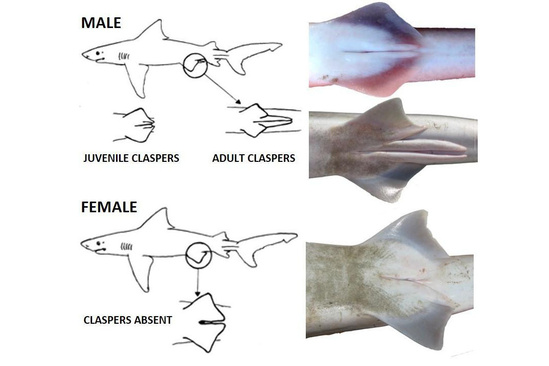
    Mating scars recorded on female blue sharks. The pale arcs and punctures along the flank, gill region, and fins are bite marks left during courtship, when males grip females to maintain position in open water. Some individuals carry a single mark; others bear layered evidence of repeated encounters. These scars are not pathology but record — the body retaining brief moments of reproductive contact long after the act itself has vanished into current. What remains visible is the aftermath: lineage written lightly into skin. | Image credit: Vossgaetter et al., 2025

    Fishing gear produces different signatures: hooks damage the jaw, entanglement leaves constricting linear abrasions, and vessel strikes create irregular trauma. Healed injuries accumulate across a lifetime, recording survival rather than singular events. Marine biologists interpret these marks through context — season, species behavior, wound geometry — understanding that a scar is evidence, not confession (Pratt & Carrier, 2005). The ocean rarely supplies a single explanation.

    The skin of a white shark carries a record of encounters.
Different wounds trace different histories: restrained bite marks associated with courtship (A & B), deeper bites from conflict (C & D), punctures and scratches left by struggling prey (E & F), abrasions from contact with reef or hard bottom (G), and the unmistakable geometry of propeller strikes (H). Each mark is a fragment of interaction preserved after the moment has passed. To read a shark’s body is to read a map of relationships — mating, hunting, collision, survival — written not as drama, but as accumulation. | Photo credit: Anderson et al., 2025
    The skin of a white shark carries a record of encounters. Different wounds trace different histories: restrained bite marks associated with courtship (A & B), deeper bites from conflict (C & D), punctures and scratches left by struggling prey (E & F), abrasions from contact with reef or hard bottom (G), and the unmistakable geometry of propeller strikes (H). Each mark is a fragment of interaction preserved after the moment has passed. To read a shark’s body is to read a map of relationships — mating, hunting, collision, survival — written not as drama, but as accumulation. | Photo credit: Anderson et al., 2025

    Scars are only one layer of interpretation. Sharks also carry quieter markers of sex and maturity written into their form. Males develop elongated claspers — modified fins that trail beneath the body — visible even at a distance once the animal reaches reproductive age. In immature males these structures are short and flexible, almost decorative. With maturity they lengthen and calcify, projecting clearly behind the pelvic fins like paired shadows. A school viewed from a pier often reveals this difference in motion: some bodies carry that trailing geometry, others do not. Even without knowing species, an observer is watching a mixed population divided by sex and age.

    Females, lacking claspers, present a cleaner silhouette. During pregnancy their bodies shift subtly. The abdomen rounds, not dramatically but enough to change how light moves across the flank. Experienced observers recognize gravid females less by size than by proportion — a redistribution of mass that suggests internal cargo rather than surface injury.

    The clasper itself is an evolutionary innovation — a modification of pelvic fins that allows internal fertilization in a fluid environment where external fertilization would disperse gametes too widely to ensure success (Hamlett, 2005). It is a structural solution to a problem posed by water: how to keep lineage from dissolving into current.

    Sex in sharks is written into the silhouette.
Males carry paired claspers — elongated extensions of the pelvic fins that lengthen and stiffen with maturity — while females lack them entirely. Even at a distance, the trailing geometry changes how the body reads in motion. What looks like a uniform school from the surface is already divided by anatomy: juveniles, adults, males, females, each stage visible to anyone patient enough to watch. | 
Photo credit: National Oceanic and Atmospheric Administration
    Sex in sharks is written into the silhouette. Males carry paired claspers — elongated extensions of the pelvic fins that lengthen and stiffen with maturity — while females lack them entirely. Even at a distance, the trailing geometry changes how the body reads in motion. What looks like a uniform school from the surface is already divided by anatomy: juveniles, adults, males, females, each stage visible to anyone patient enough to watch. |
    Photo credit: National Oceanic and Atmospheric Administration

    These signals are quiet. They require patience. To read a shark in the water is to read a body moving through stages — juvenile, mature, gravid — each phase revealing that reproduction is not a single event but a condition carried across seasons. The distinction is anatomical literacy learned slowly, the way birdwatchers learn silhouettes or botanists learn leaf shape. Bodies announce their histories to those patient enough to look.

    Timing Written Into the Body

    Maturity does not arrive uniformly across a population. In many coastal sharks, size is a better predictor of reproductive readiness than age. Warmer water accelerates metabolism and growth, allowing juveniles in southern nurseries to reach maturity sooner than their northern counterparts (Cortés, 2000; Musick & Ellis, 2005). Temperature becomes a developmental force. A difference of a few degrees can compress or extend the timeline by years, shaping when an individual enters the reproductive pool.

    Juveniles and adults often sort themselves accordingly. Young sharks cluster in shallower, warmer margins where rapid growth offsets vulnerability. Larger, mature individuals occupy deeper or more exposed water, their size granting a margin of safety (Heupel et al., 2007). When mixed schools appear near piers, the variation in body shape reflects overlapping life stages sharing temporary habitat. What looks like a single group is often a layered demographic — future breeders moving alongside current ones.

    During mating seasons, additional cues surface. Mature males display fully calcified claspers held stiff against the body, while gravid females carry the rounded proportions of pregnancy. These changes are not theatrical. They are subtle adjustments in geometry, visible only to observers willing to compare silhouettes over time.

    Nurseries and Geographic Memory

    Many coastal shark species rely on estuaries as nursery grounds, where shallow, structured habitat increases juvenile survival by buffering predators and concentrating prey (Heupel et al., 2007). Young sharks enter a world scaled to their size. Warmer water accelerates growth, and complex shoreline geometry provides refuge during early vulnerability.

    Some females exhibit fidelity to nursery regions, returning to the same coastal systems that once sheltered them (Heupel et al., 2007). Habitat becomes inheritance. When nursery grounds degrade, the disruption extends beyond a single generation — it interrupts geographic memory embedded in the population itself.

    Multiple Ways to Continue

    Sandbar Sharks — Durability Over Speed

    A sandbar shark range from New England to Brazil. | Photo Credit: G.P. Schmahl/NOAA

    Sandbar shark | Photo Credit: G.P. Schmahl/NOAA

    Sandbar sharks (Carcharias plumbeus) invest heavily in durability. They mature late, produce relatively small litters, and rely on long development to generate robust juveniles capable of extended survival (Musick & Ellis, 2005). This strategy favors stability over speed. When mortality rises, recovery unfolds slowly because the species was never designed for rapid turnover.

    Sandbar shark reproduction unfolds slowly even by shark standards. Gestation lasts roughly 9–12 months, with litters typically ranging from 6 to 13 pups, though regional variation is common (Musick & Ellis, 2005). Along the mid-Atlantic coast mating generally occurs in spring and early summer, while birthing follows the next year in warmer estuarine margins. The delay is part of the design. Juveniles arrive when prey is abundant and water temperature accelerates growth, aligning birth with a narrow ecological window where survival odds briefly tilt in their favor.

    In Onslow County waters, juvenile sandbar sharks use shallow estuary margins as thermal accelerators. Warm, protected water shortens the time required to reach a size less vulnerable to predation. Growth in these early months is not cosmetic; it is survival measured in centimeters. A difference of a few inches can determine whether a young shark passes unnoticed beneath larger predators or becomes part of their diet (Heupel et al., 2007). The nursery functions as a buffer against probability. By compressing early growth into a brief window of ecological generosity, sandbars convert geography into longevity.

    Blacktip Sharks — Timing as Opportunity

    Atlantic blacktip sharks | Photo credit: Shutterstock
    Atlantic blacktip sharks | Photo credit: Shutterstock

    Blacktip sharks (Carcharhinus limbatus) align reproduction with seasonal pulses. Birth coincides with warm water and prey abundance, creating a temporary ecological advantage for juveniles. This strategy accepts higher early mortality but compensates through timing — survival synchronized with opportunity (Heupel & Simpfendorfer, 2008).

    Blacktip sharks compress their timeline. Gestation averages 10–12 months and litters often contain 1 to 10 pups, with smaller litters more common in northern portions of their range (Heupel & Simpfendorfer, 2008). Mating occurs in late spring and summer; pups are born the following late spring when baitfish concentrations peak in shallow coastal waters. Their strategy hinges on synchronization. Birth is timed not to safety, but to opportunity — a calculated arrival into abundance.

    Along our piers in late spring and summer, blacktip juveniles appear in pulses that mirror the prey fields they depend on. Schools of baitfish create moving refuges — density as defense — and young blacktips learn to survive inside motion itself. Survival belongs to individuals able to exploit brief windows, grow fast, and disperse before scarcity returns (Heupel & Simpfendorfer, 2008).

    Bonnethead Sharks — Redundancy and Retention

    Bonnethead shark | Photo credit: NC Aquariums
    Bonnethead shark | Photo credit: NC Aquariums

    Bonnethead sharks (Sphyrna tiburo) operate on one of the shortest reproductive cycles among coastal sharks. Gestation lasts approximately 4–5 months, and litters commonly range from 4 to 16 pups depending on female size (Hamlett, 2005). Mating generally occurs in late summer, but sperm storage allows fertilization to be delayed until environmental conditions favor gestation. Pups are born in late spring and early summer, entering warm shallow waters that function as immediate nurseries. The speed of the cycle reflects a species built for resilience through repetition — rapid turnover as insurance against instability.

    Bonnetheads add evolutionary contingency. Rare cases of parthenogenesis — reproduction without fertilization — demonstrate biological redundancy when mates are scarce (Chapman et al., 2007). Such flexibility underscores a principle of lineage persistence: survival tolerates complexity if complexity improves continuity.

    Bonnetheads, often glimpsed in shallow surf or near pilings, compress life history into shorter cycles, allowing populations to respond quickly to environmental change. Unlike many coastal sharks, females are capable of storing viable sperm for extended periods, delaying fertilization until conditions favor successful gestation (Hamlett, 2005). This ability decouples mating from pregnancy, allowing reproduction to align with environmental timing rather than immediate opportunity. Redundancy becomes insurance in a fragmented coastal landscape. Their persistence is not brute strength but flexibility — an evolutionary acknowledgment that coastlines are rarely stable for long (Cortés, 2000).

    Sand Tiger Sharks — Survival Before Birth

    Sand tiger shark | Photo credit: Mitchell, 2024
    Sand tiger sharks | Photo credit: Mitchell, 2024

    Sand tiger sharks (Carcharias taurus) represent an uncompromising alternative. Embryos compete within the uterus, and only the strongest survive to birth through intrauterine cannibalism — a process that produces a small number of highly developed juveniles (Hamlett, 2005). From a human perspective the mechanism appears brutal. In evolutionary terms it is a concentrated investment in pre-birth survival.

    Sand tiger gestation stretches close to 9–12 months, but the internal competition that defines their development reduces litters to one or two surviving pups per uterus despite a much larger initial embryo count (Hamlett, 2005; Branstetter & Musick, 1994). Mating occurs offshore in cooler months, and births typically follow in spring or early summer. The resulting juveniles are large at birth — already capable hunters — trading quantity for immediate competence. Survival is front-loaded. The species invests in a few individuals built to endure rather than many built to gamble.

    For sand tigers occasionally seen near South Topsail Island, this pre-birth selection produces juveniles that enter the water already comparable in size to many adult coastal fish. They arrive as functioning predators. Instead of a long vulnerable childhood, sand tigers begin life past the most dangerous bottleneck. Their subsequent behavior reflects this early security: slow movement, energy conservation, and longevity built on having cleared the lethal threshold before birth (Branstetter & Musick, 1994).

    It is tempting to read personality into origin. Yet adult sand tigers move with calm efficiency, rarely engaging in unnecessary conflict. A harsh developmental filter does not predict a harsh adulthood. It simply ensures survival past the most intense threshold.

    Together, these strategies map the same coastline through different biological clocks. Some sharks survive by accelerating early growth. Others invest in a few individuals built to last. Still others hedge their future with redundancy. Diversity is not excess — it is resilience expressed through bodies.

    The Coast as a Clock

    Longevity is the silent partner in every reproductive strategy. Long-lived sharks can afford to reproduce slowly, distributing investment across decades. Shorter-lived species compress reproduction into tighter intervals. Neither strategy is superior in isolation. Each is calibrated to environmental tempo (Cortés, 2000).

    The coastline holds many clocks at once — tides measured in hours, migrations in seasons, lineage in centuries. Sharks survive by aligning their bodies to the clock that fits their niche. Gestation becomes a wager on stability. Migration becomes inheritance in motion. A nursery becomes infrastructure for continuity.

    To observe a pregnant shark offshore is to witness a process already years in motion. The animal carries not only embryos but evolutionary decisions accumulated across millennia: how many to produce, when to move, where to shelter, how long to live. Reproduction is less an event than a continuity. Its future depends not on spectacle, but on whether the slow mathematics of these lives can continue unfolding inside waters still capable of carrying them forward.

    References

    Branstetter, S., & Musick, J. A. (1994). Age and growth estimates for the sand tiger in the northwestern Atlantic Ocean. Transactions of the American Fisheries Society, 123(2), 242-254. https://doi.org/10.1577/1548-8659(1994)123<0242:aageft>2.3.co;2

    Carlson, A. E., Hoffmayer, E. R., Tribuzio, C. A., & Sulikowski, J. A. (2014). The use of satellite tags to redefine movement patterns of spiny dogfish (Squalus acanthias) along the U.S. East Coast: Implications for fisheries management. PLoS ONE, 9(7), e103384. https://doi.org/10.1371/journal.pone.0103384

    Carrier, J. C., Musick, J. A., & Heithaus, M. R. (2012). Biology of sharks and their relatives (2nd ed.). CRC Press.

    Chapman, D. D., Shivji, M. S., Louis, E., Sommer, J., Fletcher, H., & Prodöhl, P. A. (2007). Virgin birth in a hammerhead shark. Biology Letters, 3(4), 425-427. https://doi.org/10.1098/rsbl.2007.0189

    Cortés, E. (2000). Life history patterns and correlations in Sharks. Reviews in Fisheries Science, 8(4), 299-344. https://doi.org/10.1080/10408340308951115

    DeVries, C., Gartland, J., & Latour, R. J. (2025). Patterns in spiny dogfish consumption by sex and maturity stage relate to prey availability and environmental forcing in the Northwest Atlantic. Frontiers in Marine Science, 12. https://doi.org/10.3389/fmars.2025.1621343

    Heupel, M., Carlson, J., & Simpfendorfer, C. (2007). Shark nursery areas: Concepts, definition, characterization and assumptions. Marine Ecology Progress Series, 337, 287-297. https://doi.org/10.3354/meps337287

    Heupel, M., & Simpfendorfer, C. (2008). Movement and distribution of young bull sharks Carcharhinus leucas in a variable estuarine environment. Aquatic Biology, 1, 277-289. https://doi.org/10.3354/ab00030

    Musick, J. A., & Ellis, J. K. (2005). Reproductive evolution of chondrichthyans. In Reproductive Biology and Phylogeny of Chondrichthyes (1st ed., pp. 45-79). Science Publishers.

    Pratt, H. L., & Carrier, J. C. (2005). Elasmobranch courtship and mating behavior. In Reproductive Biology and Phylogeny of Chondrichthyes (1st ed., pp. 129-169). Science Publishers.

  • Shark Sleigh Bells: How Sharks Track Vibrations in the Winter Sea

    Shark Sleigh Bells: How Sharks Track Vibrations in the Winter Sea

    Winter’s Quiet Chorus

    December hushes the coastline of Onslow County. The marshgrass stiffens in the cold, the surf stills between storms, and the New River Inlet carries the metallic stillness of early winter. Yet beneath that calm, the water hums with motion — tiny pulses, ripples, and vibrations that weave a hidden holiday soundtrack, a kind of underwater sleigh bells rung in pressure waves.

    Sharks, lingering along the nearshore troughs or cruising the outer edge of the estuary, sense these disturbances with remarkable clarity. Every mullet tail-beat, crab scuttle, and sediment shift radiates through the water as a low-frequency pressure wave. In the quiet of December, these signals travel farther and cleaner, strengthened by winter’s denser water, slower prey, and reduced turbidity (Mickle & Higgs, 2021; Mogdans, 2019).

    To sharks, these vibrations form a map, a three-dimensional winter soundscape that reveals direction, distance, and urgency (Montgomery, Baker & Carton, 2000; Montgomery et al., 2000). And layered beneath these hydrodynamic cues, the faint electric fields produced by the heartbeat and muscle activity of nearby prey glow through the water, detectable at nanovolt precision (Anderson et al., 2017; England et al., 2021).

    This “music” is not metaphor — it is the sensory world sharks inhabit, sharpened by the very conditions winter imposes.

    The Winter Sea as a Soundscape

    Illustration showing how different animals create underwater vibrations detectable by sharks. A school of fish at the top produces wide, rolling displacement waves. A crab on the sandy seafloor generates small, intermittent pulse rings. Two individual fish create subtle fin-flick ripple patterns. Concentric circles radiate from each animal to visually represent hydrodynamic cues in the water.
    Sharks detect a wide range of underwater vibrations—from the rolling displacement waves of schooling fish to the intermittent pulses of crabs and the subtle fin flicks of solitary prey—using their highly sensitive mechanosensory systems.

    Cold water shifts the physics of survival. As temperatures fall, prey metabolism slows, creating weaker and more irregular movement patterns — the exact low-frequency signatures sharks detect most easily (Sisneros & Rogers, 2016). Reduced plankton and sediment yield a clearer path for particle motion, allowing hydrodynamic cues to propagate farther through the winter water column (Mogdans, 2019).

    This turns the estuary into a rich field of vibrations. Fish schooling tightly create rolling displacement waves. Crabs shifting beneath the sand produce intermittent pulses. Even subtle fin flicks produce particle motion detectable by sharks’ sensory systems (Maruska, 2001).

    Winter looks barren to us.
    To sharks, it resonates.

    Hydrodynamic “Bells”: The Lateral Line

    A scientific-style illustration explaining how a shark’s lateral line detects underwater vibrations. A sandbar shark is shown with a highlighted lateral line running along its body and head. Concentric rings radiate from a struggling fish, a crustacean on the seafloor, and a distant object to demonstrate low-frequency hydrodynamic signals. Icons represent cold water, low light, prey movement, and inlet geometry as factors that enhance vibration transmission in winter. Text describes neuromasts encoding direction and amplitude to create a spatial map of nearby activity.
    Sharks use their lateral line to “feel” tiny vibrations in the water. Winter makes these signals even easier to detect, helping sharks follow the movement of fish, crabs, and other prey in low-light conditions.

    The shark’s lateral line is a mechanosensory canal system tuned to detect water displacement in the exact frequency range produced by struggling fish and crustaceans (Montgomery, Baker & Carton, 2000). Neuromasts within the canal encode both direction and amplitude, transforming low-frequency motion into a spatial map of nearby activity (Mogdans, 2019).

    In December, this system excels:

    • cold water enhances transmission of pressure waves,
    • prey move more predictably and more weakly,
    • low-light conditions reduce visual noise,
    • and inlet geometry funnels vibrations along natural corridors.

    Even acoustic cues — particle motion at frequencies under ~300 Hz — become part of this integration. Sharks are most sensitive to these low-frequency bands, enabling discrimination of movement types in murky or dark winter water (Poppelier et al., 2022).

    To a shark, each pulse is information.
    Each ripple is direction.
    Each vibration is a bell rung underwater.

    Watch how sharks use their lateral line system to sense ripples and vibrations long before they see their prey. | Video courtesy of National Aquarium – “Sharks Lateral Line”

    Closer Than Sight: The Ampullae of Lorenzini

    When a shark closes the final distance, tracking transitions from vibration to electricity. The Ampullae of Lorenzini detect microvolt-scale electric fields emitted by the body of every living animal. Sensitivity thresholds fall into the tens of nanovolts per centimeter — among the most refined biological detection limits known (Anderson et al., 2017; Newton, Gill & Kajiura, 2019; England et al., 2021).

    Electroreception enables sharks to:

    • locate prey buried beneath sand,
    • perceive fish hidden in silt clouds,
    • detect immobile or slow-moving animals,
    • and navigate complex, low-light environments.

    Classic electroreception work demonstrated these capacities decades ago, and modern experimental studies in hammerheads confirm high-resolution electro-sensitivity during close-range hunting (Kajiura & Holland, 2002; Kalmijn, 2000).

    In winter, when storms churn the sediment and twilight comes early, this sense becomes even more essential.

    Sharks do not need light — they follow electricity.

    Video courtesy of PBS Deep Look, illustrating how sharks use electroreception to locate prey invisible to sight or sound.

    A December Hunt at the New River Mouth

    Illustration of a juvenile Atlantic sharpnose shark approaching a partially buried mullet in shallow winter water. Orange concentric lines show the mullet’s electric field and the shark’s detection of hydrodynamic and electrical cues through its lateral line and Ampullae of Lorenzini.
    A juvenile Atlantic sharpnose shark follows the faint hydrodynamic pulse of a cold-slowed mullet, then locks onto its electric field—an underwater hunt guided by vibration and microvolts.

    Picture a December evening at the New River Inlet. The ebb tide pulls cold water from the sound toward the ocean. A juvenile Atlantic sharpnose shark glides along a shallow bar, guided not by sight, but by the underwater vibrations pulsing through its lateral line.

    A faint, uneven pressure wave reaches the shark — the hydrodynamic signature of a mullet slowed by the cold (Montgomery et al., 2000). The shark turns. Another pulse follows, the rhythm revealing both direction and weakness.

    Within a few body lengths, electric cues rise above the hydrodynamic noise. The Ampullae of Lorenzini detect microvolt-scale oscillations from the mullet’s buried body (Newton, Gill & Kajiura, 2019; England et al., 2021). One quick strike completes the hunt.

    This is winter’s choreography:
    vibrations at a distance,
    electricity up close,
    all woven seamlessly through still December water.

    The Importance of Winter Hunting

    four-panel educational graphic titled “Winter Survival: How Sharks Thrive When Other Animals Slow Down.” The top panels show a shark pursuing a slow-moving fish labeled “Winter Energy Reserves” and a shark navigating an inlet with arrows labeled “Predictable Movement Corridors.” The bottom panels show a shark approaching a weakened fish with vibration rings labeled “Removing Weakened Individuals” and a shark outlined by sensory icons—spiral wave, lightning bolt, and low-light symbol—labeled “Low Visibility Navigation.” The artwork illustrates how sharks use sensory advantages to hunt effectively during winter.
    Even as the season quiets the coast, sharks thrive—reading vibrations, following winter corridors, finding weakened prey, and navigating the dim water with senses far beyond our own.

    Although prey slow in winter, sharks must continue to feed. Their dual sensory systems allow efficient predation in the season that challenges most marine animals. These abilities help sharks:

    • build winter energy reserves,
    • exploit predictable movement corridors,
    • maintain population stability by removing weakened individuals (Tricas & McCosker, 1984),
    • and navigate cold, low-visibility environments effectively (Mickle & Higgs, 2021).

    Even as water temperatures drop, species like Atlantic sharpnose sharks, bonnetheads, and offshore Atlantic spiny dogfish remain active, relying heavily on the interplay of hydrodynamic and electroreceptive cues (Maruska, 2001).

    Winter is not lifeless.
    It is a sensory masterclass.

    Bells That Never Stop Ringing

    While we celebrate the holidays with sleigh bells, carols, and glowing lights, the Atlantic hums with its own winter rhythms. Sharks navigate December through vibrations, particle motion, and faint electrical fields — signals older than any tradition and tuned to the pulse of life beneath the cold.

    Their bells are not made of metal.
    They are made of motion.
    Of electricity.
    Of the quiet echoes of survival beneath the tide. These are the Shark Sleigh Bells, ringing softly beneath Onslow County’s winter waters.

    References

    Anderson, J. M., Clegg, T. M., Véras, L. V., & Holland, K. N. (2017). Insight into shark magnetic field perception from empirical observations. Scientific Reports, 7(1). https://doi.org/10.1038/s41598-017-11459-8

    England, S. J., & Robert, D. (2021). The ecology of electricity and electroreception. Biological Reviews, 97(1), 383-413. https://doi.org/10.1111/brv.12804

    Kajiura, S. M., & Holland, K. N. (2002). Electroreception in juvenile scalloped hammerhead and sandbar sharks. Journal of Experimental Biology, 205(23), 3609-3621. https://doi.org/10.1242/jeb.205.23.3609

    Kalmijn, A. J. (2000). Detection and processing of electromagnetic and near–field acoustic signals in elasmobranch fishes. Philosophical Transactions of the Royal Society of London. Series B: Biological Sciences, 355(1401), 1135-1141. https://doi.org/10.1098/rstb.2000.0654

    Maruska, K. P. (2001). Morphology of the Mechanosensory lateral line system in elasmobranch fishes: Ecological and behavioral considerations. Environmental Biology of Fishes, 60(1-3), 47-75. https://doi.org/10.1023/a:1007647924559

    Mickle, M. F., & Higgs, D. M. (2021). Towards a new understanding of elasmobranch hearing. Marine Biology, 169(1). https://doi.org/10.1007/s00227-021-03996-8

    Mogdans, J. (2019). Sensory ecology of The Fish lateral‐line system: Morphological and physiological adaptations for the perception of hydrodynamic stimuli. Journal of Fish Biology, 95(1), 53-72. https://doi.org/10.1111/jfb.13966

    Montgomery, J., Carton, G., Voigt, R., Baker, C., & Diebel, C. (2000). Sensory processing of water currents by fishes. Philosophical Transactions of the Royal Society of London. Series B: Biological Sciences, 355(1401), 1325-1327. https://doi.org/10.1098/rstb.2000.0693

    Montgomery, J. C., Baker, C. F., & Carton, A. G. (1997). The lateral line can mediate rheotaxis in fish. Nature, 389(6654), 960-963. https://doi.org/10.1038/40135

    Newton, K. C., Gill, A. B., & Kajiura, S. M. (2019). Electroreception in marine fishes: Chondrichthyans. Journal of Fish Biology, 95(1), 135-154. https://doi.org/10.1111/jfb.14068

    Poppelier, T., Bonsberger, J., Berkhout, B. W., Pollmanns, R., & Schluessel, V. (2022). Acoustic discrimination in the grey bamboo shark Chiloscyllium griseum. Scientific Reports, 12(1). https://doi.org/10.1038/s41598-022-10257-1

    Tricas, T. C., & McCosker, J. E. (1984). Predatory behavior of the white shark (Carcharodon carcharias) and other large sharks. Proceedings of the California Academy of Sciences, 43(14), 221-238. https://ia801302.us.archive.org/16/items/biostor-78396/biostor-78396.pdf 

  • The Leftovers: What Happens to Summer’s Prey When the Big Fish Leave?

    The Leftovers: What Happens to Summer’s Prey When the Big Fish Leave?

    The Quiet Season Begins

    When the red drum, flounder, and summer sharks follow the cooling tides offshore, Onslow County’s estuaries fall quiet. The flashy chases fade, and the splashes that once rippled through the creeks give way to stillness. But the story doesn’t end. Beneath November’s calm water, the estuary begins to rewrite itself.

    The absence of its top hunters leaves behind both energy and opportunity — a banquet for the small and the overlooked. The currents no longer echo with the heavy pulse of pursuit. Instead, what remains is a more deliberate rhythm — a slow exchange between detritus, crabs, and the smaller fish that endure the cold months ahead.

    Winter in the New River Estuary: The Vacancy in the Food Web

    Every migration leaves an ecological vacancy. When red drum and southern flounder depart, they take with them both predatory pressure and nutrient export. The estuary briefly relaxes its guard. Prey fish, shrimp, and crabs experience a momentary release from predation from top predator populations that cause a cascade that momentarily alters predation pressure on lower-level prey (Clark et al., 2003).

    In this lull, energy that once fueled apex biomass lingers in the system, stored in crustaceans and schooling fish that escaped the hunt (Baird et al., 1998). The estuary, ever adaptive, redistributes that energy downward. Blue crabs (Callinectes sapidus) and juvenile spot (Leiostomus xanthurus) surge in number, exploiting the leftovers of summer’s feast (Allen et al., 2024). The marsh becomes a recycling ground — energy looping through smaller players instead of flowing outward to the sea.

    Late-Fall Estuarine Food Web
    Late-fall estuarine food web diagram showing energy flow from detritus to shrimp, fish, and mesopredators.

    The Winter Guardians

    But not all predators have gone. When the warm-water hunters leave, colder visitors arrive. Along the inlets and nearshore waters of Onslow Bay, Atlantic spiny dogfish (Squalus acanthias) drift in with the falling temperatures. They are the quiet inheritors of the season — small sharks with silver eyes and slate-gray backs, moving in disciplined schools just offshore.

    Atlantic spiny dogfish school by Andy Murch
    Atlantic spiny dogfish (Squalus acanthius) — the “winter guardians” — patrol coastal waters when larger predators have departed, sustaining the rhythm of predation. | Photo credit: Andy Murch

    Where the big sharks of summer — sandbars, blacktips, and bulls — have vanished southward or deeper, the dogfish remain. Their bodies are built for cold water, thriving where others slow (Carlson et al., 2014). And while their size may not inspire awe, their purpose is no less vital: they fill the empty seats at the top of the table.

    Dogfish are mesopredators, but in winter they act as temporary apex hunters, patrolling the inlet and inner shelf where menhaden, herring, and squid still linger (Carlson et al., 2014). Their presence keeps the ecosystem in motion. They thin out the schools that might otherwise explode in number, preventing imbalance and decay. Like patient custodians, they maintain the continuity of predation, ensuring that energy continues to flow up and down the food web even in the cold months (Prugh et al., 2009).

    In their absence, the estuary might collapse inward — prey would overgraze, detritus would pile, and oxygen would vanish from the mud. But the dogfish, efficient and tireless, keep the waters breathing.

    Crabs and Killifish Take the Stage

    Blue crab foraging in estuary
    Blue crabs roam the winter marsh, feeding on detritus and benthic invertebrates. Their slow foraging helps recycle nutrients and sustain the estuary’s energy balance through the cold season.

    Within the estuary itself, the smaller actors continue their work. By December, the New River’s mudflats and marsh creeks host a quieter cast — mummichogs (Fundulus heteroclitus), sheepshead minnows (Cyprinodon variegatus), and grass shrimp (Palaemonetes pugio). These resident species, often unnoticed, now carry the estuary’s metabolism on their backs.

    They thrive on detritus and microbial mats, converting decay into new life (Kneib, 2015). Blue crabs roam like slow-moving janitors, shifting through sediment to feed on worms and organic matter (Kennedy & Cronin, 2007). Each movement releases trapped nutrients, fueling microbial blooms that will later nourish the first plankton of spring.

    While the spiny dogfish patrol the edges of the continental shelf, these smaller species sustain the inner heart of the estuary. Their labor keeps the water alive long after the glamour of migration fades.

    Nutrient Loops and Winter Stability

    Without large predators, the estuary depends on microbial and detrital loops to keep its energy cycling. Up to 70% of carbon transfer between November and February occurs through benthic detritivory and microbial remineralization rather than direct predation (Friedrichs & Perry, 2001).

    This invisible economy sustains the overwintering fish and crustaceans — the leftovers that, in time, will become the first meal of spring’s returning predators. It’s the estuary’s savings account: energy stored as biomass and sediment, ready to be withdrawn when the tides warm again.

    Graphical abstract of dentrification in a coastal lagoon from https://doi.org/10.1016/j.scitotenv.2020.140169
    When winter quiets the hunt, the estuary turns inward. Instead of predators driving the cycle, nutrients move through the mud itself — microbes and detritivores recycling what’s left behind. This unseen flow keeps the New River alive until spring’s return (adapted from Erler et al., 2020).

    A Resilient Feast

    By January, the estuary seems dormant to the casual eye, but beneath its glassy surface, life reorganizes with quiet precision. Crabs clean the table. Dogfish patrol the edge. Minnows and shrimp sift through the silt for remnants of summer.

    The New River continues to breathe — slower, deeper, deliberate.
    When the big fish return with the first warm tides, the table is set once more, and the energy once left behind has been transformed — recycled through countless small mouths and patient currents into the promise of another season’s chase.

    References

    Allen, D. M., Govoni, J. J., Able, K. W., Buckel, J. A., Hale, E. A., Hilton, E. J., Kellison, G. T., Targett, T. E., Taylor, J. C., & Walsh, H. J. (2024). Long-term dynamics of larval and early juvenile spot (Leiostomus xanthurus) off the U.S. East Coast: Relating ocean origins, estuarine Ingress, and changing environmental conditions. Fishery Bulletin, 122(4), 162-185. https://doi.org/10.7755/fb.122.4.3  

    Baird, D., Luczkovich, J., & Christian, R. (1998). Assessment of spatial and temporal variability in ecosystem attributes of the St marks national wildlife refuge, Apalachee Bay, Florida. Estuarine, Coastal and Shelf Science, 47(3), 329-349. https://doi.org/10.1006/ecss.1998.0360

    Carlson, A. E., Hoffmayer, E. R., Tribuzio, C. A., & Sulikowski, J. A. (2014). The use of satellite tags to redefine movement patterns of spiny dogfish (Squalus acanthias) along the U.S. East Coast: Implications for fisheries management. PLoS ONE, 9(7), e103384. https://doi.org/10.1371/journal.pone.0103384

    Clark, K. L., Ruiz, G. M., & Hines, A. H. (2003). Diel variation in predator abundance, predation risk and prey distribution in shallow-water estuarine habitats. Journal of Experimental Marine Biology and Ecology, 287(1), 37-55. https://doi.org/10.1016/s0022-0981(02)00439-2

    Foster, S. Q., & Fulweiler, R. W. (2014). Spatial and historic variability of benthic nitrogen cycling in an anthropogenically impacted Estuary. Frontiers in Marine Science, 1. https://doi.org/10.3389/fmars.2014.00056

    Friedrichs, C. T., & Perry, J. E. (2001). Tidal Salt Marsh Morphodynamics: A Synthesis. Journal of Coastal Research, (27), 7-37. https://www.jstor.org/stable/25736162

    Kennedy, V. S., & Cronin, L. E. (2007). The blue crab: Callinectes Sapidus. Maryland Sea Grant College University of Maryland.

    Kneib, R. T. (1986). The role of Fundulus heteroclitus in salt marsh trophic dynamics. American Zoologist, 26(1), 259-269. https://doi.org/10.1093/icb/26.1.259

    Prugh, L. R., Stoner, C. J., Epps, C. W., Bean, W. T., Ripple, W. J., Laliberte, A. S., & Brashares, J. S. (2009). The rise of the Mesopredator. BioScience, 59(9), 779-791. https://doi.org/10.1525/bio.2009.59.9.9 

  • Thanksgiving Tides: New River Inlet Fish Migration in Fall

    Thanksgiving Tides: New River Inlet Fish Migration in Fall

    A Different Kind of Thanksgiving Journey

    Each November, when highways fill with travelers heading home for Thanksgiving, the waters of Onslow County’s New River Estuary host a quieter kind of migration. Beneath the surface, schools of silvery menhaden, golden spot, croaker, and even small sharks begin the New River Inlet fish migration, drawn by instincts older than any holiday tradition. The tides quicken. Water cools. Marsh grasses brown and whisper in the wind. And with every falling tide, the river seems to breathe outward, carrying its pilgrims toward the sea.

    The Gate Between River and Sea

    New River Inlet is not simply a passage between Sneads Ferry and North Topsail Beach—it is a living threshold.

    Winter migration path new river inlet to ocean
    The New River winds toward its inlet, where marsh channels, sandbars, and tidal creeks converge into a single hydrodynamic corridor — the living gateway between Onslow County’s estuary and the open Atlantic.


    As autumn advances, the estuary’s chemistry shifts: cooler water holds more oxygen, salinity rises with lower rainfall, and winds begin steering surface currents southward. These changes open a corridor that hundreds of thousands of fish follow instinctively from the creeks to the ocean shelf.

    For species like spot (Leiostomus xanthurus) and Atlantic croaker (Micropogonias undulatus), this downstream journey completes the first half of a circular life cycle. After spending spring and summer feeding in the calm nurseries of the estuary, they now join the coastal current to overwinter in deeper, warmer water—traveling the same path their parents once took (Odell et al., 2017).

    This path is more than instinct. It follows the physical architecture of the river itself—the deep, tidally flushed channels that connect Stones Bay and the main river to the inlet’s thalweg. When autumn winds push water seaward, these channels become a hydrodynamic migration corridor, a natural conveyor that funnels fish from the upper river toward the mouth (Odell et al., 2017).

    The inlet becomes a moving parade: ripples flashing silver, gulls diving, and every outgoing tide pulling another wave of life toward the horizon.

    Menhaden: The Silver Procession

    School of atlantic menhaden
    A vast school of Atlantic menhaden (Brevoortia tyrannus) moves as one body near the surface — a living current of silver that links the New River Estuary to the open Atlantic each fall.

    Among the first to leave are Atlantic menhaden (Brevoortia tyrannus), the shimmering filter-feeders that fuel much of the coastal food web. Juveniles spend the warmer months feeding in the upper river, turning sunlight and plankton into pure energy. When the water dips below 18 °C, they form tight schools and funnel through the inlet, their bodies reflecting the low winter sun like coins scattered across the tide.

    Studies of otolith chemistry show that these migrants come from multiple estuarine nurseries along the Atlantic seaboard, each contributing recruits to the coast-wide population (Anstead et al., 2016). Their exodus through the New River Inlet is not just a local event—it’s part of a continental rhythm that keeps the Atlantic alive.

    Beyond the inlet, menhaden rarely swim straight into the deep. Instead, they travel through the nearshore transition zone, staying within roughly 10 kilometers of the coast, guided by southward longshore currents driven by seasonal winds (Lozano et al., 2013). Here they join massive coastal schools that drift toward Cape Fear and beyond, remaining within waters of 12–18 °C—their preferred thermal band. Each year, these moving rivers of fish carry the New River’s energy down the Atlantic coast like a living current of light.

    Spot and Croaker: The Drummers of the Migration

    Spot and Atlantic croaker
    Spot (Leiostomus xanthurus) and Atlantic croaker (Micropogonias undulatus) — schooling estuarine “drummers” whose late-fall migration carries the New River’s summer energy seaward through New River Inlet.

    Close behind move the “drums”—spot (Leiostomus xanthurus) and Atlantic croaker (Micropogonias undulatus)—so named for the sound they make vibrating muscles against their swim bladders. By late autumn, they too feel the pull of the current. Their bodies, now heavy from a summer of estuarine abundance, drift downstream in schools that seem to hum with the low percussion of their name.

    In coastal surveys, researchers have traced these migrations from estuarine creeks to the continental shelf, where the fish spend the winter in relative warmth before returning north in spring (Odell et al., 2017). In ecological terms, it’s an energy transfer: the nutrients once locked in the mud and detritus of the New River now exported to the open sea.

    Once through the inlet, spot and croaker follow two primary routes—some hugging the coast within the surf zone, others settling on the inner continental shelf at 15–35 meters depth. They drift southward along the Carolina Coastal Current, a steady, wind-driven flow that connects Onslow Bay to warmer waters off South Carolina and Georgia. Beneath the surface, these fish form vast, undulating layers—millions of tiny drummers keeping rhythm with the season.

    Juvenile Sharks: The Shadow Pilgrims

    Sandbar shark pups
    Juvenile coastal sharks glide over a sandy inlet floor — quiet travelers of the New River system, following ancient tidal cues that guide them from sheltered estuaries to the open Atlantic.

    Following the smaller fish come the quiet shadows—juvenile coastal sharks moving through the inlet on their own pilgrimage. Tagging studies across North Carolina reveal that blacktip, sandbar, and bull sharks use shallow estuarine margins as summer nurseries before shifting offshore in late fall when the water cools (Bangley et al., 2018; Rulifson & Bangley, 2015).

    In the turbid water at the inlet’s mouth, these young predators trace invisible highways along sandbars and channels, following the scent of prey schools that have already departed. Many continue to ride the same southward current as the drum and menhaden but at greater depth—sometimes reaching the outer continental shelf (30–80 meters) where the water remains above 18 °C. For a few short weeks, river and sea mingle in one shared migration—prey, predator, and current moving together through the same watery passage.

    The Importance of the Journey

    The departure is not random. Temperature, daylight, and shifting prey availability synchronize this movement. When shrimp and plankton thin in the creeks, the fish follow the energy gradient seaward. In doing so, they maintain the seasonal connectivity that defines an estuary’s health: nutrients exported from the marsh become the foundation of offshore food webs, feeding mackerel, tuna, and seabirds far beyond the New River’s mouth (Lozano et al., 2013).

    The Ekman Transport
    Alongshore winds along the North Carolina coast generate offshore surface flow through Ekman transport. This movement is balanced by deeper onshore currents and localized upwelling, circulating nutrients and carrying estuarine water and organisms seaward. Adapted from Job Dronkers (2025), Coastal Wiki.

    This corridor of movement also depends on the forces of wind and tide. During late fall, northwest winds push surface waters offshore through Ekman transport, enhancing the ebb flow that draws fish outward. Each tide functions as a breath of the estuary—an exhalation of life—carrying energy from the marshes to the sea (Odell et al., 2017).

    This is the river’s gift to the ocean—the annual offering that ensures what leaves the estuary returns as new life months later.

    A Thanksgiving of Currents

    N Topsail Beach NC at Sunset by David Ogorman
    North Topsail Beach at sunset | Photo Credit: David Ogorman

    If seen from above, the late-autumn water resembles a conveyor of light: streaks of silver menhaden, bronze drum, and dark shark fins blending into the green-blue inlet plume. Each species is a pilgrim, carried by tides instead of highways, guided by magnetic fields instead of maps. Their departure is as old as the coastline itself—a Thanksgiving procession written in currents and instincts rather than calendars. For those standing on the dunes at North Topsail Beach, the scene feels both ancient and immediate: the hush of wind, the roll of the tide, and somewhere beneath, the silent travelers heading home.

    References

    Anstead, K. A., Schaffler, J. J., & Jones, C. M. (2016). Coast-wide nursery contribution of new recruits to the population of Atlantic menhaden. Transactions of the American Fisheries Society, 145(3), 627–636. https://doi.org/10.1080/00028487.2016.1150345

    Bangley, C. W., Paramore, L., Dedman, S., & Rulifson, R. A. (2018). Delineation and mapping of coastal shark habitat within a shallow lagoonal estuary. PLOS ONE, 13(4), e0195221. https://doi.org/10.1371/journal.pone.0195221

    Lozano, C. J., Houde, E. D., & Severin, K. P. (2013). Factors contributing to variability in larval ingress of Atlantic menhaden (Brevoortia tyrannus) to Chesapeake Bay. Estuarine, Coastal and Shelf Science, 118, 1–10. https://doi.org/10.1016/j.ecss.2012.12.018

    Odell, J., Adams, D. H., Boutin, B., Collier, W., Deary, A., Havel, L. N., Johnson, J. A. Jr., Midway, S. R., Murray, J., Smith, K., Wilke, K. M., & Yuen, M. W. (2017). Atlantic Sciaenid habitats: A review of utilization, threats, and recommendations for conservation, management, and research (Habitat Management Series No. 14). Atlantic States Marine Fisheries Commission. https://asmfc.org/wp-content/uploads/2024/12/HMS14_AtlanticSciaenidHabitats_Winter2017.pdf

    Rulifson, R. A., & Bangley, C. W. (2015). Quantifying estuarine habitat use by multiple coastal shark species (NOAA Technical Report). NOAA Institutional Repository. https://repository.library.noaa.gov/view/noaa/46115