
Where the Ground Doesn’t Hold
There are places along the edges of the water in Onslow County where the ground stops behaving like ground.
You find them along the sound side, at the margins of tidal creeks, and in the quieter edges of channels that drain toward New River Inlet. Places like the shallows near Soundside Park or the creek edges around Kenneth D. Batts Family Park look ordinary when the tide is in—flat water, sometimes with a darker tone beneath the surface, but otherwise unremarkable.
As the tide pulls away, that surface is left behind, exposed in a way that suggests continuity, as though it will hold underfoot the same way sand does along the open beach.
It holds just long enough to believe that.
Then it gives way.
A step sinks past the ankle before there is time to adjust, and the next carries deeper, the sediment tightening around your leg—not suddenly, but with a steady resistance that makes each movement slower than expected, until pulling free requires more effort than the surface first suggested and the footing you thought you had no longer offers anything solid to push against.
Sometimes the mud keeps what you brought with you.

Each step releases a faint, unmistakable sulfur smell from below, brief but distinct, rising as the sediment shifts and settling again as it closes around the space you’ve displaced.
Nothing about it suggests stability, and yet nothing about it is still.
Where It Forms: Water That Slows Down
If you step back—onto firmer ground, where your footing holds—the pattern begins to show itself.
These places gather along edges where water loses momentum. Along the sound side, there are no breaking waves to constantly overturn the bottom. Water moves in, spreads thin across the flats, and then drains back through the same narrow paths, slowing as it goes.
When that movement slows, what the water was carrying no longer stays suspended.
Fine silts and clays begin to settle. Fragments of marsh grass drift down. Microscopic shells and organic particles—too small to notice while they are moving—collect layer by layer until the bottom changes character (Folk, 1980; Riggs et al., 2008).
Much of that material begins only a few feet away.

Along the edges of these creeks, smooth cordgrass—Spartina alterniflora—holds the shoreline in place. When it dies back, it doesn’t disappear. It breaks apart, and with each tide, that material moves outward. What looks like loss becomes movement—organic matter carried away from the marsh and into these quieter edges (Odum, 1980).
Where the water lingers, that material accumulates.
And over time, accumulation becomes something you can step into.
The Surface: What Almost Holds
From above, it can look continuous.
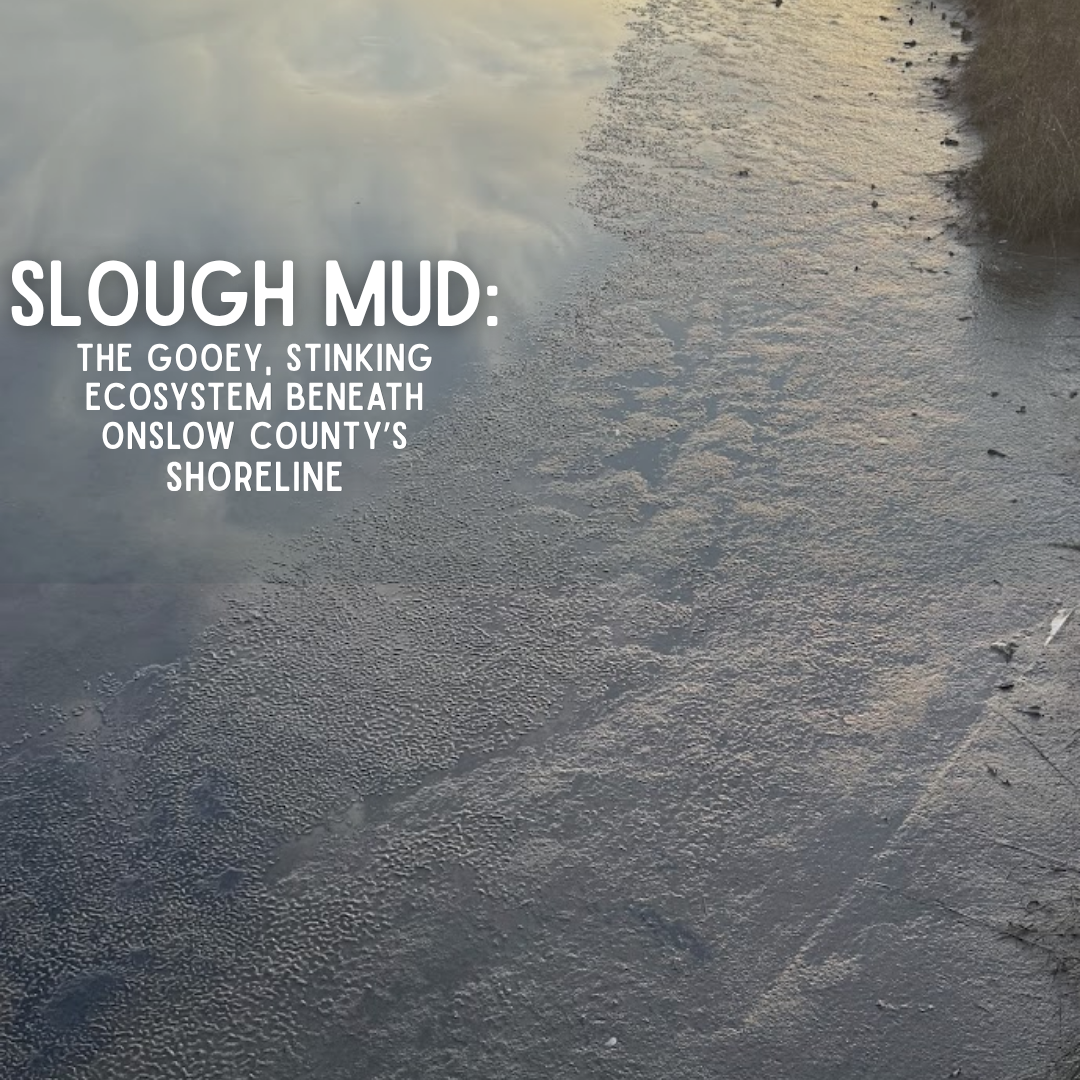
In certain light—especially when the sun is low—there is a faint sheen across the surface, something smoother and more uniform than water alone would create. It can appear firm enough to cross, at least for a step or two.
That thin layer is not just sediment.

Microscopic organisms—diatoms and cyanobacteria—spread across the surface, forming a film that binds particles together. They produce substances that hold grains in place, creating a surface that can briefly support weight before it gives way beneath it (Rimmer et al., 2025).
It is just enough structure to mislead you.
Just enough to suggest that what lies beneath it will behave the same way.
Why It Gives Way: Structure Without Support
Once that surface breaks, the difference becomes immediate.
The particles here are small enough to trap water between them, and once that water is there, it does not drain the way it does through sand. The sediment remains saturated, and when pressure is applied, the water has nowhere to go.
Instead of holding its shape, the ground shifts.
There is a way to describe how well a surface resists that kind of movement—shear strength. Sand has enough of it to support your weight.
This does not (Folk, 1980).

And beneath the surface, the structure is already interrupted. Burrows open and collapse. Small voids form and disappear. Gas collects in pockets that shift when disturbed. What looks continuous from above is already moving below.
So when your foot sinks, it is not breaking through something solid.
It is entering something that was never still to begin with.
Below the Surface: Where the Air Runs Out
The smell arrives as soon as the surface opens.
It rises quickly, sharp and distinct, and then fades again as the mud closes.
Just beneath the surface, oxygen is used up rapidly by microorganisms breaking down the organic material that has accumulated there. Below that thin layer, the sediment becomes anoxic—oxygen is no longer present (Fenchel & Riedl, 1970; Jørgensen & Nelson, 2004).
But the process doesn’t stop.
Bacteria continue to break material down, using sulfate from seawater instead of oxygen. That shift produces hydrogen sulfide gas, which remains trapped until the sediment is disturbed (Kasten & Jørgensen, 2000).
Each step releases it.
The smell is not separate from the system. It is evidence that the breakdown is still happening—just without air.
And because it is happening without oxygen, it happens more slowly.
What Stays Behind
If that same plant material were left exposed to air, it would break down quickly. Most of what it contains would return to the atmosphere as carbon dioxide.
Here, much of it does not.
The organic material that settles into this mud—marsh grass, algae, microscopic debris—is buried into a system where oxygen disappears almost immediately. Without that oxygen, decomposition slows, and a portion of that carbon remains stored in the sediment instead of returning to the air (Chmura et al., 2003).
It does not stop changing.
It is broken down, reworked, and shifted. But it is not fully released.
Layer after layer builds beneath the surface—material that was once living, now held within the mud you step into.
What smells like decay is also storage.
The Surface Is Breathing
Even without oxygen below, the surface is not sealed.
If you stand still long enough, you begin to see small openings, slight movements, places where the mud seems to shift or pulse.
Water moves in and out with the tide. Burrows connect the surface to what lies below. Worms, shrimp, and crabs pull oxygenated water downward as they move through the sediment (Aller, 1982; McCave, 1976).
And the plants at the edge are part of it too.
Marsh grasses do not just sit in the mud. They move oxygen from the air above down into their roots. Some of that oxygen leaks into the surrounding sediment, creating small zones where oxygen briefly exists before it is used up again.
It is uneven. Temporary. Constantly shifting.
At the surface, gases move both ways.
Oxygen enters. Carbon dioxide leaves. Small amounts of other gases—products of what is happening below—escape when the sediment is disturbed or when pressure changes with the tide.
The boundary is thin.
But it is active.
Movement You Don’t See
If you stop looking for stable ground and begin watching the surface itself, other patterns start to emerge.

Small openings appear—round, spaced in ways that suggest something below rather than something left behind. Around them, slight mounds form and disappear as the mud dries and softens again.
These are not marks left on the surface. They are the surface expression of what is moving through it.
Polychaete worms pass through the sediment, ingesting it and depositing what remains behind them (Rhoads, 1974). Burrowing shrimp and amphipods maintain tunnels that allow water—and with it, oxygen—to move deeper into the mud than it otherwise could (Aller, 1982).
Crabs hold the edges.
Fiddler crabs open and close their burrows with the tide. Blue crabs move through when water returns, feeding within the same soft substrate that gives way underfoot. Mud crabs remain within it, emerging only when conditions allow.
Bivalves stay buried beneath it all, filtering water when submerged, holding position when exposed.
Sometimes you don’t see them until you feel them.
A sharp edge beneath your foot where the mud shifted just moments before.
The surface does not tell you everything that is there.
When the Water Returns
Then the water comes back.
It fills the same space that resisted your footing, covering the surface without changing what lies beneath it. The ground that gave way becomes part of a shallow, moving system again.
Fish arrive with the water.
Killifish move into these margins first, tolerating the low oxygen conditions that remain in the sediment. Flounder settle directly onto the bottom, their bodies flattening, their coloration shifting until they disappear against it.
Juvenile blue crabs move through these same areas, using them as nursery habitat—protected, shallow, and full of food (Bilkovic et al., 2020).
They are not just using the space. They are feeding on what the mud is processing.
Detritus, microbes, and organic material move through the system below the surface, supporting what arrives above it.
Other species follow.
Stingrays glide over the surface, feeding on what is buried below. Croaker move through slightly deeper channels. Along exposed flats near The Point at Topsail Beach, shorebirds track the retreating tide—probing, picking, following the movement of water as it exposes and covers the same ground again.

What looked still becomes active.
Not because it changed.
But because the conditions around it did.
What Comes From the Marsh
At the edge where your footing gave way, the connection is already there.
The marsh does not end where the grass stops. It extends outward through what it releases.

The grasses along the shoreline slow the water, trapping sediment and holding the edge in place. During storms, they absorb energy that would otherwise move inland, reducing erosion and limiting how much material is carried away (Barbier, 2012).
But they also export material.
As grasses break down, they move with the tide—out of the marsh, into the creeks, and into these quieter margins where the water slows again.
What settles here is not separate from the marsh.
It is what the marsh becomes once it begins to move—and what it leaves behind when it does.
What Changes, and What Doesn’t
The ground beneath you is not fixed.
Periods of calm allow fine sediments to build, thickening the layer and increasing the amount of organic material held within it. Warmer temperatures increase microbial activity, accelerating what is happening below the surface.
A storm can undo that quickly.
Sediment lifts back into the water, moves elsewhere, and settles in new places. Edges shift. Channels deepen or fill. What held you in place one week may not exist in the same way the next (Pilkey et al., 2014).
Other changes move more slowly.
Development alters how water flows. Marsh edges are reduced or hardened. Invasive plants like Vitex rotundifolia change how sediment is captured and released.
The system continues.
But the way it moves through the landscape can change.
Standing at the Edge of It
Standing at the edge of one of these places, it is easy to focus on the moment your footing failed—the way the ground gave way when it seemed like it shouldn’t.
But nothing about it failed.
What felt unstable is a working layer—one that gathers what the marsh releases, slows its return to the air, supports what can move within it, and disappears beneath the water as the tide returns.
The same ground that held you in place becomes part of something continuous again, connected to marsh, creek, sound, and ocean.
It does not hold because it is not meant to.
It holds because it is already in motion.

References
Able, K., Manderson, J., & Studholme, A. (1999). Habitat quality for shallow water fishes in an urban estuary:the effects of man-made structures on growth. Marine Ecology Progress Series, 187, 227-235. https://doi.org/10.3354/meps187227
Aller, R. C. (1982). The effects of Macrobenthos on chemical properties of marine sediment and overlying water. Topics in Geobiology, 53-102. https://doi.org/10.1007/978-1-4757-1317-6_2
Barbier, E. B. (2012). Progress and challenges in valuing coastal and marine ecosystem services. Review of Environmental Economics and Policy, 6(1), 1-19. https://doi.org/10.1093/reep/rer017
Bilkovic, D., Isdell, R., Stanhope, D., Angstadt, K., Havens, K., & Chambers, R. (2021). Nursery habitat use by juvenile blue crabs in created and natural marshes. Ecological Engineering, 170(106333). https://doi.org/10.1016/j.ecoleng.2021.106333
Chmura, G. L., Anisfeld, S. C., Cahoon, D. R., & Lynch, J. C. (2003). Global carbon sequestration in tidal, saline wetland soils. Global Biogeochemical Cycles, 17(4). https://doi.org/10.1029/2002gb001917
Fenchel, T. M., & Riedl, R. J. (1970). The sulfide system: A new biotic community underneath the oxidized layer of marine sand bottoms. Marine Biology, 7(3), 255-268. https://doi.org/10.1007/bf00367496
Folk, R. L. (1980). Petrology of sedimentary rocks (2nd ed.). Hemphill Publishing Company.
Jørgensen, B. B., & Nelson, D. C. (2004). Sulfide oxidation in marine sediments: Geochemistry meets microbiology. Sulfur Biogeochemistry – Past and Present. https://doi.org/10.1130/0-8137-2379-5.63
Kasten, S., & Jørgensen, B. B. (2000). Sulfate Reduction in Marine Sediments. In Marine Geochemistry (pp. 263-264). Springer, Berlin, Heidelberg.
https://doi.org/10.1007/978-3-662-04242-7_8
McCave, I. N. (1976). Organism-Sediment Relationships. In The Benthic Boundary Layer (pp. 273-295). Plenum Press.
Odum, E. P. (1980). The status of three ecosystem-level hypotheses regarding salt marsh estuaries: Tidal subsidy, outwelling, and detritus-based food chains. Estuarine Perspectives, 485-495. https://doi.org/10.1016/b978-0-12-404060-1.50045-9
Pilkey, O. H., Rice, T. M., & Neal, W. J. (2014). How to read a North Carolina beach: Bubble holes, Barking sands, and rippled Runnels. UNC Press Books.
Riggs, S. R., Ames, D. V., & Dawkins, K. R. (2008). Coastal processes and conflicts: North Carolina’s Outer Banks: A curriculum for middle and high school students (NCU-E-08-002). NOAA Oceanic and Atmospheric Research; Sea Grant. https://repository.library.noaa.gov/view/noaa/46454/noaa_46454_DS1.pdf
Rimmer, J., Blight, A., Chocholek, M., & Paterson, D. (2025). Response of natural estuarine Microphytobenthic Biofilms to multiple anthropogenic stressors. Environmental Pollution, 387(127285). https://doi.org/10.1016/j.envpol.2025.127285