
More Than Meets the Eye
Spend enough time walking along a salt marsh and you’ll eventually stop noticing the marsh rabbits.
Not because they’ve disappeared.
Because they’ve become part of the landscape.
They feed quietly along the marsh edge, slipping into the grasses when startled before appearing again somewhere you didn’t expect. Some evenings you may count half a dozen. Other days you wonder if there were ever any there at all.
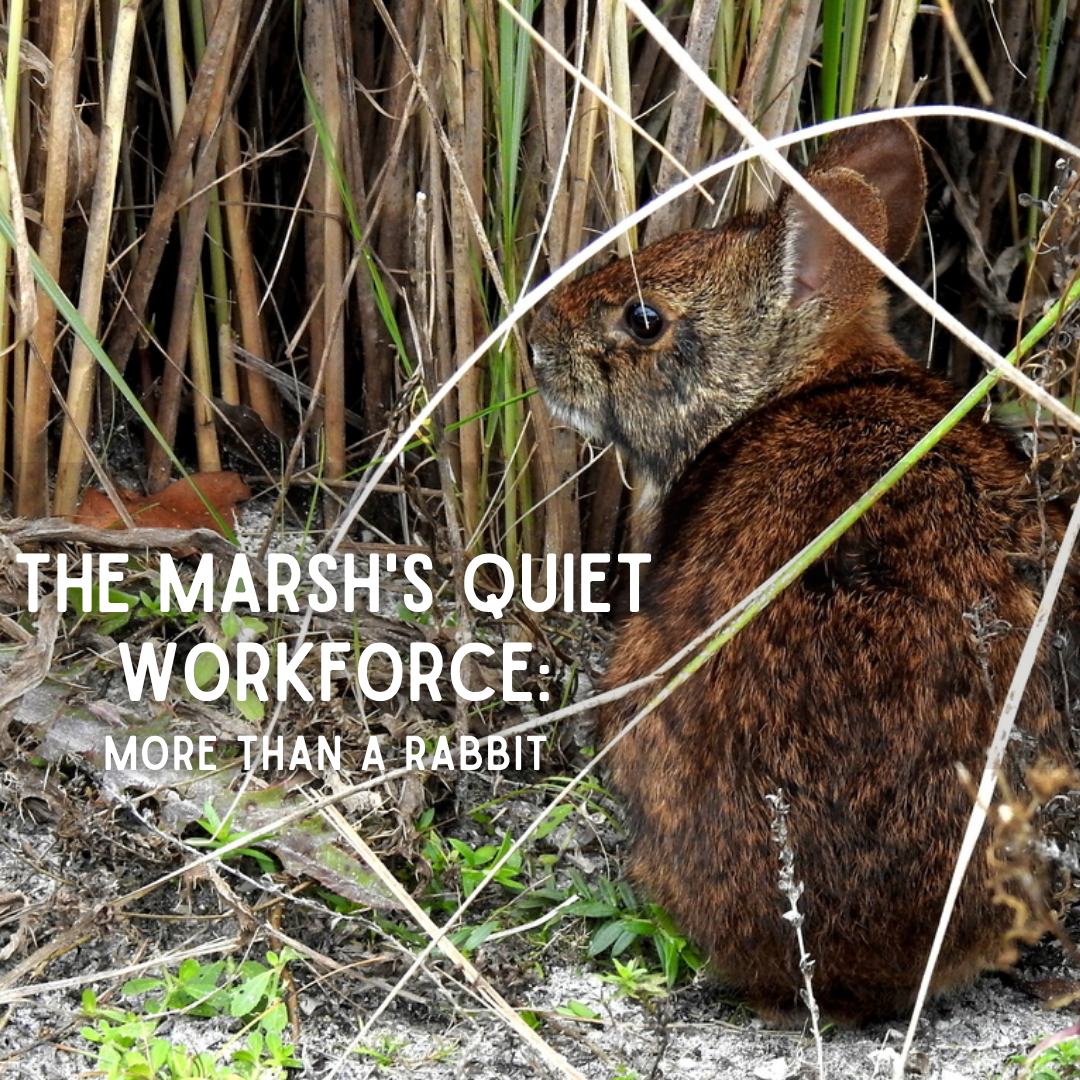
Unlike the brighter cottontails many people are used to seeing, marsh rabbits are darker, with coarse brown to reddish-brown fur, a grayish underside, and a rusty cinnamon patch along the back of the neck. Even the tail gives them away. Instead of flashing bright white, it appears darker and more bluish, one reason marsh rabbits have sometimes been called “bluetails” (Chapman & Trani, 2007; Chapman & Willner, 1981).
Like so much of the marsh, they’re easy to overlook.

For more than a century, naturalists have described marsh rabbits (Sylvilagus palustris) by documenting where they lived, what they looked like, and what they ate (Rhoads & Young, 1897). Those observations gave us our first understanding of the species. Today, ecology invites us to ask a different question.
What happens because marsh rabbits are here?
The answer reaches far beyond the rabbit itself.
We often measure an animal’s importance by how exciting it is to watch.
The marsh doesn’t.
The marsh measures importance by how many lives are connected to one another (Soulé et al., 2003).
Following One Rabbit
If you’ve ever taken a science class, you’ve probably learned the First Law of Conservation of Energy: energy cannot be created or destroyed. It only changes form.
For many of us, that idea remained in a textbook or written across a classroom whiteboard. It became something to memorize rather than something we expected to witness.
Yet every walk beside a salt marsh quietly brings that principle to life.
Standing beside a marsh, it’s easy to underestimate what you’re seeing. From a distance, much of it appears to be little more than grass. Yet every growing season those grasses capture enormous amounts of energy from the sun, making salt marshes among the most productive ecosystems on Earth (Frizzell, 1988).
That productivity, however, cannot remain in the plants.
It has to move.
Imagine following a single marsh rabbit through its life.

At only about 2.5 to 3.5 pounds, its small body holds energy gathered first by the marsh plants around it (Chapman & Trani, 2007; Chapman & Willner, 1981).The grasses it consumes become muscle, bone, blood, fur, and new life. That rabbit may one day feed a hawk, an owl, a fox, a bobcat, or a snake. Throughout its life it supports parasites. After its death it feeds scavengers, fungi, bacteria, and countless decomposers before eventually returning nutrients to the marsh where another season of growth begins.
Nothing has appeared from nowhere.
Nothing has truly disappeared.
The energy has simply changed form.
Every day, marsh rabbits transform marsh vegetation into something that can support an entirely different community of organisms (Chapman & Trani, 2007; Chapman & Willner, 1981).
The rabbit isn’t the end of the story.
In many ways, it’s where the story begins.
More Than a Meal
Spend a few minutes watching a marsh rabbit and it may not seem particularly busy.
It grazes along the marsh edge, pauses to listen, slips into dense cover, then returns to feeding when the danger seems to have passed. At first glance, it looks like a small animal moving through its day.
But even before a marsh rabbit becomes food for something else, it is already shaping the marsh around it.
Every bite influences which plants are grazed and which continue growing (Conner & Cherry, 2017). As it moves between the marsh edge, nearby cover, and slightly higher ground, the rabbit is also moving through the boundary between habitats most of us see as separate. The same dense vegetation that protects the rabbit also provides shelter for insects, reptiles, amphibians, birds, and countless other small lives moving through the marsh (Canepuccia et al., 2023; Larsen & Gray et al., 2021; Wigley & Lancia, 1998).

This is why the rabbit matters before the hawk ever appears.
Its value is not limited to becoming prey. Its ordinary life helps move energy, shape vegetation, and connect habitats long before that energy travels farther up the food web (Chapman & Trani, 2007; Chapman & Willner, 1981; Conner & Cherry, 2017).
Perhaps that is the quiet work of a marsh rabbit.
Not simply feeding something else.
But helping hold together the conditions that allow so much else to live there.
Why There Are So Many
Sometimes marsh rabbits seem to be everywhere — in yards, along road edges, near parking lots, and wherever the Spartina meets slightly higher ground.

The easy explanation is that rabbits reproduce quickly. They can produce several litters in a year, often three to seven, with roughly 15 to 20 young produced annually under favorable conditions (Holler & Conaway, 1979).
That is true, but it is not the whole story.
Nature rarely invests heavily in something that does not matter. In a marsh, abundance is not waste. It is part of the system.
Marsh rabbits live under constant pressure. Every choice — where to feed, when to move, when to freeze, and when to disappear into the grasses — is shaped by predators, tides, weather, and the daily balance between finding food and becoming food (Hill et al., 2019; Holler & Conaway, 1979).
Predators influence far more than the animals they catch. Their presence can change where prey feed, how long they remain exposed, and how energy moves through the landscape (Suraci et al., 2019). When predator communities shift, those changes can ripple through the food web in ways that affect many other species (Bransford et al., 2024; Jiménez et al., 2019) .
Seen this way, abundant marsh rabbits are not simply evidence of successful reproduction.
They are evidence of how much work this one ordinary species performs.
The Rabbit You Didn’t See
Perhaps this also explains something you’ve probably noticed yourself.
One moment several marsh rabbits are feeding along the marsh edge.
You look away for only a moment.
When you look back, they’re gone.
They haven’t left the marsh.
Unlike many rabbits people are used to seeing, marsh rabbits are strong swimmers. Water is not simply something they avoid; it is part of the landscape they know how to use. In a place shaped by tides, wet ground, and narrow edges of cover, the ability to move through water helps explain how they can vanish so completely without ever leaving the marsh (Chapman & Trani, 2007; Chapman & Willner, 1981).
The same dense vegetation that feeds them also protects them. Slight changes in elevation, the rhythm of the tides, the angle of the evening sun, and generations of natural selection have shaped an animal that survives by knowing exactly when to be seen — and when not to be (Chapman & Willner, 1981; Holler & Conaway, 1979).
The rabbit disappeared from sight.
Its place in the marsh never did.
Looking at the Marsh Differently
The next time you notice a marsh rabbit quietly feeding along the marsh edge, pause before it disappears.
What once looked like an ordinary rabbit is now something entirely different.
Not because the rabbit has changed.
But because you can now see the countless connections passing through it (Soulé et al., 2003).
And once you see those connections, the marsh becomes harder to overlook.

References
Bransford, T. D., Harris, S. A., & Forys, E. A. (2024). Seasonal variation in mammalian Mesopredator spatiotemporal overlap on a barrier island complex. Animals, 14(16), 2431. https://doi.org/10.3390/ani14162431
Canepuccia, A. D., Fanjul, M. S., & Iribarne, O. O. (2023). Global distribution and richness of terrestrial mammals in tidal marshes. Diversity and Distributions, 29(5), 598-612. https://doi.org/10.1111/ddi.13683
Chapman, B. R., & Trani, M. K. (2007). Marsh Rabbit (Sylvilagus palustris). In The Land Manager’s Guide to Mammals of the South (pp. 247-251). Durham, NC: The Nature Conservancy; Atlanta, GA: U.S. Forest Service.
Chapman, J. A., & Willner, G. R. (1981). Sylvilagus palustris. Mammalian Species, (153), 1. https://doi.org/10.2307/3503947
Conner, L. M., & Cherry, M. J. (2017). Considering Herbivory and Predation in Forest Management. In Ecological Restoration and Management of Longleaf Pine Forests (1st ed., p. 12). CRC Press.
Frizzell, E. K. (1988). Mammals and Wetlands. In The Ecology and Management of Wetlands: Volume 1: Ecology of Wetlands (1st ed., pp. 213-226). Croom Helm Ltd.; Timber Press.
Hill, J. E., DeVault, T. L., & Belant, J. L. (2019). Cause‐specific mortality of the world’s terrestrial vertebrates. Global Ecology and Biogeography, 28(5), 680-689. https://doi.org/10.1111/geb.12881
Holler, N. R., & Conaway, C. H. (1979). Reproduction of the marsh rabbit (Sylvilagus palustris) in South Florida. Journal of Mammalogy, 60(4), 769-777. https://doi.org/10.2307/1380192
Jiménez, J., Nuñez-Arjona, J. C., Mougeot, F., Ferreras, P., González, L. M., García-Domínguez, F., Muñoz-Igualada, J., Palacios, M. J., Pla, S., Rueda, C., Villaespesa, F., Nájera, F., Palomares, F., & López-Bao, J. V. (2019). Restoring APEX predators can reduce mesopredator abundances. Biological Conservation, 238, 108234. https://doi.org/10.1016/j.biocon.2019.108234
Larsen-Gray, A. L., Loeb, S. C., & Kalcounis-Rueppell, M. C. (2021). Rodent population and community responses to experimental, large scale, long-term coarse Woody debris manipulations. Forest Ecology and Management, 496, 119427. https://doi.org/10.1016/j.foreco.2021.119427
Macarthur, R., & Levins, R. (1967). The limiting similarity, convergence, and divergence of coexisting species. The American Naturalist, 101(921), 377-385. https://doi.org/10.1086/282505
Rhoads, S. N., & Young, R. T. (1897). Notes on a Collection of Small Mammals from Northeastern North Carolina. Proceedings of the Academy of Natural Sciences of Philadelphia, 49, 303-312. https://www.jstor.org/stable/4062279?seq=1
Soulé, M. E., Estes, J. A., Berger, J., & Del Rio, C. M. (2003). Ecological effectiveness: Conservation goals for interactive species. Conservation Biology, 17(5), 1238-1250. https://doi.org/10.1046/j.1523-1739.2003.01599.x
Suraci, J. P., Clinchy, M., Zanette, L. Y., & Wilmers, C. C. (2019). Fear of humans as APEX predators has landscape‐scale impacts from mountain lions to mice. Ecology Letters, 22(10), 1578-1586. https://doi.org/10.1111/ele.13344
Wigley, T. B., & Lancia, R. A. (1998). Wildlife Communities. In Southern Forested Wetlands (1st ed., p. 32). Routledge.