Tag: North Carolina salt marsh

  • Winter at the Exposed Marsh

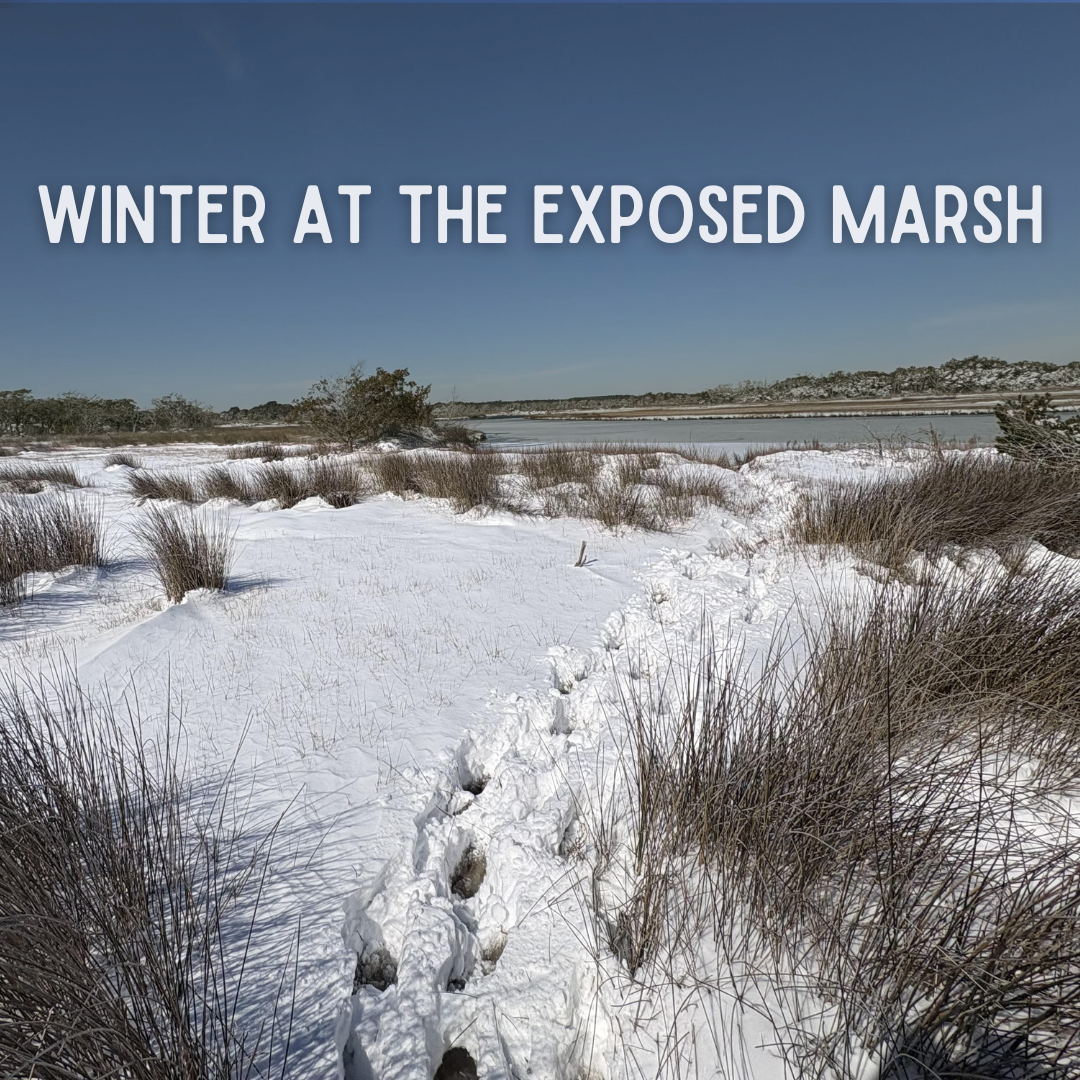
    Winter at the Exposed Marsh

    The surface that appears

    At low tide in winter the creek mouths behind Topsail Island widen into ground that is usually concealed, and the exposed marsh does not appear emptied so much as translated into another state where water has thinned into channels narrow enough to reveal the structure it normally masks. The flats emerge as a textured plane stitched by the remains of Spartina alterniflora, each stem cluster surrounded by a faint collar of darker mud where drainage lags by seconds, and the surface separates into alternating bands that hold or soften depending on how recently porewater escaped. This firmness reflects sediment consolidation, the gradual compression of mud as water drains between tides, tightening elevated shelves first and leaving adjacent troughs saturated, so the exposed ground becomes a map of load-bearing ridges that anticipates where larger animals will move once the marsh opens (Christiansen et al., 2000; Morris et al., 2002).

    Close to the surface, winter resolves into finer evidence that the marsh is neither dormant nor still. Fiddler crab chimneys crumble into damp grains that expose darker sediment beneath a thin crust, while hoofprints from the previous tide hold shallow mirrors rimmed with frost where a faint olive sheen gathers as diatoms trap warmth and moisture (Underwood & Kromkamp, 1999). Beside the prints, spirals of fine sediment rise like coiled handwriting, polychaete casts lifted from below and dried into granular ridges that record upward movement from buried layers. Every centimeter of mud registers exchange between subsurface metabolism and cold air, and the exposed flats behave less like the absence of water than a temporary reorganization of it, one that prepares a surface already structured for the next set of crossings.

    Clusters of crab burrow openings mark the marsh surface, each hole a vertical conduit linking oxygen, water, and nutrients to the sediment below. | Photo credit: M. Mitchell, 2026
    Clusters of crab burrow openings mark the marsh surface, each hole a vertical conduit linking oxygen, water, and nutrients to the sediment below. | Photo credit: M. Mitchell, 2026

    Where winter concentrates energy

    The winter low tide exposes more than terrain, because the withdrawal of water aligns accessibility with abundance in a way that concentrates food at the surface for a brief interval. Spartina rhizomes lie just beneath the crust, their pale ends visible where deer have bitten through the mud, and detached stems gather in wrack lines where microbial films soften fibrous blades into digestible pulp. Small bivalves remain gaping in shallow pools where temperature lingers above the surrounding flats, and worm casts cluster where organic matter has settled densely enough to support continuous feeding below. This alignment functions as a resource pulse, a moment when energy stored in buried plant tissue and invertebrate biomass becomes reachable simultaneously.

    Winter at the exposed marsh coastal salt marsh
    Wrack concentrated by winter tides stores organic energy in dense bands, drawing shorebirds to feed where nutrients accumulate along the marsh edge. | Photo credit: American Birding Association

    Deer enter the marsh along consolidated ridges that hold their weight, yet the crossings do not run straight through these zones of exposure but instead loop and return around feeding sites where sediment has been churned darker than its surroundings. The mud at these points holds fragments of torn rhizomes pressed into its surface and shredded plant fibers mixed into the crust, while overlapping tracks form shallow basins that later fill with water and preserve the geometry of the feeding circuit. Raccoon prints braid across the same lines, Canada goose droppings mark cropped stems, and dunlin and greater yellowlegs settle repeatedly where the surface softens under pressure, their bills puncturing the crust in arcs that echo the paths carved by hooves. Exposure redistributes energy upward, and movement gathers along the same ridges that consolidation established, tying feeding to structure without separating the two processes.

    The skin that reforms
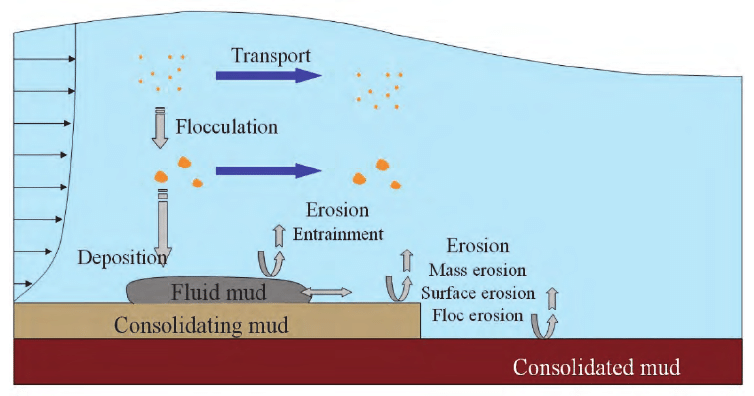
    Cross-section of marsh sediment showing deposition, erosion, and consolidation, the shifting layers that form and reform the exposed winter surface. | Graphic credit: G. S. Sylvain, 2011
    Cross-section of marsh sediment showing deposition, erosion, and consolidation, the shifting layers that form and reform the exposed winter surface. | Graphic credit: G. S. Sylvain, 2011

    Between exposures, slack water leaves a thin veneer that dries into a continuous surface film through sediment sealing, a layer fine enough to slow the exchange of gases between air and mud (Christiansen et al., 2000). When intact, the flats dull into a flexible sheet that bends faintly under weight, and breaking it releases a muted sulfur odor that signals redox cycling, the shift between oxygenated and oxygen-poor states driven by microbial respiration in buried sediment (Howarth & Teal, 1979; Mendelssohn et al., 1981). Color reveals the chemistry more reliably than smell. Black veins branch through exposed mud where iron binds sulfide, while pale halos surround Spartina roots where oxygen leaks downward along living tissues.

    Each footprint becomes an aperture in this membrane, allowing oxygen to enter and reduced compounds to rise, so the breach brightens temporarily before darkening again as metabolism rebalances. Feeding animals convert chemical gradients into visible patterns, and the flats accumulate a shifting mosaic of sealed and reopened zones that migrate with every tide, ensuring that the next exposure inherits the chemical memory of the previous one.

    Tracks fracture the sealed winter crust, revealing darker sediment where oxygen re-enters and the surface begins to reform. | Photo Credit: M. Gold, 2023
    Tracks fracture the sealed winter crust, revealing darker sediment where oxygen re-enters and the surface begins to reform. | Photo Credit: M. Gold, 2023

    The ground below the ground

    Beneath the crust, the sediment continues to reorganize through bioturbation, the mixing of mud by infaunal animals whose activity does not cease with falling temperature. Polychaete worms thread galleries through the upper layers, lifting sediment to the surface in tight spirals while their burrows act as ventilation shafts through burrow ventilation, drawing oxygen downward and leaking reduced porewater upward (Kristensen, 2000; Aller, 1982). Small bivalves pump water through siphons that leave paired pinholes scattered across the flats, and amphipods graze biofilms coating the worm casts, linking subsurface feeding to surface texture.

    Each round of burrowing lifts buried debris and nutrients toward the surface, making crab tunnels pathways that continually rebuild the marsh from below. | Graphic credit: Wang et al., 2010
    Each round of burrowing lifts buried debris and nutrients toward the surface, making crab tunnels pathways that continually rebuild the marsh from below. | Graphic credit: Wang et al., 2010

    Where deer cross and feed, hooves collapse some tunnels while sealing others, producing prints that darken unevenly because subsurface architecture differs from step to step. The feeding circuits therefore overlay hidden engineering that maintains permeability and redistributes nutrients, ensuring that exposure, grazing, and burrowing operate as one continuous process rather than as isolated events separated by layers of mud.

    Smell in shallow water

    Disturbed sediment releases dissolved compounds that spread through shallow pools as porewater plumes, chemical gradients that extend beyond the visible cloud of suspended mud. Killifish and juvenile mullet navigate these gradients through chemoreception, keeping their snouts close to the surface while pivoting toward intensifying scent (Kneib, 1997; Kristensen, 2000). Their feeding loosens additional sediment and amplifies the plume before particles settle again, creating a moving field of chemical information that overlaps with the physical contours of the flats.

    What appears from above as a brief swirl becomes a signal that attracts birds, and dunlin and yellowlegs converge on fresh pits where worms remain exposed. Each crater fills with water and darkens as sulfide seeps upward, and feeding layers stack in sequence so that invertebrate disturbance leads to fish excavation, which leads to avian probing, all anchored to the same exposure that first drew deer into the marsh. Leaning close reveals faint popping as methane and carbon dioxide escape through gas ebullition, ticking upward from saturated sediment while animals feed across the surface. The marsh ventilates audibly, and the sound marks exchange continuing beneath apparent stillness.

    As the tide withdraws, exposed mud concentrates scent and invertebrates near the surface, guiding shorebirds to feeding zones written into the sediment. | Photo credit: Ron Watts
    As the tide withdraws, exposed mud concentrates scent and invertebrates near the surface, guiding shorebirds to feeding zones written into the sediment. | Photo credit: Ron Watts

    Memory in the surface

    Winter tides and storms deposit sediment that raises the marsh through vertical accretion, stacking particles in increments small enough to disappear into the surface unless read over time (Morris et al., 2002). Hurricane overwash leaves thin sand sheets that redirect drainage for months, oyster clusters trap suspended grains in their lee (Newell et al., 2005), and worm burrows stabilize some deposits while loosening others (Kirwan & Megonigal, 2013). Feeding compresses ridges and excavation softens troughs, embedding each disturbance into the next layer so that the flats carry a structural memory of their own use.

    Returning after weeks reveals crossings shifted, wrack lines buried, and worm casts clustered in new zones, evidence that the marsh does not reset between exposures but accumulates the imprint of repeated winter engineering.

    Winters that change

    Warmer temperatures extend microbial activity through temperature-driven metabolic acceleration, thinning the interval between sealing and decay and allowing chemical gradients to persist longer at the surface (Bridgham et al., 2006). Rising water levels narrow exposure windows, stronger storms redistribute sediment in thicker pulses, and shifting coastal currents alter nutrient delivery and larval supply, influencing which species occupy the winter flats (Kirwan & Megonigal, 2013). The marsh continues to open, yet the rhythm of exposure recalibrates, and feeding circuits migrate toward higher shelves where consolidation still holds.

    Chemical plumes stretch farther in warmer water, grazing concentrates into narrower bands, and the same negotiations between structure and feeding repeat under altered timing, ensuring that winter engineering continues without preserving its previous schedule.

    Seasonal temperature outlook showing shifting winter probabilities across the southeastern United States, a regional signal that filters down to marsh-level processes. | NOAA - National Weather Service, 2026
    Seasonal temperature outlook showing shifting winter probabilities across the southeastern United States, a regional signal that filters down to marsh-level processes. | NOAA – National Weather Service, 2026

    The surface in motion

    The creek mouth appears quiet until attention lowers to the scale of sediment. Frost melts along print rims before surrounding crust warms, gas ticks upward through worm tubes, fish pits refill, and diatoms bloom where warmth collects. Each tide writes another layer into a system held in dynamic equilibrium, continuous adjustment that maintains form while never remaining fixed (Morris et al., 2002). Exposure leads to feeding, feeding reshapes structure, and structure governs the next exposure as the marsh opens again.

    The same ridges that hold a deer’s weight will soften again when the tide returns, and the feeding circuits traced across them will dissolve into channels that redistribute the next layer of sediment. Worm burrows will reopen where hooves sealed them, chemical plumes will reassemble in newly flooded pools, and the surface will carry forward the imprint of this exposure into the next one. Winter does not suspend the marsh. It recalculates it at a slower tempo, redistributing energy across the same structures that will support spring growth and summer density, so that even in the coldest intervals the creek mouth continues its quiet accounting of exchange, preparing another surface that will open and be read again.

    Deer cross the marsh to reach winter feeding exposed by the tide, moving along corridors that appear only when the surface opens. | Photo credit: L. W. Hamilton, 2025
    Deer cross the marsh to reach winter feeding exposed by the tide, moving along corridors that appear only when the surface opens. | Photo credit: L. W. Hamilton, 2025

    References

    Aller, R. C. (1982). The effects of Macrobenthos on chemical properties of marine sediment and overlying water. Topics in Geobiology, 53-102. https://doi.org/10.1007/978-1-4757-1317-6_2

    Bridgham, S. D., Megonigal, J. P., Keller, J. K., Bliss, N. B., & Trettin, C. (2006). The carbon balance of North American wetlands. Wetlands, 26(4), 889-916. https://doi.org/10.1672/0277-5212(2006)26[889:tcbona]2.0.co;2

    Christiansen, T., Wiberg, P., & Milligan, T. (2000). Flow and sediment transport on a tidal salt marsh surface. Estuarine, Coastal and Shelf Science, 50(3), 315-331. https://doi.org/10.1006/ecss.2000.0548

    Howarth, R. W., & Teal, J. M. (1979). Sulfate reduction in a New England salt marsh1. Limnology and Oceanography, 24(6), 999-1013. https://doi.org/10.4319/lo.1979.24.6.0999

    Kirwan, M. L., & Megonigal, J. P. (2013). Tidal wetland stability in the face of human impacts and sea-level rise. Nature, 504(7478), 53-60. https://doi.org/10.1038/nature12856

    Kneib, R. T. (1997). The role of tidal marshes in the ecology of estuarine nekton. Oceanography And Marine Biology, 35(35), 159-216. https://doi.org/10.1201/b12590-5

    Kristensen, E. (2000). Organic matter diagenesis at the oxic/anoxic interface in coastal marine sediments, with emphasis on the role of burrowing animals. Hydrobiologia, 426(1), 1-24. https://doi.org/10.1023/a:1003980226194

    Mendelssohn, I. A., McKee, K. L., & Patrick, W. H. (1981). Oxygen deficiency in Spartina alterniflora roots: Metabolic adaptation to anoxia. Science, 214(4519), 439-441. https://doi.org/10.1126/science.214.4519.439

    Morris, J. T., Sundareshwar, P. V., Nietch, C. T., Kjerfve, B., & Cahoon, D. R. (2002). Responses of coastal wetlands to rising sea level. Ecology, 83(10), 2869. https://doi.org/10.2307/3072022

    Newell, R. I., Fisher, T. R., Holyoke, R. R., & Cornwell, J. C. (2005). Influence of eastern oysters on nitrogen and phosphorus regeneration in Chesapeake Bay, USA. NATO Science Series IV: Earth and Environmental Series, 282, 93-120. https://doi.org/10.1007/1-4020-3030-4_6

    Underwood, G., & Kromkamp, J. (1999). Primary production by phytoplankton and Microphytobenthos in estuaries. Advances in Ecological Research, 29, 93-153. https://doi.org/10.1016/s0065-2504(08)60192-0
  • The Hidden City in the Grass

    The Hidden City in the Grass

    How seagrasses and marsh grasses—and the animals within them—build the marshes of Onslow County

    In Onslow County’s estuarine marshes, the best time to understand how the landscape works is when the water pulls back. As tides drain from creeks and shallow flats, patterns begin to emerge—where water lingers, where it moves easily, and where it hesitates. These patterns are not random. They reflect the combined influence of plants, animals, and sediments continually reshaping the boundary between land and sea.

    Like the microscopic shells of foraminifera preserved in sediment, marsh and seagrass communities record environmental conditions. But unlike the past locked in mud, these systems are alive, constantly negotiated by plants, grazers, predators, and microbes.

    From permanently submerged seagrass beds to the highest marsh edge, each elevation zone in Onslow County is maintained not just by vegetation, but by species that actively regulate growth, chemistry, and water flow.

    Subtidal shallows: seagrass beds maintained by grazers

    In the shallow, light-penetrated waters of the New River Estuary and protected soundside areas, seagrass beds form underwater meadows that stabilize sediments and provide nursery habitat for fish and invertebrates. Species present or expected in Onslow County waters include eelgrass (Zostera marina), shoalgrass (Halodule wrightii), and widgeongrass (Ruppia maritima) (Mallin, 2000; Orth, 1984).

    Seagrass blades rapidly accumulate epiphytic algae and microbial films. Without constant grazing, this layer can block light and suppress photosynthesis. Amphipods, isopods, and small gastropods act as continuous maintenance crews, grazing epiphytes and preventing them from overwhelming the plants themselves (Orth & van Montfrans, 1984; Valentine & Duffy, 2006).

    Experimental studies show that when these grazers are removed, seagrass condition declines even under favorable light conditions, demonstrating that plant survival depends as much on animal activity as on physical environment (Duffy et al., 2015). Beneath the canopy, burrowing worms and bivalves recycle nutrients and oxygenate sediments, preventing organic matter from accumulating around roots (Orth, 1984).

    In this zone, seagrass persists because grazers keep blades clean and sediments breathable—a cooperative system built on constant biological upkeep.

    Gammarus mucronatus, a common amphipod grazer on eelgrass | Photo credit: E. A. Lazo-Wasem, Yale Peabody Museum, 2013
    Gammarus mucronatus, a common amphipod grazer on eelgrass | Photo credit: E. A. Lazo-Wasem, Yale Peabody Museum, 2013.

    The low marsh edge: cordgrass shaped by snails and crabs

    At the daily-flooded edge of the marsh, smooth cordgrass (Spartina alterniflora) dominates. This narrow fringe marks the boundary between open water and marsh interior, where erosion pressure is highest and stability matters most.

    Smooth cordgrass (Spartina alterniflora) line the estuary edge in Surf City, NC. | Photo credit: A. Mitchell, 2022.Salt marsh die-off from grazing stress by marsh periwinkle snails and reduced predation by crabs, such as blue crabs, can create bare mudflats. | Photo credit: By Esuglia at English Wikipedia, CC BY-SA 3.0, https://commons.wikimedia.org/w/index.php?curid=65794096
    Left: Healthy smooth cordgrass (Spartina alterniflora) line the estuary edge in Surf City, NC. | Photo credit: A. Mitchell, 2022. Right: Salt marsh die-off from grazing stress by marsh periwinkle snails and reduced predation by crabs, such as blue crabs, can create bare mudflats. | Photo credit: By Esuglia at English Wikipedia, CC BY-SA 3.0, https://commons.wikimedia.org/w/index.php?curid=65794096

    Cordgrass growth here is tightly regulated by the marsh periwinkle snail (Littoraria irrorata). These snails climb grass stems to avoid inundation and graze directly on living tissue, often intensifying damage by facilitating fungal infection. At high densities, periwinkle grazing can dramatically reduce cordgrass height and biomass, effectively mowing the marsh edge (Silliman & Zieman, 2001).

    Marsh periwinkle snails (Littoraria irrorata) are a common sight on cordgrass (Spartina alterniflora) in North Carolina - part of the Hidden city in the grass | Photo credit: North Carolina Aquarium at Roanoke Island, 2018
    Marsh periwinkle snails (Littoraria irrorata) are a common sight on cordgrass (Spartina alterniflora) in North Carolina | Photo credit: North Carolina Aquarium at Roanoke Island, 2018.

    Unchecked grazing can destabilize the marsh platform—but periwinkles themselves are regulated by crabs, including blue crabs (Callinectes sapidus), fiddler crabs (Genus Uca), purple marsh crabs (Sesarma reticulatum), hermit crabs and other burrowing species. Crabs prey on snails, limiting grazing pressure and indirectly protecting cordgrass (Silliman et al., 2005).

    Crabs also function as ecosystem engineers. Their burrows aerate sediments, relieve sulfide stress around plant roots, and improve tidal water movement through compacted soils (Bertness, 1985; Thomas & Blum, 2010). Where crabs are abundant, cordgrass grows taller and denser; where they are lost, marsh die-off can occur rapidly.

    This zone persists through a trophic cascade: grass builds land, snails limit grass, and crabs keep the system in balance.

    Mid-marsh: mussels and detritus processors reinforce the platform

    Just upslope, where flooding becomes less frequent, plant communities shift toward mixtures that often include saltmeadow cordgrass (Spartina patens). Here, the ribbed mussel (Geukensia demissa) emerges as a key stabilizing force.

    Saltmeadow cordgrass (Spartina patens) is an important marsh stabilizer that has higher productivity when it grows near ribbed mussel aggregations | Photo credit: Kristie Gianopulos
    Saltmeadow cordgrass (Spartina patens) is an important marsh stabilizer that has higher productivity when it grows near ribbed mussel aggregations | Photo credit: Kristie Gianopulos

    Ribbed mussels form dense clusters at the base of marsh vegetation, binding sediments with byssal threads and physically reinforcing marsh soils against erosion (Bertness, 1984). As filter-feeders, they concentrate nutrients by removing organic matter from tidal waters and depositing nitrogen-rich biodeposits directly into marsh sediments (Jordan & Valiela, 1982).

    Ribbed mussels (Geukensia demissa) at the base of marsh vegetation | Photo credit: R. Bachand
    Ribbed mussels (Geukensia demissa) at the base of marsh vegetation | Photo credit: R. Bachand

    Grasses growing near mussel aggregations exhibit higher productivity than those without mussels, demonstrating a strong facilitative relationship between animals and plants (Bertness, 1984). As vegetation senesces, detritivorous worms, insects, and microbial decomposers break down dead plant material, converting standing biomass into detritus that fuels food webs throughout the estuary (Mann, 1988).

    The mid-marsh functions as a processing zone, reinforcing marsh structure while converting plant matter into usable energy.

    High marsh: microbes that manage chemical stress

    In the high marsh, dominated by black needlerush (Juncus roemerianus) and saltmeadow cordgrass (Spartina patens), flooding is limited to spring tides and storms. Prolonged exposure to air creates harsh soil conditions, including elevated salinity and sulfide accumulation.

    Black needlerush grass (Juncus roemerianus) dominates the high marsh | Photo credit: ©Andy Newman
    Black needlerush grass (Juncus roemerianus) dominates the high marsh | Photo credit: ©Andy Newman

    Here, microbial communities play a central role. Sulfate-reducing and sulfur-oxidizing bacteria regulate sulfide concentrations that would otherwise become toxic to plant roots, while microbial decomposition controls nutrient availability under fluctuating oxygen conditions (Howarth & Giblin, 1983).

    Beneath the marsh surface, soil microbes regulate decomposition, carbon exchange, and chemical stress. Changes in salinity and flooding reshape microbial communities, influencing how marsh soils process organic matter and support vegetation across tidal elevations. | Image credit: Zhang et al., 2023
    Beneath the marsh surface, soil microbes regulate decomposition, carbon exchange, and chemical stress. Changes in salinity and flooding reshape microbial communities, influencing how marsh soils process organic matter and support vegetation across tidal elevations. | Image credit: Zhang et al., 2023.

    Small soil invertebrates maintain pore spaces that allow brief pulses of oxygenated water to penetrate during flooding. Unlike the visibly engineered low marsh, the high marsh is stabilized largely through biogeochemical regulation rather than grazing or predation.

    This zone endures because microbes quietly buffer plants against chemical extremes.

    From microbes in the soil to grasses at the surface, biological interactions drive marsh formation. Microbial processes govern decomposition and organic matter buildup, helping determine whether marsh platforms gain elevation, remain stable, or collapse | Image credit: Abbot, Quirk & Fultz, 2022.
    From microbes in the soil to grasses at the surface, biological interactions drive marsh formation. Microbial processes govern decomposition and organic matter buildup, helping determine whether marsh platforms gain elevation, remain stable, or collapse | Image credit: Abbot, Quirk & Fultz, 2022.

    The marsh–upland transition: keeping the boundary intact

    At the uppermost margin of the marsh, tidal influence becomes intermittent and environmental stress shifts from salinity to erosion and freshwater input. Burrowing invertebrates increase soil permeability, allowing stormwater and tidal surges to infiltrate rather than scour the surface (Thomas & Blum, 2010).

    A profile illustration . depicting the recommended transition of plant types from the edge of the salt marsh to the upland buffer. | Image credit: Massachusetts Office of Coastal Zone Management
    A profile illustration . depicting the recommended transition of plant types from the edge of the salt marsh to the upland buffer. | Image credit: Massachusetts Office of Coastal Zone Management

    Vegetation root networks stabilize soils exposed to drying and wave action, while animal burrows act as pressure-release pathways during extreme events. When these biological processes are disrupted—by shoreline hardening or vegetation removal—the marsh edge often collapses abruptly rather than adjusting gradually.

    This boundary holds only as long as water can move through it.

    Black, organic-rich peat exposed after storms marks the remains of an ancient salt marsh once buried beneath barrier sands. Its reappearance along North Topsail Beach records long-term shoreline change and marsh migration. Photo credit: Bill Tresnan, 2024
    Black, organic-rich peat exposed after storms marks the remains of an ancient salt marsh once buried beneath barrier sands. Its reappearance along North Topsail Beach records long-term shoreline change and marsh migration. Photo credit: Bill Tresnan, 2024.

    A marsh built by interactions

    Across all elevations in Onslow County marshes, the pattern is consistent:

    Plants define the zones—but animals and microbes determine whether those zones endure.

    Conceptual diagram of revised juvenile blue crab ontogenetic habitat shifts. Arrows depict transitions between habitats with increases in size. Arrow widths denote abundance contributions of individuals between habitats. | Image credit: Hyman et al., 2023

    From grazers that keep seagrass blades clean, to crabs that hold the marsh edge together, to microbes that manage invisible chemical stress, the marsh is sustained by small organisms with outsized influence. Together, these interactions determine not just what lives in the marsh, but whether the marsh itself endures.

    Purple marsh crabs (Sesarma reticulatum) moving together along the marsh edge on South Topsail Island, North Carolina. Their collective movement and feeding activity illustrate how small organisms play outsized roles in maintaining marsh structure. Photo credit: A. Mitchell, 2025.
    Purple marsh crabs (Sesarma reticulatum) moving together along the marsh edge on South Topsail Island, North Carolina. Their collective movement and feeding activity illustrate how small organisms play outsized roles in maintaining marsh structure. Photo credit: A. Mitchell, 2025.

    References

    Abbott, K. M., Quirk, T., & Fultz, L. M. (2022). Soil microbial community development across a 32-year coastal wetland restoration time series and the relative importance of environmental factors. Science of The Total Environment, 821, 153359. https://doi.org/10.1016/j.scitotenv.2022.153359

    Bertness, M. D. (1984). Ribbed mussels and Spartina Alterniflora production in a New England salt marsh. Ecology, 65(6), 1794-1807. https://doi.org/10.2307/1937776

    Bertness, M. D. (1985). Fiddler crab regulation of Spartina alterniflora production on a New England salt marsh. Ecology, 66(3), 1042-1055. https://doi.org/10.2307/1940564

    Duffy, J. E., Reynolds, P. L., Boström, C., Coyer, J. A., Cusson, M., Donadi, S., Douglass, J. G., Eklöf, J. S., Engelen, A. H., Eriksson, B. K., Fredriksen, S., Gamfeldt, L., Gustafsson, C., Hoarau, G., Hori, M., Hovel, K., Iken, K., Lefcheck, J. S., Moksnes, P., … Stachowicz, J. J. (2015). Biodiversity mediates top–down control in eelgrass ecosystems: A global comparative‐experimental approach. Ecology Letters, 18(7), 696-705. https://doi.org/10.1111/ele.12448

    Howarth, R. W., & Giblin, A. (1983). Sulfate reduction in the salt marshes at Sapelo island, Georgia. Limnology and Oceanography, 28(1), 70-82. https://doi.org/10.4319/lo.1983.28.1.0070

    Hyman, A. C., Chiu, G. S., Seebo, M. S., Smith, A., Saluta, G. G., Knick, K. E., & Lipcius, R. N. (2023). Model-based evaluation of critical nursery habitats for juvenile blue crabs through ontogeny: Abundance and survival in seagrass, salt marsh, and unstructured bottom. https://doi.org/10.1101/2023.07.20.549877

    Jordan, T. E., & Valiela, I. (1982). A nitrogen budget of the ribbed mussel, Geukensia demissa, and its significance in nitrogen flow in a New England salt marsh. Limnology and Oceanography, 27(1), 75-90. https://doi.org/10.4319/lo.1982.27.1.0075

    Mallin, M. A., Burkholder, J. M., Cahoon, L. B., & Posey, M. H. (2000). North and South Carolina coasts. Marine Pollution Bulletin, 41(1-6), 56-75. https://doi.org/10.1016/s0025-326x(00)00102-8

    Mann, K. H. (1988). Production and use of detritus in various freshwater, estuarine, and coastal marine ecosystems. Limnology and Oceanography, 33(4part2), 910-930. https://doi.org/10.4319/lo.1988.33.4part2.0910

    Orth, R. J., Heck, K. L., & Van Montfrans, J. (1984). Faunal communities in seagrass beds: A review of the influence of plant structure and prey characteristics on predator: Prey relationships. Estuaries, 7(4), 339. https://doi.org/10.2307/1351618

    Orth, R. J., & Van Montfrans, J. (1984). Epiphyte-seagrass relationships with an emphasis on the role of micrograzing: A review. Aquatic Botany, 18(1-2), 43-69. https://doi.org/10.1016/0304-3770(84)90080-9

    Silliman, B. R., Van de Koppel, J., Bertness, M. D., Stanton, L. E., & Mendelssohn, I. A. (2005). Drought, snails, and large-scale die-off of southern U.S. salt marshes. Science, 310(5755), 1803-1806. https://doi.org/10.1126/science.1118229

    Silliman, B. R., & Zieman, J. C. (2001). Top-down control of Spartina alterniflora production by periwinkle grazing in a Virginia salt marsh. Ecology, 82(10), 2830. https://doi.org/10.2307/2679964

    Thomas, C., & Blum, L. (2010). Importance of the fiddler crab Uca pugnax to salt marsh soil organic matter accumulation. Marine Ecology Progress Series, 414, 167-177. https://doi.org/10.3354/meps08708

    Valentine, J. F., & Duffy, J. E. (n.d.). The central role of grazing in seagrass ecology. Seagrasses: Biology, Ecology and Conservation, 463-501. https://doi.org/10.1007/1-4020-2983-7_20

    Zhang, G., Bai, J., Jia, J., Wang, W., Wang, D., Zhao, Q., Wang, C., & Chen, G. (2023). Soil microbial communities regulate the threshold effect of salinity stress on SOM decomposition in coastal salt marshes. Fundamental Research, 3(6), 868-879. https://doi.org/10.1016/j.fmre.2023.02.024