Tag: North Carolina sharks

  • Beyond the Horizon: The Pelagic Sharks Off Onslow County

    Beyond the Horizon: The Pelagic Sharks Off Onslow County

    Most people standing on the beach watch the Atlantic as though the ocean ends where detail disappears.

    Nearshore water is easy to read. Pelicans diving offshore reveal where baitfish have gathered near the surface. The first sea turtle crawls of the season begin appearing along the upper beach. Sandbars reveal themselves through shifting wave patterns and changes in water color.  Even when the water is murky, the coastline still feels structured because the movement happening near shore leaves visible clues.

    Farther offshore, those visible clues become harder to read.

    Beyond the breakers, past the shrimp boats and distant military vessels that sometimes mark the horizon, the Atlantic off Onslow County drops across the continental shelf into deeper pelagic water. From shore, that open water can appear empty simply because most of its structure is hidden beneath distance, depth, and moving currents. But the offshore ocean is highly organized. Temperature layers separate water masses. Squid and fish rise toward the surface at night and descend again before daylight. Currents gather plankton and compress bait schools into dense patches of life that may stretch for miles before dissolving again.

    And moving through those shifting layers are sharks most beachgoers never see.

    Species like the bigeye thresher shark, scalloped hammerhead, Carolina hammerhead, smooth hammerhead, great hammerhead, and tiger shark all occupy different parts of the same Atlantic system connected to North Carolina’s coast. They are not interchangeable predators simply sharing the same water. Each species is specialized for a different way of hunting, sensing, and moving through the pelagic environment.

    Even though most people never see these sharks directly, their influence does not remain offshore.

    They work their way back toward the coast through changes in prey behavior, bait distribution, migration timing, and the balance of the food web itself.

    The Shark Built for Dim Water

    The bigeye thresher shark (Alopias superciliosus) does not resemble most sharks people imagine from coastal documentaries or fishing piers. Its eyes are unusually large, and nearly half of its body length is tail.

    A bigeye thresher shark (Alopias superciliosus) moves through dim offshore Atlantic water beyond the Carolina coast. Its enlarged eyes help it hunt in low light, while its elongated tail can be used to stun schooling prey before feeding. | Image credit: NC Sea Grant
    A bigeye thresher shark (Alopias superciliosus) moves through dim offshore Atlantic water beyond the Carolina coast. Its enlarged eyes help it hunt in low light, while its elongated tail can be used to stun schooling prey before feeding. | Image credit: NC Sea Grant

    Both features are tied directly to life in deeper offshore water.

    Bigeye threshers spend much of their time moving vertically through the water column, often descending into dim water during daylight hours and returning closer to the surface at night as squid and mesopelagic fish migrate upward under darkness (Weng & Block, 2004). Offshore pelagic systems are layered environments. Light fades rapidly with depth, and many prey species spend daylight hours far below the surface where visibility is limited.

    The shark’s large eyes help gather more available light in those darker layers.

    For someone standing on the beach at sunset, the horizon still appears bright. Offshore, hundreds of feet below the surface, the bigeye thresher is already hunting in water where daylight barely penetrates.

    Its tail is equally specialized. Schooling fish survive by moving together in synchronized motion, creating confusion for predators trying to isolate individual prey. The elongated upper lobe of the thresher’s tail evolved as a way to disrupt that coordination. Researchers have documented threshers using powerful overhead tail strikes to stun schooling fish before circling back to feed (Oliver et al., 2013).

    That hunting strategy matters ecologically because the species targeted by threshers are often highly connected to broader Atlantic food webs. Squid, mackerel, and schooling pelagic fish move energy between offshore and coastal systems. Large predators help regulate those populations and alter how tightly schools gather, where they move, and how heavily they feed on smaller forage species beneath them in the food web (Heithaus et al., 2008).

    Without predators thinning and disrupting those mid-level prey schools, feeding pressure shifts downward. Larger populations of squid and predatory fish consume more small forage species, including baitfish that later support seabirds, larger fish, and predators closer to shore. The result is not an empty ocean, but a gradual reorganization of how energy moves through the coastal ecosystem.

    What beachgoers may eventually notice are changes in feeding activity: fewer concentrated bird flocks offshore, shifting bait movements, or less predictable surface eruptions beyond the breakers.

    The Sharks That Hunt Electricity

    Hammerheads occupy a different sensory world than most coastal predators.

    The broad hammer-shaped head shared by species like the scalloped hammerhead, great hammerhead, smooth hammerhead, and Carolina hammerhead is called a cephalofoil. Spread across that wide structure are sensory pores known as ampullae of Lorenzini, specialized organs capable of detecting weak electrical fields produced by other animals (Kajiura, 2001).

    Every muscle contraction and heartbeat generated by prey produces tiny electrical signals in the water.

    A stingray buried beneath sand may be invisible to a human observer, but to a hammerhead it is still broadcasting electrical information.

    The widened head helps the shark compare those signals across a broader sensory field, improving directional accuracy while hunting. Scientists have compared shark electroreception to detecting the output of a small household battery from extraordinary distances under ideal conditions, though in the ocean the system functions at close range to help sharks pinpoint hidden prey.

    While beachgoers scan the water looking for dorsal fins, hammerheads are effectively scanning the seafloor for living electrical currents.

    That sensory adaptation helps explain why multiple hammerhead species can occupy overlapping Atlantic waters without performing identical ecological roles.

    The Offshore Traveler

    The scalloped hammerhead (Sphyrna lewini) is one of the more oceanic hammerhead species associated with continental shelf edges, offshore structures, and migratory routes through deeper Atlantic water (Klimley, 1993).

    A scalloped hammerhead shark (Sphyrna lewini) moves through offshore Atlantic water beyond the Carolina coast. The broad cephalofoil spreading from its head contains electroreceptors capable of detecting faint electrical signals produced by prey hidden beneath sand and low-visibility water. | Image credit: A. Murch
    A scalloped hammerhead shark (Sphyrna lewini) moves through offshore Atlantic water beyond the Carolina coast. The broad cephalofoil spreading from its head contains electroreceptors capable of detecting faint electrical signals produced by prey hidden beneath sand and low-visibility water. | Image credit: A. Murch

    Scalloped hammerheads often move in schools, particularly when younger, and feed heavily on fish, squid, and smaller sharks. Their body shape and behavior are well suited for highly mobile pelagic hunting where prey concentrations shift constantly with temperature and current boundaries.

    They are not simply “using deeper water.” They are adapted to a system where the structure itself is always moving.

    Warm and cool water masses sliding against one another can compress bait into narrow feeding corridors. Squid rise toward the surface after dark. Pelagic fish move vertically and horizontally depending on light levels and prey availability. The scalloped hammerhead’s movement patterns mirror that instability.

    Because they occupy such mobile offshore environments, scalloped hammerheads help regulate prey populations across broad sections of the continental shelf rather than within a single localized habitat.

    The Hidden Hammerhead

    For decades, scientists believed many hammerheads moving through the western Atlantic belonged to the same species.

    But the Carolina hammerhead (Sphyrna gilberti) had likely been there the entire time unnoticed.

    Researchers eventually discovered that some sharks identified as scalloped hammerheads were genetically distinct and consistently possessed fewer vertebrae, revealing that two separate species had been moving through the same waters unnoticed (Quattro et al., 2013).

    Radiographs of the Carolina hammerhead (Sphyrna gilberti) helped reveal that a second hammerhead species had been moving through western Atlantic waters largely unnoticed. Although visually similar to the scalloped hammerhead, skeletal differences and genetic analysis confirmed the Carolina hammerhead as a distinct species in 2013. | Image credit: J. Quattro et al., 2013 (left); S. Raredon, Smithsonian Institution, National Museum of Natural History (right)Radiographs of the Carolina hammerhead (Sphyrna gilberti) helped reveal that a second hammerhead species had been moving through western Atlantic waters largely unnoticed. Although visually similar to the scalloped hammerhead, skeletal differences and genetic analysis confirmed the Carolina hammerhead as a distinct species in 2013. | Image credit: J. Quattro et al., 2013 (left); S. Raredon, Smithsonian Institution, National Museum of Natural History (right)
    Radiographs of the Carolina hammerhead (Sphyrna gilberti) (left) helped reveal that a second hammerhead species had been moving through western Atlantic waters largely unnoticed. Although visually similar to the scalloped hammerhead (right), skeletal differences and genetic analysis confirmed the Carolina hammerhead as a distinct species in 2013. | Image credit: J. Quattro et al., 2013 (left); S. Raredon, Smithsonian Institution, National Museum of Natural History (right)

    The discovery revealed that even sharks moving through the same Atlantic waters were more specialized than they first appeared.

    From the beach, the offshore Atlantic often appears open and uniform because distance hides most of its detail. But even scientists were still uncovering hidden structures within those waters. Sharks that looked nearly identical from the surface were occupying the same coastline as separate species with potentially different ecological roles.

    The Carolina hammerhead still overlaps geographically with other hammerheads along the southeastern United States, and researchers are continuing to study how those species divide habitat, prey, and movement through the Atlantic.

    For beachgoers, the discovery is a reminder that the Atlantic beyond the breakers is more ecologically layered than it first appears, with multiple shark species occupying waters that can look uniform from shore. 

    The Ray Hunter

    The great hammerhead (Sphyrna mokarran) occupies a different ecological role than its smaller relatives.

    A great hammerhead shark (Sphyrna mokarran) moves through offshore water. The species is highly specialized for hunting rays, using its broad cephalofoil to improve maneuverability and detect prey hidden along the seafloor. | Image credit: Oregon State University
    A great hammerhead shark (Sphyrna mokarran) moves through offshore water. The species is highly specialized for hunting rays, using its broad cephalofoil to improve maneuverability and detect prey hidden along the seafloor. | Image credit: Oregon State University

    Great hammerheads are more solitary and strongly associated with rays, including stingrays and cownose rays. Their cephalofoil is not simply a sensory structure. It also improves maneuverability and may help pin rays against the seafloor during feeding attempts (Strong et al., 1990).

    That specialization matters because rays themselves strongly influence coastal ecosystems.

    Rays such as cownose rays and Atlantic stingrays disturb sediment, expose buried organisms, and alter benthic communities while feeding across shallow coastal bottoms. Great hammerheads help regulate those ray populations and influence where rays spend time feeding.

    Great hammerheads influence more than the number of rays moving through coastal habitats.  The presence of large predators changes prey behavior as well. Rays may avoid lingering in exposed feeding areas when hammerheads are nearby, redistributing feeding pressure across habitats.

    For beachgoers, those ecological effects may eventually appear through changes in ray abundance, feeding activity, or shifting patterns of disturbed sediment along shallow coastal waters.

    The Cooler-Water Hunter

    The smooth hammerhead (Sphyrna zygaena) can look, at first glance, like another variation of the same hammerhead design.

    But its head gives away part of its story.

    Unlike the scalloped hammerhead, the smooth hammerhead lacks the central notch along the front edge of the cephalofoil. That difference may seem small to a casual observer, but it reflects a separate species adapted to a somewhat different part of the Atlantic system. Smooth hammerheads are often associated with cooler temperate waters and feed heavily on schooling fish and cephalopods moving through offshore shelf waters (Compagno, 2001).

    A smooth hammerhead shark (Sphyrna zygaena) moves through open offshore water. Unlike the scalloped hammerhead, the smooth hammerhead lacks the central notch along the front edge of the cephalofoil and is more commonly associated with cooler temperate waters and schooling prey along the continental shelf. | Image credit: S. Judd
    A smooth hammerhead shark (Sphyrna zygaena) moves through open offshore water. Unlike the scalloped hammerhead, the smooth hammerhead lacks the central notch along the front edge of the cephalofoil and is more commonly associated with cooler temperate waters and schooling prey along the continental shelf. | Image credit: S. Judd

    That specialization matters because schooling fish and squid help move energy through the open Atlantic.

    These prey species do not stay fixed in one place. They shift with temperature, currents, light, and season, gathering in patches that may appear briefly before dispersing again. Smooth hammerheads are part of the predator community that follows and regulates that movement through cooler portions of the continental shelf.

    The relationship is not simply a shark chasing fish through open water. By feeding within those moving schools, smooth hammerheads help shape how prey gathers, how long those schools remain concentrated, and how much pressure they place on smaller forage species below them in the food web.

    For beachgoers, those ecological effects may eventually appear through seasonal changes in bait movement, bird activity, or the mix of predators feeding along the shelf as offshore waters warm and cool through the year.

    The Shark That Connects Habitats

    Few sharks move between offshore and coastal systems as fluidly as the tiger shark.

    Tiger sharks (Galeocerdo cuvier) are often reduced in public imagination to sensational headlines or descriptions as “garbage eaters,” largely because of their opportunistic feeding behavior and willingness to consume a wide range of prey.

    But ecological flexibility is precisely what makes them important.

    A tiger shark (Galeocerdo cuvier) moves through tropical offshore water. Tiger sharks travel between offshore habitats, shoals, and coastal systems following seasonal prey movements, linking distant parts of the Atlantic food web through their wide-ranging movements and opportunistic feeding behavior. | Image credit: Fishes of Sarasota County, FL
    A tiger shark (Galeocerdo cuvier) moves through tropical offshore water. Tiger sharks travel between offshore habitats, shoals, and coastal systems following seasonal prey movements, linking distant parts of the Atlantic food web through their wide-ranging movements and opportunistic feeding behavior. | Image credit: Fishes of Sarasota County, FL

    Tiger sharks move between offshore waters, shoals, nearshore habitats, and sometimes estuarine environments following seasonal prey movements and temperature shifts (Heithaus, 2001). Sea turtles, rays, fish, carrion, and other prey species all become part of that broader movement pattern.

    Their presence changes how other animals use the same habitats.

    Sea turtles may avoid grazing too heavily in exposed areas when tiger sharks are nearby. Rays redistribute feeding activity. Schools of fish alter where they gather. The presence of a large predator changes how long prey species remain in one place and how intensely they feed before moving on. Areas that might otherwise experience constant grazing or disturbance begin receiving periods of recovery as animals move more cautiously through the habitat (Heithaus et al., 2008). 

    That movement connects habitats that people often think of as separate parts of the ocean.

    A tiger shark feeding offshore may later move closer to shoals, estuaries, or coastal waters as prey shifts with season and temperature. The same predator influencing sea turtle grazing patterns offshore may eventually pass along the edges of bait schools closer to shore weeks later.

    For beachgoers, those connections may appear through changing patterns of sea turtle activity, shifting schools of fish near the breakers, or the seasonal movement of predators along the Carolina coast.

    The Sharks People Talk About Most

    Not all sharks connected to Onslow County remain far offshore.

    Species like the great white shark and bull shark tend to dominate public attention because they are more familiar through media coverage and coastal sightings. Tagged great whites moving along the Atlantic coast frequently make headlines, while sharks seen near inlets or murky water are often assumed to be bull sharks whether identification is confirmed or not.

    But those assumptions can flatten the complexity of the coastal ecosystem.

    Bull sharks (Carcharhinus leucas) are well known for their ability to tolerate freshwater, but they are not the only sharks capable of handling changing salinity. Along the Carolina coast, species such as bonnetheads and juvenile hammerheads also use estuarine environments where tides, rainfall, and river flow constantly shift the balance between salt and fresh water. Coastal systems are not divided into simple categories of “ocean” and “freshwater.” They are gradients, and many sharks are adapted to move through those changing conditions. 

    A bull shark (Carcharhinus leucas) moves through offshore water accompanied by remoras. Although bull sharks are known for their ability to tolerate lower salinity and move into estuaries and rivers, they are also highly mobile coastal and offshore predators that regularly travel through marine waters along the Atlantic coast. | Image credit: B. Skinstad
    A bull shark (Carcharhinus leucas) moves through offshore water accompanied by remoras. Although bull sharks are known for their ability to tolerate lower salinity and move into estuaries and rivers, they are also highly mobile coastal and offshore predators that regularly travel through marine waters along the Atlantic coast. | Image credit: B. Skinstad

    Great whites (Carcharodon carcharias), meanwhile, are often discussed as solitary coastal hunters, but along the western Atlantic they are also highly migratory predators tied to seasonal prey movements, temperature ranges, and offshore habitats (Block et al., 2011).

    A great white shark (Carcharodon carcharias) moves through open offshore water. Great whites are highly migratory predators capable of traveling vast distances between offshore habitats and productive coastal feeding grounds, linking distant regions of the Atlantic and Pacific through seasonal movement. | Image credit: E. Levy
    A great white shark (Carcharodon carcharias) moves through open offshore water. Great whites are highly migratory predators capable of traveling vast distances between offshore habitats and productive coastal feeding grounds, linking distant regions of the Atlantic and Pacific through seasonal movement. | Image credit: E. Levy

    Both species are part of the broader Atlantic system connected to North Carolina’s coast, but the sharks occupying pelagic waters beyond the visible horizon often receive far less attention despite shaping offshore food webs just as strongly.

    Why Recovery Takes So Long

    Many fish species along the Carolina coast mature quickly and reproduce in enormous numbers. Menhaden, mullet, and other forage fish may begin reproducing within only a few years while releasing hundreds of thousands—or even millions—of eggs.

    Large sharks follow a very different strategy.

    Species like great hammerheads, tiger sharks, and threshers often require more than a decade to reach reproductive maturity, and they produce far fewer offspring than most bony fish (Cortés, 2000). Some large female sharks may spend well over a decade surviving storms, fishing pressure, predators, disease, and changing ocean conditions before producing pups for the first time.

    That slower reproductive strategy evolved partly because large sharks occupy upper levels of the food web where adults face relatively few natural predators. Evolution favored longer lifespans, slower growth, and fewer offspring with higher survival chances.

    But the same strategy creates vulnerability.

    A fish population capable of reproducing within two or three years can rebound relatively quickly after declines. A shark population that requires fifteen years or more to produce breeding adults cannot.

    The offshore Atlantic built these predators slowly.

    And when populations decline, recovery happens slowly as well.

    Why More Sightings Do Not Always Mean More Sharks

    For many people along the Carolina coast, sharks can feel more visible now than they did decades ago.

    Drone footage from the North Carolina coast reveals how modern technology now captures shark movement near beaches that would have gone largely unseen from shore only a few decades ago. Increased visibility does not necessarily mean sharks are suddenly overwhelming coastal waters, but it does change how people perceive the Atlantic around them. | Image credit: L. Abed
    Drone footage from the North Carolina coast reveals how modern technology now captures shark movement near beaches that would have gone largely unseen from shore only a few decades ago. Increased visibility does not necessarily mean sharks are suddenly overwhelming coastal waters, but it does change how people perceive the Atlantic around them. | Image credit: L. Abed

    Anglers report more sharks taking hooked fish before they can be reeled in, a behavior known as depredation. Drone footage captures feeding activity that would have gone unseen from shore years ago. Social media spreads sightings quickly, sometimes creating the impression that sharks are suddenly overwhelming coastal waters.

    Some shark populations have shown signs of recovery following decades of decline and changing fishing regulations. Long-time fishers noticing more shark encounters in certain areas may not be imagining it. In some cases, there likely are more sharks present than there were during periods of heavier population decline in the late twentieth century.

    But recovery is not the same as overabundance.

    Forty years ago, far fewer people were fishing offshore, kayaking through estuaries, filming the surf with drones, or posting shark encounters online in real time. Coastal waters are now observed more continuously than at any point in history, while recreational fishing activity itself creates more opportunities for sharks and people to interact.

    Even with signs of recovery, many large shark species along the Atlantic coast still exist at a fraction of the population levels seen before major declines in the late twentieth century (Baum et al., 2003; Worm et al., 2013). 

    A true overabundance of large predators would likely look very different along the Carolina coast. Bait schools would become harder to find, feeding activity along the surface would begin thinning out, and predators would increasingly compete over limited prey. Instead, much of what people are witnessing today is the overlap between recovering shark populations, concentrated recreational fishing activity, and a coastline watched more closely than ever before (Heithaus et al., 2008). 

    For beachgoers, that change can make sharks feel suddenly more common, even as many offshore ecosystems are still rebuilding from declines that unfolded over generations.

    What Changes Along the Coast When They Decline

    By the time most people arrive at the beach in summer, the offshore system is already in motion.

    Pelicans are not simply following random schools of fish. The bait moving through the breakers may have spent weeks feeding along temperature boundaries farther offshore. Rays passing through the shallows are connected to predators that hunt them beyond the visible edge of the continental shelf. Squid rising toward the surface at night become part of a food web that stretches from deep Atlantic water back toward the surf zone.

    Most of those connections remain invisible from shore.

    A person standing on the beach cannot see a bigeye thresher moving through dim offshore water hundreds of feet below the surface, or a hammerhead sweeping across the bottom searching for the electrical signals of buried prey. They cannot see tiger sharks shifting between offshore and coastal habitats as water temperatures change through the season.

    But those predators still influence what eventually reaches the coastline.

    The schools of fish birds gather over, the movement of rays through shallow water, the distribution of predators and prey along the continental shelf, and even the timing of seasonal feeding activity are tied to an offshore ecosystem organized partly by sharks most people never encounter directly.

    From the beach, the Atlantic often appears flat and open beyond the horizon.

    In reality, it is layered with movement, specialization, and predators adapted to parts of the ocean most people never realize are there.

    What the Horizon Conceals

    From the beach, the Atlantic often appears flat and empty beyond the breakers. Most people will never see a bigeye thresher rising from dim offshore water or a hammerhead sweeping across the continental shelf searching for prey hidden beneath the sand. The larger structure of the pelagic Atlantic remains mostly invisible from shore.

    But the absence of visibility is not the same as absence of life.

    Far beyond the swimming beaches and nearshore bars, sharks continue moving through layered offshore habitats shaped by depth, temperature, migration, and prey. Some travel between offshore waters and shoals. Others patrol deeper pelagic systems where sunlight fades and the surface reveals little of what exists below.

    Those movements eventually connect back to the coast itself.

    The same Atlantic that carries sea turtle hatchlings past the breakers, pushes baitfish toward the shoreline, and gathers pelicans over feeding fish also extends outward into a far larger offshore ecosystem organized by predators most people never see directly.

    The horizon does not separate the beach from another ocean.

    It only marks the point where the visible Atlantic gives way to the hidden one.

    Even from the shoreline, the Atlantic extends into a far larger offshore ecosystem shaped by predators, migration, depth, and movement beyond what can easily be seen from shore. The horizon does not mark the end of the ocean’s structure, only the limit of what we can observe from the beach. | Image credit: A. Mitchell
    Even from the shoreline, the Atlantic extends into a far larger offshore ecosystem shaped by predators, migration, depth, and movement beyond what can easily be seen from shore. The horizon does not mark the end of the ocean’s structure, only the limit of what we can observe from the beach. | Image credit: A. Mitchell

    References

    Baum, J. K., Myers, R. A., Kehler, D. G., Worm, B., Harley, S. J., & Doherty, P. A. (2003). Collapse and conservation of shark populations in the Northwest Atlantic. Science, 299(5605), 389-392. https://doi.org/10.1126/science.1079777

    Block, B. A., Jonsen, I. D., Jorgensen, S. J., Winship, A. J., Shaffer, S. A., Bograd, S. J., Hazen, E. L., Foley, D. G., Breed, G. A., Harrison, A., Ganong, J. E., Swithenbank, A., Castleton, M., Dewar, H., Mate, B. R., Shillinger, G. L., Schaefer, K. M., Benson, S. R., Weise, M. J., … Costa, D. P. (2011). Tracking APEX marine predator movements in a dynamic ocean. Nature, 475(7354), 86-90. https://doi.org/10.1038/nature10082

    Compagno, L. J. (2001). Sharks of the world: An annotated and illustrated catalogue of shark species known to date (2nd ed.). Food and Agriculture Organization of the United Nations.

    Cortés, E. (2000). Life history patterns and correlations in Sharks. Reviews in Fisheries Science, 8(4), 299-344. https://doi.org/10.1080/10408340308951115

    Heithaus, M. R. (2001). The biology of tiger sharks, Galeocerdo Cuvier, in Shark Bay, Western Australia: Sex ratio, size distribution, diet, and seasonal changes in catch rates. Environmental Biology of Fishes, 61(1), 25-36. https://doi.org/10.1023/a:1011021210685

    Heithaus, M. R., Frid, A., Wirsing, A. J., & Worm, B. (2008). Predicting ecological consequences of marine top predator declines. Trends in Ecology & Evolution, 23(4), 202-210. https://doi.org/10.1016/j.tree.2008.01.003

    Kajiura, S. M. (2001). Head morphology and Electrosensory pore distribution of Carcharhinid and Sphyrnid sharks. Environmental Biology of Fishes, 61(2), 125-133. https://doi.org/10.1023/a:1011028312787

    Klimley, A. P. (1993). The Behavior and Ecology of the Scalloped Hammerhead Shark. Stanford University Press.

    Musick, J. A., Burgess, G., Cailliet, G., Camhi, M., & Fordham, S. (2000). Management of sharks and their relatives (Elasmobranchii). Fisheries, 25(3), 9-13. https://doi.org/10.1577/1548-8446(2000)025<0009:mosatr>2.0.co;2

    Oliver, S. P., Turner, J. R., Gann, K., Silvosa, M., & D’Urban Jackson, T. (2013). Thresher sharks use tail-slaps as a hunting strategy. PLoS ONE, 8(7), e67380. https://doi.org/10.1371/journal.pone.0067380

    Quattro, J. M., Driggers, W. B., Grady, J. M., Ulrich, G. F., & Roberts, M. A. (2013). Sphyrna gilberti, a new hammerhead shark (Carcharhiniformes, Sphyrnidae) from the western Atlantic Ocean. Zootaxa, 3702(2), 159. https://doi.org/10.11646/zootaxa.3702.2.5

    Sims, D. W. (2006). Differences in habitat selection and reproductive strategies of male and female sharks. Sexual Segregation in Vertebrates, 127-147. https://doi.org/10.1017/cbo9780511525629.009

    Strong, W. R., Snelson, F. F., & Gruber, S. H. (1990). Hammerhead shark predation on Stingrays: An observation of prey handling by Sphyrna mokarran. Copeia, 1990(3), 836. https://doi.org/10.2307/1446449

    Weng, K. C., & Block, B. A. (2004). Diel vertical migration of the bigeye thresher shark (Alopias superciliosus), a species possessing orbital retia mirabilia (102:221–229). NMFS Scientific Publications Offic. https://spo.nmfs.noaa.gov/sites/default/files/pdf-content/2004/1021/weng.pdf

    Worm, B., Davis, B., Kettemer, L., Ward-Paige, C. A., Chapman, D., Heithaus, M. R., Kessel, S. T., & Gruber, S. H. (2013). Global catches, exploitation rates, and rebuilding options for sharks.
  • How Sharks Carry the Future: Life Histories Written in Tide and Time

    How Sharks Carry the Future: Life Histories Written in Tide and Time

    The Season Beneath the Surface

    Along the North Carolina coast, spring does not arrive all at once. It filters in through temperature gradients, longer light, and currents that shift almost imperceptibly until the water itself feels different. Animals respond before people do. Some move north. Some move inshore. Others arrive carrying a process already underway — reproduction unfolding quietly inside bodies designed to measure time in seasons rather than days.

    This post explores shark reproduction in North Carolina, not as spectacle, but as a system of time, geography, and survival.

    Shark reproduction is rarely visible. There are no surface displays, no spectacle to announce the moment. Instead, lineage advances through anatomical engineering and geographic choreography. The coastline becomes a corridor through which inheritance travels. What appears to be migration is often the hidden architecture of the next generation. Across shark species, reproductive strategies are tightly bound to life history pacing — longevity, growth rate, and investment per offspring — forming evolutionary solutions calibrated to risk and time (Cortés, 2000; Musick & Ellis, 2005).

    Sharks do not share a single blueprint for reproduction. Some lay eggs encased in protective capsules that anchor to the seafloor. Others carry embryos internally and give birth to fully formed young. Between those extremes lies a spectrum of strategies — eggs retained inside the mother, embryos nourished in different ways, gestation stretched across seasons rather than weeks. The diversity is not incidental. It is the result of a lineage experimenting with how best to move the future through water: protect it externally, carry it internally, or invest in a few individuals built to survive from the first moment they enter open ocean (Carrier et al., 2012; Cortés, 2000).

    The Long Circuit of the Dogfish

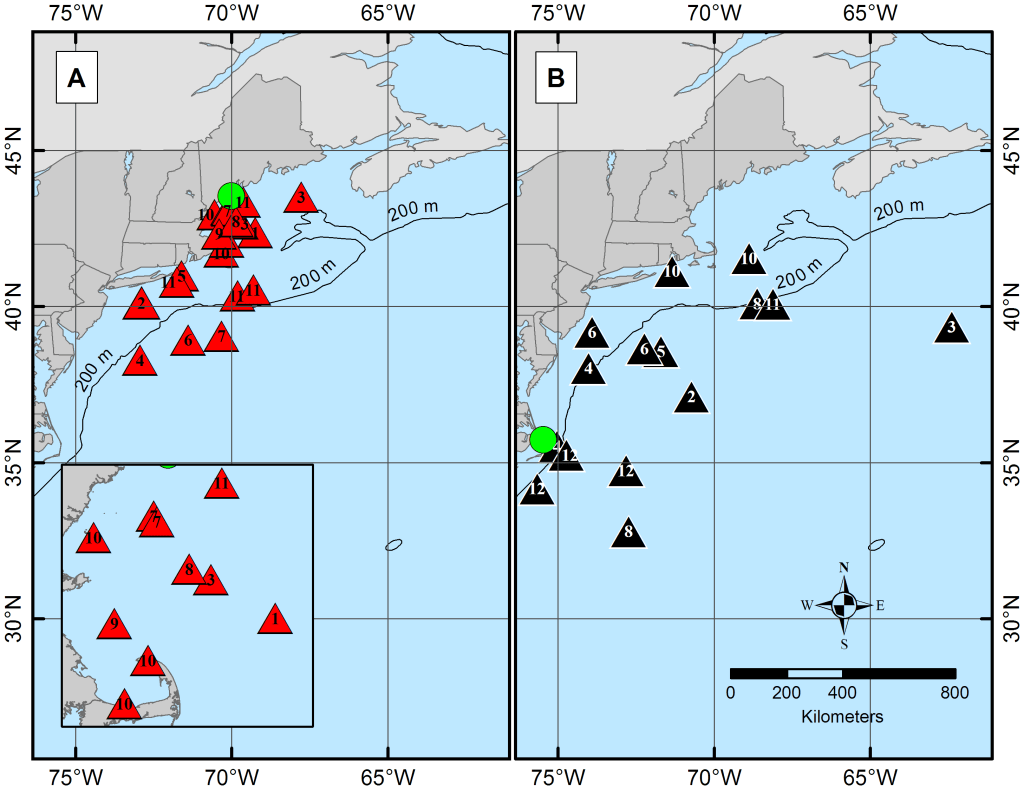
    Each winter, Atlantic spiny dogfish (Squalus acanthias) thin from our nearshore waters. Their absence is not disappearance but redistribution. Along the Northwest Atlantic coast the species occupies a broad range from Canada to the Carolinas, but this range is not a single undifferentiated mass. Seasonal movements reveal two general latitudinal tendencies — a northern contingent centered toward New England and Canadian waters, and a southern contingent extending toward North Carolina. In spring, portions of both groups converge in mid-Atlantic shelf waters, where overlapping migrations create temporary reproductive mixing before adults disperse again toward their habitual ranges (Carlson et al., 2014).

    This convergence is not random drift. It is structured migration. Satellite tracking shows that spiny dogfish follow repeatable north–south circuits tied to temperature and habitat gradients rather than wandering opportunistically (Carlson et al., 2014). During these seasonal overlaps, sex and maturity stage influence where individuals position themselves within the shared corridor. Females and mature animals use space differently from juveniles, reflecting reproductive status and energetic demand (DeVries et al., 2025). The result is a coastline briefly braided by lineage: individuals from distant home waters exchanging genetic material before returning south or north to complete gestation.

    migration patterns atlantic spiny dogfish

    Atlantic spiny dogfish do not disappear when they leave our waters; they redistribute. Each triangle marks where a tagged shark surfaced months after deployment, tracing seasonal circuits that braid northern and southern populations together before they separate again. The shaded regions show the broad envelope of movement and the smaller core areas used most consistently. Migration here is not wandering — it is structure. Reproduction moves along these same corridors, written into geography long before it is visible at the surface. | Graphic credit: Carlson et al., 2014

    After fertilization, females carry embryos for nearly two years — among the longest gestation periods recorded in sharks (Hamlett, 2005). A single pregnancy produces relatively small litters, commonly averaging six to twelve pups, each representing a substantial maternal investment spread across seasons rather than weeks (Hamlett, 2005; Cortés, 2000). Birth does not occur in the same waters where mating took place. Instead, adults retreat toward their familiar temperature zones and feeding grounds, and the next generation enters the ocean already geographically sorted. Migration and reproduction form a loop rather than a point. Each cycle redistributes genes across the coast while preserving the regional rhythms that structure the population.

    This extraordinary investment in time creates vulnerability. Sharks with slow growth, delayed maturity, and extended gestation replace themselves gradually, making populations sensitive to elevated fishing pressure (Cortés, 2000; Musick & Ellis, 2005). Removing a late-term female represents not a single loss, but the collapse of years of biological investment in a species evolved for endurance rather than speed.

    Reading the Body

    Female sharks often carry scars along their flanks and fins — pale arcs and punctures that appear deliberate enough to invite explanation. These marks are frequently attributed to mating, and sometimes that interpretation is correct. During copulation, males grip females with their teeth to maintain position in moving water, producing patterned abrasions consistent with tooth spacing (Pratt & Carrier, 2005). But the body of a coastal predator is an archive of many encounters, not all of them reproductive.

    Mating scars recorded on female blue sharks.
The pale arcs and punctures along the flank, gill region, and fins are bite marks left during courtship, when males grip females to maintain position in open water. Some individuals carry a single mark; others bear layered evidence of repeated encounters. These scars are not pathology but record — the body retaining brief moments of reproductive contact long after the act itself has vanished into current. What remains visible is the aftermath: lineage written lightly into skin. | Image credit: Vossgaetter et al., 2025
    Mating scars recorded on female blue sharks. The pale arcs and punctures along the flank, gill region, and fins are bite marks left during courtship, when males grip females to maintain position in open water. Some individuals carry a single mark; others bear layered evidence of repeated encounters. These scars are not pathology but record — the body retaining brief moments of reproductive contact long after the act itself has vanished into current. What remains visible is the aftermath: lineage written lightly into skin. | Image credit: Vossgaetter et al., 2025

    Fishing gear produces different signatures: hooks damage the jaw, entanglement leaves constricting linear abrasions, and vessel strikes create irregular trauma. Healed injuries accumulate across a lifetime, recording survival rather than singular events. Marine biologists interpret these marks through context — season, species behavior, wound geometry — understanding that a scar is evidence, not confession (Pratt & Carrier, 2005). The ocean rarely supplies a single explanation.

    The skin of a white shark carries a record of encounters.
Different wounds trace different histories: restrained bite marks associated with courtship (A & B), deeper bites from conflict (C & D), punctures and scratches left by struggling prey (E & F), abrasions from contact with reef or hard bottom (G), and the unmistakable geometry of propeller strikes (H). Each mark is a fragment of interaction preserved after the moment has passed. To read a shark’s body is to read a map of relationships — mating, hunting, collision, survival — written not as drama, but as accumulation. | Photo credit: Anderson et al., 2025
    The skin of a white shark carries a record of encounters. Different wounds trace different histories: restrained bite marks associated with courtship (A & B), deeper bites from conflict (C & D), punctures and scratches left by struggling prey (E & F), abrasions from contact with reef or hard bottom (G), and the unmistakable geometry of propeller strikes (H). Each mark is a fragment of interaction preserved after the moment has passed. To read a shark’s body is to read a map of relationships — mating, hunting, collision, survival — written not as drama, but as accumulation. | Photo credit: Anderson et al., 2025

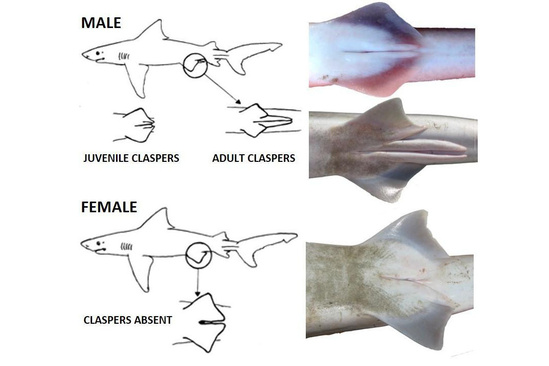
    Scars are only one layer of interpretation. Sharks also carry quieter markers of sex and maturity written into their form. Males develop elongated claspers — modified fins that trail beneath the body — visible even at a distance once the animal reaches reproductive age. In immature males these structures are short and flexible, almost decorative. With maturity they lengthen and calcify, projecting clearly behind the pelvic fins like paired shadows. A school viewed from a pier often reveals this difference in motion: some bodies carry that trailing geometry, others do not. Even without knowing species, an observer is watching a mixed population divided by sex and age.

    Females, lacking claspers, present a cleaner silhouette. During pregnancy their bodies shift subtly. The abdomen rounds, not dramatically but enough to change how light moves across the flank. Experienced observers recognize gravid females less by size than by proportion — a redistribution of mass that suggests internal cargo rather than surface injury.

    The clasper itself is an evolutionary innovation — a modification of pelvic fins that allows internal fertilization in a fluid environment where external fertilization would disperse gametes too widely to ensure success (Hamlett, 2005). It is a structural solution to a problem posed by water: how to keep lineage from dissolving into current.

    Sex in sharks is written into the silhouette.
Males carry paired claspers — elongated extensions of the pelvic fins that lengthen and stiffen with maturity — while females lack them entirely. Even at a distance, the trailing geometry changes how the body reads in motion. What looks like a uniform school from the surface is already divided by anatomy: juveniles, adults, males, females, each stage visible to anyone patient enough to watch. | 
Photo credit: National Oceanic and Atmospheric Administration
    Sex in sharks is written into the silhouette. Males carry paired claspers — elongated extensions of the pelvic fins that lengthen and stiffen with maturity — while females lack them entirely. Even at a distance, the trailing geometry changes how the body reads in motion. What looks like a uniform school from the surface is already divided by anatomy: juveniles, adults, males, females, each stage visible to anyone patient enough to watch. |
    Photo credit: National Oceanic and Atmospheric Administration

    These signals are quiet. They require patience. To read a shark in the water is to read a body moving through stages — juvenile, mature, gravid — each phase revealing that reproduction is not a single event but a condition carried across seasons. The distinction is anatomical literacy learned slowly, the way birdwatchers learn silhouettes or botanists learn leaf shape. Bodies announce their histories to those patient enough to look.

    Timing Written Into the Body

    Maturity does not arrive uniformly across a population. In many coastal sharks, size is a better predictor of reproductive readiness than age. Warmer water accelerates metabolism and growth, allowing juveniles in southern nurseries to reach maturity sooner than their northern counterparts (Cortés, 2000; Musick & Ellis, 2005). Temperature becomes a developmental force. A difference of a few degrees can compress or extend the timeline by years, shaping when an individual enters the reproductive pool.

    Juveniles and adults often sort themselves accordingly. Young sharks cluster in shallower, warmer margins where rapid growth offsets vulnerability. Larger, mature individuals occupy deeper or more exposed water, their size granting a margin of safety (Heupel et al., 2007). When mixed schools appear near piers, the variation in body shape reflects overlapping life stages sharing temporary habitat. What looks like a single group is often a layered demographic — future breeders moving alongside current ones.

    During mating seasons, additional cues surface. Mature males display fully calcified claspers held stiff against the body, while gravid females carry the rounded proportions of pregnancy. These changes are not theatrical. They are subtle adjustments in geometry, visible only to observers willing to compare silhouettes over time.

    Nurseries and Geographic Memory

    Many coastal shark species rely on estuaries as nursery grounds, where shallow, structured habitat increases juvenile survival by buffering predators and concentrating prey (Heupel et al., 2007). Young sharks enter a world scaled to their size. Warmer water accelerates growth, and complex shoreline geometry provides refuge during early vulnerability.

    Some females exhibit fidelity to nursery regions, returning to the same coastal systems that once sheltered them (Heupel et al., 2007). Habitat becomes inheritance. When nursery grounds degrade, the disruption extends beyond a single generation — it interrupts geographic memory embedded in the population itself.

    Multiple Ways to Continue

    Sandbar Sharks — Durability Over Speed

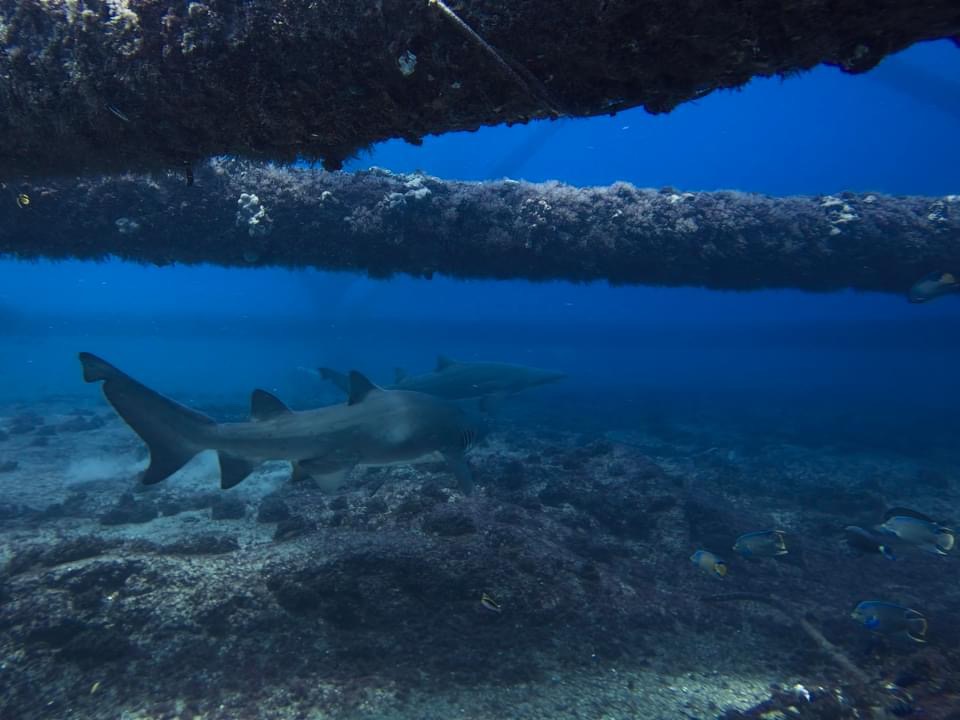
    A sandbar shark range from New England to Brazil. | Photo Credit: G.P. Schmahl/NOAA

    Sandbar shark | Photo Credit: G.P. Schmahl/NOAA

    Sandbar sharks (Carcharias plumbeus) invest heavily in durability. They mature late, produce relatively small litters, and rely on long development to generate robust juveniles capable of extended survival (Musick & Ellis, 2005). This strategy favors stability over speed. When mortality rises, recovery unfolds slowly because the species was never designed for rapid turnover.

    Sandbar shark reproduction unfolds slowly even by shark standards. Gestation lasts roughly 9–12 months, with litters typically ranging from 6 to 13 pups, though regional variation is common (Musick & Ellis, 2005). Along the mid-Atlantic coast mating generally occurs in spring and early summer, while birthing follows the next year in warmer estuarine margins. The delay is part of the design. Juveniles arrive when prey is abundant and water temperature accelerates growth, aligning birth with a narrow ecological window where survival odds briefly tilt in their favor.

    In Onslow County waters, juvenile sandbar sharks use shallow estuary margins as thermal accelerators. Warm, protected water shortens the time required to reach a size less vulnerable to predation. Growth in these early months is not cosmetic; it is survival measured in centimeters. A difference of a few inches can determine whether a young shark passes unnoticed beneath larger predators or becomes part of their diet (Heupel et al., 2007). The nursery functions as a buffer against probability. By compressing early growth into a brief window of ecological generosity, sandbars convert geography into longevity.

    Blacktip Sharks — Timing as Opportunity

    Atlantic blacktip sharks | Photo credit: Shutterstock
    Atlantic blacktip sharks | Photo credit: Shutterstock

    Blacktip sharks (Carcharhinus limbatus) align reproduction with seasonal pulses. Birth coincides with warm water and prey abundance, creating a temporary ecological advantage for juveniles. This strategy accepts higher early mortality but compensates through timing — survival synchronized with opportunity (Heupel & Simpfendorfer, 2008).

    Blacktip sharks compress their timeline. Gestation averages 10–12 months and litters often contain 1 to 10 pups, with smaller litters more common in northern portions of their range (Heupel & Simpfendorfer, 2008). Mating occurs in late spring and summer; pups are born the following late spring when baitfish concentrations peak in shallow coastal waters. Their strategy hinges on synchronization. Birth is timed not to safety, but to opportunity — a calculated arrival into abundance.

    Along our piers in late spring and summer, blacktip juveniles appear in pulses that mirror the prey fields they depend on. Schools of baitfish create moving refuges — density as defense — and young blacktips learn to survive inside motion itself. Survival belongs to individuals able to exploit brief windows, grow fast, and disperse before scarcity returns (Heupel & Simpfendorfer, 2008).

    Bonnethead Sharks — Redundancy and Retention

    Bonnethead shark | Photo credit: NC Aquariums
    Bonnethead shark | Photo credit: NC Aquariums

    Bonnethead sharks (Sphyrna tiburo) operate on one of the shortest reproductive cycles among coastal sharks. Gestation lasts approximately 4–5 months, and litters commonly range from 4 to 16 pups depending on female size (Hamlett, 2005). Mating generally occurs in late summer, but sperm storage allows fertilization to be delayed until environmental conditions favor gestation. Pups are born in late spring and early summer, entering warm shallow waters that function as immediate nurseries. The speed of the cycle reflects a species built for resilience through repetition — rapid turnover as insurance against instability.

    Bonnetheads add evolutionary contingency. Rare cases of parthenogenesis — reproduction without fertilization — demonstrate biological redundancy when mates are scarce (Chapman et al., 2007). Such flexibility underscores a principle of lineage persistence: survival tolerates complexity if complexity improves continuity.

    Bonnetheads, often glimpsed in shallow surf or near pilings, compress life history into shorter cycles, allowing populations to respond quickly to environmental change. Unlike many coastal sharks, females are capable of storing viable sperm for extended periods, delaying fertilization until conditions favor successful gestation (Hamlett, 2005). This ability decouples mating from pregnancy, allowing reproduction to align with environmental timing rather than immediate opportunity. Redundancy becomes insurance in a fragmented coastal landscape. Their persistence is not brute strength but flexibility — an evolutionary acknowledgment that coastlines are rarely stable for long (Cortés, 2000).

    Sand Tiger Sharks — Survival Before Birth

    Sand tiger shark | Photo credit: Mitchell, 2024
    Sand tiger sharks | Photo credit: Mitchell, 2024

    Sand tiger sharks (Carcharias taurus) represent an uncompromising alternative. Embryos compete within the uterus, and only the strongest survive to birth through intrauterine cannibalism — a process that produces a small number of highly developed juveniles (Hamlett, 2005). From a human perspective the mechanism appears brutal. In evolutionary terms it is a concentrated investment in pre-birth survival.

    Sand tiger gestation stretches close to 9–12 months, but the internal competition that defines their development reduces litters to one or two surviving pups per uterus despite a much larger initial embryo count (Hamlett, 2005; Branstetter & Musick, 1994). Mating occurs offshore in cooler months, and births typically follow in spring or early summer. The resulting juveniles are large at birth — already capable hunters — trading quantity for immediate competence. Survival is front-loaded. The species invests in a few individuals built to endure rather than many built to gamble.

    For sand tigers occasionally seen near South Topsail Island, this pre-birth selection produces juveniles that enter the water already comparable in size to many adult coastal fish. They arrive as functioning predators. Instead of a long vulnerable childhood, sand tigers begin life past the most dangerous bottleneck. Their subsequent behavior reflects this early security: slow movement, energy conservation, and longevity built on having cleared the lethal threshold before birth (Branstetter & Musick, 1994).

    It is tempting to read personality into origin. Yet adult sand tigers move with calm efficiency, rarely engaging in unnecessary conflict. A harsh developmental filter does not predict a harsh adulthood. It simply ensures survival past the most intense threshold.

    Together, these strategies map the same coastline through different biological clocks. Some sharks survive by accelerating early growth. Others invest in a few individuals built to last. Still others hedge their future with redundancy. Diversity is not excess — it is resilience expressed through bodies.

    The Coast as a Clock

    Longevity is the silent partner in every reproductive strategy. Long-lived sharks can afford to reproduce slowly, distributing investment across decades. Shorter-lived species compress reproduction into tighter intervals. Neither strategy is superior in isolation. Each is calibrated to environmental tempo (Cortés, 2000).

    The coastline holds many clocks at once — tides measured in hours, migrations in seasons, lineage in centuries. Sharks survive by aligning their bodies to the clock that fits their niche. Gestation becomes a wager on stability. Migration becomes inheritance in motion. A nursery becomes infrastructure for continuity.

    To observe a pregnant shark offshore is to witness a process already years in motion. The animal carries not only embryos but evolutionary decisions accumulated across millennia: how many to produce, when to move, where to shelter, how long to live. Reproduction is less an event than a continuity. Its future depends not on spectacle, but on whether the slow mathematics of these lives can continue unfolding inside waters still capable of carrying them forward.

    References

    Branstetter, S., & Musick, J. A. (1994). Age and growth estimates for the sand tiger in the northwestern Atlantic Ocean. Transactions of the American Fisheries Society, 123(2), 242-254. https://doi.org/10.1577/1548-8659(1994)123<0242:aageft>2.3.co;2

    Carlson, A. E., Hoffmayer, E. R., Tribuzio, C. A., & Sulikowski, J. A. (2014). The use of satellite tags to redefine movement patterns of spiny dogfish (Squalus acanthias) along the U.S. East Coast: Implications for fisheries management. PLoS ONE, 9(7), e103384. https://doi.org/10.1371/journal.pone.0103384

    Carrier, J. C., Musick, J. A., & Heithaus, M. R. (2012). Biology of sharks and their relatives (2nd ed.). CRC Press.

    Chapman, D. D., Shivji, M. S., Louis, E., Sommer, J., Fletcher, H., & Prodöhl, P. A. (2007). Virgin birth in a hammerhead shark. Biology Letters, 3(4), 425-427. https://doi.org/10.1098/rsbl.2007.0189

    Cortés, E. (2000). Life history patterns and correlations in Sharks. Reviews in Fisheries Science, 8(4), 299-344. https://doi.org/10.1080/10408340308951115

    DeVries, C., Gartland, J., & Latour, R. J. (2025). Patterns in spiny dogfish consumption by sex and maturity stage relate to prey availability and environmental forcing in the Northwest Atlantic. Frontiers in Marine Science, 12. https://doi.org/10.3389/fmars.2025.1621343

    Heupel, M., Carlson, J., & Simpfendorfer, C. (2007). Shark nursery areas: Concepts, definition, characterization and assumptions. Marine Ecology Progress Series, 337, 287-297. https://doi.org/10.3354/meps337287

    Heupel, M., & Simpfendorfer, C. (2008). Movement and distribution of young bull sharks Carcharhinus leucas in a variable estuarine environment. Aquatic Biology, 1, 277-289. https://doi.org/10.3354/ab00030

    Musick, J. A., & Ellis, J. K. (2005). Reproductive evolution of chondrichthyans. In Reproductive Biology and Phylogeny of Chondrichthyes (1st ed., pp. 45-79). Science Publishers.

    Pratt, H. L., & Carrier, J. C. (2005). Elasmobranch courtship and mating behavior. In Reproductive Biology and Phylogeny of Chondrichthyes (1st ed., pp. 129-169). Science Publishers.