Tag: onslow county

  • When the Water Turns Gelatinous: The Hidden Filter Feeders of Onslow County

    When the Water Turns Gelatinous: The Hidden Filter Feeders of Onslow County

    Sometimes the estuary changes before people notice why.

    The water may look normal from shore, but drifting just beneath the surface are long ribbons of translucent gelatin — soft strands that gather along marsh edges, collect in eddies, or drift through the current like mucus suspended in the tide. In Surf City this week, people described them as “whale snot.”

    Gelatinous material collected from Murrells Inlet, South Carolina at the low tide edge. Such suspended material may include colonial tunicates, salps, mucus-rich plankton aggregates, and other organic matter associated with productive estuarine conditions. | Image credit: J. Mattevi
    Gelatinous material collected from Murrells Inlet, South Carolina at the low tide edge. Such suspended material may include colonial tunicates, salps, mucus-rich plankton aggregates, and other organic matter associated with productive estuarine conditions. | Image credit: J. Mattevi

    They are more likely colonial tunicates or salps, gelatinous filter-feeders that can appear suddenly when conditions in the water favor rapid plankton growth (Bone, 1998; Madin & Deibel, 1998).

    What matters is not only the organisms themselves, but what their appearance says about the estuary around them.

    The drifting forms

    These blooms often form when the water column becomes temporarily stable and productive (Madin, 1982). Warmer temperatures, calmer conditions, reduced wave turbulence, and elevated plankton concentrations create an environment where filter-feeding gelatinous organisms can reproduce rapidly. Water moving through the inlets may also transport offshore plankton communities into the estuary, concentrating them in tidal creeks and slower-moving surface water (Bone, 1998; Madin, 1982).

    In these calmer stretches, the water column begins separating into layers. Suspended plankton remains concentrated near the surface while weaker turbulence allows fragile gelatinous colonies to persist long enough for blooms to form. What would normally disperse through wave action instead remains suspended within the estuary itself (Madin, 1982).

    To most people, they look like debris.

    Ecologically, they are processing the estuary in real time.

    Salps and colonial tunicates continuously pump water through their bodies, removing suspended phytoplankton, bacteria, and organic particles from the water column. During bloom periods, enormous volumes of water can be filtered each day (Madin, 1982; Sutherland et al., 2010). In effect, the estuary briefly develops a drifting layer of living filtration suspended between the surface and the bottom.

    Each colony filters continuously. Thousands moving through a tidal creek or marsh edge at once can collectively filter enormous volumes of suspended material over short periods of time, temporarily altering the clarity and composition of the surrounding water (Riisgård & Larsen, 2010).

    That shift affects everything around them.

    When these blooms are abundant, water clarity can temporarily improve as suspended particles are removed. Organic material becomes concentrated into mucus-rich waste pellets and decaying gelatinous tissue that sink toward the bottom, transferring energy from the surface into benthic food webs below (Madin & Deibel, 1998). Microbes, worms, crustaceans, and scavengers begin responding almost immediately (Madin, 1982; Madin & Deibel, 1998).

    Instead of remaining suspended near the surface, nutrients and organic matter begin settling downward through the water column. What had been dispersed through open water becomes concentrated along the bottom, where deposit-feeding worms, small crustaceans, microbes, and scavengers begin incorporating that material into the estuary below (Madin, 1982).

    The bloom itself becomes food.

    The drifting masses also create temporary structure within otherwise open water. Small fish gather along their edges. Tiny invertebrates gather within folds and strands of gelatinous tissue. Predators begin responding not only to the bloom itself, but to the concentration of life forming around it (Bone, 1998; Madin & Deibel, 1998).

    Small fish and invertebrates feed around the edges of these drifting masses. Juvenile fishes may remain near these drifting masses as food becomes concentrated around them. Sea turtles, some fishes, and other gelatinous predators may increase feeding activity where blooms become dense enough to concentrate prey (Bone, 1998).

    But like many ecological events, balance matters.

    If too few filter-feeders are present during periods of elevated nutrients, water grows murkier and oxygen conditions become less stable, particularly during heat and nighttime respiration. But filtration at the opposite extreme can also reshape the food web. Too many gelatinous filter-feeders, however, may strip large amounts of plankton from the water column, altering food availability for larval fishes and other plankton-dependent organisms higher in the food web (Petersen & Riisgård, 1992).

    Most blooms are temporary. 

    Currents disperse them. Heat and bacteria break them apart. Waves fragment the colonies into nearly invisible strands that disappear back into the system as quickly as they arrived. Even in collapse, the bloom continues feeding the estuary. Decaying tissue is broken apart by bacteria, consumed by scavengers, and recycled back into the same nutrient pathways that allowed the bloom to form in the first place (Madin, 1982).

    But for a short period, the estuary reveals something normally hidden: the water between the marsh and the bottom is not empty space. It is an active habitat, filled with organisms that filter, recycle, transport, and redistribute energy through the coastal ecosystem (Bone, 1998; Madin, 1982).

    The attached forms

    Not all tunicates remain suspended in the water column. Some attach themselves directly to the surfaces that hold still long enough for life to accumulate—dock pilings, oyster shell, ropes, marsh grass roots, floats, and the shaded undersides of piers where current continues moving but turbulence drops away.

    Along the estuaries of Onslow County, these attached forms become part of what looks, at first glance, like simple buildup.

    The surfaces beneath docks rarely stay bare for long (Wahl, 1989; Lindeyer & Gittenberger, 2011). Marine scientists often describe these layered growths as fouling communities, but along the estuary they appear simply as the layer of life that forms on anything left in the water long enough. First comes a film too thin to notice, then algae, then colonies of organisms layered over one another until wood, shell, and rope begin carrying part of the estuary itself.

    Sea squirts and other attached filter-feeders beneath a dock in Surf City, North Carolina. | Image credit: A. Mitchell
    Sea squirts and other attached filter-feeders beneath a dock in Surf City, North Carolina. | Image credit: A. Mitchell

    Tunicates are part of that layer.

    Along this coast, attached tunicates can include solitary species like the pleated sea squirt (Styela plicata) and the sea grape (Molgula manhattensis), as well as colonial species such as Clavelina oblonga and sea pork (Aplidium stellatum) (Van Name, 1945; Lambert, 2007).

    Some grow individually, attached like soft sacs with openings at the top. Others spread as colonial sheets or clustered lobes, sharing a common outer covering while continuously filtering water moving past them. Around pilings and floating docks, entire communities can form this way—sponges beside hydroids, bryozoans layered against tunicates, all responding to current, salinity, temperature, and suspended food moving through the tide (Wahl, 1989).

    To most people, these surfaces register as slime.

    Ecologically, they are filtration, habitat, and nutrient transfer occurring simultaneously (Wahl, 1989).

    Sea squirts

    The organisms most people recognize first are usually sea squirts. They appear as rubbery sacs attached beneath docks or clustered along ropes, and shell. Press one accidentally and water jets outward through small siphons near the top of the body, giving rise to the common name.

    A sea squirt partially coated in algae and sediment beneath shallow estuarine water in Surf City, North Carolina. The two siphon openings are part of the continuous filtration process occurring beneath docks and marsh edges. | Image credit: A. Mitchell
    A sea squirt partially coated in algae and sediment beneath shallow estuarine water in Surf City, North Carolina. The two siphon openings are part of the continuous filtration process occurring beneath docks and marsh edges. | Image credit: A. Mitchell

    Species such as the pleated sea squirt (Styela plicata) often develop thick, wrinkled outer coverings ranging from tan and off-white to purple, while the sea grape (Molgula manhattensis) forms smaller rounded bodies attached within the layered communities growing beneath docks and along estuarine structure — what marine scientists often call fouling communities (Van Name, 1945).

    What looks like a reaction is actually the visible end of a process already underway.

    Sea squirts continuously pull water inward through one siphon, filter out phytoplankton, bacteria, and suspended particles from the water, then expel the filtered water back into the estuary through another opening. The animal does not begin filtering when disturbed. It has been filtering the entire time (Riisgård & Larsen, 2010).

    In productive estuarine water, thousands of these organisms may be pumping simultaneously (Riisgård & Larsen, 2010).

    That filtration matters.

    As suspended particles are removed, nutrients become concentrated into waste and biomass that can be transferred downward into bottom communities. Water clarity may improve locally (Riisgård & Larsen, 2010). Microbial activity shifts around them. Small invertebrates begin using the folds and surfaces their bodies create.

    Their presence also signals something about the surrounding water.

    Sea squirts tend to cluster where flow remains steady enough to deliver oxygen and suspended food continuously, but not so violent that colonies are torn free. Around tidal creeks, dock edges, and quieter stretches of the Intracoastal Waterway, their abundance often reflects a system carrying enough suspended productivity to sustain constant filtration (Barros, 2009).

    Sea pork

    Some tunicates take a different form entirely.

    One of these is sea pork, commonly associated with colonial tunicates such as Aplidium stellatum, which spread outward as shared gelatinous colonies rather than isolated individuals (Van Name, 1945).

    Sea pork, a colonial tunicate, washed ashore along Surf City, North Carolina. Though it appears as a single gelatinous mass, it is made up of thousands of tiny filter-feeding animals embedded within a shared outer layer. | Image credit: D. Miles
    Sea pork, a colonial tunicate, washed ashore along Surf City, North Carolina. Though it appears as a single gelatinous mass, it is made up of thousands of tiny filter-feeding animals embedded within a shared outer layer. | Image credit: D. Miles

    Sea pork spreads across submerged surfaces in thick, rubbery colonies that look less like individual animals and more like flesh-colored mats attached beneath floats and pilings. Depending on the species and age of the colony, the surface may appear muted pink, tan, orange, or almost translucent beneath the waterline.

    Most people don’t realize they are looking at colonies made up of thousands of tiny individual filter-feeding bodies embedded together within a shared outer layer.

    The colony functions collectively (Van Name, 1945).

    Water moves continuously through countless small openings across the surface, carrying suspended plankton and organic particles into the colony while waste and filtered water move back outward into the surrounding estuary (Riisgård & Larsen, 2010).

    That structure changes the surface around it.

    Sea pork colonies trap sediment and create small protected surfaces where microorganisms and invertebrates begin to accumulate between folds and protected edges. Tiny crustaceans move across them. Worms and microbial films develop within the folds and protected spaces between colonies. What appears smooth from above becomes, at smaller scales, complex terrain (Wahl, 1989).

    Like other filter-feeding communities along this coast, sea pork helps transfer suspended energy from the water column into the attached world beneath docks and marsh edges.

    And once that layered habitat forms, other organisms begin responding to it—including the nudibranchs moving slowly across its surface.

    Nudibranchs

    At low tide along the edges of the sound—where pilings hold a thin skin of life and oyster shells stack into uneven ridges—the water sometimes carries color that doesn’t belong to the sand or the grass. It moves slowly, almost deliberately, across surfaces that most people step over without noticing. What looks like a fragment of drifting algae or a soft piece of shell resolves, if you stop long enough, into something alive.

    These are nudibranchs.

    They are not fish, not worms, not plants. They are marine gastropods—relatives of snails—but without shells (Valdés et al., 2006). Along the coast of Onslow County, they appear in the quiet places: beneath docks in the Intracoastal Waterway, along the edges of Topsail Island marsh creeks, and on the submerged surfaces where current slows just enough for growth to take hold.

    Along shallow estuarine structure in this region—beneath docks, across pilings, and within the layered growth attached to ropes and shell—nudibranchs may include species such as the striped nudibranch (Cratena pilata), the Brazilian aeolid sea slug (Spurilla braziliana), the fringeback dondice (Dondice occidentalis), Thecacera pennigera, Berghia rissodominguezi, and the brackish-water species Tenellia adspersa (Marcus, 1972; Valdés et al., 2006). 

    Most people never see them. But they are there, working through the same system that shapes everything else along this coast.

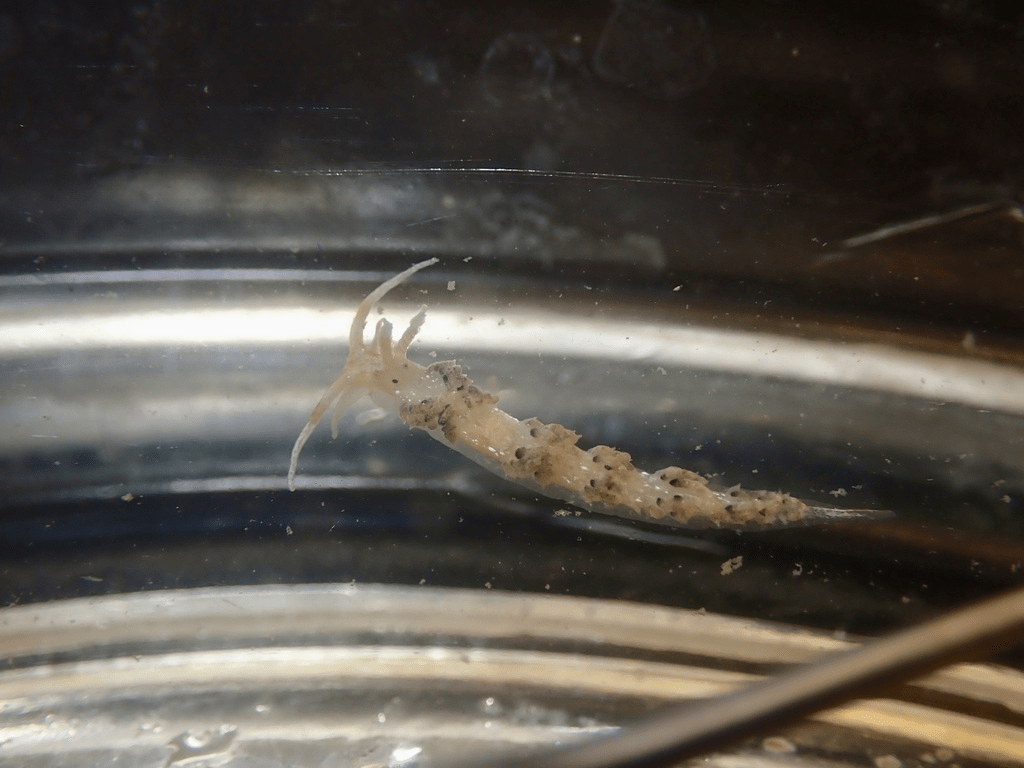
    A nudibranch collected near Morehead City, North Carolina, viewed under magnification. The cerata along its back increase surface area for respiration and, in some species, store defensive stinging cells obtained from prey. | Image credit: marineinvertgirl, iNaturalist
    A nudibranch collected near Morehead City, North Carolina, viewed under magnification. The cerata along its back increase surface area for respiration and, in some species, store defensive stinging cells obtained from prey. | Image credit: marineinvertgirl, iNaturalist

    Built for sensing, not speed

    A nudibranch’s body is built for sensing and feeding, not speed. The two structures at the front—rhinophores—sample the water chemically, reading it the way a shoreline bird reads the wind. Along their backs, many species carry cerata, small extensions that look ornamental but function as both respiration and defense.

    In aeolid nudibranchs like Spurilla braziliana, Cratena pilata, and Berghia rissodominguezi, these cerata become important sites for both respiration and defensive storage of stinging cells obtained from prey (Goodheart et al., 2018).

    The Brazilian aeolid sea slug (Spurilla braziliana) moving across submerged structure near Morehead City, North Carolina. The cerata lining its back function in respiration and can store defensive stinging cells obtained from prey such as anemones and hydroids. | Image credit: wonglab, iNaturalist
    The Brazilian aeolid sea slug (Spurilla braziliana) moving across submerged structure near Morehead City, North Carolina. The cerata lining its back function in respiration and can store defensive stinging cells obtained from prey such as anemones and hydroids. | Image credit: wonglab, iNaturalist

    They move slowly because they can afford to. Their food doesn’t run.

    Sponges, hydroids, bryozoans—these are the surfaces most people would describe as “growth” on docks or shells. To a nudibranch, those surfaces are structure, habitat, and food all at once (Valdés et al., 2006).

    The work they do (even when no one’s watching)

    Along this coastline, growth is constant. Give any hard surface—an old piling, a piece of shell, a boat hull—enough time in the water and it becomes layered. First a film, then algae, then invertebrates. The system builds upward and outward, creating what scientists call structural complexity, but what you actually see is texture: roughness where there used to be smoothness (Wahl, 1989).

    Along shallow estuarine bottoms, algae, shell, and attached growth begin forming the layered habitat that supports juvenile fish, crabs, filter-feeders, and the organisms moving through the estuary food web. | Image credit: A. Mitchell
    Along shallow estuarine bottoms, algae, shell, and attached growth begin forming the layered habitat that supports juvenile fish, crabs, filter-feeders, and the organisms moving through the estuary food web. | Image credit: A. Mitchell

    Nudibranchs move through that texture selectively.

    Many species feed on a single type of prey. One may specialize in a particular sponge. Another tracks hydroids, those delicate branching animals that resemble tiny underwater ferns. Species such as Dondice occidentalis, Cratena pilata, and Tenellia adspersa are commonly associated with hydroids and other organisms growing across submerged pilings, docks, ropes and shell in shallow coastal environments (Marcus, 1972; Valdés et al., 2006). This selectivity matters more than their size suggests. They are not removing everything. They are removing specific pieces of the system.

    That kind of feeding does not flatten the landscape—it shapes it.

    Where one organism begins to dominate, nudibranchs can limit its spread. Where surfaces would otherwise become uniform, their grazing introduces variation. Over time, this helps maintain the uneven habitat small fish, shrimp, and juvenile invertebrates depend on (Wahl, 1989).

    Growth that begins as algae quickly becomes habitat. Along shallow estuarine edges, layered vegetation and attached organisms create shelter for crabs, juvenile fish, shrimp, and other small life moving through the system. | Image credit: A. Mitchell
    Growth that begins as algae quickly becomes habitat. Along shallow estuarine edges, layered vegetation and attached organisms create shelter for crabs, juvenile fish, shrimp, and other small life moving through the system. | Image credit: A. Mitchell

    It’s easy to miss because nothing dramatic happens. There’s no visible clearing, no sudden absence. But the balance of what grows, and where, shifts quietly in response to their presence.

    Borrowed defenses, redistributed energy

    Some nudibranchs do something that seems improbable until you see it up close: they take the defenses of what they eat and keep them.

    Hydroids and certain cnidarians carry stinging cells—nematocysts—that function as protection. When a nudibranch feeds on them, those cells pass through the digestive system intact and are stored within the cerata along its back. The nudibranch doesn’t just consume its prey; it incorporates part of its defense (Goodheart et al., 2018).

    This changes how energy moves through the system.

    Instead of defenses being lost when prey is consumed, they are transferred upward. The nudibranch becomes both grazer and deterrent, a small organism that is less likely to be eaten because of what it has already eaten.

    You can see the result in their coloration. Many are bright, almost out of place against the muted tones of sand and shell. That color is not decoration—it’s a signal (Avila, 1995). Along this coast, where predation pressure is constant, visibility can function as warning rather than risk.

    Where they sit in the trophic cascade

    They are not apex predators. They don’t regulate fish populations or move through the system in ways that draw attention. But they occupy a position that connects the base of the food web to everything above it.

    They feed on organisms that build habitat.

    Those organisms—sponges, hydroids, bryozoans—form the living surface that supports small invertebrates and juvenile fish. Those smaller organisms, in turn, become prey for larger fish, which then connect to the predators people are more familiar with along this coast—species like blacktip shark (Carcharhinus limbatus) and Atlantic sharpnose shark (Rhizopriodion terranovae) that move along the breakers and through the sounds.

    Remove the visible predators, and people notice quickly.

    Remove something like a nudibranch, and what changes is slower, but it moves in the same direction. Surfaces become dominated by fewer species. Habitat becomes more uniform. The small organisms that rely on variation lose space. That change works its way upward, not as a single event, but as a shift in the system’s capacity to support diversity.

    Even small organisms attached to pilings and submerged structure become part of much larger coastal food webs. Scientific food-web models show nudibranchs, hydroids, bryozoans, worms, shrimp, and fishes linked together through the transfer of energy across the ecosystem. 

    Generalized food web showing how organisms associated with sponge and attached invertebrate communities connect upward through coastal ecosystems. Nudibranchs, hydroids, bryozoans, worms, shrimp, and fishes all participate in the transfer of energy through these layered habitats. Adapted from Archer et al. (2020).
    Generalized food web showing how organisms associated with sponge and attached invertebrate communities connect upward through coastal ecosystems. Nudibranchs, hydroids, bryozoans, worms, shrimp, and fishes all participate in the transfer of energy through these layered habitats. Adapted from Archer et al. (2020).

    Why they stay hidden

    There’s a reason most beachgoers never encounter them.

    They live where water movement slows just enough to allow growth to accumulate, but not so still that oxygen drops away. Around docks, inside creeks, along the quieter edges of the New River estuary, they remain attached to the surfaces that feed them.

    Out in the open surf, where sand shifts constantly and hard structure is buried and exposed with each change in wind and tide, there’s less for them to hold onto and less for them to eat. The breakers are a moving environment (Wahl, 1989). Nudibranchs belong to the places that hold still just long enough for complexity to form.

    What changes if they’re gone

    Nothing you would notice in a single afternoon at the beach.

    But over time, the surfaces beneath the waterline would begin to simplify. One or two fast-growing organisms would spread further, covering space that would otherwise remain shared. The small sheltered spaces used by larval fish, juvenile shrimp, and small crabs would begin to thin out.

    That loss doesn’t stay at the bottom.

    It moves upward, changing how much life the system can support, and how evenly that life is distributed. By the time it reaches the fish people see from the shore, the cause is no longer visible. But it started here, in the slow movement of something small across a surface most people never look at twice.

    Nudibranchs don’t reshape the coastline in ways that draw attention. They don’t mark their presence with absence or disturbance. Instead, they work within what’s already there—adjusting, redistributing, and maintaining the uneven structure that makes this coast function.

    If you happen to see one, it won’t be moving fast. It won’t need to.

    What they’re feeding on (and why it looks familiar)

    Along the docks and pilings of Onslow County, the surfaces most people notice first aren’t fish at all. They’re the things attached to everything.

    The branching, plant-like fuzz that brushes your hand when you reach into the water—those are hydroids. The firm, uneven coatings that look like they’re part of the structure itself are often sponges or bryozoans.

    It’s easy to group all of it together as buildup. Something slimy, something in the way.

    But that “squirt” people laugh about isn’t random. A tunicate pulls water in, filters out plankton and suspended particles, and then expels that water back out. What looks like a reaction is just the visible end of constant filtration. They are processing the water column—removing particles, cycling nutrients, and clarifying the water in small, continuous ways (Riisgård & Larsen, 2010).

    Hydroids are doing something different. They are predators at a scale most people don’t consider, capturing microscopic prey drifting past. Sponges filter continuously as well, pulling bacteria and organic matter from the water and converting it into biomass that other organisms can use.

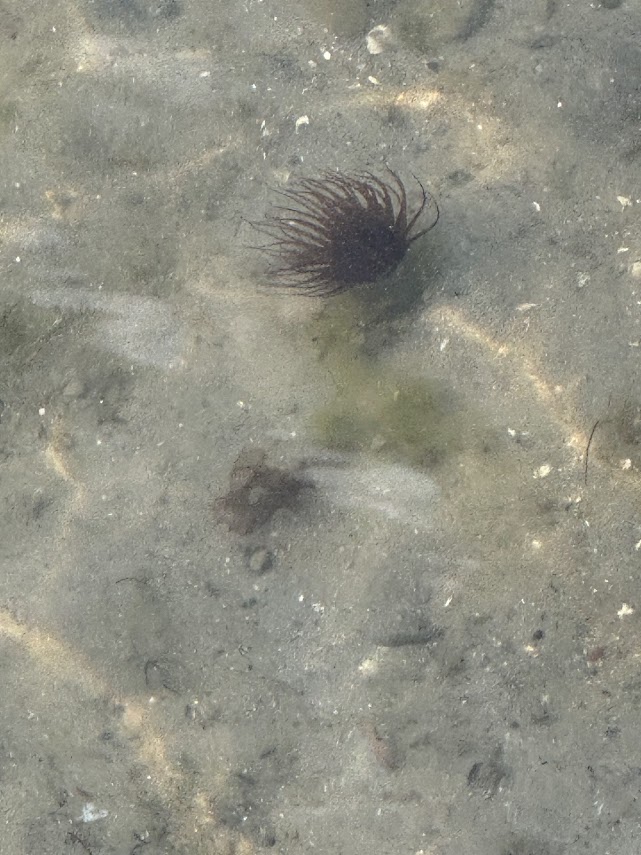
    A sea anemone beneath shallow estuarine water in Surf City, North Carolina. Organisms like these become part of the layered communities that nudibranchs, tunicates, hydroids, and other invertebrates move through beneath the surface. | Image credit: A. Mitchell
    A sea anemone beneath shallow estuarine water in Surf City, North Carolina. Organisms like these become part of the layered communities that nudibranchs, tunicates, hydroids, and other invertebrates move through beneath the surface. | Image credit: A. Mitchell

    This is the surface layer of the ecosystem.
    And it doesn’t stay unchecked.

    The ones moving across the surface

    Species like the Brazilian aeolid sea slug (Spurilla braziliana) often feed directly on anemones associated with these same submerged communities, while smaller species such as Tenellia adspersa are frequently associated with hydroids in brackish and estuarine waters (Valdés et al., 2006). 

    The nudibranchs moving across these surfaces are not all the same, and what they eat tells you what role they’re playing.

    Some of the small, leaf-like sea slugs in this region—species in the genus Elysia—feed on algae and can even retain the chloroplasts from what they consume, briefly using sunlight as part of their energy system. They blur the line between grazing and something closer to plant-like function (Valdés et al., 2006).

    Others, like Cratena pilata and Dondice occidentalis, track hydroids specifically. Where hydroids begin to spread across a piling, these nudibranchs follow, feeding in a way that limits how dense those colonies can become (Marcus, 1972).

    Species such as Thecacera pennigera are often associated with the layered communities growing beneath docks and harbor structure, while Berghia rissodominguezi and Spurilla braziliana move through shallow cnidarian-rich habitat where anemones and hydroids provide both food and defensive material (Valdés et al., 2006).

    Heavier-bodied nudibranchs—often in groups like Doris—tend to feed on sponges. Not all sponges, and not everywhere, but selectively enough that no single form easily dominates a surface for long.

    Even their eggs reflect this connection. The ribbon-like spirals sometimes seen attached to docks are laid directly where food is available. The next generation doesn’t disperse randomly—it begins where the system is already functioning.

    Beneath the surface layer

    Most of the time, these organisms go unnoticed.

    People see the drifting ribbons and call them whale snot. They scrape tunicates from pilings without thinking about what those colonies were filtering from the water. They brush past hydroids and sponges growing beneath docks without realizing those surfaces are part of the estuary’s food web just as much as the fish moving above them.

    But the water between the marsh and the bottom is never empty.

    It carries suspended plankton, drifting larvae, dissolved nutrients, bacteria, predators, scavengers, and colonies of organisms filtering continuously through the tide. Along the quieter edges of Onslow County—beneath floats, around oyster shells, beside marsh grass roots, and inside the slower water of creeks and sounds—entire communities form within that suspended layer (Wahl, 1989; Lindeyer & Gittenberger, 2011).

    Some drift. Some attach. Some graze slowly across the surface consuming the organisms beneath them.

    Together, they reshape the estuary constantly.

    The gelatinous ribbons appearing this week are not separate from the rest of the system. They are one visible moment in a larger cycle of filtration, growth, decay, grazing, and redistribution that normally happens out of sight (Bone, 1998; Madin, 1982). For a short time, the estuary simply becomes easier to see.

    What appears empty from above often contains layered communities of algae, filter-feeders, invertebrates, and microorganisms quietly redistributing energy through the estuary. Surf City, North Carolina. | Image credit: A. Mitchell
    What appears empty from above often contains layered communities of algae, filter-feeders, invertebrates, and microorganisms quietly redistributing energy through the estuary. Surf City, North Carolina. | Image credit: A. Mitchell

    References

    Avila, C. (1995). Natural products of opisthobranch molluscs: A biological review. In Oceanography and marine biology: An annual review (33rd ed., pp. 487-559). UCL Press.

    Barros, R. (2009). Human-mediated global dispersion of Styela plicata (Tunicata, Ascidiacea). Aquatic Invasions, 4(1), 45-57. https://doi.org/10.3391/ai.2009.4.1.4

    Bone, Q. (1998). The biology of pelagic tunicates. Oxford University Press on Demand.

    Encarnação, J., Seyer, T., Teodósio, M. A., & Leitão, F. (2020). First record of the nudibranch Tenellia adspersa (Nordmann, 1845) in Portugal, associated with the invasive hydrozoan Cordylophora caspia (Pallas, 1771). Diversity, 12(6), 214. https://doi.org/10.3390/d12060214

    Goodheart, J. A., Bleidißel, S., Schillo, D., Strong, E. E., Ayres, D. L., Preisfeld, A., Collins, A. G., Cummings, M. P., & Wägele, H. (2018). Comparative morphology and evolution of the cnidosac in Cladobranchia (Gastropoda: Heterobranchia: Nudibranchia). Frontiers in Zoology, 15(1). https://doi.org/10.1186/s12983-018-0289-2

    Korshunova, T., Lundin, K., Malmberg, K., Picton, B., & Martynov, A. (2018). First true brackish-water nudibranch mollusc provides new insights for phylogeny and biogeography and reveals paedomorphosis-driven evolution. PLOS ONE, 13(3), e0192177. https://doi.org/10.1371/journal.pone.0192177

    Lambert, G. (2007). Invasive sea squirts: A growing global problem. Journal of Experimental Marine Biology and Ecology, 342(1), 3-4. https://doi.org/10.1016/j.jembe.2006.10.009

    Lindeyer, F., & Gittenberger, A. (2011). Ascidians in the succession of marine fouling communities. Aquatic Invasions, 6(4), 421-434. https://doi.org/10.3391/ai.2011.6.4.07

    Madin, L. P. (1982). Production, composition and sedimentation of salp fecal pellets in oceanic waters. Marine Biology, 67(1), 39-45. https://doi.org/10.1007/bf00397092

    Madin, L. P., & Deibel, D. (1998). Feeding and energetics of Thaliacea. The Biology of Pelagic Tunicates, 81-104. https://doi.org/10.1093/oso/9780198540243.003.0005

    Marcus, E. D. (1972). On Some Opisthobranchs from Florida. Bulletin of Marine Science, 22(2), 284-308. https://www.ingentaconnect.com/content/umrsmas/bullmar/1972/00000022/00000002/art00002

    Petersen, J., & Riisgard, H. (1992). Filtration capacity of the ascidian Ciona intestinalis and its grazing impact in a shallow fjord. Marine Ecology Progress Series, 88, 9-17. https://doi.org/10.3354/meps088009

    Riisgård, H., & Larsen, P. (2010). Particle capture mechanisms in suspension-feeding invertebrates. Marine Ecology Progress Series, 418, 255-293. https://doi.org/10.3354/meps08755

    Sutherland, K. R., Madin, L. P., & Stocker, R. (2010). Filtration of submicrometer particles by pelagic tunicates. Proceedings of the National Academy of Sciences, 107(34), 15129-15134. https://doi.org/10.1073/pnas.1003599107

    Valdés, Á., Behrens, D. W., & DuPont, A. (2006). Caribbean Sea slugs: A Field guide to the opisthobranch mollusks from the tropical Nortwestern Atlantic. Sea Challengers Natural History Books.

    Van Name, W. G. (1945). The North and South American Ascidians. Bulletin of American Museum of Natural History, 84, 1-476. http://hdl.handle.net/2246/1186

    Wahl, M. (1989). Marine epibiosis. I. Fouling and antifouling: Some basic aspects. Marine Ecology Progress Series, 58, 175-189. https://doi.org/10.3354/meps058175

  • Where Wings Meet Water: Reading Birds Along the Edges of Onslow County

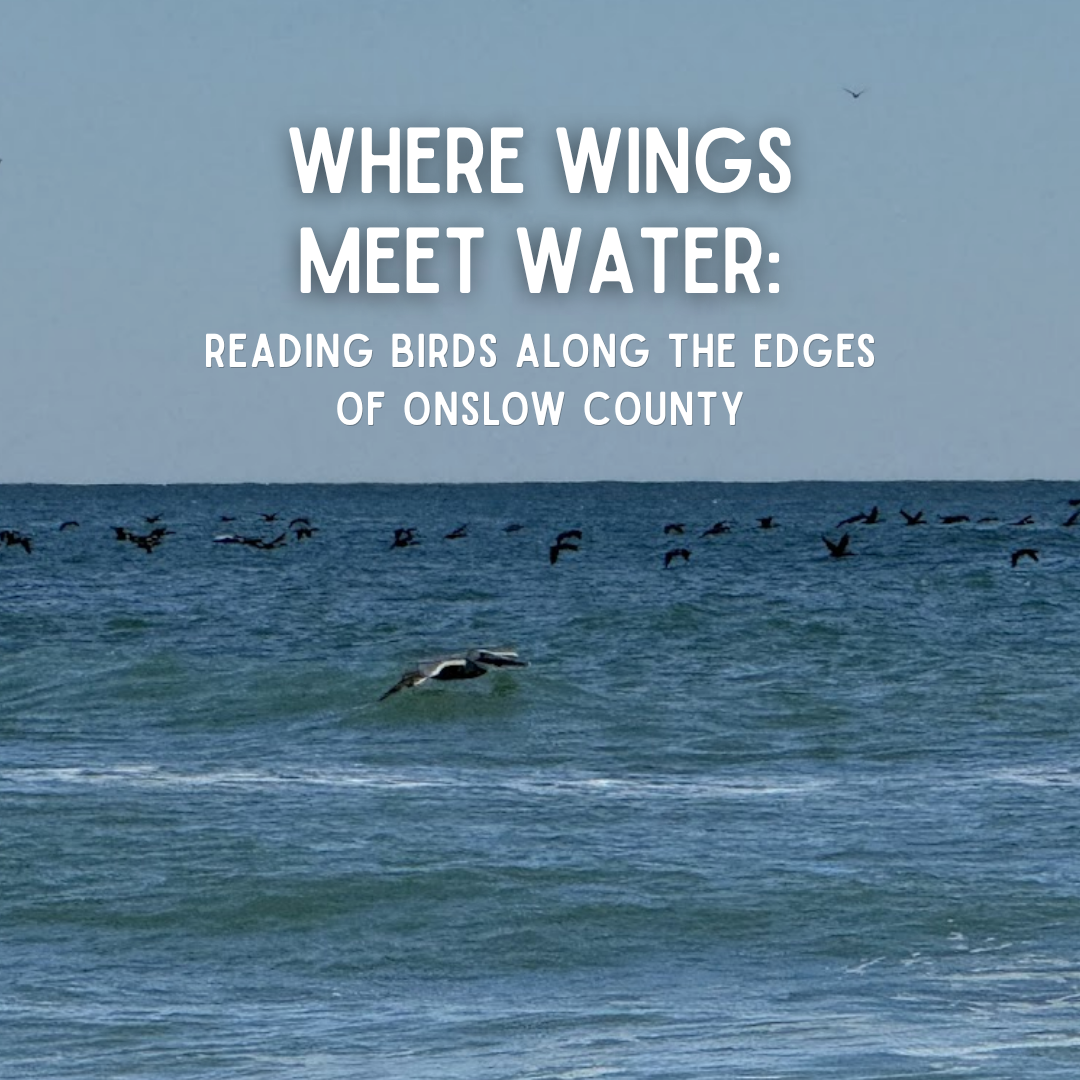
    Where Wings Meet Water: Reading Birds Along the Edges of Onslow County

    At the Line Where Air Meets Water

    On a late spring morning along Surf City, the first movement is often above the water, not within it. Brown pelicans travel low and steady just beyond the breakers, their wingtips nearly touching the surface as they follow a line that seems invisible from shore. Farther out, a group of terns holds in place against the wind, hovering, adjusting, then dropping sharply into the water before rising again. Closer to the sound side of Topsail Island, an osprey circles once, then folds into a dive toward a channel edge that looks, at first glance, no different than the water around it.

    Nothing about these movements is random. They are responses to structure that exists beneath the surface—structure shaped by tide, wind, and the movement of other organisms. What appears as scattered bird activity is, in practice, a map of where the water is concentrating life.

    For someone standing at the edge of it, that movement is one of the most accessible ways to read what cannot be seen directly.

    What Birds Are Following Beneath the Surface

    The birds that move along this stretch of coast are not searching broadly; they are tracking concentration. Along barrier island systems like those in Onslow County, physical processes—tidal exchange through inlets, wind-driven surface currents, and subtle differences in bottom shape—create zones where small fish, shrimp, and other prey accumulate (Peterson & Peterson, 1979; Piersma, 1997).

    When the tide moves through places like New River Inlet, water does not flow evenly across the landscape. It accelerates through constrictions, slows along marsh edges, and bends around sandbars and channels. These shifts in speed and direction compress organisms into tighter spaces, particularly along boundaries where moving water meets something that resists it—an edge, a drop-off, or a change in depth (Wright et al., 1985).

    Small schooling fish respond to that compression by tightening their formation. In doing so, they become more visible and more vulnerable. Larger fish—bluefish, Spanish mackerel, and juvenile coastal sharks—often move in from below, using that same concentration to feed. The pressure from below pushes prey upward, sometimes all the way to the surface.

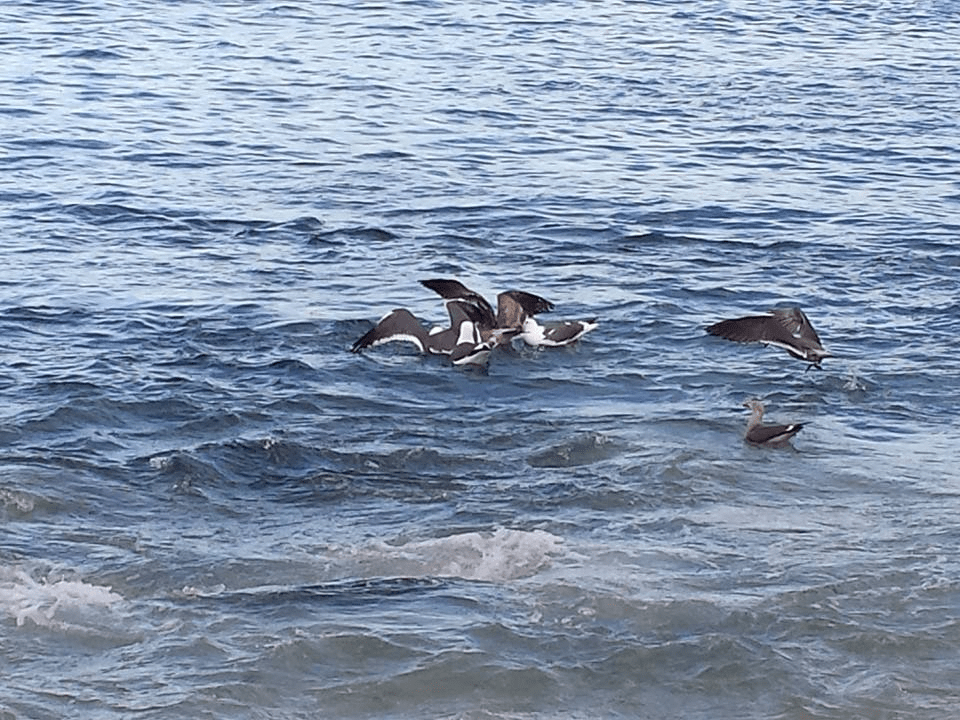
    Coastal birds feeding where prey has been concentrated near the surface along the breakers. | Image credit: A. Mitchell
    Coastal birds feeding where prey has been concentrated near the surface along the breakers. | Image credit: A. Mitchell

    What appears overhead depends on which part of that concentration each species is built to exploit.

    Terns hovering and diving are often responding to prey that has been driven upward by predatory fish (Safina & Burger, 1985). Brown pelicans, which rely on plunge-diving, tend to follow more stable schools of fish that remain near the surface for longer periods (Shields, 2014). Ospreys, in contrast, depend on clear water and individual fish they can visually isolate, which is why their activity often aligns with calmer conditions and defined channel edges (Poole et al., 2002).

    Each species is not simply feeding in the same place; each is reading a different layer of the same system.

    When Surface Activity Signals Pressure Below

    From the shoreline, bird activity can appear as isolated events—one dive, then another, then a sudden shift down the beach. Watched over time, a pattern emerges. A cluster of terns may concentrate in one location for several minutes, then disperse abruptly, reforming farther along the shoreline. Pelicans may align along a narrow band just beyond the breakers, following it as it drifts.

    These shifts often reflect changes in how prey is being compressed and released beneath the surface. When predatory fish move through a bait school, the school tightens, rises, and becomes briefly accessible from above. When that pressure dissipates, the school spreads out again, and the birds move on.

    This movement of energy—from smaller organisms to larger predators, and upward through the water column—is one visible expression of a trophic cascade. The term itself is often used to describe longer chains of ecological influence, but along the coast it can be observed in compressed moments, where the effects of predation become visible within seconds (Heithaus et al., 2008).

    Birds do not initiate this process. They respond to it. Their presence marks where the system has already intensified.

    Indicator Species at the Water’s Edge

    From the beach, the difference is subtle. The water does not change color dramatically, and the waves continue to break as they did before. The level of activity shifts within that band—first visible in the air, then inferred below– marking places where the system has tightened, energy is moving through multiple layers at once, and the distance between surface and depth has, for a time, narrowed (Heithaus et al., 2008; Estes et al., 2011).

    For someone entering the water, these differences in bird behavior can offer practical information, not in a predictive or absolute sense, but as indicators of what is happening just below the surface.

    Brown pelicans traveling low in a consistent line often indicate schools of fish moving parallel to shore. Terns repeatedly diving in a tight area suggest smaller prey being pushed upward, frequently by larger fish feeding below. Ospreys focusing on a specific channel edge reflect clearer water and individual prey availability, rather than broad schooling events. Along the shoreline, shorebirds probing the sand at low tide are responding to invertebrates exposed by receding water, signaling a different layer of the system entirely—one tied to sediment and tidal timing rather than active predation (Colwell, 2010; Piersma, 1997).

    None of these signals point directly to a specific species beneath the surface. What they indicate is concentration, and concentration is what draws larger predators closer to shore.

    Along the coast of North Carolina, nearshore and juvenile shark presence is often associated with areas of high prey density, particularly where schooling fish aggregate (Heupel & Hueter, 2002). These conditions are not constant, and they shift with tide, temperature, and time of day. Birds make those shifts visible in real time. 

    At times, that activity stretches into lines that run the length of the breakers. 

    For someone stepping into the water, that narrowing matters. Not as a warning in the abstract, but as a recognition that the conditions supporting visible feeding above often extend below, linking organisms that are rarely seen together into the same moving structure.

    Where the System Tightens

    The patterns become easier to see near places where the water is forced to narrow, turn, or accelerate. The most consistent bird activity along this coast tends to occur where water movement is constrained and redirected. Inlets, marsh edges, sandbars, and the transitions between the Intracoastal Waterway and adjacent sounds create these zones (Wright et al., 1985).

    At New River and its inlet, tidal flow compresses water into narrow channels before releasing it into broader areas, creating gradients in speed and depth. Along these gradients, prey accumulates, predators follow, and birds gather above.

    These are not fixed points. As tide rises and falls, and as wind reshapes surface conditions, the locations of these compression zones shift. The birds move with them, tracing patterns that are constantly changing but not random.

    For someone watching from shore, these movements can be read as lines, clusters, and absences—places where activity intensifies, and places where it suddenly drops away.

    Standing Within It

    Entering the water along this coast means stepping into a system already in motion. The surface may appear uniform, but the activity above it often reveals where that motion is focused.

    Birds diving repeatedly in a confined area, or tracking a narrow band just beyond the breakers, indicate where prey is concentrated. Those same conditions are what draw larger predators into closer proximity to shore, not as an anomaly, but as part of the same process.

    Watching the birds does not eliminate risk, and it does not provide certainty about what is beneath the surface. What it offers is context—a way to recognize when the water is more active, more compressed, and more connected across its layers.

    What appears as feeding from above is part of a larger structure moving through the water. The birds do not create it, and they do not remain once it passes. They mark it, briefly, making visible what is otherwise difficult to see.

    Bird movement along the shoreline often draws attention toward activity that remains unseen beneath the surface. | Image credit: A. Mitchell
    Bird movement along the shoreline often draws attention toward activity that remains unseen beneath the surface. | Image credit: A. Mitchell

    References

    Castro, J. I. (1993). The shark nursery of bulls Bay, South Carolina, with a review of the shark nurseries of the southeastern coast of the United States. Environmental Biology of Fishes, 38(1-3), 37-48. https://doi.org/10.1007/bf00842902

    Colwell, M. A. (2010). Shorebird ecology, conservation, and management. University of California Press.

    Estes, J. A., Terborgh, J., Brashares, J. S., Power, M. E., Berger, J., Bond, W. J., Carpenter, S. R., Essington, T. E., Holt, R. D., C. Jackson, J. B., Marquis, R. J., Oksanen, L., Oksanen, T., Paine, R. T., Pikitch, E. K., Ripple, W. J., Sandin, S. A., Scheffer, M., Schoener, T. W., & Wardle, D. A. (2011). Trophic downgrading of planet Earth. Science, 33(6040), 301-306. https://doi.org/10.1126/science.1205106

    Heithaus, M. R., Frid, A., Wirsing, A. J., & Worm, B. (2008). Predicting ecological consequences of marine top predator declines. Trends in Ecology & Evolution, 23(4), 202-210. https://doi.org/10.1016/j.tree.2008.01.003

    Heupel, M. R., & Hueter, R. E. (2002). Importance of prey density in relation to the movement patterns of juvenile blacktip sharks ( Carcharhinus limbatus ) within a coastal nursery area. Marine and Freshwater Research, 53(2), 543-550. https://doi.org/10.1071/mf01132

    Peterson, C. H., & Peterson, N. M. (1979). Ecology of intertidal flats of North Carolina: A community profile (79/39). FWS/OBS. https://pubs.usgs.gov/publication/fwsobs79_39

    Piersma, T. (1997). Do global patterns of habitat use and migration strategies Co-evolve with relative investments in Immunocompetence due to spatial variation in parasite pressure? Oikos, 80(3), 623-631. https://doi.org/10.2307/3546640

    Poole, A. F., Bierregaard, R. O., & Martell, M. S. (2002). Osprey (Pandion haliaetus). In The Birds of North America (1st ed.). Cornell Lab of Ornithology.

    Safina, C., & Burger, J. (1985). Common tern foraging: Seasonal trends in prey fish densities and competition with bluefish. Ecology, 66(5), 1457-1463. https://doi.org/10.2307/1938008

    Shields, M. (2014). Brown Pelican (Pelecanus occidentalis). In Birds of North America (1st ed.). Cornell Lab of Ornithology.

    Wright, L., Short, A., & Green, M. (1985). Short-term changes in the morphodynamic states of beaches and surf zones: An empirical predictive model. Marine Geology, 62(3-4), 339-364. https://doi.org/10.1016/0025-3227(85)90123-9

  • Where the Water Moves Before the Storm: Sharks, Estuaries, and the Illusion of Shelter in Onslow County

    Where the Water Moves Before the Storm: Sharks, Estuaries, and the Illusion of Shelter in Onslow County

    Where the Water Turns Before the Storm

    There’s a version of this story that shows up often—sometimes in films, sometimes in passing explanations—that when a large storm approaches, sharks move into estuaries to escape the violence of the open ocean.

    It makes intuitive sense.

    The ocean becomes something unmanageable—waves building, wind stacking energy across the surface. And just inland, the estuary appears contained. Narrower. Protected. A place where the water feels like it should be quieter.

    But if you stand at the edge of a tidal creek before a storm, what you see first isn’t protection.

    It’s change.

    The surface tightens. Wind presses across it—not yet breaking it into waves, but organizing it into long, directional movement. The irregular texture of a normal day disappears into something aligned. Purposeful.

    Water levels begin to rise before rainfall arrives. The boundary between water and marsh softens. Spartina no longer holds a sharp edge. The ground beneath your feet gives way more easily, saturated beyond its usual resistance.

    Water moving through a beach access during storm conditions, as rising levels and wind-driven flow begin to overtake the boundary between ocean and land. | Image credit: Jaime Armstrong
    Water moving through a beach access during storm conditions along the North Carolina coast, as rising levels and wind-driven flow begin to overtake the boundary between ocean and land. | Image credit: J. Armstrong

    This is the first shift.

    Not force, but redistribution.

    And everything in the system is already responding.

    What Lives Here When the System Starts Moving

    The sharks that use estuaries are not here because these places offer protection from storms.

    They are here because of what you can’t always see at first glance.

    A juvenile blacktip shark (Carcharhinus limbatus) doesn’t move through open water the way people imagine sharks do. It stays in the shallows—along the edges where the water darkens slightly, where small schools of fish break apart and reform, where the bottom shifts from sand to scattered shell. These areas are harder for larger predators to move through quickly. Not impossible—but slower, more complicated.

    Blacktip sharks move through estuaries in Onslow County, North Carolina, using shallow coastal water where movement, depth, and structure shape where they travel. | Image credit: kseym001. iNaturalist
    Blacktip sharks move through estuaries in Onslow County, North Carolina, using shallow water where depth, structure and movement shape where they travel. | Image credit: kseym001, iNaturalist

    That difference matters when you’re small.

    What scientists describe as “structure” is this: broken bottom, uneven depth, patches of grass, oyster shell, shadow, current seams. From the shoreline, it just looks like variation. To a young shark, it’s the difference between being exposed and being able to disappear for a second.

    That’s why these areas are used as nurseries—not because they are safe, but because they are less predictable in a way that favors smaller animals (Heupel et al., 2007).

    From a distance, it looks like open water. Up close, it’s a series of edges—grass, mud, and channels—where movement slows, shifts, and concentrates. | Image credit: A. Mitchell
    From a distance, it looks like open water. Up close, it’s a series of edges—grass, mud, and channels—where movement slows, shifts, and concentrates. | Image credit: A. Mitchell

    An Atlantic sharpnose shark (Rhizoprionodon terraenovae) uses that same space differently. You wouldn’t see it cruising the center of a channel. You’d find it where things intersect—along the drop where shallow water slips into deeper flow, near the edges of grass beds, or where current carries small prey out of the marsh and into open water.

    It’s not avoiding predators in the same way a juvenile blacktip is.

    It’s positioning itself where food moves, while still staying just out of the most exposed water (Ulrich et al., 2007).

    Even the bonnethead shark (Sphyrna tiburo)—often described as a “benthic feeder”—is easier to understand if you ignore the word and watch the behavior. It spends time over the bottom, moving slowly across seagrass beds and sandy patches, nosing through the substrate for crabs and small invertebrates.

    You’re most likely to notice it not by seeing the whole animal, but by the movement it leaves behind.

    A subtle disturbance. A shift in the grass. A shape that doesn’t hold still long enough to resolve.

    It’s also one of the few sharks you’re likely to find deeper into the estuary, where the water begins to lose its salt edge. Bonnetheads can tolerate lower salinity than many coastal sharks, which allows them to follow food farther into these mixed waters rather than staying closer to the inlet (Bethea et al., 2007).

    Not because it’s calmer there.

    Because the feeding opportunities extend into that space.

    These sharks are here because the estuary offers layers—places to feed, places to pass through, places where movement is broken up just enough to matter (Knip et al., 2010; Bangley et al., 2018).

    But all of those layers depend on something staying consistent—edges holding their shape, water moving in predictable directions, and clarity allowing animals to track one another.

    And those are the first things a storm begins to take apart.

    The Problem With “Shelter”

    When a hurricane approaches, an estuary does not become a refuge.

    It becomes harder to read.

    If you stand on the ocean side of Topsail Island, you’ll see the change first as energy—waves building, spacing tightening, the surface lifting and falling with more force than it did the day before. But if you cross to the other side of the island—along the Intracoastal Waterway or into Stump Sound—it doesn’t look like that.

    There, it rises.

    Steadily. Quietly. Without the same visible force.

    And that difference is exactly why the idea of “shelter” feels convincing.

    On the ocean side, the storm is easier to recognize. Energy builds into waves, making the movement visible in a way it isn’t on the other side of the island. | Image credit: WITN-TVFrom this side, it doesn’t look like a storm in the same way. The water rises and shifts along the shoreline, even as the system is already building offshore. | Image credit: A. Mitchell
    On the ocean side, the storm is easier to recognize. Energy builds into waves, making the movement visible in a way it isn’t on the other side of the island. | Image credit: WITN-TV. On the sound side, it doesn’t look like a storm in the same way. The water rises and shifts along the shoreline, even as the system is already building offshore. | Image credit: A. Mitchell

    Under normal conditions, these waters are connected—but they don’t move together. Ocean tides enter through New River Inlet and New Topsail Inlet, then work their way through the back-barrier system—the marshes, the Intracoastal, the sounds. That movement slows as it spreads out, which is why tides behind the island can lag the ocean by hours (Friedrichs & Aubrey, 1988).

    From the shoreline, it feels like separation.

    Like the ocean is doing one thing, and the water behind the island is doing another.

    As a storm approaches, that timing begins to compress. Wind pushes water through the inlets faster than the system can distribute it, while water already inside has less opportunity to drain back out.

    What was once staggered in time begins to overlap.

    Storm surge doesn’t just raise water levels—it disrupts the normal exchange between ocean and estuary, forcing water inland and holding it there longer than a typical tidal cycle (National Oceanic and Atmospheric Administration, 2023).

    That’s why the sound side doesn’t look violent at first.

    It’s not because it’s protected.

    It’s because it’s filling.

    You can watch it happen without measuring anything. The usual drop after high tide doesn’t come when you expect it. Water continues to rise or holds in place. The difference between ocean and sound begins to disappear—not because the ocean calms down, but because the back-barrier system begins to behave more like a single body of water under pressure.

    Edges blur as marsh grass floods from below. The bottom disappears as suspended sediment increases, and runoff and resuspension mix material into the water column faster than it can settle (Mallin et al., 1999).

    The system is no longer cycling. It’s shifting faster than it can recover, with the patterns that usually hold it together breaking down in real time (Resh et al., 1988).

    It’s accumulating.

    And once that happens, the things that made this environment usable begin to disappear with it.

    Where the Larger Sharks Actually Go

    If an estuary loses the very structure that makes it usable during a storm, then the question shifts.

    Sharks are not staying in place and enduring that change.

    They are moving with it.

    But not in the way we tend to imagine.

    They don’t need to move into something more protected, because the ocean itself isn’t uniform. What looks chaotic at the surface is layered, and that layering holds even as a storm passes overhead. Wave energy dissipates quickly with depth, which means that the violence you see from the beach does not extend indefinitely downward.

    A few meters below the surface, movement changes.

    Deeper still, it stabilizes.

    From above, the structure becomes visible—shallow bars, deeper channels, and the connections between ocean and estuary that shape how water moves through the system. | Image credit: Town of Topsail Beach
    From above, the structure becomes visible—shallow bars, deeper channels, and the connections between ocean and estuary that shape how water moves through the system. | Image credit: Town of Topsail Beach

    For larger coastal sharks like the bull shark (Carcharhinus leucas), that difference matters more than distance from shore. They are not choosing between rough ocean and calm estuary.

    They are moving within a three-dimensional space.

    And they sense the change before it arrives. It’s the same shift you feel before a storm—the air getting heavier, the pressure dropping, something changing before you can point to it. In the water, that change travels differently, and sharks begin responding to it well before anything looks different at the surface (Papastamatiou et al., 2015).

    From the shoreline, it can feel like the storm suddenly arrives. But for animals in the water, it doesn’t. The change builds, and they are already moving within it—shifting position, adjusting depth, following the parts of the system that are still holding together as everything else begins to change long before it’s visible from the shoreline (Heupel et al., 2003).

    Where the Shallow-Water Sharks Go

    The sharks that spend their time in these shallow systems don’t have the same options as those offshore, because there is no deeper layer to move into when conditions begin to change. Instead, their response is tied to what parts of the system still hold together. As water levels rise and flow patterns begin to shift, the backs of creeks and the shallowest flats are often the first places to lose definition. These are areas where water can become cut off or overly mixed, where direction is no longer consistent, and where the features that usually structure movement begin to disappear.

    What follows is not a movement further inland, but a gradual pulling back toward places that remain more stable. That often means deeper channels, intersections where water is still moving in a defined direction, or areas closer to inlets where exchange is still occurring. Rather than leaving the estuary entirely, many individuals consolidate within the portions of it that continue to function in a recognizable way. This kind of movement—shifting position as conditions change rather than holding in place—has been observed in coastal sharks as these systems begin to break down (Heupel et al., 2003).

    At the same time, the system itself is expanding beyond its usual boundaries. Storm surge and flooding connect environments that are typically separate, allowing water to move across marsh, into low-lying land, and through built spaces like roads, canals, and retention areas. When that happens, animals already present in the water column move with it, not because they are selecting those environments, but because the physical structure that normally contains them is temporarily absent. Observations of sharks and other marine species in flooded coastal areas are most often associated with these short-lived hydrological connections rather than deliberate movement into unfamiliar habitats (Snelson et al., 1984).

    As water spreads across the landscape, the system expands with it—connecting marsh, channels, and developed areas into a single, continuous space. | Image credit: C. Mitchell, AccuWeather
    As water spreads across the landscape, the system expands with it—connecting marsh, channels, and developed areas into a single, continuous space. | Image credit: C. Mitchell, AccuWeather

    As water recedes, those connections close just as quickly as they formed. The system contracts, and the pathways that briefly allowed movement into those spaces disappear. Animals either move back with the retreating water or are left in conditions that no longer support them. What appears from the outside as unusual behavior is, in most cases, the result of a system that has temporarily lost its boundaries and then reestablished them.

    Where the Assumption Breaks

    The idea that sharks move into estuaries for shelter during storms rests on a simple assumption: that calmer-looking water offers protection. From the shoreline, that assumption is easy to make. The ocean side of Topsail Island shows the storm first—waves building, energy increasing—while the waters behind the island, along the Intracoastal Waterway and within Stump Sound, often appear quieter in the early stages. But that difference is not a separation of systems. It is a difference in timing.

    Under normal conditions, tidal exchange through New River Inlet and New Topsail Inlet distributes ocean energy into the back-barrier environment with a delay, shaped by channel geometry and friction. That lag creates the appearance that one side of the island is responding differently than the other, when in reality both are part of the same connected system (Friedrichs & Aubrey, 1988). As storm conditions intensify, that delay compresses. Water is pushed through the inlets more rapidly than the system can accommodate, and the distinction between ocean and estuary begins to collapse into a single, continuous response driven by surge, wind, and pressure (NOAA, 2023).

    Sharks are responding to that shift the entire time, not by seeking out calm water, but by staying within parts of the system that hold their structure for as long as they can. Offshore, that structure exists vertically, allowing movement into deeper, more stable layers. Within estuaries, it exists horizontally and can disappear quickly as gradients break down. The concept of “shelter” depends on the persistence of those gradients—clear edges, directional flow, and predictable relationships between different parts of the system—but during a storm, those features are among the first to be altered.

    What remains after the storm is not evidence of animals moving into safer spaces, but the memory of contrast between what those spaces usually are and what they became under changing conditions. That contrast is compelling enough to shape interpretation, even when the underlying processes point to a different explanation.

    After the water recedes, the boundary remains shifted—marking where movement passed through, rather than where it began. | Image credit: J. Lester
    After the water recedes, the boundary remains shifted—marking where movement passed through, rather than where it began. | Image credit: J. Lester

    References

    Bangley, C. W., Paramore, L., Shiffman, D. S., & Rulifson, R. A. (2018). Increased abundance and nursery habitat use of the bull shark (Carcharhinus leucas) in response to a changing environment in a warm-temperate Estuary. Scientific Reports, 8(1). https://doi.org/10.1038/s41598-018-24510-z

    Bethea, D., Buckel, J., & Carlson, J. (2004). Foraging ecology of the early life stages of four sympatric shark species. Marine Ecology Progress Series, 268, 245-264. https://doi.org/10.3354/meps268245

    Ebert, D. A., Dando, M., & Fowler, S. (2021). Sharks of the world: A complete guide. Princeton University Press.

    Friedrichs, C. T., & Aubrey, D. G. (1988). Non-linear tidal distortion in shallow well-mixed estuaries: A synthesis. Estuarine, Coastal and Shelf Science, 27(5), 521-545. https://doi.org/10.1016/0272-7714(88)90082-0

    Heupel, M., Carlson, J., & Simpfendorfer, C. (2007). Shark nursery areas: Concepts, definition, characterization and assumptions. Marine Ecology Progress Series, 337, 287-297. https://doi.org/10.3354/meps337287

    Heupel, M. R., Simpfendorfer, C. A., & Hueter, R. E. (2003). Running before the storm: Blacktip sharks respond to falling barometric pressure associated with tropical storm Gabrielle. Journal of Fish Biology, 63(5), 1357-1363. https://doi.org/10.1046/j.1095-8649.2003.00250.x

    Knip, D., Heupel, M., & Simpfendorfer, C. (2010). Sharks in nearshore environments: Models, importance, and consequences. Marine Ecology Progress Series, 402, 1-11. https://doi.org/10.3354/meps08498

    Mallin, M. A., Posey, M. H., Shank, G. C., McIver, M. R., Ensign, S. H., & Alphin, T. D. (1999). Hurricane effects on water quality and benthos in the cape fear watershed: Natural and anthropogenic impacts. Ecological Applications, 9(1), 350. https://doi.org/10.2307/2641190

    NOAA. (2024, June 16). What is storm surge? National Ocean Service website. https://oceanservice.noaa.gov/facts/stormsurge-stormtide.html

    Papastamatiou, Y. P., Watanabe, Y. Y., Bradley, D., Dee, L. E., Weng, K., Lowe, C. G., & Caselle, J. E. (2015). Drivers of daily routines in an ectothermic marine predator: Hunt warm, rest warmer? PLOS ONE, 10(6), e0127807. https://doi.org/10.1371/journal.pone.0127807

    Pine, W. E., Pollock, K. H., Hightower, J. E., Kwak, T. J., & Rice, J. A. (2003). A review of tagging methods for estimating fish population size and components of mortality. Fisheries, 28(10), 10-23. https://doi.org/10.1577/1548-8446(2003)28[10:arotmf]2.0.co;2
    Resh, V. H., Brown, A. V., Covich, A. P., Gurtz, M. E., Li, H. W., Minshall, G. W., Reice, S. R., Sheldon, A. L., Wallace, J. B., & Wissmar, R. C. (1988). The Role of Disturbance in Stream Ecology. Journal of the North American Benthological Society; Freshwater Science, 7(4). https://doi.org/10.2307/1467300

    Ulrich, G. F., Jones, C. M., Driggers III, W. B., Drymon, J. M., Oakley, D., & Riley, C. (2007). Habitat Utilization, Relative Abundance, and Seasonality of Sharks in the Estuarine and Nearshore Waters of South Carolina. American Fisheries Society Symposium, 50, 125-139. https://lowcountryinstitute.org/images/research/dox/Ulrichetal2007.pdf

    Valiela, I., & Cole, M. L. (2002). Comparative evidence that salt marshes and mangroves may protect seagrass meadows from land-derived nitrogen loads. Ecosystems, 5(1), 92-102. https://doi.org/10.1007/s10021-001-0058-4

  • When the Bottom Moves: Rays in the Shallows of Onslow County

    When the Bottom Moves: Rays in the Shallows of Onslow County

    What People Are Seeing

    In the last few weeks, the water along the edges of Onslow County has felt different.

    Not because the water itself has changed—but because something beneath it has become harder to ignore.

    Schools of cownose ray (Rhinoptera bonasus) move just below the surface nearshore, their wingbeats lifting faint clouds from the bottom as they pass. In the soundside shallows, where the water thins over sand and mud, Atlantic stingray (Hypanus sabinus) settle into the substrate, half-buried and nearly invisible until a step comes too close and the outline breaks.

    People are seeing them more often now—but they’re also reacting to them.

    A pause mid-step in shallow water.
    A quick shift backward when something moves.
    Fishermen lifting a line and stopping for a second longer than usual—not what they expected to find.

    There is awe in it.

    And sometimes hesitation.

    Because the same thing that makes them easy to notice now also makes them easy to miss.

    The question follows quickly:

    Are there more of them this year?

    Maybe.

    But that question lingers longer than the answer.

    Cownose rays migrating in Swansboro, NC. | Image credit: Pogie’s Academy
    Cownose rays migrating in Swansboro, NC. | Image credit: Pogie’s Academy

    What Brings Them Here

    As spring settles in along the North Carolina coast, the system begins to reorganize.

    Water temperatures rise, and with that rise comes a shift in metabolism. Rays—like many coastal species—become more active as conditions move into a narrower range that supports feeding and movement (Smith & Merriner, 1987; Schwartz & Dahlberg, 1978).

    For cownose rays, this seasonal transition includes a northward migration along the Atlantic coast, bringing large groups into nearshore and estuarine waters (Smith & Merriner, 1987).

    Large groups of cownose rays like these move north along our coast each season, arriving together in shallow water. | Image credit: Vidyacharan A. Alchi
    Large groups of cownose rays like these move north along our coast each season, arriving together in shallow water. | Image credit: Vidyacharan A. Alchi

    But movement alone does not explain what people are seeing.

    What matters is where that movement meets the structure of the environment.

    The water does not always look the same—some days it is flat and clear enough to see straight to the bottom, and other days the slightest movement turns it cloudy, changing what can be seen and what remains hidden (Peterson et al., 2001).

    And beneath all of it is food.

    Cownose rays move through the shallows, sweeping across the bottom and disrupting what lies beneath them, crushing clams, oysters, and other shelled invertebrates with broad, flattened tooth plates (Collins et al., 2007; Fisher, 2010).

    Atlantic stingrays hold low against the bottom, burying into the sand as they feed and working within the sediment itself—not moving across it—uncovering and drawing in small invertebrates hidden below (Snelson et al., 1988; Schwartz & Dahlberg, 1978).

    Atlantic stingrays hold close to the bottom, often blending in until something shifts and gives them away. | Image credit: Andy Murch
    Atlantic stingrays hold close to the bottom, often blending in until something shifts and gives them away. | Image credit: Andy Murch

    Where prey is accessible, rays follow.

    Where prey is concentrated in shallow, warming water, rays do not just pass through—they stay, turn, feed, and linger.

    And in doing so, they cross into the same narrow band of space where people enter the water (Bangley et al., 2018).

    They are not simply “here more.”

    They are here in ways—and in places—that make them visible.

    What Happens When They Feed

    When a ray feeds, the bottom does not remain the same.

    A cownose ray moving across a flat is not just searching—it is actively restructuring the surface beneath it. As it passes, the bottom is turned over behind it, patches of sand and mud disturbed where clams and other buried life have just been uncovered and crushed (Peterson et al., 2001; Smith & Merriner, 1985).

    Feeding pits left behind by rays. Easy to mistake for crab holes at first—until you start to recognize the pattern and what’s actually shaping the bottom. | Image credit: Giaroli et al., 2024
    Feeding pits left behind by rays. Easy to mistake for crab holes at first—until you start to recognize the pattern and what’s actually shaping the bottom. | Image credit: Giaroli et al., 2024

    Atlantic stingrays leave a different kind of trace. Where they settle, the surface shifts more subtly—small depressions, softened patches, places where the sediment has been worked rather than overturned, as buried invertebrates are uncovered and drawn in (Snelson et al., 1988; Schwartz & Dahlberg, 1978).

    This is bioturbation—the bottom being reworked by the animals moving through it and within it (Thrush & Dayton, 2002).

    As they feed, the bottom lifts into the water—fine particles rising and hanging there, turning clear water slightly cloudy (Thrush & Dayton, 2002).

    The water does not stay still—the bottom here is constantly shifting, the way much of this coastline does, even when it appears unchanged.

    And neither does the system.

    Oysters and clams quietly filter the water as they feed, and when their numbers shift—even in small areas—the water and everything moving through it begins to change with them (Newell, 2004; zu Ermgassen et al., 2013).

    In places where rays have been feeding, those filtering communities can be reduced or redistributed (Peterson et al., 2001).

    Not removed entirely—but changed.

    And that change does not stay in one place.

    It moves outward, carried in the way the water looks, the way it settles, and what it can hold.

    Layers of the Food Web

    Rays do not sit at the top of the system, and they are not at the bottom of it.

    As mesopredators, they feed on what is buried in the sediment, but they are also available to what moves through the water above. That position—between—links parts of the system that do not often meet directly (Myers et al., 2007; Heithaus et al., 2008).

    What they do in that space matters.

    As cownose rays move through andAtlantic stingrays work within the bottom, they are not just feeding—they are shaping what persists there. Clams, oysters, and other invertebrates do not simply accumulate unchecked. Their numbers are reduced, redistributed, and in some places kept from becoming dominant (Peterson et al., 2001).

    Movement like this doesn’t stay in one place for long.

    That pressure shapes the bottom itself.

    Bivalves filter the water. Invertebrates stabilize sediment. When their abundance shifts, the system responds—sometimes toward clearer water, sometimes toward more suspended material, depending on what remains and where (Newell, 2004; zu Ermgassen et al., 2013).

    Rays do not create those conditions alone—but they influence which direction the system moves.

    At the same time, they carry that energy upward.

    Juvenile sharks moving through these shallow waters encounter not just prey, but a system already in motion—areas where the bottom has been disturbed, where feeding has recently occurred, where something has been uncovered or displaced (Bangley et al., 2018).

    And in some cases, the rays themselves become part of that exchange.

    This is what it means to sit in the middle.

    Not just connecting layers—but regulating how energy and movement pass between them.

    If that middle shifts, the balance does not disappear.

    It changes direction.

    Why It Feels Sudden

    There is a moment, standing in shallow water, when the bottom stops feeling like something you can trust.

    What looked like sand shifts.
    What felt still is no longer still.

    Sometimes you notice it in time—a shape lifting away, a shadow moving just beneath the surface. A plume of fine sediment rising to the surface under a paddleboard with a trail following it.

    The moment when the bottom stops looking empty. | Image credit: iStock
    The moment when the bottom stops looking empty. | Image credit: iStock

    Sometimes you don’t.

    A step comes down where something is already settled.
    Hidden in the sand.
    Working within it.

    The reaction is immediate.
    Surprise first. Then pain. Then the realization of what was there all along.

    It is easy, in that moment, to think something unexpected has happened—the same kind of sudden awareness that comes when something just beneath the surface reveals itself.

    But what you are stepping into is not a single event.

    It is a convergence.

    Water temperatures have risen, bringing rays into the shallows as they feed and move through these systems (Smith & Merriner, 1987; Schwartz & Dahlberg, 1978).

    Tides narrow the space, concentrating movement into a thinner band of water.

    The bottom has already been worked—turned by cownose rays moving through, disturbed by Atlantic stingrays holding within it.

    And at the same time, people have returned to the water.

    For a brief window, all of it overlaps.

    Not more.
    But more visible.

    It feels sudden because you are standing at the point where all of these things meet.

    And for a moment, the system lets you see it.

    References

    Bangley, C. W., Paramore, L., Dedman, S., & Rulifson, R. A. (2018). Delineation and mapping of coastal shark habitat within a shallow lagoonal Estuary. PLOS ONE, 13(4), e0195221. https://doi.org/10.1371/journal.pone.0195221

    Giaroli, M. L., Byrne, I., Gilby, B. L., Taylor, M., Chargulaf, C. A., & Tibbetts, I. R. (2024). The distribution and significance of stingray feeding pits in Quandamooka (Moreton Bay), Australia. Marine and Freshwater Research, 75(18). https://doi.org/10.1071/mf23247

    Heithaus, M. R., Frid, A., Wirsing, A. J., & Worm, B. (2008). Predicting ecological consequences of marine top predator declines. Trends in Ecology & Evolution, 23(4), 202-210. https://doi.org/10.1016/j.tree.2008.01.003

    Kolmann, M. A., Huber, D. R., Motta, P. J., & Grubbs, R. D. (2015). Feeding biomechanics of the cownose ray, Rhinoptera bonasus, over ontogeny. Journal of Anatomy, 227(3), 341-351. https://onlinelibrary.wiley.com/doi/full/10.1111/joa.12342

    Myers, R. A., Baum, J. K., Shepherd, T. D., Powers, S. P., & Peterson, C. H. (2007). Cascading effects of the loss of APEX predatory sharks from a coastal ocean. Science, 315(5820), 1846-1850. https://doi.org/10.1126/science.1138657

    Newell, R. I. (2004). Ecosystem influences of natural and cultivated populations of suspension-feeding bivalve molluscs: A review. 23(1), 51–61. Journal of Shellfish Research, 23(1), 51-61. https://go.gale.com/ps/i.do?id=GALE%7CA118543914

    Peterson, C. H., Fodrie, J. F., Summerson, H. C., & Powers, S. P. (2001). Site-specific and density-dependent extinction of prey by schooling rays: generation of a population sink in top-quality habitat for bay scallops. Oecologia, 129, 349-356. https://link.springer.com/article/10.1007/s004420100742

    Schwartz, F. J., & Dahlberg, M. D. (1978). Biology and ecology of the Atlantic Stingray, Dasyatis Sabina (Pisces: Dasyatidae) in North Carolina and Georgia. Northeast Gulf Science, 2(1). https://doi.org/10.18785/negs.0201.01

    Smith, J. W., & Merriner, J. V. (1985). Food habits and feeding behavior of the Cownose ray, Rhinoptera bonasus, in lower Chesapeake Bay. Estuaries, 8(3), 305. https://doi.org/10.2307/1351491

    Smith, J. W., & Merriner, J. V. (1987). Age and growth, movements and distribution of the Cownose ray, Rhinoptera bonasus, in Chesapeake Bay. Estuaries, 10(2), 153. https://doi.org/10.2307/1352180

    Snelson, F. F., Williams-Hooper, S. E., & Schmid, T. H. (1988). Reproduction and ecology of the Atlantic Stingray, Dasyatis Sabina, in Florida coastal lagoons. Copeia, 1988(3), 729. https://doi.org/10.2307/1445395

    Thrush, S. F., & Dayton, P. K. (2002). Disturbance to marine benthic habitats by trawling and dredging: Implications for marine biodiversity. Annual Review of Ecology and Systematics, 33(1), 449-473. https://doi.org/10.1146/annurev.ecolsys.33.010802.150515

    Zu Ermgassen, P. S., Spalding, M. D., Blake, B., Coen, L. D., Dumbauld, B., Geiger, S., Grabowski, J. H., Grizzle, R., Luckenbach, M., McGraw, K., Rodney, W., Ruesink, J. L., Powers, S. P., & Brumbaugh, R. (2012). Historical ecology with real numbers: Past and present extent and biomass of an imperilled estuarine habitat. Proceedings of the Royal Society B: Biological Sciences, 279(1742), 3393-3400. https://doi.org/10.1098/rspb.2012.0313

  • Where the Coast Keeps Its Wrecks: Shipwrecks Along Onslow County, North Carolina

    Where the Coast Keeps Its Wrecks: Shipwrecks Along Onslow County, North Carolina

    Encountering the Past in the Sand: When the Beach Opens

    There are mornings when the beach feels newly made.

    The tide has pulled back just enough to smooth the sand into a long, pale sheet, the wind from the night before erased except for faint ripples that catch the light at an angle. Ghost crab tracks cross and recross the surface, stitching together small territories that vanish with the next wave. The wrack line sits just above the reach of the water—shells, grasses, fragments of offshore life placed carefully along a boundary that shifts a little each day.

    And then, walking that line, something interrupts the pattern.

    At first it looks like driftwood. Dark. Angular. Out of place, but not unusual. But the closer you get, the more it resists that explanation. The pieces are too regular, too aligned. The sand around it feels different underfoot—firmer, compacted, as though something beneath it has been holding shape long before this tide receded.

    What emerges is not debris, but structure.

    Ribs of timber curve in a way that only makes sense once you recognize them as part of a hull. Iron fastenings stain deep into the grain. The geometry of a vessel that once moved across this water now rests within it.

    The beach has not received this. It has revealed it.

    What remains of the William H. Sumner when shifting sand briefly reveals it along the shoreline. | Photo credit: A. Mitchell
    What remains of the William H. Sumner when shifting sand briefly reveals it along the shoreline. | Photo credit: A. Mitchell

    Along the Onslow County coast, shipwrecks do not arrive as singular events. They exist in cycles of concealment and return. Storms strip sand away. Longshore currents redistribute what was settled. A wreck that has been buried for decades can appear in a single tide cycle, as if placed there overnight, only to be covered again before the week ends.

    The shoreline is not a surface. It is a moving archive (Riggs & Ames, 2003).

    A Coast That Does Not Hold Still

    Standing at the edge of the water, the coastline can appear steady, almost fixed, as though the boundary between land and ocean has settled into a reliable position. The horizon holds its line. Waves repeat their approach in familiar intervals. Even the inlets, from a distance, seem to occupy defined openings in the land.

    But that stability is a surface impression.

    Beneath it, the coastline is in constant adjustment. Sand moves even when the water appears calm, carried alongshore by currents that shift direction with changing wind and wave conditions. Bars form offshore, migrate, and dissolve. Channels deepen and fill. The openings at places like New River Inlet or Topsail are not permanent features so much as temporary alignments of water and sediment, reshaped seasonally and sometimes abruptly after storms.

    For someone approaching from offshore, especially before modern navigation, this would not have presented as a clear pathway but as uncertainty. Depth changes could occur over short distances. A channel that allowed passage one season might be obstructed the next. What looked like open water could rise into a shoal just beneath the surface, invisible until it was encountered.

    Ships moving along this coast were not simply traveling past it. They were moving across a landscape that was itself in motion.

    When a vessel grounded here, it was often not because of a single error, but because the environment it relied on for passage had already changed. The ship met a bottom that no longer matched expectation, and once contact was made, wave energy did the rest—breaking the structure apart and distributing its remains across the same shifting system that had caused the grounding.

    Over time, those remains became part of that movement. Buried, exposed, and buried again as sand continued to migrate, they settled into the coastline not as isolated events but as elements within an ongoing process.

    What appears now as a sudden discovery—a line of timbers revealed after a storm—is not the arrival of something new, but a brief moment when the motion of the coast allows what has long been present to be seen again.

    Vessels Carried Into This Coast

    An early French map depicting the coastal regions of the Carolinas and Georgia before the American Revolution from an antique map, the  "Carte de la Caroline et Georgie" by Jacques-Nicolas Bellin, published around 1773.
    An early French map depicting the coastal regions of the Carolinas and Georgia before the American Revolution from an antique map, the “Carte de la Caroline et Georgie” by Jacques-Nicolas Bellin, published around 1773.

    Walk this shoreline long enough and shipwrecks begin to feel less like isolated events and more like recurring encounters with the same conditions. Different vessels, different centuries, but the same meeting between movement and a coast that does not stay where it was. What changes is not only the vessel, but the way it is lost.

    Two Ways a Ship Becomes Part of the Sea

    Not all shipwrecks begin the same way. Some are lost far offshore, where depth replaces sand as the defining feature. A vessel may be damaged by storm, fire, or attack, take on water, and settle downward through open water until it reaches the seafloor. The descent is vertical, the structure often remaining largely intact as it comes to rest in deeper, more stable conditions. These wrecks lie beyond the horizon, where the bottom changes more slowly and the surrounding water does not rearrange them in the same way (Ward et al., 1999; Hoyt et al., 2021).

    Others meet the coast itself. Along barrier shorelines like Onslow County, ships often do not sink all at once. They run aground. A hull meets sand where water had been expected, forward motion stops, and the energy of waves and tide begins to work against the structure. The vessel lifts, pivots, and settles unevenly as water moves beneath and around it. Over time, it breaks apart. What remains is not a single intact form, but a field of structure distributed across the seabed and shoreline (Riggs & Ames, 2003; Pilkey, 1998).

    Both are shipwrecks, but they belong to different processes. One settles into depth. The other becomes part of a coast that does not hold still.

    Pirate Waters

    Model of the Queen Anne’s Revenge | Photo credit: Qualiesin, licensed under CC BY-SA 4.0.
    Model of the Queen Anne’s Revenge | Photo credit: Qualiesin, licensed under CC BY-SA 4.0.

    Long before modern navigation, these waters were already understood as difficult to pass through cleanly. The channels around what is now Topsail Island were narrow, shifting, and often uncertain from offshore. What appears now as a continuous coastline is, and always has been, a series of openings that do not hold their shape for long.

    Even today, that instability can be seen without leaving shore. After a strong storm or a week of changing wind, the edge of the waterline shifts, bars appear where there had been none, and shallow areas extend farther out than expected. A stretch of water that looked open a few days earlier begins to break differently, waves lifting and folding over something just beneath the surface. The bottom has moved, even if the horizon has not (Riggs & Ames, 2003; Pilkey, 1998).

    For a vessel approaching from offshore, especially without precise depth measurements, that change would not be visible until it was too late. The hull would meet sand where water had been expected. Forward motion would slow abruptly, then stop, while the energy of the sea continued to act on the vessel. Waves begin to lift and drop the structure unevenly, pivoting it sideways, driving it further onto the bar. What had been a path forward becomes a fixed point under pressure (Riggs et al., 1995; Delgado, 1997).

    Stories persist that pirates used this uncertainty to their advantage, positioning themselves within these shifting inlets where passing ships were forced into slower, more confined routes. Whether or not every account is precise, the setting itself made such encounters possible.Further north along this same coastline, in 1718, Blackbeard ran his flagship Queen Anne’s Revenge aground while entering what is now Beaufort Inlet. The ship struck a shallow shoal at the mouth of the inlet, where water depths even today remain modest—on the order of twenty to twenty-five feet at the wreck site. Rather than sinking intact into the deep ocean, it remained within a high-energy, shallow environment where waves and tidal currents gradually broke it apart. Its remains settled into the seabed and have since been buried and re-exposed as sediment continues to move across the inlet (Wilde-Ramsey & Carnes-McNaughton, 2016; Wilde-Ramsing & Carnes-McNaughton, 2018).

    To learn more about Blackbeard’s Queen Anne’s Revenge Shipwreck, watch the Nautilus Productions video.

    Colonial Trade and Storm-Driven Wrecks

    By the mid-eighteenth century, heavily loaded merchant vessels were moving along this coastline as part of transatlantic trade. Their routes followed currents that offered efficiency, but those same currents carried them close to a shoreline that did not remain fixed.

    In 1750, the Spanish ship El Salvador, part of a treasure fleet transporting gold and silver, encountered a hurricane that pushed it northward along the Gulf Stream. The storm did not introduce danger so much as concentrate it. Wind and current worked together, driving the vessel toward a coast already defined by shifting shoals and unstable inlets. Other ships in the same fleet were carried along the same path, driven ashore at different points along the Outer Banks, separated from one another by the same forces that moved them north (Shomette, 2008; Pilkey, 1998).

    When El Salvador met the shoals, there was little margin left for recovery.

    Only a small number of crew survived, carried ashore as the vessel came apart in the surf. The hull did not settle into the water as a whole. Instead, waves lifted and broke it against a bottom that would not hold it in one place. For a short time, portions of the structure remained visible—rigging, fragments of timber, the outline of something that had recently been intact. And then the shoreline resumed its movement. Sand shifted across what remained. Water moved through it. What had been a vessel became something distributed, its structure absorbed into sediment and carried within the same system that had stopped it, continuing to migrate along the coast (Riggs & Ames, 2003; Pilkey, 1998; Shomette, 2008).

    The pattern holds: a vessel enters under force, meets a shifting bottom, and becomes part of it.

    Steam and Certainty: Pulaski (1838)

    The Pulaski is depicted during its boiler explosion | Image credit: C. Elms
    The Pulaski is depicted during its boiler explosion | Image credit: C. Elms

    By the early nineteenth century, steam navigation had begun to change expectations. Routes were more regular. Travel felt more predictable. Distance could be measured in time rather than uncertainty.

    The coastline, however, had not changed.

    When the steamship Pulaski exploded offshore of North Carolina in 1838, the rupture was immediate. What followed did not resolve as quickly. Survivors, separated into lifeboats and fragments of wreckage, were no longer traveling across water with direction. They were moving within it (North Carolina Department of Natural and Cultural Resources [DNCR], 2016).

    They drifted for more than a day, in some cases closer to two.

    There was no fixed path in that movement. Coordinates were not precisely recorded, and what direction remained was shaped by current, wind, and wave rather than intention. The horizon held its line, but offered no reference. The sun marked time without marking progress. Salt settled into the skin. Thirst extended the length of the day. Movement continued, but without a way to measure where it led.

    Some survivors eventually reached the barrier islands along this stretch of North Carolina, carried by those same forces rather than guided toward land. Their arrival was not coordinated or immediate, but scattered—individual landings along a shoreline that did not announce itself as destination, only as the end of exposure (DNCR, 2016). Of its 150 passengers and 37 crew, only 59 survived (Falk, 2025).

    The wreck remains offshore, beyond the shifting bars where waves no longer break it apart in the same way. It does not return to the surface in the way some grounded vessels do. It settles instead into deeper water, where structure changes more slowly and remains largely out of view.

    The shoreline holds something else. Not the wreck itself, but the moment when motion without direction became arrival. A place where drifting resolved, not into discovery, but into contact—where water gave way to land, and movement, at last, found its edge.

    Want to learn more about the Pulaski? Listen to a podcast from Shipwrecks and Seadogs about its history.

    War Along the Inlets: New River

    Blockade runner, Teaser, near Fort Monroe, Virginia, is an example of the blockade runners along our coastline. | Photo credit: MPI/Getty Images
    Blockade runner, Teaser, near Fort Monroe, Virginia, is an example of the blockade runners along our coastline. | Photo credit: MPI/Getty Images

    During the Civil War, this coastline was not only a place of navigation, but of control.

    New River Inlet, leading inland toward what is now Jacksonville, served as a potential access point between coastal waters and interior routes. Union naval forces patrolled the coast as part of a broader blockade, attempting to restrict movement of goods and supplies, while Confederate forces relied on smaller vessels and local knowledge of the waterways to move through the system (Browning, 2002; Stick, 1990).

    For any vessel entering New River, the challenge would have been familiar.

    The inlet itself was shallow and shifting, defined by sandbars that changed position with storms and tides. Navigation required timing, local knowledge, and an ability to read water that did not present itself clearly from offshore (Riggs & Ames, 2003).

    Unlike some of the more widely known Civil War wreck sites along the North Carolina coast, there is no clear record of a major vessel sinking within New River itself. But the absence of a wreck does not mean the absence of difficulty. The conditions that prevent passage do not always leave a visible record. Any ship moving through that inlet would have encountered the same conditions that shape it today.

    Shallow approaches, moving sand, and water that changes faster than it can be mapped. The difference is not in the coastline, only in the ships that attempt to pass through it.

    Farther south along this same stretch of coast lies the Cape Fear Civil War Shipwreck District, a cluster of documented wreck sites near the approaches to the Cape Fear River and the port of Wilmington. These wrecks, concentrated off Brunswick, New Hanover, and parts of Pender County, represent vessels involved in the Confederate blockade-running trade. Ships attempting to slip past Union naval patrols carried cargo that ranged from military supplies and weapons to manufactured goods and cloth desperately needed in the South. Many were narrow, fast steamers built with shallow drafts and reinforced hulls designed to move quickly through inlets and across shoals. Their loss was not incidental, but patterned—occurring in a region where shifting channels, shallow bars, and the pressure of pursuit converged. Archaeological surveys of this coastline describe a dense concentration of wreck sites associated with these movements, forming one of the most significant Civil War maritime landscapes along the Atlantic seaboard (North Carolina Office of State Archaeology, n.d.; Browning, 2002; Hall, 2004).

    Working Maritime Coast: William H. Sumner (1919)

    The William H. Sumner | Photo credit: Cape Fear Museum of History and ScienceWhat remains of the William H. Sumner when shifting sand briefly reveals it along the shoreline. | Photo credit: A. Mitchell
    The William H. Sumner circa 1919 and what remains today. | Photo credits: Cape Fear Museum of History and Science (left); A. Mitchell (right)

    In 1919, the schooner William H. Sumner approached this same coastline carrying cargo northward. The conditions it encountered were not new. The channel it relied on had shifted beyond what the vessel could safely cross.

    The grounding was not violent, but it was final.

    Accounts from the time suggest that by the final days of the voyage, conditions aboard the vessel had already begun to shift. Rations had reportedly run low, and attention moved away from navigation. In the hours after the grounding, the captain was found dead in his cabin from a gunshot wound, and the ship’s mate was later charged with mutiny and murder. Testimony conflicted. Some described tension among the crew, others described familiarity and routine. The trial that followed ended without resolution, leaving the cause of the captain’s death uncertain (North Carolina Shipwrecks, n.d.; Wrightsville Beach Magazine, 2015).

    Once the hull met the sandbar near Topsail Inlet, where multiple vessels have grounded over centuries of shifting channels, wave energy began to work against it, gradually breaking the structure apart (Riggs & Ames, 2003; Pilkey, 1998; Hall, 2004). Salvage efforts removed what could be taken. What remained did not leave with it. It settled into the shoreline system, where it was taken in and buried beneath moving sand (Riggs & Ames, 2003; Pilkey, 1998).

    Over time, and then at intervals shaped by storms, it appeared again.

    Storms and low tides continue to strip away the sand that covers portions of the wreck, exposing curved timbers that seem, for a short time, to return. These exposures are often described as discoveries, but the structure has been present throughout, shifting between visibility and concealment as sediment moves across it (Riggs & Ames, 2003). When these timbers reappear, they are not simply objects to be collected. As registered historic shipwreck remains, they are protected under state law, and removing or disturbing them is prohibited, preserving both the structure and the record it represents (ABC45 News, 2024).

    The wreck does not travel. The coastline moves around it.

    Wrecks Beyond the Shoals

    Farther offshore, beyond the shifting bars and inlets, the nature of shipwrecks begins to change.

    In deeper water, vessels are less likely to run aground and more likely to be lost through damage that begins within the ship itself—fire, structural failure, or, in the case of the North Carolina coast during World War II, torpedo strikes from German U-boats operating just off the continental shelf (Hoyt et al., 2021; Blair, 2000).

    By the time of World War II, this stretch of coastline was already part of what is often called the “Graveyard of the Atlantic,” a name shaped by centuries of shipwrecks driven by storms, shifting shoals, strong currents, and difficult navigation along the North Carolina coast (Stick, 1990; Hoyt et al., 2021). The war did not create this pattern, but added to it, concentrating losses offshore as vessels were targeted in transit. Tankers and cargo ships moving along the eastern seaboard were struck at sea, often at night, their hulls breached below the waterline as they traveled.

    The process is different. Instead of grounding, there is descent.

    A vessel lists, loses buoyancy, and slips beneath the surface, settling onto the seafloor often in a more intact form than those broken apart in shallow surf. Once compromised, these ships took on water rapidly and sank into deeper channels where the seabed lay far below the reach of waves (Wells & McNinch, 1991).

    In some cases, even when a wreck is located, its identity remains uncertain. Historical comparisons of structure, propulsion, and location have led to tentative identifications—such as the possible association of certain offshore remains with Civil War–era blockade runners—but these connections are not always definitive and may remain unresolved despite decades of study (Stallman, 2011).

    Off the coast of Onslow County, these deeper wrecks remain present, though rarely visible from shore.These wrecks are not isolated features, but part of a broader offshore field of structure, scattered across the continental shelf. Some have been mapped and studied, while others remain only partially defined, their forms intact below the reach of waves. What defines them is not their visibility, but their persistence—structures that remain in place long after the events that created them, shaping the surrounding environment in ways that are not immediately seen.

    Storm Without Shore: Normannia (1924)

    The Normannia | Photo credit: Library of Congress
    The Normannia | Photo credit: Library of Congress

    Vessels in deeper water faced a different kind of exposure than those nearer to the shoals.

    In 1924, the Normannia foundered during a storm offshore. The forces at work were not those of shifting shoals, but of sustained wind, wave height, and structural stress. Far from the influence of the coastline’s sandbars, the vessel did not run aground. It remained in open water until the structure failed (Gentile, 1992).

    As the hull lost integrity, water entered faster than it could be expelled. Stability gave way. The vessel listed, settled, and slipped beneath the surface (Gentile, 1992).

    There was no bar to hold it, no shoreline to break it apart—only depth to receive it.

    March 1942: A Concentrated Loss Offshore

    In March of 1942, multiple vessels moving along this coastline were struck within a matter of days, part of a concentrated period of U-boat activity along the North Carolina coast.

    Other vessels from this same period reflect the intensity of offshore loss during the war. The tanker Naeco, more than 400 feet in length, was struck by a torpedo from U-124 and broke apart before sinking, its bow and stern sections settling separately on the seafloor miles apart. The tanker Esso Nashville was also torpedoed that year; its bow section sank offshore while the stern remained afloat long enough to be recovered, later refitted and returned to service. When the tanker John D. Gill was struck by U-158, where 23 were lost and 26 survived, burning oil ignited on the water, creating a fire visible from shore, extending the event into the night sky itself (Taylor, 2025).

    John D. Gill | Photo credit: G. GentileNaeco | Photo credit: Marines Museum
    The John D. Gill (left) and the Naeco (left) | Photo credits: G. Gentile (left) and Marines Museum {right}

    These vessels did not meet the coast through sand. They were lost to force applied below the waterline, their structures descending into deeper channels beyond the reach of waves (Hoyt et al., 2021; Blair, 2000; Wells & McNinch, 1991).

    Over time, these wrecks become stable structures in deeper water, less influenced by shifting sand and more by currents, corrosion, and biological growth. They are still part of the same coastal system, but they are shaped by depth rather than motion (Paxton et al., 2023).

    Likely a picture of the Esso Nashville due to stern configuration | Photo credit: G. GentileStarboard and bow anchor | Photo credit: P. Hudy
    Likely a picture of the Esso Nashville, due to its stern configuration (left) and the starboard and bow anchor of the Esso Nashville (right) | Photo credits: G. Gentile (left) and P. Hudy (right)

    War Along the Shore: Observation Without Contact

    While vessels were being lost offshore, the coastline itself became part of the wartime landscape.

    Along Topsail Island, a series of observation towers were constructed as part of Operation Bumblebee, where military personnel tracked missile tests and coastal activity from elevated positions above the shoreline. From these towers, the ocean was not empty space but an active field—ships moving along the horizon, and at times, evidence of conflict unfolding beyond direct reach (Island Life NC, 2025).

    The coastline did not receive these wrecks.

    But it witnessed them.

    Collision in Transit: Cassimir (1942)

    Not all vessels lost during this period were the result of attack.

    The Cassimir, built in 1920, sank in 1942 following a collision with the freighter Lara. The loss occurred offshore, in deeper water, where the structure did not ground but instead descended to the seafloor. Its presence reflects a different kind of vulnerability—navigation intersecting with proximity rather than conflict or storm (Gentile, 1992).

    The outcome, however, remains consistent.

    The vessel did not meet sand.

    It entered depth.

    The Cassimer | Photo credit: G. GentileAnchor of the Cassimer | Photo credit: P. Hudy
    The Cassimer circa 1920 (left) and its anchor at the wreck site (right) | Photo credits: G. Gentile (left) and P. Hudy (right)

    Modern Abandoned Vessels: Those That Become Something Else

    Along the coast today, abandoned vessels follow a similar trajectory, though their timeline is still unfolding. Shrimp boats grounded on shoals or left after mechanical failure may remain in place for years, shifting slightly with storms but never fully leaving.

    Abandoned shrimp vessel in Stump Sound | Photo credit: L. Caldwell
    Abandoned shrimp vessel in Stump Sound | Photo credit: L. Caldwell

    During that time, they begin to change.

    Osprey use the elevated structure for nesting. Barnacles attach to submerged surfaces. Fish gather beneath the hull where shade and form offer protection. In a sandy coastal system, any stable structure creates opportunities for life to organize around it.

    But what develops on these vessels depends strongly on where they come to rest.

    When a boat grounds on a shoal or nearshore bar, the surrounding environment remains in constant motion. Waves pass through the structure with each tide cycle, sand migrates around the hull, and storms periodically bury or expose different portions of the wreck. Habitat in these places is shaped by disturbance. The organisms that establish themselves must tolerate shifting sediment, abrasion, and periodic exposure to air.

    The first arrivals appear quickly. Within weeks, thin microbial films and algae coat the surfaces of exposed wood, steel, or fiberglass. Barnacles and oysters follow, attaching themselves wherever water continues to move across the hull. Mussels cluster along beams and ribs where currents deliver suspended food. Small fish begin to gather in the shadows beneath the structure—pinfish, blennies, and juvenile black sea bass slipping into crevices created by broken ribs or propeller shafts. Sheepshead move in to feed on barnacles and shellfish, while blue crabs and shrimp occupy pockets where sand collects between fragments.

    Over time, the wreck becomes less a single object than a patch of structure embedded in the moving beach system. Sandbars migrate across it. Portions disappear beneath sediment, only to reappear after storms. Habitat here is temporary and episodic, shaped by the same forces that buried the vessel in the first place.

    View interactive Map of Derelict Vessels in North Carolina.

    Farther offshore, the process unfolds differently.

    When a vessel sinks into deeper water beyond the reach of breaking waves, the surrounding seabed is more stable and the structure often settles largely intact. Steel hulls, decks, and internal compartments create vertical relief in a landscape otherwise dominated by sand. Hard surfaces are scarce along this portion of the continental shelf, and life responds quickly when they appear.

    Shipwrecks in North Carolina reflect rich maritime history and are home to a diversity of marine life. | Photo credit: T. Casserley, NOAA.
    Shipwrecks in North Carolina reflect rich maritime history and are home to a diversity of marine life. | Photo credit: T. Casserley, NOAA.

    Within weeks, bacterial films coat the structure. Barnacles, hydroids, and tube worms attach soon after, followed by sponges, anemones, and soft corals that require firm substrate to establish. Over months and years, these organisms layer over one another, transforming the wreck from bare metal or timber into something resembling natural reef.

    Within weeks, bacterial films coat the structure. Barnacles, hydroids, and tube worms attach soon after, followed by sponges, anemones, and soft corals that require firm substrate to establish. Over months and years, these organisms layer over one another, transforming the wreck from bare metal or timber into something resembling natural reef.

    Fish respond just as quickly. Small schooling species—tomtate, baitfish, and spadefish—begin to circle the structure, drawn to shelter and feeding opportunities. As prey accumulates, larger predators follow. Snapper and grouper hold close to the hull, amberjack patrol the upper water column, and barracuda and sharks move through the surrounding water where prey becomes concentrated (Bohnsack & Sutherland, 1985; Paxton et al., 2023).

    In waters off North Carolina, these offshore wrecks are also known for attracting one of the coast’s most recognizable predators. Sand tiger sharks often patrol the edges of wreck sites along the continental shelf, moving slowly through the water column where schools of fish gather around the structure (Castro, 2011; Paxton et al., 2023). Unlike fast-moving pelagic sharks, sand tigers tend to hover deliberately near reefs and wrecks, conserving energy while watching the dense concentrations of prey that form there (Castro, 2011). Divers frequently encounter them circling shipwrecks in loose groups, their presence marking the final stage of a habitat that began as bare metal or timber settling onto an otherwise sandy seafloor (Paxton et al., 2023).

    Over decades, these deeper wrecks can support complex communities that persist long after the vessel itself begins to corrode. The structure weakens slowly, but before it collapses it may host a dense network of organisms comparable to natural hard-bottom reefs.

    A sand tiger shark patrols the SS Tarpon shipwreck. Scientists believe these sharks use shipwrecks as “rest stops” on their long migratory path from New England to Florida and can be beneficial for their conservation. | Photo credit: NOAA
    A sand tiger shark patrols the SS Tarpon shipwreck. Scientists believe these sharks use shipwrecks as “rest stops” on their long migratory path from New England to Florida and can be beneficial for their conservation. | Photo credit: NOAA

    Artificial Reefs and Intentional Sinking

    Recognizing this ecological potential, many coastal states—including North Carolina—have intentionally sunk vessels as part of artificial reef programs. Before sinking, ships are stripped of fuels, wiring, plastics, and other materials that could pollute surrounding waters. What remains is the structural framework: steel decks, beams, and bulkheads that provide vertical complexity.

    Once placed on the seafloor, these vessels follow much the same ecological trajectory as accidental wrecks, often more quickly because the structure is intact and positioned on a stable bottom. Fish communities can begin forming within months, with predators arriving as prey species establish themselves (Bohnsack & Sutherland, 1985; Pickering & Whitmarsh, 1997).

    The resulting reef does more than host new organisms. It changes the surrounding environment. Currents interacting with the hull create eddies that trap plankton and organic material. Sand that once held little structure becomes a landmark on the seafloor where life gathers.

    But the distinction between prepared artificial reefs and abandoned vessels remains important. Ships intentionally sunk for reef programs are cleaned to reduce contamination, while vessels left to deteriorate in place undergo corrosion and material breakdown that can introduce contaminants into surrounding waters as their structure degrades (MacLeod, 2006).

    Even so, the ecological impulse is the same. Wherever the coast receives structure, life organizes around it.

    In some cases, this ecological response has led coastal managers to intentionally place vessels on the seafloor as artificial reefs, recognizing that stable structure can support complex marine communities. Along this coastline, however, similar structures are not treated in the same way. Some wrecks are preserved as part of the historical record, protected because they represent events that cannot be reconstructed once disturbed. Others are managed as hazards, their removal shaped by environmental risk and navigational safety. Still others are placed deliberately, prepared and sunk to provide habitat without the long-term effects of deterioration. What appears similar from the surface carries different meanings depending on how it is understood—as a record, a risk, or a design.

    Along the Topsail Island coast, vessels have been intentionally placed on the seafloor as part of North Carolina’s artificial reef program, where cleaned ships are sunk to create habitat for fish and other marine life while providing new structure in otherwise sandy environments (Report, 2024).

    What the Coast Does With What We Leave Behind

    Shipwrecks are often described as endings, but along the Onslow coast they function more as transitions.

    A vessel moves through stages. It carries people and cargo, meets a coastline that does not hold still, and becomes structure. That structure gathers life, shifts within the movement of sand, and settles into memory. The boundaries between these stages are not fixed. They move with the same currents and tides that shape the shoreline itself.

    Nothing here is entirely lost. It is redistributed.

    Wood, iron, fiberglass, and story all enter the same system, resurfacing when conditions allow. What appears after a storm is not new, but newly visible—a brief alignment of movement and exposure that allows what has long been present to be seen again.

    The beach does not keep everything in sight. But it keeps everything, waiting for the moment the sand moves and the past becomes visible again.

    The surface returns to quiet. The system does not. | Photo credit: A. Mitchell
    The surface returns to quiet. The system does not. | Photo credit: A. Mitchell

    References

    Blair, C. (2000). Hitler’s U-boat war: The hunted, 1942-1945. Modern Library.

    Bohnsack, J. A., & Sutherland, D. L. (1985). Artificial Reef Research: A Review with Recommendations for Future Priorities. Bulletin of Marine Science, 37(1), 11-39(29). https://www.ingentaconnect.com/content/umrsmas/bullmar/1985/00000037/00000001/art00003

    Browning, R. M. (2002). Success is all that was expected: The south Atlantic blockading squadron during the Civil War. Potomac Books.

    Castro, J. I. (2011). The sharks of North America. Oxford University Press.

    Delgado, J. P. (1997). Encyclopaedia of underwater and maritime archaeology. British Museum Press.

    Falk, C. (2025, November 26). The wreck of the S.B. Pulaski (1838). Sedwick Coins Blog. https://sedwickcoins.blog/2025/11/10/the-wreck-of-the-s-b-pulaski-1838/

    Gentile, G. (1992). Shipwrecks of North Carolina from Hatteras inlet south. Gary Gentile Productions.

    Hall, W. (2004). Archaeological Remote Sensing Survey of Topsail and West Onslow Beaches Offshore Borrow Areas (DACW54-03-D-0002-003). U.S. Army Corps of Engineers, Wilmington District. https://www.saw.usace.army.mil/Portals/59/docs/coastal_storm_damage_reduction/TBGRR/Appx_U_Cultural%20Resources%20Report.pdf

    Hoyt, J. C., Bright, J. C., Hoffman, W., Carrier, B., Marx, D., Richards, N., Sassorossi, W., Davis, 

    K., Wagner, J., & McCord, J. (2021). Battle of the Atlantic: A Catalog of Shipwrecks off North Carolina’s Coast from the Second World War (BOEM IA M10PG00048). BOEM’s Office of Renewable Energy Programs and NOAA’s Office of National Marine Sanctuaries. https://www.govinfo.gov/app/details/GOVPUB-Ib4c8d5485d6e8270384848d0e6d5efbc

    Island Life NC. (2025, September 3). Operation bumblebee— the story of the topsail towers. https://islandlifenc.com/operation-bumblebee-topsail-towers/

    Macleod, I. D. (2006). Corrosion and conservation management of iron shipwrecks in Chuuk 

    lagoon, Federated States of Micronesia. Conservation and Management of Archaeological Sites, 7(4), 203-223. https://doi.org/10.1179/135050306793137359

    NC DNCR. (2016, June 14). The Pulaski explosion, 1838. North Carolina Department of Natural and Cultural Resources. https://www.dncr.nc.gov/blog/2016/06/14/pulaski-explosion-1838

    NC OSA. (n.d.). Shipwrecks of North Carolina. North Carolina Office of State Archaeology. https://archaeology.ncdcr.gov/programs/uab/education/shipwrecks

    Paxton, A. B., McGonigle, C., Damour, M., Holly, G., Caporaso, A., Campbell, P. B., 

    Meyer-Kaiser, K. S., Hamdan, L. J., Mires, C. H., & Taylor, J. C. (2023). Shipwreck ecology: Understanding the function and processes from microbes to megafauna. BioScience, 74(1), 12-24. https://doi.org/10.1093/biosci/biad084

    Pickering, H., & Whitmarsh, D. (1997). Artificial reefs and fisheries exploitation: A review of the ‘attraction versus production’ debate, the influence of design and its significance for policy. Fisheries Research, 31(1-2), 39-59. https://doi.org/10.1016/s0165-7836(97)00019-2

    Pilkey, O. H. (1998). The North Carolina shore and its barrier islands: Restless ribbons of sand. Duke University Press.

    Report, S. (2024, March 23). Artificial reef program sinks vessel off topsail. Coastal Review. https://coastalreview.org/2020/07/artificial-reef-program-sinks-vessel-off-topsail/

    Riggs, S. R., & Ames, D. V. (2003). Drowning the North Carolina coast: Sea-level rise and estuarine dynamics (0-9747801-0-3). North Carolina Sea Grant. https://repository.library.noaa.gov/view/noaa/38437

    Riggs, S. R., Cleary, W. J., & Snyder, S. W. (1995). Influence of inherited geologic framework on barrier shoreface morphology and dynamics. Marine Geology, 126(1-4), 213-234. https://doi.org/10.1016/0025-3227(95)00079-e

    Shomette, D. G. (2008). The price of amity: Of wrecking, piracy, and the tragic loss of the 1750 Spanish treasure fleet. The Northern Mariner / Le marin du nord, 18(3-4), 25-48. https://doi.org/10.25071/2561-5467.354

    Stallman, D. A. (2011). Echoes of topsail: Stories of the island’s past (3rd ed.). Carlisle Printing.

    Stick, D. (1990). The Outer Banks of North Carolina, 1584-1958. The University of North Carolina Press.

    Taylor, A. (2025). John D. Gill. Sunken Ships OBX. https://sunkenshipsobx.com/john-d-gill/

    Ward, I., Larcombe, P., & Veth, P. (1999). A new process-based model for wreck site formation. Journal of Archaeological Science, 26(5), 561-570. https://doi.org/10.1006/jasc.1998.0331

    Wells, J. T., & McNinch, J. E. (1991). Role Of Inlet Dynamics In Scour And Burial Of Marine Artifacts In Energetic Coastal Settings. In Maritime heritage (65th ed., pp. 87-96). WIT Press. https://doi.org/10.2495/MH030081

    Wilde-Ramsey, M. U., & Carnes-McNaughton, L. F. (2016). Blackbeard’s Queen Anne’s Revenge and Its French Connection. In Pieces of Eight: More Archaeology of Piracy (pp. 15-56). University Press of Florida.

    Wilde-Ramsing, M. U., & Carnes-McNaughton, L. F. (2018). Blackbeard’s sunken prize: The 300-Year voyage of Queen Anne’s revenge. UNC Press Books.

  • A Phantom on the Sand: The Mysterious Atlantic Ghost Crab

    A Phantom on the Sand: The Mysterious Atlantic Ghost Crab

    When the sun sets behind the dunes and the surf begins to whisper, pale shapes flicker across the sand. Their movements are quick, darting, and silent – like apparitions under moonlight. These aren’t the spirits of shipwrecked sailors but the true “ghosts” of our Carolina coast: Atlantic ghost crabs (Oxypode quadrata).

    Atlantic ghost crab (Oxypode quadrata
    Atlantic ghost crab (Oxypode quadrata) | From iNaturalist

    Living Between Worlds

    Ghost crabs live in that liminal zone between land and sea – not quite aquatic, not quite terrestrial. They spend most daylight hours deep inside burrows up to four feet long, spiraling down in the cool, moist sand where they can keep their gills damp (Lucrezi & Schlacher, 2014).

    Architecture types of ghost crab burrows
    Architecture types of ghost crab burrows. | From Silva & Colado, Burrow architectural types of the Atlantic ghost crab, Ocypode quadrata (Fabricius, 1787) (Brachyura: Ocypodidae), in Brazil (July 2014)

    At night, they emerge to feed and patrol their territories. Their footprints – delicate, zigzagging tracks across the high tide line – are often the only sign they’ve been there. Scientists describe O. quadrata as a “semi-terrestrial” species, adapted to breath air while still depending on water for respiration (Lucrezi & Schlacher, 2014). Each burrow is unique, shaped like a J or L., with a single opening and a smooth rim that the crab maintains meticulously (Strachan et al., 1999). It’s both a refuge from predators and a fortress against the summer sun.

    ghost crab footprints
    Ghost crab footprints | From UF/IFAS Extension Escambia County

    Predators and Predators’ Prey

    Despite their spectral charm, ghost crabs are voracious predators. They scavenge for dead fish, clams, and organic debris but will actively hunt small invertebrates and even sea turtle hatchlings (Wolcott, 1978; Call et al., 2024).

    In many coastal ecosystems, ghost crabs are top invertebrate consumers, linking marine and terrestrial food webs by recycling nutrients back into the sand (Wolcott, 1978). Yet their own lives are precarious – shorebirds, raccoons, and even humans are a constant threat. A study in Virginia found that burrow abundance correlated with temperature and habitat type, showing how these crabs respond to subtle environmental shifts (Call et al., 2024). They’re not just scavengers – they’re indicators of a beach’s health.

    The Science of the “Ghost”

    There’s a reason they earned their spectral reputation. Their translucent shells and lightning-fast reflexes make them appear and vanish like spirits. In low light, the fine grains of sand reflecting off their bodies amplify that effect – a built-in camouflage evolved for moonlit hunting. Can you spot them in the images below?

    Ghost crabs also possess 360-degree vision from their elevated eye stalks, allowing them to spot threats in any direction (Lucrezi & Schlacher, 2014). And if the idea of “haunted sounds” intrigues you, here’s a Halloween twist: they “growl” by grinding their internal stomach plates – a process called stridulation – to warn off intruders. The sound, faint but distinct, echoes eerily under the dunes.

    Ghosts of Onslow County

    If you’ve ever walked Topsail Beach under a full moon, you’ve probably seen them: glowing white blurs racing sideways across your flashlight beam. (It’s best to use red or blue light as you search for ghost crabs and sea turtles.) Locally, these crabs are essential dune engineers. Their burrows aerate sand, help control organic decay, can reduce erosion, and maintain the delicate balance between dry and wet zones of the shore.

    ghost crab at night
    Ghost crab at night | From iNaturalist

    You might wonder: since ghost crabs dig deep into the sand, do their burrows stabilize the beach and help fend off erosion? The answer is – sometimes, but not always.

    You don’t even need to see a ghost crab to know it’s there – just look for the telltale burrow holes scattered along the upper beach. Each one marks a crab’s hiding place, and scientists often estimate ghost crab populations by counting burrow openings rather than the crabs themselves (Call et al., 2024; Lucrezi & Schlacher, 2014). The more holes you find, the healthier the local population – assuming the beach hasn’t been compacted or disturbed by human traffic.

    ghost crab holes near dunes in the Outer Banks
    Ghost crab holes near the dunes in the Outer Banks | From OuterBanks.com

    Ghost crabs don’t just dig- they reshape their sandy underworld. Their burrows loosen compacted sediments, which can lower resistance to wind and wave forces (Rinehart et al., 2024). In some species, burrowing stabilizes surface flows, but in ghost crab systems the effect is less predictable – sometimes helping, sometimes hindering.

    Unfortunately, they’re also victims of human disturbance. Coastal development, trampling, beach renourishment, and nighttime beach driving can collapse burrows and disrupt populations (Costa, Madureira & Zalmon, 2018). During the COVID-19 lockdown, researchers noticed ghost crab populations rebounding on urban beaches – a reminder that these “ghosts” return quickly when given peace (Costa et al., 2022).

    ghost crab don't step on me or my home

    The Real Spirits of the Shore

    So this Halloween, as you wander along the moonlit sands of Onslow County, remember that the pale forms darting ahead of your footsteps aren’t apparitions – they’re guardians of the dunes, keeping our coasts breathing and balanced.

    Every footprint, every scuttle, every faint rustle beneath the stars tells a story of adaptation and resilience. Ghost crabs may look like specters, but they’re among the most living, vital spirits of the beach. 

    “They vanish without a trace…except for their tracks.” – A. Mitchell

    References

    Antunes, G. D., Do Amaral, A. P., Ribarcki, F. P., Wiilland, E. D., Zancan, D. M., & Vinagre, A. S. (2010). Seasonal variations in the biochemical composition and reproductive cycle of the ghost crab Ocypode quadrata (Fabricius, 1787) in southern Brazil. Journal of Experimental Zoology Part A: Ecological Genetics and Physiology, 313A(5), 280-291. https://doi.org/10.1002/jez.593

    Call, M. N., Pongnon, R. S., Wails, C. N., Karpanty, S. M., Lapenta, K. C., Wilke, A. L., Boettecher, R., Alvino, C. R., & Fraser, J. D. (2024). Biotic and abiotic factors affecting Atlantic ghost crab (Ocypode quadrata) spatiotemporal activity at an important shorebird nesting site in Virginia. PLoSONE, 19(8), e0307821. https://doi.org/10.1371/journal.pone.0307821

    Costa, L. L., Machado, P. M., Barboza, C. A., Soares-Gomes, A., & Zalmon, I. R. (2022). Recovery of ghost crabs metapopulations on urban beaches during the COVID-19 “anthropause”. Marine Environmental Research, 180, 105733. https://doi.org/10.1016/j.marenvres.2022.105733

    Costa, L. L., Madureira, J. F., & Zalmon, I. R. (2018). Changes in the behaviour of Ocypode quadrata (Fabricius, 1787) after experimental trampling. Journal of the Marine Biological Association of the United Kingdom, 99(5), 1135-1140. https://doi.org/10.1017/s0025315418001030 

    Gül, M. R.(2019). Energetic Consequences of Human Impacts for Bioindicator Atlantic Ghost Crab (Ocypode Quadrata). (Doctoral dissertation). Retrieved from https://scholarcommons.sc.edu/etd/5460 

    Lucrezi, S., & Schlacher, T. A. (2014). The ecology of ghost crabs. Oceanography and Marine Biology, 201-256. https://doi.org/10.1201/b17143-5

    Rinehart, S. A., Dybiec, J. M., Walker, J. B., Simpson, L., & Cherry, J. A. (2024). Effects of burrowing crabs on coastal sediments and their functions: A systematic meta‐analysis. Ecosphere, 15(7). https://doi.org/10.1002/ecs2.4927

    Strachan, P. H., Smith, R. C., Hamilton, D. A., Taylor, A. C., & Atkinson, R. J. (1999). Studies on the ecology and behaviour of the ghost crab, Ocypode cursor (L.) in Northern Cyprus. Scientia Marina, 63(1), 51-60. https://doi.org/10.3989/scimar.1999.63n151

    Wolcott, T. G. (1978). Ecological role of ghost crabs, Ocypode quadrata (Fabricius) on an ocean beach: Scavengers or predators? Journal of Experimental Marine Biology and Ecology, 31(1), 67-82. https://doi.org/10.1016/0022-0981(78)90137-5

  • Shark Research in Onslow County: Why We Know So Much—And So Little—About Sharks

    Shark Research in Onslow County: Why We Know So Much—And So Little—About Sharks

    Sharks inspire awe, fear, and fascination. They headline documentaries, fuel conservation campaigns, and even star in Hollywood blockbusters. Yet the science behind these predators tells a paradoxical story: while we know a lot about a handful of species, most sharks remain scientific mysteries. In fact, some of the most “current” research used to guide conservation decisions is more than 20 years old. Shark research may be older or non-existent in Onslow County.

    Why We Know More About Some Sharks Than Others

    Not all sharks are studied equally. Species such as great whites, tiger sharks, and hammerheads dominate scientific literature, while smaller, deep-sea, or less charismatic species are far less understood. Several reasons explain this disparity. Large, coastal sharks are easier to find, capture, and tag, while many species in offshore or deep-water habitats are logistically challenging and prohibitively expensive to study (Pardo et al., 2016).

    Public fascination also drives research priorities. Charismatic species that attract media attention and ecotourism often attract more funding (Dulvy et al., 2014). Likewise, species that interact with commercial or recreational fisheries receive greater attention because of their economic importance (Shiffman & Hammerschlag, 2016). Analyses of global research output confirm that funding and effort cluster around a small set of high-profile species, leaving the majority of sharks and rays understudied (Pacoureau et al., 2021; Sherman et al., 2022).

    Why Huge Gaps Still Remain

    Even with advances in technology, enormous gaps in our knowledge persist. Many sharks live offshore, in deep waters, or migrate across vast ranges, making them hard to study without costly expeditions (Rigby et al., 2021). Compared to terrestrial megafauna like elephants or tigers, marine species receive far less consistent funding (Barlow et al., 2016).

    Sharks also live long lives and reproduce slowly, meaning their life cycles require long-term monitoring that exceeds the typical research grant timeline (Natanson et al., 2018). To make matters worse, much of the available life-history information—on growth rates, reproduction, and mortality—was collected in the 1980s and 1990s (Cailliet & Goldman, 2004). Indeed, a global reassessment found that more than one-third of sharks and rays are threatened with extinction, yet the underlying data for many species is decades out of date (Dulvy et al., 2021).

    Why “The Latest Research” Can Be 20+ Years Old

    Outdated shark science is not a sign of disinterest but of structural barriers. For rare or protected species, new sampling is not always possible (Natanson et al., 2018). Most grants last only 12–36 months, which is far shorter than the decades often needed to capture reliable shark life-history data (NOAA, 2023). And while powerful new tools like environmental DNA (eDNA) and genomics are revolutionizing marine science, they have only become mainstream within the last decade (Huang et al., 2021).

    As a result, managers frequently rely on data estimated 20 or more years ago. This is not cherry-picking or bias—it is simply the best available science within the constraints of cost, time, and access.

    What the Cameras Don’t Show: Fieldwork vs. Research

    When people see shark research on television—whether on Discovery Channel’s Shark Week or National Geographic—they see the action: tagging sharks, lowering cameras, or collecting samples on deck. What is rarely shown is that those expeditions represent only a fraction of the work.

    Most field trips last just a few days to a few weeks (Hussey et al., 2015; VIMS, 2022). Yet fieldwork makes up only 20–30 percent of a project’s total effort. The majority—70–80 percent—is spent on data analysis, lab work, writing, and compiling results (Barlow et al., 2016). In reality, a ten-minute encounter with a shark may represent years of preparation, permit applications, data processing, and grant writing.

    It is also important to recognize that television shark programs are supported by advertising partners. The larger the audience, the more valuable the advertising space, which means shows rely on catchy themes, dramatic editing, and sensational titles to maximize viewership. This does not make the science itself unreliable—but it does mean that the goal of networks is often as much about entertainment and ratings as about education. The result is a balance: bringing shark research into living rooms worldwide, while framing it in ways that appeal to mass audiences.

    Career Realities: The Human Cost of Shark Science

    Behind the science are people, and their realities often go unseen. Marine biology careers are notoriously underfunded, with salaries lagging behind most STEM fields (Dawson et al., 2022). Many researchers pay out of pocket for travel, conferences, and even some equipment. A significant portion of field and lab labor is carried out by interns, many of whom are unpaid or receive only a small stipend for room and board (Baker et al., 2019).

    Most shark studies are conducted through universities, which have access to federal grants. Independent researchers face steep barriers, and corporations rarely fund shark science given the high costs and low commercial return (Barlow et al., 2016). Even within academia, shark science must compete with higher-priority grant areas such as biomedicine or agriculture. Ocean research consistently ranks lower in funding priorities, leaving marine scientists competing for a smaller share of resources (Barlow et al., 2016).

    The Price of Shark Science

    Studying sharks is expensive at every stage.

    • Biodiversity surveys: Baited remote underwater video (BRUV) costs around $9,300 per year for 28 sites. eDNA surveys, while more accurate, cost $15,000–17,000 per year and require major laboratory infrastructure. Samples often must be shipped to specialized labs on dry ice, with field collection supplies adding thousands more (Sims et al., 2022).
    • Tagging: Acoustic tags cost about $375 each, with studies typically deploying 20–50 tags ($7,500–18,750). Projects also budget 10–20 percent more for backup tags. Receivers cost about $2,000 each, and arrays often require 10–30 units ($20,000–60,000). Satellite tags cost $3,000–7,000 each, with even small projects using 10–15 tags ($30,000–100,000). Large-scale studies with 50+ tags can exceed $250,000, not including annual service fees (Hussey et al., 2015).
    • Fieldwork: Small inshore boats cost $1,500–2,000 per day, while large offshore vessels run about $10,000 per day (University of Georgia, 2022; VIMS, 2022). A multi-week expedition can easily surpass $200,000 in vessel costs alone.
    • Grants: Most conservation grants range from $5,000–25,000, while large-scale projects can secure $50,000–1 million per year—almost always through universities or major NGOs (Save Our Seas Foundation, 2024; Shark Conservation Fund, 2024).
    • A nearshore juvenile tagging study may cost $20,000–40,000, while a deep-ocean satellite tagging project can exceed $300,000.

    Large-Scale Projects: OCEARCH and Great Whites

    One of the most famous large-scale shark research projects is OCEARCH, which operates a 126-foot vessel equipped with hydraulic lifts to bring large sharks onboard. This project has produced some of the most detailed maps of great white movements in the western Atlantic, shaping management decisions from Cape Cod to the Carolinas (OCEARCH, 2023).

    But this level of science comes with a price: operating such a vessel costs tens of thousands of dollars per day, requires a full crew, and involves satellite tagging budgets in the millions each year.

    Several OCEARCH-tagged great whites, including well-known sharks like Katharine and Lydia, have migrated through Onslow County, pinging near Topsail and New River Inlet. This highlights both the importance of our waters and the reality that most of the science here is conducted by large outside organizations, not by locally based projects.

    Local Connections: What This Means for Onslow County

    Here in Onslow County, North Carolina, shark research has both benefits and challenges. Studies of sandbar, blacktip, spinner, and sand tiger sharks in our waters help protect fisheries, support ecotourism, and build local pride in our coastal identity.

    But barriers remain. Most grants are awarded to large universities, and local scientists often lack vessels, lab space, or funding to run long-term studies. As a result, Onslow County often relies on data generated elsewhere. NOAA’s Highly Migratory Species stock assessments, for example, model shark populations across the entire U.S. East Coast (NOAA, 2023). While useful, this means that data collected in Florida or New Jersey may be used to guide management here, even though our region has unique nursery grounds, migration corridors, and estuarine habitats.

    Two species illustrate the point:

    • Sand tiger sharks (Carcharias taurus): Offshore wrecks in Onslow County serve as seasonal aggregation sites. Yet most research on sand tigers is conducted in places like Delaware Bay, leaving gaps about how our local populations behave.
    • Spinner sharks (Carcharhinus brevipinna): These acrobatic sharks migrate past Topsail, Surf City, and New River each summer. But tagging studies are rare in Onslow waters, with most of our knowledge coming from Florida and Gulf research.

    Without sustained local investment, the science that guides decisions in Onslow County will continue to rely on broad regional datasets that may miss the nuances of our waters.

    Conclusion

    When it comes to sharks, the paradox is clear: we know a lot about a few species, yet for most, we are still in the early stages of discovery. The fact that the “latest” studies for some sharks date back 20+ years is not because scientists do not care, cherry-pick evidence, or show bias. Rather, it reflects the reality that ocean science sits lower on funding priorities, grants are short-term, and research is costly.

    For communities like Onslow County, this means both benefit and burden. We gain from the knowledge these studies provide, but we are hindered by funding gaps and access challenges that limit how often and how deeply research can be conducted locally. Scientists often work with the best available data, even when it is broad, outdated, or incomplete—not out of negligence, but because structural barriers constrain what is possible.

    Even when shark research does reach the public through television, it is shaped by network goals and advertising models. Programs may emphasize drama or catchy themes to draw larger audiences, because more viewers mean more advertising revenue. This doesn’t make the science unreliable—but it does mean that the public’s view of sharks is filtered through entertainment as much as education.

    Without larger and longer-term investment, conservation decisions will continue to rely on imperfect information at a time when sharks—and the communities connected to them—can least afford it.

    Further Reading & Local Resources

    Local Call to Action

    Shark science in Onslow County depends not only on big research vessels and university grants, but also on the support and interest of local communities. You can help strengthen research and conservation in our waters by:

    • Visiting and supporting NC aquariums, such as the North Carolina Aquarium at Pine Knoll Shores, which regularly features shark conservation programs and local species.
    • Engaging in citizen science by reporting shark sightings, catches, or strandings to the North Carolina Division of Marine Fisheries. These reports help fill gaps in local data.
    • Supporting local eco-charter businesses that promote responsible shark and marine life interactions in Onslow County.
    • Sharing accurate information about sharks to counter myths and build community pride in our unique coastal ecosystem.

    Even small actions—like attending a local lecture, following ongoing shark tagging projects, or teaching kids about the importance of sharks—help ensure that the science shaping our future includes the voices and experiences of Onslow County.

    References

    Baker, S., Motta, R., & Zlotnick, H. (2019). Barriers to entry in marine science: The hidden costs of internships. Marine Policy, 108, 103624. https://doi.org/10.1016/j.marpol.2019.103624

    Barlow, J., Barrett, L. A., Field, I. C., et al. (2016). Funding biases and challenges in marine megafauna research. Conservation Biology, 30(3), 678–685. https://doi.org/10.1111/cobi.12641

    Cailliet, G. M., & Goldman, K. J. (2004). Age determination and validation in chondrichthyan fishes. In J. C. Carrier, J. A. Musick, & M. R. Heithaus (Eds.), Biology of sharks and their relatives (pp. 399–447). CRC Press.

    Dawson, C. L., Webster, J., & Rhoades, J. (2022). Salary disparities in marine biology: The cost of conservation careers. Frontiers in Marine Science, 9, 934211. https://doi.org/10.3389/fmars.2022.934211

    Dulvy, N. K., Fowler, S. L., Musick, J. A., et al. (2014). Extinction risk and conservation of the world’s sharks and rays. eLife, 3, e00590. https://doi.org/10.7554/eLife.00590

    Dulvy, N. K., Pacoureau, N., Rigby, C. L., Pollom, R. A., Jabado, R. W., Ebert, D. A., … Simpfendorfer, C. A. (2021). Overfishing drives over one-third of all sharks and rays toward a global extinction crisis. Current Biology, 31(21), 4773–4787. https://doi.org/10.1016/j.cub.2021.08.062

    Huang, D., et al. (2021). Genomic resources and challenges for shark conservation. Frontiers in Marine Science, 8, 635301. https://doi.org/10.3389/fmars.2021.635301

    Hussey, N. E., Kessel, S. T., Aarestrup, K., Cooke, S. J., Cowley, P. D., Fisk, A. T., … Whoriskey, F. G. (2015). Aquatic animal telemetry: A panoramic window into the underwater world. Science, 348(6240), 1255642. https://doi.org/10.1126/science.1255642

    Natanson, L. J., Gervelis, B. J., Winton, M. V., et al. (2018). Age and growth of sharks: revisiting methods, validity, and inference. Marine and Freshwater Research, 69(9), 1423–1436. https://doi.org/10.1071/MF17184

    NOAA. (2023). Highly Migratory Species research priorities. National Marine Fisheries Service. https://www.fisheries.noaa.gov

    OCEARCH. (2023). Tracking great white sharks. https://www.ocearch.org

    Pacoureau, N., Rigby, C. L., Kyne, P. M., et al. (2021). Half a century of global decline in oceanic sharks and rays. Nature, 589(7843), 567–571. https://doi.org/10.1038/s41586-020-03173-9

    Pardo, S. A., Kindsvater, H. K., Reynolds, J. D., & Dulvy, N. K. (2016). Maximum intrinsic rate of population increase in sharks, rays, and chimaeras: the importance of survival to maturity. Canadian Journal of Fisheries and Aquatic Sciences, 73(8), 1159–1167. https://doi.org/10.1139/cjfas-2016-0069

    Rigby, C. L., Dulvy, N. K., Barreto, R., et al. (2021). The conservation status of the world’s sharks and rays. Scientific Reports, 11(1), 10430. https://doi.org/10.1038/s41598-021-92320-9

    Save Our Seas Foundation. (2024). Funding opportunities. https://saveourseas.com

    Shark Conservation Fund. (2024). Grantmaking. https://www.sharkconservationfund.org

    Sherman, C. S., Shiffman, D. S., & Dulvy, N. K. (2022). Trends in global shark research: disparities in conservation relevance. Fish and Fisheries, 23(5), 1069–1083. https://doi.org/10.1111/faf.12675

    Sims, D. W., et al. (2022). Cost-effectiveness of BRUVs vs eDNA for marine biodiversity monitoring. Marine Ecology Progress Series, 689, 1–15. https://doi.org/10.3354/meps13998

    University of Georgia. (2022). Research vessel rates. Athens, GA.

    Virginia Institute of Marine Science (VIMS). (2022). Research vessel operations. Gloucester Point, VA.