
Most beachgoers look across the shoreline and see a boundary.
The ocean ends. The land begins.
But the strip of sand where waves wash ashore and slide back toward the sea is not really either one. It is a threshold—a place that becomes ocean and land again with every passing wave.
At first glance, this narrow band of wet sand appears empty. There are no marsh grasses, no oyster reefs, and no obvious schools of fish. Yet beneath the surface, the sand is alive with animals digging, filtering, feeding, hunting, and breathing.
This is the swash zone: the constantly shifting seam between ocean and land.
It is one of the most overlooked ecosystems on the North Carolina coast.

The Beach That Never Stops Moving
Unlike a marsh, oyster reef, or seagrass meadow, the swash zone never stays still.
Each wave pushes seawater into the sand and then pulls it back out again. Water moves through the spaces between sand grains, carrying oxygen, microscopic algae, bacteria, and organic matter. The sand itself acts almost like a living filter, supporting communities of organisms adapted to conditions that change minute by minute (Brown & McLachlan, 2018; McLachlan & Defeo, 2018).
To survive here, animals must tolerate burial, shifting sediments, crashing waves, changing salinity, and predators arriving from both land and sea.
Few species can endure such instability.
Those that do are specialists (Defeo et al., 2009).
The Living Wave Riders: Mole Crabs and Coquina Clams
If you’ve ever noticed the wet sand suddenly shimmer or seem to move as a wave retreats, you’ve likely witnessed two of the swash zone’s most abundant residents.
Atlantic Mole Crabs (Emerita talpoida)

Known locally as sand fleas, Atlantic mole crabs spend nearly their entire lives buried beneath the surface of the swash zone.
They are not true crabs. Instead, they belong to a group of highly specialized crustaceans adapted for life where waves break on the shore. Their bodies are smooth, streamlined, and shaped almost like a small bean. Using powerful rear legs, they can bury themselves in saturated sand in seconds (Abude et al., 2024).
When waves wash overhead, they extend feathery antennae into the water and filter microscopic plankton and organic particles from the surf (Abude et al., 2024).
Rather than remaining stationary, mole crabs occupy the constantly shifting swash zone, where food and oxygen are delivered by breaking waves. Their abundance makes them one of the most important food sources for shorebirds, fish, and ghost crabs (Abude et al., 2024).
Coquina Clams (Donax variabilis)
Sharing the same habitat is one of the most recognizable shells on Atlantic beaches.
Coquina clams are the tiny, brightly colored shells scattered across the tide line in shades of pink, yellow, purple, blue, orange, and white.
Most people only notice the shells.
The living animal beneath them is remarkably adapted to life in moving sand.
Coquinas live just beneath the surface of the swash zone where they filter microscopic algae and suspended particles from the water. As waves advance and retreat, they repeatedly rebury themselves, using a muscular foot to dig into the sand with astonishing speed (Ellers, 1995).
Like mole crabs, coquinas are adapted to the dynamic conditions of the swash zone. Their abundance provides food for fish, crabs, and shorebirds, making them a critical link between microscopic plankton and larger coastal predators (Wilson, 1999).
Standing at the water’s edge, it is easy to think the beach is motionless.
In reality, thousands of coquinas and mole crabs may be moving beneath your feet with every wave.
The Night Shift: Atlantic Ghost Crabs (Ocypode quadrata)
Higher on the beach, above the reach of most waves, another resident waits.
Atlantic ghost crabs spend daylight hours hidden inside deep burrows excavated into the sand. Their pale coloration blends almost perfectly with the beach, making them difficult to see unless they move.

While the swash zone below is dominated by animals filtering food from the surf, ghost crabs are hunters and scavengers.
After sunset, they emerge to patrol the shoreline, feeding on mole crabs, coquina clams, stranded marine organisms, insects, carrion, and whatever other opportunities the beach provides (Wolcott, 1978).
Many beachgoers never see them at all. Instead, they notice the evidence they leave behind. Round burrow openings dot the upper beach. Fresh tracks crisscross the sand overnight and disappear with the next tide. Occasionally, a pale shape darts sideways through the beam of a flashlight before vanishing into darkness.
Those burrows tell a story of their own. Beaches with abundant ghost crab burrows often support richer communities of animals living both above and below the sand, which is why scientists sometimes use ghost crabs as one way of assessing beach condition and disturbance (Schlacher et al., 2016).
The next time you notice a round hole in the upper beach with a pile of freshly excavated sand nearby, you are likely looking at the entrance to a ghost crab burrow—and evidence that the beach is still very much alive after dark.
Between the Grains
The largest residents of the swash zone are only part of the story.
Beneath the surface lies an even larger community that most beachgoers never see. Between individual grains of sand are tiny water-filled spaces that form a hidden habitat known as the interstitial zone. To us, a handful of wet sand looks solid. To these organisms, it is an underwater landscape of tunnels, chambers, and passageways (Higgins & Thiel, 1988).

Amphipods: The Cleanup Crew
The line of seaweed, shells, and debris left behind by the tide may look messy, but it is often one of the busiest places on the beach.
Hidden among the wrack, in the upper intertidal zone, are amphipods, small crustaceans often called Atlantic beach hoppers (Americorchestia longicornis). If you sift through a pile of damp seaweed or drift algae, you may catch a glimpse of them springing away before disappearing back into cover.
Much of what washes ashore eventually becomes food for something else. Amphipods feed on decaying seaweed, dead animals, and other organic material stranded by the tide. In doing so, they help break down material that would otherwise accumulate along the shoreline. They also become food themselves, supporting shorebirds, fish, and other invertebrates that forage along the beach (Dugan et al., 2003).
Polychaete Worms: Engineers Beneath the Sand
Most beachgoers never see the worms living beneath the tide line, but their work is happening constantly beneath the surface.
As polychaete worms burrow through the sand, they create tiny pathways that allow water and oxygen to penetrate deeper into the sediment. In many ways, they perform the same role that earthworms do in a garden, except their garden is the beach itself.
Some species spend their lives feeding on organic material trapped between the sand grains, such as Lugworms (Arenicolidae). Others hunt small crustaceans and worms moving through the sediment such as Bloodworms (Glyceridae) and Paddle Worms / Shimmy Worms (Nephtyidae). As they burrow, feed, and move through the beach, they continually mix the sand and help create conditions that allow countless other organisms to survive there (McLachlan & Defeo, 2018).
Ribbon Worms: Hidden Predators
Not every animal beneath the sand is feeding on algae, bacteria, or decaying material.
Ribbon worms (Nemertea) are predators, though few people ever realize they are there. Hidden beneath the surface, they hunt some of the same tiny animals that share the spaces between the sand grains, including small worms, crustaceans, and other invertebrates moving through the sediment (Thiel & Kruse, 2001).
Many possess a remarkable feeding structure called a proboscis that can be rapidly extended to capture prey (Thiel & Kruse, 2001).
Most beachgoers will never see a ribbon worm, yet they are part of the same hidden food web as the amphipods, copepods, and nematodes surrounding them. Even beneath a seemingly empty stretch of sand, animals are feeding, avoiding predators, and competing for resources every hour of the day.
Nematodes: Life at Microscopic Scale
If you could shrink yourself down and explore a handful of wet sand, the landscape would look very different.
What appears solid to us is actually filled with tiny spaces between the grains. Moving through those water-filled passages are microscopic animals called nematodes (phylum Nematoda).
These tiny roundworms feed on bacteria, algae, fungi, and organic matter coating the sand. Though nearly invisible, they are among the most abundant animals on many beaches and play an important role in breaking down organic material and recycling nutrients throughout the sediment (Coull, 1999; Schratzberger & Ingels, 2018).
Harpacticoid Copepods: Tiny Links in the Food Web
Sharing those same microscopic spaces are harpacticoid copepods (Paraleptastacus wilsoni), tiny crustaceans that spend their lives moving between individual sand grains.
They graze on algae and microbial films coating the sediment, feeding on resources too small for larger animals to use directly. In turn, they become prey for larger invertebrates and juvenile fishes.
Most beachgoers will never see a harpacticoid copepod. Yet every handful of wet sand may contain a community of animals like these, quietly connecting the microscopic world to the larger food web of the beach (Schratzberger & Ingels, 2018).
Individually, these animals are easy to overlook.
Collectively, they form much of the living foundation of the tide line. The coquinas, mole crabs, ghost crabs, fishes, and shorebirds visible along the shoreline all depend, directly or indirectly, on countless small interactions taking place beneath the sand.
Following the Birds
One of the easiest ways to observe this hidden ecosystem is not by looking down.
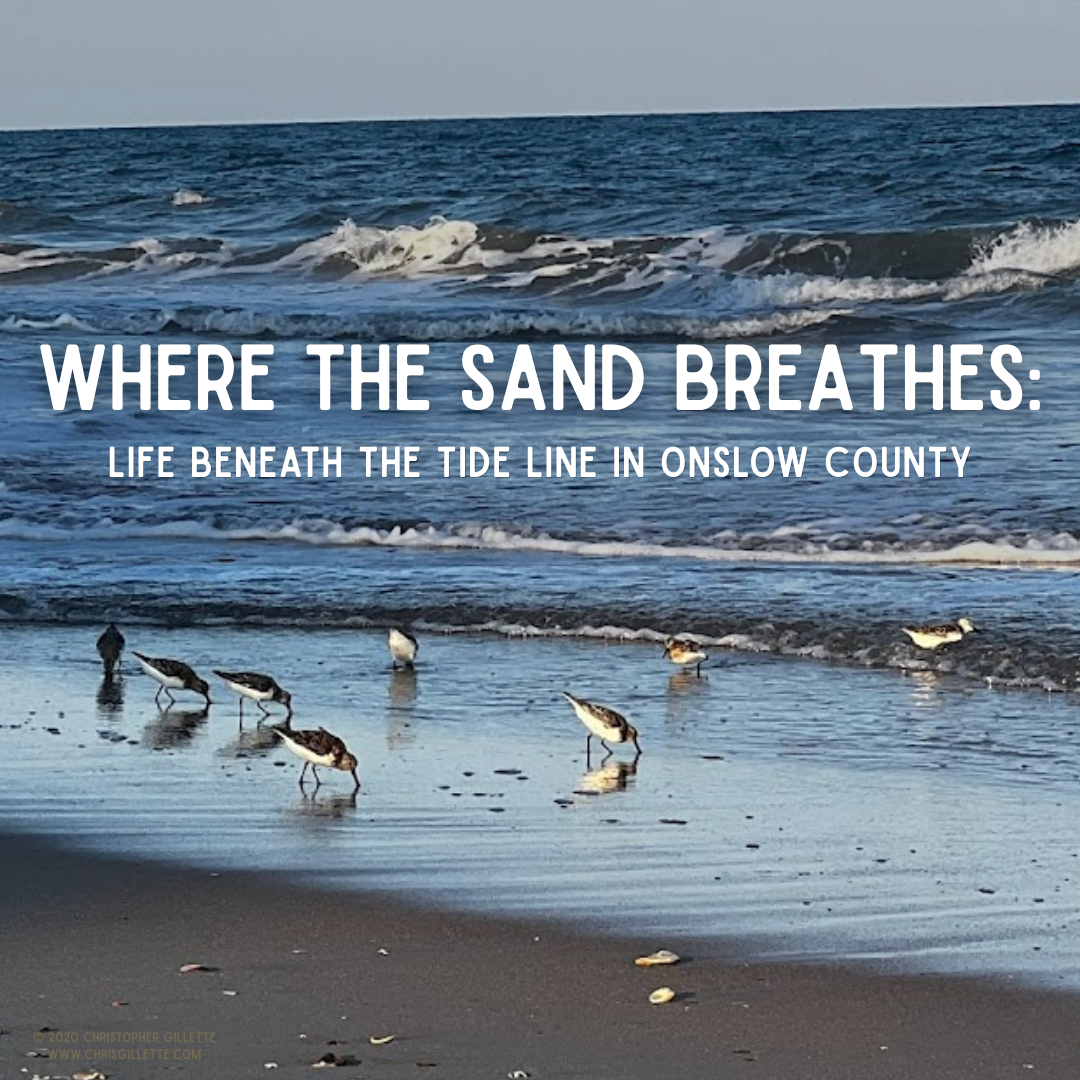
It is by looking up.Anyone who spends time on the beach has likely watched sanderlings (Calidris alba) racing along the edge of the surf. They dart forward as a wave retreats, stop suddenly to probe the sand, and then sprint away from the next incoming wave. A little farther up the beach, ruddy turnstones (Arenaria interpres) pick through wrack lines left behind by the tide. Along the surf edge, Eastern willets (Tringa semipalmata semipalmata) walk deliberately through the shallows, searching for movement beneath the water.
To many beachgoers, they are simply birds feeding along the shoreline.
What they are actually doing is reading the beach.
Each probe into the sand is a search for prey hidden beneath the surface. Mole crabs, small worms, amphipods, coquinas, and other invertebrates living within the tide line provide food for these birds (Dugan et al., 2003; Hubbard & Dugan, 2003).
The birds go where the food is.
When shorebirds gather along a stretch of beach, they are often revealing an ecosystem that would otherwise remain invisible. Their presence tells us that the sand beneath them is alive with prey, even if we cannot see it ourselves.
In many ways, shorebirds act as interpreters of the tide line. By watching where they feed, pause, and congregate, we gain a glimpse into the hidden community supporting them below.
Reading the Beach
From a distance, the tide line can seem almost empty. A narrow strip of wet sand separates the ocean from the rest of the beach. Waves arrive, waves leave, and little appears to change.
Spend a few minutes watching, however, and a different picture begins to emerge.
Shorebirds gather where the surf is most active. Tiny shells appear and disappear with the retreating waves. Fresh ghost crab burrows punctuate the upper beach. Even the wrack line left behind by the tide becomes a gathering place for scavengers and foraging birds.
What first appears to be a simple boundary between land and sea begins to look more like a busy shoreline neighborhood.

The animals living here are responding to the same thing: the constant movement of the tide. Food arrives with the surf, becomes available for a brief moment, and is quickly claimed by whatever creature is best adapted to find it. Some filter it from the water. Some collect it from the sand. Others hunt the animals already feeding there.
Because these organisms live so closely tied to the conditions of the beach, changes in their numbers can provide clues about the habitat itself (Defeo et al., 2009). A shoreline where birds are feeding, ghost crab burrows remain active, and life continues to reveal itself at the edge of the surf is often a sign that this narrow strip of beach is supporting the community that depends upon it.
When those communities decline, the change may not be immediately obvious. Yet over time the beach can begin to feel quieter. Fewer birds stop to feed. Fewer burrows appear in the sand. The signs become harder to find. Those changes can ripple outward through the food web, affecting species both on the beach and beyond it (Peterson et al., 2006).
The Threshold
The next time you stand at the edge of the surf, watch where the waves pause before sliding back toward the sea.
It is easy to see this narrow strip of shoreline as a boundary. Ocean on one side. Land on the other.
But the tide line is not really a dividing line at all.
It is a place where both worlds meet.
With every passing wave, food, oxygen, and life arrive from the ocean. Beneath the sand, animals capture it, consume it, recycle it, and pass it on. Shorebirds search for it. Ghost crabs emerge after dark to hunt it. Countless organisms spend their entire lives within a space that is neither fully ocean nor fully land.
Most people walk across this strip of beach without ever noticing it.
Yet it is one of the busiest places along the coast.
The next time you see shells appearing and disappearing in the surf, a flock of sanderlings racing the tide, or ghost crab burrows scattered across the upper beach, remember that these are not separate observations. They are pieces of the same story.
What appears to be an empty stretch of wet sand is actually a living threshold—a place where ocean and land remain connected through countless interactions happening beneath every step.
And once you see it, it becomes difficult to look at the shoreline the same way again.

References
Abude, R. R., Lôbo-Hajdu, G., Moreira, D. A., & Cabrini, T. M. (2024). Sandy beach mole crabs (Decapoda: Hippidae: Emerita): A systematic review of the anthropic impacts, populations density, and conservation strategies. Marine Environmental Research, 202, 106745. https://doi.org/10.1016/j.marenvres.2024.106745
Coull, B. C. (1999). Role of meiofauna in estuarine soft‐bottom habitats. Australian Journal of Ecology, 24(4), 327-343. https://doi.org/10.1046/j.1442-9993.1999.00979.x
Defeo, O., McLachlan, A., Schoeman, D. S., Schlacher, T. A., Dugan, J., Jones, A., Lastra, M., & Scapini, F. (2009). Threats to sandy beach ecosystems: A review. Estuarine, Coastal and Shelf Science, 81(1), 1-12. https://doi.org/10.1016/j.ecss.2008.09.022
Dugan, J. E., Hubbard, D. M., McCrary, M. D., & Pierson, M. O. (2003). The response of macrofauna communities and shorebirds to macrophyte wrack subsidies on exposed sandy beaches of Southern California. Estuarine, Coastal and Shelf Science, 58, 25-40. https://doi.org/10.1016/s0272-7714(03)00045-3
Ellers, O. (1995). Behavioral control of swash-riding in the clam Donax variabilis. The Biological Bulletin, 189(2), 120-127. https://doi.org/10.2307/1542462
Hubbard, D. M., & Dugan, J. E. (2003). Shorebird use of an exposed sandy beach in Southern California. Estuarine, Coastal and Shelf Science, 58, 41-54. https://doi.org/10.1016/s0272-7714(03)00048-9
McLachlan, A., & Defeo, O. (2018). The ecology of sandy shores (3rd ed.). Academic Press.
P, H. R., & Thiel, H. (1988). Intro study meiofauna. Smithsonian Books (DC).
Peterson, C. H., Bishop, M. J., Johnson, G. A., D’Anna, L. M., & Manning, L. M. (2006). Exploiting beach filling as an unaffordable experiment: Benthic intertidal impacts propagating upwards to shorebirds. Journal of Experimental Marine Biology and Ecology, 338(2), 205-221. https://doi.org/10.1016/j.jembe.2006.06.021
Pilkey, O. H., Rice, T. M., & Neal, W. J. (2014). How to read a North Carolina beach: Bubble holes, Barking sands, and rippled Runnels. UNC Press Books.
Schlacher, T. A., Lucrezi, S., Connolly, R. M., Peterson, C. H., Gilby, B. L., Maslo, B., Olds, A. D., Walker, S. J., Leon, J. X., Huijbers, C. M., Weston, M. A., Turra, A., Hyndes, G. A., Holt, R. A., & Schoeman, D. S. (2016). Human threats to sandy beaches: A meta-analysis of ghost crabs illustrates global anthropogenic impacts. Estuarine, Coastal and Shelf Science, 169, 56-73. https://doi.org/10.1016/j.ecss.2015.11.025
Schratzberger, M., & Ingels, J. (2018). Meiofauna matters: The roles of meiofauna in benthic ecosystems. Journal of Experimental Marine Biology and Ecology, 502, 12-25. https://doi.org/10.1016/j.jembe.2017.01.007
Thiel, M., & Kruse, I. (2001). Status of the nemertea as predators in marine ecosystems. Hydrobiologia, 456(1-3), 21-32. https://doi.org/10.1023/a:1013005814145
Wilson, J. G. (1999). Population dynamics and energy budget for a population of Donax variabilis (Say) on an exposed South Carolina beach. Journal of Experimental Marine Biology and Ecology, 239(1), 61-83. https://doi.org/10.1016/s0022-0981(99)00027-1
Wolcott, T. G. (1978). Ecological role of ghost crabs, Ocypode quadrata (Fabricius) on an ocean beach: Scavengers or predators? Journal of Experimental Marine Biology and Ecology, 31(1), 67-82. https://doi.org/10.1016/0022-0981(78)90137-5