The Hole at the Grass Line
At the soundside edge of Topsail Island, a hole in the ground is not unusual. Marsh grass gives way to higher soil, fiddler crabs disappear when footsteps approach, and small brown crabs move beneath boards, leaves, and anything else that holds a little shade. A burrow at the edge of a coastal yard may belong to an animal that has lived along this shore far longer than the yard has.
That is why a hole alone would be poor evidence of a blue land crab.
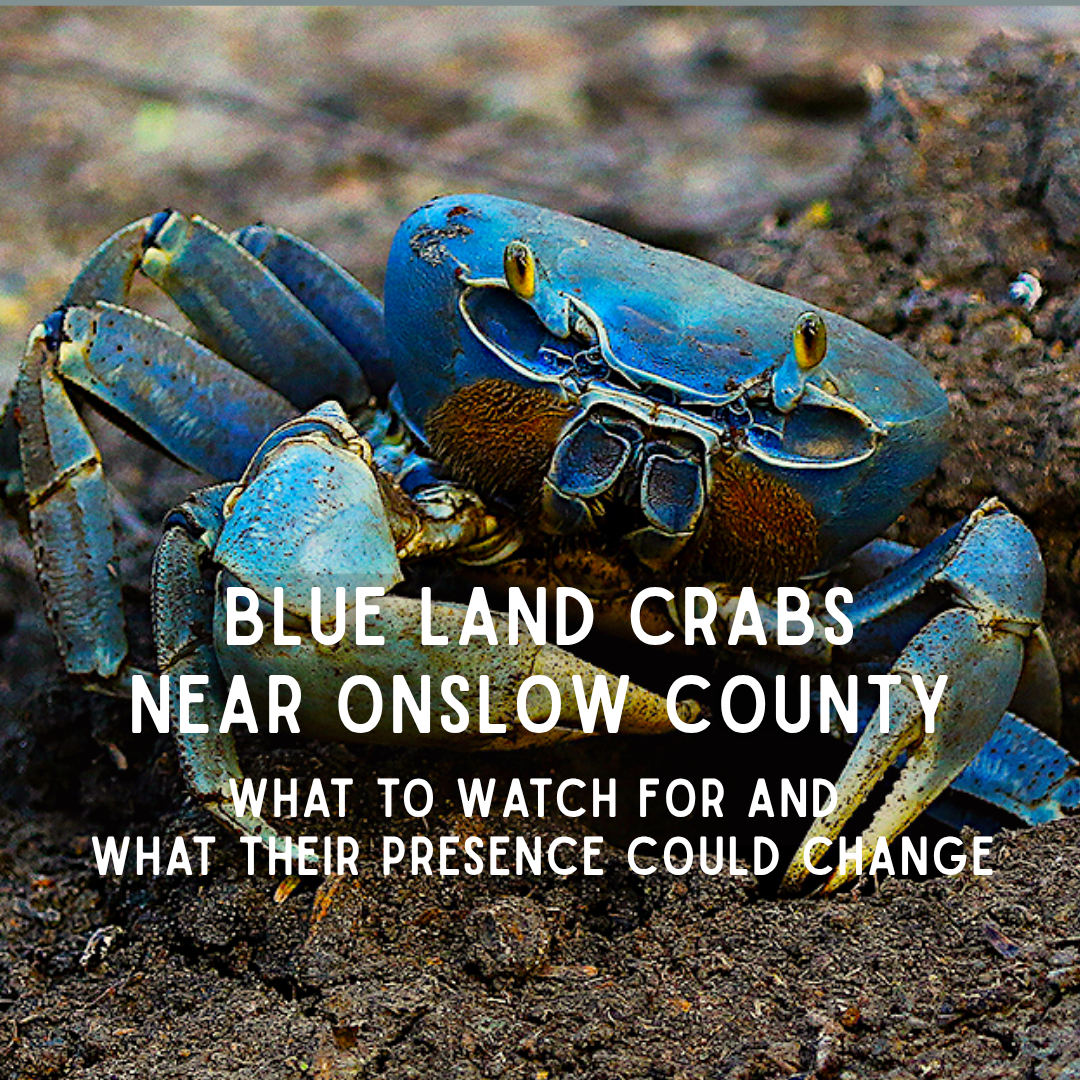
The animal itself would be harder to overlook. A mature blue land crab, Cardisoma guanhumi, can grow to nearly six inches across its shell, with legs that make it appear larger still. An adult male is often blue-gray and carries one powerful claw, but females may be pale gray or white, while younger crabs can be orange, brown, or purple. From a distance, the uneven claws can resemble those of a fiddler crab, except the entire animal has been enlarged to a scale unfamiliar in a Carolina backyard (Hostetler et al., 2025).
Until recently, it was also unfamiliar along this part of the coast. The blue land crab’s historically documented range in the continental United States followed the Gulf of Mexico and southern Florida, with Vero Beach long recognized as its northern Atlantic limit (Scott et al., 2023). Occasional South Carolina records began in 2008, followed by 53 verified sightings there during a concentrated period of public reporting in fall 2022 (Scott et al., 2023). North Carolina confirmed its first blue land crab in summer 2023. By August 2026, 23 sightings had been confirmed statewide and another 34 reports remained unverified. Two of the confirmed records this year came from Emerald Isle (NC DEQ, 2026).
Those numbers do not yet describe a population. They describe a question appearing in yards, along roads, and beside the marsh: whether a warm-water crab is occasionally reaching North Carolina or beginning to live here.
A Crab That Does Not Stay in One World
The blue land crab is neither a displaced Atlantic blue crab nor simply a giant fiddler. The shared color and oversized claw describe what it looks like, not its closest relatives. It belongs to Gecarcinidae, the land-crab family, whose members have moved much of adult life above the tide. Their gills still do the breathing, even in air, and those gills must remain damp. The crab can leave the water; it cannot leave water behind (Marin & Tiunov, 2023).
That need for moisture keeps the crab between two worlds. Adults may live above the reach of ordinary tides—in coastal forests, brushy ground, grasslands, drainage edges, and even yards—but they return to damp shelter when the day becomes hot or when a newly molted shell leaves them vulnerable. Many blue land crabs can live near one another without sharing that refuge; each normally keeps a burrow of its own (Herreid & Gifford, 1963; Moraes-Costa & Schwamborn, 2018).
That higher position separates the blue land crab from many crabs living in the flooded marsh below it, but not completely. Its life still returns to the estuary. After mating, a female carries hundreds of thousands of eggs beneath her abdomen and travels to salt or brackish water to release them (Hostetler et al., 2025). The larvae drift through several planktonic stages before settling and returning to land as small crabs. Warm water is particularly important during this development, while salinity determines which parts of an estuary can carry the larvae successfully (Costlow & Bookhout, 1968a, 1968b).
An adult can therefore live beneath shrubs beside a yard while its offspring begin among fishes and plankton. The species belongs to the coastal upland and the estuary at the same time, and that divided life helps explain how an animal tied to one burrow can appear far beyond the range where its adults were previously known.
How a Southern Crab Reached This Shore
Blue land crabs are not likely to have walked from Florida to the Carolinas. Adults forage close to their burrows and show strong attachment to a small home area. Females make longer reproductive movements toward water, but those are local journeys between upland burrows and larval-release sites rather than migrations along hundreds of miles of coastline (Moraes-Costa & Schwamborn, 2018).
Long-distance movement is more plausible during the larval stage. Once released, larvae spend weeks in coastal water before returning to land, allowing currents to carry them beyond the place where they hatched (Hostetler et al., 2023). A widening pattern of sightings from Florida through Georgia and South Carolina would be consistent with natural range expansion as warming water and milder cold periods make northern development and survival more possible (Costlow & Bookhout, 1968b; NC DEQ, 2026; Scott et al., 2023). Human transport, including movement with vessels or materials, remains another possibility because the present records do not yet reveal how the crabs arrived (NC DEQ, 2026).
Warmer conditions in Florida would not simply make the crabs decide to leave. The more relevant change would occur at the northern boundary, where conditions that once killed larvae or prevented overwintering may no longer do so as reliably (Costlow & Bookhout, 1968b). Warming can open habitat ahead of a species without pushing adults out of the habitat behind it.
It is tempting to imagine worsening conditions in Florida sending blue land crabs north, but that does not fit particularly well with how the adults live. Coastal development, altered groundwater, harvesting, and the loss of mangrove-edge habitat have reduced populations in parts of Puerto Rico and Brazil. When the ground around an adult’s burrow is destroyed, however, the crab may move only a short distance or disappear with the habitat. It does not begin a walk to North Carolina (Govender et al., 2008; Moraes-Costa & Schwamborn, 2018).
Development may matter after the much smaller, drifting stage has already reached a new shore. A canal edge, drainage ditch, watered lawn, or patch of coastal vegetation can offer the damp ground a young crab needs as it leaves the estuary. Human-altered places may therefore help connect suitable patches without being the reason the crab traveled north in the first place (Riascos et al., 2024).
So is the blue land crab native to North Carolina, or is it invasive? Neither label fits neatly yet. The species is native to warmer parts of the western Atlantic and Gulf of Mexico, including Florida, but North Carolina lies beyond its historically recognized Atlantic range in the United States. If larvae are reaching the Carolinas on coastal currents and surviving because conditions have become more favorable, then the crab’s natural range may be expanding. If crabs arrived with boats or transported materials, that would be an introduction. The sightings cannot yet tell us which occurred (Scott et al., 2023; NC DEQ, 2026).
Either way, arrival alone does not make a species invasive. The blue land crab would have to establish a reproducing population, continue spreading, and cause ecological or economic harm. North Carolina has confirmed crabs, but it does not yet have evidence of an established, harmful population (NC DEQ, 2026).
Emerald Isle Is Not Far Away
There were two confirmed blue land crab sightings in Emerald Isle this year, out of 23 confirmed cases across North Carolina (NC DEQ, 2026). This is what makes the Emerald Isle records matter here. The confirmed crabs were not found along some distant part of the North Carolina coast. They were found on Bogue Banks, northeast of Onslow County and only several dozen coastal miles from North Topsail Beach.
Between Emerald Isle and Topsail are connected sounds, tidal creeks, inlets, marshes, developed islands, and the Intracoastal Waterway. A crab confirmed on Bogue Banks does not prove that one is already living around North Topsail, Surf City, or the soundside of Topsail Island. It does place the animal within a coastal landscape that continues toward all three.
That does not mean currents are carrying crabs neatly from Emerald Isle toward Topsail, and the statewide sightings should not be read as a marching line. Some animals may represent separate arrivals; others may have gone unnoticed for years. The map brings the question closer. Only repeated observations can show where the crab has actually found a place—and which members of the existing crab community are already there.
The Crabs Already Here
Onslow County’s marsh edge is not waiting empty for a land crab to arrive. Several native crabs divide the same transition from tidal creek to high ground, although each uses a somewhat different part of it.

At low tide, the easiest to notice are often fiddlers. Atlantic marsh fiddler crabs, Minuca pugnax, favor muddier marsh sediment, while Atlantic sand fiddlers, Leptuca pugilator, are more common across sandy flats and the higher portions of the marsh. Red-jointed fiddler crabs, Minuca minax, appear where the water is fresher. Marsh and sand fiddlers have long been documented in North Carolina salt marshes, gathering into the familiar patches that vanish into small holes when a person approaches (O’Connor, 1993).
They sift algae, microbes, and bits of organic material from the surface, leaving tiny feeding marks across exposed sediment. Even a male carrying an oversized claw has a body only a fraction of the width of an adult blue land crab.
Closer to the cordgrass, purple marsh crabs, Sesarma reticulatum, move along muddy creek banks and feed heavily on the grass, including stems and tissues belowground. At ordinary numbers they are part of the marsh’s long-established community. Where their numbers become unusually high, their feeding can strip away vegetation and leave sediment exposed (Bertness et al., 2014; Wittyngham et al., 2024).
At the upper edge, the small brown crab beneath a board or patch of leaves may be a squareback marsh crab, Armases cinereum. Of the native crabs, it is the most likely to meet a blue land crab where marsh gives way to the yard. It moves above the high-water line, sometimes crossing lawns or climbing garage walls, and eats fallen leaves, living plants, and small invertebrates. Its menu is broad in much the same way as a blue land crab’s, although the squareback itself is far smaller (Buck et al., 2003).
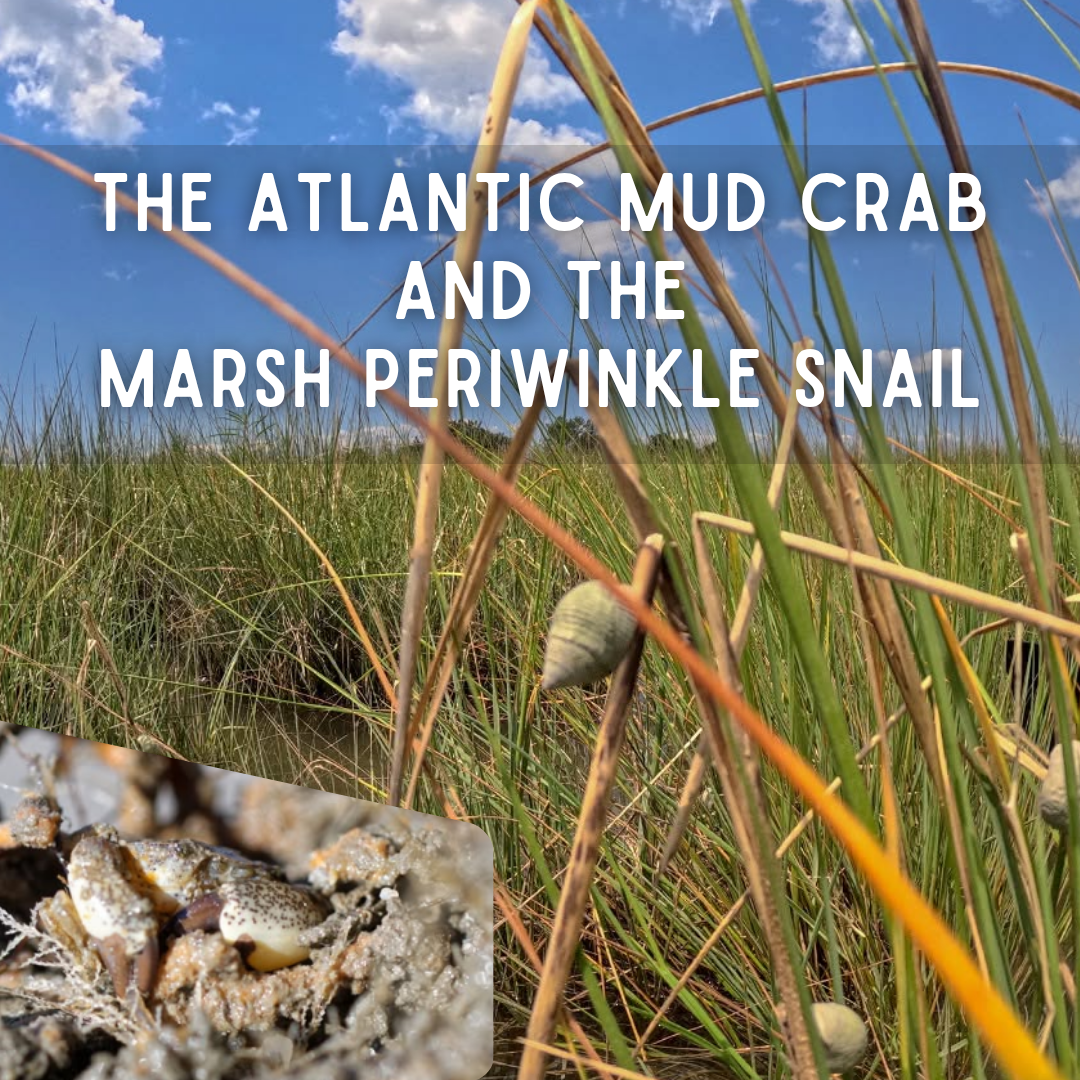
Other familiar crabs belong to neighboring settings. Atlantic mud crabs such as Panopeus herbstii remain among oyster shells, rocks, and submerged structure, where their heavy claws open oysters, clams, barnacles, and snails. Ghost crabs, Ocypode quadrata, occupy the open beach and dune sand on the ocean side. Either may be close in geographic distance to a blue land crab, but neither uses the soundside grass-to-yard boundary in quite the same way.
Each of these crabs already belongs to a particular part of the shore. A blue land crab would not arrive in an empty niche, but it would not duplicate any one of them either. To see where the differences matter, we have to look below the opening.
The Architecture Beneath the Opening
For a burrowing crab, the tunnel is more than a hiding place. It is a shelter from heat and predators, a humid chamber that protects the gills, and a safe place to molt. Its shape reflects the problem the crab needs it to solve, which is why burrows built only a few yards apart can belong to very different lives.
A blue land crab begins on higher ground with a comparatively broad entrance, then turns downward toward moisture. There is no single blueprint hidden below it. Burrows examined with a fiber-optic camera in Puerto Rico included short passages that descended at a shallow angle, longer tunnels that leveled before dropping sharply, and deep curves resembling an inverted S. Forked and corkscrew forms occurred less often. The route varied with the site, but the essential destination was usually the same: a humid refuge at or near groundwater, occupied by one crab rather than a colony sharing one chamber (Moraes-Costa & Schwamborn, 2018; Sample & Albrecht, 2016).

An Atlantic sand fiddler builds at another scale and for another rhythm. Its narrow shaft descends through sand exposed between tides, and a deeper breeding burrow may extend farther than the temporary refuge used while feeding. Across a flat, many small entrances can stand close together because each belongs to a small crab defending little more than the ground immediately around it. Although the shafts provide shelter and moist air, they remain much narrower than the passage required by an adult blue land crab (Christy, 1982). A fiddler opening would therefore be a poor ready-made home for a mature Cardisoma.

The purple marsh crab offers a different contrast. Its burrows occupy muddy, rooted creek banks and can become part of a connected network with several openings. When those networks become dense, especially where vegetation has already thinned, excavation and cordgrass feeding can loosen the bank and make sediment easier for moving water to carry away (Bertness et al., 2014; Farron et al., 2020). A blue land crab generally begins above ordinary tidal flooding and maintains a more solitary route toward groundwater. Its burrow should not be assumed to undercut a creek bank in the same way simply because both animals dig.
A ghost crab may also leave one obvious opening and a mound of newly moved sand, but its address is usually the open ocean beach or foredune. Its sloping or curving refuge is built in loose, comparatively dry beach sand, not at the moist soundside boundary between marsh and yard.

The squareback marsh crab makes an even clearer distinction. It commonly slips beneath leaves, logs, rocks, boards, and other cover at the upper marsh edge instead of constructing the large groundwater-reaching tunnel associated with an adult blue land crab. Mud crabs and Atlantic blue crabs do not make permanent terrestrial burrows at all. One uses submerged crevices; the other may bury itself temporarily in bottom sediment.

Burrow reuse deserves equal care. Smaller blue land crabs have been found in openings much larger than their bodies, which is consistent with their moving into burrows abandoned by larger blue land crabs (Carmona-Suárez & Guerra-Castro, 2012). For a smaller crab, an empty tunnel would mean less digging, less time exposed aboveground, and immediate access to a refuge that already holds moisture. Those are likely advantages rather than benefits tested directly.
The other crabs along a Carolina shore do not appear to offer the same shortcut. Their shelters are too narrow, too low in the marsh, too dry, or not true burrows at all. Nothing currently shows that blue land crabs routinely take over and enlarge the burrows of another crab species.
The digging leaves more than a hole. Soil brought up from below is spread across the surface, while leaves, scraps of food, old molts, and waste may collect inside. In places where blue land crabs are established, the soil within their burrows differs from the ground beside them in its mixture of sand and silt, acidity, organic matter, and nutrients including nitrogen, magnesium, and potassium (Quintero-Torres et al., 2018).
The open tunnel also allows air and water to reach soil that had been sealed underground. Across many kinds of coastal crabs, burrowing tends to loosen sediment and change the chemical work carried out there by microbes. How much changes—and whether the effect helps or harms the plants above—depends upon the crab, the vegetation, and where the burrow sits (Rinehart et al., 2024).

That does not mean each hole ventilates an entire marsh. Oxygen entering a tunnel may change only a thin layer of soil along its walls. Around fiddler burrows, that reach has been far smaller than the familiar phrase “aerates the soil” might suggest (Michaels & Zieman, 2013). A single high-ground blue land crab tunnel is not a new tidal creek either. Rain, groundwater, or an unusually high tide may enter it and change the wetness immediately around the opening, but blue land crab burrows have not been shown to redirect tidal flow through a maritime forest.
Roots present the same uncertainty. Digging can break fine roots and loosen the soil holding them, while the extra space and shifted nutrients around a tunnel may create new conditions for roots and soil life. Blue land crabs also clip and eat plants aboveground, so a damaged plant would not tell us whether feeding, digging, or both were responsible.
One occupied hole may change little beyond a small patch of ground. If the same digging were repeated across many burrows, those patches could begin to influence which plants take hold, how firmly their roots bind the edge, and how water moves through the soil. That possibility is one reason burrows are worth mapping. It is not evidence that those changes are already happening at North Carolina sighting sites.
At first, the tunnel keeps one crab alive. Only when that work is repeated across a place does it begin to become part of the landscape.
From the surface, however, most of that architecture remains hidden.
What a Burrow Can—and Cannot—Tell Us
A mature blue land crab may leave an opening three to five inches wide. Freshly excavated soil may collect around the entrance, and plant pieces or tracks may be visible nearby. These clues become more persuasive when the hole sits above normal tidal flooding in shaded, moist ground and a very large crab has been seen retreating into it (Hostetler et al., 2025).
It is still not an identification. A smaller blue land crab may occupy an older, larger burrow, while erosion can widen the entrance to a much smaller tunnel. Marsh soil also collapses, roots leave openings, rodents dig, and water continually reshapes the grass line. Size alone can mislead, particularly in a photograph with nothing nearby for scale.
The setting and the pattern offer better clues. Many small holes spread across exposed mud or sand point toward fiddlers. Several openings cut through a rooted creek bank fit purple marsh crabs. One hole high on the dry ocean beach is more likely a ghost crab’s. Squarebacks are often found beneath something rather than beside a large mound of freshly dug soil. The strongest match for the blue land crab would bring several details together: a broad opening on higher soundside ground, signs of recent digging, and a crab far larger than the native marsh species.
That is why a useful photograph includes more than the hole. The crab, entrance, moved soil, surrounding plants, nearby water, and something familiar for scale allow the scene to be read together. There is no need to dig, probe, or flood the tunnel. Without the animal, a burrow can identify a place worth watching, but not the species living beneath it.
What the New Crab Would Eat
The large claw may make a blue land crab look like a hunter arriving to eat every smaller crab in its path. Most of what it gathers, however, is plant material: fallen leaves, fruit, berries, flowers, tender shoots, grasses, and seeds. It may carry that food home and pull some of it underground. Insects, carrion, feces, and other animal matter add to the diet when available, and blue land crabs sometimes eat one another (Gifford, 1962; Herreid, 1963; Moraes-Costa & Schwamborn, 2018).
That does not place native crabs entirely off the menu. A blue land crab may seize a small animal it can catch, but regular hunting of fiddlers, squarebacks, or purple marsh crabs is unlikely to be its main influence. The more important changes would probably begin with the plants and fallen leaves it removes, the ground it excavates, and the space it keeps around its burrow.
The amount of competition would differ from crab to crab. Fiddlers graze the thin film of algae, microbes, and organic particles coating the marsh surface, so they share relatively little food with a crab gathering fruit and leaves above the high-tide line. Squareback and purple marsh crabs share more of that plant-based menu, although they forage at different scales and in different parts of the marsh. If blue land crabs remain, the strongest overlap may be over shaded ground, damp refuge, and nearby plant food rather than over a particular prey animal.
What Established Populations Tell Us
Sharing food and high ground does not make displacement inevitable. Where blue land crabs have lived for generations, other crabs continue to live beside them by using different levels of the shore. Along the Brazilian coast, for example, the mangrove crab, Ucides cordatus, digs into softer ground between the tides, while Cardisoma lives higher in firmer, sandier soil. Their ranges overlap without their burrows occupying precisely the same ground (Firmo et al., 2012).
North Carolina has a different community, but the same separation by water, soil, and elevation is already familiar here. The squareback comes closest to overlapping with a blue land crab at the upper edge. Even there, one defended Cardisoma burrow might cost a squareback a feeding spot without removing squarebacks from the wider marsh.
The first change people noticed might therefore be simpler than one crab replacing another: a much larger animal at the grass line, fresh soil beside an entrance, fallen fruit or leaves drawn toward it, and tender plants clipped within a short walk of the burrow.
That picture could change if the crabs became numerous. Many defended burrows would divide more of the narrow band of damp high ground, increasing competition for shelter and food. Their digging would repeat the small soil changes described above, while their feeding could influence which seeds and seedlings survive and how quickly fallen leaves disappear. Those broader forest effects are known across several land-crab species rather than from a newly established Cardisoma population, but they show why abundance matters more than the mere arrival of one large crab (Lindquist et al., 2009).
Predators would respond only if the crabs became dependable prey. Large birds and mammals eat blue land crabs within their established range, while eggs and larvae released into the estuary become food for aquatic animals (Firmo et al., 2012; Hostetler et al., 2025). One adult crossing a Carolina yard offers one unusual meal. A recurring population could give raccoons or coastal birds a reason to search the marsh edge and could place many larvae into the estuarine food web.
This is where two kinds of change can look like the same thing. Digging alters the ground directly, making the crab an ecosystem engineer (Rinehart et al., 2024). A trophic cascade would have to continue through feeding relationships: fewer surviving seedlings changing the vegetation, for example, or predators drawn to land crabs changing their pressure on other prey (Lindquist et al., 2009).
Blue land crabs are capable of beginning both pathways. What the North Carolina sightings cannot yet tell us is whether enough crabs are arriving, surviving, and reproducing for the work of individuals to become the work of a population.
When One Sighting Becomes a Place
One dated photograph gives the map a place. Another observation weeks or months later begins to show whether the crab stayed. As those records accumulate, they can reveal when the crabs are active, whether they appear after rain, which kinds of ground they use, and whether they return across seasons. Crabs of different sizes at one site may have survived across more than one year, while juveniles, egg-bearing females, or repeated movements toward the water would offer stronger evidence that the species is completing more of its life cycle here.
The same map can show where the larger ecological questions belong. One wandering adult does not tell us that native crabs are being displaced or that a trophic cascade has begun. Several occupied burrows, plant damage, younger crabs, and repeated sightings at the same place would give biologists a reason to compare its vegetation, soil, native crabs, and predators with nearby places where Cardisoma is absent.
Anyone who sees a possible blue land crab can photograph it from a safe distance and submit the image, date, and location through the Blue Land Crab Sightings reporting. A photograph showing the animal, its approximate scale, and the surrounding habitat is more useful than trying to catch or relocate it.
That distinction matters for anyone standing at the grass line. A three-inch hole is not an identification, clipped leaves are not proof of ecological harm, and a large crab is not automatically an invasive species. Each is a piece of context. Together, photographed and reported without catching or relocating the animal, those pieces can show whether North Carolina is receiving occasional southern visitors or adding a new resident to the narrow landscape between the forest and the sea.
The coast will answer that slowly, one place at a time.
References
Bertness, M. D., Brisson, C. P., Bevil, M. C., & Crotty, S. M. (2014). Herbivory drives the spread of salt marsh die-off. PLoS ONE, 9(3), e92916. https://doi.org/10.1371/journal.pone.0092916
Buck, T. L., Breed, G. A., Pennings, S. C., Chase, M. E., Zimmer, M., & Carefoot, T. H. (2003). Diet choice in an omnivorous salt-marsh crab: Different food types, body size, and habitat complexity. Journal of Experimental Marine Biology and Ecology, 292(1), 103-116. https://doi.org/10.1016/s0022-0981(03)00146-1
Carmona-Suárez, C. A., & Guerra-Castro, E. (2015). Comparison of three quick methods to estimate crab size in the land crabs <i>Cardisoma guanhumi</i> Latreille, 1825 and <i>Ucides cordatus</i> (Crustacea: Brachyura: Gecarcinidae and Ucididae). Revista de Biología Tropical, 60, 139. https://doi.org/10.15517/rbt.v60i0.19854
Christy, J. H. (1982). Burrow structure and use in the sand fiddler crab, Uca pugilator (Bosc). Animal Behaviour, 30(3), 687-694. https://doi.org/10.1016/s0003-3472(82)80139-5
Costlow, Jr., J. D., & Bookhout, C. G. (1968a). The complete larval development of the land-crab, Cardisoma guanhumi Latreille in the laboratory (Brachyura, Gecarcinidae). Crustaceana, 15(3), 259-270.
Costlow, Jr., J. D., & Bookhout, C. G. (1968b). The effect of environmental factors on development of the land-grab,cardisoma guanhumiLatreille. American Zoologist, 8(3), 399-410. https://doi.org/10.1093/icb/8.3.399
Farron, S., Hughes, Z., FitzGerald, D., & Strom, K. (2020). The impacts of bioturbation by common marsh crabs on sediment erodibility: A laboratory flume investigation. Estuarine, Coastal and Shelf Science, 238, 106710. https://doi.org/10.1016/j.ecss.2020.106710
Firmo, A., Tognella, M. M., Silva, S. R., Barboza, R. R., & Alves, R. (2012). Capture and commercialization of blue land crabs (“guaiamum”) Cardisoma guanhumi (Lattreille, 1825) along the coast of Bahia state, Brazil: An ethnoecological approach. Journal of Ethnobiology and Ethnomedicine, 8(1). https://doi.org/10.1186/1746-4269-8-12
Gifford, C. A. (1962). Some observations on the general biology of the land crab, cardisoma guanhumi (Latreille), in South Florida. The Biological Bulletin, 123(1), 207-223. https://doi.org/10.2307/1539516
Govender, Y., Sabat, A. M., & Cuevas, E. (2008). Effects of land-use/land-cover changes on land crab,Cardisoma guanhumi, abundance in Puerto Rico. Journal of Tropical Ecology, 24(4), 417-423. https://doi.org/10.1017/s0266467408005130
Herreid, C. F. (1963). Observations on the feeding behavior of Cardisoma Guanhumi (Latreille) in southern Florida1). Crustaceana, 5(3), 176-180. https://doi.org/10.1163/156854063×00093
Herreid, C. F., & Gifford, C. A. (1963). The burrow habitat of the land crab, Cardisoma guanhumi (Latreille). Ecology, 44(4), 773-775. https://doi.org/10.2307/1933027
Hostetler, M. E., Mazzottii, F. J., & Taylor, A. K. (2025, October 28). Blue land crab (Cardisoma guanhumi) (WEC 30). Department of Wildlife Ecology and Conservation, UF/IFAS Extension. https://ask.ifas.ufl.edu/publication/UW013
Lindquist, E. S., Krauss, K. W., Green, P. T., O’Dowd, D. J., Sherman, P. M., & Smith, T. J. (2009). Land crabs as key drivers in tropical coastal forest recruitment. Biological Reviews, 84(2), 203-223. https://doi.org/10.1111/j.1469-185x.2008.00070.x
Marin, I. N., & Tiunov, A. V. (2023). Terrestrial crustaceans (Arthropoda, crustacea): Taxonomic diversity, terrestrial adaptations, and ecological functions. ZooKeys, 1169, 95-162. https://doi.org/10.3897/zookeys.1169.97812
Michaels, R. E., & Zieman, J. C. (2013). Fiddler crab (Uca spp.) burrows have little effect on surrounding sediment oxygen concentrations. Journal of Experimental Marine Biology and Ecology, 448, 104-113. https://doi.org/10.1016/j.jembe.2013.06.020
Moraes-Costa, D., & Schwamborn, R. (2018). Site fidelity and population structure of blue land crabs (Cardisoma guanhumi Latreille, 1825) in a restricted-access mangrove area, analyzed using PIT tags. Helgoland Marine Research, 72(1). https://doi.org/10.1186/s10152-017-0504-0
NC Dept. of Environmental Quality. (2026, August 26). Please report blue land crab sightings. https://www.deq.nc.gov/news/press-releases/2026/08/26/please-report-blue-land-crab-sightings
O’Connor, N. (1993). Settlement and recruitment of the fiddler crabs Uca pugnax and U. pugilator in a North Carolina, USA; salt marsh. Marine Ecology Progress Series, 93, 227-234. https://doi.org/10.3354/meps093227
Quintero-Torres, E., Chacón, N., & López-Sánchez, B. (2018). The ecosystem engineering role of the neotropical crab Cardisoma guanhumi on mangrove soil properties. Wetlands Ecology and Management, 26(5), 993-1000. https://doi.org/10.1007/s11273-018-9618-7
Riascos, J. M., Obonaga, L. D., & Ramos, J. (2024). Is the threatened land crab Cardisoma guanhumi conquering human‐dominated systems? Ecology and Evolution, 14(4). https://doi.org/10.1002/ece3.10737
Rinehart, S. A., Dybiec, J. M., Walker, J. B., Simpson, L., & Cherry, J. A. (2024). Effects of burrowing crabs on coastal sediments and their functions: A systematic meta‐analysis. Ecosphere, 15(7). https://doi.org/10.1002/ecs2.4927
Sample, S., & Albrecht, M. (2016). Determination of the burrow shapes of Cardisoma guanhumi on Vieques, Puerto Rico. Journal of Coastal Life Medicine, 4(2), 94-97. https://doi.org/10.12980/jclm.4.2016j5-245
Scott, E., Kendrick, M., Kingsley-Smith, P., James, M., Lemeris, J., Weeks, E., & Sasson, D. (2023). Using public sightings to document the widespread distribution of the non-endemic blue land crab, Cardisoma guanhumi, in South Carolina. Southeastern Naturalist, 22(4). https://doi.org/10.1656/058.022.0403
Wittyngham, S. S., Johnson, D. S., Chen, Y., & Kirwan, M. L. (2024). A grazing crab drives saltmarsh carbon storage and recovery. Ecology, 105(9). https://doi.org/10.1002/ecy.4385