
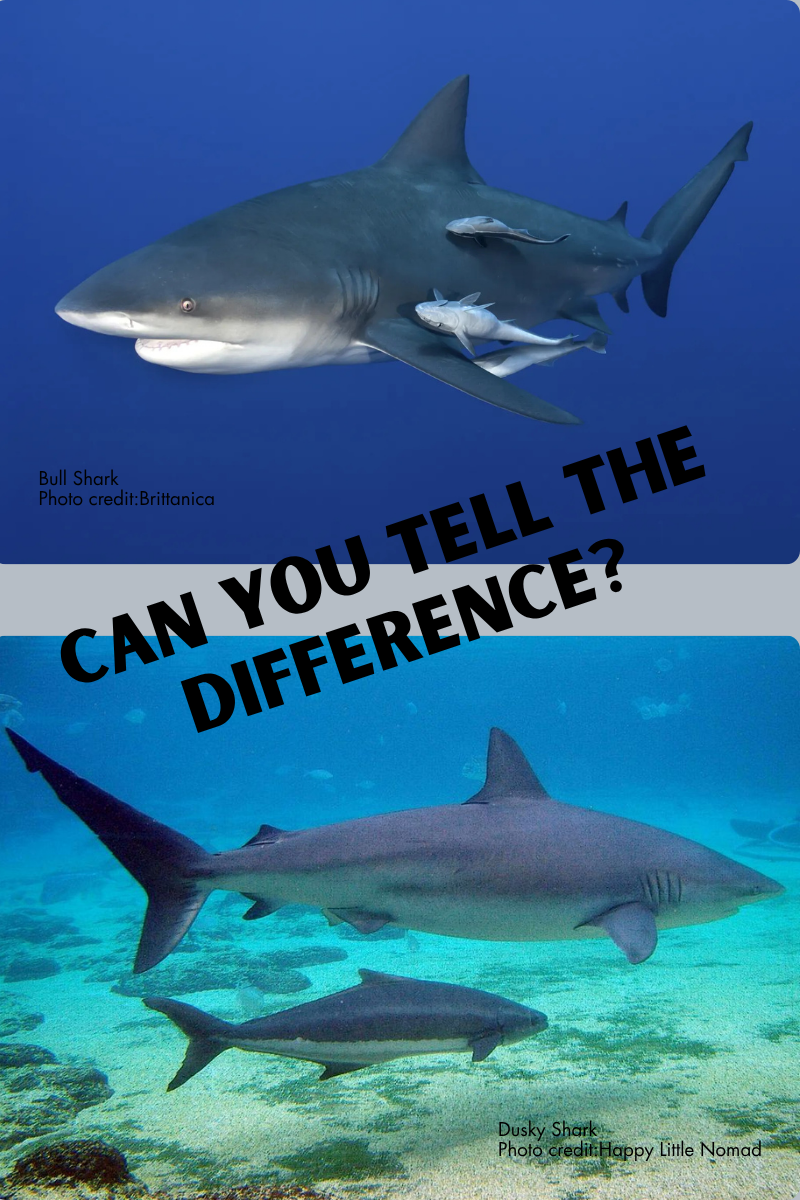
Many sharks have similar appearances in body shape and colorations, especially when viewed from above. Juvenile sharks can be difficult to identify because their markings and proportions are not developed to fully resemble adults. The ability to obtain clear, prolonged views of sharks underwater can be difficult due to shark movement and water clarity. Not all people that encounter sharks have the specialized knowledge required for accurate identification.
But which sharks are often misidentified in North Carolina, and why? It’s often like a game of “can you spot the differences?” when trying to identify similar species. Let’s review the top 3 misidentified sharks in NC.
? Who are the Top 3 Misidentified Shark
1. Sandbar shark (Carcharhinus plumbeus) vs dusky shark (Carcharhinus obscurus)
Why They Are Confused
Both sharks can grow to large sizes with a bulky appearance with overlapping habitats. Both have a brown to bronze upper body that fades into a white belly. They look similar because they are members of the same shark genus, Carcharhinus or Requiem sharks, that share some of the same qualities such as, slender to stout bodies, their first dorsal fin is larger than their second dorsal fin, have a long upper tail lobe, and single-cusped blade-shaped teeth.
Key Differences
- Sandbar shark: Large, tall dorsal fin with its leading edge located ahead of its pectoral fins
- Dusky shark: Slightly less bulky than the sandbar shark with a shorter dorsal fin that originates behind its narrower pectoral fins, and a snout length that is equal to or shorter than its mouth width making it appear more pointy. Side note: dusky sharks prefer cooler water temperatures, between 66 and 82 degrees fahrenheit, so they may not be seen frequently in warm summer waters.


2. Blacktip shark (Carcharhinus limbatus) vs spinner shark (Carcharhinus brevipinna)
Why They Are Confused
Both sharks leap from the water and spin during feeding. They look similar because they are members of the same shark genus, Carcharhinus or Requiem sharks, that share some of the same qualities such as, slender to stout bodies, their first dorsal fin is larger than their second dorsal fin, have a long upper tail lobe, and single-cusped blade-shaped teeth.
Key Differences
- Spinner shark: More slender, all fins (except the anal fin) are often black-tipped, spins more during breaching
- Blacktip shark: Heavier body than the spinner shark, only dorsal and pectoral fins have black tips, and the anal fin has a white tip.


3. Atlantic sharpnose shark (Rhizoprionodon terraenovae) vs juvenile blacktip shark (Carcharhinus limbatus)
Why They Are Confused
The juvenile blacktip shark has not fully developed into its final adult stage, so it lacks markings and definition that can distinguish it better from Atlantic sharpnose shark. The blacktip, in its adult stage, can reach up to 6 feet, while the Atlantic sharpnose shark only reaches a maximum length of 3.5 that makes it a similar size to a juvenile blacktip shark. Both forage in shallower waters and share the same habitat.
Key Differences
- Juvenile blacktip sharks: Have black tips on their fins, and a white tipped anal fin. Gray to gray-brown coloration with a white underside.Wedge-shaped line or Z-shaped line along its sides.
- Atlantic sharpnose sharks: Have white spots along its side, second dorsal fin, blacktipped, originating over or behind its anal fin. This will be the only black tipped fin on this species.


Safety Note: Are They Dangerous?
Most sharks seen nearshore in Onslow County are not aggressive toward humans and play a crucial role in ocean health. Most sightings are brief and harmless. That said, avoid swimming near fishing piers or schools of baitfish, especially at dawn or dusk, and between fishers casting from the shore.
Why It Matters
Correct species identification helps:
- Local fishermen adhere to fishing regulations
- Researchers track species populations
- Beachgoers feel informed and safe
- Conservationists protect nurseries and feeding grounds
Want to Help?
Have you seen a shark? I am looking for information on locations of juvenile sharks. You can report sightings or photos to support my independent research by posting on my social media channels or email. Please follow our Instagram and Facebook pages to stay informed, ask questions, or post your pictures!
