
Watch fish for more than a few minutes, and something begins to stand out.
They do not all move through the water the same way.
A school of mullet slips across a creek with steady, effortless motion. A red drum twists through flooded marsh grass, turning between oyster clumps where shrimp and juvenile crabs have nowhere left to hide. A southern flounder erupts from the sand where, a moment before, there seemed to be nothing at all. Farther offshore, a little tunny slices through baitfish near the surface, while a cownose ray appears to fly beneath the water with its long tail trailing quietly behind.
The water is the same.
The rules of physics are the same.
But each animal has answered those rules differently.
A fish’s tail is far more than the end of its body. It is a record of how that fish survives. It can reveal where the fish spends its time, how it captures prey, how it escapes predators, how much energy it can afford to spend moving, and the role it fills within the larger ecosystem.
Like wings on birds or feet on mammals, the tail, known as the caudal fin, carries the shape of a life lived in a particular place.
To read a tail is to begin reading how fish use the water differently.
Every Fish Faces the Same Challenge
Moving through water is expensive.
Water is nearly 800 times denser than air (Vogel, 1996). Every sweep of the body pushes against it. Every turn creates resistance. Every burst of speed requires energy that cannot later be used to grow, migrate, reproduce, or avoid becoming another animal’s meal.
No fish escapes those limits.
Instead, each species works within them.
A fish moves as muscles contract in waves along the body, transferring force toward the caudal peduncle, the narrow region where the body meets the tail (Borazjani & Daghooghi, 2013; Sfakiotakis et al., 1999). From there, energy reaches the caudal fin. Each sweep of the tail pushes against surrounding water, creating pressure differences and rotating vortices that help produce forward thrust (Borazjani & Daghooghi, 2013; Maia et al., 2021).

The tail is where the body’s power meets the water.
Yet the same basic problem has produced many different solutions.
Some fish are built for steady cruising. Others are built for sudden bursts. Some rely on tight turns. Some barely use the tail in the way we expect at all.
There is no perfect fish tail.
There are only tails shaped by different lives.
A fish that spends its life crossing miles of open water faces different problems than one weaving through flooded marsh grass. A predator that depends on surprise needs something different than one chasing baitfish across the surface. Even the bottom itself asks different things of the animals that live there.
Every tail that follows is one answer to those demands.
The Tail Never Works Alone
It is easy to focus on the tail because it is the most visible part of the movement.
But no fish swims with its tail alone.
The body determines how much drag the fish creates. The muscles generate the force. The caudal peduncle channels that force into the tail. Pectoral fins stabilize, steer, brake, or produce lift. Even the stiffness of the body changes how efficiently motion travels through the water.
A tuna is not fast because of its crescent tail alone. Its narrow caudal peduncle, streamlined body, stiff swimming motion, finlets, and powerful muscle arrangement all work together to conserve energy while moving through open water.
A red drum is not shaped for that same kind of movement. Its broader body, muscular peduncle, and less deeply forked tail serve a different purpose in a different landscape.
A flounder’s tail only makes sense after the rest of the fish has flattened into the bottom.
A shark’s tail cannot be understood without its pectoral fins.
The tail is part of a system (Lauder & Drucker, 2004; Sfakiotakis et al., 1999).
And that system is built around how the animal earns its living.
Built to Cross Open Water
Away from oyster reefs, marsh grass, docks, and submerged roots, the water opens.
There are fewer places to hide.
Prey may be scattered across greater distances.
Movement becomes less about turning around obstacles and more about conserving energy across space.
Watch Spanish mackerel feeding from a pier in late summer and they rarely seem to stop moving. The same is true for little tunny exploding through bait schools just beyond the breakers. Their tails were never built for hovering over one patch of water. They were built for finding the next meal, wherever it happens to be.
Spanish mackerel, bluefish, Atlantic bonito, little tunny, and many jacks carry deeply forked or crescent-shaped tails (Lighthill, 1971; Song et al., 2020; Tack & Gemmel, 2022). Their narrow caudal peduncles and relatively stiff bodies limit unnecessary side-to-side motion, directing more of each tail beat into forward movement. The tall, narrow shape of the tail also reduces drag while allowing fish to maintain speed through repeated strokes.
Their speed is impressive.
But efficiency is the deeper story.
Out beyond the marsh and inlets, where prey may be separated by miles rather than feet, every unnecessary movement matters. A tail that saves a small amount of energy with each stroke can eventually become another mile traveled, another school of baitfish reached, another day survived.
In open water, the tail becomes a tool of endurance.
Built for Split-Second Decisions
The marsh asks something different.
As the tide rises, red drum move into flooded Spartina where shrimp, juvenile blue crabs, and small fishes scatter through stems and oyster clusters. Sheepshead pick around pilings and shell edges. Black sea bass patrol reefs where every ledge may conceal prey or danger. Oyster toadfish wait in crevices, relying less on pursuit than on the suddenness of their strike.
These fishes do not all carry identical tails or hunt in exactly the same way.
None of them needs to cross open water all day.
They need control.
Every oyster shell, grass stem, piling, and dock creates another obstacle. The fish that succeeds here is rarely the fastest. It is the one that can change direction before its prey—or predator—does.
Compared with the narrow crescents of open-water cruisers, rounded, truncate, and slightly emarginate tails move their broader bodies through water (Song et al., 2020; Tack & Gemmel, 2022). That creates more drag, but it also allows the fish to push hard against the water at low speeds, accelerate more quickly, stop abruptly, and turn within confined spaces. A broad, muscular caudal peduncle helps deliver power immediately rather than conserving energy over long distances.
Other fins join in. Pectoral fins brake and steer. The body bends around obstacles. The tail supplies the final shove that send the fish around an oyster clump or into a pocket of flooded grass.
In a maze of oyster reefs, roots, pilings and marsh grass, turning one body length tighter can matter far more than maintaining speed over ten miles.
This type of tail reflects that reality.
Built to Become the Bottom
Few fishes rewrite the body plan as dramatically as a southern flounder.
It does not begin life looking like the fish we recognize.
As a larva, it swims upright with one eye on each side of the head, shaped much like other young fishes drifting through the water column. Then the transformation begins.
One eye slowly migrates across the skull (Okada et al., 2003). The body flattens. Pigment concentrates on what becomes the upper surface. The fish settles onto one side and begins living as part of the seafloor (Midway et al., 2024).
Most people notice the eyes.
But the tail changed jobs, too.
A flounder does not need a tail built for constant cruising. It needs one capable of launching a body that has already disappeared. The fish may remain motionless on sand or mud until a shrimp or small fish comes close enough. Then the body bends, the tail snaps, and the flounder surges forward in a short, explosive burst before settling back into the bottom (Midway et al., 2024).
Its tail serves as surprise.
On an open sandy bottom, there may be no grass, reef, or submerged root behind which a predator can wait. The flounder solves that problem by matching the bottom beneath it, sometimes shifting its color and pattern as the surrounding sediment changes.
Rather than finding cover, the flounder became the cover.
Its tail became the spring that launches an attack from a place prey never realized was occupied.
Built for Places Others Cannot Reach
Some fish survive by entering spaces where others cannot follow.
American eels move through tidal creeks, undercut banks, submerged roots, culverts, marsh edges, and dark spaces beneath docks where a stiffer fish body would become a liability.
Their dorsal, caudal, and anal fins merge into one continuous ribbon (Stin et al., 2024). Instead of relying on distinct tail beats alone, waves of motion travel along much of the body, allowing the eel to bend through narrow openings and complex structure.
Speed is not the point.
Access is.
Yet, the same flexible body that lets an eel disappear beneath roots or slip through a flooded marsh also carries it across an ocean.
American eels hatch in the Sargasso Sea and reach the North American coast after drifting within ocean currents as transparent, leaf-shaped larvae (Secor, 2015; Tsukamoto, 2009). They enter estuaries as glass eels and gradually develop the long, muscular bodies that will carry them through tidal creeks, rivers, ponds, and wetlands.,
Years later, mature eels reverse that journey. They leave inland and coastal habitats and return toward the Sargasso Sea to spawn.
They do not cross ocean like tuna. Rather that holding most of the body stiff and driving a narrow tail rapidly from side to side, an eel sends broad waves of motion along its body (Stin et al., 2024). That swimming style creates more resistance at high speeds, but it remains effective over long distances and across changing environments.
One body design solves two very different problems: it allows the eel to move through open water, climb through a watershed, pass beneath roots and around obstructions; and the other allows it to eventually return to sea.
Its strength is not mastery of one kind of water. It is the ability to keep moving as the water changes. Flexibility opens doors that speed never could.
When the Tail Stops Being the Engine
At first glance, rays appear to have dramatic tails.
Atlantic stingrays, southern stingrays, and cownose rays all trail long, whip-like tails behind wide bodies moving through coastal waters, tidal creeks, sounds, and inlets.
But watch one closely and the story changes.
The tail is not doing most of the swimming.
The large pectoral fins are (Rosenberger, 2001).
Watch a cownose ray passing beneath the surface seems to fly through the water. Each pointed wing rises and falls in a smooth stroke, producing the thrust that carries the ray forward. It’s tail follows behind, sometimes so quietly that it appears almost disconnected from the movement of the animal.
Closer to the bottom, Atlantic and southern stingrays use their broad discs differently. Their pectoral fins ripple or undulate as they move over sand and mud, where they can settle into the sediment and wait nearly unseen. Once propulsion shifted from the tail to the expanded pectoral fins, the tail was no longer required to serve as the main engine (Rosenberger, 2001).
But it did not become useless.
These rays carry one or more serrated, venomous spines on or near the base of the tail. The spine is not used to hunt. It is defensive, capable of discouraging a shark or other predator that attacks from behind or above (Maia et al., 2012).
The placement of the tail also reflects how each ray lives. Bottom-dwelling stingrays can lift and swing it when threatened, especially when pressure from above traps the animal against the sediment. Cownose rays spend more time actively swimming with the tail streaming behind their wing-driven bodies.
The engine moved into the wings.
The tail was free to serve another purpose.
When Lift Matters
Sharks carry another kind of solution.
Unlike most bony fishes, sharks do not have a swim bladder to help regulate buoyancy (Maia et al., 2012). Their position in the water depends on several features working together: an oil-rich liver, body shape, pectoral fins, and the tail.
In many sharks, the upper lobe of the caudal fin is longer than the lower lobe. This heterocercal tail helps generate thrust while also influencing lift and body angle as the shark moves forward (Thomson, 1976; Maia et al., 2012). The pectoral fins, and in hammerhead sharks – their heads, help balance those forces, acting like underwater wings that stabilize the animal in the water column.
A shark’s tail and pectoral fins are not separate stories.
They are part of the same swimming system. But that system is adjusted for different lives.
A bull shark moving through a muddy estuary needs power at lower speeds and enough control to follow prey through channels, shorelines, and changing currents. A blacktip chasing anchovies near the breakers depends more heavily on speed and rapid changes in direction as a bait school folds and scatters around it. Atlantic sharpnose sharks remain active over sandy bottoms and within coastal food webs where they pursue fishes, shrimp, squid and other available prey.
Their tails share the same basic shark pattern, but they do not carry identical proportions. Differences in lobe length, stiffness, body shape, and musculature change how each species uses the pattern to transform into movement.
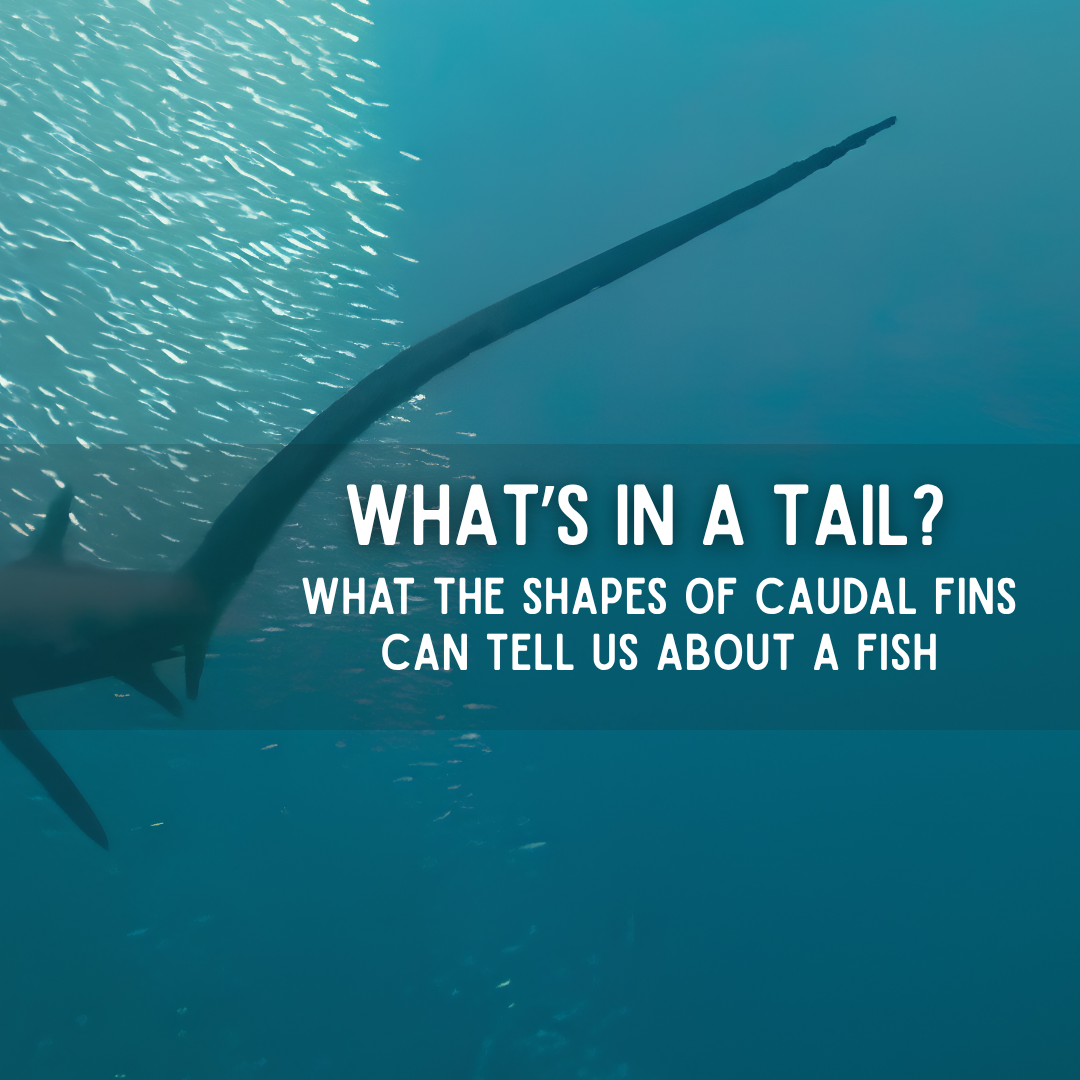
Farther offshore, the thresher shark pushes the design toward an extreme. Its greatly elongated upper tail lobe is not only part of the swimming system; it is also a hunting tool. The shark accelerates toward schooling fish and sweeps its tail through the water, gathering the school into a tighter pod to consume more fish at a time (Oliver et al., 2013).
Even among sharks, the tail is not one solution.
It changes as the shark’s habitat, prey, and method of hunting change with it.
Every Tail Has a Price
If one tail shape were truly best, fish would all look much more alike.
They do not.
Every tail carries a trade-off.
Evolution does not build perfect designs (Lauder & Drucker, 2004; Secor, 2015).
It builds workable compromises.
Every advantage comes with something surrendered. A narrow, deeply forked tail can conserve energy across open water but cannot push against the water at low speeds like a broad, rounded tail. A fish built to spin through marsh grass cannot match the endurance of a pelagic hunter. A flattened body and explosive tail make the flounder a nearly invisible ambush predator, but not a long-distance cruiser. The eel’s flexibility opens routes through an entire watershed, even though it cannot slice through water like a mackerel.
These are not failed versions of some ideal fish. They are specialists. Nature is full of specialists because environments reward specialists.
Each has inherited a way of moving that makes certain opportunities possible while placing others beyond reach. Over generations, the fish that moved well enough to feed, escape, migrate, and reproduce within a particular landscape passed that arrangement forward.
A tail is therefore more than a solution to water resistances. It is a compromise between everything an animal might do and the few things it must do well. Not a movement toward perfection – but towards belonging.
Reading the Water Differently
The next time you look at a fish, try not to begin with color.
Watch how it moves.
A steady glide across open water tells one story. A sudden turn among oyster shells tells another. A burst from the sand reveals a predator that survived by disappearing. A ray moving like a winged shadow reminds us that the tail is not always the engine. A shark’s movement shows how lift, thrust, and balance must work together in an animal without a swim bladder.
Long before we know a fish’s name, its movement has already begun telling us where it lives, how it hunts, how it escapes, and how it fits into the larger food web.
A tail gives us a place to begin..
It is the visible record of problems solved repeatedly: distances crossed, obstacles cleared, prey overtaken, predators avoided, and energy conserved..
Once we recognize these patterns, we no longer only see a fish passing through water.
We begin to see the life that shaped it.

References
Borazjani, I., & Daghooghi, M. (2013). The Fish tail motion forms an attached leading edge vortex. Proceedings of the Royal Society B: Biological Sciences, 280(1756), 20122071. https://doi.org/10.1098/rspb.2012.2071
Lauder, G., & Drucker, E. (2004). Morphology and experimental hydrodynamics of fish fin control surfaces. IEEE Journal of Oceanic Engineering, 29(3), 556-571. https://doi.org/10.1109/joe.2004.833219
Lighthill, M. J. (1971). Large-amplitude elongated-body theory of fish locomotion. Proceedings of the Royal Society of London. Series B. Biological Sciences, 179(1055), 125-138. https://doi.org/10.1098/rspb.1971.0085
Maia, A. M., Wilga, C. A., & Lauder, G. V. (2012). Biomechanics of Locomotion in Sharks, Rays, and Chimeras. In Biology of Sharks and Their Relatives (2nd ed.). CRC Press.
Midway, S. R., Scharf, F. S., Dance, M. A., Brown-Peterson, N. J., Ballenger, J. C., Beeken, N. S., Borski, R. J., Darden, T. L., Erickson, K. A., Farmer, T. M., Fincannon, A., Godwin, J., Graham, P. M., Green, J. L., Hershey, H., Kiene, D., Lee, L. M., Loeffler, M. S., Markwith, A., … White, S. B. (2024). Southern flounder: Major milestones and remaining knowledge gaps in their biology, ecology, and fishery management. Reviews in Fisheries Science & Aquaculture, 32(3), 450-478. https://doi.org/10.1080/23308249.2024.2341017
Okada, N., Takagi, Y., Tanaka, M., & Tagawa, M. (2003). Fine structure of soft and hard tissues involved in eye migration in metamorphosing Japanese flounder (Paralichthys olivaceus). The Anatomical Record Part A: Discoveries in Molecular, Cellular, and Evolutionary Biology, 273A(1), 663-668. https://doi.org/10.1002/ar.a.10074
Oliver, S. P., Turner, J. R., Gann, K., Silvosa, M., & D’Urban Jackson, T. (2013). Thresher sharks use tail-slaps as a hunting strategy. PLoS ONE, 8(7), e67380. https://doi.org/10.1371/journal.pone.0067380
Rosenberger, L. J. (2001). Pectoral fin locomotion in Batoid fishes: Undulation Versus oscillation. Journal of Experimental Biology, 204(2), 379-394. https://doi.org/10.1242/jeb.204.2.379
Secor, D. H. (2015). Migration ecology of marine fishes. JHU Press.
Sfakiotakis, M., Lane, D., & Davies, J. (1999). Review of fish swimming modes for aquatic locomotion. IEEE Journal of Oceanic Engineering, 24(2), 237-252. https://doi.org/10.1109/48.757275
Song, J., Zhong, Y., Du, R., Yin, L., & Ding, Y. (2020). Tail shapes lead to different propulsive mechanisms in the body/caudal fin undulation of fish. Proceedings of the Institution of Mechanical Engineers, Part C: Journal of Mechanical Engineering Science, 235(2), 351-364. https://doi.org/10.1177/0954406220967687
Stin, V., Godoy‐Diana, R., Bonnet, X., & Herrel, A. (2024). Form and function of anguilliform swimming. Biological Reviews, 99(6), 2190-2210. https://doi.org/10.1111/brv.13116
Tack, N. B., & Gemmell, B. J. (2022). A tale of two fish tails: Does a forked tail really perform better than a truncate tail when cruising? Journal of Experimental Biology, 225(22). https://doi.org/10.1242/jeb.244967
Thomson, K. S. (1976). On the heterocercal tail in sharks. Paleobiology, 2(1), 19-38. https://doi.org/10.1017/s0094837300003286
Thomson, K. S., & Simanek, D. E. (1977). Body form and locomotion in sharks. American Zoologist, 17(2), 343-354. https://doi.org/10.1093/icb/17.2.343
Tsukamoto, K. (2009). Oceanic migration and spawning of anguillid eels. Journal of Fish Biology, 74(9), 1833-1852. https://doi.org/10.1111/j.1095-8649.2009.02242.x
Vogel, S. (1996). Life in moving fluids: The physical biology of flow (2nd ed.). Princeton University Press.
Wilga, C. D., & Lauder, G. V. (2002). Function of the heterocercal tail in sharks: Quantitative wake dynamics during steady horizontal swimming and vertical maneuvering. Journal of Experimental Biology, 205(16), 2365-2374. https://doi.org/10.1242/jeb.205.16.2365