At the soundside edge of Topsail Island, a hole in the ground is not unusual. Marsh grass gives way to higher soil, fiddler crabs disappear when footsteps approach, and small brown crabs move beneath boards, leaves, and anything else that holds a little shade. A burrow at the edge of a coastal yard may belong to an animal that has lived along this shore far longer than the yard has.
That is why a hole alone would be poor evidence of a blue land crab.
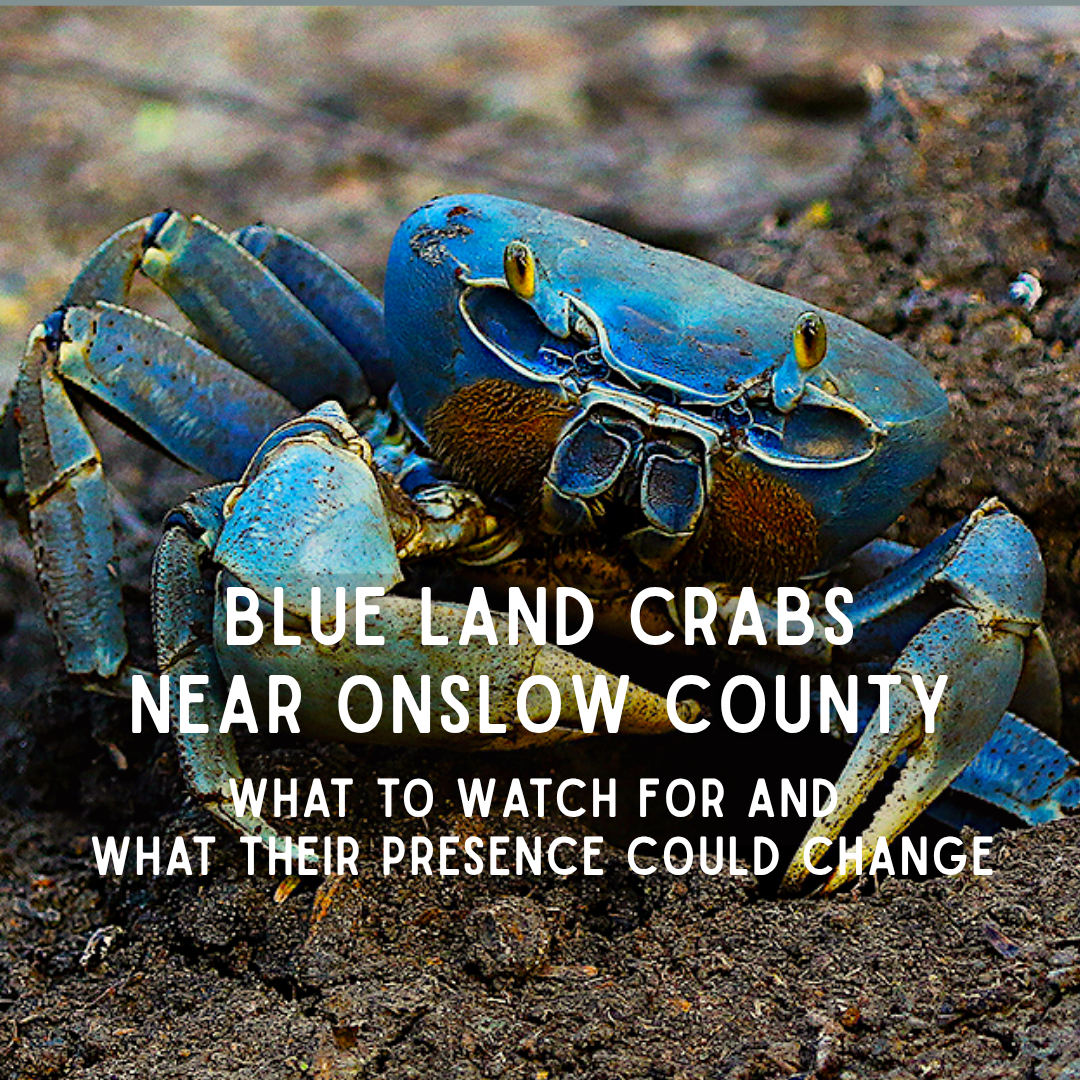
The animal itself would be harder to overlook. A mature blue land crab, Cardisoma guanhumi, can grow to nearly six inches across its shell, with legs that make it appear larger still. An adult male is often blue-gray and carries one powerful claw, but females may be pale gray or white, while younger crabs can be orange, brown, or purple. From a distance, the uneven claws can resemble those of a fiddler crab, except the entire animal has been enlarged to a scale unfamiliar in a Carolina backyard (Hostetler et al., 2025).
Until recently, it was also unfamiliar along this part of the coast. The blue land crab’s historically documented range in the continental United States followed the Gulf of Mexico and southern Florida, with Vero Beach long recognized as its northern Atlantic limit (Scott et al., 2023). Occasional South Carolina records began in 2008, followed by 53 verified sightings there during a concentrated period of public reporting in fall 2022 (Scott et al., 2023). North Carolina confirmed its first blue land crab in summer 2023. By August 2026, 23 sightings had been confirmed statewide and another 34 reports remained unverified. Two of the confirmed records this year came from Emerald Isle (NC DEQ, 2026).
Those numbers do not yet describe a population. They describe a question appearing in yards, along roads, and beside the marsh: whether a warm-water crab is occasionally reaching North Carolina or beginning to live here.
A Crab That Does Not Stay in One World
The blue land crab is neither a displaced Atlantic blue crab nor simply a giant fiddler. The shared color and oversized claw describe what it looks like, not its closest relatives. It belongs to Gecarcinidae, the land-crab family, whose members have moved much of adult life above the tide. Their gills still do the breathing, even in air, and those gills must remain damp. The crab can leave the water; it cannot leave water behind (Marin & Tiunov, 2023).
That need for moisture keeps the crab between two worlds. Adults may live above the reach of ordinary tides—in coastal forests, brushy ground, grasslands, drainage edges, and even yards—but they return to damp shelter when the day becomes hot or when a newly molted shell leaves them vulnerable. Many blue land crabs can live near one another without sharing that refuge; each normally keeps a burrow of its own (Herreid & Gifford, 1963; Moraes-Costa & Schwamborn, 2018).
That higher position separates the blue land crab from many crabs living in the flooded marsh below it, but not completely. Its life still returns to the estuary. After mating, a female carries hundreds of thousands of eggs beneath her abdomen and travels to salt or brackish water to release them (Hostetler et al., 2025). The larvae drift through several planktonic stages before settling and returning to land as small crabs. Warm water is particularly important during this development, while salinity determines which parts of an estuary can carry the larvae successfully (Costlow & Bookhout, 1968a, 1968b).
An adult can therefore live beneath shrubs beside a yard while its offspring begin among fishes and plankton. The species belongs to the coastal upland and the estuary at the same time, and that divided life helps explain how an animal tied to one burrow can appear far beyond the range where its adults were previously known.
How a Southern Crab Reached This Shore
Blue land crabs are not likely to have walked from Florida to the Carolinas. Adults forage close to their burrows and show strong attachment to a small home area. Females make longer reproductive movements toward water, but those are local journeys between upland burrows and larval-release sites rather than migrations along hundreds of miles of coastline (Moraes-Costa & Schwamborn, 2018).
Long-distance movement is more plausible during the larval stage. Once released, larvae spend weeks in coastal water before returning to land, allowing currents to carry them beyond the place where they hatched (Hostetler et al., 2023). A widening pattern of sightings from Florida through Georgia and South Carolina would be consistent with natural range expansion as warming water and milder cold periods make northern development and survival more possible (Costlow & Bookhout, 1968b; NC DEQ, 2026; Scott et al., 2023). Human transport, including movement with vessels or materials, remains another possibility because the present records do not yet reveal how the crabs arrived (NC DEQ, 2026).
Warmer conditions in Florida would not simply make the crabs decide to leave. The more relevant change would occur at the northern boundary, where conditions that once killed larvae or prevented overwintering may no longer do so as reliably (Costlow & Bookhout, 1968b). Warming can open habitat ahead of a species without pushing adults out of the habitat behind it.
It is tempting to imagine worsening conditions in Florida sending blue land crabs north, but that does not fit particularly well with how the adults live. Coastal development, altered groundwater, harvesting, and the loss of mangrove-edge habitat have reduced populations in parts of Puerto Rico and Brazil. When the ground around an adult’s burrow is destroyed, however, the crab may move only a short distance or disappear with the habitat. It does not begin a walk to North Carolina (Govender et al., 2008; Moraes-Costa & Schwamborn, 2018).
Development may matter after the much smaller, drifting stage has already reached a new shore. A canal edge, drainage ditch, watered lawn, or patch of coastal vegetation can offer the damp ground a young crab needs as it leaves the estuary. Human-altered places may therefore help connect suitable patches without being the reason the crab traveled north in the first place (Riascos et al., 2024).
So is the blue land crab native to North Carolina, or is it invasive? Neither label fits neatly yet. The species is native to warmer parts of the western Atlantic and Gulf of Mexico, including Florida, but North Carolina lies beyond its historically recognized Atlantic range in the United States. If larvae are reaching the Carolinas on coastal currents and surviving because conditions have become more favorable, then the crab’s natural range may be expanding. If crabs arrived with boats or transported materials, that would be an introduction. The sightings cannot yet tell us which occurred (Scott et al., 2023; NC DEQ, 2026).
Either way, arrival alone does not make a species invasive. The blue land crab would have to establish a reproducing population, continue spreading, and cause ecological or economic harm. North Carolina has confirmed crabs, but it does not yet have evidence of an established, harmful population (NC DEQ, 2026).
Emerald Isle Is Not Far Away
There were two confirmed blue land crab sightings in Emerald Isle this year, out of 23 confirmed cases across North Carolina (NC DEQ, 2026). This is what makes the Emerald Isle records matter here. The confirmed crabs were not found along some distant part of the North Carolina coast. They were found on Bogue Banks, northeast of Onslow County and only several dozen coastal miles from North Topsail Beach.
Between Emerald Isle and Topsail are connected sounds, tidal creeks, inlets, marshes, developed islands, and the Intracoastal Waterway. A crab confirmed on Bogue Banks does not prove that one is already living around North Topsail, Surf City, or the soundside of Topsail Island. It does place the animal within a coastal landscape that continues toward all three.
That does not mean currents are carrying crabs neatly from Emerald Isle toward Topsail, and the statewide sightings should not be read as a marching line. Some animals may represent separate arrivals; others may have gone unnoticed for years. The map brings the question closer. Only repeated observations can show where the crab has actually found a place—and which members of the existing crab community are already there.
The Crabs Already Here
Onslow County’s marsh edge is not waiting empty for a land crab to arrive. Several native crabs divide the same transition from tidal creek to high ground, although each uses a somewhat different part of it.
Comparison of the blue land crab to other crabs seen in our Onslow County area. | Image credit: SC Department of Natural Resources
At low tide, the easiest to notice are often fiddlers. Atlantic marsh fiddler crabs,Minuca pugnax, favor muddier marsh sediment, while Atlantic sand fiddlers,Leptuca pugilator, are more common across sandy flats and the higher portions of the marsh. Red-jointed fiddler crabs,Minuca minax, appear where the water is fresher. Marsh and sand fiddlers have long been documented in North Carolina salt marshes, gathering into the familiar patches that vanish into small holes when a person approaches (O’Connor, 1993).
They sift algae, microbes, and bits of organic material from the surface, leaving tiny feeding marks across exposed sediment. Even a male carrying an oversized claw has a body only a fraction of the width of an adult blue land crab.
Closer to the cordgrass, purple marsh crabs,Sesarma reticulatum, move along muddy creek banks and feed heavily on the grass, including stems and tissues belowground. At ordinary numbers they are part of the marsh’s long-established community. Where their numbers become unusually high, their feeding can strip away vegetation and leave sediment exposed (Bertness et al., 2014; Wittyngham et al., 2024).
At the upper edge, the small brown crab beneath a board or patch of leaves may be a squareback marsh crab,Armases cinereum. Of the native crabs, it is the most likely to meet a blue land crab where marsh gives way to the yard. It moves above the high-water line, sometimes crossing lawns or climbing garage walls, and eats fallen leaves, living plants, and small invertebrates. Its menu is broad in much the same way as a blue land crab’s, although the squareback itself is far smaller (Buck et al., 2003).
Other familiar crabs belong to neighboring settings. Atlantic mud crabs such as Panopeus herbstii remain among oyster shells, rocks, and submerged structure, where their heavy claws open oysters, clams, barnacles, and snails. Ghost crabs,Ocypode quadrata, occupy the open beach and dune sand on the ocean side. Either may be close in geographic distance to a blue land crab, but neither uses the soundside grass-to-yard boundary in quite the same way.
Each of these crabs already belongs to a particular part of the shore. A blue land crab would not arrive in an empty niche, but it would not duplicate any one of them either. To see where the differences matter, we have to look below the opening.
The Architecture Beneath the Opening
For a burrowing crab, the tunnel is more than a hiding place. It is a shelter from heat and predators, a humid chamber that protects the gills, and a safe place to molt. Its shape reflects the problem the crab needs it to solve, which is why burrows built only a few yards apart can belong to very different lives.
A blue land crab begins on higher ground with a comparatively broad entrance, then turns downward toward moisture. There is no single blueprint hidden below it. Burrows examined with a fiber-optic camera in Puerto Rico included short passages that descended at a shallow angle, longer tunnels that leveled before dropping sharply, and deep curves resembling an inverted S. Forked and corkscrew forms occurred less often. The route varied with the site, but the essential destination was usually the same: a humid refuge at or near groundwater, occupied by one crab rather than a colony sharing one chamber (Moraes-Costa & Schwamborn, 2018; Sample & Albrecht, 2016).
The blue land crab’s burrow will begin their entrance with a steep angle that levels off until a sharp downward turn to reach the water table. | Image credit: Sample & Albrecht, 2016
An Atlantic sand fiddler builds at another scale and for another rhythm. Its narrow shaft descends through sand exposed between tides, and a deeper breeding burrow may extend farther than the temporary refuge used while feeding. Across a flat, many small entrances can stand close together because each belongs to a small crab defending little more than the ground immediately around it. Although the shafts provide shelter and moist air, they remain much narrower than the passage required by an adult blue land crab (Christy, 1982). A fiddler opening would therefore be a poor ready-made home for a mature Cardisoma.
A 3D cast and schematic show the burrow formation of an Atlantic fiddler crab. | Image Credit: di Virgilio & Riberio, 2013
The purple marsh crab offers a different contrast. Its burrows occupy muddy, rooted creek banks and can become part of a connected network with several openings. When those networks become dense, especially where vegetation has already thinned, excavation and cordgrass feeding can loosen the bank and make sediment easier for moving water to carry away (Bertness et al., 2014; Farron et al., 2020). A blue land crab generally begins above ordinary tidal flooding and maintains a more solitary route toward groundwater. Its burrow should not be assumed to undercut a creek bank in the same way simply because both animals dig.
A ghost crab may also leave one obvious opening and a mound of newly moved sand, but its address is usually the open ocean beach or foredune. Its sloping or curving refuge is built in loose, comparatively dry beach sand, not at the moist soundside boundary between marsh and yard.
Ghost crab burrow structure from a 3D cast on a sandy beach | Image credit: Shinoda et al., 2019
The squareback marsh crab makes an even clearer distinction. It commonly slips beneath leaves, logs, rocks, boards, and other cover at the upper marsh edge instead of constructing the large groundwater-reaching tunnel associated with an adult blue land crab. Mud crabs and Atlantic blue crabs do not make permanent terrestrial burrows at all. One uses submerged crevices; the other may bury itself temporarily in bottom sediment.
The squareback marsh crab may use rocks, leaves or other surface materials to hide beneath instead of a burrow. | Image credit: critterbliss, iNaturalist
Burrow reuse deserves equal care. Smaller blue land crabs have been found in openings much larger than their bodies, which is consistent with their moving into burrows abandoned by larger blue land crabs (Carmona-Suárez & Guerra-Castro, 2012). For a smaller crab, an empty tunnel would mean less digging, less time exposed aboveground, and immediate access to a refuge that already holds moisture. Those are likely advantages rather than benefits tested directly.
The other crabs along a Carolina shore do not appear to offer the same shortcut. Their shelters are too narrow, too low in the marsh, too dry, or not true burrows at all. Nothing currently shows that blue land crabs routinely take over and enlarge the burrows of another crab species.
The digging leaves more than a hole. Soil brought up from below is spread across the surface, while leaves, scraps of food, old molts, and waste may collect inside. In places where blue land crabs are established, the soil within their burrows differs from the ground beside them in its mixture of sand and silt, acidity, organic matter, and nutrients including nitrogen, magnesium, and potassium (Quintero-Torres et al., 2018).
The open tunnel also allows air and water to reach soil that had been sealed underground. Across many kinds of coastal crabs, burrowing tends to loosen sediment and change the chemical work carried out there by microbes. How much changes—and whether the effect helps or harms the plants above—depends upon the crab, the vegetation, and where the burrow sits (Rinehart et al., 2024).
Water salinity is shown in a burrowed marsh (a), a straight burrowed marsh (b), a sloped marsh (c ), and a marsh at the high tide stage and how salinity is distributed in the marsh as influenced by burrows. | Image credit: Yin et al., 2023
That does not mean each hole ventilates an entire marsh. Oxygen entering a tunnel may change only a thin layer of soil along its walls. Around fiddler burrows, that reach has been far smaller than the familiar phrase “aerates the soil” might suggest (Michaels & Zieman, 2013). A single high-ground blue land crab tunnel is not a new tidal creek either. Rain, groundwater, or an unusually high tide may enter it and change the wetness immediately around the opening, but blue land crab burrows have not been shown to redirect tidal flow through a maritime forest.
Roots present the same uncertainty. Digging can break fine roots and loosen the soil holding them, while the extra space and shifted nutrients around a tunnel may create new conditions for roots and soil life. Blue land crabs also clip and eat plants aboveground, so a damaged plant would not tell us whether feeding, digging, or both were responsible.
One occupied hole may change little beyond a small patch of ground. If the same digging were repeated across many burrows, those patches could begin to influence which plants take hold, how firmly their roots bind the edge, and how water moves through the soil. That possibility is one reason burrows are worth mapping. It is not evidence that those changes are already happening at North Carolina sighting sites.
At first, the tunnel keeps one crab alive. Only when that work is repeated across a place does it begin to become part of the landscape.
From the surface, however, most of that architecture remains hidden.
What a Burrow Can—and Cannot—Tell Us
A mature blue land crab may leave an opening three to five inches wide. Freshly excavated soil may collect around the entrance, and plant pieces or tracks may be visible nearby. These clues become more persuasive when the hole sits above normal tidal flooding in shaded, moist ground and a very large crab has been seen retreating into it (Hostetler et al., 2025).
It is still not an identification. A smaller blue land crab may occupy an older, larger burrow, while erosion can widen the entrance to a much smaller tunnel. Marsh soil also collapses, roots leave openings, rodents dig, and water continually reshapes the grass line. Size alone can mislead, particularly in a photograph with nothing nearby for scale.
The setting and the pattern offer better clues. Many small holes spread across exposed mud or sand point toward fiddlers. Several openings cut through a rooted creek bank fit purple marsh crabs. One hole high on the dry ocean beach is more likely a ghost crab’s. Squarebacks are often found beneath something rather than beside a large mound of freshly dug soil. The strongest match for the blue land crab would bring several details together: a broad opening on higher soundside ground, signs of recent digging, and a crab far larger than the native marsh species.
That is why a useful photograph includes more than the hole. The crab, entrance, moved soil, surrounding plants, nearby water, and something familiar for scale allow the scene to be read together. There is no need to dig, probe, or flood the tunnel. Without the animal, a burrow can identify a place worth watching, but not the species living beneath it.
What the New Crab Would Eat
The large claw may make a blue land crab look like a hunter arriving to eat every smaller crab in its path. Most of what it gathers, however, is plant material: fallen leaves, fruit, berries, flowers, tender shoots, grasses, and seeds. It may carry that food home and pull some of it underground. Insects, carrion, feces, and other animal matter add to the diet when available, and blue land crabs sometimes eat one another (Gifford, 1962; Herreid, 1963; Moraes-Costa & Schwamborn, 2018).
That does not place native crabs entirely off the menu. A blue land crab may seize a small animal it can catch, but regular hunting of fiddlers, squarebacks, or purple marsh crabs is unlikely to be its main influence. The more important changes would probably begin with the plants and fallen leaves it removes, the ground it excavates, and the space it keeps around its burrow.
The amount of competition would differ from crab to crab. Fiddlers graze the thin film of algae, microbes, and organic particles coating the marsh surface, so they share relatively little food with a crab gathering fruit and leaves above the high-tide line. Squareback and purple marsh crabs share more of that plant-based menu, although they forage at different scales and in different parts of the marsh. If blue land crabs remain, the strongest overlap may be over shaded ground, damp refuge, and nearby plant food rather than over a particular prey animal.
What Established Populations Tell Us
Sharing food and high ground does not make displacement inevitable. Where blue land crabs have lived for generations, other crabs continue to live beside them by using different levels of the shore. Along the Brazilian coast, for example, the mangrove crab,Ucides cordatus, digs into softer ground between the tides, while Cardisoma lives higher in firmer, sandier soil. Their ranges overlap without their burrows occupying precisely the same ground (Firmo et al., 2012).
North Carolina has a different community, but the same separation by water, soil, and elevation is already familiar here. The squareback comes closest to overlapping with a blue land crab at the upper edge. Even there, one defended Cardisoma burrow might cost a squareback a feeding spot without removing squarebacks from the wider marsh.
The first change people noticed might therefore be simpler than one crab replacing another: a much larger animal at the grass line, fresh soil beside an entrance, fallen fruit or leaves drawn toward it, and tender plants clipped within a short walk of the burrow.
That picture could change if the crabs became numerous. Many defended burrows would divide more of the narrow band of damp high ground, increasing competition for shelter and food. Their digging would repeat the small soil changes described above, while their feeding could influence which seeds and seedlings survive and how quickly fallen leaves disappear. Those broader forest effects are known across several land-crab species rather than from a newly established Cardisoma population, but they show why abundance matters more than the mere arrival of one large crab (Lindquist et al., 2009).
Predators would respond only if the crabs became dependable prey. Large birds and mammals eat blue land crabs within their established range, while eggs and larvae released into the estuary become food for aquatic animals (Firmo et al., 2012; Hostetler et al., 2025). One adult crossing a Carolina yard offers one unusual meal. A recurring population could give raccoons or coastal birds a reason to search the marsh edge and could place many larvae into the estuarine food web.
This is where two kinds of change can look like the same thing. Digging alters the ground directly, making the crab an ecosystem engineer (Rinehart et al., 2024). A trophic cascade would have to continue through feeding relationships: fewer surviving seedlings changing the vegetation, for example, or predators drawn to land crabs changing their pressure on other prey (Lindquist et al., 2009).
Blue land crabs are capable of beginning both pathways. What the North Carolina sightings cannot yet tell us is whether enough crabs are arriving, surviving, and reproducing for the work of individuals to become the work of a population.
When One Sighting Becomes a Place
One dated photograph gives the map a place. Another observation weeks or months later begins to show whether the crab stayed. As those records accumulate, they can reveal when the crabs are active, whether they appear after rain, which kinds of ground they use, and whether they return across seasons. Crabs of different sizes at one site may have survived across more than one year, while juveniles, egg-bearing females, or repeated movements toward the water would offer stronger evidence that the species is completing more of its life cycle here.
The same map can show where the larger ecological questions belong. One wandering adult does not tell us that native crabs are being displaced or that a trophic cascade has begun. Several occupied burrows, plant damage, younger crabs, and repeated sightings at the same place would give biologists a reason to compare its vegetation, soil, native crabs, and predators with nearby places where Cardisoma is absent.
Anyone who sees a possible blue land crab can photograph it from a safe distance and submit the image, date, and location through the Blue Land Crab Sightings reporting. A photograph showing the animal, its approximate scale, and the surrounding habitat is more useful than trying to catch or relocate it.
That distinction matters for anyone standing at the grass line. A three-inch hole is not an identification, clipped leaves are not proof of ecological harm, and a large crab is not automatically an invasive species. Each is a piece of context. Together, photographed and reported without catching or relocating the animal, those pieces can show whether North Carolina is receiving occasional southern visitors or adding a new resident to the narrow landscape between the forest and the sea.
The coast will answer that slowly, one place at a time.
References
Bertness, M. D., Brisson, C. P., Bevil, M. C., & Crotty, S. M. (2014). Herbivory drives the spread of salt marsh die-off. PLoS ONE, 9(3), e92916. https://doi.org/10.1371/journal.pone.0092916
Buck, T. L., Breed, G. A., Pennings, S. C., Chase, M. E., Zimmer, M., & Carefoot, T. H. (2003). Diet choice in an omnivorous salt-marsh crab: Different food types, body size, and habitat complexity. Journal of Experimental Marine Biology and Ecology, 292(1), 103-116. https://doi.org/10.1016/s0022-0981(03)00146-1
Carmona-Suárez, C. A., & Guerra-Castro, E. (2015). Comparison of three quick methods to estimate crab size in the land crabs <i>Cardisoma guanhumi</i> Latreille, 1825 and <i>Ucides cordatus</i> (Crustacea: Brachyura: Gecarcinidae and Ucididae). Revista de Biología Tropical, 60, 139. https://doi.org/10.15517/rbt.v60i0.19854
Costlow, Jr., J. D., & Bookhout, C. G. (1968a). The complete larval development of the land-crab, Cardisoma guanhumi Latreille in the laboratory (Brachyura, Gecarcinidae). Crustaceana, 15(3), 259-270.
Costlow, Jr., J. D., & Bookhout, C. G. (1968b). The effect of environmental factors on development of the land-grab,cardisoma guanhumiLatreille. American Zoologist, 8(3), 399-410. https://doi.org/10.1093/icb/8.3.399
Farron, S., Hughes, Z., FitzGerald, D., & Strom, K. (2020). The impacts of bioturbation by common marsh crabs on sediment erodibility: A laboratory flume investigation. Estuarine, Coastal and Shelf Science, 238, 106710. https://doi.org/10.1016/j.ecss.2020.106710
Firmo, A., Tognella, M. M., Silva, S. R., Barboza, R. R., & Alves, R. (2012). Capture and commercialization of blue land crabs (“guaiamum”) Cardisoma guanhumi (Lattreille, 1825) along the coast of Bahia state, Brazil: An ethnoecological approach. Journal of Ethnobiology and Ethnomedicine, 8(1). https://doi.org/10.1186/1746-4269-8-12
Gifford, C. A. (1962). Some observations on the general biology of the land crab, cardisoma guanhumi (Latreille), in South Florida. The Biological Bulletin, 123(1), 207-223. https://doi.org/10.2307/1539516
Govender, Y., Sabat, A. M., & Cuevas, E. (2008). Effects of land-use/land-cover changes on land crab,Cardisoma guanhumi, abundance in Puerto Rico. Journal of Tropical Ecology, 24(4), 417-423. https://doi.org/10.1017/s0266467408005130
Herreid, C. F. (1963). Observations on the feeding behavior of Cardisoma Guanhumi (Latreille) in southern Florida1). Crustaceana, 5(3), 176-180. https://doi.org/10.1163/156854063×00093
Herreid, C. F., & Gifford, C. A. (1963). The burrow habitat of the land crab, Cardisoma guanhumi (Latreille). Ecology, 44(4), 773-775. https://doi.org/10.2307/1933027
Hostetler, M. E., Mazzottii, F. J., & Taylor, A. K. (2025, October 28). Blue land crab (Cardisoma guanhumi) (WEC 30). Department of Wildlife Ecology and Conservation, UF/IFAS Extension. https://ask.ifas.ufl.edu/publication/UW013
Lindquist, E. S., Krauss, K. W., Green, P. T., O’Dowd, D. J., Sherman, P. M., & Smith, T. J. (2009). Land crabs as key drivers in tropical coastal forest recruitment. Biological Reviews, 84(2), 203-223. https://doi.org/10.1111/j.1469-185x.2008.00070.x
Marin, I. N., & Tiunov, A. V. (2023). Terrestrial crustaceans (Arthropoda, crustacea): Taxonomic diversity, terrestrial adaptations, and ecological functions. ZooKeys, 1169, 95-162. https://doi.org/10.3897/zookeys.1169.97812
Michaels, R. E., & Zieman, J. C. (2013). Fiddler crab (Uca spp.) burrows have little effect on surrounding sediment oxygen concentrations. Journal of Experimental Marine Biology and Ecology, 448, 104-113. https://doi.org/10.1016/j.jembe.2013.06.020
Moraes-Costa, D., & Schwamborn, R. (2018). Site fidelity and population structure of blue land crabs (Cardisoma guanhumi Latreille, 1825) in a restricted-access mangrove area, analyzed using PIT tags. Helgoland Marine Research, 72(1). https://doi.org/10.1186/s10152-017-0504-0
O’Connor, N. (1993). Settlement and recruitment of the fiddler crabs Uca pugnax and U. pugilator in a North Carolina, USA; salt marsh. Marine Ecology Progress Series, 93, 227-234. https://doi.org/10.3354/meps093227
Quintero-Torres, E., Chacón, N., & López-Sánchez, B. (2018). The ecosystem engineering role of the neotropical crab Cardisoma guanhumi on mangrove soil properties. Wetlands Ecology and Management, 26(5), 993-1000. https://doi.org/10.1007/s11273-018-9618-7
Riascos, J. M., Obonaga, L. D., & Ramos, J. (2024). Is the threatened land crab Cardisoma guanhumi conquering human‐dominated systems? Ecology and Evolution, 14(4). https://doi.org/10.1002/ece3.10737
Rinehart, S. A., Dybiec, J. M., Walker, J. B., Simpson, L., & Cherry, J. A. (2024). Effects of burrowing crabs on coastal sediments and their functions: A systematic meta‐analysis. Ecosphere, 15(7). https://doi.org/10.1002/ecs2.4927
Sample, S., & Albrecht, M. (2016). Determination of the burrow shapes of Cardisoma guanhumi on Vieques, Puerto Rico. Journal of Coastal Life Medicine, 4(2), 94-97. https://doi.org/10.12980/jclm.4.2016j5-245
Scott, E., Kendrick, M., Kingsley-Smith, P., James, M., Lemeris, J., Weeks, E., & Sasson, D. (2023). Using public sightings to document the widespread distribution of the non-endemic blue land crab, Cardisoma guanhumi, in South Carolina. Southeastern Naturalist, 22(4). https://doi.org/10.1656/058.022.0403
Wittyngham, S. S., Johnson, D. S., Chen, Y., & Kirwan, M. L. (2024). A grazing crab drives saltmarsh carbon storage and recovery. Ecology, 105(9). https://doi.org/10.1002/ecy.4385
Late August does not look much like fall along the Onslow County coast.
The sand is still hot. Afternoon thunderstorms still build over the mainland. The ocean can remain warm enough that stepping into it hardly feels like relief.
But beneath the surface, fall has already begun.
Fish that spent summer scattered through sounds, creeks, reefs, and nearshore water begin gathering. Shrimp start working their way out of nursery creeks. Mature female blue crabs move toward saltier water. Schools of mullet begin appearing along the beaches. Sharks that spent the warmer months farther north or inside coastal waters begin shifting south or offshore.
Above them, the birds begin changing too.
Some are preparing to leave. Others are arriving from places hundreds or thousands of miles away. Still others simply become more noticeable because suddenly there is food everywhere.
What looks from shore like a few gulls working over the water, a school of baitfish flashing beside a pier, or pelicans repeatedly diving beyond the breakers is part of something much larger.
For a few months each fall, the food web itself begins to move.
When the Water Begins to Change
Animals do not wait for a date on the calendar. Along the coast, fall arrives through changes in water temperature and daylight, but also through salinity, currents, rainfall, food availability, and the timing of reproduction. Different species respond to different combinations of those signals, which means the seasonal movement beginning beneath the surface is not one migration triggered in one way.
For some animals, cooling water begins narrowing where they can comfortably remain. King mackerel (Scomberomorus cavalla) favor warm coastal water and become less common as temperatures fall much below about 68°F, while cobia (Rachycentron canadum) begin leaving northern summer habitats as water cools through roughly the same range. Spotted seatrout (Cynoscion nebulosus) respond differently. Rather than leaving our estuaries altogether, they begin shifting toward creeks, channels, and deeper water where a few additional feet of depth can provide protection from the colder temperatures still to come (North Carolina Division of Marine Fisheries, 2022; Jensen & Graves, 2020; Ellis, Buckel, & Hightower, 2017; Ellis, Buckel, Hightower, & Poland, 2017).
King mackerel (Scomberomorus cavalla), a warm-water coastal fish that becomes less common as fall temperatures drop. | Image credit: Sylvain Le Bris, iNaturalist
Temperature can work together with another signal that changes every year whether the weather feels like fall or not: shortening daylight. Blacktip and sandbar sharks moving along the western Atlantic begin their southward migration as sea-surface temperatures change and the days grow shorter, leaving northern and Mid-Atlantic summer habitats and gradually shifting toward the South Atlantic Bight and Florida for winter and spring (Manz et al., 2025).
For other animals, autumn movement is tied less to escaping cooling water than to reaching the next stage of their life cycle. Southern flounder (Paralichthys lethostigma) spend their first years in estuarine waters, where shallow sounds, rivers, and creeks provide nursery and feeding habitat. Females begin maturing surprisingly early: some are reproductively mature by age one, most by age two, and nearly all by age three. Immature fish can remain within the estuary through winter, but once mature, southern flounder begin joining the fall movement through the inlets and toward offshore spawning grounds (Midway & Scharf, 2012; Craig et al., 2015).
That means fish of different ages can occupy the same estuary through summer and then take different paths as fall develops. A young flounder may remain behind while an older fish that spent the season feeding in the same system begins moving toward the ocean.
So while late-August water may still feel thoroughly summerlike to someone standing waist-deep at Topsail, the animals beneath the surface are already responding to a season that is only beginning to become visible above it.
One of the first clues may simply be a fish jumping beside you.
The Mullet Begin to Run
Striped, or sea, mullet (Mugil cephalus) spend much of the warmer season feeding throughout estuaries, sounds, tidal creeks, and protected coastal waters. By late summer, however, their movements begin to change. In North Carolina, striped mullet travel most actively between August and November as mature fish leave rivers, sounds, and tidal creeks for marine spawning habitat. Their journey carries them through the inlets and offshore into the South Atlantic Bight, with spawning habitat extending from nearshore waters toward the outer continental shelf where shelf water meets the influence of the Gulf Stream (Bacheler et al., 2005). For fish that spent the summer inside an estuary, that is a considerable change in geography, but still a relatively regional migration compared with species that will later continue much farther south along the Atlantic coast.
They begin making that seasonal journey relatively young. About half of North Carolina striped mullet are reproductively mature by age one, although maturity varies among individuals, and older adults may return to estuarine habitats after spawning. Rather than leaving the estuary permanently as they mature, they move between estuarine feeding grounds and marine spawning habitat as part of a seasonal cycle (Bichy, 2004; Bacheler et al., 2005).
For beachgoers, this can become one of the easiest fall migrations to notice. Fish that spent summer spread through rivers, creeks, and sounds begin collecting into increasingly conspicuous schools as they move toward inlets and coastal water. Once along the ocean beach, dense schools may travel remarkably close to shore, sometimes darkening the shallows or stretching along the surf zone beyond what can be seen from one spot. Mullet are frequent jumpers as well, so a school may first reveal itself as silver fish repeatedly breaking the surface. By the time those schools reach the inlet and beach, they are carrying more than themselves with them. Striped mullet feed low in the food web, consuming algae, detritus, and organic material associated with estuarine sediments. As thousands of them move out of the estuary, that stored production moves with them and becomes available to the larger fishes, sharks, and birds that feed along the coast (Bacheler et al., 2005).
Those predators are already moving through the same corridor. Bluefish (Pomatomus saltatrix) feed heavily on schooling fishes such as mullet, menhaden, and silversides. Spanish mackerel (Scomberomorus maculatus) work schools of anchovies and other small baitfish, while blacktip sharks (Carcharhinus limbatus) and spinner sharks (Carcharhinus brevipinna) take advantage of dense concentrations of coastal prey.
The fall mullet run is therefore more than thousands of fish leaving an estuary. It is estuarine production moving through the inlet and onto the beach, where it begins to intersect with predators following their own seasonal routes.
That intersection is what makes the migration suddenly visible. A school that might otherwise pass unnoticed can tighten near shore as bluefish, mackerel, sharks, and birds begin responding to the same moving concentration of prey.
Spanish Mackerel, Bluefish, and the Surface Chase
Sometimes the easiest way to find a migration is not to look for the animals themselves, but for what happens to the water when they arrive.
Spanish mackerel (Scomberomorus maculatus) spend the warmer months moving north along the Atlantic coast, reaching North Carolina in spring and remaining through summer and early fall while coastal water stays above roughly 68°F. As that warm-water window begins closing, they turn south again toward winter habitat off Florida, feeding heavily along the way on anchovies, silversides, menhaden, mullet, and other small schooling fishes (North Carolina Division of Marine Fisheries, 2026; Sutherland & Fable, 1980).
Spanish mackerel (Scomberomorus maculatus) traveling in a dense school. | Image credit: Shutterstock
Bluefish (Pomatomus saltatrix) are moving through the same changing coast, but their fall pattern varies with age. Smaller bluefish tend to migrate south along the shoreline as water cools, while larger adults make more of an inshore-to-offshore shift. Farther north, fall movement begins as water drops into roughly the mid-50s Fahrenheit, gradually carrying fish into the warmer coastal waters to the south (Lund & Maltezos, 1970). By the time those movements reach the Carolina coast, they are crossing water already crowded with prey. Anchovies, silversides, juvenile menhaden, and other tiny schooling fishes—many of the fishes beachgoers collectively call “glass minnows”—can become compressed near the surface, and even wash onto shore, as mackerel and bluefish strike through the schools from below.
Little tunny (Euthynnus alletteratus), better known locally as false albacore, can join that fall activity around inlets and nearshore waters as well. They too make seasonal movements along the Atlantic coast, shifting north through the warmer part of the year and south again through fall and winter while feeding in fast-moving schools (North Carolina Division of Marine Fisheries, 2026).
Little tunny (Euthynnus alletteratus), also known as false albacore, moving in a feeding school. | Image credit: aurelpap, iNaturalist
From the beach, separating one predator from another may be nearly impossible. What becomes visible instead is the chase. A patch of otherwise smooth ocean suddenly begins to boil as tiny fish scatter across the surface. Gulls and terns converge overhead, pelicans turn toward the commotion, and dark backs or silver flashes cut through the school below.
Sometimes the entire event moves several hundred yards down the beach within minutes.
And the animals doing the chasing are still part of the food web themselves. Spanish mackerel and bluefish may be predators here, but both can become prey for larger sharks and tunas farther up the same moving chain. A small fish feeding on plankton becomes food for a mackerel; that mackerel may later become food for a shark.
Fall has compressed several levels of the food web into the same patch of water, and for a few minutes the whole thing becomes visible from shore.
The Sharks Following Fall
Shark migration can sound dramatic because sharks are dramatic animals.
Ecologically, however, their fall movements make perfect sense. Food is moving, water temperature is changing, nursery seasons are ending, and remaining in shallow water becomes increasingly expensive for animals whose body temperature largely follows the environment around them.
Blacktip sharks (Carcharhinus limbatus) and spinner sharks (Carcharhinus brevipinna) are warm-water coastal sharks frequently associated with schools of mullet, menhaden, and other fishes.
Blacktip (Carcharhinus limbatus) and spinner sharks (Carcharhinus brevipinna) can look very similar; fin markings and body proportions help separate the two. | Image credit: Bowers & Kaijiura, 2023
As coastal waters cool, these highly mobile sharks begin shifting south. For blacktips, that can mean a substantial journey: sharks that spent the warmer months along the Carolinas and farther north move down the Atlantic coast toward Florida, with large winter aggregations forming in the warm coastal waters of southeast Florida. Spinner sharks also shift south as autumn progresses, although exactly how their seasonal routes connect Carolina summer habitat with winter habitat farther south is less clearly understood (Manz et al., 2025). Their movement is not caused by prey alone. Temperature and the gradually shortening length of the day contribute to the timing of autumn migration, while concentrations of prey can influence where sharks pause and feed along the route (Manz et al., 2025). That shortening daylight is the actual span between sunrise and sunset—not the hour shown on our clocks. The gradual loss of daylight from late summer into fall provides a predictable seasonal signal even when water temperatures vary from one year to the next.
The shallow coastal habitats these sharks use during migration are also important much earlier in life. Blacktip pups are born in protected nursery areas away from most adults, and young sharks can remain associated with shallow coastal habitat for several years as they grow. Males generally reach maturity around four to five years old, while females mature closer to six or seven; spinner sharks follow a similarly slow timetable, with females maturing later than males (Carlson et al., 2006; NOAA Fisheries, 2017).
That means the shallow water along the coast is not simply a birthplace young sharks immediately leave behind. It can remain part of their world through several juvenile years before the broader seasonal movements of adulthood become established. Exactly how strongly young sharks remain connected to individual nursery areas is still being studied, but nursery habitat can shape where they spend some of the most vulnerable years of their lives (Heupel et al., 2007; NOAA Fisheries, 2017, 2024).
Around New River Inlet and the beaches of Topsail, those later seasonal movements begin intersecting with the migrations already underway. Schools of mullet, Spanish mackerel, and other coastal fishes can create concentrated feeding opportunities along the same corridor, and both blacktips and spinner sharks may breach during fast pursuits, with spinner sharks sometimes twisting through the air in the leaps that gave the species its name (Bangley, 2014).
A beachgoer watching a fall bait ball may therefore be seeing several stages of the coastal food web converge in the same narrow stretch of water.
Atlantic sharpnose sharks (Rhizoprionodon terraenovae) use shallow coastal waters, sounds, bays, and estuaries throughout the warmer months. Adults are generally only a few feet long and feed on small fishes, shrimp, crabs, squid, and other coastal prey (Bethea et al., 2006; Roskar et al., 2024).
Their fall movement is much smaller in scale than the southward migration of blacktips. During summer, Atlantic sharpnose are abundant in the shallow nearshore waters of Onslow Bay, where both immature and mature sharks occur and pups are likely born. As autumn progresses, they become less common in those shallow areas and shift toward deeper coastal habitat. Adults have even been found using offshore wrecks in North Carolina during winter before returning toward shallower water in spring (Roskar et al., 2024).
So for Atlantic sharpnose, fall may mean moving offshore without leaving the region entirely. Predation does not disappear from the coastal food web; it simply shifts into a different part of it.
Atlantic sharpnose shark (Rhizoprionodon terraenovae), a small coastal shark common in North Carolina’s warmer months. | Image credit: Virginia Institute of Marine Science
Sandbar sharks (Carcharhinus plumbeus) show how different that scale can become. Young sandbars spend the warmer months in shallow nursery habitat farther north along the Mid-Atlantic, then move offshore and south during late September and October. Many repeat that seasonal route for several years as juveniles, wintering from North Carolina toward Florida before returning north in spring. As they grow, the journey expands, with older sandbars ranging from southern New England to Florida and Cuba (Merson & Pratt, 2001; McCandless et al., 2007; Kohler et al., 1998).
Their autumn departure is tied closely to cooling water and shortening day length, while prey encountered along the route determines where they may stop and feed (Manz et al., 2025).
Sandbar sharks (Carcharhinus plumbeus), a large coastal species that shifts south and offshore as fall progresses. | Image credit: Simon Peggs, iNaturalist
Off Onslow County, artificial reefs and natural hard-bottom habitats add patches of structure to that broader migration corridor. AR-342, the Onslow Bay Saltwater Fishing Club Reef, lies in about 49 feet of water and is one such patch where fishes and other prey can concentrate along the shelf (North Carolina Division of Marine Fisheries, 2017).
A reef does not have to be an animal’s destination to matter. Sometimes it is simply a place to feed before the migration continues.
AR-342, the Onslow Bay Saltwater Fishing Club Reef, shown within the nearshore reef network off Onslow County. | Image credit: NC Division of Marine Fisheries
Cobia and the Last Warm-Water Feeding
Cobia (Rachycentron canadum) are another warm-season visitor beginning to run out of time. During spring and summer they move north along the Atlantic coast, using coastal and offshore waters from the Carolinas into Chesapeake Bay and farther north. They favor warm water, generally around 68–86°F, and as autumn temperatures begin slipping toward the lower end of that range, they start shifting offshore and south toward warmer winter habitat (Jensen & Graves, 2020).
Cobia (Rachycentron canadum), a warm-water coastal fish that begins shifting offshore and south as autumn temperatures cool. | Image credit: georgeh04, iNaturalist
That places coastal North Carolina somewhere in the middle of the journey. The cobia moving through our waters are not necessarily arriving for winter or leaving from a summer home here.
For many, this stretch of coast is part of the route between the two.
Along the way, structure matters. Buoys, wrecks, reefs, and artificial reefs can gather baitfish and other prey into small pockets of activity in otherwise open water, giving a traveling cobia a place to feed before continuing south (Jensen & Graves, 2020). A reef that holds feeding cobia may also be busy with reef fishes, passing mackerel, schools of bait, and other predators using the same patch of water for their own reasons.
By fall, the coast begins to feel less like a collection of separate habitats and more like a series of connected stopping places along the migration route.
Flounder Leave Through the Bottom
Not every migration announces itself at the surface. Some of the most important fall movement in Onslow County happens quietly along the bottom.
Southern (left) and summer flounder (right) both spend much of their early lives over shallow estuarine and coastal bottoms before mature fish move offshore to spawn. | Image credits: J. Weferling, iNaturalist (left); harrier, iNaturalist (right)
Southern flounder (Paralichthys lethostigma) spend the first years of their lives inside estuaries, lying over mud, sand, oyster habitat, creek bottoms, and other shallow nursery and feeding areas where they prey on fish and crustaceans. In North Carolina, many females begin reaching reproductive maturity around ages one to two and roughly 16 inches in length, although growth and maturity vary considerably among individual fish (Midway & Scharf, 2012). That means a southern flounder can spend years growing within the estuary before ever contributing to the offshore spawning population. Immature fish may remain within estuarine waters through winter, while mature fish begin leaving in fall for offshore spawning habitat. Fish encountered farther offshore tend to be larger and older, while younger fish remain more closely associated with the sounds, rivers, and creeks where they grew (Craig et al., 2015). A fish that spent its first years nearly invisible beneath New River mud can suddenly become part of an offshore migration.
Summer flounder (Paralichthys dentatus) make a similar outward journey, although their early life follows a slightly different timetable. Larvae and juveniles use coastal bays, sounds, and estuaries as nursery habitat for roughly their first 18 to 20 months, and most reach reproductive maturity around age two to three. In the South Atlantic Bight, about half are mature by roughly 11 to 12 inches total length, although females generally mature at a somewhat larger size than males (Packer, 1999).
Like southern flounder, they spend their younger years feeding and growing in protected coastal habitat before mature fish begin moving offshore in fall toward continental-shelf spawning grounds. By then, the fish leaving the estuary are not simply larger versions of the juveniles that remain behind; they are the part of the population capable of producing the next generation. So the two flatfish a beachgoer might easily confuse are doing something remarkably similar at this time of year. Both spend their younger years in shallow coastal and estuarine nursery habitat, and both eventually move offshore to spawn. What differs is the timing—how quickly they mature, how long they remain closely tied to those nursery grounds, and where along the coast each species is most concentrated.
The Fall Runs Gather Nearshore
The familiar fishes around piers change with fall too.
Spot (Leiostomus xanthurus) and Atlantic croaker (Micropogonias undulatus) spend important parts of their early lives inside estuaries, feeding over sandy and muddy bottoms on worms, small crustaceans, organic material, and other small prey (Warlen & Burke, 1990; Ross, 1988)
Atlantic croaker (Micropogonias undulatus) and spot (Leiostomus xanthurus), two familiar estuarine fishes that move toward coastal spawning waters in fall. | Image credit: C. Dzbanski
Spot remain closely tied to estuarine nursery habitat through their first year, gradually moving into deeper and saltier parts of the system as they grow. By fall, the larger fish begin gathering closer to channels, inlets, and the ocean before continuing toward offshore spawning grounds south of Cape Hatteras. There, spawning continues through fall and winter in substantially warmer shelf water, roughly 63–77°F, with the strongest activity around 68°F (Warlen & Chester, 1985; Allen et al., 2024).
Atlantic croaker follow a similar route on a slightly different schedule. Young croaker enter low-salinity estuarine nursery areas after being spawned offshore, then grow rapidly through their first year. As fall develops, many begin moving back toward open coastal water, with the spawning migration beginning as early as September and continuing into winter (White & Chittenden, 1977; Norcross & Austin, 1988).
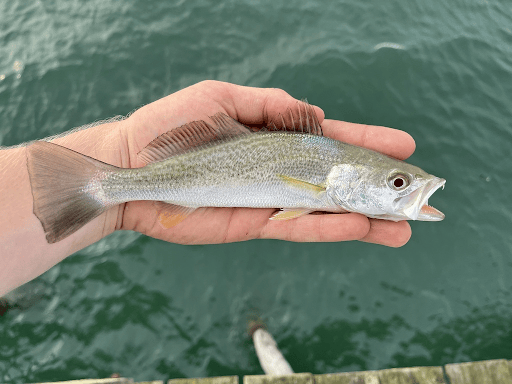
Weakfish (Cynoscion regalis) join that same seasonal pull toward the coast. Through spring and summer they use sounds, estuaries, and nearshore habitat, feeding heavily on shrimp, crustaceans, and smaller fishes. As autumn water cools toward about 75°F, they begin gathering and shifting offshore and south; during warmer years, some linger longer before making that move (Krause et al., 2020).
Weakfish (Cynoscion regalis), a fall migrant along the Atlantic coast and currently listed as Endangered on the IUCN Red List. | Image credit: aiden007, iNaturalist
By this point in fall, fishes that spent summer scattered through different parts of the estuary are beginning to converge along the same channels, inlets, and nearshore corridor. The movement is outward, but not entirely.
While larger spot and croaker are leaving for offshore spawning grounds, their next generation is already beginning the opposite journey. Larvae produced offshore in fall and winter can begin entering North Carolina estuaries by late fall and early winter, with that inward movement continuing through spring (Warlen & Burke, 1990; Allen et al., 2024).
So even as one generation moves out through the inlet, another is beginning to come back in.
The Fish That Stay—but Change Address
Migration does not always mean leaving Onslow County. For some fishes, fall means finding a different part of the same estuary.
Spotted seatrout (Cynoscion nebulosus), or speckled trout, remain in coastal North Carolina through winter, but they do not necessarily stay where they spent August. As the shallow sounds and creek edges cool, trout begin gathering around channels, deeper holes, creek mouths, and other places where a few extra feet of water can provide more stable temperatures.
Spotted seatrout (Cynoscion nebulosus) moving through shallow coastal water before shifting toward deeper winter habitat as temperatures fall. | Image credit: charliew82, iNaturalist
That difference becomes increasingly important as winter approaches. Spotted seatrout begin showing cold stress when water falls below about 45°F, and prolonged periods below roughly 44.6°F can produce substantial winter mortality in North Carolina. Deeper sections of an estuary can remain slightly warmer during a severe cold event, giving fish somewhere to retreat when the shallows become too cold (Ellis, Buckel, & Hightower, 2017; Ellis, Buckel, Hightower, & Poland, 2017).
So the autumn congregation of trout around creek mouths, bridge structure, channels, and deep holes is more than a change in where they happen to be feeding. By fall, they are beginning to settle into the parts of the estuary that may carry them through winter.
Black drum (Pogonias cromis) reorganize themselves through fall as well, although their movement depends partly on age. Young black drum spend their first year within estuaries, feeding over mud, sand, oyster habitat, and other bottoms rich in worms, small crustaceans, and mollusks. As they grow, they begin using saltier water and deeper coastal habitat, while larger fish are often associated with oyster bars, bridge and dock pilings, channels, and other structure where clams, oysters, crabs, and other bottom prey collect (North Carolina Division of Marine Fisheries, 2026).
Black drum (Pogonias cromis) use estuaries when young, then shift toward deeper, saltier water as they grow and fall progresses. | Image credit: zachs, iNaturalist
By late fall, black drum generally shift away from the shallowest summer habitat toward deeper bays, sounds, channels, and offshore water. Unlike spotted seatrout, there is not one well-defined temperature at which that movement begins. Instead, cooling water gradually changes where suitable feeding and winter habitat remain available, with older fish tending to range farther toward high-salinity and offshore waters (North Carolina Division of Marine Fisheries, 2026).
A piling or oyster bar that held one mix of fishes through summer may still be occupied in November, but by a different combination of animals using the same structure for colder-water feeding and refuge.
The habitat has not disappeared. Its seasonal community has changed.
Shrimp Begin Pouring Out of the Creeks
Some of the most important migrants along the Onslow County coast are only a few inches long.
White shrimp (Litopenaeus setiferus), locally called greentails, spend much of their early lives inside estuarine nursery habitat. They grow rapidly in warm water, and once they reach only about 0.8 to 1.2 inches long, they begin leaving the shallowest marsh habitat for deeper creeks, rivers, bays, and sounds. By late summer and fall, larger young shrimp—often around 4.7 inches or more—are moving farther downstream toward channels, inlets, and ultimately the ocean (North Carolina Division of Marine Fisheries, 2023).
White shrimp (Litopenaeus setiferus) grow quickly in estuarine nurseries before moving downstream toward sounds, inlets, and coastal water in late summer and fall. | Image credit: portulaca, iNaturalist
Cooling water helps drive that progression, but rainfall can accelerate it. Heavy freshwater input lowers estuarine salinity and can push shrimp downstream and toward the ocean before they otherwise would have left. That means a wet fall and a dry fall do not necessarily produce the same migration (North Carolina Division of Marine Fisheries, 2023).
The shrimp are responding to an estuary that is changing around them, and almost everything seems interested in eating them. Flounder, speckled trout, red drum, weakfish, sharks, wading birds, and humans all take advantage of shrimp as they move through the coastal food web (North Carolina Division of Marine Fisheries, 2023).
A strong outward movement of white shrimp is therefore not merely a shrimp migration. It is a moving food resource.
When those shrimp leave marsh creeks and spread toward the sound and inlet, predators that were previously separated begin encountering the same pulse of prey in increasingly narrow parts of the estuary.
The estuary briefly becomes a funnel.
The Blue Crabs Take Different Roads
Blue crabs (Callinectes sapidus) complicate the idea of a single fall migration even further because males and females do not necessarily go the same direction.
Blue crab (Callinectes sapidus) in shallow estuarine habitat; mature females eventually move toward saltier water and coastal spawning areas. | Image credit: lenora_irene, iNaturalist
Adult males generally remain farther upriver in lower-salinity water, while mature females move toward saltier portions of the estuary and eventually toward inlet and coastal spawning habitat. Females can travel considerable distances during this migration, using salinity gradients, tides, and currents to move toward the high-salinity water needed for spawning (Bell & Eggleston, 2023; Forward et al., 2003).
That split makes sense once their life cycle is considered. Females typically mate in brackish estuarine water, then store sperm until they are ready to produce an egg mass. As spawning approaches, they move toward the lower estuary and inlet, where much saltier water provides the conditions their developing larvae need. Eggs hatch near the mouth of the estuary or just beyond it, and the larvae are carried offshore before later returning toward the coast as postlarvae (Forward et al., 2003; Epifanio, 2019).
The same inlet therefore serves two directions of the blue crab life cycle: mature females move outward toward spawning water, while a later generation is carried back toward estuarine nursery habitat.
For a blue crab, the difference between a brackish river and a salty inlet is not simply scenery. One supports mating and much of adult life, while the other provides the salinity needed to begin the next generation.
A single life cycle requires both.
Rays Begin Leaving the Shallows
Large dark wings moving beneath clear water are among the more obvious signs that rays are using shallow coastal habitat during summer. By fall, where those rays appear—and how they move through the coast—begins to change.
Cownose rays (Rhinoptera bonasus) are highly mobile schooling rays that use North Carolina sounds, estuaries, and nearshore waters during the warmer months. Through summer they may be scattered across that habitat, sometimes appearing alone or in small groups over shallow flats and sounds. As fall develops, rays that have been using North Carolina estuaries begin moving toward the ocean side, while migrants arriving from farther north join the same southbound corridor along the Carolina coast.
That is when larger schools can become more noticeable along the beaches and nearshore waters. Their movement continues south toward winter habitat off Florida, with cooling water helping shape when they leave northern and estuarine habitats (Goodman et al., 2010; Omori & Fisher, 2017; Bangley et al., 2021).
Cownose rays (Rhinoptera bonasus) traveling in a school, a familiar sight as they gather and move along the coast in fall. | Image credit: Chesapeake Bay Program
For someone watching from Topsail, the rays seen scattered through the sound during summer can become part of something much larger by fall. A few dark wings moving over an estuarine flat may give way to schools traveling along the ocean side as North Carolina becomes part of the passage between northern summer waters and winter habitat farther south.
Southern stingrays (Hypanus americanus) make a quieter seasonal shift. Their summer presence along North Carolina is part of a much older warm-season pattern, with southern stingrays historically documented moving north along the Carolina coast as warmer water expands their usable habitat (Coles, 1913).
Unlike cownose rays traveling in schools higher in the water column, southern stingrays remain closely tied to the bottom. Through summer, they can be a familiar sight moving over warm sand and mud flats, along creek mouths, and through shallow estuarine water as they search the bottom for worms, bivalves, shrimp, crabs, and small fishes. Even when they move between habitats, much of that movement remains along or just above the benthic surface rather than through open water (Gilliam & Sullivan, 1993; Tilley et al., 2013).
As the shallow flats cool through fall, they become less common in the places where beachgoers may have seen them repeatedly through July and August. Their seasonal movement is not mapped nearly as clearly in North Carolina as that of cownose rays, so we cannot point to one temperature or one offshore route. What we can say is that southern stingrays are capable of moving between shallow flats and considerably deeper bottom habitat while remaining closely associated with the seafloor (Coles, 1913; Corcoran et al., 2013).
For someone watching the shallows, that change may simply look like absence. The stingray that repeatedly crossed the same warm flat all summer is suddenly harder to find—not because it has joined a large southbound school above the bottom, but because its usable benthic habitat has shifted beyond the shallows where it was easiest to see.
Red Drum Gather at the Edges
Red drum (Sciaenops ocellatus), and our state fish, add another layer to the fall movement. Young fish spend their first years closely tied to estuaries, growing quickly from roughly 12 to 14 inches by their first birthday to more than 27 inches during their second full year. They do not reach reproductive maturity quite as quickly, however. In North Carolina, most become mature around ages three to four, when they are roughly 30 to 36 inches long (Ross et al., 1995).
Red drum (Sciaenops ocellatus) grow in estuaries when young, while larger adults gather around inlets and nearshore waters during late-summer and fall spawning. | Image credit: colesutton, iNaturalist
That difference is something a beachgoer or angler can actually see. The smaller “puppy drum” encountered along marsh edges, creeks, and sounds are still growing within the estuarine part of their life cycle, while the much larger fish appearing around beaches and inlets are increasingly part of the adult population that spends more time in coastal and ocean waters. By late summer and early fall, mature red drum gather around inlets, beaches, and nearshore waters, where spawning and feeding can overlap. In North Carolina, spawning occurs from August into early October near barrier-island inlets and adjacent coastal waters. During that same period, adults move more actively between estuarine and ocean habitats (Ross et al., 1995; Bacheler et al., 2009).
That puts a large red drum outside New River Inlet directly into the same corridor carrying mullet, menhaden, shrimp, spot, croaker, and other prey toward the ocean. It may be there to spawn, to feed, or simply because its own seasonal movement has brought it into the same narrow stretch of coast.
As fall gives way to winter, mature adults increasingly move into ocean waters where temperatures remain more moderate, while younger red drum are much more likely to remain behind in the estuary (Stewart & Scharf, 2008).
The Offshore Visitors Come Close
Fall also brings some animals toward the coast before eventually carrying them away.
King mackerel (Scomberomorus cavalla) are warm-water fish that seldom move into water much below about 68°F. Through summer and the warmer part of fall, they can move surprisingly close to the beaches, inlet mouths, and nearshore reefs of North Carolina, following schools of menhaden, mullet, sardines, and other prey into places where a beachgoer or pier angler may suddenly encounter a fish that spends much of its time farther offshore (North Carolina Division of Marine Fisheries, 2022).
That window does not last. As coastal water continues cooling toward the lower edge of their preferred range, king mackerel begin shifting south and farther toward the warmer waters of the continental shelf. By winter, much of the Atlantic population has moved toward southern Florida, while some fish remain in deeper North Carolina waters near the Gulf Stream (North Carolina Division of Marine Fisheries, 2022).
For a few weeks, that creates an unusual overlap along the Onslow coast. Animals moving out of the estuary meet predators moving closer to shore to feed, while other migrants are already passing south or beginning their move offshore. An inlet or artificial reef that seemed relatively quiet several weeks earlier can suddenly sit at the crossing point of several different seasonal routes.
For a short time, it becomes an intersection.
Then the Menhaden Arrive
By October and November, another migration becomes increasingly visible.
Atlantic menhaden (Brevoortia tyrannus) move south along the Atlantic coast as fall deepens, with older and larger fish returning from summer waters farther north. Spawning can occur along the migration route from late fall into early spring, but one of the major winter gathering areas lies off North Carolina near Cape Hatteras (Lewis et al., 1987; Nicholson, 1978).
For Onslow County, that means some of the dark schools appearing beyond the breakers are part of a much larger coastwide movement passing our beaches on the way toward winter spawning waters.
Menhaden occupy an unusual place in the coastal food web. They filter tiny phytoplankton and zooplankton from the water, then gather that scattered production into dense schools of oily fish large enough for predators to chase (Lewis & Peters, 1994). Bluefish, striped bass, sharks, tunas, dolphins, and seabirds all take advantage of them, making menhaden one of the connections between plankton near the bottom of the food web and some of the largest predators along the coast (Chagaris et al., 2020; Lewis & Peters, 1994).
For a beachgoer, the first sign may simply be a dark patch offshore that does not move like a shadow. Then birds begin gathering above it. The surface breaks as predators push into the school from below, and what looked like an indistinct patch of water suddenly becomes one of the busiest places along the beach.
That is when looking up becomes as important as looking into the water.
Because another migration has arrived.
The Atlantic Flyway Meets the Fall Fish Run
The Atlantic Flyway follows the eastern edge of North America, placing the North Carolina coast directly beneath one of the continent’s major migration routes. For birds traveling hundreds or thousands of miles between breeding and wintering grounds, Onslow County is not simply coastline passing beneath their wings. Its beaches, marshes, tidal flats, sounds, and inlets can provide places to rest and replenish the energy needed for the next part of the journey (Smith et al., 2022).
The Atlantic Flyway follows the eastern edge of North America, carrying migrating birds directly along the North Carolina coast. | Image credit: Audubon
Fall makes that stop especially busy because the migration overhead is unfolding at the same time the water below is changing. Shrimp are moving out of creeks. Mullet and other fishes are funneling toward the inlets. Schools of bait gather along the beaches, and menhaden begin moving down the coast. For birds that feed on fishes and coastal invertebrates, those movements can turn the Onslow shoreline into a series of feeding opportunities along the Atlantic Flyway.
But the transition is not a clean exchange in which the summer birds simply leave and winter birds immediately take their places. It happens gradually, with departures, arrivals, and birds merely passing through overlapping for weeks.
The Birds Moving Through or South
Some of the first changes are easiest to notice in the marsh. Green herons (Butorides virescens) begin moving south from late August through October, while least bitterns (Ixobrychus exilis) also leave much of their northern breeding range for warmer winter habitat. A bird that spent summer hunting from the edge of a tidal creek may simply become harder to find as September advances (Smith et al., 2022).
Along the beaches and nesting islands, the summer community begins loosening in several directions at once. Wilson’s plovers (Anarhynchus wilsonia), least terns (Sternula antillarum), gull-billed terns (Gelochelidon nilotica), black skimmers (Rynchops niger), and sandwich terns (Thalasseus sandvicensis) begin leaving breeding areas or redistributing south along the coast. Royal terns (Thalasseus maximus) may linger longer, while ospreys (Pandion haliaetus) begin following waterways and coastlines toward wintering grounds farther south (North Carolina Wildlife Resources Commission, 2025; Smith et al., 2022).
The shorebirds make the transition even less tidy.
The eastern Willet (Tringa semipalmata semipalmata) breeds in Atlantic salt marshes, including those along the North Carolina coast, before leaving for wintering grounds that can lie as far away as northern South America. But the Willet standing on a Topsail flat in fall is not automatically one of the birds that nested here. Western Willets (Tringa semipalmata inornata), which breed in the interior of western North America, can also occur along the Atlantic coast outside the breeding season. For a few weeks, birds from very different summer landscapes may use the same Carolina shoreline (Oswald et al., 2016; Huysman et al., 2022).
Lesser yellowlegs (Tringa flavipes) and greater yellowlegs (Tringa melanoleuca) add another layer of passing traffic. They arrive from breeding grounds much farther north, with adults beginning their southward movements as early as July and younger birds following later. Along coastal North Carolina, exposed flats, shallow marsh edges, and pools of tidal water become temporary feeding grounds along that journey (Smith et al., 2022).
That makes the falling tide part of the migration too. A mudflat that looked empty beneath the previous high tide can suddenly hold Willets, yellowlegs, plovers, and other shorebirds probing exposed sediment for worms, small crustaceans, mollusks, and other prey. North Carolina barrier-island studies have found fall shorebirds shifting among the swash zone, wet sand, spits, and tidal habitat as water levels change, using different pieces of the shoreline for feeding and resting through the tidal cycle (Tarr, 2008).
For some of those birds, the stop may last days. For others, only hours. The tide falls, a feeding ground appears, and birds moving along the Atlantic coast briefly settle into it before the water—or the migration—carries them onward.
The Winter Coast Begins Arriving
The winter coast does not arrive all at once. Its first birds begin appearing in September, more follow through October, and by November the sounds, marshes, and beaches of Onslow County can hold a noticeably different community than they did at the end of summer.
On the sounds and protected water behind the barrier islands, buffleheads (Bucephala albeola) begin settling into sheltered coves, bays, and estuaries, repeatedly disappearing beneath the surface in search of small crustaceans, mollusks, and other aquatic prey. Red-breasted mergansers (Mergus serrator) arrive as well, often working shallow coastal water and estuaries in small groups as they dive after fish (Gauthier, 1993; Titman, 1999; Smith et al., 2022).
The marsh begins changing at the same time. American black ducks (Anas rubripes) appear more regularly in salt marshes, tidal creeks, ponds, and estuaries, while Green-winged teal (Anas crecca) increase in shallow protected water. Both spent the breeding season much farther north, but by fall the sounds and marshes of the Atlantic coast have become part of their winter landscape (Robinson et al., 2016; Smith et al., 2022).
Along the ocean side, the change is visible at the water’s edge. Dunlin (Calidris alpina), sanderlings (Calidris alba), red knots (Calidris canutus), and black-bellied plovers (Pluvialis squatarola) begin working beaches, shoals, exposed flats, and inlet margins. Some will remain along the southeastern coast through winter, while others are pausing only long enough to feed before continuing south. As the tide falls they spread across wet sand and exposed flats; when the water returns, they are gradually pushed toward higher beaches and roosting areas (Burger et al., 2012; Smith et al., 2022; Tarr, 2008).
Red knots make the scale of that movement especially clear. A bird standing quietly near the wrack line may have arrived from Arctic breeding grounds and may still be headed toward winter habitat in the southeastern United States, the Caribbean, or northern South America. Individual birds do not all travel the same route or distance, but for some, the Carolina coast is only one stop in a journey spanning thousands of miles (Burger et al., 2012; Smith et al., 2022).
That changes what a quiet fall beach can mean. The wet sand, tidal flats, wrack, marshes, and sheltered water are not empty spaces between destinations. For birds arriving from the north, they are places to replace the energy already spent before the next part of the migration begins.
When the Food Web Takes to the Air
Fall adds another layer of hunters above the shoreline.
Peregrine falcons (Falco peregrinus) move south along the Atlantic coast during migration, often following the same barrier islands, mudflats, and shorelines being used by migrating shorebirds. They are not interested in the mullet, shrimp, or menhaden moving below the surface. They are interested in the birds feeding around them. Shorebirds, ducks, gulls, and other coastal birds become prey themselves, adding another level to the food web moving through the coast (Smith et al., 2022).
Farther offshore, the change becomes visible in a different way. Double-crested cormorants (Nannopterum auritum) arrive along the Carolina coast in large numbers and spend much of their time diving after fish. Menhaden are among the schooling fishes they readily take, tying these winter visitors directly into the same fall movement already passing through the inlets and along the beaches (Watts et al., 2023).
Red-throated loons (Gavia stellata) and common loons (Gavia immer) begin appearing along the ocean side as well. Both spend the warmer months much farther north, but by late fall they are back in shallow marine waters, sounds, bays, and estuaries where fish are abundant. A bird that spent summer on a northern lake or tundra pond may now be diving just beyond the breakers along Topsail (Stenhouse et al., 2020; Smith et al., 2022).
Then come the northern gannets (Morus bassanus).
By late fall, they become one of the most spectacular signs that the seasonal food web has shifted. Northern gannets spend much of the nonbreeding season between New York and North Carolina, feeding almost entirely on schooling fishes such as herring, mackerel, and menhaden over the continental shelf (Mowbray, 2020; Smith et al., 2022).
From shore, a feeding aggregation can seem to appear from nowhere. Large white birds circle above a patch of ocean, fold their wings, and plunge headfirst into the water. One follows another until dozens may be dropping into the same moving patch of sea.
The important thing may not be the gannets themselves, but what they are pointing toward. Beneath them is a school of fish. Around that school may be bluefish, sharks, dolphins, or other large predators pushing the same prey toward the surface. The birds above and the predators below are using the same concentration of food from opposite directions.
What began months earlier as plankton, marsh production, and small animals feeding inside estuaries has now moved far enough through the food web to become visible from the beach as birds falling out of the sky.
What Happens if One Migration Does Not Arrive?
It is easy to think about migration as something belonging to individual species—the mullet run, the shrimp migration, the shark migration, the Atlantic Flyway. But the coast does not experience those movements separately. Predators are responding to prey, young fishes are entering estuaries when nursery habitat and food are available, adults are leaving when spawning habitat lies offshore, and blue crabs are moving between different salinity zones because different stages of their lives depend on different parts of the estuary (Warlen & Burke, 1990; Forward et al., 2003).
That means a change in one migration does not necessarily stop with the animal making it.
If fewer mullet leave an estuary, there may be less concentrated prey moving along the beach for bluefish, sharks, pelicans, and terns. The difference is not simply fewer mullet in one place. Some of the energy that spent summer accumulating inside the estuary now reaches the nearshore food web in a different amount, at a different time, or along a different route (Bacheler et al., 2005).
White shrimp show how quickly those relationships can shift. Heavy rainfall lowers estuarine salinity and can push shrimp toward the inlet earlier than they might have moved during a drier fall. Predators farther inside the estuary may encounter fewer shrimp, while those gathered nearer the inlet may suddenly encounter more. The migration still happens, but its timing changes where that pulse of food becomes available (North Carolina Division of Marine Fisheries, 2023).
Temperature can alter the overlap in another way. A coastal shark that remains farther north later into a warm fall may not encounter its prey in quite the same places or at quite the same time if those prey are responding to a different set of seasonal cues. Warmer ocean conditions are already capable of delaying southward shark migrations and extending how long some species remain in northern seasonal habitat (Manz et al., 2025).
None of this means every migration must occur on the same date each year. Coastal systems have always varied with storms, rainfall, temperature, currents, and food availability. What matters is that the movements continue to cross one another often enough for the relationships among them to persist.
A predator still has to encounter its prey. A larva still has to reach suitable nursery habitat, and a migrating bird still has to find enough food to continue south.
The timing does not have to be exact, but the meeting still has to happen.
Watching the Coast Change
By September, the first changes are already beginning. Mullet gather near the inlets, shrimp move out of tidal creeks, rays become less common over shallow flats, and feeding birds begin revealing where bait has collected near the surface.
By October and November, the same places can hold a very different community. Some animals have moved only a few miles into deeper water, while others are passing Onslow County on journeys that continue far beyond the Carolina coast.
The landscape itself looks much the same. New River Inlet still cuts through the barrier island. The marsh grass still bends with the wind. The same beach stretches north and south. What changes is who is moving through it.
For a few months each fall, Onslow County becomes a meeting place between departures, arrivals, and animals simply shifting into the next piece of habitat they need.
The landscape stays where it is. The food web moves through it.
Wilson Bay along the New River in Jacksonville, North Carolina. The landscape stays where it is, even as the food web moves through it. | Image credit: A. Mitchell
References
Allen, D. M., Govoni, J. J., Able, K. W., Buckel, J. A., Hale, E. A., Hilton, E. J., Kellison, G. T., Targett, T. E., Taylor, J. C., & Walsh, H. J. (2024). Long-term dynamics of larval and early juvenile spot (Leiostomus xanthurus) off the U.S. East Coast: Relating ocean origins, estuarine Ingress, and changing environmental conditions. Fishery Bulletin, 122(4), 162-185. https://doi.org/10.7755/fb.122.4.3
Bacheler, N. M., Paramore, L. M., Burdick, S. M., Buckel, J. A., & Hightower, J. E. (2009). Variation in movement patterns of red drum (Sciaenops ocellatus) inferred from conventional tagging and ultrasonic telemetry. Fishery Bulletin, 107(4), 405-419. https://spo.nmfs.noaa.gov/sites/default/files/pdf-content/2009/1074/bacheler.pdf
Bacheler, N. M., Wong, R. A., & Buckel, J. A. (2005). Movements and mortality rates of striped mullet in North Carolina. North American Journal of Fisheries Management, 25(1), 361-373. https://doi.org/10.1577/m04-033.1
Bangley, C. W., Edwards, M. L., Mueller, C., Fisher, R. A., Aguilar, R., Heggie, K., Richie, K., Ahr, B. J., & Ogburn, M. B. (2021). Environmental associations of cownose ray (Rhinoptera bonasus) seasonal presence along the U.S. Atlantic coast. Ecosphere, 12(9). https://doi.org/10.1002/ecs2.3743
Bell, G. W., & Eggleston, D. B. (2023). Timing and route of migration of mature female blue crabs in a large, wind-driven Estuary. Transactions of the American Fisheries Society, 152(2), 253-269. https://doi.org/10.1002/tafs.10391
Bichy, J. B. (2004). A life history assessment on the reproduction and growth of striped mullet, Mugil cephalus, in North Carolina [Unpublished master’s thesis]. North Carolina State University.
Burger, J., Niles, L. J., Porter, R. R., Dey, A. D., Koch, S., & Gordon, C. (2012). Using a shore bird (red knot) fitted with geolocators to evaluate a conceptual risk model focusing on offshore wind. Renewable Energy, 43, 370-377. https://doi.org/10.1016/j.renene.2011.11.006
Carlson, J. K., Sulikowski, J. R., & Baremore, I. E. (2006). Do differences in life history exist for blacktip sharks, Carcharhinus limbatus, from the United States south Atlantic bight and eastern Gulf of Mexico? Environmental Biology of Fishes, 77(3-4), 279-292. https://doi.org/10.1007/s10641-006-9129-x
Chagaris, D., Drew, K., Schueller, A., Cieri, M., Brito, J., & Buchheister, A. (2020). Ecological reference points for Atlantic menhaden established using an ecosystem model of intermediate complexity. Frontiers in Marine Science, 7. https://doi.org/10.3389/fmars.2020.606417
Coles, R. J. (1913). Notes on the embryos of several species of rays, with remarks on the northward summer migration of certain tropical forms observed on the coast of North Carolina. Bulletin of the American Museum of Natural History, 32, 29-35. https://www.biodiversitylibrary.org/page/26891225#page/491/mode/1up
Corcoran, M. J., Wetherbee, B. M., Shivji, M. S., Potenski, M. D., Chapman, D. D., & Harvey, G. M. (2013). Supplemental feeding for ecotourism reverses Diel activity and alters movement patterns and spatial distribution of the southern Stingray, Dasyatis americana. PLoS ONE, 8(3), e59235. https://doi.org/10.1371/journal.pone.0059235
Craig, J. K., Smith, W. E., Scharf, F. S., & Monaghan, J. P. (2015). Estuarine residency and migration of southern flounder inferred from conventional tag returns at multiple spatial scales. Marine and Coastal Fisheries, 7(1), 450-463. https://doi.org/10.1080/19425120.2015.1079578
Ellis, T. A., Buckel, J. A., Hightower, J. E., & Poland, S. J. (2017). Relating cold tolerance to winterkill for spotted seatrout at its northern latitudinal limits. Journal of Experimental Marine Biology and Ecology, 490, 42-51. https://doi.org/10.1016/j.jembe.2017.01.010
Ellis, T., Buckel, J., & Hightower, J. (2017). Winter severity influences spotted seatrout mortality in a southeast US estuarine system. Marine Ecology Progress Series, 564, 145-161. https://doi.org/10.3354/meps11985
Epifanio, C. E. (2019). Early life history of the blue crab Callinectes sapidus: A review. Journal of Shellfish Research, 38(1), 1-22. https://doi.org/10.2983/035.038.0101
Forward, R. B., Tankersley, R. A., & Welch, J. M. (2003). Selective tidal-stream transport of the blue crab Callinectes sapidus: An overview. Bulletin of Marine Science, 72(2), 347-365. https://scholars.duke.edu/publication/771475
Gauthier, G. (1993). Bufflehead (Bucephala albeola). In The Birds of North America (67th ed.). The Academy of Natural Sciences of Philadelphia & The American Ornithologists’ Union.
Goodman, M. A., Conn, P. B., & Fitzpatrick, E. (2010). Seasonal occurrence of Cownose rays (Rhinoptera bonasus) in North Carolina’s estuarine and coastal waters. Estuaries and Coasts, 34(3), 640-651. https://doi.org/10.1007/s12237-010-9355-5
Heupel, M., Carlson, J., & Simpfendorfer, C. (2007). Shark nursery areas: Concepts, definition, characterization and assumptions. Marine Ecology Progress Series, 337, 287-297. https://doi.org/10.3354/meps337287
Huysman, A. E., Cooper, N. W., Smith, J. A., Haig, S. M., Heath, S. A., Johnson, L., Olson, E., Regan, K., Wilson, J. K., & Marra, P. P. (2022). Strong migratory connectivity indicates Willets need subspecies-specific conservation strategies. Ornithological Applications, 124(3). https://doi.org/10.1093/ornithapp/duac015
Jensen, D. R., & Graves, J. E. (2020). Movements, habitat utilization, and post-release survival of cobia (Rachycentron canadum) that summer in Virginia waters assessed using pop-up satellite archival tags. Animal Biotelemetry, 8(1). https://doi.org/10.1186/s40317-020-00212-0
Krause, J. R., Hightower, J. E., Buckel, J. A., Turnure, J. T., Grothues, T. M., Manderson, J. P., Rosendale, J. E., & Pessutti, J. P. (2020). Using acoustic telemetry to estimate weakfish survival rates along the U.S. East Coast. Marine and Coastal Fisheries, 12(5), 241-257. https://doi.org/10.1002/mcf2.10095
Lewis, R. M., Ahrenholz, D. W., & Epperly, S. P. (1987). Fecundity of Atlantic menhaden, Brevoortia tyrannus. Estuaries, 10(4), 347. https://doi.org/10.2307/1351894
Lund, W. A., & Maltezos, G. C. (1970). Movements and migrations of the bluefish, Pomatomus saltatrix, tagged in waters of New York and southern New England. Transactions of the American Fisheries Society, 99(4), 719-725. https://doi.org/10.1577/1548-8659(1970)99<719:mamotb>2.0.co;2
Manz, M. H., Shipley, O. N., Cerrato, R. M., Hueter, R. E., Newton, A. L., Tyminski, J. P., Franks, B. R., Curtis, T. H., Fischer, C., Zacharias, J. P., Scott, C., Dunton, K. J., Kneebone, J., Peterson, B. J., Scannell, B. J., Dodd, J. F., & Frisk, M. G. (2025). Predictions of southern migration timing in coastal sharks under future ocean warming. Conservation Biology, 39(6), e70080. https://doi.org/10.1111/cobi.70080
McCandless, C. T., Pratt, Jr., H. L., Kohler, N. E., Merson, R. R., & Recksiek, C. W. (2007). Distribution, localized abundance, movements, and migrations of juvenile sandbar sharks tagged in Delaware Bay. In Shark nursery grounds of the Gulf of Mexico and the east coast waters of the United States (pp. 45-62). American Fisheries Society Symposium. https://doi.org/10.47886/9781888569810.ch4
Merson, R. R., & Pratt, Jr., H. L. (2001). Distribution, Movements and Growth of Young Sandbar Sharks, Carcharhinus Plumbeus, in the Nursery Grounds of Delaware Bay. Environmental Biology of Fishes, 61, 13-24. https://link.springer.com/article/10.1023/A:1011017109776
Midway, S. R., & Scharf, F. S. (2012). Histological analysis reveals larger size at maturity for southern flounder with implications for biological reference points. Marine and Coastal Fisheries, 4(1), 628-638. https://doi.org/10.1080/19425120.2012.717524
Mowbray, T. B. (2020). Northern Gannet (Morus bassanus). In Birds of the World (1.0th ed.). Cornell Lab of Ornithology. https://doi.org/10.2173/bow.norgan.01
Nicholson, W. R. (1978). Movements and population structure of Atlantic menhaden indicated by tag returns. Estuaries, 1(3), 141. https://doi.org/10.2307/1351455
Norcross, B. L., & Austin, H. M. (1988). Middle Atlantic bight meridional wind component effect on bottom water temperatures and spawning distribution of Atlantic croaker. Continental Shelf Research, 8(1), 69-88. https://doi.org/10.1016/0278-4343(88)90025-8
Omori, K. L., & Fisher, R. A. (2017). Summer and fall movement of cownose ray, Rhinoptera bonasus, along the East Coast of United States observed with pop-up satellite tags. Environmental Biology of Fishes, 100(11), 1435-1449. https://doi.org/10.1007/s10641-017-0654-6
Oswald, J. A., Harvey, M. G., Remsen, R. C., Foxworth, D. U., Cardiff, S. W., Dittmann, D. L., Megna, L. C., Carling, M. D., & Brumfield, R. T. (2016). Willet be one species or two? A genomic view of the evolutionary history of Tringa semipalmata. The Auk, 133(4), 593-614. https://doi.org/10.1642/auk-15-232.1
Packer, D. B. (1999). Essential fish habitat source document. Summer flounder, Paralichthys dentatus, life history and habitat characteristics (NOAA Technical Memorandum NMFS-NE-151). National Marine Fisheries Service. https://repository.library.noaa.gov/view/noaa/3149
Robinson, O. J., McGowan, C. P., & Devers, P. K. (2016). Updating movement estimates for American Black ducks (Anas rubripes). PeerJ, 4, e1787. https://doi.org/10.7717/peerj.1787
Roskar, G., Morley, J. W., & Buckel, J. A. (2024). Seasonality and relative abundance within an elasmobranch assemblage near a major biogeographic divide. PLOS ONE, 19(6), e0300697. https://doi.org/10.1371/journal.pone.0300697
Ross, J. L., Stevens, T. M., & Vaughan, D. S. (1995). Age, growth, mortality, and reproductive biology of red drums in North Carolina waters. Transactions of the American Fisheries Society, 124(1), 37-54. https://doi.org/10.1577/1548-8659(1995)124<0037:agmarb>2.3.co;2
Ross, S. W. (1988). Age, growth, and mortality of Atlantic croaker in North Carolina, with comments on population dynamics. Transactions of the American Fisheries Society, 117(5), 461-473. https://doi.org/10.1577/1548-8659(1988)117<0461:agamoa>2.3.co;2
Smith, M. A., Mahoney, J., Knight, E. J., Taylor, L., Seavy, N. E., Bailey, O. H., Carbone, M., DeLuca, W., Gonzalez, N. S., Jimenez, M. F., W. O’Bryan, G. M., Rao, N., Witko, C. J., Wilsey, C., & Deppe, J. L. (2022). Bird Migration Explorer. National Audubon Society. https://explorer.audubon.org/
Stenhouse, I. J., Berlin, A. M., Gilbert, A. T., Goodale, M. W., Gray, C. E., Montevecchi, W. A., Savoy, L., & Spiegel, C. S. (2020). Assessing the exposure of three diving bird species to offshore wind areas on the U.S. Atlantic outer continental shelf using satellite telemetry. Diversity and Distributions, 26(12), 1703-1714. https://doi.org/10.1111/ddi.13168
Stewart, C. B., & Scharf, F. S. (2008). Estuarine recruitment, growth, and first‐year survival of juvenile red drum in North Carolina. Transactions of the American Fisheries Society, 137(4), 1089-1103. https://doi.org/10.1577/t07-176.1
Sutherland, D. F., & Fable, Jr., W. A. (1980). Results of a king mackerel (Scomberomorus cavalla) and Atlantic Spanish mackerel (Scomberomorus maculatus) migration study, 1975–79 (NOAA Technical Memorandum NMFS-SEFC-12). National Marine Fisheries Service. https://repository.library.noaa.gov/view/noaa/5385
Tilley, A., López-Angarita, J., & Turner, J. (2013). Effects of scale and habitat distribution on the movement of the southern stingray Dasyatis americana on a Caribbean atoll. Marine Ecology Progress Series, 482, 169-179. https://doi.org/10.3354/meps10285
Titman, R. D. (n.d.). Red-breasted Merganser (Mergus serrator). In The Birds of North America (443rd ed.). A. Poole & F. Gill.
Warlen, S. M., & Burke, J. S. (1990). Immigration of larvae of fall/Winter spawning marine fishes into a North Carolina Estuary. Estuaries, 13(4), 453. https://doi.org/10.2307/1351789
Warlen, S. M., & Chester, A. J. (1985). Warlen, S. M., & Chester, A. J. (1985). Age, growth, and distribution of larval spot, Leiostomus xanthurus, off North Carolina. Fishery Bulletin, 83(4), 587–599. Fishery Bulletin, 83(4), 587-599. https://spo.nmfs.noaa.gov/sites/default/files/pdf-content/fish-bull/warlen.pdf
Watts, B. D., Paxton, B. J., Hines, C., & Anderson, S. K. (2023). Estimating potential menhaden consumption by double-crested cormorants along the coast of North Carolina. Frontiers in Marine Science, 10, 1193429. https://doi.org/10.3389/fmars.2023.1193429
White, M. L., & Chittenden, Jr., M. E. (1977). Age determination, reproduction, and population dynamics of the Atlantic croaker, Micropogonias undulatus. Fishery Bulletin, 75(1), 109-123.
A breath breaks the air first — a soft exhale that sounds almost human — and then a dorsal fin lifts from the channel like a line drawn through moving water. The tide is falling. Gulls hover over the seam where current tightens. Fishermen pause mid-cast because everyone knows the rhythm: if the dolphins are working the edge, the fish are already gathering.
These encounters feel spontaneous, but they are not accidents. The dolphins that surface beside our piers, marsh creeks, and inlets are not anonymous travelers passing through. Many bottlenose dolphins show long-term site fidelity and structured community patterns in estuarine systems, returning to the same places across years (Urian et al., 2009; Wells, 2014). To live on this shoreline is to share space with minds moving just below the surface — residents of the tidal edge.
Who they are: a coastal population
The dolphins most frequently seen along Onslow County’s waters are common bottlenose dolphins (Tursiops truncatus), a species whose “coastal” lives can look very different from “offshore” lives. Across the western North Atlantic, genetic studies show fine-scale population structure that can separate dolphins using nearshore coastal waters from dolphins using inshore estuarine waters (Rosel et al., 2009). More broadly, integrative work continues to support meaningful coastal vs offshore divergence in the region (Costa et al., 2022).
In estuaries, photo-identification research (matching dorsal-fin markings) repeatedly shows that bottlenose dolphins can form discrete social communities with limited spatial overlap — a pattern consistent with long-term residency and local familiarity (Urian et al., 2009). In practical terms, the dolphin a child watches from a dock in spring may be seen again the following winter, and again the next year: not a rumor, but a biological possibility supported by long-term studies of resident dolphins elsewhere on the coast (Wells, 2014).
Photo-identification doesn’t always rely solely on human matching of fin shapes; new tools such as machine learning are being developed to improve accuracy in identifying individual dolphins and whales in the wild. For example, researchers in Hawaii are using advanced algorithms to distinguish individuals from large photo libraries of dorsal fins. As technology improves, methods like photo-ID only get more reliable — which means studies of habitat overlap and seasonal return become more precise over time.
An inside look at how scientists “read” dorsal fin shapes and markings to track the same dolphins over time.
Reading the geometry of the estuary
Dolphins do not simply occupy estuaries; they interpret them.
Tidal channels function as moving architecture. Falling tides compress fish schools toward narrowing exits. Sandbars redirect flow into faster seams. Marsh edges trap prey against shallow gradients. Dolphins exploit these features with precision, repeatedly targeting conditions that make prey capture more efficient (Barros & Wells, 1998; Torres & Read, 2009).
This is one reason dolphins so often appear where the water “looks alive” — at convergence lines, inlet throats, and channel bends. In Florida Bay, for example, foraging tactics are mapped onto habitat features that define where dolphins have spent their time, thus turning behavior into geography (Torres & Read, 2009). What seems like play from shore can be highly strategic predation.
Bottlenose dolphins breaching off Seaview Pier, N. Topsail Beach, North Carolina. The arc of the body and column spray reflect the mechanics of propulsion – force directed through the tail, momentum carried into the air. | Photo credit: Howard Crumpler Photography, 2026
Reader Question:
Why do dolphins seem more active on rainy or overcast days?
Weather, light, and the illusion of play
You may notice that dolphins seem especially active on overcast or rainy days — surfacing more frequently, breaching, or moving in tight arcs through wind-rippled water. It can look like preference, even mood. But dolphins are responding less to cloud cover than to what cloud cover does to the water.
When the sky darkens, baitfish don’t stay arranged the same way. They may bunch together or rise toward the surface. For a predator already working those upper layers, that shift can make hunting more efficient (Benoit-Bird & Au, 2003). Wind and rain can also stir the surface and cloud the water, changing who sees whom first (De Robertis et al., 2003).
There is also a perceptual component. Overcast skies reduce glare, making dorsal fins and splashes easier for human observers to detect. Wind-textured water highlights movement. What appears to be “more play” may sometimes be improved visibility — a reminder that observer experience and animal behavior are not always the same phenomenon.
In short, dolphins are responding to ecological conditions. The weather alters the water; the water alters the fish.
Two bottlenose dolphins break the surface beneath the gray horizon off Surf City, North Carolina. Overcast light and wind-roughened water can change how fish move – and how easily we notice the dolphins following them. | Photo credit: Johnny Provost, Jr., 2025
Communication and social intelligence
Bottlenose dolphins have been studied for decades not just because they are charismatic, but because their social lives depend on constant communication in a shifting, three-dimensional world. One of the strongest findings to emerge from that research is the existence of signature whistles — individually distinctive call types that function as learned identity signals, something very much like the individual name a dolphin goes by within its community (Janik & Sayigh, 2013).
Social learning runs just as deep. Some dolphin foraging habits spread from one animal to another rather than through genetics — passed along socially, a rare pattern among nonhuman species (Krützen et al., 2005). Mothers and calves stay together for years, giving calves time to learn not just how to hunt, but where — which channels to follow, which bends of water hold fish (Wells, 2014).
In some populations elsewhere in the world, dolphins even use tools — carrying marine sponges on their rostrums while foraging or trapping fish inside empty shells — behaviors that are socially learned and culturally transmitted (Krützen et al., 2005).
That learning shapes how dolphins fit into the estuary. In many tidal systems they sit near the top of the local food web, influencing the fish communities beneath them. Yet beyond those protected waters, they are not beyond risk. Large sharks prey on dolphins, placing them within a broader coastal hierarchy where even predators can become prey (Heithaus, 2001). The role shifts with scale. The ecology remains layered.
Two bottlenose dolphins surfacing together off Seaview Pier, N. Topsail Beach, North Carolina. Close positioning and timing are hallmarks of the complex social bonds that define dolphin societies. | Photo credit: Howard Crumpler Photography, 2026
Dolphins are not guardians
Popular culture has assigned dolphins a role they never chose: protector. People repeat a comforting shoreline myth — “If you’re scared of sharks, find the dolphins; they’ll protect you.” But that story is not grounded in how dolphins behave in the wild.
Bottlenose dolphins are powerful predators. They compete, establish dominance hierarchies, and can deliver forceful blows when defending calves or asserting space. Dolphin–shark interactions occur, but they are not “rescue missions” staged for humans; they are ecological encounters shaped by risk, competition, and opportunity (Heithaus, 2001).
Wild dolphins are also capable of injuring people. Research examining human–dolphin interactions show that close approaches — and especially feeding wild dolphins — increase the likelihood of risky contact and harmful outcomes for both dolphins and people (Cunningham-Smith et al., 2006; Vail, 2016). Over time, those interactions leave visible consequences. Long-term data from Sarasota Bay show that dolphins who have learned to associate people with food are more likely to carry injuries linked to boats and fishing gear (Christiansen et al., 2016).
The danger is not that dolphins are “evil.” The danger is assuming they share human intentions.
Swimming near a pod does not create a protective shield. Dolphins are not lifeguards. They are wild animals navigating their own priorities in a shared environment. Respecting that boundary is what allows coexistence.
A bottlenose dolphin pursuing prey near a recreational vessel in a waterway in Surf City, North Carolina. Foraging behavior can bring dolphins into close proximity with boats – not as companions, but as active predators focused on fish. | Video credit: Cynthia Dirosse, 2024
Winter dolphins
A persistent assumption is that dolphins vanish when the water cools. In reality, seasonal distribution can be more nuanced — changing with prey, temperature, and coastal movement patterns rather than following a simple on/off presence.
Along the mid-Atlantic coast, research shows that bottlenose dolphins shift their movements with the seasons, appearing in different areas at different times of year (Torres et al., 2005). Studies focused on estuarine dolphins in southern North Carolina document similar seasonal patterns closer to home (Silva et al., 2020). From shore, those changes can look like disappearance. But winter quiet does not always mean absence. It may simply mean dolphins are working deeper channels or less visible pathways beyond the easy reach of our eyes.
The estuary in winter is quieter, but not empty.
Dorsal fins in winter light off Surf City, North Carolina. Dolphins may appear less active this time of year, but changes in light, water depth, and travel corridors often influence what we notice from shore. | Photo credit: Surf City Parks, Recreation, and Tourism, 2017
Living beside them
Living near dolphins is a privilege — and it places us within the same waters they navigate. Vessel traffic, fishing gear, and repeated close approaches can shape the lives of animals that live for decades and raise calves slowly (Wells, 2014). Studies of dolphins that have been fed or closely approached by people show that these interactions can shift behavior, making dolphins more likely to approach boats and increasing the risk of injury and conflict (Vail, 2016). Distance, in that sense, preserves the patterns people come to watch.
The presence of dolphins is not guaranteed. It is a sign that the system still functions — prey, water quality, shoreline structure, and the complex social knowledge dolphins carry from year to year. As long-lived predators near the top of the food web, they are indicator species, reflecting the condition of the waters they inhabit — estuary, inlet, and nearshore coast alike.
And so when a dorsal fin rises beyond the channel markers, it means more than a moment of spectacle. It means the currents are still working, the fish are still moving, and the layered relationships that shape this shoreline are still holding.
There is always more to learn about dolphins than fits in a single post. For those who’d like to go further, this episode of the All Creatures Podcast offers a thoughtful exploration of their biology and behavior.
References
Barros, N. B., Wells, R. S., & Barros, N. B. (1998). Prey and feeding patterns of resident bottlenose dolphins (Tursiops truncatus) in Sarasota Bay, Florida. Journal of Mammalogy, 79(3), 1045. https://doi.org/10.2307/1383114
Benoit-Bird, K. J., & Au, W. W. (2003). Prey dynamics affect foraging by a pelagic predator (Stenella longirostris) over a range of spatial and temporal scales. Behavioral Ecology and Sociobiology, 53(6), 364-373. https://doi.org/10.1007/s00265-003-0585-4
Christiansen, F., McHugh, K. A., Bejder, L., Siegal, E. M., Lusseau, D., McCabe, E. B., Lovewell, G., & Wells, R. S. (2016). Food provisioning increases the risk of injury in a long-lived marine top predator. Royal Society Open Science, 3(12), 160560. https://doi.org/10.1098/rsos.160560
Costa, A. P., Mcfee, W., Wilcox, L. A., Archer, F. I., & Rosel, P. E. (2022). The common bottlenose dolphin (Tursiops truncatus) ecotypes of the western North Atlantic revisited: An integrative taxonomic investigation supports the presence of distinct species. Zoological Journal of the Linnean Society, 196(4), 1608-1636. https://doi.org/10.1093/zoolinnean/zlac025
Cunningham-Smith, P., Colbert, D. E., Wells, R. S., & Speakman, T. (2006). Evaluation of human interactions with a provisioned wild bottlenose dolphin (<I>Tursiops truncatus</I>) near Sarasota Bay, Florida, and efforts to curtail the interactions. Aquatic Mammals, 32(3), 346-356. https://doi.org/10.1578/am.32.3.2006.346
De Robertis, A., Ryer, C. H., Veloza, A., & Brodeur, R. D. (2003). Differential effects of turbidity on prey consumption of piscivorous and planktivorous fish. Canadian Journal of Fisheries and Aquatic Sciences, 60(12), 1517-1526. https://doi.org/10.1139/f03-123
Heithaus, M. R. (2001). Shark attacks on bottlenose dolphins (TURSIOPS ADUNCUS) in Shark Bay, Western Australia: Attack rate, bite scar frequencies, and attack seasonality. Marine Mammal Science, 17(3), 526-539. https://doi.org/10.1111/j.1748-7692.2001.tb01002.x
Janik, V. M., & Sayigh, L. S. (2013). Communication in bottlenose dolphins: 50 years of signature whistle research. Journal of Comparative Physiology A, 199(6), 479-489. https://doi.org/10.1007/s00359-013-0817-7
Krützen, M., Mann, J., Heithaus, M. R., Connor, R. C., Bejder, L., & Sherwin, W. B. (2005). Cultural transmission of tool use in bottlenose dolphins. Proceedings of the National Academy of Sciences, 102(25), 8939-8943. https://doi.org/10.1073/pnas.0500232102
Rosel, P. E., Hansen, L., & Hohn, A. A. (2009). Restricted dispersal in a continuously distributed marine species: Common bottlenose dolphinsTursiops truncatusin coastal waters of the western North Atlantic. Molecular Ecology, 18(24), 5030-5045. https://doi.org/10.1111/j.1365-294x.2009.04413.x
Silva, D. (2020). Abundance and seasonal distribution of the southern North Carolina estuarine system stock (USA) of common bottlenose dolphins (Tursiops truncatus). IWC Journal of Cetacean Research and Management, 21(1), 33-43. https://doi.org/10.47536/jcrm.v21i1.175
Torres, L. G., McLellan, W. A., Meagher, E., & Pabst, D. A. (2023). Seasonal distribution and relative abundance of bottlenose dolphins, Tursiops truncatus, along the US Mid-Atlantic coast. J. Cetacean Res. Manage, 7(2), 153-161. https://doi.org/10.47536/jcrm.v7i2.748
Torres, L. G., & Read, A. J. (2009). Where to catch a fish? The influence of foraging tactics on the ecology of bottlenose dolphins (Tursiops truncatus) in Florida Bay, Florida. Marine Mammal Science, 25(4), 797-815. https://doi.org/10.1111/j.1748-7692.2009.00297.x
Urian, K. W., Hofmann, S., Wells, R. S., & Read, A. J. (2009). Fine‐scale population structure of bottlenose dolphins (Tursiops truncatus) in Tampa Bay, Florida. Marine Mammal Science, 25(3), 619-638. https://doi.org/10.1111/j.1748-7692.2009.00284.x
Vail, C. S. (2016). An overview of increasing incidents of bottlenose dolphin harassment in the Gulf of Mexico and possible solutions. Frontiers in Marine Science, 3. https://doi.org/10.3389/fmars.2016.00110
Wells, R. S. (2013). Social structure and life history of bottlenose dolphins near Sarasota Bay, Florida: Insights from four decades and five generations. Primatology Monographs, 149-172.