Tag: trophic cascade

  • Beyond the Horizon: The Pelagic Sharks Off Onslow County

    Beyond the Horizon: The Pelagic Sharks Off Onslow County

    Most people standing on the beach watch the Atlantic as though the ocean ends where detail disappears.

    Nearshore water is easy to read. Pelicans diving offshore reveal where baitfish have gathered near the surface. The first sea turtle crawls of the season begin appearing along the upper beach. Sandbars reveal themselves through shifting wave patterns and changes in water color.  Even when the water is murky, the coastline still feels structured because the movement happening near shore leaves visible clues.

    Farther offshore, those visible clues become harder to read.

    Beyond the breakers, past the shrimp boats and distant military vessels that sometimes mark the horizon, the Atlantic off Onslow County drops across the continental shelf into deeper pelagic water. From shore, that open water can appear empty simply because most of its structure is hidden beneath distance, depth, and moving currents. But the offshore ocean is highly organized. Temperature layers separate water masses. Squid and fish rise toward the surface at night and descend again before daylight. Currents gather plankton and compress bait schools into dense patches of life that may stretch for miles before dissolving again.

    And moving through those shifting layers are sharks most beachgoers never see.

    Species like the bigeye thresher shark, scalloped hammerhead, Carolina hammerhead, smooth hammerhead, great hammerhead, and tiger shark all occupy different parts of the same Atlantic system connected to North Carolina’s coast. They are not interchangeable predators simply sharing the same water. Each species is specialized for a different way of hunting, sensing, and moving through the pelagic environment.

    Even though most people never see these sharks directly, their influence does not remain offshore.

    They work their way back toward the coast through changes in prey behavior, bait distribution, migration timing, and the balance of the food web itself.

    The Shark Built for Dim Water

    The bigeye thresher shark (Alopias superciliosus) does not resemble most sharks people imagine from coastal documentaries or fishing piers. Its eyes are unusually large, and nearly half of its body length is tail.

    A bigeye thresher shark (Alopias superciliosus) moves through dim offshore Atlantic water beyond the Carolina coast. Its enlarged eyes help it hunt in low light, while its elongated tail can be used to stun schooling prey before feeding. | Image credit: NC Sea Grant
    A bigeye thresher shark (Alopias superciliosus) moves through dim offshore Atlantic water beyond the Carolina coast. Its enlarged eyes help it hunt in low light, while its elongated tail can be used to stun schooling prey before feeding. | Image credit: NC Sea Grant

    Both features are tied directly to life in deeper offshore water.

    Bigeye threshers spend much of their time moving vertically through the water column, often descending into dim water during daylight hours and returning closer to the surface at night as squid and mesopelagic fish migrate upward under darkness (Weng & Block, 2004). Offshore pelagic systems are layered environments. Light fades rapidly with depth, and many prey species spend daylight hours far below the surface where visibility is limited.

    The shark’s large eyes help gather more available light in those darker layers.

    For someone standing on the beach at sunset, the horizon still appears bright. Offshore, hundreds of feet below the surface, the bigeye thresher is already hunting in water where daylight barely penetrates.

    Its tail is equally specialized. Schooling fish survive by moving together in synchronized motion, creating confusion for predators trying to isolate individual prey. The elongated upper lobe of the thresher’s tail evolved as a way to disrupt that coordination. Researchers have documented threshers using powerful overhead tail strikes to stun schooling fish before circling back to feed (Oliver et al., 2013).

    That hunting strategy matters ecologically because the species targeted by threshers are often highly connected to broader Atlantic food webs. Squid, mackerel, and schooling pelagic fish move energy between offshore and coastal systems. Large predators help regulate those populations and alter how tightly schools gather, where they move, and how heavily they feed on smaller forage species beneath them in the food web (Heithaus et al., 2008).

    Without predators thinning and disrupting those mid-level prey schools, feeding pressure shifts downward. Larger populations of squid and predatory fish consume more small forage species, including baitfish that later support seabirds, larger fish, and predators closer to shore. The result is not an empty ocean, but a gradual reorganization of how energy moves through the coastal ecosystem.

    What beachgoers may eventually notice are changes in feeding activity: fewer concentrated bird flocks offshore, shifting bait movements, or less predictable surface eruptions beyond the breakers.

    The Sharks That Hunt Electricity

    Hammerheads occupy a different sensory world than most coastal predators.

    The broad hammer-shaped head shared by species like the scalloped hammerhead, great hammerhead, smooth hammerhead, and Carolina hammerhead is called a cephalofoil. Spread across that wide structure are sensory pores known as ampullae of Lorenzini, specialized organs capable of detecting weak electrical fields produced by other animals (Kajiura, 2001).

    Every muscle contraction and heartbeat generated by prey produces tiny electrical signals in the water.

    A stingray buried beneath sand may be invisible to a human observer, but to a hammerhead it is still broadcasting electrical information.

    The widened head helps the shark compare those signals across a broader sensory field, improving directional accuracy while hunting. Scientists have compared shark electroreception to detecting the output of a small household battery from extraordinary distances under ideal conditions, though in the ocean the system functions at close range to help sharks pinpoint hidden prey.

    While beachgoers scan the water looking for dorsal fins, hammerheads are effectively scanning the seafloor for living electrical currents.

    That sensory adaptation helps explain why multiple hammerhead species can occupy overlapping Atlantic waters without performing identical ecological roles.

    The Offshore Traveler

    The scalloped hammerhead (Sphyrna lewini) is one of the more oceanic hammerhead species associated with continental shelf edges, offshore structures, and migratory routes through deeper Atlantic water (Klimley, 1993).

    A scalloped hammerhead shark (Sphyrna lewini) moves through offshore Atlantic water beyond the Carolina coast. The broad cephalofoil spreading from its head contains electroreceptors capable of detecting faint electrical signals produced by prey hidden beneath sand and low-visibility water. | Image credit: A. Murch
    A scalloped hammerhead shark (Sphyrna lewini) moves through offshore Atlantic water beyond the Carolina coast. The broad cephalofoil spreading from its head contains electroreceptors capable of detecting faint electrical signals produced by prey hidden beneath sand and low-visibility water. | Image credit: A. Murch

    Scalloped hammerheads often move in schools, particularly when younger, and feed heavily on fish, squid, and smaller sharks. Their body shape and behavior are well suited for highly mobile pelagic hunting where prey concentrations shift constantly with temperature and current boundaries.

    They are not simply “using deeper water.” They are adapted to a system where the structure itself is always moving.

    Warm and cool water masses sliding against one another can compress bait into narrow feeding corridors. Squid rise toward the surface after dark. Pelagic fish move vertically and horizontally depending on light levels and prey availability. The scalloped hammerhead’s movement patterns mirror that instability.

    Because they occupy such mobile offshore environments, scalloped hammerheads help regulate prey populations across broad sections of the continental shelf rather than within a single localized habitat.

    The Hidden Hammerhead

    For decades, scientists believed many hammerheads moving through the western Atlantic belonged to the same species.

    But the Carolina hammerhead (Sphyrna gilberti) had likely been there the entire time unnoticed.

    Researchers eventually discovered that some sharks identified as scalloped hammerheads were genetically distinct and consistently possessed fewer vertebrae, revealing that two separate species had been moving through the same waters unnoticed (Quattro et al., 2013).

    Radiographs of the Carolina hammerhead (Sphyrna gilberti) helped reveal that a second hammerhead species had been moving through western Atlantic waters largely unnoticed. Although visually similar to the scalloped hammerhead, skeletal differences and genetic analysis confirmed the Carolina hammerhead as a distinct species in 2013. | Image credit: J. Quattro et al., 2013 (left); S. Raredon, Smithsonian Institution, National Museum of Natural History (right)Radiographs of the Carolina hammerhead (Sphyrna gilberti) helped reveal that a second hammerhead species had been moving through western Atlantic waters largely unnoticed. Although visually similar to the scalloped hammerhead, skeletal differences and genetic analysis confirmed the Carolina hammerhead as a distinct species in 2013. | Image credit: J. Quattro et al., 2013 (left); S. Raredon, Smithsonian Institution, National Museum of Natural History (right)
    Radiographs of the Carolina hammerhead (Sphyrna gilberti) (left) helped reveal that a second hammerhead species had been moving through western Atlantic waters largely unnoticed. Although visually similar to the scalloped hammerhead (right), skeletal differences and genetic analysis confirmed the Carolina hammerhead as a distinct species in 2013. | Image credit: J. Quattro et al., 2013 (left); S. Raredon, Smithsonian Institution, National Museum of Natural History (right)

    The discovery revealed that even sharks moving through the same Atlantic waters were more specialized than they first appeared.

    From the beach, the offshore Atlantic often appears open and uniform because distance hides most of its detail. But even scientists were still uncovering hidden structures within those waters. Sharks that looked nearly identical from the surface were occupying the same coastline as separate species with potentially different ecological roles.

    The Carolina hammerhead still overlaps geographically with other hammerheads along the southeastern United States, and researchers are continuing to study how those species divide habitat, prey, and movement through the Atlantic.

    For beachgoers, the discovery is a reminder that the Atlantic beyond the breakers is more ecologically layered than it first appears, with multiple shark species occupying waters that can look uniform from shore. 

    The Ray Hunter

    The great hammerhead (Sphyrna mokarran) occupies a different ecological role than its smaller relatives.

    A great hammerhead shark (Sphyrna mokarran) moves through offshore water. The species is highly specialized for hunting rays, using its broad cephalofoil to improve maneuverability and detect prey hidden along the seafloor. | Image credit: Oregon State University
    A great hammerhead shark (Sphyrna mokarran) moves through offshore water. The species is highly specialized for hunting rays, using its broad cephalofoil to improve maneuverability and detect prey hidden along the seafloor. | Image credit: Oregon State University

    Great hammerheads are more solitary and strongly associated with rays, including stingrays and cownose rays. Their cephalofoil is not simply a sensory structure. It also improves maneuverability and may help pin rays against the seafloor during feeding attempts (Strong et al., 1990).

    That specialization matters because rays themselves strongly influence coastal ecosystems.

    Rays such as cownose rays and Atlantic stingrays disturb sediment, expose buried organisms, and alter benthic communities while feeding across shallow coastal bottoms. Great hammerheads help regulate those ray populations and influence where rays spend time feeding.

    Great hammerheads influence more than the number of rays moving through coastal habitats.  The presence of large predators changes prey behavior as well. Rays may avoid lingering in exposed feeding areas when hammerheads are nearby, redistributing feeding pressure across habitats.

    For beachgoers, those ecological effects may eventually appear through changes in ray abundance, feeding activity, or shifting patterns of disturbed sediment along shallow coastal waters.

    The Cooler-Water Hunter

    The smooth hammerhead (Sphyrna zygaena) can look, at first glance, like another variation of the same hammerhead design.

    But its head gives away part of its story.

    Unlike the scalloped hammerhead, the smooth hammerhead lacks the central notch along the front edge of the cephalofoil. That difference may seem small to a casual observer, but it reflects a separate species adapted to a somewhat different part of the Atlantic system. Smooth hammerheads are often associated with cooler temperate waters and feed heavily on schooling fish and cephalopods moving through offshore shelf waters (Compagno, 2001).

    A smooth hammerhead shark (Sphyrna zygaena) moves through open offshore water. Unlike the scalloped hammerhead, the smooth hammerhead lacks the central notch along the front edge of the cephalofoil and is more commonly associated with cooler temperate waters and schooling prey along the continental shelf. | Image credit: S. Judd
    A smooth hammerhead shark (Sphyrna zygaena) moves through open offshore water. Unlike the scalloped hammerhead, the smooth hammerhead lacks the central notch along the front edge of the cephalofoil and is more commonly associated with cooler temperate waters and schooling prey along the continental shelf. | Image credit: S. Judd

    That specialization matters because schooling fish and squid help move energy through the open Atlantic.

    These prey species do not stay fixed in one place. They shift with temperature, currents, light, and season, gathering in patches that may appear briefly before dispersing again. Smooth hammerheads are part of the predator community that follows and regulates that movement through cooler portions of the continental shelf.

    The relationship is not simply a shark chasing fish through open water. By feeding within those moving schools, smooth hammerheads help shape how prey gathers, how long those schools remain concentrated, and how much pressure they place on smaller forage species below them in the food web.

    For beachgoers, those ecological effects may eventually appear through seasonal changes in bait movement, bird activity, or the mix of predators feeding along the shelf as offshore waters warm and cool through the year.

    The Shark That Connects Habitats

    Few sharks move between offshore and coastal systems as fluidly as the tiger shark.

    Tiger sharks (Galeocerdo cuvier) are often reduced in public imagination to sensational headlines or descriptions as “garbage eaters,” largely because of their opportunistic feeding behavior and willingness to consume a wide range of prey.

    But ecological flexibility is precisely what makes them important.

    A tiger shark (Galeocerdo cuvier) moves through tropical offshore water. Tiger sharks travel between offshore habitats, shoals, and coastal systems following seasonal prey movements, linking distant parts of the Atlantic food web through their wide-ranging movements and opportunistic feeding behavior. | Image credit: Fishes of Sarasota County, FL
    A tiger shark (Galeocerdo cuvier) moves through tropical offshore water. Tiger sharks travel between offshore habitats, shoals, and coastal systems following seasonal prey movements, linking distant parts of the Atlantic food web through their wide-ranging movements and opportunistic feeding behavior. | Image credit: Fishes of Sarasota County, FL

    Tiger sharks move between offshore waters, shoals, nearshore habitats, and sometimes estuarine environments following seasonal prey movements and temperature shifts (Heithaus, 2001). Sea turtles, rays, fish, carrion, and other prey species all become part of that broader movement pattern.

    Their presence changes how other animals use the same habitats.

    Sea turtles may avoid grazing too heavily in exposed areas when tiger sharks are nearby. Rays redistribute feeding activity. Schools of fish alter where they gather. The presence of a large predator changes how long prey species remain in one place and how intensely they feed before moving on. Areas that might otherwise experience constant grazing or disturbance begin receiving periods of recovery as animals move more cautiously through the habitat (Heithaus et al., 2008). 

    That movement connects habitats that people often think of as separate parts of the ocean.

    A tiger shark feeding offshore may later move closer to shoals, estuaries, or coastal waters as prey shifts with season and temperature. The same predator influencing sea turtle grazing patterns offshore may eventually pass along the edges of bait schools closer to shore weeks later.

    For beachgoers, those connections may appear through changing patterns of sea turtle activity, shifting schools of fish near the breakers, or the seasonal movement of predators along the Carolina coast.

    The Sharks People Talk About Most

    Not all sharks connected to Onslow County remain far offshore.

    Species like the great white shark and bull shark tend to dominate public attention because they are more familiar through media coverage and coastal sightings. Tagged great whites moving along the Atlantic coast frequently make headlines, while sharks seen near inlets or murky water are often assumed to be bull sharks whether identification is confirmed or not.

    But those assumptions can flatten the complexity of the coastal ecosystem.

    Bull sharks (Carcharhinus leucas) are well known for their ability to tolerate freshwater, but they are not the only sharks capable of handling changing salinity. Along the Carolina coast, species such as bonnetheads and juvenile hammerheads also use estuarine environments where tides, rainfall, and river flow constantly shift the balance between salt and fresh water. Coastal systems are not divided into simple categories of “ocean” and “freshwater.” They are gradients, and many sharks are adapted to move through those changing conditions. 

    A bull shark (Carcharhinus leucas) moves through offshore water accompanied by remoras. Although bull sharks are known for their ability to tolerate lower salinity and move into estuaries and rivers, they are also highly mobile coastal and offshore predators that regularly travel through marine waters along the Atlantic coast. | Image credit: B. Skinstad
    A bull shark (Carcharhinus leucas) moves through offshore water accompanied by remoras. Although bull sharks are known for their ability to tolerate lower salinity and move into estuaries and rivers, they are also highly mobile coastal and offshore predators that regularly travel through marine waters along the Atlantic coast. | Image credit: B. Skinstad

    Great whites (Carcharodon carcharias), meanwhile, are often discussed as solitary coastal hunters, but along the western Atlantic they are also highly migratory predators tied to seasonal prey movements, temperature ranges, and offshore habitats (Block et al., 2011).

    A great white shark (Carcharodon carcharias) moves through open offshore water. Great whites are highly migratory predators capable of traveling vast distances between offshore habitats and productive coastal feeding grounds, linking distant regions of the Atlantic and Pacific through seasonal movement. | Image credit: E. Levy
    A great white shark (Carcharodon carcharias) moves through open offshore water. Great whites are highly migratory predators capable of traveling vast distances between offshore habitats and productive coastal feeding grounds, linking distant regions of the Atlantic and Pacific through seasonal movement. | Image credit: E. Levy

    Both species are part of the broader Atlantic system connected to North Carolina’s coast, but the sharks occupying pelagic waters beyond the visible horizon often receive far less attention despite shaping offshore food webs just as strongly.

    Why Recovery Takes So Long

    Many fish species along the Carolina coast mature quickly and reproduce in enormous numbers. Menhaden, mullet, and other forage fish may begin reproducing within only a few years while releasing hundreds of thousands—or even millions—of eggs.

    Large sharks follow a very different strategy.

    Species like great hammerheads, tiger sharks, and threshers often require more than a decade to reach reproductive maturity, and they produce far fewer offspring than most bony fish (Cortés, 2000). Some large female sharks may spend well over a decade surviving storms, fishing pressure, predators, disease, and changing ocean conditions before producing pups for the first time.

    That slower reproductive strategy evolved partly because large sharks occupy upper levels of the food web where adults face relatively few natural predators. Evolution favored longer lifespans, slower growth, and fewer offspring with higher survival chances.

    But the same strategy creates vulnerability.

    A fish population capable of reproducing within two or three years can rebound relatively quickly after declines. A shark population that requires fifteen years or more to produce breeding adults cannot.

    The offshore Atlantic built these predators slowly.

    And when populations decline, recovery happens slowly as well.

    Why More Sightings Do Not Always Mean More Sharks

    For many people along the Carolina coast, sharks can feel more visible now than they did decades ago.

    Drone footage from the North Carolina coast reveals how modern technology now captures shark movement near beaches that would have gone largely unseen from shore only a few decades ago. Increased visibility does not necessarily mean sharks are suddenly overwhelming coastal waters, but it does change how people perceive the Atlantic around them. | Image credit: L. Abed
    Drone footage from the North Carolina coast reveals how modern technology now captures shark movement near beaches that would have gone largely unseen from shore only a few decades ago. Increased visibility does not necessarily mean sharks are suddenly overwhelming coastal waters, but it does change how people perceive the Atlantic around them. | Image credit: L. Abed

    Anglers report more sharks taking hooked fish before they can be reeled in, a behavior known as depredation. Drone footage captures feeding activity that would have gone unseen from shore years ago. Social media spreads sightings quickly, sometimes creating the impression that sharks are suddenly overwhelming coastal waters.

    Some shark populations have shown signs of recovery following decades of decline and changing fishing regulations. Long-time fishers noticing more shark encounters in certain areas may not be imagining it. In some cases, there likely are more sharks present than there were during periods of heavier population decline in the late twentieth century.

    But recovery is not the same as overabundance.

    Forty years ago, far fewer people were fishing offshore, kayaking through estuaries, filming the surf with drones, or posting shark encounters online in real time. Coastal waters are now observed more continuously than at any point in history, while recreational fishing activity itself creates more opportunities for sharks and people to interact.

    Even with signs of recovery, many large shark species along the Atlantic coast still exist at a fraction of the population levels seen before major declines in the late twentieth century (Baum et al., 2003; Worm et al., 2013). 

    A true overabundance of large predators would likely look very different along the Carolina coast. Bait schools would become harder to find, feeding activity along the surface would begin thinning out, and predators would increasingly compete over limited prey. Instead, much of what people are witnessing today is the overlap between recovering shark populations, concentrated recreational fishing activity, and a coastline watched more closely than ever before (Heithaus et al., 2008). 

    For beachgoers, that change can make sharks feel suddenly more common, even as many offshore ecosystems are still rebuilding from declines that unfolded over generations.

    What Changes Along the Coast When They Decline

    By the time most people arrive at the beach in summer, the offshore system is already in motion.

    Pelicans are not simply following random schools of fish. The bait moving through the breakers may have spent weeks feeding along temperature boundaries farther offshore. Rays passing through the shallows are connected to predators that hunt them beyond the visible edge of the continental shelf. Squid rising toward the surface at night become part of a food web that stretches from deep Atlantic water back toward the surf zone.

    Most of those connections remain invisible from shore.

    A person standing on the beach cannot see a bigeye thresher moving through dim offshore water hundreds of feet below the surface, or a hammerhead sweeping across the bottom searching for the electrical signals of buried prey. They cannot see tiger sharks shifting between offshore and coastal habitats as water temperatures change through the season.

    But those predators still influence what eventually reaches the coastline.

    The schools of fish birds gather over, the movement of rays through shallow water, the distribution of predators and prey along the continental shelf, and even the timing of seasonal feeding activity are tied to an offshore ecosystem organized partly by sharks most people never encounter directly.

    From the beach, the Atlantic often appears flat and open beyond the horizon.

    In reality, it is layered with movement, specialization, and predators adapted to parts of the ocean most people never realize are there.

    What the Horizon Conceals

    From the beach, the Atlantic often appears flat and empty beyond the breakers. Most people will never see a bigeye thresher rising from dim offshore water or a hammerhead sweeping across the continental shelf searching for prey hidden beneath the sand. The larger structure of the pelagic Atlantic remains mostly invisible from shore.

    But the absence of visibility is not the same as absence of life.

    Far beyond the swimming beaches and nearshore bars, sharks continue moving through layered offshore habitats shaped by depth, temperature, migration, and prey. Some travel between offshore waters and shoals. Others patrol deeper pelagic systems where sunlight fades and the surface reveals little of what exists below.

    Those movements eventually connect back to the coast itself.

    The same Atlantic that carries sea turtle hatchlings past the breakers, pushes baitfish toward the shoreline, and gathers pelicans over feeding fish also extends outward into a far larger offshore ecosystem organized by predators most people never see directly.

    The horizon does not separate the beach from another ocean.

    It only marks the point where the visible Atlantic gives way to the hidden one.

    Even from the shoreline, the Atlantic extends into a far larger offshore ecosystem shaped by predators, migration, depth, and movement beyond what can easily be seen from shore. The horizon does not mark the end of the ocean’s structure, only the limit of what we can observe from the beach. | Image credit: A. Mitchell
    Even from the shoreline, the Atlantic extends into a far larger offshore ecosystem shaped by predators, migration, depth, and movement beyond what can easily be seen from shore. The horizon does not mark the end of the ocean’s structure, only the limit of what we can observe from the beach. | Image credit: A. Mitchell

    References

    Baum, J. K., Myers, R. A., Kehler, D. G., Worm, B., Harley, S. J., & Doherty, P. A. (2003). Collapse and conservation of shark populations in the Northwest Atlantic. Science, 299(5605), 389-392. https://doi.org/10.1126/science.1079777

    Block, B. A., Jonsen, I. D., Jorgensen, S. J., Winship, A. J., Shaffer, S. A., Bograd, S. J., Hazen, E. L., Foley, D. G., Breed, G. A., Harrison, A., Ganong, J. E., Swithenbank, A., Castleton, M., Dewar, H., Mate, B. R., Shillinger, G. L., Schaefer, K. M., Benson, S. R., Weise, M. J., … Costa, D. P. (2011). Tracking APEX marine predator movements in a dynamic ocean. Nature, 475(7354), 86-90. https://doi.org/10.1038/nature10082

    Compagno, L. J. (2001). Sharks of the world: An annotated and illustrated catalogue of shark species known to date (2nd ed.). Food and Agriculture Organization of the United Nations.

    Cortés, E. (2000). Life history patterns and correlations in Sharks. Reviews in Fisheries Science, 8(4), 299-344. https://doi.org/10.1080/10408340308951115

    Heithaus, M. R. (2001). The biology of tiger sharks, Galeocerdo Cuvier, in Shark Bay, Western Australia: Sex ratio, size distribution, diet, and seasonal changes in catch rates. Environmental Biology of Fishes, 61(1), 25-36. https://doi.org/10.1023/a:1011021210685

    Heithaus, M. R., Frid, A., Wirsing, A. J., & Worm, B. (2008). Predicting ecological consequences of marine top predator declines. Trends in Ecology & Evolution, 23(4), 202-210. https://doi.org/10.1016/j.tree.2008.01.003

    Kajiura, S. M. (2001). Head morphology and Electrosensory pore distribution of Carcharhinid and Sphyrnid sharks. Environmental Biology of Fishes, 61(2), 125-133. https://doi.org/10.1023/a:1011028312787

    Klimley, A. P. (1993). The Behavior and Ecology of the Scalloped Hammerhead Shark. Stanford University Press.

    Musick, J. A., Burgess, G., Cailliet, G., Camhi, M., & Fordham, S. (2000). Management of sharks and their relatives (Elasmobranchii). Fisheries, 25(3), 9-13. https://doi.org/10.1577/1548-8446(2000)025<0009:mosatr>2.0.co;2

    Oliver, S. P., Turner, J. R., Gann, K., Silvosa, M., & D’Urban Jackson, T. (2013). Thresher sharks use tail-slaps as a hunting strategy. PLoS ONE, 8(7), e67380. https://doi.org/10.1371/journal.pone.0067380

    Quattro, J. M., Driggers, W. B., Grady, J. M., Ulrich, G. F., & Roberts, M. A. (2013). Sphyrna gilberti, a new hammerhead shark (Carcharhiniformes, Sphyrnidae) from the western Atlantic Ocean. Zootaxa, 3702(2), 159. https://doi.org/10.11646/zootaxa.3702.2.5

    Sims, D. W. (2006). Differences in habitat selection and reproductive strategies of male and female sharks. Sexual Segregation in Vertebrates, 127-147. https://doi.org/10.1017/cbo9780511525629.009

    Strong, W. R., Snelson, F. F., & Gruber, S. H. (1990). Hammerhead shark predation on Stingrays: An observation of prey handling by Sphyrna mokarran. Copeia, 1990(3), 836. https://doi.org/10.2307/1446449

    Weng, K. C., & Block, B. A. (2004). Diel vertical migration of the bigeye thresher shark (Alopias superciliosus), a species possessing orbital retia mirabilia (102:221–229). NMFS Scientific Publications Offic. https://spo.nmfs.noaa.gov/sites/default/files/pdf-content/2004/1021/weng.pdf

    Worm, B., Davis, B., Kettemer, L., Ward-Paige, C. A., Chapman, D., Heithaus, M. R., Kessel, S. T., & Gruber, S. H. (2013). Global catches, exploitation rates, and rebuilding options for sharks.

  • Where Wings Meet Water: Reading Birds Along the Edges of Onslow County

    Where Wings Meet Water: Reading Birds Along the Edges of Onslow County

    At the Line Where Air Meets Water

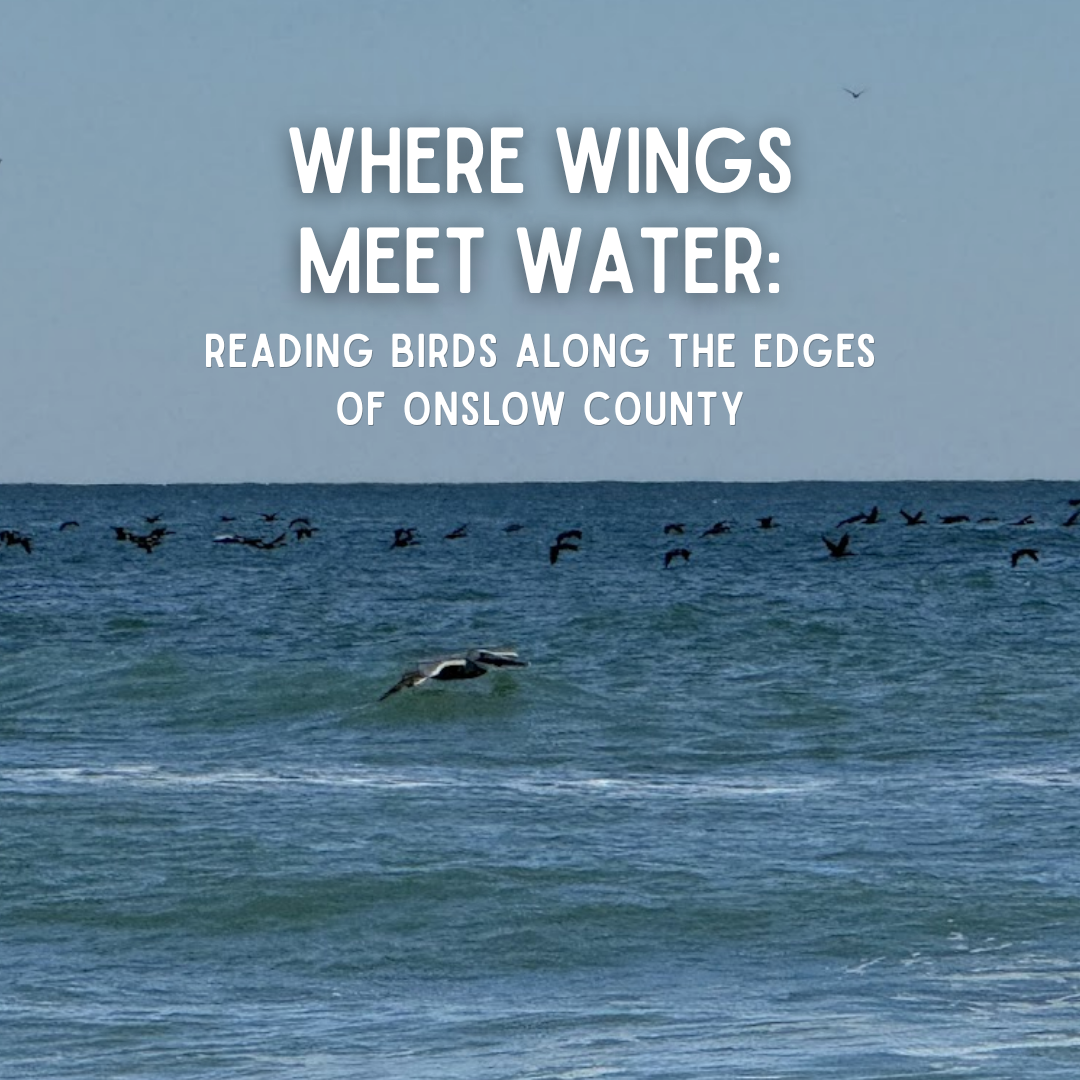
    On a late spring morning along Surf City, the first movement is often above the water, not within it. Brown pelicans travel low and steady just beyond the breakers, their wingtips nearly touching the surface as they follow a line that seems invisible from shore. Farther out, a group of terns holds in place against the wind, hovering, adjusting, then dropping sharply into the water before rising again. Closer to the sound side of Topsail Island, an osprey circles once, then folds into a dive toward a channel edge that looks, at first glance, no different than the water around it.

    Nothing about these movements is random. They are responses to structure that exists beneath the surface—structure shaped by tide, wind, and the movement of other organisms. What appears as scattered bird activity is, in practice, a map of where the water is concentrating life.

    For someone standing at the edge of it, that movement is one of the most accessible ways to read what cannot be seen directly.

    What Birds Are Following Beneath the Surface

    The birds that move along this stretch of coast are not searching broadly; they are tracking concentration. Along barrier island systems like those in Onslow County, physical processes—tidal exchange through inlets, wind-driven surface currents, and subtle differences in bottom shape—create zones where small fish, shrimp, and other prey accumulate (Peterson & Peterson, 1979; Piersma, 1997).

    When the tide moves through places like New River Inlet, water does not flow evenly across the landscape. It accelerates through constrictions, slows along marsh edges, and bends around sandbars and channels. These shifts in speed and direction compress organisms into tighter spaces, particularly along boundaries where moving water meets something that resists it—an edge, a drop-off, or a change in depth (Wright et al., 1985).

    Small schooling fish respond to that compression by tightening their formation. In doing so, they become more visible and more vulnerable. Larger fish—bluefish, Spanish mackerel, and juvenile coastal sharks—often move in from below, using that same concentration to feed. The pressure from below pushes prey upward, sometimes all the way to the surface.

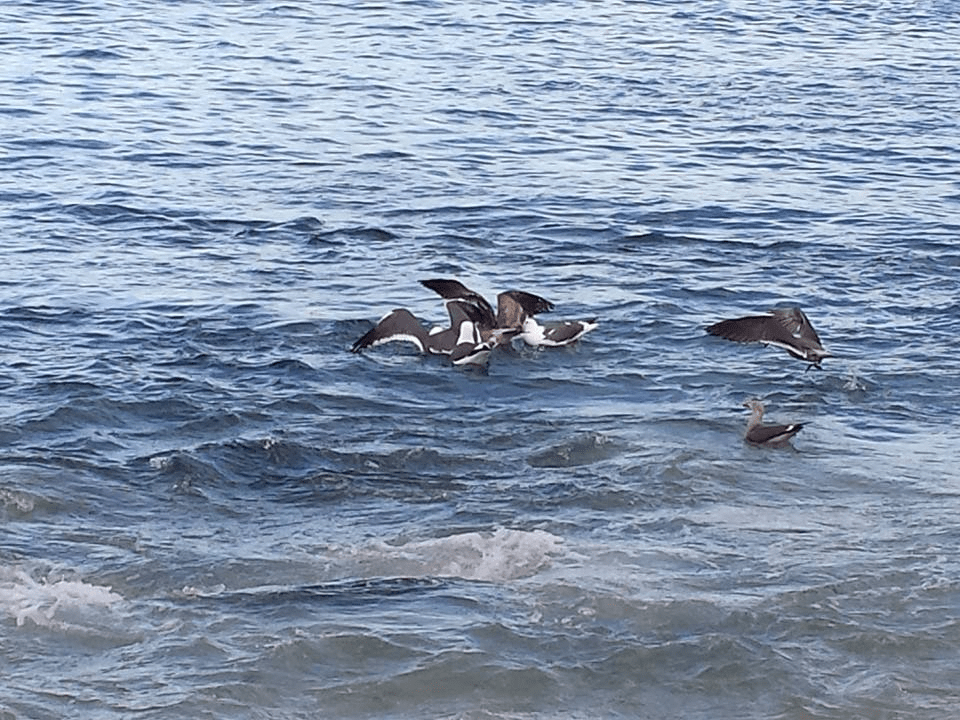
    Coastal birds feeding where prey has been concentrated near the surface along the breakers. | Image credit: A. Mitchell
    Coastal birds feeding where prey has been concentrated near the surface along the breakers. | Image credit: A. Mitchell

    What appears overhead depends on which part of that concentration each species is built to exploit.

    Terns hovering and diving are often responding to prey that has been driven upward by predatory fish (Safina & Burger, 1985). Brown pelicans, which rely on plunge-diving, tend to follow more stable schools of fish that remain near the surface for longer periods (Shields, 2014). Ospreys, in contrast, depend on clear water and individual fish they can visually isolate, which is why their activity often aligns with calmer conditions and defined channel edges (Poole et al., 2002).

    Each species is not simply feeding in the same place; each is reading a different layer of the same system.

    When Surface Activity Signals Pressure Below

    From the shoreline, bird activity can appear as isolated events—one dive, then another, then a sudden shift down the beach. Watched over time, a pattern emerges. A cluster of terns may concentrate in one location for several minutes, then disperse abruptly, reforming farther along the shoreline. Pelicans may align along a narrow band just beyond the breakers, following it as it drifts.

    These shifts often reflect changes in how prey is being compressed and released beneath the surface. When predatory fish move through a bait school, the school tightens, rises, and becomes briefly accessible from above. When that pressure dissipates, the school spreads out again, and the birds move on.

    This movement of energy—from smaller organisms to larger predators, and upward through the water column—is one visible expression of a trophic cascade. The term itself is often used to describe longer chains of ecological influence, but along the coast it can be observed in compressed moments, where the effects of predation become visible within seconds (Heithaus et al., 2008).

    Birds do not initiate this process. They respond to it. Their presence marks where the system has already intensified.

    Indicator Species at the Water’s Edge

    From the beach, the difference is subtle. The water does not change color dramatically, and the waves continue to break as they did before. The level of activity shifts within that band—first visible in the air, then inferred below– marking places where the system has tightened, energy is moving through multiple layers at once, and the distance between surface and depth has, for a time, narrowed (Heithaus et al., 2008; Estes et al., 2011).

    For someone entering the water, these differences in bird behavior can offer practical information, not in a predictive or absolute sense, but as indicators of what is happening just below the surface.

    Brown pelicans traveling low in a consistent line often indicate schools of fish moving parallel to shore. Terns repeatedly diving in a tight area suggest smaller prey being pushed upward, frequently by larger fish feeding below. Ospreys focusing on a specific channel edge reflect clearer water and individual prey availability, rather than broad schooling events. Along the shoreline, shorebirds probing the sand at low tide are responding to invertebrates exposed by receding water, signaling a different layer of the system entirely—one tied to sediment and tidal timing rather than active predation (Colwell, 2010; Piersma, 1997).

    None of these signals point directly to a specific species beneath the surface. What they indicate is concentration, and concentration is what draws larger predators closer to shore.

    Along the coast of North Carolina, nearshore and juvenile shark presence is often associated with areas of high prey density, particularly where schooling fish aggregate (Heupel & Hueter, 2002). These conditions are not constant, and they shift with tide, temperature, and time of day. Birds make those shifts visible in real time. 

    At times, that activity stretches into lines that run the length of the breakers. 

    For someone stepping into the water, that narrowing matters. Not as a warning in the abstract, but as a recognition that the conditions supporting visible feeding above often extend below, linking organisms that are rarely seen together into the same moving structure.

    Where the System Tightens

    The patterns become easier to see near places where the water is forced to narrow, turn, or accelerate. The most consistent bird activity along this coast tends to occur where water movement is constrained and redirected. Inlets, marsh edges, sandbars, and the transitions between the Intracoastal Waterway and adjacent sounds create these zones (Wright et al., 1985).

    At New River and its inlet, tidal flow compresses water into narrow channels before releasing it into broader areas, creating gradients in speed and depth. Along these gradients, prey accumulates, predators follow, and birds gather above.

    These are not fixed points. As tide rises and falls, and as wind reshapes surface conditions, the locations of these compression zones shift. The birds move with them, tracing patterns that are constantly changing but not random.

    For someone watching from shore, these movements can be read as lines, clusters, and absences—places where activity intensifies, and places where it suddenly drops away.

    Standing Within It

    Entering the water along this coast means stepping into a system already in motion. The surface may appear uniform, but the activity above it often reveals where that motion is focused.

    Birds diving repeatedly in a confined area, or tracking a narrow band just beyond the breakers, indicate where prey is concentrated. Those same conditions are what draw larger predators into closer proximity to shore, not as an anomaly, but as part of the same process.

    Watching the birds does not eliminate risk, and it does not provide certainty about what is beneath the surface. What it offers is context—a way to recognize when the water is more active, more compressed, and more connected across its layers.

    What appears as feeding from above is part of a larger structure moving through the water. The birds do not create it, and they do not remain once it passes. They mark it, briefly, making visible what is otherwise difficult to see.

    Bird movement along the shoreline often draws attention toward activity that remains unseen beneath the surface. | Image credit: A. Mitchell
    Bird movement along the shoreline often draws attention toward activity that remains unseen beneath the surface. | Image credit: A. Mitchell

    References

    Castro, J. I. (1993). The shark nursery of bulls Bay, South Carolina, with a review of the shark nurseries of the southeastern coast of the United States. Environmental Biology of Fishes, 38(1-3), 37-48. https://doi.org/10.1007/bf00842902

    Colwell, M. A. (2010). Shorebird ecology, conservation, and management. University of California Press.

    Estes, J. A., Terborgh, J., Brashares, J. S., Power, M. E., Berger, J., Bond, W. J., Carpenter, S. R., Essington, T. E., Holt, R. D., C. Jackson, J. B., Marquis, R. J., Oksanen, L., Oksanen, T., Paine, R. T., Pikitch, E. K., Ripple, W. J., Sandin, S. A., Scheffer, M., Schoener, T. W., & Wardle, D. A. (2011). Trophic downgrading of planet Earth. Science, 33(6040), 301-306. https://doi.org/10.1126/science.1205106

    Heithaus, M. R., Frid, A., Wirsing, A. J., & Worm, B. (2008). Predicting ecological consequences of marine top predator declines. Trends in Ecology & Evolution, 23(4), 202-210. https://doi.org/10.1016/j.tree.2008.01.003

    Heupel, M. R., & Hueter, R. E. (2002). Importance of prey density in relation to the movement patterns of juvenile blacktip sharks ( Carcharhinus limbatus ) within a coastal nursery area. Marine and Freshwater Research, 53(2), 543-550. https://doi.org/10.1071/mf01132

    Peterson, C. H., & Peterson, N. M. (1979). Ecology of intertidal flats of North Carolina: A community profile (79/39). FWS/OBS. https://pubs.usgs.gov/publication/fwsobs79_39

    Piersma, T. (1997). Do global patterns of habitat use and migration strategies Co-evolve with relative investments in Immunocompetence due to spatial variation in parasite pressure? Oikos, 80(3), 623-631. https://doi.org/10.2307/3546640

    Poole, A. F., Bierregaard, R. O., & Martell, M. S. (2002). Osprey (Pandion haliaetus). In The Birds of North America (1st ed.). Cornell Lab of Ornithology.

    Safina, C., & Burger, J. (1985). Common tern foraging: Seasonal trends in prey fish densities and competition with bluefish. Ecology, 66(5), 1457-1463. https://doi.org/10.2307/1938008

    Shields, M. (2014). Brown Pelican (Pelecanus occidentalis). In Birds of North America (1st ed.). Cornell Lab of Ornithology.

    Wright, L., Short, A., & Green, M. (1985). Short-term changes in the morphodynamic states of beaches and surf zones: An empirical predictive model. Marine Geology, 62(3-4), 339-364. https://doi.org/10.1016/0025-3227(85)90123-9

  • Alligators in North Carolina Coastal Waters: What Their Presence Really Means

    Alligators in North Carolina Coastal Waters: What Their Presence Really Means

    The Surface That Holds

    There are mornings along the edges of the water in Onslow County when the surface looks still enough to trust.

    The marsh grass has not yet reached its summer height. What stands there leaves more water exposed between the stems, and without sustained wind, the surface holds its shape. You can see farther into it now than you will in a few weeks, before suspended sediment and constant movement return it to opacity. The water carries less of the season, and because of that, more of what moves beneath it becomes visible—if you are willing to wait long enough to see the difference between movement and reflection.

    This is when people begin to notice them again.

    Not all at once. Not everywhere. Just a change that does not follow wind or tide. A line that holds where the rest of the surface releases. Something that holds its position in a system that is always adjusting.

    An alligator does not arrive in that moment.

    It becomes visible.

    Alligator emerging from the mud. | Photo credit: Gilbert Grant, iNaturalist
    Alligator emerging from the mud. | Photo credit: Gilbert Grant, iNaturalist

    Seasonal Absence Is Not Absence

    Through winter, they remain within these same creeks, marsh edges, and quieter channels. What changes is not location, but how they occupy it. As temperatures fall, activity narrows. Movement slows, and the need for it slows with it. Energy is conserved, not spent. And the surface carries fewer signs of what lies beneath it. Individuals hold in deeper water or along softer margins where mud retains heat longer than the surrounding water column, remaining within conditions that allow them to persist without constant movement (Nifong et al., 2014; Rosenblatt & Heithaus, 2011).

    The same stretch of water that in spring will hold a visible form can pass through winter without interruption, its stillness mistaken for absence.

    But the system does not empty.

    It compresses.

    The System Wakes in Layers

    By early spring, that compression begins to release—not all at once, but in layers that build on each other before they are recognized. Shallow water warms first, taking in solar heat more quickly than deeper channels. Along these edges, fish begin to hold longer. Movements that in winter passed through quickly begin to extend into areas that had remained quiet. Invertebrates return to the sediment surface, and the water column begins to carry more suspended life, even before it becomes visible as turbidity.

    Birds respond to this before most other changes are noticed. Their movements tighten. Landings become more frequent, departures more abrupt. What they are tracking is not random. It is the redistribution of energy into places where it can be accessed.

    The alligator moves within that shift.

    Not as a trigger. Not as something layered on top. But as part of a system reorganizing itself across temperature, light, and movement at the same time.

    Great blue heron and alligator are part of an interconnected system. | Photo credit: Audubon North Carolina
    Great blue heron and alligator are part of an interconnected system. | Photo credit: Audubon North Carolina

    Reading What It Is Responding To

    When one becomes visible along the edge of a creek or marsh, it is easy to reduce that moment to temperature alone. Warmer water allows for more activity.

    But what draws it into that position is more specific than warmth.

    It is the arrangement of prey.

    Along the margins where water meets land, movement compresses. Fish traveling with the tide encounter shallow gradients that limit how long they can remain. Small mammals moving between marsh and upland must cross exposed edges. Birds landing to feed do so in places where depth and access align for only short intervals.

    These are not isolated events. They are recurring patterns shaped by tidal cycles, substrate, and seasonal change.

    The alligator positions itself within those patterns.

    Its diet reflects that flexibility, spanning invertebrates, fish, birds, reptiles, and mammals depending on size and availability (Nifong, 2016). But the diet alone does not explain its placement. What matters is where energy becomes concentrated, even briefly.

    That concentration is not constant. It forms and dissolves with tide, with light, with movement.

    And the predator tracks that.

    And what appears as a single movement—a fish turning, a bird lifting, something crossing the edge of the marsh—is part of a larger structure that holds only briefly before dissolving again.

    The alligator does not respond to the individual movement.

    It responds to the pattern that produces it.

    Where Freshwater Meets Salt

    These are not just places where water mixes.

    They are places where movement is forced—and where that movement becomes available to something waiting at the top of it.

    There are places along this coastline where those changes concentrate.

    At the mouths of creeks, along the edges of the Intracoastal Waterway, and near the shifting bars of New River Inlet, the water does not settle into a single condition. Freshwater moves outward with tide and rainfall, meeting saltwater pressing back in with tidal exchange. The result is not a fixed boundary, but a gradient that shifts continuously—sometimes visible as a faint line, sometimes only detectable in how the surface moves differently from one side to the other.

    This is where alligators are most often encountered—because this is where the system compresses into something they can use.

    They are not marine animals. They do not possess the specialized salt glands that allow for extended life in high salinity environments. Over time, saltwater carries a physiological cost, requiring a return to freshwater to restore balance (Rosenblatt & Heithaus, 2011; Fujisaki et al., 2014).

    But that limitation does not exclude them.

    It defines how they move through them.

    In these mixing zones, salinity is not constant. It rises and falls with tide, with rainfall, with wind direction. A location that carries higher salinity at one stage may shift toward fresher conditions hours later. What appears to be a boundary is, in practice, a moving field.

    Within that field, movement compresses.

    Fish traveling with the tide are funneled into narrower pathways. Shallow gradients limit how long they can remain in deeper water. Schools tighten. Individuals encounter edges that restrict escape. The system concentrates energy into space.

    The predator does not need to range widely in these conditions.

    It needs to hold where movement is forced.

    And so it does.

    An alligator near the tall grass near Marine Corps Air Station New River | Photo credit: Martin Egnash
    An alligator near the tall grass near Marine Corps Air Station New River | Photo credit: Martin Egnash

    At the Edge of the Open Water

    There are moments when that pattern extends beyond the mixing zones, into places that appear, at first, outside of where an alligator belongs.

    Along the shoreline, in the breaking waves where the ocean meets sand, one will sometimes appear—rising and falling with the swell, holding position just beyond where the water turns over onto the beach. It looks misplaced, as though it has moved beyond the system that defines it.

    It has not.

    The surf zone is one of the most compressed environments along the coast. Waves reduce depth, disrupt orientation, and concentrate movement into a narrow band where escape is limited. Fish pushed into breaking water lose some ability to maintain direction. Schools fragment. Individuals become briefly exposed in ways that do not occur in deeper, more stable water.

    For a predator capable of stillness followed by short bursts of movement, that compression creates opportunity.

    But the cost is higher.

    Salinity is elevated. The water is in constant motion. There is no stable refuge within immediate reach. Time in this environment cannot be extended indefinitely.

    And so it does not.

    Movements into higher salinity water tend to be brief—extensions outward, followed by a return to freshwater or lower salinity conditions where balance can be restored (Nifong et al., 2014).

    What appears as an anomaly is part of a larger pattern.

    The predator crosses the boundary not to remain, but to use it, moving where the system briefly offers more than it costs.

    The same forces that shape the marsh edge—compression, constraint, and brief exposure—are recreated here, just for a moment, in a different place.

    An alligator rests at the ocean’s edge in North Topsail. | Photo credit: Fox8 Digital Desk
    An alligator rests at the ocean’s edge in North Topsail. | Photo credit: Fox8 Digital Desk

    What Its Presence Changes

    Most of what that presence changes cannot be seen when it is observed.

    Long before any direct interaction occurs, it is already altering how other organisms use space.

    Fish moving along the edge do not simply pass through. They adjust their depth, their speed, the amount of time they remain exposed. Birds land with shorter intervals between contact and departure. Mammals approaching the water shift their paths or their timing. These changes are not dramatic in isolation. But they are continuous.

    Over time, they accumulate into structure—the kind that determines who feeds, where they feed, and how long they remain.

    The influence of a predator at this level extends beyond what it consumes. It shapes behavior across multiple species, redistributing where and how energy moves through the system. The possibility of predation—present even when not observed—alters interactions in ways that regulate access to habitat and resources (Heithaus et al., 2008; Ripple et al., 2014; Estes et al., 2011).

    What holds the system in place is not removal alone.

    It is pressure.

    What is being shaped is not just movement, but access—and access is what determines how energy moves through the system.

    More Than Predation

    The influence of the alligator does not end with what it hunts, but extends beyond those interactions.

    As it moves through shallow systems, it disturbs sediment, creating depressions and pathways that alter how water is retained and how nutrients are redistributed. These small changes in physical structure create conditions that other species use—temporary refuges, feeding areas, and zones where organic material accumulates (Eversole et al., 2018; Subalusky et al., 2009).

    In wetland systems, these disturbances have been linked to broader effects, including nutrient cycling and carbon storage, where the presence of large predators contributes to the retention of organic material within the system rather than its export (Murray et al., 2025; Atwood et al., 2015).

    These processes do not occur in isolation.

    They intersect with the same patterns of movement, feeding, and behavior that define the system at larger scales.

    Seeing the Surface, Reading the System

    When one becomes visible along the surface, it is easy to treat the moment as singular.

    A sighting. An encounter. Something separate from everything around it.

    But that form at the surface is supported by layers extending beyond what can be seen.

    It reflects water temperatures crossing into ranges that support sustained activity. It reflects prey moving into positions where access becomes possible. It reflects a system where behavior is still shaped by the presence of something at the top.

    The alligator is not an interruption to that system.

    It is an expression of it.

    What Becomes Visible

    Seeing one does not indicate that something has entered the water.

    It indicates that enough beneath the surface is functioning to hold it.

    Not in a static sense. Not as balance in the way it is often described. But as a set of interactions that remain connected—movement, response, pressure—each shaping the others even when they are not directly observed.

    What becomes visible at the surface is only a fraction of that structure.

    But it is enough to know that the rest is still in place.

    An alligator in Onslow County sits at the edge of the saltmarsh. |Photo credit: Gilbert Grant, iNaturalist
    An alligator in Onslow County sits at the edge of the saltmarsh. |Photo credit: Gilbert Grant, iNaturalist

    When That Pressure Is Reduced

    If that pressure is reduced, the system does not leave an obvious gap.

    It shifts.

    Movements that were once constrained begin to extend. Species that passed quickly through exposed areas begin to remain longer. Edges that functioned as transition zones become used differently—not because the physical environment has changed, but because the conditions that shaped behavior within it have relaxed.

    Mid-level predators expand their activity under these conditions, increasing their access to prey and space when not constrained from above (Nifong et al., 2013).

    The change is subtle.

    It appears in how long something stays. In how often it returns. In where it lingers. In how quietly the structure of behavior begins to loosen.

    The food web and trophic cascade of the American alligator in the Florida Everglades.
    The food web and trophic cascade of the American alligator in the Florida Everglades.

    A System Written Into Temperature

    There is another layer to this that does not show itself at the surface.

    The structure of that presence is set years earlier, in a place that can be overlooked when standing at the water’s edge. Along the margins of marsh and wetland, slightly above the reach of regular water movement, nests are built from vegetation and sediment, forming mounds that hold heat as they decompose.

    Within those mounds, temperature determines something that will not be visible for much later.

    Sex is not fixed at fertilization. It emerges during incubation, shaped by the thermal conditions held within the nest. A difference of only a few degrees is enough to shift the outcome, producing more males or more females depending on where within that range the nest remains (Lang & Andrews, 1994; Janzen, 1994).

    Under variable conditions—differences in shading, rainfall, timing, and placement—those outcomes are distributed across the landscape. Some nests produce more females, others more males. That variability holds the population in a form that can sustain itself over time.

    When conditions become more consistent, that variation narrows.

    Warmer nights hold heat longer within the nest. Seasonal transitions extend. The range of outcomes compresses. What was once distributed begins to align.

    And that alignment carries forward into the structure of the population—into how individuals occupy space, into how pressure is applied across the system, into what will eventually be visible at the surface.

    Alligator eggs hatch after 65 days of incubation in the fall. The babies will chirp to alert their mom, who then digs out the nest while the babies use their egg tooth to hatch from their eggs. Their mom will then safely carry them to the water.
    Alligator eggs hatch after 65 days of incubation in the fall. The babies will chirp to alert their mom, who then digs out the nest while the babies use their egg tooth to hatch from their eggs. Their mom will then safely carry them to the water.

    Where the Next Generation Is Set

    The placement of those nests depends on something even more constrained.

    A narrow band of land that remains above water just long enough to hold them.

    That band is not fixed.

    It shifts with tide, with rainfall, with the gradual reworking of shoreline that occurs across seasons and years. With rising sea levels, water reaches farther into areas that once remained above it. Flooding becomes more frequent, not always through singular events, but through repeated intrusions that saturate and destabilize what had previously held (Joanen & McNease, 1989; Sweet et al., 2022).

    Human alteration compresses this space further.

    Hardened shorelines, dredging, and development reduce the gradual transition between land and water. Where there was once a slope capable of holding multiple elevations, there becomes a defined edge. That edge does not provide the same range of conditions required for successful nesting.

    The number of suitable sites decreases.

    More importantly, the variability between them narrows.

    And with that, the system loses one of the mechanisms that allowed it to absorb change.

    Alligator on her nest that can hold up to 60 eggs. | Photo credit: National Park Service (NPS)
    Alligator on her nest that can hold up to 60 eggs. | Photo credit: National Park Service (NPS)

    What Its Presence Means

    When an alligator becomes visible along the surface, it reflects conditions that have aligned across multiple layers.

    Temperature has reached a range that supports activity. Prey has moved into positions where access becomes possible. Behavioral pressure remains in place across the system. Reproduction has held across enough years, in enough suitable places, to sustain what is now present.

    What is seen at the surface is not separate from them.

    It is supported by them.

    Seeing one does not signal that something has entered the water.

    It signals that enough of what lies beneath it—movement, pressure, response, and continuity—remains intact.

    And that—even when most of it is not visible—the system is still holding together.

    And that is what becomes visible—just long enough to be seen, before the system closes back over it again.

    The system does not end at the water’s edge.

    Epilogue: Chicken Nugget

    We came across him along the New River, near the courthouse in Jacksonville.

    We were there to clear what had been left behind—fishing line caught along the walkways, hooks, and the overflow from a trash can that had spilled out onto the edge. Fast food containers, grocery store chicken trays, scattered along the bank. The signs were clear enough. People had been there for a while—crabbing, fishing, eating, leaving what remained.

    He was directly below us.

    Small enough to miss at first. Still enough to blend into the water until you stopped looking for movement and started noticing what held its position.

    A juvenile alligator, watching.

    He stayed there while we worked, then slipped beneath the surface and crossed the small bay. On the opposite side, someone tossed a piece of food into the water. He surfaced almost immediately, took it, and remained.

    Waiting.

    I came back later and stayed longer.

    The pattern repeated. He would disappear until footsteps approached, then return to the same place along the edge. Holding position. Watching. Waiting for something to fall.

    No fishermen or crabbers passed through while I was there, but the behavior was consistent with what happens when food becomes predictable. Bait, catch, scraps—anything that can be taken without the cost of searching or pursuing.

    Energy, without effort.

    It is easy to see something like that and respond to what it looks like in that moment. A small animal. Still. Attentive. Something that feels close enough to interact with.

    But what is being shaped there is not just a single interaction.

    It is behavior.

    A shift away from the conditions that formed it—toward something more efficient, more immediate, and less stable over time. The system that once required movement, patience, and response begins to narrow into expectation.

    And expectation changes how an animal uses space.

    What happens when that animal is no longer small is not a separate question.

    It is the continuation of the same pattern.

    Alligators do not forget where food has been easy to obtain. They return to it. They hold in those places. They begin to associate presence—human presence—with opportunity.

    What begins as something that feels harmless becomes something that alters how the system functions around it.

    Not just for the animal, but for everything that responds to it.

    There are instincts at work here that were shaped long before any walkway, any dock, any place where food might be dropped from above. Those instincts are not just about survival in isolation. They are part of how pressure is applied, how movement is shaped, how the system holds.

    When those instincts are replaced with something easier, the effect does not remain contained.

    It carries outward.

    He stayed there while I watched. Returning to the same place. Holding the same position. Waiting for something to fall.

    There is a kind of kindness in wanting to give something to an animal like that.

    But there is another kind in leaving it as it is.

    Not interrupting the conditions that shape it. Not narrowing what it has learned to expect. Not replacing a system built on movement and response with one built on waiting.

    Let it remember the water as it is.

    And you, only as something that passed through it.

    We affectionately named this juvenile alligator in the New River in Jacksonville, NC “Chicken Nugget” for all of the chicken nugget boxes left behind on the walkway from an overflowing trash can. | Photo credit: A. Mitchell
    We affectionately named this juvenile alligator in the New River in Jacksonville, NC “Chicken Nugget” for all of the chicken nugget boxes left behind on the walkway from an overflowing trash can. | Photo credit: A. Mitchell

    References

    Atwood, T. B., Connolly, R. M., Ritchie, E. G., Lovelock, C. E., Heithaus, M. R., Hays, G. C., Fourqurean, J. W., & Macreadie, P. I. (2015). Predators help protect carbon stocks in blue carbon ecosystems. Nature Climate Change5(12), 1038-1045. https://doi.org/10.1038/nclimate2763

    Estes, J. A., Terbough, J., Brashares, J. S., Power, M. E., Berger, J., Bond, W. J., Carpenter, S. R., Essington, T. E., Holt, R. D., & Wardle, D. A. (2011). Trophic Downgrading of Planet Earth. Science333(604), 301-306. https://www.science.org/doi/abs/10.1126/science.1205106

    Fujisaki, I., Hart, K. M., Mazzotti, F. J., Cherkiss, M. S., Sartain, A. R., Jeffery, B. M., Beauchamp, J. S., & Denton, M. (2014). Home range and movements of American alligators (Alligator mississippiensis) in an Estuary habitat. Animal Biotelemetry2(1), 8. https://doi.org/10.1186/2050-3385-2-8

    Heithaus, M. R., Frid, A., Wirsing, A. J., & Worm, B. (2008). Predicting ecological consequences of marine top predator declines. Trends in Ecology & Evolution23(4), 202-210. https://doi.org/10.1016/j.tree.2008.01.003

    Janzen, F. J. (1994). Climate change and temperature-dependent sex determination in reptiles. PNAS91(16), 7487-7490. https://doi.org/10.1073/pnas.91.16.7487

    Joanen, T., & McNease, L. L. (1989). Ecology and physiology of nesting and early development of the American alligator. American Zoologist29(3), 987-998. https://doi.org/10.1093/icb/29.3.987

    Lang, J. W., & Andrews, H. V. (1994). Temperature‐dependent sex determination in crocodilians. Journal of Experimental Zoology270(1), 28-44. https://doi.org/10.1002/jez.1402700105

    Nifong, J. C. (2016). Living on the edge: Trophic ecology of alligator mississippiensis (American alligator) with access to a shallow estuarine impoundment. Bulletin of the Florida Museum of Natural History54(2), 13-49. https://doi.org/10.58782/flmnh.xkdw7119

    Nifong, J. C., Nifong, R. L., Silliman, B. R., Lowers, R. H., Guillette, L. J., Ferguson, J. M., Welsh, M., Abernathy, K., & Marshall, G. (2014). Animal-borne imaging reveals novel insights into the foraging behaviors and Diel activity of a large-bodied APEX predator, the American alligator (Alligator mississippiensis). PLoS ONE9(1), e83953. https://doi.org/10.1371/journal.pone.0083953

    Nifong, J. C., & Silliman, B. R. (2013). Impacts of a large-bodied, APEX predator (Alligator mississippiensis Daudin 1801) on salt marsh food webs. Journal of Experimental Marine Biology and Ecology440, 185-191. https://doi.org/10.1016/j.jembe.2013.01.002

    Ripple, W. J., Estes, J. A., Beschta, R. L., Wilmers, C. C., Ritchie, E. G., Hebblewhite, M., Berger, J., Elmhagen, B., Letnic, M., Nelson, M. P., Schmitz, O. J., Smith, D. W., Wallach, A. D., & Wirsing, A. J. (2014). Status and ecological effects of the world’s largest carnivores. Science343(6167). https://doi.org/10.1126/science.1241484

    Rosenblatt, A. E., & Heithaus, M. R. (2011). Does variation in movement tactics and trophic interactions among American alligators create habitat linkages? Journal of Animal Ecology80(4), 786-798. https://doi.org/10.1111/j.1365-2656.2011.01830.x

    Sweet, W. V., Hamlington, B. D., Kopp, R. E., Weaver, C. P., Barnard, P. L., Bekaert, D., Brooks, W., Craghan, M., Dusek, G., Frederickse, T., Garner, G., Genz, A. S., Krasting, J. P., Larour, E., Marcy, D., Marra, J. J., Obeysekera, J., Osler, M., Pendleton, M., … Zuzak, C. (2022). Global and regional sea level rise scenarios for the United States: Updated mean projections and extreme water level probabilities along U.S. coastlines (Technical Report NOS 01). National Oceanic and Atmospheric Administration, National Ocean Service. https://earth.gov/sealevel/us/internal_resources/756/noaa-nos-techrpt01-global-regional-SLR-scenarios-US.pdf