Category: Sharks

  • Beyond the Horizon: The Pelagic Sharks Off Onslow County

    Beyond the Horizon: The Pelagic Sharks Off Onslow County

    Most people standing on the beach watch the Atlantic as though the ocean ends where detail disappears.

    Nearshore water is easy to read. Pelicans diving offshore reveal where baitfish have gathered near the surface. The first sea turtle crawls of the season begin appearing along the upper beach. Sandbars reveal themselves through shifting wave patterns and changes in water color.  Even when the water is murky, the coastline still feels structured because the movement happening near shore leaves visible clues.

    Farther offshore, those visible clues become harder to read.

    Beyond the breakers, past the shrimp boats and distant military vessels that sometimes mark the horizon, the Atlantic off Onslow County drops across the continental shelf into deeper pelagic water. From shore, that open water can appear empty simply because most of its structure is hidden beneath distance, depth, and moving currents. But the offshore ocean is highly organized. Temperature layers separate water masses. Squid and fish rise toward the surface at night and descend again before daylight. Currents gather plankton and compress bait schools into dense patches of life that may stretch for miles before dissolving again.

    And moving through those shifting layers are sharks most beachgoers never see.

    Species like the bigeye thresher shark, scalloped hammerhead, Carolina hammerhead, smooth hammerhead, great hammerhead, and tiger shark all occupy different parts of the same Atlantic system connected to North Carolina’s coast. They are not interchangeable predators simply sharing the same water. Each species is specialized for a different way of hunting, sensing, and moving through the pelagic environment.

    Even though most people never see these sharks directly, their influence does not remain offshore.

    They work their way back toward the coast through changes in prey behavior, bait distribution, migration timing, and the balance of the food web itself.

    The Shark Built for Dim Water

    The bigeye thresher shark (Alopias superciliosus) does not resemble most sharks people imagine from coastal documentaries or fishing piers. Its eyes are unusually large, and nearly half of its body length is tail.

    A bigeye thresher shark (Alopias superciliosus) moves through dim offshore Atlantic water beyond the Carolina coast. Its enlarged eyes help it hunt in low light, while its elongated tail can be used to stun schooling prey before feeding. | Image credit: NC Sea Grant
    A bigeye thresher shark (Alopias superciliosus) moves through dim offshore Atlantic water beyond the Carolina coast. Its enlarged eyes help it hunt in low light, while its elongated tail can be used to stun schooling prey before feeding. | Image credit: NC Sea Grant

    Both features are tied directly to life in deeper offshore water.

    Bigeye threshers spend much of their time moving vertically through the water column, often descending into dim water during daylight hours and returning closer to the surface at night as squid and mesopelagic fish migrate upward under darkness (Weng & Block, 2004). Offshore pelagic systems are layered environments. Light fades rapidly with depth, and many prey species spend daylight hours far below the surface where visibility is limited.

    The shark’s large eyes help gather more available light in those darker layers.

    For someone standing on the beach at sunset, the horizon still appears bright. Offshore, hundreds of feet below the surface, the bigeye thresher is already hunting in water where daylight barely penetrates.

    Its tail is equally specialized. Schooling fish survive by moving together in synchronized motion, creating confusion for predators trying to isolate individual prey. The elongated upper lobe of the thresher’s tail evolved as a way to disrupt that coordination. Researchers have documented threshers using powerful overhead tail strikes to stun schooling fish before circling back to feed (Oliver et al., 2013).

    That hunting strategy matters ecologically because the species targeted by threshers are often highly connected to broader Atlantic food webs. Squid, mackerel, and schooling pelagic fish move energy between offshore and coastal systems. Large predators help regulate those populations and alter how tightly schools gather, where they move, and how heavily they feed on smaller forage species beneath them in the food web (Heithaus et al., 2008).

    Without predators thinning and disrupting those mid-level prey schools, feeding pressure shifts downward. Larger populations of squid and predatory fish consume more small forage species, including baitfish that later support seabirds, larger fish, and predators closer to shore. The result is not an empty ocean, but a gradual reorganization of how energy moves through the coastal ecosystem.

    What beachgoers may eventually notice are changes in feeding activity: fewer concentrated bird flocks offshore, shifting bait movements, or less predictable surface eruptions beyond the breakers.

    The Sharks That Hunt Electricity

    Hammerheads occupy a different sensory world than most coastal predators.

    The broad hammer-shaped head shared by species like the scalloped hammerhead, great hammerhead, smooth hammerhead, and Carolina hammerhead is called a cephalofoil. Spread across that wide structure are sensory pores known as ampullae of Lorenzini, specialized organs capable of detecting weak electrical fields produced by other animals (Kajiura, 2001).

    Every muscle contraction and heartbeat generated by prey produces tiny electrical signals in the water.

    A stingray buried beneath sand may be invisible to a human observer, but to a hammerhead it is still broadcasting electrical information.

    The widened head helps the shark compare those signals across a broader sensory field, improving directional accuracy while hunting. Scientists have compared shark electroreception to detecting the output of a small household battery from extraordinary distances under ideal conditions, though in the ocean the system functions at close range to help sharks pinpoint hidden prey.

    While beachgoers scan the water looking for dorsal fins, hammerheads are effectively scanning the seafloor for living electrical currents.

    That sensory adaptation helps explain why multiple hammerhead species can occupy overlapping Atlantic waters without performing identical ecological roles.

    The Offshore Traveler

    The scalloped hammerhead (Sphyrna lewini) is one of the more oceanic hammerhead species associated with continental shelf edges, offshore structures, and migratory routes through deeper Atlantic water (Klimley, 1993).

    A scalloped hammerhead shark (Sphyrna lewini) moves through offshore Atlantic water beyond the Carolina coast. The broad cephalofoil spreading from its head contains electroreceptors capable of detecting faint electrical signals produced by prey hidden beneath sand and low-visibility water. | Image credit: A. Murch
    A scalloped hammerhead shark (Sphyrna lewini) moves through offshore Atlantic water beyond the Carolina coast. The broad cephalofoil spreading from its head contains electroreceptors capable of detecting faint electrical signals produced by prey hidden beneath sand and low-visibility water. | Image credit: A. Murch

    Scalloped hammerheads often move in schools, particularly when younger, and feed heavily on fish, squid, and smaller sharks. Their body shape and behavior are well suited for highly mobile pelagic hunting where prey concentrations shift constantly with temperature and current boundaries.

    They are not simply “using deeper water.” They are adapted to a system where the structure itself is always moving.

    Warm and cool water masses sliding against one another can compress bait into narrow feeding corridors. Squid rise toward the surface after dark. Pelagic fish move vertically and horizontally depending on light levels and prey availability. The scalloped hammerhead’s movement patterns mirror that instability.

    Because they occupy such mobile offshore environments, scalloped hammerheads help regulate prey populations across broad sections of the continental shelf rather than within a single localized habitat.

    The Hidden Hammerhead

    For decades, scientists believed many hammerheads moving through the western Atlantic belonged to the same species.

    But the Carolina hammerhead (Sphyrna gilberti) had likely been there the entire time unnoticed.

    Researchers eventually discovered that some sharks identified as scalloped hammerheads were genetically distinct and consistently possessed fewer vertebrae, revealing that two separate species had been moving through the same waters unnoticed (Quattro et al., 2013).

    Radiographs of the Carolina hammerhead (Sphyrna gilberti) helped reveal that a second hammerhead species had been moving through western Atlantic waters largely unnoticed. Although visually similar to the scalloped hammerhead, skeletal differences and genetic analysis confirmed the Carolina hammerhead as a distinct species in 2013. | Image credit: J. Quattro et al., 2013 (left); S. Raredon, Smithsonian Institution, National Museum of Natural History (right)Radiographs of the Carolina hammerhead (Sphyrna gilberti) helped reveal that a second hammerhead species had been moving through western Atlantic waters largely unnoticed. Although visually similar to the scalloped hammerhead, skeletal differences and genetic analysis confirmed the Carolina hammerhead as a distinct species in 2013. | Image credit: J. Quattro et al., 2013 (left); S. Raredon, Smithsonian Institution, National Museum of Natural History (right)
    Radiographs of the Carolina hammerhead (Sphyrna gilberti) (left) helped reveal that a second hammerhead species had been moving through western Atlantic waters largely unnoticed. Although visually similar to the scalloped hammerhead (right), skeletal differences and genetic analysis confirmed the Carolina hammerhead as a distinct species in 2013. | Image credit: J. Quattro et al., 2013 (left); S. Raredon, Smithsonian Institution, National Museum of Natural History (right)

    The discovery revealed that even sharks moving through the same Atlantic waters were more specialized than they first appeared.

    From the beach, the offshore Atlantic often appears open and uniform because distance hides most of its detail. But even scientists were still uncovering hidden structures within those waters. Sharks that looked nearly identical from the surface were occupying the same coastline as separate species with potentially different ecological roles.

    The Carolina hammerhead still overlaps geographically with other hammerheads along the southeastern United States, and researchers are continuing to study how those species divide habitat, prey, and movement through the Atlantic.

    For beachgoers, the discovery is a reminder that the Atlantic beyond the breakers is more ecologically layered than it first appears, with multiple shark species occupying waters that can look uniform from shore. 

    The Ray Hunter

    The great hammerhead (Sphyrna mokarran) occupies a different ecological role than its smaller relatives.

    A great hammerhead shark (Sphyrna mokarran) moves through offshore water. The species is highly specialized for hunting rays, using its broad cephalofoil to improve maneuverability and detect prey hidden along the seafloor. | Image credit: Oregon State University
    A great hammerhead shark (Sphyrna mokarran) moves through offshore water. The species is highly specialized for hunting rays, using its broad cephalofoil to improve maneuverability and detect prey hidden along the seafloor. | Image credit: Oregon State University

    Great hammerheads are more solitary and strongly associated with rays, including stingrays and cownose rays. Their cephalofoil is not simply a sensory structure. It also improves maneuverability and may help pin rays against the seafloor during feeding attempts (Strong et al., 1990).

    That specialization matters because rays themselves strongly influence coastal ecosystems.

    Rays such as cownose rays and Atlantic stingrays disturb sediment, expose buried organisms, and alter benthic communities while feeding across shallow coastal bottoms. Great hammerheads help regulate those ray populations and influence where rays spend time feeding.

    Great hammerheads influence more than the number of rays moving through coastal habitats.  The presence of large predators changes prey behavior as well. Rays may avoid lingering in exposed feeding areas when hammerheads are nearby, redistributing feeding pressure across habitats.

    For beachgoers, those ecological effects may eventually appear through changes in ray abundance, feeding activity, or shifting patterns of disturbed sediment along shallow coastal waters.

    The Cooler-Water Hunter

    The smooth hammerhead (Sphyrna zygaena) can look, at first glance, like another variation of the same hammerhead design.

    But its head gives away part of its story.

    Unlike the scalloped hammerhead, the smooth hammerhead lacks the central notch along the front edge of the cephalofoil. That difference may seem small to a casual observer, but it reflects a separate species adapted to a somewhat different part of the Atlantic system. Smooth hammerheads are often associated with cooler temperate waters and feed heavily on schooling fish and cephalopods moving through offshore shelf waters (Compagno, 2001).

    A smooth hammerhead shark (Sphyrna zygaena) moves through open offshore water. Unlike the scalloped hammerhead, the smooth hammerhead lacks the central notch along the front edge of the cephalofoil and is more commonly associated with cooler temperate waters and schooling prey along the continental shelf. | Image credit: S. Judd
    A smooth hammerhead shark (Sphyrna zygaena) moves through open offshore water. Unlike the scalloped hammerhead, the smooth hammerhead lacks the central notch along the front edge of the cephalofoil and is more commonly associated with cooler temperate waters and schooling prey along the continental shelf. | Image credit: S. Judd

    That specialization matters because schooling fish and squid help move energy through the open Atlantic.

    These prey species do not stay fixed in one place. They shift with temperature, currents, light, and season, gathering in patches that may appear briefly before dispersing again. Smooth hammerheads are part of the predator community that follows and regulates that movement through cooler portions of the continental shelf.

    The relationship is not simply a shark chasing fish through open water. By feeding within those moving schools, smooth hammerheads help shape how prey gathers, how long those schools remain concentrated, and how much pressure they place on smaller forage species below them in the food web.

    For beachgoers, those ecological effects may eventually appear through seasonal changes in bait movement, bird activity, or the mix of predators feeding along the shelf as offshore waters warm and cool through the year.

    The Shark That Connects Habitats

    Few sharks move between offshore and coastal systems as fluidly as the tiger shark.

    Tiger sharks (Galeocerdo cuvier) are often reduced in public imagination to sensational headlines or descriptions as “garbage eaters,” largely because of their opportunistic feeding behavior and willingness to consume a wide range of prey.

    But ecological flexibility is precisely what makes them important.

    A tiger shark (Galeocerdo cuvier) moves through tropical offshore water. Tiger sharks travel between offshore habitats, shoals, and coastal systems following seasonal prey movements, linking distant parts of the Atlantic food web through their wide-ranging movements and opportunistic feeding behavior. | Image credit: Fishes of Sarasota County, FL
    A tiger shark (Galeocerdo cuvier) moves through tropical offshore water. Tiger sharks travel between offshore habitats, shoals, and coastal systems following seasonal prey movements, linking distant parts of the Atlantic food web through their wide-ranging movements and opportunistic feeding behavior. | Image credit: Fishes of Sarasota County, FL

    Tiger sharks move between offshore waters, shoals, nearshore habitats, and sometimes estuarine environments following seasonal prey movements and temperature shifts (Heithaus, 2001). Sea turtles, rays, fish, carrion, and other prey species all become part of that broader movement pattern.

    Their presence changes how other animals use the same habitats.

    Sea turtles may avoid grazing too heavily in exposed areas when tiger sharks are nearby. Rays redistribute feeding activity. Schools of fish alter where they gather. The presence of a large predator changes how long prey species remain in one place and how intensely they feed before moving on. Areas that might otherwise experience constant grazing or disturbance begin receiving periods of recovery as animals move more cautiously through the habitat (Heithaus et al., 2008). 

    That movement connects habitats that people often think of as separate parts of the ocean.

    A tiger shark feeding offshore may later move closer to shoals, estuaries, or coastal waters as prey shifts with season and temperature. The same predator influencing sea turtle grazing patterns offshore may eventually pass along the edges of bait schools closer to shore weeks later.

    For beachgoers, those connections may appear through changing patterns of sea turtle activity, shifting schools of fish near the breakers, or the seasonal movement of predators along the Carolina coast.

    The Sharks People Talk About Most

    Not all sharks connected to Onslow County remain far offshore.

    Species like the great white shark and bull shark tend to dominate public attention because they are more familiar through media coverage and coastal sightings. Tagged great whites moving along the Atlantic coast frequently make headlines, while sharks seen near inlets or murky water are often assumed to be bull sharks whether identification is confirmed or not.

    But those assumptions can flatten the complexity of the coastal ecosystem.

    Bull sharks (Carcharhinus leucas) are well known for their ability to tolerate freshwater, but they are not the only sharks capable of handling changing salinity. Along the Carolina coast, species such as bonnetheads and juvenile hammerheads also use estuarine environments where tides, rainfall, and river flow constantly shift the balance between salt and fresh water. Coastal systems are not divided into simple categories of “ocean” and “freshwater.” They are gradients, and many sharks are adapted to move through those changing conditions. 

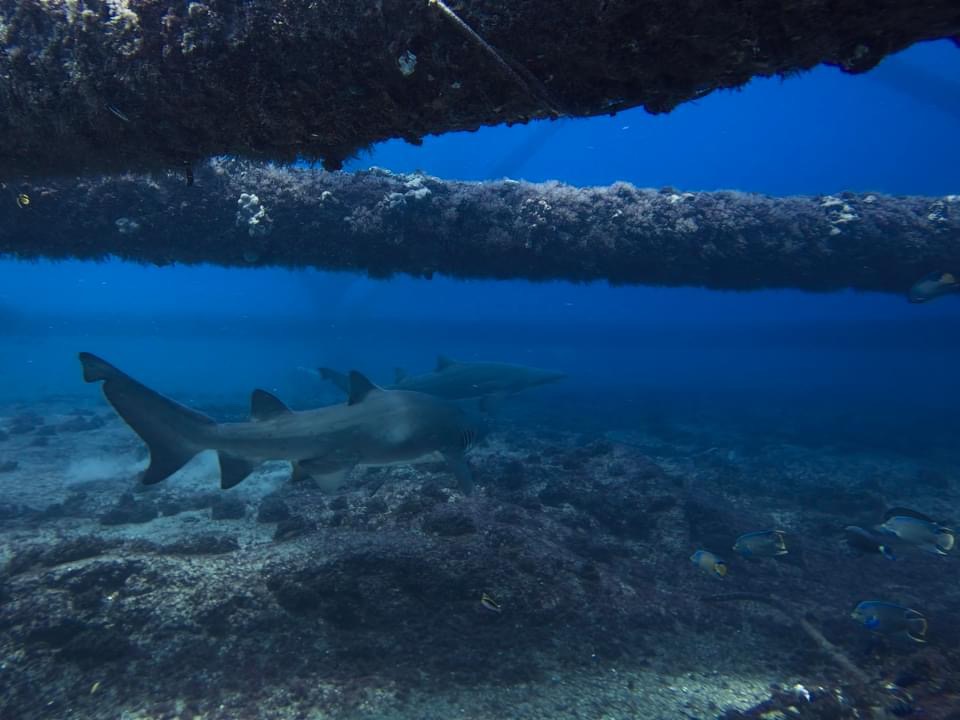
    A bull shark (Carcharhinus leucas) moves through offshore water accompanied by remoras. Although bull sharks are known for their ability to tolerate lower salinity and move into estuaries and rivers, they are also highly mobile coastal and offshore predators that regularly travel through marine waters along the Atlantic coast. | Image credit: B. Skinstad
    A bull shark (Carcharhinus leucas) moves through offshore water accompanied by remoras. Although bull sharks are known for their ability to tolerate lower salinity and move into estuaries and rivers, they are also highly mobile coastal and offshore predators that regularly travel through marine waters along the Atlantic coast. | Image credit: B. Skinstad

    Great whites (Carcharodon carcharias), meanwhile, are often discussed as solitary coastal hunters, but along the western Atlantic they are also highly migratory predators tied to seasonal prey movements, temperature ranges, and offshore habitats (Block et al., 2011).

    A great white shark (Carcharodon carcharias) moves through open offshore water. Great whites are highly migratory predators capable of traveling vast distances between offshore habitats and productive coastal feeding grounds, linking distant regions of the Atlantic and Pacific through seasonal movement. | Image credit: E. Levy
    A great white shark (Carcharodon carcharias) moves through open offshore water. Great whites are highly migratory predators capable of traveling vast distances between offshore habitats and productive coastal feeding grounds, linking distant regions of the Atlantic and Pacific through seasonal movement. | Image credit: E. Levy

    Both species are part of the broader Atlantic system connected to North Carolina’s coast, but the sharks occupying pelagic waters beyond the visible horizon often receive far less attention despite shaping offshore food webs just as strongly.

    Why Recovery Takes So Long

    Many fish species along the Carolina coast mature quickly and reproduce in enormous numbers. Menhaden, mullet, and other forage fish may begin reproducing within only a few years while releasing hundreds of thousands—or even millions—of eggs.

    Large sharks follow a very different strategy.

    Species like great hammerheads, tiger sharks, and threshers often require more than a decade to reach reproductive maturity, and they produce far fewer offspring than most bony fish (Cortés, 2000). Some large female sharks may spend well over a decade surviving storms, fishing pressure, predators, disease, and changing ocean conditions before producing pups for the first time.

    That slower reproductive strategy evolved partly because large sharks occupy upper levels of the food web where adults face relatively few natural predators. Evolution favored longer lifespans, slower growth, and fewer offspring with higher survival chances.

    But the same strategy creates vulnerability.

    A fish population capable of reproducing within two or three years can rebound relatively quickly after declines. A shark population that requires fifteen years or more to produce breeding adults cannot.

    The offshore Atlantic built these predators slowly.

    And when populations decline, recovery happens slowly as well.

    Why More Sightings Do Not Always Mean More Sharks

    For many people along the Carolina coast, sharks can feel more visible now than they did decades ago.

    Drone footage from the North Carolina coast reveals how modern technology now captures shark movement near beaches that would have gone largely unseen from shore only a few decades ago. Increased visibility does not necessarily mean sharks are suddenly overwhelming coastal waters, but it does change how people perceive the Atlantic around them. | Image credit: L. Abed
    Drone footage from the North Carolina coast reveals how modern technology now captures shark movement near beaches that would have gone largely unseen from shore only a few decades ago. Increased visibility does not necessarily mean sharks are suddenly overwhelming coastal waters, but it does change how people perceive the Atlantic around them. | Image credit: L. Abed

    Anglers report more sharks taking hooked fish before they can be reeled in, a behavior known as depredation. Drone footage captures feeding activity that would have gone unseen from shore years ago. Social media spreads sightings quickly, sometimes creating the impression that sharks are suddenly overwhelming coastal waters.

    Some shark populations have shown signs of recovery following decades of decline and changing fishing regulations. Long-time fishers noticing more shark encounters in certain areas may not be imagining it. In some cases, there likely are more sharks present than there were during periods of heavier population decline in the late twentieth century.

    But recovery is not the same as overabundance.

    Forty years ago, far fewer people were fishing offshore, kayaking through estuaries, filming the surf with drones, or posting shark encounters online in real time. Coastal waters are now observed more continuously than at any point in history, while recreational fishing activity itself creates more opportunities for sharks and people to interact.

    Even with signs of recovery, many large shark species along the Atlantic coast still exist at a fraction of the population levels seen before major declines in the late twentieth century (Baum et al., 2003; Worm et al., 2013). 

    A true overabundance of large predators would likely look very different along the Carolina coast. Bait schools would become harder to find, feeding activity along the surface would begin thinning out, and predators would increasingly compete over limited prey. Instead, much of what people are witnessing today is the overlap between recovering shark populations, concentrated recreational fishing activity, and a coastline watched more closely than ever before (Heithaus et al., 2008). 

    For beachgoers, that change can make sharks feel suddenly more common, even as many offshore ecosystems are still rebuilding from declines that unfolded over generations.

    What Changes Along the Coast When They Decline

    By the time most people arrive at the beach in summer, the offshore system is already in motion.

    Pelicans are not simply following random schools of fish. The bait moving through the breakers may have spent weeks feeding along temperature boundaries farther offshore. Rays passing through the shallows are connected to predators that hunt them beyond the visible edge of the continental shelf. Squid rising toward the surface at night become part of a food web that stretches from deep Atlantic water back toward the surf zone.

    Most of those connections remain invisible from shore.

    A person standing on the beach cannot see a bigeye thresher moving through dim offshore water hundreds of feet below the surface, or a hammerhead sweeping across the bottom searching for the electrical signals of buried prey. They cannot see tiger sharks shifting between offshore and coastal habitats as water temperatures change through the season.

    But those predators still influence what eventually reaches the coastline.

    The schools of fish birds gather over, the movement of rays through shallow water, the distribution of predators and prey along the continental shelf, and even the timing of seasonal feeding activity are tied to an offshore ecosystem organized partly by sharks most people never encounter directly.

    From the beach, the Atlantic often appears flat and open beyond the horizon.

    In reality, it is layered with movement, specialization, and predators adapted to parts of the ocean most people never realize are there.

    What the Horizon Conceals

    From the beach, the Atlantic often appears flat and empty beyond the breakers. Most people will never see a bigeye thresher rising from dim offshore water or a hammerhead sweeping across the continental shelf searching for prey hidden beneath the sand. The larger structure of the pelagic Atlantic remains mostly invisible from shore.

    But the absence of visibility is not the same as absence of life.

    Far beyond the swimming beaches and nearshore bars, sharks continue moving through layered offshore habitats shaped by depth, temperature, migration, and prey. Some travel between offshore waters and shoals. Others patrol deeper pelagic systems where sunlight fades and the surface reveals little of what exists below.

    Those movements eventually connect back to the coast itself.

    The same Atlantic that carries sea turtle hatchlings past the breakers, pushes baitfish toward the shoreline, and gathers pelicans over feeding fish also extends outward into a far larger offshore ecosystem organized by predators most people never see directly.

    The horizon does not separate the beach from another ocean.

    It only marks the point where the visible Atlantic gives way to the hidden one.

    Even from the shoreline, the Atlantic extends into a far larger offshore ecosystem shaped by predators, migration, depth, and movement beyond what can easily be seen from shore. The horizon does not mark the end of the ocean’s structure, only the limit of what we can observe from the beach. | Image credit: A. Mitchell
    Even from the shoreline, the Atlantic extends into a far larger offshore ecosystem shaped by predators, migration, depth, and movement beyond what can easily be seen from shore. The horizon does not mark the end of the ocean’s structure, only the limit of what we can observe from the beach. | Image credit: A. Mitchell

    References

    Baum, J. K., Myers, R. A., Kehler, D. G., Worm, B., Harley, S. J., & Doherty, P. A. (2003). Collapse and conservation of shark populations in the Northwest Atlantic. Science, 299(5605), 389-392. https://doi.org/10.1126/science.1079777

    Block, B. A., Jonsen, I. D., Jorgensen, S. J., Winship, A. J., Shaffer, S. A., Bograd, S. J., Hazen, E. L., Foley, D. G., Breed, G. A., Harrison, A., Ganong, J. E., Swithenbank, A., Castleton, M., Dewar, H., Mate, B. R., Shillinger, G. L., Schaefer, K. M., Benson, S. R., Weise, M. J., … Costa, D. P. (2011). Tracking APEX marine predator movements in a dynamic ocean. Nature, 475(7354), 86-90. https://doi.org/10.1038/nature10082

    Compagno, L. J. (2001). Sharks of the world: An annotated and illustrated catalogue of shark species known to date (2nd ed.). Food and Agriculture Organization of the United Nations.

    Cortés, E. (2000). Life history patterns and correlations in Sharks. Reviews in Fisheries Science, 8(4), 299-344. https://doi.org/10.1080/10408340308951115
    Heithaus, M. R. (2001). The biology of tiger sharks, Galeocerdo Cuvier, in Shark Bay, Western Australia: Sex ratio, size distribution, diet, and seasonal changes in catch rates. Environmental Biology of Fishes, 61(1), 25-36. https://doi.org/10.1023/a:1011021210685

    Heithaus, M. R., Frid, A., Wirsing, A. J., & Worm, B. (2008). Predicting ecological consequences of marine top predator declines. Trends in Ecology & Evolution, 23(4), 202-210. https://doi.org/10.1016/j.tree.2008.01.003

    Kajiura, S. M. (2001). Head morphology and Electrosensory pore distribution of Carcharhinid and Sphyrnid sharks. Environmental Biology of Fishes, 61(2), 125-133. https://doi.org/10.1023/a:1011028312787

    Klimley, A. P. (1993). The Behavior and Ecology of the Scalloped Hammerhead Shark. Stanford University Press.

    Musick, J. A., Burgess, G., Cailliet, G., Camhi, M., & Fordham, S. (2000). Management of sharks and their relatives (Elasmobranchii). Fisheries, 25(3), 9-13. https://doi.org/10.1577/1548-8446(2000)025<0009:mosatr>2.0.co;2

    Oliver, S. P., Turner, J. R., Gann, K., Silvosa, M., & D’Urban Jackson, T. (2013). Thresher sharks use tail-slaps as a hunting strategy. PLoS ONE, 8(7), e67380. https://doi.org/10.1371/journal.pone.0067380

    Quattro, J. M., Driggers, W. B., Grady, J. M., Ulrich, G. F., & Roberts, M. A. (2013). Sphyrna gilberti, a new hammerhead shark (Carcharhiniformes, Sphyrnidae) from the western Atlantic Ocean. Zootaxa, 3702(2), 159. https://doi.org/10.11646/zootaxa.3702.2.5

    Sims, D. W. (2006). Differences in habitat selection and reproductive strategies of male and female sharks. Sexual Segregation in Vertebrates, 127-147. https://doi.org/10.1017/cbo9780511525629.009

    Strong, W. R., Snelson, F. F., & Gruber, S. H. (1990). Hammerhead shark predation on Stingrays: An observation of prey handling by Sphyrna mokarran. Copeia, 1990(3), 836. https://doi.org/10.2307/1446449

    Weng, K. C., & Block, B. A. (2004). Diel vertical migration of the bigeye thresher shark (Alopias superciliosus), a species possessing orbital retia mirabilia (102:221–229). NMFS Scientific Publications Offic. https://spo.nmfs.noaa.gov/sites/default/files/pdf-content/2004/1021/weng.pdf

    Worm, B., Davis, B., Kettemer, L., Ward-Paige, C. A., Chapman, D., Heithaus, M. R., Kessel, S. T., & Gruber, S. H. (2013). Global catches, exploitation rates, and rebuilding options for sharks.

  • Where the Water Moves Before the Storm: Sharks, Estuaries, and the Illusion of Shelter in Onslow County

    Where the Water Moves Before the Storm: Sharks, Estuaries, and the Illusion of Shelter in Onslow County

    Where the Water Turns Before the Storm

    There’s a version of this story that shows up often—sometimes in films, sometimes in passing explanations—that when a large storm approaches, sharks move into estuaries to escape the violence of the open ocean.

    It makes intuitive sense.

    The ocean becomes something unmanageable—waves building, wind stacking energy across the surface. And just inland, the estuary appears contained. Narrower. Protected. A place where the water feels like it should be quieter.

    But if you stand at the edge of a tidal creek before a storm, what you see first isn’t protection.

    It’s change.

    The surface tightens. Wind presses across it—not yet breaking it into waves, but organizing it into long, directional movement. The irregular texture of a normal day disappears into something aligned. Purposeful.

    Water levels begin to rise before rainfall arrives. The boundary between water and marsh softens. Spartina no longer holds a sharp edge. The ground beneath your feet gives way more easily, saturated beyond its usual resistance.

    Water moving through a beach access during storm conditions, as rising levels and wind-driven flow begin to overtake the boundary between ocean and land. | Image credit: Jaime Armstrong
    Water moving through a beach access during storm conditions along the North Carolina coast, as rising levels and wind-driven flow begin to overtake the boundary between ocean and land. | Image credit: J. Armstrong

    This is the first shift.

    Not force, but redistribution.

    And everything in the system is already responding.

    What Lives Here When the System Starts Moving

    The sharks that use estuaries are not here because these places offer protection from storms.

    They are here because of what you can’t always see at first glance.

    A juvenile blacktip shark (Carcharhinus limbatus) doesn’t move through open water the way people imagine sharks do. It stays in the shallows—along the edges where the water darkens slightly, where small schools of fish break apart and reform, where the bottom shifts from sand to scattered shell. These areas are harder for larger predators to move through quickly. Not impossible—but slower, more complicated.

    Blacktip sharks move through estuaries in Onslow County, North Carolina, using shallow coastal water where movement, depth, and structure shape where they travel. | Image credit: kseym001. iNaturalist
    Blacktip sharks move through estuaries in Onslow County, North Carolina, using shallow water where depth, structure and movement shape where they travel. | Image credit: kseym001, iNaturalist

    That difference matters when you’re small.

    What scientists describe as “structure” is this: broken bottom, uneven depth, patches of grass, oyster shell, shadow, current seams. From the shoreline, it just looks like variation. To a young shark, it’s the difference between being exposed and being able to disappear for a second.

    That’s why these areas are used as nurseries—not because they are safe, but because they are less predictable in a way that favors smaller animals (Heupel et al., 2007).

    From a distance, it looks like open water. Up close, it’s a series of edges—grass, mud, and channels—where movement slows, shifts, and concentrates. | Image credit: A. Mitchell
    From a distance, it looks like open water. Up close, it’s a series of edges—grass, mud, and channels—where movement slows, shifts, and concentrates. | Image credit: A. Mitchell

    An Atlantic sharpnose shark (Rhizoprionodon terraenovae) uses that same space differently. You wouldn’t see it cruising the center of a channel. You’d find it where things intersect—along the drop where shallow water slips into deeper flow, near the edges of grass beds, or where current carries small prey out of the marsh and into open water.

    It’s not avoiding predators in the same way a juvenile blacktip is.

    It’s positioning itself where food moves, while still staying just out of the most exposed water (Ulrich et al., 2007).

    Even the bonnethead shark (Sphyrna tiburo)—often described as a “benthic feeder”—is easier to understand if you ignore the word and watch the behavior. It spends time over the bottom, moving slowly across seagrass beds and sandy patches, nosing through the substrate for crabs and small invertebrates.

    You’re most likely to notice it not by seeing the whole animal, but by the movement it leaves behind.

    A subtle disturbance. A shift in the grass. A shape that doesn’t hold still long enough to resolve.

    It’s also one of the few sharks you’re likely to find deeper into the estuary, where the water begins to lose its salt edge. Bonnetheads can tolerate lower salinity than many coastal sharks, which allows them to follow food farther into these mixed waters rather than staying closer to the inlet (Bethea et al., 2007).

    Not because it’s calmer there.

    Because the feeding opportunities extend into that space.

    These sharks are here because the estuary offers layers—places to feed, places to pass through, places where movement is broken up just enough to matter (Knip et al., 2010; Bangley et al., 2018).

    But all of those layers depend on something staying consistent—edges holding their shape, water moving in predictable directions, and clarity allowing animals to track one another.

    And those are the first things a storm begins to take apart.

    The Problem With “Shelter”

    When a hurricane approaches, an estuary does not become a refuge.

    It becomes harder to read.

    If you stand on the ocean side of Topsail Island, you’ll see the change first as energy—waves building, spacing tightening, the surface lifting and falling with more force than it did the day before. But if you cross to the other side of the island—along the Intracoastal Waterway or into Stump Sound—it doesn’t look like that.

    There, it rises.

    Steadily. Quietly. Without the same visible force.

    And that difference is exactly why the idea of “shelter” feels convincing.

    On the ocean side, the storm is easier to recognize. Energy builds into waves, making the movement visible in a way it isn’t on the other side of the island. | Image credit: WITN-TVFrom this side, it doesn’t look like a storm in the same way. The water rises and shifts along the shoreline, even as the system is already building offshore. | Image credit: A. Mitchell
    On the ocean side, the storm is easier to recognize. Energy builds into waves, making the movement visible in a way it isn’t on the other side of the island. | Image credit: WITN-TV. On the sound side, it doesn’t look like a storm in the same way. The water rises and shifts along the shoreline, even as the system is already building offshore. | Image credit: A. Mitchell

    Under normal conditions, these waters are connected—but they don’t move together. Ocean tides enter through New River Inlet and New Topsail Inlet, then work their way through the back-barrier system—the marshes, the Intracoastal, the sounds. That movement slows as it spreads out, which is why tides behind the island can lag the ocean by hours (Friedrichs & Aubrey, 1988).

    From the shoreline, it feels like separation.

    Like the ocean is doing one thing, and the water behind the island is doing another.

    As a storm approaches, that timing begins to compress. Wind pushes water through the inlets faster than the system can distribute it, while water already inside has less opportunity to drain back out.

    What was once staggered in time begins to overlap.

    Storm surge doesn’t just raise water levels—it disrupts the normal exchange between ocean and estuary, forcing water inland and holding it there longer than a typical tidal cycle (National Oceanic and Atmospheric Administration, 2023).

    That’s why the sound side doesn’t look violent at first.

    It’s not because it’s protected.

    It’s because it’s filling.

    You can watch it happen without measuring anything. The usual drop after high tide doesn’t come when you expect it. Water continues to rise or holds in place. The difference between ocean and sound begins to disappear—not because the ocean calms down, but because the back-barrier system begins to behave more like a single body of water under pressure.

    Edges blur as marsh grass floods from below. The bottom disappears as suspended sediment increases, and runoff and resuspension mix material into the water column faster than it can settle (Mallin et al., 1999).

    The system is no longer cycling. It’s shifting faster than it can recover, with the patterns that usually hold it together breaking down in real time (Resh et al., 1988).

    It’s accumulating.

    And once that happens, the things that made this environment usable begin to disappear with it.

    Where the Larger Sharks Actually Go

    If an estuary loses the very structure that makes it usable during a storm, then the question shifts.

    Sharks are not staying in place and enduring that change.

    They are moving with it.

    But not in the way we tend to imagine.

    They don’t need to move into something more protected, because the ocean itself isn’t uniform. What looks chaotic at the surface is layered, and that layering holds even as a storm passes overhead. Wave energy dissipates quickly with depth, which means that the violence you see from the beach does not extend indefinitely downward.

    A few meters below the surface, movement changes.

    Deeper still, it stabilizes.

    From above, the structure becomes visible—shallow bars, deeper channels, and the connections between ocean and estuary that shape how water moves through the system. | Image credit: Town of Topsail Beach
    From above, the structure becomes visible—shallow bars, deeper channels, and the connections between ocean and estuary that shape how water moves through the system. | Image credit: Town of Topsail Beach

    For larger coastal sharks like the bull shark (Carcharhinus leucas), that difference matters more than distance from shore. They are not choosing between rough ocean and calm estuary.

    They are moving within a three-dimensional space.

    And they sense the change before it arrives. It’s the same shift you feel before a storm—the air getting heavier, the pressure dropping, something changing before you can point to it. In the water, that change travels differently, and sharks begin responding to it well before anything looks different at the surface (Papastamatiou et al., 2015).

    From the shoreline, it can feel like the storm suddenly arrives. But for animals in the water, it doesn’t. The change builds, and they are already moving within it—shifting position, adjusting depth, following the parts of the system that are still holding together as everything else begins to change long before it’s visible from the shoreline (Heupel et al., 2003).

    Where the Shallow-Water Sharks Go

    The sharks that spend their time in these shallow systems don’t have the same options as those offshore, because there is no deeper layer to move into when conditions begin to change. Instead, their response is tied to what parts of the system still hold together. As water levels rise and flow patterns begin to shift, the backs of creeks and the shallowest flats are often the first places to lose definition. These are areas where water can become cut off or overly mixed, where direction is no longer consistent, and where the features that usually structure movement begin to disappear.

    What follows is not a movement further inland, but a gradual pulling back toward places that remain more stable. That often means deeper channels, intersections where water is still moving in a defined direction, or areas closer to inlets where exchange is still occurring. Rather than leaving the estuary entirely, many individuals consolidate within the portions of it that continue to function in a recognizable way. This kind of movement—shifting position as conditions change rather than holding in place—has been observed in coastal sharks as these systems begin to break down (Heupel et al., 2003).

    At the same time, the system itself is expanding beyond its usual boundaries. Storm surge and flooding connect environments that are typically separate, allowing water to move across marsh, into low-lying land, and through built spaces like roads, canals, and retention areas. When that happens, animals already present in the water column move with it, not because they are selecting those environments, but because the physical structure that normally contains them is temporarily absent. Observations of sharks and other marine species in flooded coastal areas are most often associated with these short-lived hydrological connections rather than deliberate movement into unfamiliar habitats (Snelson et al., 1984).

    As water spreads across the landscape, the system expands with it—connecting marsh, channels, and developed areas into a single, continuous space. | Image credit: C. Mitchell, AccuWeather
    As water spreads across the landscape, the system expands with it—connecting marsh, channels, and developed areas into a single, continuous space. | Image credit: C. Mitchell, AccuWeather

    As water recedes, those connections close just as quickly as they formed. The system contracts, and the pathways that briefly allowed movement into those spaces disappear. Animals either move back with the retreating water or are left in conditions that no longer support them. What appears from the outside as unusual behavior is, in most cases, the result of a system that has temporarily lost its boundaries and then reestablished them.

    Where the Assumption Breaks

    The idea that sharks move into estuaries for shelter during storms rests on a simple assumption: that calmer-looking water offers protection. From the shoreline, that assumption is easy to make. The ocean side of Topsail Island shows the storm first—waves building, energy increasing—while the waters behind the island, along the Intracoastal Waterway and within Stump Sound, often appear quieter in the early stages. But that difference is not a separation of systems. It is a difference in timing.

    Under normal conditions, tidal exchange through New River Inlet and New Topsail Inlet distributes ocean energy into the back-barrier environment with a delay, shaped by channel geometry and friction. That lag creates the appearance that one side of the island is responding differently than the other, when in reality both are part of the same connected system (Friedrichs & Aubrey, 1988). As storm conditions intensify, that delay compresses. Water is pushed through the inlets more rapidly than the system can accommodate, and the distinction between ocean and estuary begins to collapse into a single, continuous response driven by surge, wind, and pressure (NOAA, 2023).

    Sharks are responding to that shift the entire time, not by seeking out calm water, but by staying within parts of the system that hold their structure for as long as they can. Offshore, that structure exists vertically, allowing movement into deeper, more stable layers. Within estuaries, it exists horizontally and can disappear quickly as gradients break down. The concept of “shelter” depends on the persistence of those gradients—clear edges, directional flow, and predictable relationships between different parts of the system—but during a storm, those features are among the first to be altered.

    What remains after the storm is not evidence of animals moving into safer spaces, but the memory of contrast between what those spaces usually are and what they became under changing conditions. That contrast is compelling enough to shape interpretation, even when the underlying processes point to a different explanation.

    After the water recedes, the boundary remains shifted—marking where movement passed through, rather than where it began. | Image credit: J. Lester
    After the water recedes, the boundary remains shifted—marking where movement passed through, rather than where it began. | Image credit: J. Lester

    References

    Bangley, C. W., Paramore, L., Shiffman, D. S., & Rulifson, R. A. (2018). Increased abundance and nursery habitat use of the bull shark (Carcharhinus leucas) in response to a changing environment in a warm-temperate Estuary. Scientific Reports, 8(1). https://doi.org/10.1038/s41598-018-24510-z

    Bethea, D., Buckel, J., & Carlson, J. (2004). Foraging ecology of the early life stages of four sympatric shark species. Marine Ecology Progress Series, 268, 245-264. https://doi.org/10.3354/meps268245

    Ebert, D. A., Dando, M., & Fowler, S. (2021). Sharks of the world: A complete guide. Princeton University Press.

    Friedrichs, C. T., & Aubrey, D. G. (1988). Non-linear tidal distortion in shallow well-mixed estuaries: A synthesis. Estuarine, Coastal and Shelf Science, 27(5), 521-545. https://doi.org/10.1016/0272-7714(88)90082-0

    Heupel, M., Carlson, J., & Simpfendorfer, C. (2007). Shark nursery areas: Concepts, definition, characterization and assumptions. Marine Ecology Progress Series, 337, 287-297. https://doi.org/10.3354/meps337287

    Heupel, M. R., Simpfendorfer, C. A., & Hueter, R. E. (2003). Running before the storm: Blacktip sharks respond to falling barometric pressure associated with tropical storm Gabrielle. Journal of Fish Biology, 63(5), 1357-1363. https://doi.org/10.1046/j.1095-8649.2003.00250.x

    Knip, D., Heupel, M., & Simpfendorfer, C. (2010). Sharks in nearshore environments: Models, importance, and consequences. Marine Ecology Progress Series, 402, 1-11. https://doi.org/10.3354/meps08498

    Mallin, M. A., Posey, M. H., Shank, G. C., McIver, M. R., Ensign, S. H., & Alphin, T. D. (1999). Hurricane effects on water quality and benthos in the cape fear watershed: Natural and anthropogenic impacts. Ecological Applications, 9(1), 350. https://doi.org/10.2307/2641190

    NOAA. (2024, June 16). What is storm surge? National Ocean Service website. https://oceanservice.noaa.gov/facts/stormsurge-stormtide.html

    Papastamatiou, Y. P., Watanabe, Y. Y., Bradley, D., Dee, L. E., Weng, K., Lowe, C. G., & Caselle, J. E. (2015). Drivers of daily routines in an ectothermic marine predator: Hunt warm, rest warmer? PLOS ONE, 10(6), e0127807. https://doi.org/10.1371/journal.pone.0127807

    Pine, W. E., Pollock, K. H., Hightower, J. E., Kwak, T. J., & Rice, J. A. (2003). A review of tagging methods for estimating fish population size and components of mortality. Fisheries, 28(10), 10-23. https://doi.org/10.1577/1548-8446(2003)28[10:arotmf]2.0.co;2

    Resh, V. H., Brown, A. V., Covich, A. P., Gurtz, M. E., Li, H. W., Minshall, G. W., Reice, S. R., Sheldon, A. L., Wallace, J. B., & Wissmar, R. C. (1988). The Role of Disturbance in Stream Ecology. Journal of the North American Benthological Society; Freshwater Science, 7(4). https://doi.org/10.2307/1467300

    Ulrich, G. F., Jones, C. M., Driggers III, W. B., Drymon, J. M., Oakley, D., & Riley, C. (2007). Habitat Utilization, Relative Abundance, and Seasonality of Sharks in the Estuarine and Nearshore Waters of South Carolina. American Fisheries Society Symposium, 50, 125-139. https://lowcountryinstitute.org/images/research/dox/Ulrichetal2007.pdf

    Valiela, I., & Cole, M. L. (2002). Comparative evidence that salt marshes and mangroves may protect seagrass meadows from land-derived nitrogen loads. Ecosystems, 5(1), 92-102. https://doi.org/10.1007/s10021-001-0058-4

  • How Sharks Carry the Future: Life Histories Written in Tide and Time

    How Sharks Carry the Future: Life Histories Written in Tide and Time

    The Season Beneath the Surface

    Along the North Carolina coast, spring does not arrive all at once. It filters in through temperature gradients, longer light, and currents that shift almost imperceptibly until the water itself feels different. Animals respond before people do. Some move north. Some move inshore. Others arrive carrying a process already underway — reproduction unfolding quietly inside bodies designed to measure time in seasons rather than days.

    This post explores shark reproduction in North Carolina, not as spectacle, but as a system of time, geography, and survival.

    Shark reproduction is rarely visible. There are no surface displays, no spectacle to announce the moment. Instead, lineage advances through anatomical engineering and geographic choreography. The coastline becomes a corridor through which inheritance travels. What appears to be migration is often the hidden architecture of the next generation. Across shark species, reproductive strategies are tightly bound to life history pacing — longevity, growth rate, and investment per offspring — forming evolutionary solutions calibrated to risk and time (Cortés, 2000; Musick & Ellis, 2005).

    Sharks do not share a single blueprint for reproduction. Some lay eggs encased in protective capsules that anchor to the seafloor. Others carry embryos internally and give birth to fully formed young. Between those extremes lies a spectrum of strategies — eggs retained inside the mother, embryos nourished in different ways, gestation stretched across seasons rather than weeks. The diversity is not incidental. It is the result of a lineage experimenting with how best to move the future through water: protect it externally, carry it internally, or invest in a few individuals built to survive from the first moment they enter open ocean (Carrier et al., 2012; Cortés, 2000).

    The Long Circuit of the Dogfish

    Each winter, Atlantic spiny dogfish (Squalus acanthias) thin from our nearshore waters. Their absence is not disappearance but redistribution. Along the Northwest Atlantic coast the species occupies a broad range from Canada to the Carolinas, but this range is not a single undifferentiated mass. Seasonal movements reveal two general latitudinal tendencies — a northern contingent centered toward New England and Canadian waters, and a southern contingent extending toward North Carolina. In spring, portions of both groups converge in mid-Atlantic shelf waters, where overlapping migrations create temporary reproductive mixing before adults disperse again toward their habitual ranges (Carlson et al., 2014).

    This convergence is not random drift. It is structured migration. Satellite tracking shows that spiny dogfish follow repeatable north–south circuits tied to temperature and habitat gradients rather than wandering opportunistically (Carlson et al., 2014). During these seasonal overlaps, sex and maturity stage influence where individuals position themselves within the shared corridor. Females and mature animals use space differently from juveniles, reflecting reproductive status and energetic demand (DeVries et al., 2025). The result is a coastline briefly braided by lineage: individuals from distant home waters exchanging genetic material before returning south or north to complete gestation.

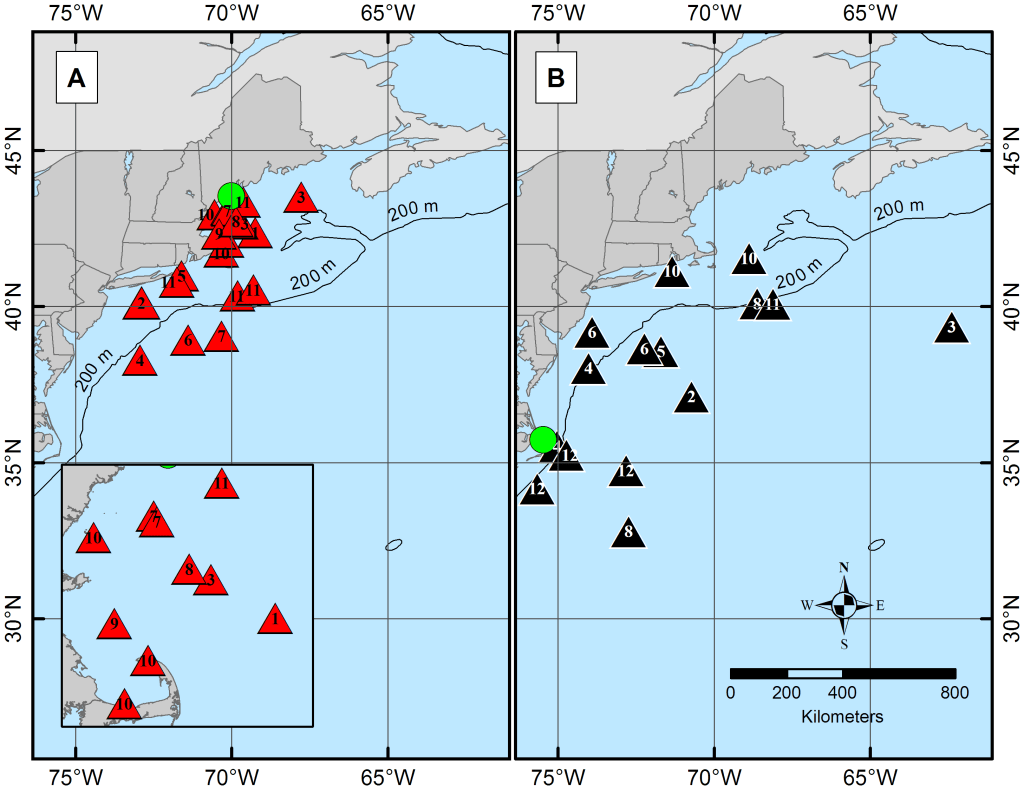
    migration patterns atlantic spiny dogfish

    Atlantic spiny dogfish do not disappear when they leave our waters; they redistribute. Each triangle marks where a tagged shark surfaced months after deployment, tracing seasonal circuits that braid northern and southern populations together before they separate again. The shaded regions show the broad envelope of movement and the smaller core areas used most consistently. Migration here is not wandering — it is structure. Reproduction moves along these same corridors, written into geography long before it is visible at the surface. | Graphic credit: Carlson et al., 2014

    After fertilization, females carry embryos for nearly two years — among the longest gestation periods recorded in sharks (Hamlett, 2005). A single pregnancy produces relatively small litters, commonly averaging six to twelve pups, each representing a substantial maternal investment spread across seasons rather than weeks (Hamlett, 2005; Cortés, 2000). Birth does not occur in the same waters where mating took place. Instead, adults retreat toward their familiar temperature zones and feeding grounds, and the next generation enters the ocean already geographically sorted. Migration and reproduction form a loop rather than a point. Each cycle redistributes genes across the coast while preserving the regional rhythms that structure the population.

    This extraordinary investment in time creates vulnerability. Sharks with slow growth, delayed maturity, and extended gestation replace themselves gradually, making populations sensitive to elevated fishing pressure (Cortés, 2000; Musick & Ellis, 2005). Removing a late-term female represents not a single loss, but the collapse of years of biological investment in a species evolved for endurance rather than speed.

    Reading the Body

    Female sharks often carry scars along their flanks and fins — pale arcs and punctures that appear deliberate enough to invite explanation. These marks are frequently attributed to mating, and sometimes that interpretation is correct. During copulation, males grip females with their teeth to maintain position in moving water, producing patterned abrasions consistent with tooth spacing (Pratt & Carrier, 2005). But the body of a coastal predator is an archive of many encounters, not all of them reproductive.

    Mating scars recorded on female blue sharks.
The pale arcs and punctures along the flank, gill region, and fins are bite marks left during courtship, when males grip females to maintain position in open water. Some individuals carry a single mark; others bear layered evidence of repeated encounters. These scars are not pathology but record — the body retaining brief moments of reproductive contact long after the act itself has vanished into current. What remains visible is the aftermath: lineage written lightly into skin. | Image credit: Vossgaetter et al., 2025
    Mating scars recorded on female blue sharks. The pale arcs and punctures along the flank, gill region, and fins are bite marks left during courtship, when males grip females to maintain position in open water. Some individuals carry a single mark; others bear layered evidence of repeated encounters. These scars are not pathology but record — the body retaining brief moments of reproductive contact long after the act itself has vanished into current. What remains visible is the aftermath: lineage written lightly into skin. | Image credit: Vossgaetter et al., 2025

    Fishing gear produces different signatures: hooks damage the jaw, entanglement leaves constricting linear abrasions, and vessel strikes create irregular trauma. Healed injuries accumulate across a lifetime, recording survival rather than singular events. Marine biologists interpret these marks through context — season, species behavior, wound geometry — understanding that a scar is evidence, not confession (Pratt & Carrier, 2005). The ocean rarely supplies a single explanation.

    The skin of a white shark carries a record of encounters.
Different wounds trace different histories: restrained bite marks associated with courtship (A & B), deeper bites from conflict (C & D), punctures and scratches left by struggling prey (E & F), abrasions from contact with reef or hard bottom (G), and the unmistakable geometry of propeller strikes (H). Each mark is a fragment of interaction preserved after the moment has passed. To read a shark’s body is to read a map of relationships — mating, hunting, collision, survival — written not as drama, but as accumulation. | Photo credit: Anderson et al., 2025
    The skin of a white shark carries a record of encounters. Different wounds trace different histories: restrained bite marks associated with courtship (A & B), deeper bites from conflict (C & D), punctures and scratches left by struggling prey (E & F), abrasions from contact with reef or hard bottom (G), and the unmistakable geometry of propeller strikes (H). Each mark is a fragment of interaction preserved after the moment has passed. To read a shark’s body is to read a map of relationships — mating, hunting, collision, survival — written not as drama, but as accumulation. | Photo credit: Anderson et al., 2025

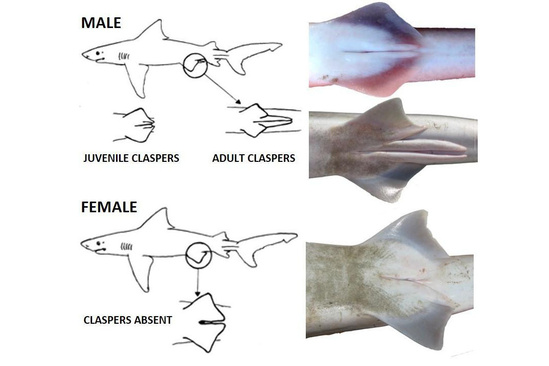
    Scars are only one layer of interpretation. Sharks also carry quieter markers of sex and maturity written into their form. Males develop elongated claspers — modified fins that trail beneath the body — visible even at a distance once the animal reaches reproductive age. In immature males these structures are short and flexible, almost decorative. With maturity they lengthen and calcify, projecting clearly behind the pelvic fins like paired shadows. A school viewed from a pier often reveals this difference in motion: some bodies carry that trailing geometry, others do not. Even without knowing species, an observer is watching a mixed population divided by sex and age.

    Females, lacking claspers, present a cleaner silhouette. During pregnancy their bodies shift subtly. The abdomen rounds, not dramatically but enough to change how light moves across the flank. Experienced observers recognize gravid females less by size than by proportion — a redistribution of mass that suggests internal cargo rather than surface injury.

    The clasper itself is an evolutionary innovation — a modification of pelvic fins that allows internal fertilization in a fluid environment where external fertilization would disperse gametes too widely to ensure success (Hamlett, 2005). It is a structural solution to a problem posed by water: how to keep lineage from dissolving into current.

    Sex in sharks is written into the silhouette.
Males carry paired claspers — elongated extensions of the pelvic fins that lengthen and stiffen with maturity — while females lack them entirely. Even at a distance, the trailing geometry changes how the body reads in motion. What looks like a uniform school from the surface is already divided by anatomy: juveniles, adults, males, females, each stage visible to anyone patient enough to watch. | 
Photo credit: National Oceanic and Atmospheric Administration
    Sex in sharks is written into the silhouette. Males carry paired claspers — elongated extensions of the pelvic fins that lengthen and stiffen with maturity — while females lack them entirely. Even at a distance, the trailing geometry changes how the body reads in motion. What looks like a uniform school from the surface is already divided by anatomy: juveniles, adults, males, females, each stage visible to anyone patient enough to watch. |
    Photo credit: National Oceanic and Atmospheric Administration

    These signals are quiet. They require patience. To read a shark in the water is to read a body moving through stages — juvenile, mature, gravid — each phase revealing that reproduction is not a single event but a condition carried across seasons. The distinction is anatomical literacy learned slowly, the way birdwatchers learn silhouettes or botanists learn leaf shape. Bodies announce their histories to those patient enough to look.

    Timing Written Into the Body

    Maturity does not arrive uniformly across a population. In many coastal sharks, size is a better predictor of reproductive readiness than age. Warmer water accelerates metabolism and growth, allowing juveniles in southern nurseries to reach maturity sooner than their northern counterparts (Cortés, 2000; Musick & Ellis, 2005). Temperature becomes a developmental force. A difference of a few degrees can compress or extend the timeline by years, shaping when an individual enters the reproductive pool.

    Juveniles and adults often sort themselves accordingly. Young sharks cluster in shallower, warmer margins where rapid growth offsets vulnerability. Larger, mature individuals occupy deeper or more exposed water, their size granting a margin of safety (Heupel et al., 2007). When mixed schools appear near piers, the variation in body shape reflects overlapping life stages sharing temporary habitat. What looks like a single group is often a layered demographic — future breeders moving alongside current ones.

    During mating seasons, additional cues surface. Mature males display fully calcified claspers held stiff against the body, while gravid females carry the rounded proportions of pregnancy. These changes are not theatrical. They are subtle adjustments in geometry, visible only to observers willing to compare silhouettes over time.

    Nurseries and Geographic Memory

    Many coastal shark species rely on estuaries as nursery grounds, where shallow, structured habitat increases juvenile survival by buffering predators and concentrating prey (Heupel et al., 2007). Young sharks enter a world scaled to their size. Warmer water accelerates growth, and complex shoreline geometry provides refuge during early vulnerability.

    Some females exhibit fidelity to nursery regions, returning to the same coastal systems that once sheltered them (Heupel et al., 2007). Habitat becomes inheritance. When nursery grounds degrade, the disruption extends beyond a single generation — it interrupts geographic memory embedded in the population itself.

    Multiple Ways to Continue

    Sandbar Sharks — Durability Over Speed

    A sandbar shark range from New England to Brazil. | Photo Credit: G.P. Schmahl/NOAA

    Sandbar shark | Photo Credit: G.P. Schmahl/NOAA

    Sandbar sharks (Carcharias plumbeus) invest heavily in durability. They mature late, produce relatively small litters, and rely on long development to generate robust juveniles capable of extended survival (Musick & Ellis, 2005). This strategy favors stability over speed. When mortality rises, recovery unfolds slowly because the species was never designed for rapid turnover.

    Sandbar shark reproduction unfolds slowly even by shark standards. Gestation lasts roughly 9–12 months, with litters typically ranging from 6 to 13 pups, though regional variation is common (Musick & Ellis, 2005). Along the mid-Atlantic coast mating generally occurs in spring and early summer, while birthing follows the next year in warmer estuarine margins. The delay is part of the design. Juveniles arrive when prey is abundant and water temperature accelerates growth, aligning birth with a narrow ecological window where survival odds briefly tilt in their favor.

    In Onslow County waters, juvenile sandbar sharks use shallow estuary margins as thermal accelerators. Warm, protected water shortens the time required to reach a size less vulnerable to predation. Growth in these early months is not cosmetic; it is survival measured in centimeters. A difference of a few inches can determine whether a young shark passes unnoticed beneath larger predators or becomes part of their diet (Heupel et al., 2007). The nursery functions as a buffer against probability. By compressing early growth into a brief window of ecological generosity, sandbars convert geography into longevity.

    Blacktip Sharks — Timing as Opportunity

    Atlantic blacktip sharks | Photo credit: Shutterstock
    Atlantic blacktip sharks | Photo credit: Shutterstock

    Blacktip sharks (Carcharhinus limbatus) align reproduction with seasonal pulses. Birth coincides with warm water and prey abundance, creating a temporary ecological advantage for juveniles. This strategy accepts higher early mortality but compensates through timing — survival synchronized with opportunity (Heupel & Simpfendorfer, 2008).

    Blacktip sharks compress their timeline. Gestation averages 10–12 months and litters often contain 1 to 10 pups, with smaller litters more common in northern portions of their range (Heupel & Simpfendorfer, 2008). Mating occurs in late spring and summer; pups are born the following late spring when baitfish concentrations peak in shallow coastal waters. Their strategy hinges on synchronization. Birth is timed not to safety, but to opportunity — a calculated arrival into abundance.

    Along our piers in late spring and summer, blacktip juveniles appear in pulses that mirror the prey fields they depend on. Schools of baitfish create moving refuges — density as defense — and young blacktips learn to survive inside motion itself. Survival belongs to individuals able to exploit brief windows, grow fast, and disperse before scarcity returns (Heupel & Simpfendorfer, 2008).

    Bonnethead Sharks — Redundancy and Retention

    Bonnethead shark | Photo credit: NC Aquariums
    Bonnethead shark | Photo credit: NC Aquariums

    Bonnethead sharks (Sphyrna tiburo) operate on one of the shortest reproductive cycles among coastal sharks. Gestation lasts approximately 4–5 months, and litters commonly range from 4 to 16 pups depending on female size (Hamlett, 2005). Mating generally occurs in late summer, but sperm storage allows fertilization to be delayed until environmental conditions favor gestation. Pups are born in late spring and early summer, entering warm shallow waters that function as immediate nurseries. The speed of the cycle reflects a species built for resilience through repetition — rapid turnover as insurance against instability.

    Bonnetheads add evolutionary contingency. Rare cases of parthenogenesis — reproduction without fertilization — demonstrate biological redundancy when mates are scarce (Chapman et al., 2007). Such flexibility underscores a principle of lineage persistence: survival tolerates complexity if complexity improves continuity.

    Bonnetheads, often glimpsed in shallow surf or near pilings, compress life history into shorter cycles, allowing populations to respond quickly to environmental change. Unlike many coastal sharks, females are capable of storing viable sperm for extended periods, delaying fertilization until conditions favor successful gestation (Hamlett, 2005). This ability decouples mating from pregnancy, allowing reproduction to align with environmental timing rather than immediate opportunity. Redundancy becomes insurance in a fragmented coastal landscape. Their persistence is not brute strength but flexibility — an evolutionary acknowledgment that coastlines are rarely stable for long (Cortés, 2000).

    Sand Tiger Sharks — Survival Before Birth

    Sand tiger shark | Photo credit: Mitchell, 2024
    Sand tiger sharks | Photo credit: Mitchell, 2024

    Sand tiger sharks (Carcharias taurus) represent an uncompromising alternative. Embryos compete within the uterus, and only the strongest survive to birth through intrauterine cannibalism — a process that produces a small number of highly developed juveniles (Hamlett, 2005). From a human perspective the mechanism appears brutal. In evolutionary terms it is a concentrated investment in pre-birth survival.

    Sand tiger gestation stretches close to 9–12 months, but the internal competition that defines their development reduces litters to one or two surviving pups per uterus despite a much larger initial embryo count (Hamlett, 2005; Branstetter & Musick, 1994). Mating occurs offshore in cooler months, and births typically follow in spring or early summer. The resulting juveniles are large at birth — already capable hunters — trading quantity for immediate competence. Survival is front-loaded. The species invests in a few individuals built to endure rather than many built to gamble.

    For sand tigers occasionally seen near South Topsail Island, this pre-birth selection produces juveniles that enter the water already comparable in size to many adult coastal fish. They arrive as functioning predators. Instead of a long vulnerable childhood, sand tigers begin life past the most dangerous bottleneck. Their subsequent behavior reflects this early security: slow movement, energy conservation, and longevity built on having cleared the lethal threshold before birth (Branstetter & Musick, 1994).

    It is tempting to read personality into origin. Yet adult sand tigers move with calm efficiency, rarely engaging in unnecessary conflict. A harsh developmental filter does not predict a harsh adulthood. It simply ensures survival past the most intense threshold.

    Together, these strategies map the same coastline through different biological clocks. Some sharks survive by accelerating early growth. Others invest in a few individuals built to last. Still others hedge their future with redundancy. Diversity is not excess — it is resilience expressed through bodies.

    The Coast as a Clock

    Longevity is the silent partner in every reproductive strategy. Long-lived sharks can afford to reproduce slowly, distributing investment across decades. Shorter-lived species compress reproduction into tighter intervals. Neither strategy is superior in isolation. Each is calibrated to environmental tempo (Cortés, 2000).

    The coastline holds many clocks at once — tides measured in hours, migrations in seasons, lineage in centuries. Sharks survive by aligning their bodies to the clock that fits their niche. Gestation becomes a wager on stability. Migration becomes inheritance in motion. A nursery becomes infrastructure for continuity.

    To observe a pregnant shark offshore is to witness a process already years in motion. The animal carries not only embryos but evolutionary decisions accumulated across millennia: how many to produce, when to move, where to shelter, how long to live. Reproduction is less an event than a continuity. Its future depends not on spectacle, but on whether the slow mathematics of these lives can continue unfolding inside waters still capable of carrying them forward.

    References

    Branstetter, S., & Musick, J. A. (1994). Age and growth estimates for the sand tiger in the northwestern Atlantic Ocean. Transactions of the American Fisheries Society, 123(2), 242-254. https://doi.org/10.1577/1548-8659(1994)123<0242:aageft>2.3.co;2

    Carlson, A. E., Hoffmayer, E. R., Tribuzio, C. A., & Sulikowski, J. A. (2014). The use of satellite tags to redefine movement patterns of spiny dogfish (Squalus acanthias) along the U.S. East Coast: Implications for fisheries management. PLoS ONE, 9(7), e103384. https://doi.org/10.1371/journal.pone.0103384

    Carrier, J. C., Musick, J. A., & Heithaus, M. R. (2012). Biology of sharks and their relatives (2nd ed.). CRC Press.

    Chapman, D. D., Shivji, M. S., Louis, E., Sommer, J., Fletcher, H., & Prodöhl, P. A. (2007). Virgin birth in a hammerhead shark. Biology Letters, 3(4), 425-427. https://doi.org/10.1098/rsbl.2007.0189

    Cortés, E. (2000). Life history patterns and correlations in Sharks. Reviews in Fisheries Science, 8(4), 299-344. https://doi.org/10.1080/10408340308951115

    DeVries, C., Gartland, J., & Latour, R. J. (2025). Patterns in spiny dogfish consumption by sex and maturity stage relate to prey availability and environmental forcing in the Northwest Atlantic. Frontiers in Marine Science, 12. https://doi.org/10.3389/fmars.2025.1621343

    Heupel, M., Carlson, J., & Simpfendorfer, C. (2007). Shark nursery areas: Concepts, definition, characterization and assumptions. Marine Ecology Progress Series, 337, 287-297. https://doi.org/10.3354/meps337287

    Heupel, M., & Simpfendorfer, C. (2008). Movement and distribution of young bull sharks Carcharhinus leucas in a variable estuarine environment. Aquatic Biology, 1, 277-289. https://doi.org/10.3354/ab00030

    Musick, J. A., & Ellis, J. K. (2005). Reproductive evolution of chondrichthyans. In Reproductive Biology and Phylogeny of Chondrichthyes (1st ed., pp. 45-79). Science Publishers.

    Pratt, H. L., & Carrier, J. C. (2005). Elasmobranch courtship and mating behavior. In Reproductive Biology and Phylogeny of Chondrichthyes (1st ed., pp. 129-169). Science Publishers.

  • Reader Request: The Horizon Line: Where Great White Sharks Live off Onslow County

    Reader Request: The Horizon Line: Where Great White Sharks Live off Onslow County

    At low tide in winter, the creeks around Topsail Island narrow into quiet channels. Spartina stems lean toward one another across dark water. Oyster reefs stand exposed, their edges iced with salt. What remains moves slowly—ribbed mussels closing, mullet idling in the deeper bends, a heron pacing the shallows with stiff patience. The marsh looks reduced, as though winter has thinned it to structure and shadow.

    Out beyond the last line of cordgrass, the sound changes. Surf carries a different cadence in January—longer intervals, heavier breaks. The nearshore bar holds a pale line of foam that drifts south with the longshore current. Between creek mouth and open ocean, water mixes: tannin-dark runoff meeting green Atlantic, cold layers sliding beneath one another, density sorting itself by temperature and salinity. This seam—where the estuary exhales into the sea—remains active even when everything else seems paused.

    Stand at the mouth of a Topsail inlet in winter. Behind you, the marsh exhales through narrow creeks, dark water slipping between oyster and spartina. In front of you, the ocean opens in bands—foam, green, deeper blue.

    Now lift your eyes. Let them pass the breakers, the outer bar, the long surface of moving water. Where sky finally meets ocean—two to four miles offshore—the shelf settles into depths of roughly 10–40 m (30–130 ft), and winter temperatures stabilize between about 12–18 °C (54–64 °F) (Thorrold et al., 2014; Jorgensen et al., 2012; Weng et al., 2007). That is the band these sharks inhabit. Not the inlet. Not the surf. The horizon itself.

    It is along that distant seam, where depth, temperature, and prey structure become coherent across miles of water, that great white sharks pass.

    They do not announce themselves. Their movement is inferred through instruments, through acoustic detections and satellite tracks that appear weeks later as lines on maps. Winter on this coast is a season of quiet transfers—energy shifting offshore, biomass redistributing, heat draining southward along the shelf—and the sharks move within that transfer rather than against it.

    A Corridor Without a Shoreline

    Juvenile and subadult great white sharks (Carcharodon carcharias) follow these gradients. Individuals tagged in the western North Atlantic move south in autumn, traveling along the inner continental shelf in response to cooling surface temperatures and changing prey fields (Thorrold et al., 2014; Weng et al., 2007). Their paths run parallel to beaches that appear empty, unfolding not at wading depth but across the first miles of open water beyond land.

    What scientists call nearshore along this coast is not the water at your feet, but the inner shelf itself—the first one to five miles of ocean beyond the dunes. From Topsail, that span begins well past the surf zone and extends to the horizon. It is within this band, most often two to four miles offshore, that great white sharks are detected, tracking thermal structure and prey fields rather than the visible edge of land (Jorgensen et al., 2012; Thorrold et al., 2014).

    Satellite track of the white shark Lydia across the western North Atlantic. Each point marks a location in time. The Carolina coast appears here not as an edge, but as a corridor—one segment in a much larger pattern of movement measured in hundreds of miles, not yards. | Photo credit: OCEARCH
    Satellite track of the white shark Lydia across the western North Atlantic. Each point marks a location in time. The Carolina coast appears here not as an edge, but as a corridor—one segment in a much larger pattern of movement measured in hundreds of miles, not yards. | Photo credit: OCEARCH

    Near Topsail, winter surface temperatures drop into the low teens Celsius. Estuarine outflow forms narrow plumes that extend beyond the bars on ebb tides, carrying silts, copepods, and the chemical signature of the marsh outward. These plumes flatten and stretch across miles of shelf water, generating faint fronts—microboundaries in temperature and turbidity that organize small fishes and forage species into coherent fields (Govoni & Grimes, 1992). Where prey becomes legible at that scale, predators follow.

    The sharks do not enter the creeks. Their bodies are built for open water: rigid caudal keels, high-aspect fins, a metabolism tuned for sustained movement. Estuaries in this region are shallow, variable, and often less saline than oceanic preference. Studies of juvenile white shark habitat use show strong association with nearshore coastal zones but little penetration into true estuarine environments (Curtis et al., 2015; Weng et al., 2007). They patrol the edge instead, working along bars and troughs that persist far offshore as submerged ridges, where mullet, menhaden, and small elasmobranchs concentrate.

    This boundary behavior is not avoidance. It is partitioning.

    The marsh produces, the ocean receives, and predators remain where exchange becomes structured.

    Winter as Reconfiguration

    In winter, this exchange intensifies. Cold fronts arrive from the northwest, pushing surface water offshore and steepening nearshore wave energy. Bottom stress increases. Sand and shells are mobilized along the bars. Each storm reshapes the nearshore topography, altering trough depth and current velocity across miles of shelf in ways that reorganize prey habitat in real time (Riggs et al., 1995). Fish shift position, rays redistribute, and the water column reorders itself around new gradients.

    White sharks read these changes through sensory fields invisible to surface observers. Their lateral lines register turbulence. Electroreception resolves the faint impulses of buried prey. Olfaction extends across kilometers. Movement becomes a continuous dialogue between physiology and physics (Kajiura & Holland, 2002; Klimley, 1994).

    The sensory landscape of a shark is measured in gradients, not edges. Vision resolves only tens of meters. Pressure and electrical cues register within arm’s length. Scent and sound, however, extend across hundreds to thousands of meters, allowing sharks to navigate and track structure far beyond what any shoreline observer can perceive. | Photo credit: Ocean Noise
    The sensory landscape of a shark is measured in gradients, not edges. Vision resolves only tens of meters. Pressure and electrical cues register within arm’s length. Scent and sound, however, extend across hundreds to thousands of meters, allowing sharks to navigate and track structure far beyond what any shoreline observer can perceive. | Photo credit: Ocean Noise

    Winter is not a pause in this system. It is a reconfiguration.

    Acoustic detections along the Carolina coast show juvenile white sharks present through late autumn and early winter, with some individuals remaining offshore well into colder months (Thorrold et al., 2014). Their movements correlate more strongly with temperature fronts than with latitude alone (Jorgensen et al., 2012). They do not migrate in straight lines. Instead, they spiral along shelf edges, revisit productive zones, and pause in thermal refugia that may lie several miles from the beach.

    These behaviors mirror the structure of the coast itself. Topsail Island is not a fixed boundary but a shifting interface shaped by inlet migration, storm overwash, and sediment exchange, where creek mouths relocate over decades and bars emerge and vanish under successive storms, leaving the spatial memory of the landscape provisional—held only as long as sediment and flow allow.

    So too is the habitat of a shark.

    Why There Are Nurseries Elsewhere—and Not Here

    Nursery grounds for great white sharks are well documented along parts of the U.S. Atlantic coast and in southern California, where juveniles aggregate in shallow nearshore zones that maintain moderate depths, stable thermal structure, and consistent prey availability (Curtis et al., 2015; Weng et al., 2007). These systems tend to hold water within the same 12–20 °C (54–68 °F) envelope for extended periods and provide refuge from larger predators while supporting rapid growth.

    Relative size of baby, juvenile, and adult white sharks. True nurseries support animals in the 4–6 ft range—small, energetically constrained, and vulnerable. These habitats are shallow, protected, and bounded. The open, wave-driven shelf off Onslow County is built for movement, not residence. | California State University of Long Beach
    Relative size of baby, juvenile, and adult white sharks. True nurseries support animals in the 4–6 ft range—small, energetically constrained, and vulnerable. These habitats are shallow, protected, and bounded. The open, wave-driven shelf off Onslow County is built for movement, not residence. | California State University of Long Beach

    What distinguishes these regions is not simply abundance, but predictability.

    Along the Pacific coast and in parts of the Northeast, pinniped rookeries concentrate thousands of seals and sea lions into narrow coastal bands. Each breeding season injects dense, spatially fixed pulses of biomass into shallow water. Energy arrives at the same place, at the same time, year after year. Juvenile white sharks in these systems do not patrol corridors; they occupy fields. Foraging becomes localized rather than distributed (Curtis et al., 2015; Weng et al., 2007; Heithaus et al., 2008).

    The waters off Topsail differ.

    There are no pinniped rookeries anchoring prey to shore. Winter temperatures fall rapidly below nursery thresholds. Nearshore depths drop into energetic surf zones. Storm frequency reshapes the seafloor weekly. Forage fishes are abundant, but diffuse—organized by fronts and bars that shift across miles of shelf rather than accumulating at fixed nodes. Energy here is mobile.

    This does not exclude juvenile white sharks. It alters how they use the coast.

    Rather than residency, this region becomes a corridor.

    A short field documentary traces this same corridor northward, showing how white sharks follow seals and thermal structure along the Atlantic shelf. The movement is quiet, methodical, and seasonal—more migration than pursuit.

    The Horizon Line

    Great white sharks moving along the Carolina coast occupy a band of water that feels farther away than it is. Telemetry detections cluster not in the surf, not in the creeks, but along the inner continental shelf—most often between one and five miles offshore, with a strong concentration in the two–to–four mile range (Thorrold et al., 2014; Jorgensen et al., 2012).

    From the beach at Topsail, that distance aligns almost exactly with the horizon line. At eye level, the curve of the Earth hides the ocean surface at roughly two to three miles. The place where water meets sky is not poetic. It is geometric. It is where the sharks most often pass.

    Stand at an inlet and let your eyes move outward. Past the spartina. Past the oyster. Past the breakers. Past the outer bar. Across the long surface of moving water.

    The marsh is feet.
    The surf is tens of yards.
    The sharks are miles.

    Satellite-tracked movements of two white sharks, Lydia and Mary Lee, overlaid on sea surface height anomalies. Pink and green points show locations within ocean eddies and Gulf Stream meanders—features invisible from shore but persistent in the water column. These are not random paths. They trace structure. | Photo credit: Peter Gaube/University of Washington
    Satellite-tracked movements of two white sharks, Lydia and Mary Lee, overlaid on sea surface height anomalies. Pink and green points show locations within ocean eddies and Gulf Stream meanders—features invisible from shore but persistent in the water column. These are not random paths. They trace structure. | Photo credit: Peter Gaube/University of Washington

    They move along a band of sea that is still shaped by the coast—where sandbars continue offshore as submerged ridges, where storm energy reorganizes the bottom across long reaches of shelf, where creek plumes stretch into faint fronts that may never be visible from land. It is nearshore in every ecological sense, but far beyond the scale of swimmers and anglers.

    This is why their presence feels paradoxical. They are coastal sharks, yet almost never beach sharks.

    The surf zone is turbulent, shallow, and repeatedly reworked. For a large-bodied predator built for glide efficiency and sustained cruising, it is energetically expensive and ecologically thin. The outer bars and troughs beyond it, however, form stable corridors where prey aligns with bathymetry and current seams persist long enough to be read across miles of water (Riggs et al., 1995; Govoni & Grimes, 1992).

    White sharks patrol the architecture of the coast rather than its edge.

    Reading the Geometry of Water

    Along this coast, the critical structure is not reef or rock but relief within sand. Outer bars, troughs, and subtle shelf undulations shape current velocity and wave energy so that where flow accelerates over a bar and relaxes into a trough, particles accumulate, plankton concentrates, and baitfish align across long seams of water. These features are transient, redrawn by storms, but the process persists, and sharks move with that process rather than with any single landmark.

    Temperature acts as the first gate.

    Juvenile and subadult white sharks in the western North Atlantic consistently occupy water between roughly 12–20 °C, shifting position to remain within that band as seasons change (Thorrold et al., 2014; Jorgensen et al., 2012). In winter, this envelope compresses toward the shelf and organizes into narrow ribbons—fronts formed where cold coastal water meets slightly warmer offshore layers.

    These fronts emerge precisely where nearshore bathymetry and estuarine outflow intersect.

    They are not visible in calm seas. They are persistent enough to organize prey.

    Schooling fishes—menhaden, mullet, anchovies, juvenile drum—respond to temperature microgradients, oxygen regimes shaped by mixing, turbidity edges created by creek plumes, and current seams formed by bar–trough relief (Able & Fahay, 2010; Whitfield et al., 2012). Their schools elongate along these boundaries and compress where water masses converge.

    White sharks are not oriented to the bottom in the way flounder, rays, or crabs are. They move through fields of temperature, density, and motion, following the places where gradients hold their shape long enough to be read. Far offshore, those gradients diffuse into broad, indistinct layers. In the surf, they fracture under turbulence. Between them lies a narrow, shifting band where structure persists—where fronts stretch, prey aligns, and information remains coherent across distance.

    As the tide turns, creek water pauses and then begins to drain. Foam lines detach from oyster edges and slide seaward. The surface darkens as tannins mix with green. That exported water does not vanish at the bar; it stretches outward across miles of shelf, flattening into a plume that reorganizes temperature and turbidity along its path. Miles offshore, a shark adjusts depth, not in response to the marsh itself, but to the geometry that marsh has become within the sea.

    Elevation and coastal structure along the North Carolina shore. What appears from the beach as a single edge is, in fact, a layered interface—river basins, marsh plains, barrier islands, and shelf waters braided together. The geometry of this coast is written in gradients, not lines. | Image credit: J. P. Walsh
    Elevation and coastal structure along the North Carolina shore. What appears from the beach as a single edge is, in fact, a layered interface—river basins, marsh plains, barrier islands, and shelf waters braided together. The geometry of this coast is written in gradients, not lines. Orange rectangle shows Onslow county area. | Image credit: J. P. Walsh

    Closing

    The tide does not complete this exchange. It only begins it. Each ebb redraws the shelf in faint ways—altering where heat settles, where turbidity thins, where prey holds for a moment before dispersing. The coast does not end at the dunes. It continues offshore as structure, as gradient, as corridor. Somewhere within that extension, a shark moves, not toward land and not away from it, but along the shifting shape of the boundary itself.

    References

    Able, K. W., & Fahay, M. P. (2010). Ecology of estuarine fishes: Temperate waters of the western North Atlantic. Johns Hopkins University Press.

    Curtis, T. H., Metzger, G., Fischer, C., McBride, B., McCallister, M., Winn, L. J., Quinlan, J., & Ajemian, M. J. (2018). First insights into the movements of young-of-the-year white sharks (Carcharodon carcharias) in the western North Atlantic Ocean. Scientific Reports, 8(1). https://doi.org/10.1038/s41598-018-29180-5

    Govoni, J. J., & Grimes, C. B. (1992). The surface accumulation of larval fishes by hydrodynamic convergence within the Mississippi River plume front. Continental Shelf Research, 12(11), 1265-1276. https://doi.org/10.1016/0278-4343(92)90063-p

    Heithaus, M. R., Frid, A., Wirsing, A. J., & Worm, B. (2008). Predicting ecological consequences of marine top predator declines. Trends in Ecology & Evolution, 23(4), 202-210. https://doi.org/10.1016/j.tree.2008.01.003

    Jorgensen, S. J., Reeb, C. A., Chapple, T. K., Anderson, S., Perle, C., Van Sommeran, S. R., Fritz-Cope, C., Brown, A. C., Klimley, A. P., & Block, B. A. (2009). Philopatry and migration of Pacific white sharks. Proceedings of the Royal Society B: Biological Sciences, 277(1682), 679-688. https://doi.org/10.1098/rspb.2009.1155

    Kajiura, S. M., & Holland, K. N. (2002). Electroreception in juvenile scalloped hammerhead and sandbar sharks. Journal of Experimental Biology, 205(23), 3609-3621. https://doi.org/10.1242/jeb.205.23.3609

    Klimley, A. P. (1994). The predatory behavior of the white shark. American Scientist, 82(2), 122-133. https://www.jstor.org/stable/29775147

    Riggs, S. R., Cleary, W. J., & Snyder, S. W. (1995). Influence of inherited geologic framework on barrier shoreface morphology and dynamics. Marine Geology, 126(1-4), 213-234. https://doi.org/10.1016/0025-3227(95)00079-e

    Thorrold, S., Houghton, L., & Skomal, G. (2014). Temperature-depth profiles from archival tags deployed on basking sharks tagged from F/V Ezyduzit in the Northwest Atlantic ocean from 2004-2011 (Basking shark Geochem tracers project). Biological and Chemical Oceanography Data Management Office. https://doi.org/10.1575/1912/bco-dmo.476294.1

    Weng, K. C., Boustany, A. M., Pyle, P., Anderson, S. D., Brown, A., & Block, B. A. (2007). Migration and habitat of white sharks (Carcharodon carcharias) in the eastern Pacific Ocean. Marine Biology, 152(4), 877-894. https://doi.org/10.1007/s00227-007-0739-4

    Whitfield, A., Elliott, M., Basset, A., Blaber, S., & West, R. (2012). Paradigms in estuarine ecology – A review of the Remane diagram with a suggested revised model for estuaries. Estuarine, Coastal and Shelf Science, 97, 78-90. https://doi.org/10.1016/j.ecss.2011.11.026

  • The Winter Guild: Nearshore Sharks and the Ecology of Cold Water

    The Winter Guild: Nearshore Sharks and the Ecology of Cold Water

    On a winter morning in Surf City, the beach feels emptied of its usual cast. Pelicans still cruise the shoreline in loose, patient lines, rising and settling with the wind. Gulls hover over seams in the water where green folds into brown. The tide sounds heavier now, denser, carrying cold through the shallows.

    Along Topsail Island, the nearshore zone becomes a narrow corridor of motion and restraint. Waves collapse without urgency. The water clears between fronts. What summer spreads wide, winter compresses.

    To most people, this looks like absence. The season reads as retreat.

    But the coastal system has not gone dormant. It has been edited.

    Cold water does not simply slow life along the coast; it reorganizes it. As the air cools, shallow waters lose heat first. Deeper layers follow. The sharp thermal steps of summer—warm surface, cool bottom—soften into sameness. What had been stacked becomes blended. Oceanographers describe this seasonal collapse as thermal and density homogenization (Cai et al., 2021), but on the shore it feels like weight: the water darker, heavier, less willing to give anything up.

    This change reshapes everything that lives within it. Temperature governs metabolism. Light governs production. Density governs movement. Winter redraws those rules.

    Predation does not vanish. It narrows.

    Reading the Cold and Salt

    Winter along the Carolina coast is defined less by dates than by gradients. Surface waters along the inner shelf commonly cool into the range of about 8–12 °C (46–54 °F), while deeper waters offshore remain slightly warmer under the influence of slope waters and the Gulf Stream (Atkinson et al., 1983; Cai et al., 2021; Rasmussen et al., 2005). The warm-bottom refuges of summer collapse. The mixed layer deepens. A single, colder column replaces the layered world of warm months.

    Sea surface temperature (SST) range for Topsail Island, NC from 1981-2005. The thick yellow line shows average SST compared to 1984, while thin, black lines show extreme temperatures. | Photo credit: Surf-forecast.com, 2005
    Sea surface temperature (SST) range for Topsail Island, NC from 1981-2005. The thick yellow line shows average SST compared to 1984, while thin, black lines show extreme temperatures. | Photo credit: Surf-forecast.com, 2005

    Salinity follows a similar simplification. In winter, open shelf waters settle into a narrow band—typically around 32–35 parts per thousand (ppt), the same saltiness as the open Atlantic. Freshwater input diminishes, and stronger winds and tides smooth what summer once layered.

    Average salinity utilizing historical ship and buoy data. Notice practical salinity is higher (red) along the North Carolina coastline. | Photo credit: World Ocean Atlas, 2009
    Average salinity utilizing historical ship and buoy data. Notice practical salinity is higher (red) along the North Carolina coastline. | Photo credit: World Ocean Atlas, 2009

    In summer, that chemistry fractures. Heavy rains, river discharge, and weak vertical mixing dilute nearshore and estuarine waters into the low 20s ppt or even the teens, sending plumes of brackish water outward from creek mouths and sounds (Singer et al., 1980). Onslow Bay becomes chemically patchworked: stratified sounds, plume-fed inlets, and salinity fronts that drift and reform with each tide.

    Winter erases that mosaic. Only near inlets and estuary mouths do sharp gradients persist, briefly stacking fresher creek water over denser seawater before winds and tides flatten them again. Where summer offered a quilt of chemical habitats, winter replaces it with continuity.

    Light changes too. Shorter days and deeper mixing reduce phytoplankton growth, pushing the productive layer below the surface and dimming the water’s green cast. Satellite and in situ records from the Mid-Atlantic shelf show winter as the seasonal low point for surface chlorophyll and primary productivity (Xu et al., 2011). The surface darkens. The food web thins from its base upward.

    Winter does not remove life. It rearranges it.

    Benthic invertebrates burrow or slow. Many fishes retreat or become lethargic. Bait compresses into fewer corridors—thermal seams, nearshore troughs, inlet mouths, shelf breaks—where temperature and oxygen remain tolerable. What summer scattered across marsh, creek, sound, and surf now funnels into lines.

    This is what the filter does. It sheds surplus. It strips away species that require warmth, shallow stability, or dense prey. What remains are animals built to endure cold, exploit structure, or move precisely between systems.

    Winter does not simplify the coast. It sharpens it.

    3D perspective of coastline of Topsail Beach inner shoreface visualizes depth. | Photo credit: Greenhorn & O'Mara Consulting Engineers & Geodynamics, 2007, p. 221
    3D perspective of coastline of Topsail Beach inner shoreface visualizes depth. | Photo credit: Greenhorn & O’Mara Consulting Engineers & Geodynamics, 2007, p. 221

    The Inshore Winterer: Atlantic Spiny Dogfish

    By midwinter, nearshore waters along this coast settle into a narrow thermal band—often between about 8 and 12 °C (46–54 °F) from surface to bottom (Atkinson et al., 1983; Cai et al., 2021). For many coastal fishes, that range marks the edge of activity. For Atlantic spiny dogfish (Squalus acanthias), it is home.

    Across the North Atlantic, dogfish remain active in waters as cold as 4–6 °C (39–43 °F), with their highest densities often occurring well below the temperatures that drive other sharks away (Bangley & Rulifson, 2014; Sulikowski et al., 2010). Their physiology, growth patterns, and life history are tuned to persistence rather than speed, favoring endurance in lean systems over burst performance in rich ones (Tribuzio et al., 2010).

    When winter flattens the water column into uniform cold, dogfish are not pushed to the margins of survival. They are moving within their preferred envelope.

    Their bodies are built for this season. Unlike sharks bound to a narrow depth band, dogfish move freely through the water column—from the surface to depths approaching 200 meters—tracking temperature and prey through vertical space (Campana et al., 2009; Carlson et al., 2014; Sulikowski et al., 2010). In winter, when baitfish and invertebrates compress into fewer layers, that vertical freedom becomes a hunting advantage. A predator locked to one plane must wait. Dogfish can follow.

    Nearshore waters and inlets become conveyor belts in winter. Tides concentrate prey flushed from estuaries. Cold fronts reorganize the column. What looks empty from the beach is often a thin band of movement just beyond the breakers. Dogfish occupy that band—persistent, economical, often in loose groups—feeding on schooling fishes and benthic prey even as energy margins tighten (Bangley & Rulifson, 2014).

    Winter does not exclude them. It clears room for them.

    The Atlantic spiny dogfish moves freely through the water column from the surface up to 200 meters. | Photo credit: ©Malcolm Francis
    The Atlantic spiny dogfish moves freely through the water column from the surface up to 200 meters. | Photo credit: ©Malcolm Francis

    The Threshold Species: Sandbar Sharks

    Sandbar sharks (Carcharhinus plumbeus) read that same winter map very differently. In warm months, juveniles rely on shallow estuaries where bottom temperatures routinely exceed 15–18 °C (59–64 °F), conditions that accelerate growth, digestion, and survival (Bangley et al., 2018; Collatos, Abel & Martin, 2020). These flats become engines of development—wide, shallow spaces where warmth turns food into body.

    By winter, those same bottoms cool into the low teens Celsius—often around 10–13 °C (50–55 °F) and sometimes lower. The estuary does not become lethal. It becomes unprofitable. Feeding no longer offsets the energetic cost of movement and digestion in cold water, particularly for juveniles still building mass.

    Unlike dogfish, sandbar sharks cannot remain inside a cold system and adapt to its structure. Their bodies and life histories are tuned to warm, shallow stability. Their performance drops rapidly as temperature declines; muscle efficiency, digestion, and growth all slow (Crear et al., 2019). When that stability collapses, they respond laterally rather than vertically—sliding down the coast or into slightly deeper nearshore waters where bottom temperatures remain marginally warmer (Bangley et al., 2018).

    Where dogfish remain and work winter’s compression, sandbars leave it.

    They are still part of the region, but they are absent from the nearshore corridor. They become threshold species—present in the seasonal arc, absent from the winter system itself. The estuary no longer belongs to them.

    Sandbar sharks will move to warmer water in winter and will move to deeper offshore waters or move southward down the coast. | Photo credit: (c) The Wet Lens, 2023
    Sandbar sharks will move to warmer water in winter and will move to deeper offshore waters or move southward down the coast. | Photo credit: (c) The Wet Lens, 2023

    The Offshore Presence: Dusky Sharks

    Dusky sharks (Carcharhinus obscurus) follow a third geometry. They tolerate cool water, but within a narrower band than many coastal sharks—most often occupying waters between roughly 10 and 20 °C (50–68 °F) (Bangley et al., 2020; Manz et al., 2025). When nearshore temperatures along this coast fall into that range, duskies can be present. When they rise beyond it in spring and summer, they are gone.

    Their winter preference therefore lies not in the compressed nearshore column, but along offshore corridors where temperature is steadier and remains within that narrow envelope. Shelf and slope waters influenced by the Gulf Stream often stay buffered within those bounds even as inshore waters swing widely (Atkinson et al., 1983; Rasmussen et al., 2005).

    Dusky sharks do not attempt to work winter’s compression. They choose stability instead. Rather than hunting within a narrowed corridor, they reposition along thermally buffered routes where cold arrives slowly and predictably.

    From land, this reads as vacancy. The surf appears emptied. Yet beyond the bar, duskies remain active in a parallel winter economy—tracking prey along shelf edges and slope corridors invisible from shore.

    They have not disappeared. They have changed address.

    Dusky sharks prefer cooler temperature waters and may be present in our nearshore waters. However, when waters warm beyond 20 °C (68 °F), they will move to cooler waters. | Photo credit: jmartincrossley, iNaturalist, 2026
    Dusky sharks prefer cooler temperature waters and may be present in our nearshore waters. However, when waters warm beyond 20 °C (68 °F), they will move to cooler waters. | Photo credit: jmartincrossley, iNaturalist, 2026

    Winter as an Ecological Filter

    By February, the coast has shed its surplus.

    The fish that needed warmth are gone. The invertebrates that depended on light have slowed or buried. What remains are species built to move through cold, to wait, or to follow structure instead of abundance.

    Winter filters by physics first.

    A deep mixed layer removes warm-bottom refuges (Cai et al., 2021). Bottom-water intrusions in Onslow Bay and adjacent shelf waters restructure the vertical habitat, replacing summer’s layered gradients with cold continuity (Hofmann et al., 1981). Uniform salinity simplifies the chemical landscape. Reduced light and productivity shrink the food web’s base (Xu et al., 2011). Currents sharpen boundaries between inshore and offshore waters, and periodic Gulf Stream intrusions create moving seams of heat and prey (Atkinson et al., 1983; Rasmussen et al., 2005).

    These constraints become biological.

    Prey compress. Movement costs rise. Energy budgets tighten. Species that require constant warmth, shallow stability, or dense forage are excluded. Those that remain are specialists: animals that tolerate cold, exploit vertical structure, or reposition with precision.

    Dogfish persist because they can work the layered winter column, remaining inside nearshore waters and inlets even as surface and bottom temperatures converge. Sandbar sharks withdraw from estuaries and shallow flats, shifting down the coast or into slightly deeper nearshore habitats where bottom temperatures remain metabolically tolerable. Dusky sharks relocate more completely, leaving the coastal corridor for offshore shelf and slope waters where Gulf Stream influence preserves thermal stability and prey remains distributed.

    Each species reads the same season and answers it differently—not by disappearance, but by repositioning within a changing map.

    Winter does not erase complexity. It concentrates it.

    Meteorological seasons are based upon the annual temperature cycle and differ from the astronomical seasons based upon the position of the sun relative to the Earth. The meteorological seasons help scientists track climate and weather changes. | Photo credit: NOAA, 2024
    Meteorological seasons are based upon the annual temperature cycle and differ from the astronomical seasons based upon the position of the sun relative to the Earth. The meteorological seasons help scientists track climate and weather changes. | Photo credit: NOAA, 2024

    A Season That Is Beginning to Shift

    The cues that drive migration—photoperiod, temperature thresholds, energetic margins—are no longer fixed. Recent models suggest that warming oceans are already altering how and when coastal sharks move, stretching winter windows and delaying departures (Manz et al., 2025).

    This does not announce collapse. It signals reorganization.

    From the beach, the change may remain imperceptible. The surf will still look calm. Pelicans will still cruise. The marsh will still pale. But beneath that surface, the system will continue to read its invisible clocks.

    Winter along Surf City and Topsail Island is not an end. It is a narrowing—a season where cold, salt, light, and current decide who remains.

    They are still here. They have simply become harder to see.

    References

    Atkinson, L. P., Lee, T. N., Blanton, J. O., & Chandler, W. S. (1983). Climatology of the southeastern United States continental shelf waters. Journal of Geophysical Research: Oceans, 88(C8), 4705-4718. https://doi.org/10.1029/jc088ic08p04705

    Bangley, C. W., Curtis, T. H., Secor, D. H., Latour, R. J., & Ogburn, M. B. (2020). Identifying important juvenile dusky shark habitat in the Northwest Atlantic ocean using acoustic telemetry and spatial modeling. Marine and Coastal Fisheries, 12(5), 348-363. https://doi.org/10.1002/mcf2.10120

    Bangley, C. W., Paramore, L., Dedman, S., & Rulifson, R. A. (2018). Delineation and mapping of coastal shark habitat within a shallow lagoonal Estuary. PLOS ONE, 13(4), e0195221. https://doi.org/10.1371/journal.pone.0195221

    Bangley, C. W., & Rulifson, R. A. (2014). Feeding habits, daily ration, and potential predatory impact of mature female spiny dogfish in North Carolina coastal waters. North American Journal of Fisheries Management, 34(3), 668-677. https://doi.org/10.1080/02755947.2014.902410

    Cai, C., Kwon, Y., Chen, Z., & Fratantoni, P. (2021). Mixed layer depth climatology over the Northeast U.S. continental shelf (1993–2018). Continental Shelf Research, 231, 104611. https://doi.org/10.1016/j.csr.2021.104611

    Campana, S. E., Jamie, A., & Gibson, F. (2008). Stock structure, life history, fishery and abundance indices for spiny dogfish (Squalus Acanthias) in Atlantic Canada (2007/089). Canadian Science Advisory Secretariat. https://www.researchgate.net/publication/268389393_Stock_Structure_Life_History_Fishery_and_Abundance_Indices_for_Spiny_Dogfish_Squalus_acanthias_in_Atlantic_Canada

    Carlson, A. E., Hoffmayer, E. R., Tribuzio, C. A., & Sulikowski, J. A. (2014). The use of satellite tags to redefine movement patterns of spiny dogfish (Squalus acanthias) along the U.S. East Coast: Implications for fisheries management. PLoS ONE, 9(7), e103384. https://doi.org/10.1371/journal.pone.0103384

    Collatos, C., Abel, D. C., & Martin, K. L. (2020). Seasonal occurrence, relative abundance, and migratory movements of juvenile sandbar sharks, Carcharhinus plumbeus, in Winyah Bay, South Carolina. Environmental Biology of Fishes, 103(7), 859-873. https://doi.org/10.1007/s10641-020-00989-2

    Crear, D. P., Brill, R. W., Bushnell, P. G., Latour, R. J., Schweiterman, G. D., Steffen, R. M., & Weng, K. C. (2019). The impacts of warming and hypoxia on the performance of an obligate ram ventilator. Conservation Physiology, 7(1). https://doi.org/10.1093/conphys/coz026

    Greenhorn & O’Mara Consulting Engineers, & Geodynamics. (2007). High-Resolution 3D Bathymetric Assessment of Potential Hard Bottom Habitats: Topsail Island, Surf City and North Topsail Island, NC (Project No. DACW54-02-D-0006, Delivery Order 0035 Modification 01 Nearshore Hardbottom Sidescan Survey for Multibeam Data Collections Topsail Island, NC G&O Project Number 146046.T35.6481.GEO). https://www.saw.usace.army.mil/Portals/59/docs/coastal_storm_damage_reduction/SCNTB/R%20-%20Hard%20Bottom%20Survey%20Reports.pdf

    Hofmann, E. E., Pietrafesa, L. J., & Atkinson, L. P. (1981). A bottom water intrusion in Onslow Bay, North Carolina. Deep Sea Research Part A. Oceanographic Research Papers, 28(4), 329-345. https://doi.org/10.1016/0198-0149(81)90003-0

    Manz, M. H., Shipley, O. N., Cerrato, R. M., Hueter, R. E., Newton, A. L., Tyminski, J. P., Franks, B. R., Curtis, T. H., Fischer, C., Zacharias, J. P., Scott, C., Dunton, K. J., Kneebone, J., Peterson, B. J., Scannell, B. J., Dodd, J. F., & Frisk, M. G. (2025). Predictions of southern migration timing in coastal sharks under future ocean warming. Conservation Biology, 39(6). https://doi.org/10.1111/cobi.70080

    NASA Salinity. (2011, October 20). Average Salinity From Historical Ship and Buoy Data. https://salinity.oceansciences.org/gallery-images-more.htm?id=10

    Rasmussen, L. L., Gawarkiewicz, G., Owens, W. B., & Lozier, M. S. (2005). Slope water, Gulf Stream, and seasonal influences on southern Mid‐Atlantic bight circulation during the fall‐winter transition. Journal of Geophysical Research: Oceans, 110(C2). https://doi.org/10.1029/2004jc002311

    Singer, J. J., Atkinson, L. P., & Pietrafesa, L. J. (1980). Summertime advection of low salinity surface waters into Onslow Bay. Estuarine and Coastal Marine Science, 11(1), 73-82. https://doi.org/10.1016/s0302-3524(80)80030-2

    Sulikowski, J., Galuardi, B., Bubley, W., Furey, N., Driggers, W., Ingram, G., & Tsang, P. (2010). Use of satellite tags to reveal the movements of spiny dogfish Squalus acanthias in the western North Atlantic Ocean. Marine Ecology Progress Series, 418, 249-254. https://doi.org/10.3354/meps08821

    Surf-forecast.com. (2005). Topsail island water temperature (Sea) and wetsuit guide (Carolina north, USA). https://www.surf-forecast.com/breaks/Topsail-Island/seatemp

    Tribuzio, C. A., Kruse, G. H., & Fujioka, J. T. (2010). Age and growth of spiny dogfish (Squalus acanthias) in the Gulf of Alaska: analysis of alternative growth models ( Fishery Bulletin(Vol. 108, Issue 2)). National Marine Fisheries Service. https://go.gale.com/ps/i.do?id=GALE%7CA227944663&sid=googleScholar&v=2.1&it=r&linkaccess=abs&issn=00900656&p=AONE&sw=w&userGroupName=anon%7E4fe11d55&aty=open-web-entry

    Xiu, Y., Chant, R., Gong, D., Castelao, R., Glenn, S., & Schofield, O. (2011). Seasonal variability of chlorophyll a in the Mid-Atlantic Bight. Continental Shelf Research, 31(16), 1640-1650. https://doi.org/10.1016/j.csr.2011.05.019

  • Reader Request: Cookiecutter Sharks and the Evidence They Leave Behind

    Reader Request: Cookiecutter Sharks and the Evidence They Leave Behind

    This post comes from a reader’s question sent in as our season has shifted toward winter: Can you tell me more about cookiecutter sharks—their life history, diet, and range—and do we have any evidence of them connected to our area? It’s a winter question, shaped by migration and distance. Cookiecutter sharks are not animals we expect to see off the beach or inside our estuaries. But their story does brush our coast—quietly and indirectly—on the bodies of animals that move past North Carolina each year.

    Cookiecutter sharks are small, elusive, and rarely observed alive. Yet their marks travel widely, carried northward along offshore pathways that tighten in winter, when the Gulf Stream draws migratory lives closer to our horizon.

    A small shark with a global range

    Cookiecutter sharks belong to the genus Isistius, with Isistius brasiliensis the most widely documented species in the Atlantic. Adults are typically 40–60 cm (15.7-23.6 in) long, with a compact, cylindrical body and proportionally large eyes adapted for low-light conditions (Compagno, 1984). Despite their size, their distribution is vast. They occur circumglobally in tropical and subtropical oceans and are strongly associated with pelagic, offshore environments rather than continental shelves or coastal waters (Compagno, 1984; Papastamatiou et al., 2010).

    Most of a cookiecutter shark’s life unfolds far from shore and largely out of sight. This is one reason they remain poorly known to the public, even as their ecological footprint spans entire ocean basins.

    Morphology built for taking a piece

    The cookiecutter shark’s reputation comes from a feeding strategy unlike that of any other shark. Thick, muscular lips create a suction seal against prey, while the lower jaw carries a single row of large, triangular teeth fused into a continuous cutting blade. These lower teeth are shed as a single unit, maintaining an efficient cutting edge throughout the shark’s life (Compagno, 1984).

    During feeding, the shark attaches briefly, anchors with its upper teeth, and rotates its body to excise a plug of tissue. The result is a circular or oval wound with clean margins—so precise it can look manufactured rather than bitten (Papastamatiou et al., 2010). This strategy allows a small shark to feed on animals far larger than itself without prolonged pursuit or lethal force.

    Photos of cookiecutter shark teeth and jaws
    Cookiecutter shark jaws and teeth | Photo credits (from left to right): The Australian Museum (2022); Grant Museum of Zoology. LDUCZ-V415; Smithsonian Institute

    Diet and trophic role in the open ocean

    Cookiecutter sharks feed across a wide range of pelagic organisms. Documented prey include tunas, swordfish, other large teleost fishes, squids, dolphins, and large whales (Muñoz-Chápuli et al., 1988; Niella et al., 2018; Best et al., 2016). Rather than functioning as apex predators, they act as ectoparasitic predators—removing tissue while leaving prey alive. Chemical tracer and stable isotope analyses place Isistius species at relatively high trophic positions despite their small size, integrating energy from multiple pelagic food webs (Carlisle et al., 2021). Their influence is subtle but widespread, written not in dramatic predation events but in repeated, measurable interactions across the open ocean.

    Life in the vertical: behavior and movement

    Cookiecutter sharks are closely associated with diel vertical migration. During daylight hours, they occupy deeper mesopelagic waters; at night, they ascend toward the surface as fishes and marine mammals rise to feed (Papastamatiou et al., 2010). This nightly overlap increases encounter rates with large, fast-moving prey under low-light conditions.

    This behavior explains both their effectiveness and their invisibility. Cookiecutter sharks rarely interact directly with humans, and most evidence of their presence comes not from sightings, but from the wounds they leave behind.

    Cookiecutter shark diel migration
    Depth and migration of cookiecutter sharks | Image credit: Johnson-Gould, J. (2011)

    Light in the dark: photophores and deception

    Cookiecutter sharks are not only adapted for darkness—they produce it. Embedded within their skin are photophores, specialized light-emitting organs that allow the shark to generate bioluminescence. Detailed anatomical and biochemical analyses show that these photophores are distributed across much of the ventral surface, creating a soft glow that closely matches downwelling light from the surface at night (Delroisse et al., 2014).

    This light is not decorative. It functions as counterillumination, a camouflage strategy common among midwater organisms, in which emitted light reduces the shark’s silhouette when viewed from below. Against the faint glow of the night surface, the shark effectively erases its outline. Only one area remains dark: the region beneath the jaw. That shadowed patch may act as a visual lure, resembling a small fish when seen from a distance—drawing larger predators close enough for the cookiecutter to strike (Delroisse et al., 2014).

    The photogenic skin of Isistius brasiliensis is also chemically complex. Enzymatic studies reveal multiple biochemical pathways involved in light production (bioluminescence), suggesting fine control over luminescence intensity and distribution (Delroisse et al., 2014). In the open ocean at night, where contrast matters more than size, this combination of light and shadow allows a small shark to manipulate perception—remaining unseen until it is already attached.

    This ability to move invisibly through the pelagic night helps explain both the cookiecutter shark’s success and its absence from human observation. Like its scars, its light is part of an ecology that works best when it goes unnoticed.

    image of cookiecutter shark photophores
    (A) Dorsal view of cookiecutter shark; (B) Dorsal view of cookiecutter shark’s photophores | Photo credit: Delroisse J, Duchatelet L, Flammang P and Mallefet J (2021)

    Do cookiecutter sharks occur off North Carolina?

    There are no records of resident cookiecutter sharks in nearshore North Carolina waters, and none would be expected. However, the western North Atlantic—including waters influenced by the Gulf Stream—falls well within the documented range of Isistius brasiliensis (Compagno, 1984).

    While the sharks themselves remain far offshore, the animals that pass our coast often arrive bearing quiet records of where they have already traveled—small, circular marks that hint at warm pelagic waters well beyond our horizon.

    Many species that migrate past North Carolina seasonally—swordfish, tunas, offshore dolphins, and large whales—spend portions of their annual cycle in oceanic regions where cookiecutter sharks are active. When those animals move northward or closer to the continental shelf, they may carry visible evidence of those offshore encounters.

    Scars as evidence: how cookiecutter sharks touch our region

    cookiecutter shark bites from fresh to healed
    Evidence of cookiecutter shark bites | Photo credit: Menezes, R., Marinho, J.P.D., de Mesquita, G.C. et al. (2022)

    Some of the clearest evidence for cookiecutter sharks in the Atlantic comes from the scars themselves. Circular crater wounds on swordfish have been used to infer the distribution and biogeography of Isistius brasiliensis in the North Atlantic (Muñoz-Chápuli et al., 1988). Similar bite marks have been documented on multiple tuna species, confirming repeated interactions between cookiecutter sharks and highly migratory pelagic fishes (Niella et al., 2018).

    Large whales tell the same story. Studies have documented characteristic cookiecutter scars across multiple whale species, often accumulated during time spent in warmer offshore waters and retained as animals migrate into higher latitudes (Best et al., 2016). In the Gulf of Mexico, cookiecutter bite wounds have been recorded on several cetacean species, reinforcing the consistency of this interaction across the western Atlantic (Grace et al., 2018).

    In this way, a scar becomes more than an injury; it functions as a trace of movement, carried northward by the same currents that shape our winter seas, like a passport stamp of their journey.

    What a cookiecutter scar looks like

    Cookiecutter scars are often described as “punched out.” In the scientific literature, they are characterized by:

    • Circular or oval crater-shaped wounds
    • Clean, well-defined edges
    • Relatively consistent size
    • Often multiple scars on a single individual

    When these features occur together—particularly on pelagic fishes or marine mammals—they are widely attributed to Isistius species (Best et al., 2016; Niella et al., 2018).

    cookiecutter shark bites on a great white shark
    A great white shark bears the marks of a cookiecutter shark – a fresh bite (upper image) and scarring from previous bite (lower image) | Photo credit: Mauricio Hoyos-Padilla et al. (2013)

    Closing: marks of a longer journey

    Cookiecutter sharks remind us that our coastal waters are shaped by lives lived far beyond the horizon. In winter, when migrations tighten along the Gulf Stream, animals pass our shore carrying the quiet evidence of where they have already been. Those circular scars are not just wounds; they are records—impressions left by warm nights, deep water, and encounters that happened far offshore.

    Long after the shark itself has disappeared into the pelagic dark, its mark remains. A small, precise circle becomes a trace of movement, a reminder that the animals we see here arrive with histories written on their bodies. In that way, cookiecutter scars function like a biological travel log—proof that our local waters are connected to distant places, and that the ocean keeps track of its travelers even when we do not.

    References

    Best, P. B., & Photopoulou, T. (2016). Identifying the “demon whale-biter”: Patterns of scarring on large whales attributed to a cookie-Cutter shark Isistius Sp. PLOS ONE, 11(4), e0152643. https://doi.org/10.1371/journal.pone.0152643

    Carlisle, A. B., Allan, E. A., Kim, S. L., Meyer, L., Port, J., Scherrer, S., & O’Sullivan, J. (2021). Integrating multiple chemical tracers to elucidate the diet and habitat of Cookiecutter sharks. Scientific Reports, 11(1). https://doi.org/10.1038/s41598-021-89903-z

    Compagno, L. J. (1984). FAO species catalogue, Vol. 4: Sharks of the world, Part 1 – Hexanchiformes to Lamniformes (125). FAO Fisheries Synopsis.

    Delroisse, J., Duchatelet, L., Flammang, P., & Mallefet, J. (2021). Photophore distribution and enzymatic diversity within the photogenic integument of the Cookie-Cutter shark Isistius brasiliensis (Chondrichthyes: Dalatiidae). Frontiers in Marine Science, 8. https://doi.org/10.3389/fmars.2021.627045

    Grace, M. A., Dias, L. A., Maze-Foley, K., Sinclair, C., Mullin, K. D., Garrison, L., & Noble, L. (2018). Cookiecutter shark bite wounds on cetaceans of the Gulf of Mexico. Aquatic Mammals, 43(5), 491-499. https://doi.org/10.1578/am.44.5.2018.491

    Muñoz-Chápuli, R., Salgado, J. C., & Serna, J. M. (1988). Biogeography of Isistius brasiliensis in the north-eastern Atlantic, inferred from crater wounds on swordfish (<i>Xiphias gladius</i>). Journal of the Marine Biological Association of the United Kingdom, 68(2), 315-321. https://doi.org/10.1017/s0025315400052218

    Niella, Y. V., Duarte, L. A., Bandeira, V. R., Crespo, O., Beare, D., & Hazin, F. H. (2018). Cookie‐Cutter shark Isistius spp. predation upon different tuna species from the south‐western Atlantic Ocean. Journal of Fish Biology, 92(4), 1082-1089. https://doi.org/10.1111/jfb.13569

    Papastamatiou, Y. P., Wetherbee, B. M., O’Sullivan, J., Goodmanlowe, G. D., & Lowe, C. G. (2010). Foraging ecology of Cookiecutter sharks (Isistius brasiliensis) on pelagic fishes in Hawaii, inferred from prey bite wounds. Environmental Biology of Fishes, 88(4), 361-368. https://doi.org/10.1007/s10641-010-9649-2

  • The 12 Days of Estuary Christmas | New River Estuary

    The 12 Days of Estuary Christmas | New River Estuary

    In the season of chilly tides and twinkling pier lights, the New River estuary doesn’t quiet down — it parties in its own salty way. So grab your cocoa, bundle up, and join us for a winter countdown of festive fins, feathers, and the ecological magic beneath the misty surface.

    (Sing along if you dare — apologies in advance.)

    Day 12: Twelve Dolphins Dancing

    12 dolphins dancing

    Bottlenose dolphins along the mid-Atlantic coast shift into cooperative foraging teams in the cooler months — synchronized movements that feel almost choreographed (Torres & Read, 2009). Their leaping, circling, and flipper-flicking tactics help herd fish just like dancers driving the story across a winter stage.

    Cue underwater Nutcracker ballet.

    Day 11: Eleven Stripers Schooling

    11 stripers schooling

    Atlantic striped bass move into estuarine channels when the water cools, fueling popular winter fisheries (Boyd, 2011).

    Cold water? Hot bite.

    Day 10: Ten Blue Crabs Burrowing

    Ten Blue Crabs Burrowing

    Blue crabs overwinter right here — burrowed into sediment, metabolism slowed, waiting for spring, or when water temperatures rise above 9℃ (Glandon, Kilborn & Miller, 2019).

    The ultimate cozy blanket fort.

    Day 9: Nine Oysters Filtering

    Nine Oysters Filtering

    Oysters continue filtering water through the winter, though more slowly — still improving water quality and boosting biodiversity (Grabowski & Peterson, 2007).

    Nature’s tiny elves never clock out.

    Day 8: Eight Croakers Drumming

    Eight Croakers Drumming

    Atlantic croaker remain common in NC coastal waters during cooler months, shifting to deeper estuarine areas (Miller et al., 2003).

    Rumble, rumble — underwater holiday percussion.

    Day 7: Seven Specks Still Striking

    Seven Specks Still Striking

    Speckled seatrout stay active in winter, especially in deeper holes and marsh channels where prey concentrates and water temperatures remain above 7℃ (Ellis, Buckle & Hightower, 2017).

    Even cold-blooded fish love a good holiday snack.

    Day 6: Six Sharks Snow-Birding

    Six Sharks Snow-Birding

    Juvenile coastal sharks like sandbars and sharpnose depart estuaries in late fall, migrating offshore and southward (Bangley et al., 2018).

    “See you after the thaw!”

    Day 5: FIVE… OYS-TER REEFS!

    Five oyster reefs

    Oyster reefs provide the essential winter housing market — structured refuge for juvenile fish, crustaceans, and invertebrates (Coen et al., 2007).

    Deck the reefs with beds and breakfasts..

    Day 4: Four Buffleheads Diving

    Four Buffleheads Diving

    These small sea ducks, buffleheads, arrive from the Arctic and forage in our coastal waters all winter long (Gauthier, 2014).

    Feathered travelers escaping the Arctic freeze.

    Day 3: Three Terrapins Burrowed

    Three Terrapins Burrowed

    Diamondback terrapins overwinter in marsh sediments, lowering heart rate and waiting out the cold (Harden, Midway & Willard, 2015).

    A brumation vacation.

    Day 2: Two Menhaden Shoals

    Two Menhaden Shoals

    Atlantic menhaden form huge winter schools offshore and near inlet mouths, fueling predator energy budgets (Orth, 2023).

    The estuary’s holiday punch bowl.

    Day 1: And a Red Drum in the Mar-sh-Tree

    And a Red Drum in the Mar-sh-Tree

    Red drum remain year-round, feeding in creeks and marsh edges even in winter low-temp slow-motion (Bacheler et al., 2009).

    Our coastal Christmas (and state) mascot.

    The Estuary Never Sleeps

    Even as we wrap gifts and check lists twice, life beneath the cold surface hustles on — feeding, moving, filtering, and keeping the New River ecosystem healthy through the darkest season.

    So here’s to the citizens of our winter waters —
    May your tides be merry and bright!

    References

    Bacheler, N., Paramore, L., Buckel, J., & Hightower, J. (2009). Abiotic and biotic factors influence the habitat use of an estuarine fish. Marine Ecology Progress Series, 377, 263-277. https://doi.org/10.3354/meps07805

    Bangley, C. W., Paramore, L., Dedman, S., & Rulifson, R. A. (2018). Delineation and mapping of coastal shark habitat within a shallow lagoonal Estuary. PLOS ONE, 13(4), e0195221. https://doi.org/10.1371/journal.pone.0195221

    Boyd, J. B. (2011). Maturation, fecundity, and spawning frequency of the Albemarle/Roanoke striped bass stock (2011. 1510474) [Doctoral dissertation]. ProQuest Dissertations and Theses Global.

    Coen, L., Brumbaugh, R., Bushek, D., Grizzle, R., Luckenbach, M., Posey, M., Powers, S., & Tolley, S. (2007). Ecosystem services related to oyster restoration. Marine Ecology Progress Series, 341, 303-307. https://doi.org/10.3354/meps341303

    Ellis, T., Buckel, J., & Hightower, J. (2017). Winter severity influences spotted seatrout mortality in a southeast US estuarine system. Marine Ecology Progress Series, 564, 145-161. https://doi.org/10.3354/meps11985

    Gauthier, G. (2014, July 14). Bufflehead – Bucephala albeola. Birds of the World – Cornell Lab of Ornithology. Retrieved November 29, 2025, from https://birdsoftheworld.org/bow/historic/bna/buffle/2.0/introduction

    Glandon, H. L., Kilbourne, K. H., & Miller, T. J. (2019). Winter is (not) coming: Warming temperatures will affect the overwinter behavior and survival of blue crab. PLOS ONE, 14(7), e0219555. https://doi.org/10.1371/journal.pone.0219555

    Grabowski, J. H., & Peterson, C. H. (2007). Restoring oyster reefs to recover ecosystem services. Theoretical Ecology Series, 281-298. https://doi.org/10.1016/s1875-306x(07)80017-7

    Harden, L. A., Midway, S. R., & Williard, A. S. (2015). The blood biochemistry of overwintering diamondback terrapins (Malaclemys terrapin). Journal of Experimental Marine Biology and Ecology, 466, 34-41. https://doi.org/10.1016/j.jembe.2015.01.017

    Mead, J. G., & Potter, C. W. (1995). Recognizing two populations off the bottlenose dolphin (Tursiops Truncatus) of the Atlantic coast of North America-Morphologic and Ecologic Considerations. https://repository.si.edu/server/api/core/bitstreams/9c563919-2b27-4ac4-bba1-92e7d090fd72/content

    Orth, D. J. (2023). Fish, fishing and conservation. Blacksburg: Virginia Tech Department of Fish and Wildlife Conservation.Torres, L. G., & Read, A. J. (2009). Where to catch a fish? The influence of foraging tactics on the ecology of bottlenose dolphins (Tursiops truncatus) in Florida Bay, Florida. Marine Mammal Science, 25(4), 797-815. https://doi.org/10.1111/j.1748-7692.2009.00297.x

  • Shark Sleigh Bells: How Sharks Track Vibrations in the Winter Sea

    Shark Sleigh Bells: How Sharks Track Vibrations in the Winter Sea

    Winter’s Quiet Chorus

    December hushes the coastline of Onslow County. The marshgrass stiffens in the cold, the surf stills between storms, and the New River Inlet carries the metallic stillness of early winter. Yet beneath that calm, the water hums with motion — tiny pulses, ripples, and vibrations that weave a hidden holiday soundtrack, a kind of underwater sleigh bells rung in pressure waves.

    Sharks, lingering along the nearshore troughs or cruising the outer edge of the estuary, sense these disturbances with remarkable clarity. Every mullet tail-beat, crab scuttle, and sediment shift radiates through the water as a low-frequency pressure wave. In the quiet of December, these signals travel farther and cleaner, strengthened by winter’s denser water, slower prey, and reduced turbidity (Mickle & Higgs, 2021; Mogdans, 2019).

    To sharks, these vibrations form a map, a three-dimensional winter soundscape that reveals direction, distance, and urgency (Montgomery, Baker & Carton, 2000; Montgomery et al., 2000). And layered beneath these hydrodynamic cues, the faint electric fields produced by the heartbeat and muscle activity of nearby prey glow through the water, detectable at nanovolt precision (Anderson et al., 2017; England et al., 2021).

    This “music” is not metaphor — it is the sensory world sharks inhabit, sharpened by the very conditions winter imposes.

    The Winter Sea as a Soundscape

    Illustration showing how different animals create underwater vibrations detectable by sharks. A school of fish at the top produces wide, rolling displacement waves. A crab on the sandy seafloor generates small, intermittent pulse rings. Two individual fish create subtle fin-flick ripple patterns. Concentric circles radiate from each animal to visually represent hydrodynamic cues in the water.
    Sharks detect a wide range of underwater vibrations—from the rolling displacement waves of schooling fish to the intermittent pulses of crabs and the subtle fin flicks of solitary prey—using their highly sensitive mechanosensory systems.

    Cold water shifts the physics of survival. As temperatures fall, prey metabolism slows, creating weaker and more irregular movement patterns — the exact low-frequency signatures sharks detect most easily (Sisneros & Rogers, 2016). Reduced plankton and sediment yield a clearer path for particle motion, allowing hydrodynamic cues to propagate farther through the winter water column (Mogdans, 2019).

    This turns the estuary into a rich field of vibrations. Fish schooling tightly create rolling displacement waves. Crabs shifting beneath the sand produce intermittent pulses. Even subtle fin flicks produce particle motion detectable by sharks’ sensory systems (Maruska, 2001).

    Winter looks barren to us.
    To sharks, it resonates.

    Hydrodynamic “Bells”: The Lateral Line

    A scientific-style illustration explaining how a shark’s lateral line detects underwater vibrations. A sandbar shark is shown with a highlighted lateral line running along its body and head. Concentric rings radiate from a struggling fish, a crustacean on the seafloor, and a distant object to demonstrate low-frequency hydrodynamic signals. Icons represent cold water, low light, prey movement, and inlet geometry as factors that enhance vibration transmission in winter. Text describes neuromasts encoding direction and amplitude to create a spatial map of nearby activity.
    Sharks use their lateral line to “feel” tiny vibrations in the water. Winter makes these signals even easier to detect, helping sharks follow the movement of fish, crabs, and other prey in low-light conditions.

    The shark’s lateral line is a mechanosensory canal system tuned to detect water displacement in the exact frequency range produced by struggling fish and crustaceans (Montgomery, Baker & Carton, 2000). Neuromasts within the canal encode both direction and amplitude, transforming low-frequency motion into a spatial map of nearby activity (Mogdans, 2019).

    In December, this system excels:

    • cold water enhances transmission of pressure waves,
    • prey move more predictably and more weakly,
    • low-light conditions reduce visual noise,
    • and inlet geometry funnels vibrations along natural corridors.

    Even acoustic cues — particle motion at frequencies under ~300 Hz — become part of this integration. Sharks are most sensitive to these low-frequency bands, enabling discrimination of movement types in murky or dark winter water (Poppelier et al., 2022).

    To a shark, each pulse is information.
    Each ripple is direction.
    Each vibration is a bell rung underwater.

    Watch how sharks use their lateral line system to sense ripples and vibrations long before they see their prey. | Video courtesy of National Aquarium – “Sharks Lateral Line”

    Closer Than Sight: The Ampullae of Lorenzini

    When a shark closes the final distance, tracking transitions from vibration to electricity. The Ampullae of Lorenzini detect microvolt-scale electric fields emitted by the body of every living animal. Sensitivity thresholds fall into the tens of nanovolts per centimeter — among the most refined biological detection limits known (Anderson et al., 2017; Newton, Gill & Kajiura, 2019; England et al., 2021).

    Electroreception enables sharks to:

    • locate prey buried beneath sand,
    • perceive fish hidden in silt clouds,
    • detect immobile or slow-moving animals,
    • and navigate complex, low-light environments.

    Classic electroreception work demonstrated these capacities decades ago, and modern experimental studies in hammerheads confirm high-resolution electro-sensitivity during close-range hunting (Kajiura & Holland, 2002; Kalmijn, 2000).

    In winter, when storms churn the sediment and twilight comes early, this sense becomes even more essential.

    Sharks do not need light — they follow electricity.

    Video courtesy of PBS Deep Look, illustrating how sharks use electroreception to locate prey invisible to sight or sound.

    A December Hunt at the New River Mouth

    Illustration of a juvenile Atlantic sharpnose shark approaching a partially buried mullet in shallow winter water. Orange concentric lines show the mullet’s electric field and the shark’s detection of hydrodynamic and electrical cues through its lateral line and Ampullae of Lorenzini.
    A juvenile Atlantic sharpnose shark follows the faint hydrodynamic pulse of a cold-slowed mullet, then locks onto its electric field—an underwater hunt guided by vibration and microvolts.

    Picture a December evening at the New River Inlet. The ebb tide pulls cold water from the sound toward the ocean. A juvenile Atlantic sharpnose shark glides along a shallow bar, guided not by sight, but by the underwater vibrations pulsing through its lateral line.

    A faint, uneven pressure wave reaches the shark — the hydrodynamic signature of a mullet slowed by the cold (Montgomery et al., 2000). The shark turns. Another pulse follows, the rhythm revealing both direction and weakness.

    Within a few body lengths, electric cues rise above the hydrodynamic noise. The Ampullae of Lorenzini detect microvolt-scale oscillations from the mullet’s buried body (Newton, Gill & Kajiura, 2019; England et al., 2021). One quick strike completes the hunt.

    This is winter’s choreography:
    vibrations at a distance,
    electricity up close,
    all woven seamlessly through still December water.

    The Importance of Winter Hunting

    four-panel educational graphic titled “Winter Survival: How Sharks Thrive When Other Animals Slow Down.” The top panels show a shark pursuing a slow-moving fish labeled “Winter Energy Reserves” and a shark navigating an inlet with arrows labeled “Predictable Movement Corridors.” The bottom panels show a shark approaching a weakened fish with vibration rings labeled “Removing Weakened Individuals” and a shark outlined by sensory icons—spiral wave, lightning bolt, and low-light symbol—labeled “Low Visibility Navigation.” The artwork illustrates how sharks use sensory advantages to hunt effectively during winter.
    Even as the season quiets the coast, sharks thrive—reading vibrations, following winter corridors, finding weakened prey, and navigating the dim water with senses far beyond our own.

    Although prey slow in winter, sharks must continue to feed. Their dual sensory systems allow efficient predation in the season that challenges most marine animals. These abilities help sharks:

    • build winter energy reserves,
    • exploit predictable movement corridors,
    • maintain population stability by removing weakened individuals (Tricas & McCosker, 1984),
    • and navigate cold, low-visibility environments effectively (Mickle & Higgs, 2021).

    Even as water temperatures drop, species like Atlantic sharpnose sharks, bonnetheads, and offshore Atlantic spiny dogfish remain active, relying heavily on the interplay of hydrodynamic and electroreceptive cues (Maruska, 2001).

    Winter is not lifeless.
    It is a sensory masterclass.

    Bells That Never Stop Ringing

    While we celebrate the holidays with sleigh bells, carols, and glowing lights, the Atlantic hums with its own winter rhythms. Sharks navigate December through vibrations, particle motion, and faint electrical fields — signals older than any tradition and tuned to the pulse of life beneath the cold.

    Their bells are not made of metal.
    They are made of motion.
    Of electricity.
    Of the quiet echoes of survival beneath the tide. These are the Shark Sleigh Bells, ringing softly beneath Onslow County’s winter waters.

    References

    Anderson, J. M., Clegg, T. M., Véras, L. V., & Holland, K. N. (2017). Insight into shark magnetic field perception from empirical observations. Scientific Reports, 7(1). https://doi.org/10.1038/s41598-017-11459-8

    England, S. J., & Robert, D. (2021). The ecology of electricity and electroreception. Biological Reviews, 97(1), 383-413. https://doi.org/10.1111/brv.12804

    Kajiura, S. M., & Holland, K. N. (2002). Electroreception in juvenile scalloped hammerhead and sandbar sharks. Journal of Experimental Biology, 205(23), 3609-3621. https://doi.org/10.1242/jeb.205.23.3609

    Kalmijn, A. J. (2000). Detection and processing of electromagnetic and near–field acoustic signals in elasmobranch fishes. Philosophical Transactions of the Royal Society of London. Series B: Biological Sciences, 355(1401), 1135-1141. https://doi.org/10.1098/rstb.2000.0654

    Maruska, K. P. (2001). Morphology of the Mechanosensory lateral line system in elasmobranch fishes: Ecological and behavioral considerations. Environmental Biology of Fishes, 60(1-3), 47-75. https://doi.org/10.1023/a:1007647924559

    Mickle, M. F., & Higgs, D. M. (2021). Towards a new understanding of elasmobranch hearing. Marine Biology, 169(1). https://doi.org/10.1007/s00227-021-03996-8

    Mogdans, J. (2019). Sensory ecology of The Fish lateral‐line system: Morphological and physiological adaptations for the perception of hydrodynamic stimuli. Journal of Fish Biology, 95(1), 53-72. https://doi.org/10.1111/jfb.13966

    Montgomery, J., Carton, G., Voigt, R., Baker, C., & Diebel, C. (2000). Sensory processing of water currents by fishes. Philosophical Transactions of the Royal Society of London. Series B: Biological Sciences, 355(1401), 1325-1327. https://doi.org/10.1098/rstb.2000.0693

    Montgomery, J. C., Baker, C. F., & Carton, A. G. (1997). The lateral line can mediate rheotaxis in fish. Nature, 389(6654), 960-963. https://doi.org/10.1038/40135

    Newton, K. C., Gill, A. B., & Kajiura, S. M. (2019). Electroreception in marine fishes: Chondrichthyans. Journal of Fish Biology, 95(1), 135-154. https://doi.org/10.1111/jfb.14068

    Poppelier, T., Bonsberger, J., Berkhout, B. W., Pollmanns, R., & Schluessel, V. (2022). Acoustic discrimination in the grey bamboo shark Chiloscyllium griseum. Scientific Reports, 12(1). https://doi.org/10.1038/s41598-022-10257-1

    Tricas, T. C., & McCosker, J. E. (1984). Predatory behavior of the white shark (Carcharodon carcharias) and other large sharks. Proceedings of the California Academy of Sciences, 43(14), 221-238. https://ia801302.us.archive.org/16/items/biostor-78396/biostor-78396.pdf 

  • The Leftovers: What Happens to Summer’s Prey When the Big Fish Leave?

    The Leftovers: What Happens to Summer’s Prey When the Big Fish Leave?

    The Quiet Season Begins

    When the red drum, flounder, and summer sharks follow the cooling tides offshore, Onslow County’s estuaries fall quiet. The flashy chases fade, and the splashes that once rippled through the creeks give way to stillness. But the story doesn’t end. Beneath November’s calm water, the estuary begins to rewrite itself.

    The absence of its top hunters leaves behind both energy and opportunity — a banquet for the small and the overlooked. The currents no longer echo with the heavy pulse of pursuit. Instead, what remains is a more deliberate rhythm — a slow exchange between detritus, crabs, and the smaller fish that endure the cold months ahead.

    Winter in the New River Estuary: The Vacancy in the Food Web

    Every migration leaves an ecological vacancy. When red drum and southern flounder depart, they take with them both predatory pressure and nutrient export. The estuary briefly relaxes its guard. Prey fish, shrimp, and crabs experience a momentary release from predation from top predator populations that cause a cascade that momentarily alters predation pressure on lower-level prey (Clark et al., 2003).

    In this lull, energy that once fueled apex biomass lingers in the system, stored in crustaceans and schooling fish that escaped the hunt (Baird et al., 1998). The estuary, ever adaptive, redistributes that energy downward. Blue crabs (Callinectes sapidus) and juvenile spot (Leiostomus xanthurus) surge in number, exploiting the leftovers of summer’s feast (Allen et al., 2024). The marsh becomes a recycling ground — energy looping through smaller players instead of flowing outward to the sea.

    Late-Fall Estuarine Food Web
    Late-fall estuarine food web diagram showing energy flow from detritus to shrimp, fish, and mesopredators.

    The Winter Guardians

    But not all predators have gone. When the warm-water hunters leave, colder visitors arrive. Along the inlets and nearshore waters of Onslow Bay, Atlantic spiny dogfish (Squalus acanthias) drift in with the falling temperatures. They are the quiet inheritors of the season — small sharks with silver eyes and slate-gray backs, moving in disciplined schools just offshore.

    Atlantic spiny dogfish school by Andy Murch
    Atlantic spiny dogfish (Squalus acanthius) — the “winter guardians” — patrol coastal waters when larger predators have departed, sustaining the rhythm of predation. | Photo credit: Andy Murch

    Where the big sharks of summer — sandbars, blacktips, and bulls — have vanished southward or deeper, the dogfish remain. Their bodies are built for cold water, thriving where others slow (Carlson et al., 2014). And while their size may not inspire awe, their purpose is no less vital: they fill the empty seats at the top of the table.

    Dogfish are mesopredators, but in winter they act as temporary apex hunters, patrolling the inlet and inner shelf where menhaden, herring, and squid still linger (Carlson et al., 2014). Their presence keeps the ecosystem in motion. They thin out the schools that might otherwise explode in number, preventing imbalance and decay. Like patient custodians, they maintain the continuity of predation, ensuring that energy continues to flow up and down the food web even in the cold months (Prugh et al., 2009).

    In their absence, the estuary might collapse inward — prey would overgraze, detritus would pile, and oxygen would vanish from the mud. But the dogfish, efficient and tireless, keep the waters breathing.

    Crabs and Killifish Take the Stage

    Blue crab foraging in estuary
    Blue crabs roam the winter marsh, feeding on detritus and benthic invertebrates. Their slow foraging helps recycle nutrients and sustain the estuary’s energy balance through the cold season.

    Within the estuary itself, the smaller actors continue their work. By December, the New River’s mudflats and marsh creeks host a quieter cast — mummichogs (Fundulus heteroclitus), sheepshead minnows (Cyprinodon variegatus), and grass shrimp (Palaemonetes pugio). These resident species, often unnoticed, now carry the estuary’s metabolism on their backs.

    They thrive on detritus and microbial mats, converting decay into new life (Kneib, 2015). Blue crabs roam like slow-moving janitors, shifting through sediment to feed on worms and organic matter (Kennedy & Cronin, 2007). Each movement releases trapped nutrients, fueling microbial blooms that will later nourish the first plankton of spring.

    While the spiny dogfish patrol the edges of the continental shelf, these smaller species sustain the inner heart of the estuary. Their labor keeps the water alive long after the glamour of migration fades.

    Nutrient Loops and Winter Stability

    Without large predators, the estuary depends on microbial and detrital loops to keep its energy cycling. Up to 70% of carbon transfer between November and February occurs through benthic detritivory and microbial remineralization rather than direct predation (Friedrichs & Perry, 2001).

    This invisible economy sustains the overwintering fish and crustaceans — the leftovers that, in time, will become the first meal of spring’s returning predators. It’s the estuary’s savings account: energy stored as biomass and sediment, ready to be withdrawn when the tides warm again.

    Graphical abstract of dentrification in a coastal lagoon from https://doi.org/10.1016/j.scitotenv.2020.140169
    When winter quiets the hunt, the estuary turns inward. Instead of predators driving the cycle, nutrients move through the mud itself — microbes and detritivores recycling what’s left behind. This unseen flow keeps the New River alive until spring’s return (adapted from Erler et al., 2020).

    A Resilient Feast

    By January, the estuary seems dormant to the casual eye, but beneath its glassy surface, life reorganizes with quiet precision. Crabs clean the table. Dogfish patrol the edge. Minnows and shrimp sift through the silt for remnants of summer.

    The New River continues to breathe — slower, deeper, deliberate.
    When the big fish return with the first warm tides, the table is set once more, and the energy once left behind has been transformed — recycled through countless small mouths and patient currents into the promise of another season’s chase.

    References

    Allen, D. M., Govoni, J. J., Able, K. W., Buckel, J. A., Hale, E. A., Hilton, E. J., Kellison, G. T., Targett, T. E., Taylor, J. C., & Walsh, H. J. (2024). Long-term dynamics of larval and early juvenile spot (Leiostomus xanthurus) off the U.S. East Coast: Relating ocean origins, estuarine Ingress, and changing environmental conditions. Fishery Bulletin, 122(4), 162-185. https://doi.org/10.7755/fb.122.4.3  

    Baird, D., Luczkovich, J., & Christian, R. (1998). Assessment of spatial and temporal variability in ecosystem attributes of the St marks national wildlife refuge, Apalachee Bay, Florida. Estuarine, Coastal and Shelf Science, 47(3), 329-349. https://doi.org/10.1006/ecss.1998.0360

    Carlson, A. E., Hoffmayer, E. R., Tribuzio, C. A., & Sulikowski, J. A. (2014). The use of satellite tags to redefine movement patterns of spiny dogfish (Squalus acanthias) along the U.S. East Coast: Implications for fisheries management. PLoS ONE, 9(7), e103384. https://doi.org/10.1371/journal.pone.0103384

    Clark, K. L., Ruiz, G. M., & Hines, A. H. (2003). Diel variation in predator abundance, predation risk and prey distribution in shallow-water estuarine habitats. Journal of Experimental Marine Biology and Ecology, 287(1), 37-55. https://doi.org/10.1016/s0022-0981(02)00439-2

    Foster, S. Q., & Fulweiler, R. W. (2014). Spatial and historic variability of benthic nitrogen cycling in an anthropogenically impacted Estuary. Frontiers in Marine Science, 1. https://doi.org/10.3389/fmars.2014.00056

    Friedrichs, C. T., & Perry, J. E. (2001). Tidal Salt Marsh Morphodynamics: A Synthesis. Journal of Coastal Research, (27), 7-37. https://www.jstor.org/stable/25736162

    Kennedy, V. S., & Cronin, L. E. (2007). The blue crab: Callinectes Sapidus. Maryland Sea Grant College University of Maryland.

    Kneib, R. T. (1986). The role of Fundulus heteroclitus in salt marsh trophic dynamics. American Zoologist, 26(1), 259-269. https://doi.org/10.1093/icb/26.1.259

    Prugh, L. R., Stoner, C. J., Epps, C. W., Bean, W. T., Ripple, W. J., Laliberte, A. S., & Brashares, J. S. (2009). The rise of the Mesopredator. BioScience, 59(9), 779-791. https://doi.org/10.1525/bio.2009.59.9.9 

  • Thanksgiving Tides: New River Inlet Fish Migration in Fall

    Thanksgiving Tides: New River Inlet Fish Migration in Fall

    A Different Kind of Thanksgiving Journey

    Each November, when highways fill with travelers heading home for Thanksgiving, the waters of Onslow County’s New River Estuary host a quieter kind of migration. Beneath the surface, schools of silvery menhaden, golden spot, croaker, and even small sharks begin the New River Inlet fish migration, drawn by instincts older than any holiday tradition. The tides quicken. Water cools. Marsh grasses brown and whisper in the wind. And with every falling tide, the river seems to breathe outward, carrying its pilgrims toward the sea.

    The Gate Between River and Sea

    New River Inlet is not simply a passage between Sneads Ferry and North Topsail Beach—it is a living threshold.

    Winter migration path new river inlet to ocean
    The New River winds toward its inlet, where marsh channels, sandbars, and tidal creeks converge into a single hydrodynamic corridor — the living gateway between Onslow County’s estuary and the open Atlantic.


    As autumn advances, the estuary’s chemistry shifts: cooler water holds more oxygen, salinity rises with lower rainfall, and winds begin steering surface currents southward. These changes open a corridor that hundreds of thousands of fish follow instinctively from the creeks to the ocean shelf.

    For species like spot (Leiostomus xanthurus) and Atlantic croaker (Micropogonias undulatus), this downstream journey completes the first half of a circular life cycle. After spending spring and summer feeding in the calm nurseries of the estuary, they now join the coastal current to overwinter in deeper, warmer water—traveling the same path their parents once took (Odell et al., 2017).

    This path is more than instinct. It follows the physical architecture of the river itself—the deep, tidally flushed channels that connect Stones Bay and the main river to the inlet’s thalweg. When autumn winds push water seaward, these channels become a hydrodynamic migration corridor, a natural conveyor that funnels fish from the upper river toward the mouth (Odell et al., 2017).

    The inlet becomes a moving parade: ripples flashing silver, gulls diving, and every outgoing tide pulling another wave of life toward the horizon.

    Menhaden: The Silver Procession

    School of atlantic menhaden
    A vast school of Atlantic menhaden (Brevoortia tyrannus) moves as one body near the surface — a living current of silver that links the New River Estuary to the open Atlantic each fall.

    Among the first to leave are Atlantic menhaden (Brevoortia tyrannus), the shimmering filter-feeders that fuel much of the coastal food web. Juveniles spend the warmer months feeding in the upper river, turning sunlight and plankton into pure energy. When the water dips below 18 °C, they form tight schools and funnel through the inlet, their bodies reflecting the low winter sun like coins scattered across the tide.

    Studies of otolith chemistry show that these migrants come from multiple estuarine nurseries along the Atlantic seaboard, each contributing recruits to the coast-wide population (Anstead et al., 2016). Their exodus through the New River Inlet is not just a local event—it’s part of a continental rhythm that keeps the Atlantic alive.

    Beyond the inlet, menhaden rarely swim straight into the deep. Instead, they travel through the nearshore transition zone, staying within roughly 10 kilometers of the coast, guided by southward longshore currents driven by seasonal winds (Lozano et al., 2013). Here they join massive coastal schools that drift toward Cape Fear and beyond, remaining within waters of 12–18 °C—their preferred thermal band. Each year, these moving rivers of fish carry the New River’s energy down the Atlantic coast like a living current of light.

    Spot and Croaker: The Drummers of the Migration

    Spot and Atlantic croaker
    Spot (Leiostomus xanthurus) and Atlantic croaker (Micropogonias undulatus) — schooling estuarine “drummers” whose late-fall migration carries the New River’s summer energy seaward through New River Inlet.

    Close behind move the “drums”—spot (Leiostomus xanthurus) and Atlantic croaker (Micropogonias undulatus)—so named for the sound they make vibrating muscles against their swim bladders. By late autumn, they too feel the pull of the current. Their bodies, now heavy from a summer of estuarine abundance, drift downstream in schools that seem to hum with the low percussion of their name.

    In coastal surveys, researchers have traced these migrations from estuarine creeks to the continental shelf, where the fish spend the winter in relative warmth before returning north in spring (Odell et al., 2017). In ecological terms, it’s an energy transfer: the nutrients once locked in the mud and detritus of the New River now exported to the open sea.

    Once through the inlet, spot and croaker follow two primary routes—some hugging the coast within the surf zone, others settling on the inner continental shelf at 15–35 meters depth. They drift southward along the Carolina Coastal Current, a steady, wind-driven flow that connects Onslow Bay to warmer waters off South Carolina and Georgia. Beneath the surface, these fish form vast, undulating layers—millions of tiny drummers keeping rhythm with the season.

    Juvenile Sharks: The Shadow Pilgrims

    Sandbar shark pups
    Juvenile coastal sharks glide over a sandy inlet floor — quiet travelers of the New River system, following ancient tidal cues that guide them from sheltered estuaries to the open Atlantic.

    Following the smaller fish come the quiet shadows—juvenile coastal sharks moving through the inlet on their own pilgrimage. Tagging studies across North Carolina reveal that blacktip, sandbar, and bull sharks use shallow estuarine margins as summer nurseries before shifting offshore in late fall when the water cools (Bangley et al., 2018; Rulifson & Bangley, 2015).

    In the turbid water at the inlet’s mouth, these young predators trace invisible highways along sandbars and channels, following the scent of prey schools that have already departed. Many continue to ride the same southward current as the drum and menhaden but at greater depth—sometimes reaching the outer continental shelf (30–80 meters) where the water remains above 18 °C. For a few short weeks, river and sea mingle in one shared migration—prey, predator, and current moving together through the same watery passage.

    The Importance of the Journey

    The departure is not random. Temperature, daylight, and shifting prey availability synchronize this movement. When shrimp and plankton thin in the creeks, the fish follow the energy gradient seaward. In doing so, they maintain the seasonal connectivity that defines an estuary’s health: nutrients exported from the marsh become the foundation of offshore food webs, feeding mackerel, tuna, and seabirds far beyond the New River’s mouth (Lozano et al., 2013).

    The Ekman Transport
    Alongshore winds along the North Carolina coast generate offshore surface flow through Ekman transport. This movement is balanced by deeper onshore currents and localized upwelling, circulating nutrients and carrying estuarine water and organisms seaward. Adapted from Job Dronkers (2025), Coastal Wiki.

    This corridor of movement also depends on the forces of wind and tide. During late fall, northwest winds push surface waters offshore through Ekman transport, enhancing the ebb flow that draws fish outward. Each tide functions as a breath of the estuary—an exhalation of life—carrying energy from the marshes to the sea (Odell et al., 2017).

    This is the river’s gift to the ocean—the annual offering that ensures what leaves the estuary returns as new life months later.

    A Thanksgiving of Currents

    N Topsail Beach NC at Sunset by David Ogorman
    North Topsail Beach at sunset | Photo Credit: David Ogorman

    If seen from above, the late-autumn water resembles a conveyor of light: streaks of silver menhaden, bronze drum, and dark shark fins blending into the green-blue inlet plume. Each species is a pilgrim, carried by tides instead of highways, guided by magnetic fields instead of maps. Their departure is as old as the coastline itself—a Thanksgiving procession written in currents and instincts rather than calendars. For those standing on the dunes at North Topsail Beach, the scene feels both ancient and immediate: the hush of wind, the roll of the tide, and somewhere beneath, the silent travelers heading home.

    References

    Anstead, K. A., Schaffler, J. J., & Jones, C. M. (2016). Coast-wide nursery contribution of new recruits to the population of Atlantic menhaden. Transactions of the American Fisheries Society, 145(3), 627–636. https://doi.org/10.1080/00028487.2016.1150345

    Bangley, C. W., Paramore, L., Dedman, S., & Rulifson, R. A. (2018). Delineation and mapping of coastal shark habitat within a shallow lagoonal estuary. PLOS ONE, 13(4), e0195221. https://doi.org/10.1371/journal.pone.0195221

    Lozano, C. J., Houde, E. D., & Severin, K. P. (2013). Factors contributing to variability in larval ingress of Atlantic menhaden (Brevoortia tyrannus) to Chesapeake Bay. Estuarine, Coastal and Shelf Science, 118, 1–10. https://doi.org/10.1016/j.ecss.2012.12.018

    Odell, J., Adams, D. H., Boutin, B., Collier, W., Deary, A., Havel, L. N., Johnson, J. A. Jr., Midway, S. R., Murray, J., Smith, K., Wilke, K. M., & Yuen, M. W. (2017). Atlantic Sciaenid habitats: A review of utilization, threats, and recommendations for conservation, management, and research (Habitat Management Series No. 14). Atlantic States Marine Fisheries Commission. https://asmfc.org/wp-content/uploads/2024/12/HMS14_AtlanticSciaenidHabitats_Winter2017.pdf

    Rulifson, R. A., & Bangley, C. W. (2015). Quantifying estuarine habitat use by multiple coastal shark species (NOAA Technical Report). NOAA Institutional Repository. https://repository.library.noaa.gov/view/noaa/46115