Category: Marine Geology

  • Slough Mud: The Gooey, Stinking Ecosystem Beneath Onslow County’s Shoreline

    Slough Mud: The Gooey, Stinking Ecosystem Beneath Onslow County’s Shoreline

    Where the Ground Doesn’t Hold

    There are places along the edges of the water in Onslow County where the ground stops behaving like ground.

    You find them along the sound side, at the margins of tidal creeks, and in the quieter edges of channels that drain toward New River Inlet. Places like the shallows near Soundside Park or the creek edges around Kenneth D. Batts Family Park look ordinary when the tide is in—flat water, sometimes with a darker tone beneath the surface, but otherwise unremarkable.

    As the tide pulls away, that surface is left behind, exposed in a way that suggests continuity, as though it will hold underfoot the same way sand does along the open beach.

    It holds just long enough to believe that.

    Then it gives way.

    A step sinks past the ankle before there is time to adjust, and the next carries deeper, the sediment tightening around your leg—not suddenly, but with a steady resistance that makes each movement slower than expected, until pulling free requires more effort than the surface first suggested and the footing you thought you had no longer offers anything solid to push against.

    Sometimes the mud keeps what you brought with you.

    It holds—until it doesn’t. | Image credit: Florida Tech
    It holds—until it doesn’t. | Image credit: Florida Tech

    Each step releases a faint, unmistakable sulfur smell from below, brief but distinct, rising as the sediment shifts and settling again as it closes around the space you’ve displaced.

    Nothing about it suggests stability, and yet nothing about it is still.

    Where It Forms: Water That Slows Down

    If you step back—onto firmer ground, where your footing holds—the pattern begins to show itself.

    These places gather along edges where water loses momentum. Along the sound side, there are no breaking waves to constantly overturn the bottom. Water moves in, spreads thin across the flats, and then drains back through the same narrow paths, slowing as it goes.

    When that movement slows, what the water was carrying no longer stays suspended.

    Fine silts and clays begin to settle. Fragments of marsh grass drift down. Microscopic shells and organic particles—too small to notice while they are moving—collect layer by layer until the bottom changes character (Folk, 1980; Riggs et al., 2008).

    Much of that material begins only a few feet away.

    Where the water slows, what it carries begins to settle. | Image credit: A. Mitchell
    Where the water slows, what it carries begins to settle. | Image credit: A. Mitchell

    Along the edges of these creeks, smooth cordgrassSpartina alterniflora—holds the shoreline in place. When it dies back, it doesn’t disappear. It breaks apart, and with each tide, that material moves outward. What looks like loss becomes movement—organic matter carried away from the marsh and into these quieter edges (Odum, 1980).

    Where the water lingers, that material accumulates.

    And over time, accumulation becomes something you can step into.

    The Surface: What Almost Holds

    From above, it can look continuous.

    In certain light—especially when the sun is low—there is a faint sheen across the surface, something smoother and more uniform than water alone would create. It can appear firm enough to cross, at least for a step or two.

    That thin layer is not just sediment.

    It settles just enough to look stable—until the weight shifts. | Image credit: A. Mitchell
    It settles just enough to look stable—until the weight shifts. | Image credit: A. Mitchell

    Microscopic organisms—diatoms and cyanobacteria—spread across the surface, forming a film that binds particles together. They produce substances that hold grains in place, creating a surface that can briefly support weight before it gives way beneath it (Rimmer et al., 2025).

    It is just enough structure to mislead you.

    Just enough to suggest that what lies beneath it will behave the same way.

    Why It Gives Way: Structure Without Support

    Once that surface breaks, the difference becomes immediate.

    The particles here are small enough to trap water between them, and once that water is there, it does not drain the way it does through sand. The sediment remains saturated, and when pressure is applied, the water has nowhere to go.

    Instead of holding its shape, the ground shifts.

    There is a way to describe how well a surface resists that kind of movement—shear strength. Sand has enough of it to support your weight.

    This does not (Folk, 1980).

    There’s form here, but no support—only water and loosened sediment. | Image credit:  A. Mitchell
    There’s form here, but no support—only water and loosened sediment. | Image credit: A. Mitchell

    And beneath the surface, the structure is already interrupted. Burrows open and collapse. Small voids form and disappear. Gas collects in pockets that shift when disturbed. What looks continuous from above is already moving below.

    So when your foot sinks, it is not breaking through something solid.

    It is entering something that was never still to begin with.

    Below the Surface: Where the Air Runs Out

    The smell arrives as soon as the surface opens.

    It rises quickly, sharp and distinct, and then fades again as the mud closes.

    Just beneath the surface, oxygen is used up rapidly by microorganisms breaking down the organic material that has accumulated there. Below that thin layer, the sediment becomes anoxic—oxygen is no longer present (Fenchel & Riedl, 1970; Jørgensen & Nelson, 2004).

    But the process doesn’t stop.

    Bacteria continue to break material down, using sulfate from seawater instead of oxygen. That shift produces hydrogen sulfide gas, which remains trapped until the sediment is disturbed (Kasten & Jørgensen, 2000).

    Each step releases it.

    The smell is not separate from the system. It is evidence that the breakdown is still happening—just without air.

    And because it is happening without oxygen, it happens more slowly.

    What Stays Behind

    If that same plant material were left exposed to air, it would break down quickly. Most of what it contains would return to the atmosphere as carbon dioxide.

    Here, much of it does not.

    The organic material that settles into this mud—marsh grass, algae, microscopic debris—is buried into a system where oxygen disappears almost immediately. Without that oxygen, decomposition slows, and a portion of that carbon remains stored in the sediment instead of returning to the air (Chmura et al., 2003).

    It does not stop changing.

    It is broken down, reworked, and shifted. But it is not fully released.

    Layer after layer builds beneath the surface—material that was once living, now held within the mud you step into.

    What smells like decay is also storage.

    The Surface Is Breathing

    Even without oxygen below, the surface is not sealed.

    If you stand still long enough, you begin to see small openings, slight movements, places where the mud seems to shift or pulse.

    Water moves in and out with the tide. Burrows connect the surface to what lies below. Worms, shrimp, and crabs pull oxygenated water downward as they move through the sediment (Aller, 1982; McCave, 1976).

    And the plants at the edge are part of it too.

    Marsh grasses do not just sit in the mud. They move oxygen from the air above down into their roots. Some of that oxygen leaks into the surrounding sediment, creating small zones where oxygen briefly exists before it is used up again.

    It is uneven. Temporary. Constantly shifting.

    At the surface, gases move both ways.

    Oxygen enters. Carbon dioxide leaves. Small amounts of other gases—products of what is happening below—escape when the sediment is disturbed or when pressure changes with the tide.

    The boundary is thin.

    But it is active.

    Movement You Don’t See

    If you stop looking for stable ground and begin watching the surface itself, other patterns start to emerge.

    What looks still is already in use. | Image credit: A. Mitchell
    What looks still is already in use. | Image credit: A. Mitchell

    Small openings appear—round, spaced in ways that suggest something below rather than something left behind. Around them, slight mounds form and disappear as the mud dries and softens again.

    These are not marks left on the surface. They are the surface expression of what is moving through it.

    Polychaete worms pass through the sediment, ingesting it and depositing what remains behind them (Rhoads, 1974). Burrowing shrimp and amphipods maintain tunnels that allow water—and with it, oxygen—to move deeper into the mud than it otherwise could (Aller, 1982).

    Crabs hold the edges.

    Fiddler crabs open and close their burrows with the tide. Blue crabs move through when water returns, feeding within the same soft substrate that gives way underfoot. Mud crabs remain within it, emerging only when conditions allow.

    Bivalves stay buried beneath it all, filtering water when submerged, holding position when exposed.

    Sometimes you don’t see them until you feel them.

    A sharp edge beneath your foot where the mud shifted just moments before.

    The surface does not tell you everything that is there.

    When the Water Returns

    Then the water comes back.

    It fills the same space that resisted your footing, covering the surface without changing what lies beneath it. The ground that gave way becomes part of a shallow, moving system again.

    Fish arrive with the water.

    Killifish move into these margins first, tolerating the low oxygen conditions that remain in the sediment. Flounder settle directly onto the bottom, their bodies flattening, their coloration shifting until they disappear against it.

    Juvenile blue crabs move through these same areas, using them as nursery habitat—protected, shallow, and full of food (Bilkovic et al., 2020).

    They are not just using the space. They are feeding on what the mud is processing.

    Detritus, microbes, and organic material move through the system below the surface, supporting what arrives above it.

    Other species follow.

    Stingrays glide over the surface, feeding on what is buried below. Croaker move through slightly deeper channels. Along exposed flats near The Point at Topsail Beach, shorebirds track the retreating tide—probing, picking, following the movement of water as it exposes and covers the same ground again.

    As the water returns, the surface changes—and life moves with it. | Image credit: A. Mitchell
    As the water returns, the surface changes—and life moves with it. | Image credit: A. Mitchell

    What looked still becomes active.

    Not because it changed.

    But because the conditions around it did.

    What Comes From the Marsh

    At the edge where your footing gave way, the connection is already there.

    The marsh does not end where the grass stops. It extends outward through what it releases.

    This isn’t separate from the marsh—it’s what the marsh leaves behind. | Image credit: A. Mitchell
    This isn’t separate from the marsh—it’s what the marsh leaves behind. | Image credit: A. Mitchell

    The grasses along the shoreline slow the water, trapping sediment and holding the edge in place. During storms, they absorb energy that would otherwise move inland, reducing erosion and limiting how much material is carried away (Barbier, 2012).

    But they also export material.

    As grasses break down, they move with the tide—out of the marsh, into the creeks, and into these quieter margins where the water slows again.

    What settles here is not separate from the marsh.

    It is what the marsh becomes once it begins to move—and what it leaves behind when it does.

    What Changes, and What Doesn’t

    The ground beneath you is not fixed.

    Periods of calm allow fine sediments to build, thickening the layer and increasing the amount of organic material held within it. Warmer temperatures increase microbial activity, accelerating what is happening below the surface.

    A storm can undo that quickly.

    Sediment lifts back into the water, moves elsewhere, and settles in new places. Edges shift. Channels deepen or fill. What held you in place one week may not exist in the same way the next (Pilkey et al., 2014).

    Other changes move more slowly.

    Development alters how water flows. Marsh edges are reduced or hardened. Invasive plants like Vitex rotundifolia change how sediment is captured and released.

    The system continues.

    But the way it moves through the landscape can change.

    Standing at the Edge of It

    Standing at the edge of one of these places, it is easy to focus on the moment your footing failed—the way the ground gave way when it seemed like it shouldn’t.

    But nothing about it failed.

    What felt unstable is a working layer—one that gathers what the marsh releases, slows its return to the air, supports what can move within it, and disappears beneath the water as the tide returns.

    The same ground that held you in place becomes part of something continuous again, connected to marsh, creek, sound, and ocean.

    It does not hold because it is not meant to.

    It holds because it is already in motion.

    Nothing here failed—it’s doing exactly what it’s meant to do. | Image credit: A. Mitchell
    Nothing here failed—it’s doing exactly what it’s meant to do. | Image credit: A. Mitchell

    References

    Able, K., Manderson, J., & Studholme, A. (1999). Habitat quality for shallow water fishes in an urban estuary:the effects of man-made structures on growth. Marine Ecology Progress Series, 187, 227-235. https://doi.org/10.3354/meps187227

    Aller, R. C. (1982). The effects of Macrobenthos on chemical properties of marine sediment and overlying water. Topics in Geobiology, 53-102. https://doi.org/10.1007/978-1-4757-1317-6_2

    Barbier, E. B. (2012). Progress and challenges in valuing coastal and marine ecosystem services. Review of Environmental Economics and Policy, 6(1), 1-19. https://doi.org/10.1093/reep/rer017

    Bilkovic, D., Isdell, R., Stanhope, D., Angstadt, K., Havens, K., & Chambers, R. (2021). Nursery habitat use by juvenile blue crabs in created and natural marshes. Ecological Engineering, 170(106333). https://doi.org/10.1016/j.ecoleng.2021.106333

    Chmura, G. L., Anisfeld, S. C., Cahoon, D. R., & Lynch, J. C. (2003). Global carbon sequestration in tidal, saline wetland soils. Global Biogeochemical Cycles, 17(4). https://doi.org/10.1029/2002gb001917

    Fenchel, T. M., & Riedl, R. J. (1970). The sulfide system: A new biotic community underneath the oxidized layer of marine sand bottoms. Marine Biology, 7(3), 255-268. https://doi.org/10.1007/bf00367496

    Folk, R. L. (1980). Petrology of sedimentary rocks (2nd ed.). Hemphill Publishing Company.

    Jørgensen, B. B., & Nelson, D. C. (2004). Sulfide oxidation in marine sediments: Geochemistry meets microbiology. Sulfur Biogeochemistry – Past and Present. https://doi.org/10.1130/0-8137-2379-5.63

    Kasten, S., & Jørgensen, B. B. (2000). Sulfate Reduction in Marine Sediments. In Marine Geochemistry (pp. 263-264). Springer, Berlin, Heidelberg.
    https://doi.org/10.1007/978-3-662-04242-7_8 

    McCave, I. N. (1976). Organism-Sediment Relationships. In The Benthic Boundary Layer (pp. 273-295). Plenum Press.

    Odum, E. P. (1980). The status of three ecosystem-level hypotheses regarding salt marsh estuaries: Tidal subsidy, outwelling, and detritus-based food chains. Estuarine Perspectives, 485-495. https://doi.org/10.1016/b978-0-12-404060-1.50045-9

    Pilkey, O. H., Rice, T. M., & Neal, W. J. (2014). How to read a North Carolina beach: Bubble holes, Barking sands, and rippled Runnels. UNC Press Books.

    Riggs, S. R., Ames, D. V., & Dawkins, K. R. (2008). Coastal processes and conflicts: North Carolina’s Outer Banks: A curriculum for middle and high school students (NCU-E-08-002). NOAA Oceanic and Atmospheric Research; Sea Grant. https://repository.library.noaa.gov/view/noaa/46454/noaa_46454_DS1.pdf

    Rimmer, J., Blight, A., Chocholek, M., & Paterson, D. (2025). Response of natural estuarine Microphytobenthic Biofilms to multiple anthropogenic stressors. Environmental Pollution, 387(127285). https://doi.org/10.1016/j.envpol.2025.127285
  • When the Coast Was a Shallow Sea: Onslow County 66 Million Years Ago

    When the Coast Was a Shallow Sea: Onslow County 66 Million Years Ago

    Onslow County 66 Million Years Ago: Before the Coastline Existed

    Today, the shoreline of Onslow County forms part of the Atlantic Coastal Plain — a broad, low landscape stretching from New Jersey to Florida (Riggs et al., 2020). Marshes, barrier islands, and estuaries define the modern coast, shaped by tides, storms, and the slow migration of sand (Riggs et al., 1995; Riggs et al., 2020). But the ground beneath those systems records a far older history. Long before marsh grass rooted the shoreline or barrier islands assembled offshore, this region lay beneath a shallow sea.

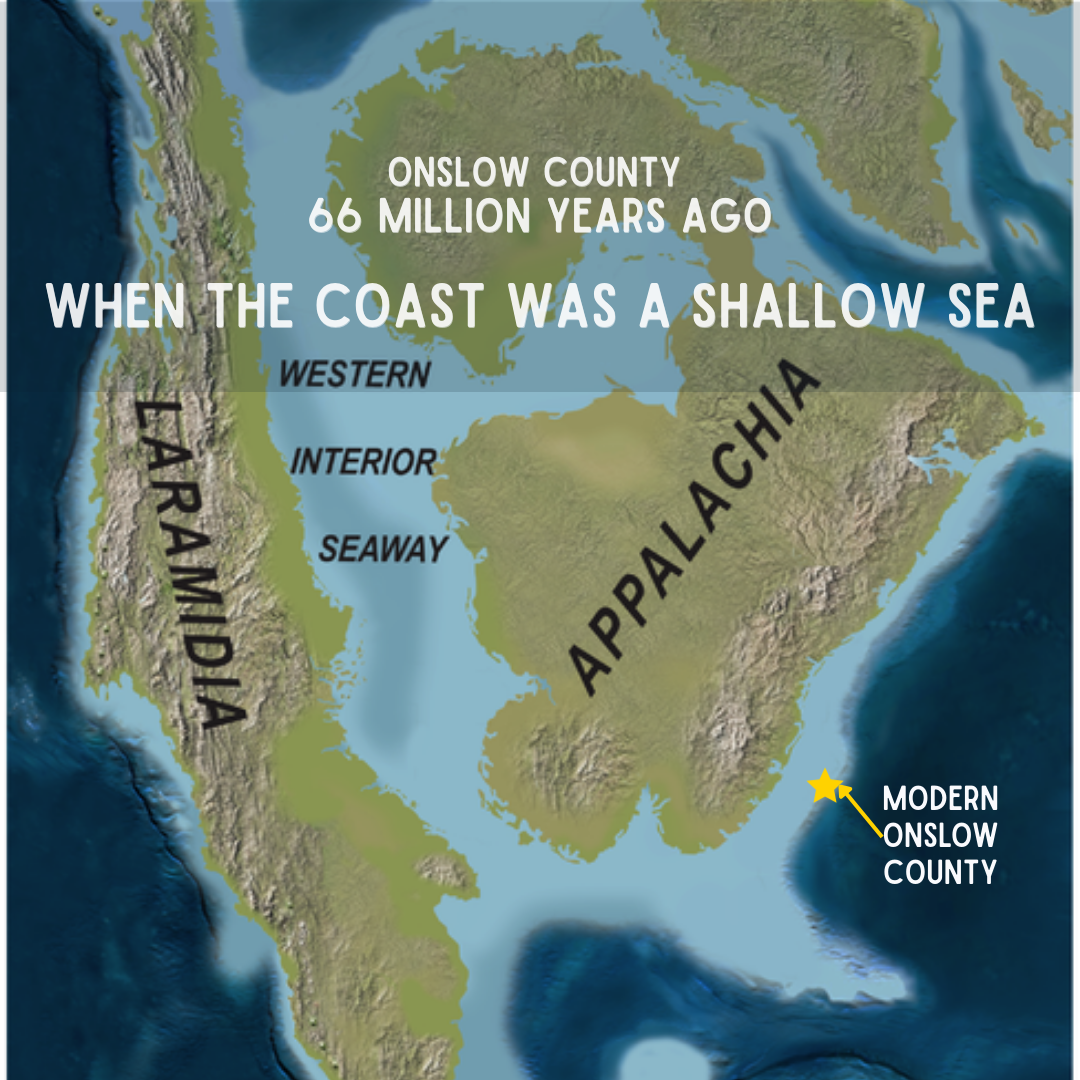
    Reconstruction of North America during the Late Cretaceous, when high global sea levels flooded large portions of the continent. Shallow epicontinental seas covered much of the interior and extended across the Atlantic Coastal Plain, submerging regions that would later become the southeastern United States.
Image credit: Illustration of Late Cretaceous North America showing the Western Interior Seaway. Adapted from U.S. Geological Survey educational materials.
    Reconstruction of North America during the Late Cretaceous, when high global sea levels flooded large portions of the continent. Shallow epicontinental seas covered much of the interior and extended across the Atlantic Coastal Plain, submerging regions that would later become the southeastern United States. |
    Image credit: Illustration of Late Cretaceous North America showing the Western Interior Seaway. Adapted from U.S. Geological Survey educational materials.

    Onslow County 66 million years ago looked nothing like it does today. If you could stand where the county sits at the end of the Cretaceous, there would be no ground beneath your feet. No marsh, no barrier islands, no inlet channels breathing with tide. The coastline lay far inland. Eastern North Carolina was submerged beneath a warm, shallow sea that stretched in a broad, quiet shelf from the continent toward an ocean still reorganizing after the breakup of Pangaea.

    If a human body could enter that sea, the first sensation would not be clarity but thickness. The water would feel warm and heavy against skin, dense with suspended life. Visibility would shorten to a green haze where light diffused instead of traveling cleanly. Through that haze, movement would register before shape: the passage of large animals built for a shelf no longer occupied by their kind — mosasaurs turning in slow arcs, plesiosaurs rising through layered water, sharks, already ancient, tracing patrol routes beneath them. Each body would displace the plankton-rich column, sending pressure outward. The ocean would feel less like empty space and more like a corridor constantly shared. Each movement would push through plankton-rich water that behaved less like modern surf and more like a living suspension, as if the ocean itself carried weight.

    The water would have been green with plankton, heavy with suspended carbonate, the kind of sea that builds geology slowly from drifting skeletons. There were no beaches yet because there was no edge — only a gradual transition from submerged coastal plain into open Atlantic. The sediments beneath modern Onslow County record this as stacked marine layers: sand, clay, marl, and chalky limestones built from microscopic shells settling through millions of seasons (Miller et al., 2005).

    This was not an empty sea. It was structured like a city.

    Reef communities rose from carbonate platforms. Ammonites spiraled through open water. Early teleost fishes filled midwater niches (Friedman, 2010; Near et al., 2013). Marine reptiles — mosasaurs and plesiosaurs — patrolled the upper food web. And sharks, already ancient by this point, occupied ecological roles recognizable even now: cruisers of the shelf, opportunists of the drop-off, specialists shaped by tooth and speed.

    The modern Atlantic Coastal Plain is the memory of that sea compressed into stone.

    Teeth as Geological Fossils

    Fossil tooth of the giant shark Otodus megalodon, found in the surf at Surf City, North Carolina. Teeth like this erode from Miocene and Pliocene marine sediments beneath the Atlantic Coastal Plain, remnants of an ocean that covered this region millions of years ago. | Photo credit: Alicia Sanders, 2025
    Fossil tooth of the giant shark, Otodus megalodon, found in the surf at Surf City, North Carolina. Teeth like this erode from Miocene and Pliocene marine sediments beneath the Atlantic Coastal Plain, remnants of an ocean that covered this region millions of years ago. | Photo credit: Alicia Sanders, 2025

    The shark teeth found along Onslow beaches are not simply remnants of animals; they are fragments of sedimentary history washing back to the surface. Rivers, storms, dredging, and shoreline erosion re-expose marine layers that were buried when sea level fell and the continent emerged. Each tooth has traveled twice: first through the animal that grew it, and later through millions of years of burial, erosion, and exposure.

    Many of the large triangular teeth people call “megalodon” are younger than the Cretaceous itself. The giant shark Otodus megalodon lived much later, during the Miocene and Pliocene, roughly 23 to 3.6 million years ago — a reminder that the Atlantic shelf has been a marine environment repeatedly across deep time (Pimiento & Balk, 2015). The reason both Cretaceous and Miocene fossils appear in the same coastal region is not contradiction but layering. Eastern North Carolina is a staircase of ancient seas, each episode leaving deposits that modern erosion cross-cuts and reveals.

    The shoreline acts like a rotating archive. Storms turn the pages.

    The Cretaceous: A Climate Without Ice

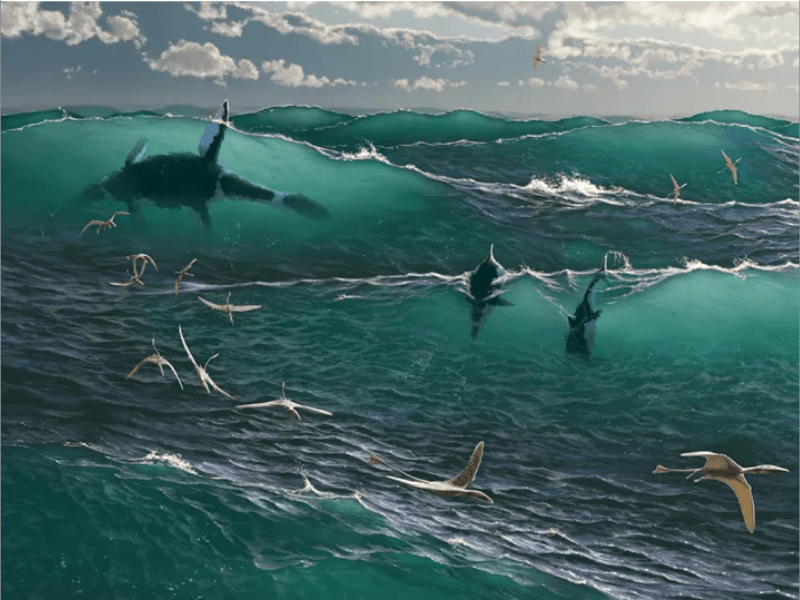
    Marine reptiles dominated ocean food webs during the Mesozoic Era, when dinosaurs ruled on land. Mosasaurs and other large predators hunted fish, ammonites, and other marine animals in the warm seas that covered much of North America. Illustration courtesy of the Smithsonian Institution
    Marine reptiles dominated ocean food webs during the Mesozoic Era, when dinosaurs ruled on land. Mosasaurs and other large predators hunted fish, ammonites, and other marine animals in the warm seas that covered much of North America. | Illustration credit: Smithsonian Institution

    The Cretaceous sea covering Onslow County existed in a greenhouse world. There were no polar ice caps. Global temperatures were higher. Sea levels stood among the highest in the last 500 million years. Warm currents circulated freely between basins, and the shallow epicontinental seas were engines of biodiversity (Hay, 2011).

    In such climates, coastal ecosystems functioned differently. Productivity was driven by ocean circulation and nutrient upwelling rather than the strong seasonal temperature swings that structure many modern coastal systems. Carbonate production accelerated. Marine food webs expanded vertically, filling ecological space with specialists. The shallow shelf that covered North Carolina would have been biologically dense — a continuous gradient from estuarine margins to open marine habitats, without the sharp land–sea boundary we recognize today.

    The modern Outer Banks, in this sense, are a recent invention. They are sand arranged by late-Quaternary sea-level oscillation. The deeper story of this coast is marine.

    Extinction as a Geological Boundary

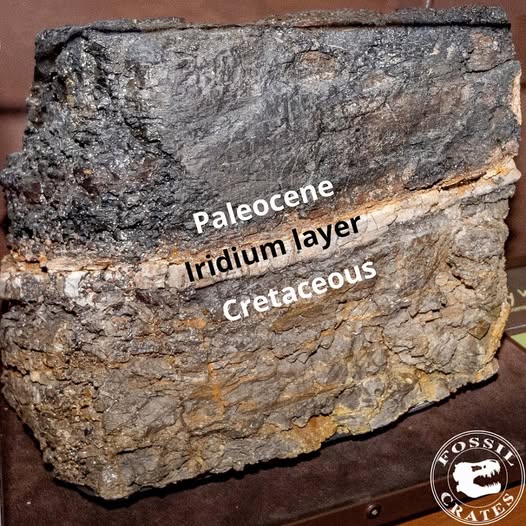
    At the end of the Cretaceous, about 66 million years ago, the asteroid impact now known as the Chicxulub event closed this chapter abruptly. Marine ecosystems did not vanish overnight; they reorganized under the cascading collapse of planktonic food webs (Schulte et al., 2010). The sedimentary record along the Atlantic margin preserves this boundary as a thin horizon enriched in iridium — a planetary fingerprint marking a moment when global systems reset.

    A rock sample showing the Cretaceous–Paleogene boundary, where a thin iridium-rich layer marks the global extinction event triggered by the Chicxulub asteroid impact about 66 million years ago. Specimen from Wyoming, displayed at the San Diego Natural History Museum.| Photo credit: Fossil Crates, 2022
    A rock sample showing the Cretaceous–Paleogene boundary, where a thin iridium-rich layer marks the global extinction event triggered by the Chicxulub asteroid impact about 66 million years ago. Specimen from Wyoming, displayed at the San Diego Natural History Museum.| Photo credit: Fossil Crates, 2022

    In the hundreds of thousands to millions of years that followed, ocean ecosystems slowly rebuilt (Schulte et al., 2010; Friedman, 2010). Plankton communities recovered first, allowing marine food webs to reassemble from the bottom upward.

    The sea that covered Onslow County withdrew gradually over the tens of millions of years following the Cretaceous–Paleogene boundary, not because of the impact alone, but because tectonics and climate redirected Earth’s balance of water and land. Through the Paleogene and into the Neogene, regression exposed portions of the Atlantic Coastal Plain. Rivers carved channels into former seabeds. Marshes colonized low ground. Much later, during the Pleistocene ice-age cycles beginning about 2.6 million years ago, barrier islands assembled from mobile sand as sea level rose and fell repeatedly.

    What we walk today is the lifted floor of a vanished ocean.

    During the late Cretaceous period, a mass extinction occurred that led to the extinction of dinosaurs, including many marine reptiles, | Visualization credit: Ian Webster, dinosaurpictures.org
    This interactive reconstruction shows how Earth’s continents shifted through deep time. At 66 million years ago, much of the Atlantic Coastal Plain—including modern eastern North Carolina—lay beneath a warm shallow sea. | Visualization credit: Ian Webster, dinosaurpictures.org

    Cretaceous Transition: After the Impact

    The end of the Cretaceous did not simply erase species; it reorganized the architecture of marine life. In the first several hundred thousand years after the Chicxulub impact, the collapse of plankton communities removed the base of food webs that had supported ammonites, many marine reptiles, and numerous large predatory fishes. Apex niches did not stay empty for long. During the early Paleogene, roughly 66 to 50 million years ago, sharks, teleost fishes, and early marine mammals diversified rapidly into the ecological space left behind (Schulte et al., 2010; Friedman, 2012).

    Reconstruction of marine life near the end of the Cretaceous Period, shortly before the Chicxulub asteroid impact triggered a global mass extinction about 66 million years ago. The event collapsed marine food webs and reshaped ocean ecosystems across the planet. Illustration: Smithsonian Institution
    Reconstruction of marine life near the end of the Cretaceous Period, shortly before the Chicxulub asteroid impact triggered a global mass extinction about 66 million years ago. The event collapsed marine food webs and reshaped ocean ecosystems across the planet. | Illustration: Smithsonian Institution

    In the aftermath, the shelf would not look empty at first glance but would feel altered, as large bodies that once displaced water in constant motion were absent, leaving the vertical space above the seafloor open, quieter, and less crowded. A swimmer would sense the difference not through sight alone but through the water’s stillness — fewer passing pressure waves and fewer shadows interrupting the light.

    In the shallow seas that once covered eastern North Carolina, this transition marked a shift from reptile-dominated predator guilds to fish- and shark-centered systems. Survivors tended to share traits that remain advantageous in modern estuaries: flexible diets, rapid reproduction, and tolerance for fluctuating conditions. The extinction boundary favored generalists over specialists, and lineages capable of exploiting disrupted ecosystems seeded the foundation of the modern Atlantic marine fauna.

    The Cretaceous sea did not end — it evolved under constraint.

    The Miocene: A Predator-Rich Shelf

    Over the tens of millions of years that followed the Paleogene recovery, marine ecosystems continued diversifying as continents drifted toward their modern positions and ocean circulation strengthened. By the Miocene, roughly 23 to 5 million years ago, the sea covering eastern North Carolina was not the same water body that drowned the Cretaceous coast. Continents had shifted. Currents reorganized. The Atlantic margin was beginning to resemble its modern geometry. What remained constant was the shelf: shallow, warm, nutrient-rich, and biologically crowded.

    The Miocene shelf was structured by productivity. Warm global climates intensified circulation patterns that mixed nutrients and supported dense prey fields. Where energy concentrates, ecosystems scale upward. Plankton blooms fueled vast schools of fish and squid that moved through the water column in shifting layers (Hay, 2012; Pimiento et al., 2016).

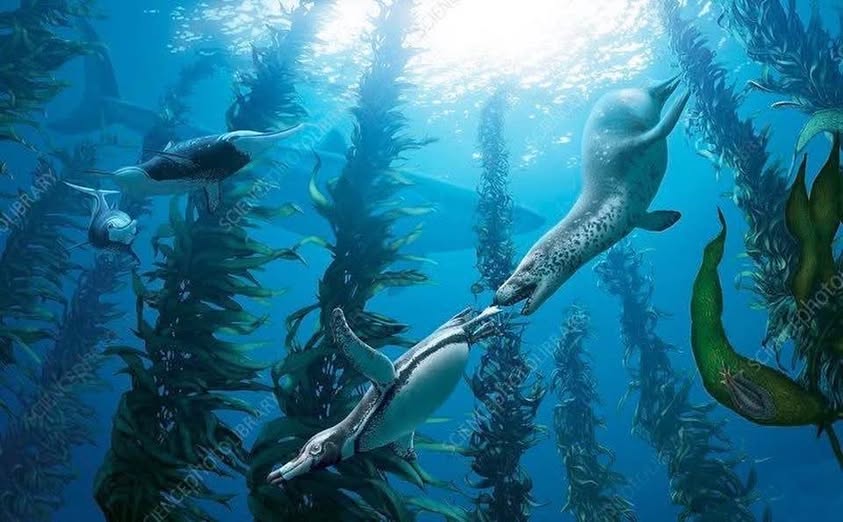
    Reconstruction of a Miocene marine ecosystem (~6 million years ago) featuring dolphins (Eurhinodelphis), a penguin (Spheniscus), the long-necked seal Acrophoca, and the giant shark Otodus megalodon. During the Miocene, the diversification of marine mammals supported some of the largest predators in ocean history. Artwork by Julius Csotonyi
    Reconstruction of a Miocene marine ecosystem (~6 million years ago) featuring dolphins (Eurhinodelphis), a penguin (Spheniscus), the long-necked seal Acrophoca, and the giant shark, Otodus megalodon. During the Miocene, the diversification of marine mammals supported some of the largest predators in ocean history. | Artwork by Julius Csotonyi

    This abundance supported a growing diversity of marine vertebrates (Pimiento et al., 2016). Whales diversified explosively: early baleen whales filtered plankton blooms that pulsed across the shelf, while toothed whales pursued schooling fish and squid, their passage shifting the light before their bodies came fully into view. Pinnipeds hauled out on emergent islands. Sea turtles nested along coastlines that advanced and retreated with slow tectonic breathing. Below that movement, sirenian grazers — ancestors of modern manatees — moved slowly through seagrass beds, shaping the shelf from the bottom while predators ruled above (Domning, 2001).

    To occupy that Miocene shelf as a small observer would be to feel scale in motion. Migrating whales and large predators would load the surrounding water with momentum before they arrived, a pressure you could feel before you could see its source. The shelf seemed to flex around movement, the water itself shaped by the animals traveling through it. The water carried that weight differently than in the Cretaceous — not the suspension of reptile-dominated seas, but the mass of mammals built for speed and scale.

    In ecosystems where prey concentrates and marine mammals flourish, apex predators inevitably emerge. In the Miocene Atlantic, that role belonged to the giant shark whose teeth still surface along North Carolina beaches: Otodus megalodon. Its immense size was not evolutionary extravagance but ecological arithmetic. A predator of that scale can exist only where the energy flowing through the system is great enough to sustain it (Pimiento et al., 2016).

    Sediments from Miocene deposits in the Atlantic Coastal Plain preserve a fossil record dominated by marine vertebrates. These fossils accumulate in the same geological staircase as older layers, which is why storms today liberate teeth from multiple epochs simultaneously. The shoreline is a cross-section through predator history.

    Megalodon disappears near the Pliocene boundary, likely a casualty of ecological restructuring — shrinking nursery habitat, prey redistribution, and competition from emerging marine mammals (Pimiento & Clements, 2014). The predator city did not vanish; it reorganized.

    The Pleistocene: Ice, Sand, and a Moving Coast (~2.6 million – 11,700 years ago)

    During glacial low stands, standing on the exposed shelf would produce a disorienting absence. Wind would move across ground that remembered being ocean. The surface would hold the texture of former seabed — compacted, rippled, cut by channels where rivers extended into newly revealed terrain. Air would replace water pressure, but the land would still read as marine, a coastline temporarily paused in withdrawal.

    The Pleistocene introduced a rhythm that still governs the modern coastline: glacial cycling. Ice sheets expanded and retreated dozens of times, locking ocean water onto continents and then releasing it. Each cycle shifted sea level by tens of meters. Eastern North Carolina repeatedly alternated between exposed coastal plain and submerged shelf (Lambeck et al., 2014).

    When sea levels fell, rivers carved deeply into former seabeds, cutting channels that later became estuaries, while rising seas flooded those valleys again, redistributing sand along migrating shorelines as barrier islands assembled from sediment sorted into long, mobile ridges by waves and currents (Riggs et al., 1995; Riggs et al., 2020).

    Reconstruction of a shallow coastal ecosystem similar to those that developed along the Atlantic Coastal Plain as sea levels stabilized after the Ice Age. Seagrass beds, shellfish, fishes, turtles, and marine mammals formed the foundation of the modern estuarine communities that now define the Carolina coast. Painting by Michael Rothman, Florida Museum of Natural History.
    Reconstruction of a shallow coastal ecosystem similar to those that developed along the Atlantic Coastal Plain as sea levels stabilized after the Ice Age. Seagrass beds, shellfish, fishes, turtles, and marine mammals formed the foundation of the modern estuarine communities that now define the Carolina coast. | Painting by Michael Rothman, Florida Museum of Natural History.

    The coast stopped being a static shelf and became a machine in motion, and Pleistocene ecosystems were shaped by that instability as species adapted to shifting salinity, temperature, and shoreline position. Many cold-adapted megafauna disappeared or shifted poleward, while warm-temperate estuarine assemblages consolidated in their place.

    The ecological winners were organisms capable of building habitat: marsh grasses trapping sediment, oysters engineering reefs, and filter feeders clarifying water. Those assemblages increasingly resembled the modern Atlantic shelf, with drum, croaker, and mullet occupying estuarine corridors carved by drowned rivers while rays and small coastal sharks patrolled nursery shallows. Oyster reefs rose in dense clusters, and early marsh communities anchored sediment with grasses similar to those that now define the Carolina coastline.

    The emerging system favored species tolerant of fluctuation — animals able to move with the shoreline rather than resist it — as cooling climates and destabilized coasts increasingly selected for flexibility over scale, replacing the giants of the Miocene shelf with communities built for movement rather than permanence.

    The modern Onslow estuary is therefore a recent equilibrium layered atop instability.

    Pleistocene Transition: From Ice Age Coast to Modern Estuary

    Shifts in the eastern North American coastline from the Last Glacial Maximum (~20,000 years ago) to the present. During the Ice Age, much of the continental shelf was exposed land. As glaciers melted and sea level rose, coastal rivers flooded and estuaries formed, creating the modern Atlantic Coastal Plain shoreline.| Illustration credit: USGS, Water Science School
    Shifts in the eastern North American coastline from the Last Glacial Maximum (~20,000 years ago) to the present. During the Ice Age, much of the continental shelf was exposed land. As glaciers melted and sea level rose, coastal rivers flooded and estuaries formed, creating the modern Atlantic Coastal Plain shoreline.| Illustration credit: USGS, Water Science School

    The close of the Pleistocene did not feature a single catastrophic boundary but a climatic stabilization. As the last major ice sheets retreated about 11,700 years ago, sea level rose rapidly and then slowed. Coastlines stopped migrating at glacial speed. Estuaries stabilized long enough for persistent marsh systems to develop. Oyster reefs expanded. Seagrass beds colonized shallow bays (Lambeck et al., 2014; Kennett & Shackleton, 1975).

    The organisms that dominate modern estuaries are ecosystem engineers. They do not simply inhabit the coast — they build it.

    What appears ancient in the marsh is, in geological terms, newly assembled.

    Survivors in Motion: Sharks and Teleost Continuity

    Standing in modern surf, that continuity is still tactile. The water along the shelf carries suspended sand and organic haze, softening visibility to a few body lengths. Something large can pass nearby without breaking the surface, announced only by a shift in current or a vibration through the feet. The present ocean feels busy in the same quiet way ancient shelves must have felt — full of motion just beyond clear sight. The modern shelf feels lighter, but not empty. The water still carries motion long before form appears, transmitting the passage of sandbar sharks, blacktips, and schooling menhaden through vibration rather than sight. The weight is subtler now — distributed across smaller bodies, faster cycles, suspended sand and organic haze — yet the sensation remains – a medium that remembers being crowded.

    The most striking feature of the Atlantic shelf is not how much has changed, but how much has endured. Sharks were already ancient when the Cretaceous sea covered this region, their lineage extending back more than 400 million years (Ebert et al., 2021).

    Ancient oceans and modern seas share the same ecological architecture. Slide to compare a Late Cretaceous shark community with a modern marine ecosystem. While species have changed across millions of years, sharks and teleost fishes continue to occupy many of the same roles within ocean food webs. | Left image: Late Cretaceous marine assemblage Ancient oceans and modern seas share the same ecological architecture. Slide to compare a Late Cretaceous shark community with a modern marine ecosystem. While species have changed across millions of years, sharks and teleost fishes continue to occupy many of the same roles within ocean food webs. | Left image: Late Cretaceous marine assemblage
    Ancient oceans and modern seas share the same ecological architecture. Slide to compare a Late Cretaceous shark community with a modern marine ecosystem. While species have changed across millions of years, sharks and teleost fishes continue to occupy many of the same roles within ocean food webs. | Left image: Late Cretaceous marine assemblage

    Modern coastal sharks reflect this inheritance, with sandbars, blacktips, bonnetheads, and dogfish representing lineages refined through repeated ecological resets (Ebert et al., 2005). Teleost fishes tell a parallel story: after the end-Cretaceous extinction, they diversified explosively, filling feeding niches that define modern marine communities (Friedman, 2010).

    Species change across epochs, but functional roles persist, and the system remembers its architecture even when its cast rotates. The sharks offshore now are not echoes of a lost world; they are its direct continuation.

    The Coast as a Layered Archive

    Shell fragments scattered across the shoreline near Surf City, North Carolina. Each tide exposes pieces of past marine life, reminders that the modern coast sits atop layers of older oceans and ecosystems.| Photo credit: Tom’s Teeth, 2019
    Shell fragments scattered across the shoreline near Surf City, North Carolina. Each tide exposes pieces of past marine life, reminders that the modern coast sits atop layers of older oceans and ecosystems.| Photo credit: Tom’s Teeth, 2019

    When a fossil tooth surfaces in the surf along the Onslow County coast, it is not emerging from a single time but from stacked histories compressed beneath the modern shoreline. Cretaceous seas. Miocene predator guilds. Pleistocene shorelines advancing and retreating with ice age pulses. Each episode writes a layer. Storm energy and human dredging occasionally cut into those layers, returning fragments to circulation.

    This is why the coast feels haunted by deep time. The sediment is not just sand; it is a palimpsest of ecosystems.

    The sharks that swim offshore now — sandbars, blacktips, bonnetheads — are heirs to lineages that survived the extinction boundary and adapted through cycles of climate and geography. Their teeth will enter the archive in turn. Millions of years from now, another shoreline will release them, and a different species will walk a beach made from our present seafloor.

    The coast is not a place fixed in space. It is a moving edge between worlds, carrying memory forward grain by grain.

    References

    Domning, D. P. (2001). The earliest known fully quadrupedal sirenian. Nature, 413(6856), 625-627. https://doi.org/10.1038/35098072

    Ebert, D. A., Dando, M., & Fowler, S. (2021). Sharks of the world: A complete guide. Princeton University Press.

    Friedman, M. (2010). Explosive morphological diversification of spiny-finned teleost fishes in the aftermath of the end-Cretaceous extinction. Proceedings of the Royal Society B: Biological Sciences, 277(1688), 1675-1683. https://doi.org/10.1098/rspb.2009.2177

    Hay, W. W. (2012). Experimenting on a small planet: A scholarly entertainment (1st ed.). Springer Science & Business Media.

    Kennett, J. P., & Shackleton, N. J. (1975). Laurentide ice sheet Meltwater recorded in Gulf of Mexico deep-sea cores. Science, 188(4184), 147-150. https://doi.org/10.1126/science.188.4184.147

    Lambeck, K., Rouby, H., Purcell, A., Sun, Y., & Sambridge, M. (2014). Sea level and global ice volumes from the last glacial maximum to the Holocene. Proceedings of the National Academy of Sciences, 111(43), 15296-15303. https://doi.org/10.1073/pnas.1411762111

    Miller, K. G., Kominz, M. A., Browning, J. V., Wright, J. D., Mountain, G. S., Katz, M. E., Sugarman, P. J., Cramer, B. S., Christie-Blick, N., & Pekar, S. F. (2005). The Phanerozoic record of global sea-level change. Science, 310(5752), 1293-1298. https://doi.org/10.1126/science.1116412

    Near, T. J., Dornburg, A., Eytan, R. I., Keck, B. P., Smith, W. L., Kuhn, K. L., Moore, J. A., Price, S. A., Burbrink, F. T., Friedman, M., & Wainwright, P. C. (2013). Phylogeny and tempo of diversification in the superradiation of spiny-rayed fishes. Proceedings of the National Academy of Sciences, 110(31), 12738-12743. https://doi.org/10.1073/pnas.1304661110

    Pimiento, C., Balk, M., & Celements, C. (2014). Reconstructing the extinction of the giant Megalodon shark (Carcharcoles Megalodon). The Paleontological Society Special Publications, 13, 52-52. https://doi.org/10.1017/s2475262200011102

    Pimiento, C., & Balk, M. A. (2015). Body-size trends of the extinct giant shark Carcharocles megalodon : A deep-time perspective on marine APEX predators. Paleobiology, 41(3), 479-490. https://doi.org/10.1017/pab.2015.16

    Pimiento, C., & Clements, C. F. (2014). When did Carcharocles megalodon become extinct? A new analysis of the fossil record. PLoS ONE, 9(10), e111086. https://doi.org/10.1371/journal.pone.0111086

    Pimiento, C., MacFadden, B. J., Clements, C. F., Varela, S., Jaramillo, C., Velez‐Juarbe, J., & 

    Silliman, B. R. (2016). Geographical distribution patterns of Carcharocles megalodon over time reveal clues about extinction mechanisms. Journal of Biogeography, 43(8), 1645-1655. https://doi.org/10.1111/jbi.12754

    Riggs, S. R., Ames, D. V., Culver, S. J., & Mallinson, D. J. (2020). The battle for North Carolina’s coast: Evolutionary history, present crisis, and vision for the future.

    Riggs, S. R., Cleary, W. J., & Snyder, S. W. (1995). Influence of inherited geologic framework on barrier shoreface morphology and dynamics. Marine Geology, 126(1-4), 213-234. https://doi.org/10.1016/0025-3227(95)00079-e

    Schulte, P., Alegret, L., Arenillas, I., Arz, J., Barton, P. J., Brown, P. R., Bralower, T. J., Christeson, G. L., Claeys, P., & Willumsen, P. S. (2010). The Chicxulub Asteroid Impact and Mass Extinction at the Cretaceous-Paleogene Boundary. Science, 327(5970), 1214-1218. https://www.science.org/doi/10.1126/science.1177265

  • Winter at the Exposed Marsh

    Winter at the Exposed Marsh

    The surface that appears

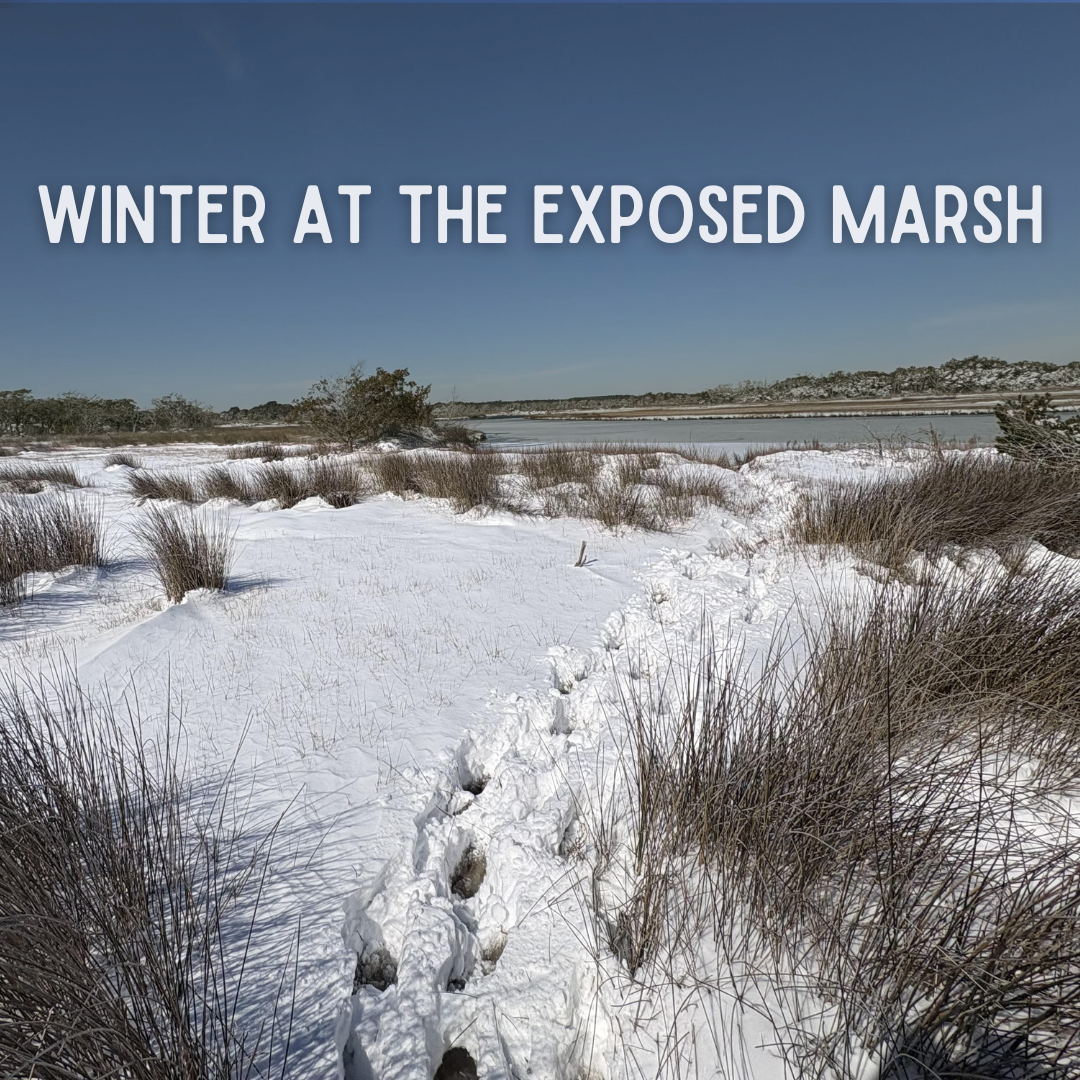
    At low tide in winter the creek mouths behind Topsail Island widen into ground that is usually concealed, and the exposed marsh does not appear emptied so much as translated into another state where water has thinned into channels narrow enough to reveal the structure it normally masks. The flats emerge as a textured plane stitched by the remains of Spartina alterniflora, each stem cluster surrounded by a faint collar of darker mud where drainage lags by seconds, and the surface separates into alternating bands that hold or soften depending on how recently porewater escaped. This firmness reflects sediment consolidation, the gradual compression of mud as water drains between tides, tightening elevated shelves first and leaving adjacent troughs saturated, so the exposed ground becomes a map of load-bearing ridges that anticipates where larger animals will move once the marsh opens (Christiansen et al., 2000; Morris et al., 2002).

    Close to the surface, winter resolves into finer evidence that the marsh is neither dormant nor still. Fiddler crab chimneys crumble into damp grains that expose darker sediment beneath a thin crust, while hoofprints from the previous tide hold shallow mirrors rimmed with frost where a faint olive sheen gathers as diatoms trap warmth and moisture (Underwood & Kromkamp, 1999). Beside the prints, spirals of fine sediment rise like coiled handwriting, polychaete casts lifted from below and dried into granular ridges that record upward movement from buried layers. Every centimeter of mud registers exchange between subsurface metabolism and cold air, and the exposed flats behave less like the absence of water than a temporary reorganization of it, one that prepares a surface already structured for the next set of crossings.

    Clusters of crab burrow openings mark the marsh surface, each hole a vertical conduit linking oxygen, water, and nutrients to the sediment below. | Photo credit: M. Mitchell, 2026
    Clusters of crab burrow openings mark the marsh surface, each hole a vertical conduit linking oxygen, water, and nutrients to the sediment below. | Photo credit: M. Mitchell, 2026

    Where winter concentrates energy

    The winter low tide exposes more than terrain, because the withdrawal of water aligns accessibility with abundance in a way that concentrates food at the surface for a brief interval. Spartina rhizomes lie just beneath the crust, their pale ends visible where deer have bitten through the mud, and detached stems gather in wrack lines where microbial films soften fibrous blades into digestible pulp. Small bivalves remain gaping in shallow pools where temperature lingers above the surrounding flats, and worm casts cluster where organic matter has settled densely enough to support continuous feeding below. This alignment functions as a resource pulse, a moment when energy stored in buried plant tissue and invertebrate biomass becomes reachable simultaneously.

    Winter at the exposed marsh coastal salt marsh
    Wrack concentrated by winter tides stores organic energy in dense bands, drawing shorebirds to feed where nutrients accumulate along the marsh edge. | Photo credit: American Birding Association

    Deer enter the marsh along consolidated ridges that hold their weight, yet the crossings do not run straight through these zones of exposure but instead loop and return around feeding sites where sediment has been churned darker than its surroundings. The mud at these points holds fragments of torn rhizomes pressed into its surface and shredded plant fibers mixed into the crust, while overlapping tracks form shallow basins that later fill with water and preserve the geometry of the feeding circuit. Raccoon prints braid across the same lines, Canada goose droppings mark cropped stems, and dunlin and greater yellowlegs settle repeatedly where the surface softens under pressure, their bills puncturing the crust in arcs that echo the paths carved by hooves. Exposure redistributes energy upward, and movement gathers along the same ridges that consolidation established, tying feeding to structure without separating the two processes.

    The skin that reforms

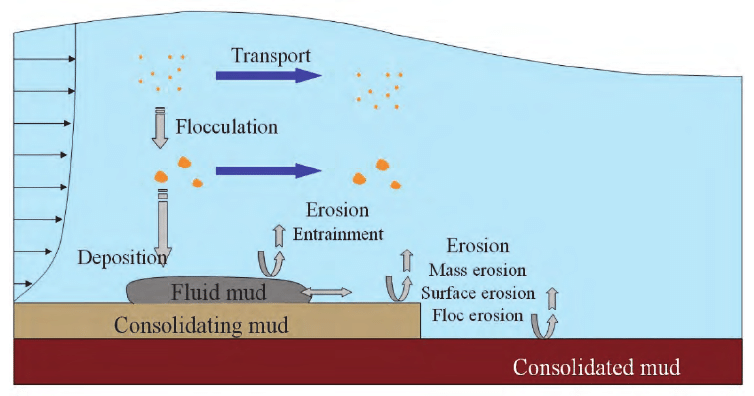
    Cross-section of marsh sediment showing deposition, erosion, and consolidation, the shifting layers that form and reform the exposed winter surface. | Graphic credit: G. S. Sylvain, 2011
    Cross-section of marsh sediment showing deposition, erosion, and consolidation, the shifting layers that form and reform the exposed winter surface. | Graphic credit: G. S. Sylvain, 2011

    Between exposures, slack water leaves a thin veneer that dries into a continuous surface film through sediment sealing, a layer fine enough to slow the exchange of gases between air and mud (Christiansen et al., 2000). When intact, the flats dull into a flexible sheet that bends faintly under weight, and breaking it releases a muted sulfur odor that signals redox cycling, the shift between oxygenated and oxygen-poor states driven by microbial respiration in buried sediment (Howarth & Teal, 1979; Mendelssohn et al., 1981). Color reveals the chemistry more reliably than smell. Black veins branch through exposed mud where iron binds sulfide, while pale halos surround Spartina roots where oxygen leaks downward along living tissues.

    Each footprint becomes an aperture in this membrane, allowing oxygen to enter and reduced compounds to rise, so the breach brightens temporarily before darkening again as metabolism rebalances. Feeding animals convert chemical gradients into visible patterns, and the flats accumulate a shifting mosaic of sealed and reopened zones that migrate with every tide, ensuring that the next exposure inherits the chemical memory of the previous one.

    Tracks fracture the sealed winter crust, revealing darker sediment where oxygen re-enters and the surface begins to reform. | Photo Credit: M. Gold, 2023
    Tracks fracture the sealed winter crust, revealing darker sediment where oxygen re-enters and the surface begins to reform. | Photo Credit: M. Gold, 2023

    The ground below the ground

    Beneath the crust, the sediment continues to reorganize through bioturbation, the mixing of mud by infaunal animals whose activity does not cease with falling temperature. Polychaete worms thread galleries through the upper layers, lifting sediment to the surface in tight spirals while their burrows act as ventilation shafts through burrow ventilation, drawing oxygen downward and leaking reduced porewater upward (Kristensen, 2000; Aller, 1982). Small bivalves pump water through siphons that leave paired pinholes scattered across the flats, and amphipods graze biofilms coating the worm casts, linking subsurface feeding to surface texture.

    Each round of burrowing lifts buried debris and nutrients toward the surface, making crab tunnels pathways that continually rebuild the marsh from below. | Graphic credit: Wang et al., 2010
    Each round of burrowing lifts buried debris and nutrients toward the surface, making crab tunnels pathways that continually rebuild the marsh from below. | Graphic credit: Wang et al., 2010

    Where deer cross and feed, hooves collapse some tunnels while sealing others, producing prints that darken unevenly because subsurface architecture differs from step to step. The feeding circuits therefore overlay hidden engineering that maintains permeability and redistributes nutrients, ensuring that exposure, grazing, and burrowing operate as one continuous process rather than as isolated events separated by layers of mud.

    Smell in shallow water

    Disturbed sediment releases dissolved compounds that spread through shallow pools as porewater plumes, chemical gradients that extend beyond the visible cloud of suspended mud. Killifish and juvenile mullet navigate these gradients through chemoreception, keeping their snouts close to the surface while pivoting toward intensifying scent (Kneib, 1997; Kristensen, 2000). Their feeding loosens additional sediment and amplifies the plume before particles settle again, creating a moving field of chemical information that overlaps with the physical contours of the flats.

    What appears from above as a brief swirl becomes a signal that attracts birds, and dunlin and yellowlegs converge on fresh pits where worms remain exposed. Each crater fills with water and darkens as sulfide seeps upward, and feeding layers stack in sequence so that invertebrate disturbance leads to fish excavation, which leads to avian probing, all anchored to the same exposure that first drew deer into the marsh. Leaning close reveals faint popping as methane and carbon dioxide escape through gas ebullition, ticking upward from saturated sediment while animals feed across the surface. The marsh ventilates audibly, and the sound marks exchange continuing beneath apparent stillness.

    As the tide withdraws, exposed mud concentrates scent and invertebrates near the surface, guiding shorebirds to feeding zones written into the sediment. | Photo credit: Ron Watts
    As the tide withdraws, exposed mud concentrates scent and invertebrates near the surface, guiding shorebirds to feeding zones written into the sediment. | Photo credit: Ron Watts

    Memory in the surface

    Winter tides and storms deposit sediment that raises the marsh through vertical accretion, stacking particles in increments small enough to disappear into the surface unless read over time (Morris et al., 2002). Hurricane overwash leaves thin sand sheets that redirect drainage for months, oyster clusters trap suspended grains in their lee (Newell et al., 2005), and worm burrows stabilize some deposits while loosening others (Kirwan & Megonigal, 2013). Feeding compresses ridges and excavation softens troughs, embedding each disturbance into the next layer so that the flats carry a structural memory of their own use.

    Returning after weeks reveals crossings shifted, wrack lines buried, and worm casts clustered in new zones, evidence that the marsh does not reset between exposures but accumulates the imprint of repeated winter engineering.

    Winters that change

    Warmer temperatures extend microbial activity through temperature-driven metabolic acceleration, thinning the interval between sealing and decay and allowing chemical gradients to persist longer at the surface (Bridgham et al., 2006). Rising water levels narrow exposure windows, stronger storms redistribute sediment in thicker pulses, and shifting coastal currents alter nutrient delivery and larval supply, influencing which species occupy the winter flats (Kirwan & Megonigal, 2013). The marsh continues to open, yet the rhythm of exposure recalibrates, and feeding circuits migrate toward higher shelves where consolidation still holds.

    Chemical plumes stretch farther in warmer water, grazing concentrates into narrower bands, and the same negotiations between structure and feeding repeat under altered timing, ensuring that winter engineering continues without preserving its previous schedule.

    Seasonal temperature outlook showing shifting winter probabilities across the southeastern United States, a regional signal that filters down to marsh-level processes. | NOAA - National Weather Service, 2026
    Seasonal temperature outlook showing shifting winter probabilities across the southeastern United States, a regional signal that filters down to marsh-level processes. | NOAA – National Weather Service, 2026

    The surface in motion

    The creek mouth appears quiet until attention lowers to the scale of sediment. Frost melts along print rims before surrounding crust warms, gas ticks upward through worm tubes, fish pits refill, and diatoms bloom where warmth collects. Each tide writes another layer into a system held in dynamic equilibrium, continuous adjustment that maintains form while never remaining fixed (Morris et al., 2002). Exposure leads to feeding, feeding reshapes structure, and structure governs the next exposure as the marsh opens again.

    The same ridges that hold a deer’s weight will soften again when the tide returns, and the feeding circuits traced across them will dissolve into channels that redistribute the next layer of sediment. Worm burrows will reopen where hooves sealed them, chemical plumes will reassemble in newly flooded pools, and the surface will carry forward the imprint of this exposure into the next one. Winter does not suspend the marsh. It recalculates it at a slower tempo, redistributing energy across the same structures that will support spring growth and summer density, so that even in the coldest intervals the creek mouth continues its quiet accounting of exchange, preparing another surface that will open and be read again.

    Deer cross the marsh to reach winter feeding exposed by the tide, moving along corridors that appear only when the surface opens. | Photo credit: L. W. Hamilton, 2025
    Deer cross the marsh to reach winter feeding exposed by the tide, moving along corridors that appear only when the surface opens. | Photo credit: L. W. Hamilton, 2025

    References

    Aller, R. C. (1982). The effects of Macrobenthos on chemical properties of marine sediment and overlying water. Topics in Geobiology, 53-102. https://doi.org/10.1007/978-1-4757-1317-6_2

    Bridgham, S. D., Megonigal, J. P., Keller, J. K., Bliss, N. B., & Trettin, C. (2006). The carbon balance of North American wetlands. Wetlands, 26(4), 889-916. https://doi.org/10.1672/0277-5212(2006)26[889:tcbona]2.0.co;2

    Christiansen, T., Wiberg, P., & Milligan, T. (2000). Flow and sediment transport on a tidal salt marsh surface. Estuarine, Coastal and Shelf Science, 50(3), 315-331. https://doi.org/10.1006/ecss.2000.0548

    Howarth, R. W., & Teal, J. M. (1979). Sulfate reduction in a New England salt marsh1. Limnology and Oceanography, 24(6), 999-1013. https://doi.org/10.4319/lo.1979.24.6.0999

    Kirwan, M. L., & Megonigal, J. P. (2013). Tidal wetland stability in the face of human impacts and sea-level rise. Nature, 504(7478), 53-60. https://doi.org/10.1038/nature12856

    Kneib, R. T. (1997). The role of tidal marshes in the ecology of estuarine nekton. Oceanography And Marine Biology, 35(35), 159-216. https://doi.org/10.1201/b12590-5

    Kristensen, E. (2000). Organic matter diagenesis at the oxic/anoxic interface in coastal marine sediments, with emphasis on the role of burrowing animals. Hydrobiologia, 426(1), 1-24. https://doi.org/10.1023/a:1003980226194

    Mendelssohn, I. A., McKee, K. L., & Patrick, W. H. (1981). Oxygen deficiency in Spartina alterniflora roots: Metabolic adaptation to anoxia. Science, 214(4519), 439-441. https://doi.org/10.1126/science.214.4519.439

    Morris, J. T., Sundareshwar, P. V., Nietch, C. T., Kjerfve, B., & Cahoon, D. R. (2002). Responses of coastal wetlands to rising sea level. Ecology, 83(10), 2869. https://doi.org/10.2307/3072022

    Newell, R. I., Fisher, T. R., Holyoke, R. R., & Cornwell, J. C. (2005). Influence of eastern oysters on nitrogen and phosphorus regeneration in Chesapeake Bay, USA. NATO Science Series IV: Earth and Environmental Series, 282, 93-120. https://doi.org/10.1007/1-4020-3030-4_6

    Underwood, G., & Kromkamp, J. (1999). Primary production by phytoplankton and Microphytobenthos in estuaries. Advances in Ecological Research, 29, 93-153. https://doi.org/10.1016/s0065-2504(08)60192-0