Onslow County 66 Million Years Ago: Before the Coastline Existed
Today, the shoreline of Onslow County forms part of the Atlantic Coastal Plain — a broad, low landscape stretching from New Jersey to Florida (Riggs et al., 2020). Marshes, barrier islands, and estuaries define the modern coast, shaped by tides, storms, and the slow migration of sand (Riggs et al., 1995; Riggs et al., 2020). But the ground beneath those systems records a far older history. Long before marsh grass rooted the shoreline or barrier islands assembled offshore, this region lay beneath a shallow sea.

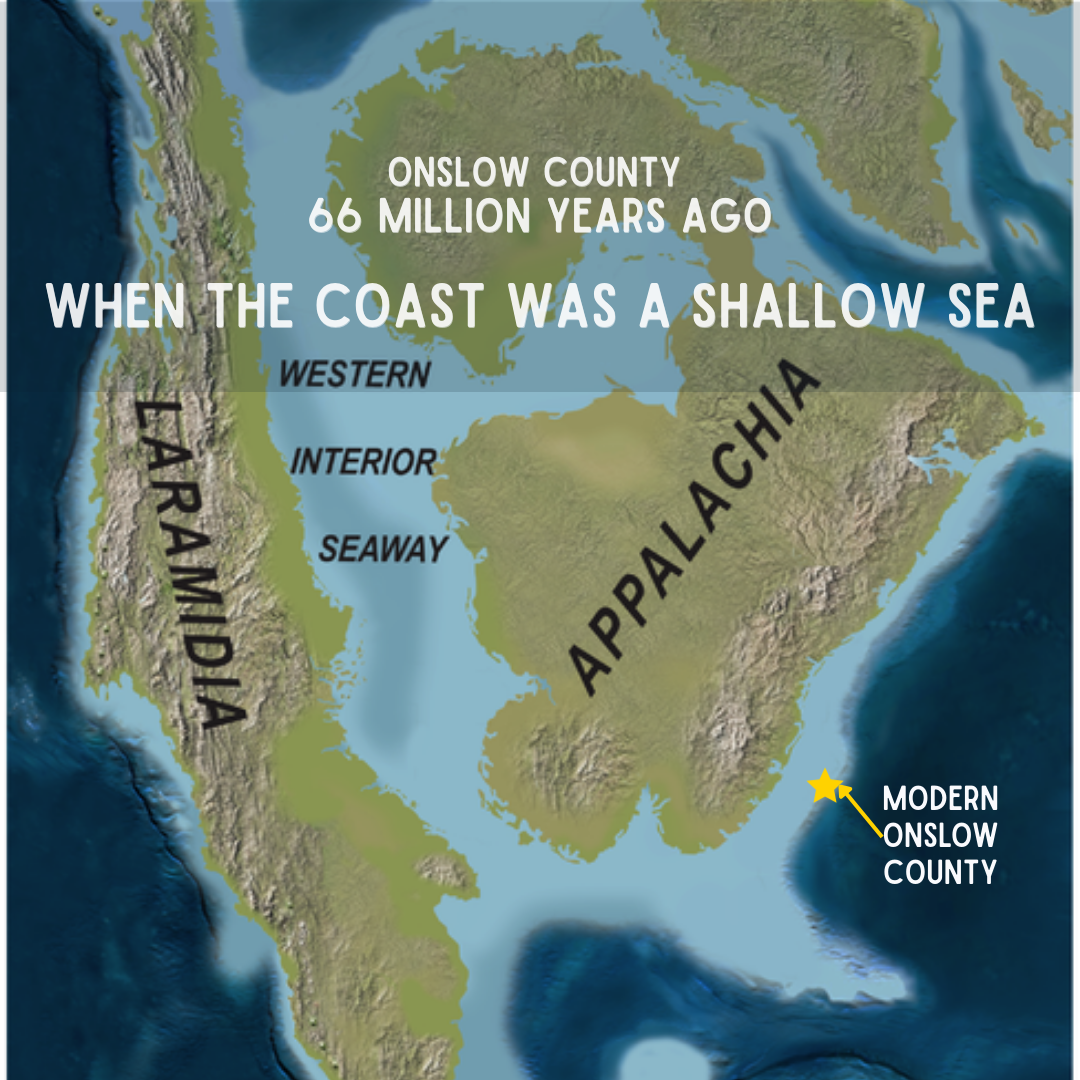
Image credit: Illustration of Late Cretaceous North America showing the Western Interior Seaway. Adapted from U.S. Geological Survey educational materials.
Onslow County 66 million years ago looked nothing like it does today. If you could stand where the county sits at the end of the Cretaceous, there would be no ground beneath your feet. No marsh, no barrier islands, no inlet channels breathing with tide. The coastline lay far inland. Eastern North Carolina was submerged beneath a warm, shallow sea that stretched in a broad, quiet shelf from the continent toward an ocean still reorganizing after the breakup of Pangaea.
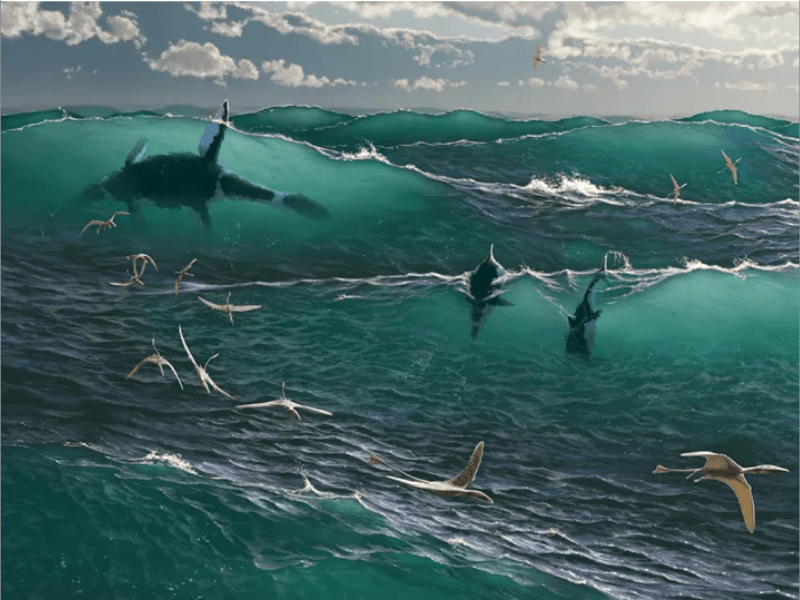
If a human body could enter that sea, the first sensation would not be clarity but thickness. The water would feel warm and heavy against skin, dense with suspended life. Visibility would shorten to a green haze where light diffused instead of traveling cleanly. Through that haze, movement would register before shape: the passage of large animals built for a shelf no longer occupied by their kind — mosasaurs turning in slow arcs, plesiosaurs rising through layered water, sharks, already ancient, tracing patrol routes beneath them. Each body would displace the plankton-rich column, sending pressure outward. The ocean would feel less like empty space and more like a corridor constantly shared. Each movement would push through plankton-rich water that behaved less like modern surf and more like a living suspension, as if the ocean itself carried weight.
The water would have been green with plankton, heavy with suspended carbonate, the kind of sea that builds geology slowly from drifting skeletons. There were no beaches yet because there was no edge — only a gradual transition from submerged coastal plain into open Atlantic. The sediments beneath modern Onslow County record this as stacked marine layers: sand, clay, marl, and chalky limestones built from microscopic shells settling through millions of seasons (Miller et al., 2005).
This was not an empty sea. It was structured like a city.
Reef communities rose from carbonate platforms. Ammonites spiraled through open water. Early teleost fishes filled midwater niches (Friedman, 2010; Near et al., 2013). Marine reptiles — mosasaurs and plesiosaurs — patrolled the upper food web. And sharks, already ancient by this point, occupied ecological roles recognizable even now: cruisers of the shelf, opportunists of the drop-off, specialists shaped by tooth and speed.
The modern Atlantic Coastal Plain is the memory of that sea compressed into stone.
Teeth as Geological Fossils

The shark teeth found along Onslow beaches are not simply remnants of animals; they are fragments of sedimentary history washing back to the surface. Rivers, storms, dredging, and shoreline erosion re-expose marine layers that were buried when sea level fell and the continent emerged. Each tooth has traveled twice: first through the animal that grew it, and later through millions of years of burial, erosion, and exposure.
Many of the large triangular teeth people call “megalodon” are younger than the Cretaceous itself. The giant shark Otodus megalodon lived much later, during the Miocene and Pliocene, roughly 23 to 3.6 million years ago — a reminder that the Atlantic shelf has been a marine environment repeatedly across deep time (Pimiento & Balk, 2015). The reason both Cretaceous and Miocene fossils appear in the same coastal region is not contradiction but layering. Eastern North Carolina is a staircase of ancient seas, each episode leaving deposits that modern erosion cross-cuts and reveals.
The shoreline acts like a rotating archive. Storms turn the pages.
The Cretaceous: A Climate Without Ice
The Cretaceous sea covering Onslow County existed in a greenhouse world. There were no polar ice caps. Global temperatures were higher. Sea levels stood among the highest in the last 500 million years. Warm currents circulated freely between basins, and the shallow epicontinental seas were engines of biodiversity (Hay, 2011).
In such climates, coastal ecosystems functioned differently. Productivity was driven by ocean circulation and nutrient upwelling rather than the strong seasonal temperature swings that structure many modern coastal systems. Carbonate production accelerated. Marine food webs expanded vertically, filling ecological space with specialists. The shallow shelf that covered North Carolina would have been biologically dense — a continuous gradient from estuarine margins to open marine habitats, without the sharp land–sea boundary we recognize today.
The modern Outer Banks, in this sense, are a recent invention. They are sand arranged by late-Quaternary sea-level oscillation. The deeper story of this coast is marine.
Extinction as a Geological Boundary
At the end of the Cretaceous, about 66 million years ago, the asteroid impact now known as the Chicxulub event closed this chapter abruptly. Marine ecosystems did not vanish overnight; they reorganized under the cascading collapse of planktonic food webs (Schulte et al., 2010). The sedimentary record along the Atlantic margin preserves this boundary as a thin horizon enriched in iridium — a planetary fingerprint marking a moment when global systems reset.
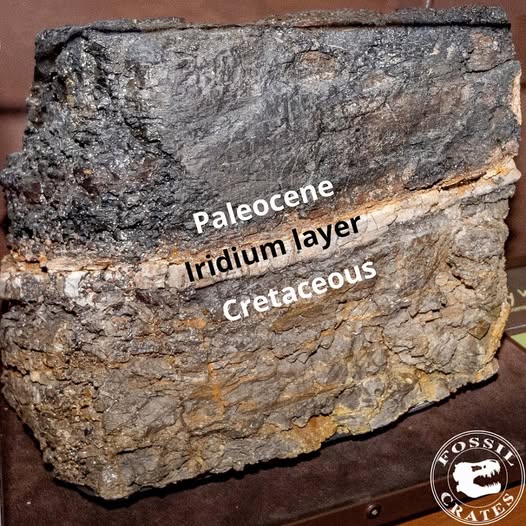
In the hundreds of thousands to millions of years that followed, ocean ecosystems slowly rebuilt (Schulte et al., 2010; Friedman, 2010). Plankton communities recovered first, allowing marine food webs to reassemble from the bottom upward.
The sea that covered Onslow County withdrew gradually over the tens of millions of years following the Cretaceous–Paleogene boundary, not because of the impact alone, but because tectonics and climate redirected Earth’s balance of water and land. Through the Paleogene and into the Neogene, regression exposed portions of the Atlantic Coastal Plain. Rivers carved channels into former seabeds. Marshes colonized low ground. Much later, during the Pleistocene ice-age cycles beginning about 2.6 million years ago, barrier islands assembled from mobile sand as sea level rose and fell repeatedly.
What we walk today is the lifted floor of a vanished ocean.

Cretaceous Transition: After the Impact
The end of the Cretaceous did not simply erase species; it reorganized the architecture of marine life. In the first several hundred thousand years after the Chicxulub impact, the collapse of plankton communities removed the base of food webs that had supported ammonites, many marine reptiles, and numerous large predatory fishes. Apex niches did not stay empty for long. During the early Paleogene, roughly 66 to 50 million years ago, sharks, teleost fishes, and early marine mammals diversified rapidly into the ecological space left behind (Schulte et al., 2010; Friedman, 2012).

In the aftermath, the shelf would not look empty at first glance but would feel altered, as large bodies that once displaced water in constant motion were absent, leaving the vertical space above the seafloor open, quieter, and less crowded. A swimmer would sense the difference not through sight alone but through the water’s stillness — fewer passing pressure waves and fewer shadows interrupting the light.
In the shallow seas that once covered eastern North Carolina, this transition marked a shift from reptile-dominated predator guilds to fish- and shark-centered systems. Survivors tended to share traits that remain advantageous in modern estuaries: flexible diets, rapid reproduction, and tolerance for fluctuating conditions. The extinction boundary favored generalists over specialists, and lineages capable of exploiting disrupted ecosystems seeded the foundation of the modern Atlantic marine fauna.
The Cretaceous sea did not end — it evolved under constraint.
The Miocene: A Predator-Rich Shelf
Over the tens of millions of years that followed the Paleogene recovery, marine ecosystems continued diversifying as continents drifted toward their modern positions and ocean circulation strengthened. By the Miocene, roughly 23 to 5 million years ago, the sea covering eastern North Carolina was not the same water body that drowned the Cretaceous coast. Continents had shifted. Currents reorganized. The Atlantic margin was beginning to resemble its modern geometry. What remained constant was the shelf: shallow, warm, nutrient-rich, and biologically crowded.
The Miocene shelf was structured by productivity. Warm global climates intensified circulation patterns that mixed nutrients and supported dense prey fields. Where energy concentrates, ecosystems scale upward. Plankton blooms fueled vast schools of fish and squid that moved through the water column in shifting layers (Hay, 2012; Pimiento et al., 2016).
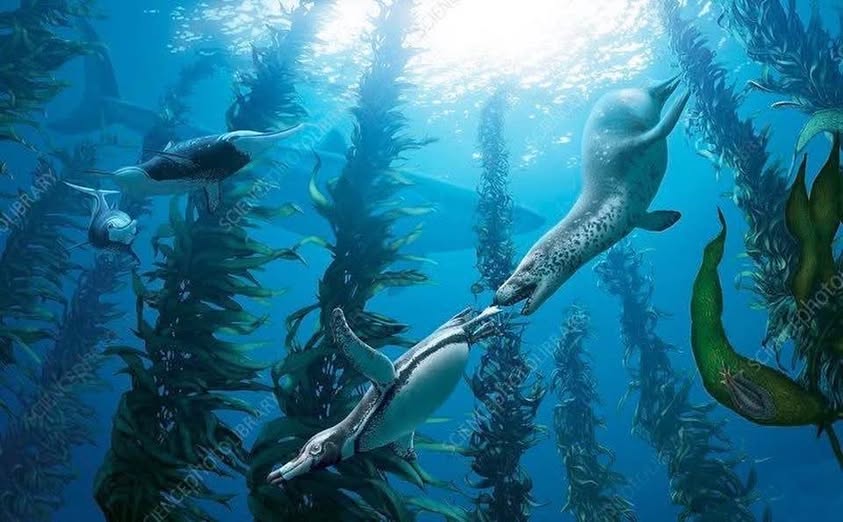
This abundance supported a growing diversity of marine vertebrates (Pimiento et al., 2016). Whales diversified explosively: early baleen whales filtered plankton blooms that pulsed across the shelf, while toothed whales pursued schooling fish and squid, their passage shifting the light before their bodies came fully into view. Pinnipeds hauled out on emergent islands. Sea turtles nested along coastlines that advanced and retreated with slow tectonic breathing. Below that movement, sirenian grazers — ancestors of modern manatees — moved slowly through seagrass beds, shaping the shelf from the bottom while predators ruled above (Domning, 2001).
To occupy that Miocene shelf as a small observer would be to feel scale in motion. Migrating whales and large predators would load the surrounding water with momentum before they arrived, a pressure you could feel before you could see its source. The shelf seemed to flex around movement, the water itself shaped by the animals traveling through it. The water carried that weight differently than in the Cretaceous — not the suspension of reptile-dominated seas, but the mass of mammals built for speed and scale.
In ecosystems where prey concentrates and marine mammals flourish, apex predators inevitably emerge. In the Miocene Atlantic, that role belonged to the giant shark whose teeth still surface along North Carolina beaches: Otodus megalodon. Its immense size was not evolutionary extravagance but ecological arithmetic. A predator of that scale can exist only where the energy flowing through the system is great enough to sustain it (Pimiento et al., 2016).
Sediments from Miocene deposits in the Atlantic Coastal Plain preserve a fossil record dominated by marine vertebrates. These fossils accumulate in the same geological staircase as older layers, which is why storms today liberate teeth from multiple epochs simultaneously. The shoreline is a cross-section through predator history.
Megalodon disappears near the Pliocene boundary, likely a casualty of ecological restructuring — shrinking nursery habitat, prey redistribution, and competition from emerging marine mammals (Pimiento & Clements, 2014). The predator city did not vanish; it reorganized.
The Pleistocene: Ice, Sand, and a Moving Coast (~2.6 million – 11,700 years ago)
During glacial low stands, standing on the exposed shelf would produce a disorienting absence. Wind would move across ground that remembered being ocean. The surface would hold the texture of former seabed — compacted, rippled, cut by channels where rivers extended into newly revealed terrain. Air would replace water pressure, but the land would still read as marine, a coastline temporarily paused in withdrawal.
The Pleistocene introduced a rhythm that still governs the modern coastline: glacial cycling. Ice sheets expanded and retreated dozens of times, locking ocean water onto continents and then releasing it. Each cycle shifted sea level by tens of meters. Eastern North Carolina repeatedly alternated between exposed coastal plain and submerged shelf (Lambeck et al., 2014).
When sea levels fell, rivers carved deeply into former seabeds, cutting channels that later became estuaries, while rising seas flooded those valleys again, redistributing sand along migrating shorelines as barrier islands assembled from sediment sorted into long, mobile ridges by waves and currents (Riggs et al., 1995; Riggs et al., 2020).

The coast stopped being a static shelf and became a machine in motion, and Pleistocene ecosystems were shaped by that instability as species adapted to shifting salinity, temperature, and shoreline position. Many cold-adapted megafauna disappeared or shifted poleward, while warm-temperate estuarine assemblages consolidated in their place.
The ecological winners were organisms capable of building habitat: marsh grasses trapping sediment, oysters engineering reefs, and filter feeders clarifying water. Those assemblages increasingly resembled the modern Atlantic shelf, with drum, croaker, and mullet occupying estuarine corridors carved by drowned rivers while rays and small coastal sharks patrolled nursery shallows. Oyster reefs rose in dense clusters, and early marsh communities anchored sediment with grasses similar to those that now define the Carolina coastline.
The emerging system favored species tolerant of fluctuation — animals able to move with the shoreline rather than resist it — as cooling climates and destabilized coasts increasingly selected for flexibility over scale, replacing the giants of the Miocene shelf with communities built for movement rather than permanence.
The modern Onslow estuary is therefore a recent equilibrium layered atop instability.
Pleistocene Transition: From Ice Age Coast to Modern Estuary

The close of the Pleistocene did not feature a single catastrophic boundary but a climatic stabilization. As the last major ice sheets retreated about 11,700 years ago, sea level rose rapidly and then slowed. Coastlines stopped migrating at glacial speed. Estuaries stabilized long enough for persistent marsh systems to develop. Oyster reefs expanded. Seagrass beds colonized shallow bays (Lambeck et al., 2014; Kennett & Shackleton, 1975).
The organisms that dominate modern estuaries are ecosystem engineers. They do not simply inhabit the coast — they build it.
What appears ancient in the marsh is, in geological terms, newly assembled.
Survivors in Motion: Sharks and Teleost Continuity
Standing in modern surf, that continuity is still tactile. The water along the shelf carries suspended sand and organic haze, softening visibility to a few body lengths. Something large can pass nearby without breaking the surface, announced only by a shift in current or a vibration through the feet. The present ocean feels busy in the same quiet way ancient shelves must have felt — full of motion just beyond clear sight. The modern shelf feels lighter, but not empty. The water still carries motion long before form appears, transmitting the passage of sandbar sharks, blacktips, and schooling menhaden through vibration rather than sight. The weight is subtler now — distributed across smaller bodies, faster cycles, suspended sand and organic haze — yet the sensation remains – a medium that remembers being crowded.
The most striking feature of the Atlantic shelf is not how much has changed, but how much has endured. Sharks were already ancient when the Cretaceous sea covered this region, their lineage extending back more than 400 million years (Ebert et al., 2021).


Modern coastal sharks reflect this inheritance, with sandbars, blacktips, bonnetheads, and dogfish representing lineages refined through repeated ecological resets (Ebert et al., 2005). Teleost fishes tell a parallel story: after the end-Cretaceous extinction, they diversified explosively, filling feeding niches that define modern marine communities (Friedman, 2010).
Species change across epochs, but functional roles persist, and the system remembers its architecture even when its cast rotates. The sharks offshore now are not echoes of a lost world; they are its direct continuation.
The Coast as a Layered Archive

When a fossil tooth surfaces in the surf along the Onslow County coast, it is not emerging from a single time but from stacked histories compressed beneath the modern shoreline. Cretaceous seas. Miocene predator guilds. Pleistocene shorelines advancing and retreating with ice age pulses. Each episode writes a layer. Storm energy and human dredging occasionally cut into those layers, returning fragments to circulation.
This is why the coast feels haunted by deep time. The sediment is not just sand; it is a palimpsest of ecosystems.
The sharks that swim offshore now — sandbars, blacktips, bonnetheads — are heirs to lineages that survived the extinction boundary and adapted through cycles of climate and geography. Their teeth will enter the archive in turn. Millions of years from now, another shoreline will release them, and a different species will walk a beach made from our present seafloor.
The coast is not a place fixed in space. It is a moving edge between worlds, carrying memory forward grain by grain.
References
Domning, D. P. (2001). The earliest known fully quadrupedal sirenian. Nature, 413(6856), 625-627. https://doi.org/10.1038/35098072
Ebert, D. A., Dando, M., & Fowler, S. (2021). Sharks of the world: A complete guide. Princeton University Press.
Friedman, M. (2010). Explosive morphological diversification of spiny-finned teleost fishes in the aftermath of the end-Cretaceous extinction. Proceedings of the Royal Society B: Biological Sciences, 277(1688), 1675-1683. https://doi.org/10.1098/rspb.2009.2177
Hay, W. W. (2012). Experimenting on a small planet: A scholarly entertainment (1st ed.). Springer Science & Business Media.
Kennett, J. P., & Shackleton, N. J. (1975). Laurentide ice sheet Meltwater recorded in Gulf of Mexico deep-sea cores. Science, 188(4184), 147-150. https://doi.org/10.1126/science.188.4184.147
Lambeck, K., Rouby, H., Purcell, A., Sun, Y., & Sambridge, M. (2014). Sea level and global ice volumes from the last glacial maximum to the Holocene. Proceedings of the National Academy of Sciences, 111(43), 15296-15303. https://doi.org/10.1073/pnas.1411762111
Miller, K. G., Kominz, M. A., Browning, J. V., Wright, J. D., Mountain, G. S., Katz, M. E., Sugarman, P. J., Cramer, B. S., Christie-Blick, N., & Pekar, S. F. (2005). The Phanerozoic record of global sea-level change. Science, 310(5752), 1293-1298. https://doi.org/10.1126/science.1116412
Near, T. J., Dornburg, A., Eytan, R. I., Keck, B. P., Smith, W. L., Kuhn, K. L., Moore, J. A., Price, S. A., Burbrink, F. T., Friedman, M., & Wainwright, P. C. (2013). Phylogeny and tempo of diversification in the superradiation of spiny-rayed fishes. Proceedings of the National Academy of Sciences, 110(31), 12738-12743. https://doi.org/10.1073/pnas.1304661110
Pimiento, C., Balk, M., & Celements, C. (2014). Reconstructing the extinction of the giant Megalodon shark (Carcharcoles Megalodon). The Paleontological Society Special Publications, 13, 52-52. https://doi.org/10.1017/s2475262200011102
Pimiento, C., & Balk, M. A. (2015). Body-size trends of the extinct giant shark Carcharocles megalodon : A deep-time perspective on marine APEX predators. Paleobiology, 41(3), 479-490. https://doi.org/10.1017/pab.2015.16
Pimiento, C., & Clements, C. F. (2014). When did Carcharocles megalodon become extinct? A new analysis of the fossil record. PLoS ONE, 9(10), e111086. https://doi.org/10.1371/journal.pone.0111086
Pimiento, C., MacFadden, B. J., Clements, C. F., Varela, S., Jaramillo, C., Velez‐Juarbe, J., &
Silliman, B. R. (2016). Geographical distribution patterns of Carcharocles megalodon over time reveal clues about extinction mechanisms. Journal of Biogeography, 43(8), 1645-1655. https://doi.org/10.1111/jbi.12754
Riggs, S. R., Ames, D. V., Culver, S. J., & Mallinson, D. J. (2020). The battle for North Carolina’s coast: Evolutionary history, present crisis, and vision for the future.
Riggs, S. R., Cleary, W. J., & Snyder, S. W. (1995). Influence of inherited geologic framework on barrier shoreface morphology and dynamics. Marine Geology, 126(1-4), 213-234. https://doi.org/10.1016/0025-3227(95)00079-e
Schulte, P., Alegret, L., Arenillas, I., Arz, J., Barton, P. J., Brown, P. R., Bralower, T. J., Christeson, G. L., Claeys, P., & Willumsen, P. S. (2010). The Chicxulub Asteroid Impact and Mass Extinction at the Cretaceous-Paleogene Boundary. Science, 327(5970), 1214-1218. https://www.science.org/doi/10.1126/science.1177265