At the soundside edge of Topsail Island, a hole in the ground is not unusual. Marsh grass gives way to higher soil, fiddler crabs disappear when footsteps approach, and small brown crabs move beneath boards, leaves, and anything else that holds a little shade. A burrow at the edge of a coastal yard may belong to an animal that has lived along this shore far longer than the yard has.
That is why a hole alone would be poor evidence of a blue land crab.
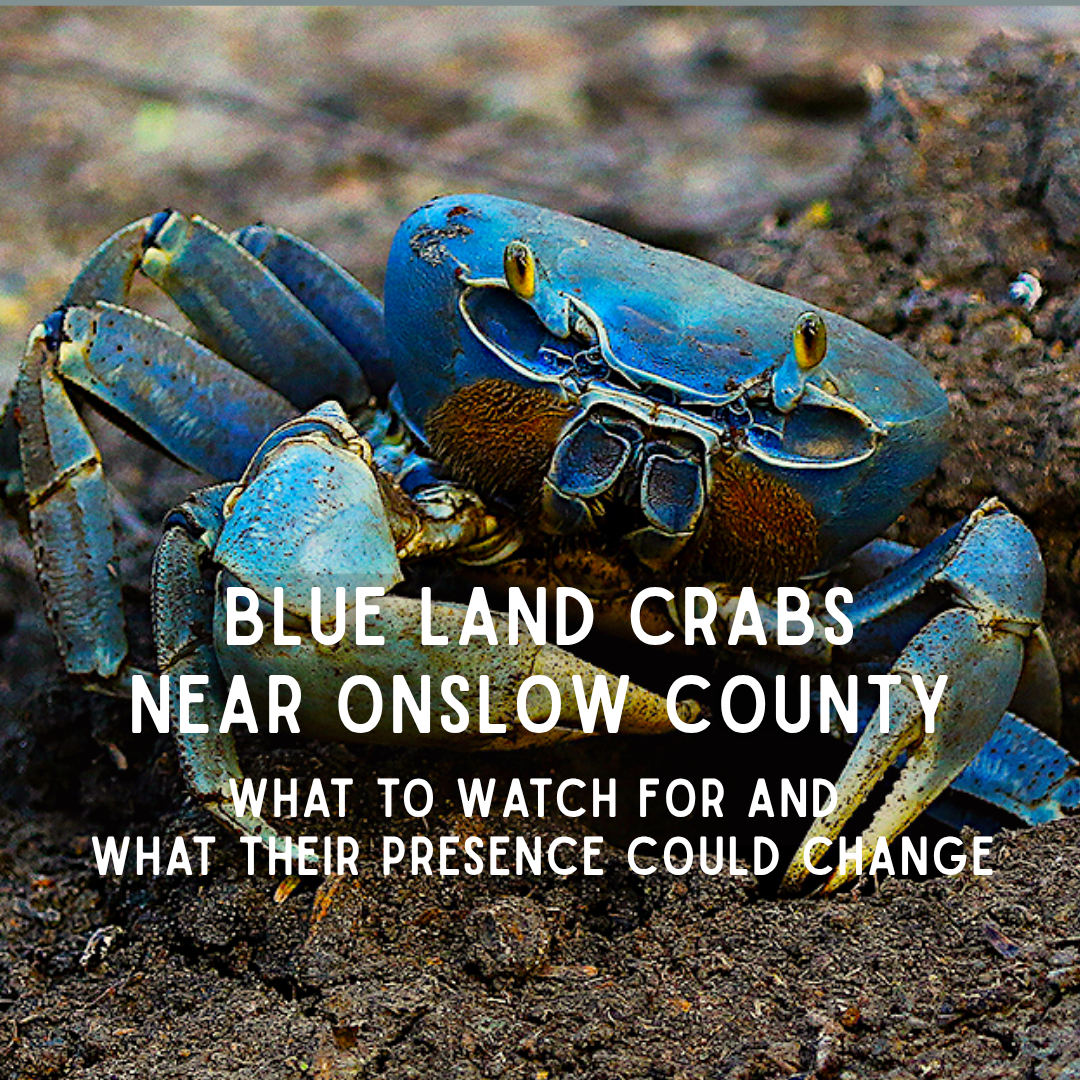
The animal itself would be harder to overlook. A mature blue land crab, Cardisoma guanhumi, can grow to nearly six inches across its shell, with legs that make it appear larger still. An adult male is often blue-gray and carries one powerful claw, but females may be pale gray or white, while younger crabs can be orange, brown, or purple. From a distance, the uneven claws can resemble those of a fiddler crab, except the entire animal has been enlarged to a scale unfamiliar in a Carolina backyard (Hostetler et al., 2025).
Until recently, it was also unfamiliar along this part of the coast. The blue land crab’s historically documented range in the continental United States followed the Gulf of Mexico and southern Florida, with Vero Beach long recognized as its northern Atlantic limit (Scott et al., 2023). Occasional South Carolina records began in 2008, followed by 53 verified sightings there during a concentrated period of public reporting in fall 2022 (Scott et al., 2023). North Carolina confirmed its first blue land crab in summer 2023. By August 2026, 23 sightings had been confirmed statewide and another 34 reports remained unverified. Two of the confirmed records this year came from Emerald Isle (NC DEQ, 2026).
Those numbers do not yet describe a population. They describe a question appearing in yards, along roads, and beside the marsh: whether a warm-water crab is occasionally reaching North Carolina or beginning to live here.
A Crab That Does Not Stay in One World
The blue land crab is neither a displaced Atlantic blue crab nor simply a giant fiddler. The shared color and oversized claw describe what it looks like, not its closest relatives. It belongs to Gecarcinidae, the land-crab family, whose members have moved much of adult life above the tide. Their gills still do the breathing, even in air, and those gills must remain damp. The crab can leave the water; it cannot leave water behind (Marin & Tiunov, 2023).
That need for moisture keeps the crab between two worlds. Adults may live above the reach of ordinary tides—in coastal forests, brushy ground, grasslands, drainage edges, and even yards—but they return to damp shelter when the day becomes hot or when a newly molted shell leaves them vulnerable. Many blue land crabs can live near one another without sharing that refuge; each normally keeps a burrow of its own (Herreid & Gifford, 1963; Moraes-Costa & Schwamborn, 2018).
That higher position separates the blue land crab from many crabs living in the flooded marsh below it, but not completely. Its life still returns to the estuary. After mating, a female carries hundreds of thousands of eggs beneath her abdomen and travels to salt or brackish water to release them (Hostetler et al., 2025). The larvae drift through several planktonic stages before settling and returning to land as small crabs. Warm water is particularly important during this development, while salinity determines which parts of an estuary can carry the larvae successfully (Costlow & Bookhout, 1968a, 1968b).
An adult can therefore live beneath shrubs beside a yard while its offspring begin among fishes and plankton. The species belongs to the coastal upland and the estuary at the same time, and that divided life helps explain how an animal tied to one burrow can appear far beyond the range where its adults were previously known.
How a Southern Crab Reached This Shore
Blue land crabs are not likely to have walked from Florida to the Carolinas. Adults forage close to their burrows and show strong attachment to a small home area. Females make longer reproductive movements toward water, but those are local journeys between upland burrows and larval-release sites rather than migrations along hundreds of miles of coastline (Moraes-Costa & Schwamborn, 2018).
Long-distance movement is more plausible during the larval stage. Once released, larvae spend weeks in coastal water before returning to land, allowing currents to carry them beyond the place where they hatched (Hostetler et al., 2023). A widening pattern of sightings from Florida through Georgia and South Carolina would be consistent with natural range expansion as warming water and milder cold periods make northern development and survival more possible (Costlow & Bookhout, 1968b; NC DEQ, 2026; Scott et al., 2023). Human transport, including movement with vessels or materials, remains another possibility because the present records do not yet reveal how the crabs arrived (NC DEQ, 2026).
Warmer conditions in Florida would not simply make the crabs decide to leave. The more relevant change would occur at the northern boundary, where conditions that once killed larvae or prevented overwintering may no longer do so as reliably (Costlow & Bookhout, 1968b). Warming can open habitat ahead of a species without pushing adults out of the habitat behind it.
It is tempting to imagine worsening conditions in Florida sending blue land crabs north, but that does not fit particularly well with how the adults live. Coastal development, altered groundwater, harvesting, and the loss of mangrove-edge habitat have reduced populations in parts of Puerto Rico and Brazil. When the ground around an adult’s burrow is destroyed, however, the crab may move only a short distance or disappear with the habitat. It does not begin a walk to North Carolina (Govender et al., 2008; Moraes-Costa & Schwamborn, 2018).
Development may matter after the much smaller, drifting stage has already reached a new shore. A canal edge, drainage ditch, watered lawn, or patch of coastal vegetation can offer the damp ground a young crab needs as it leaves the estuary. Human-altered places may therefore help connect suitable patches without being the reason the crab traveled north in the first place (Riascos et al., 2024).
So is the blue land crab native to North Carolina, or is it invasive? Neither label fits neatly yet. The species is native to warmer parts of the western Atlantic and Gulf of Mexico, including Florida, but North Carolina lies beyond its historically recognized Atlantic range in the United States. If larvae are reaching the Carolinas on coastal currents and surviving because conditions have become more favorable, then the crab’s natural range may be expanding. If crabs arrived with boats or transported materials, that would be an introduction. The sightings cannot yet tell us which occurred (Scott et al., 2023; NC DEQ, 2026).
Either way, arrival alone does not make a species invasive. The blue land crab would have to establish a reproducing population, continue spreading, and cause ecological or economic harm. North Carolina has confirmed crabs, but it does not yet have evidence of an established, harmful population (NC DEQ, 2026).
Emerald Isle Is Not Far Away
There were two confirmed blue land crab sightings in Emerald Isle this year, out of 23 confirmed cases across North Carolina (NC DEQ, 2026). This is what makes the Emerald Isle records matter here. The confirmed crabs were not found along some distant part of the North Carolina coast. They were found on Bogue Banks, northeast of Onslow County and only several dozen coastal miles from North Topsail Beach.
Between Emerald Isle and Topsail are connected sounds, tidal creeks, inlets, marshes, developed islands, and the Intracoastal Waterway. A crab confirmed on Bogue Banks does not prove that one is already living around North Topsail, Surf City, or the soundside of Topsail Island. It does place the animal within a coastal landscape that continues toward all three.
That does not mean currents are carrying crabs neatly from Emerald Isle toward Topsail, and the statewide sightings should not be read as a marching line. Some animals may represent separate arrivals; others may have gone unnoticed for years. The map brings the question closer. Only repeated observations can show where the crab has actually found a place—and which members of the existing crab community are already there.
The Crabs Already Here
Onslow County’s marsh edge is not waiting empty for a land crab to arrive. Several native crabs divide the same transition from tidal creek to high ground, although each uses a somewhat different part of it.
Comparison of the blue land crab to other crabs seen in our Onslow County area. | Image credit: SC Department of Natural Resources
At low tide, the easiest to notice are often fiddlers. Atlantic marsh fiddler crabs,Minuca pugnax, favor muddier marsh sediment, while Atlantic sand fiddlers,Leptuca pugilator, are more common across sandy flats and the higher portions of the marsh. Red-jointed fiddler crabs,Minuca minax, appear where the water is fresher. Marsh and sand fiddlers have long been documented in North Carolina salt marshes, gathering into the familiar patches that vanish into small holes when a person approaches (O’Connor, 1993).
They sift algae, microbes, and bits of organic material from the surface, leaving tiny feeding marks across exposed sediment. Even a male carrying an oversized claw has a body only a fraction of the width of an adult blue land crab.
Closer to the cordgrass, purple marsh crabs,Sesarma reticulatum, move along muddy creek banks and feed heavily on the grass, including stems and tissues belowground. At ordinary numbers they are part of the marsh’s long-established community. Where their numbers become unusually high, their feeding can strip away vegetation and leave sediment exposed (Bertness et al., 2014; Wittyngham et al., 2024).
At the upper edge, the small brown crab beneath a board or patch of leaves may be a squareback marsh crab,Armases cinereum. Of the native crabs, it is the most likely to meet a blue land crab where marsh gives way to the yard. It moves above the high-water line, sometimes crossing lawns or climbing garage walls, and eats fallen leaves, living plants, and small invertebrates. Its menu is broad in much the same way as a blue land crab’s, although the squareback itself is far smaller (Buck et al., 2003).
Other familiar crabs belong to neighboring settings. Atlantic mud crabs such as Panopeus herbstii remain among oyster shells, rocks, and submerged structure, where their heavy claws open oysters, clams, barnacles, and snails. Ghost crabs,Ocypode quadrata, occupy the open beach and dune sand on the ocean side. Either may be close in geographic distance to a blue land crab, but neither uses the soundside grass-to-yard boundary in quite the same way.
Each of these crabs already belongs to a particular part of the shore. A blue land crab would not arrive in an empty niche, but it would not duplicate any one of them either. To see where the differences matter, we have to look below the opening.
The Architecture Beneath the Opening
For a burrowing crab, the tunnel is more than a hiding place. It is a shelter from heat and predators, a humid chamber that protects the gills, and a safe place to molt. Its shape reflects the problem the crab needs it to solve, which is why burrows built only a few yards apart can belong to very different lives.
A blue land crab begins on higher ground with a comparatively broad entrance, then turns downward toward moisture. There is no single blueprint hidden below it. Burrows examined with a fiber-optic camera in Puerto Rico included short passages that descended at a shallow angle, longer tunnels that leveled before dropping sharply, and deep curves resembling an inverted S. Forked and corkscrew forms occurred less often. The route varied with the site, but the essential destination was usually the same: a humid refuge at or near groundwater, occupied by one crab rather than a colony sharing one chamber (Moraes-Costa & Schwamborn, 2018; Sample & Albrecht, 2016).
The blue land crab’s burrow will begin their entrance with a steep angle that levels off until a sharp downward turn to reach the water table. | Image credit: Sample & Albrecht, 2016
An Atlantic sand fiddler builds at another scale and for another rhythm. Its narrow shaft descends through sand exposed between tides, and a deeper breeding burrow may extend farther than the temporary refuge used while feeding. Across a flat, many small entrances can stand close together because each belongs to a small crab defending little more than the ground immediately around it. Although the shafts provide shelter and moist air, they remain much narrower than the passage required by an adult blue land crab (Christy, 1982). A fiddler opening would therefore be a poor ready-made home for a mature Cardisoma.
A 3D cast and schematic show the burrow formation of an Atlantic fiddler crab. | Image Credit: di Virgilio & Riberio, 2013
The purple marsh crab offers a different contrast. Its burrows occupy muddy, rooted creek banks and can become part of a connected network with several openings. When those networks become dense, especially where vegetation has already thinned, excavation and cordgrass feeding can loosen the bank and make sediment easier for moving water to carry away (Bertness et al., 2014; Farron et al., 2020). A blue land crab generally begins above ordinary tidal flooding and maintains a more solitary route toward groundwater. Its burrow should not be assumed to undercut a creek bank in the same way simply because both animals dig.
A ghost crab may also leave one obvious opening and a mound of newly moved sand, but its address is usually the open ocean beach or foredune. Its sloping or curving refuge is built in loose, comparatively dry beach sand, not at the moist soundside boundary between marsh and yard.
Ghost crab burrow structure from a 3D cast on a sandy beach | Image credit: Shinoda et al., 2019
The squareback marsh crab makes an even clearer distinction. It commonly slips beneath leaves, logs, rocks, boards, and other cover at the upper marsh edge instead of constructing the large groundwater-reaching tunnel associated with an adult blue land crab. Mud crabs and Atlantic blue crabs do not make permanent terrestrial burrows at all. One uses submerged crevices; the other may bury itself temporarily in bottom sediment.
The squareback marsh crab may use rocks, leaves or other surface materials to hide beneath instead of a burrow. | Image credit: critterbliss, iNaturalist
Burrow reuse deserves equal care. Smaller blue land crabs have been found in openings much larger than their bodies, which is consistent with their moving into burrows abandoned by larger blue land crabs (Carmona-Suárez & Guerra-Castro, 2012). For a smaller crab, an empty tunnel would mean less digging, less time exposed aboveground, and immediate access to a refuge that already holds moisture. Those are likely advantages rather than benefits tested directly.
The other crabs along a Carolina shore do not appear to offer the same shortcut. Their shelters are too narrow, too low in the marsh, too dry, or not true burrows at all. Nothing currently shows that blue land crabs routinely take over and enlarge the burrows of another crab species.
The digging leaves more than a hole. Soil brought up from below is spread across the surface, while leaves, scraps of food, old molts, and waste may collect inside. In places where blue land crabs are established, the soil within their burrows differs from the ground beside them in its mixture of sand and silt, acidity, organic matter, and nutrients including nitrogen, magnesium, and potassium (Quintero-Torres et al., 2018).
The open tunnel also allows air and water to reach soil that had been sealed underground. Across many kinds of coastal crabs, burrowing tends to loosen sediment and change the chemical work carried out there by microbes. How much changes—and whether the effect helps or harms the plants above—depends upon the crab, the vegetation, and where the burrow sits (Rinehart et al., 2024).
Water salinity is shown in a burrowed marsh (a), a straight burrowed marsh (b), a sloped marsh (c ), and a marsh at the high tide stage and how salinity is distributed in the marsh as influenced by burrows. | Image credit: Yin et al., 2023
That does not mean each hole ventilates an entire marsh. Oxygen entering a tunnel may change only a thin layer of soil along its walls. Around fiddler burrows, that reach has been far smaller than the familiar phrase “aerates the soil” might suggest (Michaels & Zieman, 2013). A single high-ground blue land crab tunnel is not a new tidal creek either. Rain, groundwater, or an unusually high tide may enter it and change the wetness immediately around the opening, but blue land crab burrows have not been shown to redirect tidal flow through a maritime forest.
Roots present the same uncertainty. Digging can break fine roots and loosen the soil holding them, while the extra space and shifted nutrients around a tunnel may create new conditions for roots and soil life. Blue land crabs also clip and eat plants aboveground, so a damaged plant would not tell us whether feeding, digging, or both were responsible.
One occupied hole may change little beyond a small patch of ground. If the same digging were repeated across many burrows, those patches could begin to influence which plants take hold, how firmly their roots bind the edge, and how water moves through the soil. That possibility is one reason burrows are worth mapping. It is not evidence that those changes are already happening at North Carolina sighting sites.
At first, the tunnel keeps one crab alive. Only when that work is repeated across a place does it begin to become part of the landscape.
From the surface, however, most of that architecture remains hidden.
What a Burrow Can—and Cannot—Tell Us
A mature blue land crab may leave an opening three to five inches wide. Freshly excavated soil may collect around the entrance, and plant pieces or tracks may be visible nearby. These clues become more persuasive when the hole sits above normal tidal flooding in shaded, moist ground and a very large crab has been seen retreating into it (Hostetler et al., 2025).
It is still not an identification. A smaller blue land crab may occupy an older, larger burrow, while erosion can widen the entrance to a much smaller tunnel. Marsh soil also collapses, roots leave openings, rodents dig, and water continually reshapes the grass line. Size alone can mislead, particularly in a photograph with nothing nearby for scale.
The setting and the pattern offer better clues. Many small holes spread across exposed mud or sand point toward fiddlers. Several openings cut through a rooted creek bank fit purple marsh crabs. One hole high on the dry ocean beach is more likely a ghost crab’s. Squarebacks are often found beneath something rather than beside a large mound of freshly dug soil. The strongest match for the blue land crab would bring several details together: a broad opening on higher soundside ground, signs of recent digging, and a crab far larger than the native marsh species.
That is why a useful photograph includes more than the hole. The crab, entrance, moved soil, surrounding plants, nearby water, and something familiar for scale allow the scene to be read together. There is no need to dig, probe, or flood the tunnel. Without the animal, a burrow can identify a place worth watching, but not the species living beneath it.
What the New Crab Would Eat
The large claw may make a blue land crab look like a hunter arriving to eat every smaller crab in its path. Most of what it gathers, however, is plant material: fallen leaves, fruit, berries, flowers, tender shoots, grasses, and seeds. It may carry that food home and pull some of it underground. Insects, carrion, feces, and other animal matter add to the diet when available, and blue land crabs sometimes eat one another (Gifford, 1962; Herreid, 1963; Moraes-Costa & Schwamborn, 2018).
That does not place native crabs entirely off the menu. A blue land crab may seize a small animal it can catch, but regular hunting of fiddlers, squarebacks, or purple marsh crabs is unlikely to be its main influence. The more important changes would probably begin with the plants and fallen leaves it removes, the ground it excavates, and the space it keeps around its burrow.
The amount of competition would differ from crab to crab. Fiddlers graze the thin film of algae, microbes, and organic particles coating the marsh surface, so they share relatively little food with a crab gathering fruit and leaves above the high-tide line. Squareback and purple marsh crabs share more of that plant-based menu, although they forage at different scales and in different parts of the marsh. If blue land crabs remain, the strongest overlap may be over shaded ground, damp refuge, and nearby plant food rather than over a particular prey animal.
What Established Populations Tell Us
Sharing food and high ground does not make displacement inevitable. Where blue land crabs have lived for generations, other crabs continue to live beside them by using different levels of the shore. Along the Brazilian coast, for example, the mangrove crab,Ucides cordatus, digs into softer ground between the tides, while Cardisoma lives higher in firmer, sandier soil. Their ranges overlap without their burrows occupying precisely the same ground (Firmo et al., 2012).
North Carolina has a different community, but the same separation by water, soil, and elevation is already familiar here. The squareback comes closest to overlapping with a blue land crab at the upper edge. Even there, one defended Cardisoma burrow might cost a squareback a feeding spot without removing squarebacks from the wider marsh.
The first change people noticed might therefore be simpler than one crab replacing another: a much larger animal at the grass line, fresh soil beside an entrance, fallen fruit or leaves drawn toward it, and tender plants clipped within a short walk of the burrow.
That picture could change if the crabs became numerous. Many defended burrows would divide more of the narrow band of damp high ground, increasing competition for shelter and food. Their digging would repeat the small soil changes described above, while their feeding could influence which seeds and seedlings survive and how quickly fallen leaves disappear. Those broader forest effects are known across several land-crab species rather than from a newly established Cardisoma population, but they show why abundance matters more than the mere arrival of one large crab (Lindquist et al., 2009).
Predators would respond only if the crabs became dependable prey. Large birds and mammals eat blue land crabs within their established range, while eggs and larvae released into the estuary become food for aquatic animals (Firmo et al., 2012; Hostetler et al., 2025). One adult crossing a Carolina yard offers one unusual meal. A recurring population could give raccoons or coastal birds a reason to search the marsh edge and could place many larvae into the estuarine food web.
This is where two kinds of change can look like the same thing. Digging alters the ground directly, making the crab an ecosystem engineer (Rinehart et al., 2024). A trophic cascade would have to continue through feeding relationships: fewer surviving seedlings changing the vegetation, for example, or predators drawn to land crabs changing their pressure on other prey (Lindquist et al., 2009).
Blue land crabs are capable of beginning both pathways. What the North Carolina sightings cannot yet tell us is whether enough crabs are arriving, surviving, and reproducing for the work of individuals to become the work of a population.
When One Sighting Becomes a Place
One dated photograph gives the map a place. Another observation weeks or months later begins to show whether the crab stayed. As those records accumulate, they can reveal when the crabs are active, whether they appear after rain, which kinds of ground they use, and whether they return across seasons. Crabs of different sizes at one site may have survived across more than one year, while juveniles, egg-bearing females, or repeated movements toward the water would offer stronger evidence that the species is completing more of its life cycle here.
The same map can show where the larger ecological questions belong. One wandering adult does not tell us that native crabs are being displaced or that a trophic cascade has begun. Several occupied burrows, plant damage, younger crabs, and repeated sightings at the same place would give biologists a reason to compare its vegetation, soil, native crabs, and predators with nearby places where Cardisoma is absent.
Anyone who sees a possible blue land crab can photograph it from a safe distance and submit the image, date, and location through the Blue Land Crab Sightings reporting. A photograph showing the animal, its approximate scale, and the surrounding habitat is more useful than trying to catch or relocate it.
That distinction matters for anyone standing at the grass line. A three-inch hole is not an identification, clipped leaves are not proof of ecological harm, and a large crab is not automatically an invasive species. Each is a piece of context. Together, photographed and reported without catching or relocating the animal, those pieces can show whether North Carolina is receiving occasional southern visitors or adding a new resident to the narrow landscape between the forest and the sea.
The coast will answer that slowly, one place at a time.
References
Bertness, M. D., Brisson, C. P., Bevil, M. C., & Crotty, S. M. (2014). Herbivory drives the spread of salt marsh die-off. PLoS ONE, 9(3), e92916. https://doi.org/10.1371/journal.pone.0092916
Buck, T. L., Breed, G. A., Pennings, S. C., Chase, M. E., Zimmer, M., & Carefoot, T. H. (2003). Diet choice in an omnivorous salt-marsh crab: Different food types, body size, and habitat complexity. Journal of Experimental Marine Biology and Ecology, 292(1), 103-116. https://doi.org/10.1016/s0022-0981(03)00146-1
Carmona-Suárez, C. A., & Guerra-Castro, E. (2015). Comparison of three quick methods to estimate crab size in the land crabs <i>Cardisoma guanhumi</i> Latreille, 1825 and <i>Ucides cordatus</i> (Crustacea: Brachyura: Gecarcinidae and Ucididae). Revista de Biología Tropical, 60, 139. https://doi.org/10.15517/rbt.v60i0.19854
Costlow, Jr., J. D., & Bookhout, C. G. (1968a). The complete larval development of the land-crab, Cardisoma guanhumi Latreille in the laboratory (Brachyura, Gecarcinidae). Crustaceana, 15(3), 259-270.
Costlow, Jr., J. D., & Bookhout, C. G. (1968b). The effect of environmental factors on development of the land-grab,cardisoma guanhumiLatreille. American Zoologist, 8(3), 399-410. https://doi.org/10.1093/icb/8.3.399
Farron, S., Hughes, Z., FitzGerald, D., & Strom, K. (2020). The impacts of bioturbation by common marsh crabs on sediment erodibility: A laboratory flume investigation. Estuarine, Coastal and Shelf Science, 238, 106710. https://doi.org/10.1016/j.ecss.2020.106710
Firmo, A., Tognella, M. M., Silva, S. R., Barboza, R. R., & Alves, R. (2012). Capture and commercialization of blue land crabs (“guaiamum”) Cardisoma guanhumi (Lattreille, 1825) along the coast of Bahia state, Brazil: An ethnoecological approach. Journal of Ethnobiology and Ethnomedicine, 8(1). https://doi.org/10.1186/1746-4269-8-12
Gifford, C. A. (1962). Some observations on the general biology of the land crab, cardisoma guanhumi (Latreille), in South Florida. The Biological Bulletin, 123(1), 207-223. https://doi.org/10.2307/1539516
Govender, Y., Sabat, A. M., & Cuevas, E. (2008). Effects of land-use/land-cover changes on land crab,Cardisoma guanhumi, abundance in Puerto Rico. Journal of Tropical Ecology, 24(4), 417-423. https://doi.org/10.1017/s0266467408005130
Herreid, C. F. (1963). Observations on the feeding behavior of Cardisoma Guanhumi (Latreille) in southern Florida1). Crustaceana, 5(3), 176-180. https://doi.org/10.1163/156854063×00093
Herreid, C. F., & Gifford, C. A. (1963). The burrow habitat of the land crab, Cardisoma guanhumi (Latreille). Ecology, 44(4), 773-775. https://doi.org/10.2307/1933027
Hostetler, M. E., Mazzottii, F. J., & Taylor, A. K. (2025, October 28). Blue land crab (Cardisoma guanhumi) (WEC 30). Department of Wildlife Ecology and Conservation, UF/IFAS Extension. https://ask.ifas.ufl.edu/publication/UW013
Lindquist, E. S., Krauss, K. W., Green, P. T., O’Dowd, D. J., Sherman, P. M., & Smith, T. J. (2009). Land crabs as key drivers in tropical coastal forest recruitment. Biological Reviews, 84(2), 203-223. https://doi.org/10.1111/j.1469-185x.2008.00070.x
Marin, I. N., & Tiunov, A. V. (2023). Terrestrial crustaceans (Arthropoda, crustacea): Taxonomic diversity, terrestrial adaptations, and ecological functions. ZooKeys, 1169, 95-162. https://doi.org/10.3897/zookeys.1169.97812
Michaels, R. E., & Zieman, J. C. (2013). Fiddler crab (Uca spp.) burrows have little effect on surrounding sediment oxygen concentrations. Journal of Experimental Marine Biology and Ecology, 448, 104-113. https://doi.org/10.1016/j.jembe.2013.06.020
Moraes-Costa, D., & Schwamborn, R. (2018). Site fidelity and population structure of blue land crabs (Cardisoma guanhumi Latreille, 1825) in a restricted-access mangrove area, analyzed using PIT tags. Helgoland Marine Research, 72(1). https://doi.org/10.1186/s10152-017-0504-0
O’Connor, N. (1993). Settlement and recruitment of the fiddler crabs Uca pugnax and U. pugilator in a North Carolina, USA; salt marsh. Marine Ecology Progress Series, 93, 227-234. https://doi.org/10.3354/meps093227
Quintero-Torres, E., Chacón, N., & López-Sánchez, B. (2018). The ecosystem engineering role of the neotropical crab Cardisoma guanhumi on mangrove soil properties. Wetlands Ecology and Management, 26(5), 993-1000. https://doi.org/10.1007/s11273-018-9618-7
Riascos, J. M., Obonaga, L. D., & Ramos, J. (2024). Is the threatened land crab Cardisoma guanhumi conquering human‐dominated systems? Ecology and Evolution, 14(4). https://doi.org/10.1002/ece3.10737
Rinehart, S. A., Dybiec, J. M., Walker, J. B., Simpson, L., & Cherry, J. A. (2024). Effects of burrowing crabs on coastal sediments and their functions: A systematic meta‐analysis. Ecosphere, 15(7). https://doi.org/10.1002/ecs2.4927
Sample, S., & Albrecht, M. (2016). Determination of the burrow shapes of Cardisoma guanhumi on Vieques, Puerto Rico. Journal of Coastal Life Medicine, 4(2), 94-97. https://doi.org/10.12980/jclm.4.2016j5-245
Scott, E., Kendrick, M., Kingsley-Smith, P., James, M., Lemeris, J., Weeks, E., & Sasson, D. (2023). Using public sightings to document the widespread distribution of the non-endemic blue land crab, Cardisoma guanhumi, in South Carolina. Southeastern Naturalist, 22(4). https://doi.org/10.1656/058.022.0403
Wittyngham, S. S., Johnson, D. S., Chen, Y., & Kirwan, M. L. (2024). A grazing crab drives saltmarsh carbon storage and recovery. Ecology, 105(9). https://doi.org/10.1002/ecy.4385
Late August does not look much like fall along the Onslow County coast.
The sand is still hot. Afternoon thunderstorms still build over the mainland. The ocean can remain warm enough that stepping into it hardly feels like relief.
But beneath the surface, fall has already begun.
Fish that spent summer scattered through sounds, creeks, reefs, and nearshore water begin gathering. Shrimp start working their way out of nursery creeks. Mature female blue crabs move toward saltier water. Schools of mullet begin appearing along the beaches. Sharks that spent the warmer months farther north or inside coastal waters begin shifting south or offshore.
Above them, the birds begin changing too.
Some are preparing to leave. Others are arriving from places hundreds or thousands of miles away. Still others simply become more noticeable because suddenly there is food everywhere.
What looks from shore like a few gulls working over the water, a school of baitfish flashing beside a pier, or pelicans repeatedly diving beyond the breakers is part of something much larger.
For a few months each fall, the food web itself begins to move.
When the Water Begins to Change
Animals do not wait for a date on the calendar. Along the coast, fall arrives through changes in water temperature and daylight, but also through salinity, currents, rainfall, food availability, and the timing of reproduction. Different species respond to different combinations of those signals, which means the seasonal movement beginning beneath the surface is not one migration triggered in one way.
For some animals, cooling water begins narrowing where they can comfortably remain. King mackerel (Scomberomorus cavalla) favor warm coastal water and become less common as temperatures fall much below about 68°F, while cobia (Rachycentron canadum) begin leaving northern summer habitats as water cools through roughly the same range. Spotted seatrout (Cynoscion nebulosus) respond differently. Rather than leaving our estuaries altogether, they begin shifting toward creeks, channels, and deeper water where a few additional feet of depth can provide protection from the colder temperatures still to come (North Carolina Division of Marine Fisheries, 2022; Jensen & Graves, 2020; Ellis, Buckel, & Hightower, 2017; Ellis, Buckel, Hightower, & Poland, 2017).
King mackerel (Scomberomorus cavalla), a warm-water coastal fish that becomes less common as fall temperatures drop. | Image credit: Sylvain Le Bris, iNaturalist
Temperature can work together with another signal that changes every year whether the weather feels like fall or not: shortening daylight. Blacktip and sandbar sharks moving along the western Atlantic begin their southward migration as sea-surface temperatures change and the days grow shorter, leaving northern and Mid-Atlantic summer habitats and gradually shifting toward the South Atlantic Bight and Florida for winter and spring (Manz et al., 2025).
For other animals, autumn movement is tied less to escaping cooling water than to reaching the next stage of their life cycle. Southern flounder (Paralichthys lethostigma) spend their first years in estuarine waters, where shallow sounds, rivers, and creeks provide nursery and feeding habitat. Females begin maturing surprisingly early: some are reproductively mature by age one, most by age two, and nearly all by age three. Immature fish can remain within the estuary through winter, but once mature, southern flounder begin joining the fall movement through the inlets and toward offshore spawning grounds (Midway & Scharf, 2012; Craig et al., 2015).
That means fish of different ages can occupy the same estuary through summer and then take different paths as fall develops. A young flounder may remain behind while an older fish that spent the season feeding in the same system begins moving toward the ocean.
So while late-August water may still feel thoroughly summerlike to someone standing waist-deep at Topsail, the animals beneath the surface are already responding to a season that is only beginning to become visible above it.
One of the first clues may simply be a fish jumping beside you.
The Mullet Begin to Run
Striped, or sea, mullet (Mugil cephalus) spend much of the warmer season feeding throughout estuaries, sounds, tidal creeks, and protected coastal waters. By late summer, however, their movements begin to change. In North Carolina, striped mullet travel most actively between August and November as mature fish leave rivers, sounds, and tidal creeks for marine spawning habitat. Their journey carries them through the inlets and offshore into the South Atlantic Bight, with spawning habitat extending from nearshore waters toward the outer continental shelf where shelf water meets the influence of the Gulf Stream (Bacheler et al., 2005). For fish that spent the summer inside an estuary, that is a considerable change in geography, but still a relatively regional migration compared with species that will later continue much farther south along the Atlantic coast.
They begin making that seasonal journey relatively young. About half of North Carolina striped mullet are reproductively mature by age one, although maturity varies among individuals, and older adults may return to estuarine habitats after spawning. Rather than leaving the estuary permanently as they mature, they move between estuarine feeding grounds and marine spawning habitat as part of a seasonal cycle (Bichy, 2004; Bacheler et al., 2005).
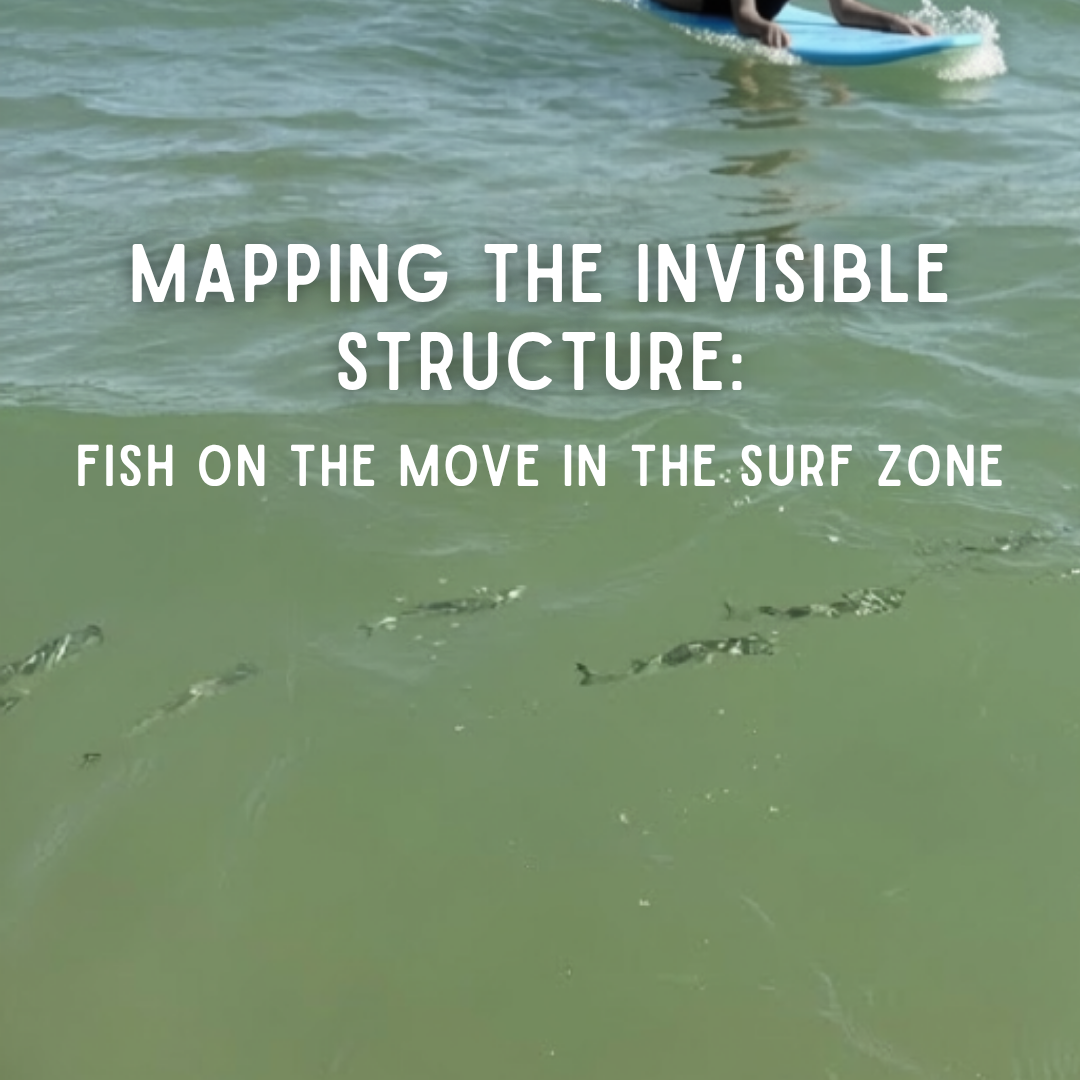
For beachgoers, this can become one of the easiest fall migrations to notice. Fish that spent summer spread through rivers, creeks, and sounds begin collecting into increasingly conspicuous schools as they move toward inlets and coastal water. Once along the ocean beach, dense schools may travel remarkably close to shore, sometimes darkening the shallows or stretching along the surf zone beyond what can be seen from one spot. Mullet are frequent jumpers as well, so a school may first reveal itself as silver fish repeatedly breaking the surface. By the time those schools reach the inlet and beach, they are carrying more than themselves with them. Striped mullet feed low in the food web, consuming algae, detritus, and organic material associated with estuarine sediments. As thousands of them move out of the estuary, that stored production moves with them and becomes available to the larger fishes, sharks, and birds that feed along the coast (Bacheler et al., 2005).
Those predators are already moving through the same corridor. Bluefish (Pomatomus saltatrix) feed heavily on schooling fishes such as mullet, menhaden, and silversides. Spanish mackerel (Scomberomorus maculatus) work schools of anchovies and other small baitfish, while blacktip sharks (Carcharhinus limbatus) and spinner sharks (Carcharhinus brevipinna) take advantage of dense concentrations of coastal prey.
The fall mullet run is therefore more than thousands of fish leaving an estuary. It is estuarine production moving through the inlet and onto the beach, where it begins to intersect with predators following their own seasonal routes.
That intersection is what makes the migration suddenly visible. A school that might otherwise pass unnoticed can tighten near shore as bluefish, mackerel, sharks, and birds begin responding to the same moving concentration of prey.
Spanish Mackerel, Bluefish, and the Surface Chase
Sometimes the easiest way to find a migration is not to look for the animals themselves, but for what happens to the water when they arrive.
Spanish mackerel (Scomberomorus maculatus) spend the warmer months moving north along the Atlantic coast, reaching North Carolina in spring and remaining through summer and early fall while coastal water stays above roughly 68°F. As that warm-water window begins closing, they turn south again toward winter habitat off Florida, feeding heavily along the way on anchovies, silversides, menhaden, mullet, and other small schooling fishes (North Carolina Division of Marine Fisheries, 2026; Sutherland & Fable, 1980).
Spanish mackerel (Scomberomorus maculatus) traveling in a dense school. | Image credit: Shutterstock
Bluefish (Pomatomus saltatrix) are moving through the same changing coast, but their fall pattern varies with age. Smaller bluefish tend to migrate south along the shoreline as water cools, while larger adults make more of an inshore-to-offshore shift. Farther north, fall movement begins as water drops into roughly the mid-50s Fahrenheit, gradually carrying fish into the warmer coastal waters to the south (Lund & Maltezos, 1970). By the time those movements reach the Carolina coast, they are crossing water already crowded with prey. Anchovies, silversides, juvenile menhaden, and other tiny schooling fishes—many of the fishes beachgoers collectively call “glass minnows”—can become compressed near the surface, and even wash onto shore, as mackerel and bluefish strike through the schools from below.
Little tunny (Euthynnus alletteratus), better known locally as false albacore, can join that fall activity around inlets and nearshore waters as well. They too make seasonal movements along the Atlantic coast, shifting north through the warmer part of the year and south again through fall and winter while feeding in fast-moving schools (North Carolina Division of Marine Fisheries, 2026).
Little tunny (Euthynnus alletteratus), also known as false albacore, moving in a feeding school. | Image credit: aurelpap, iNaturalist
From the beach, separating one predator from another may be nearly impossible. What becomes visible instead is the chase. A patch of otherwise smooth ocean suddenly begins to boil as tiny fish scatter across the surface. Gulls and terns converge overhead, pelicans turn toward the commotion, and dark backs or silver flashes cut through the school below.
Sometimes the entire event moves several hundred yards down the beach within minutes.
And the animals doing the chasing are still part of the food web themselves. Spanish mackerel and bluefish may be predators here, but both can become prey for larger sharks and tunas farther up the same moving chain. A small fish feeding on plankton becomes food for a mackerel; that mackerel may later become food for a shark.
Fall has compressed several levels of the food web into the same patch of water, and for a few minutes the whole thing becomes visible from shore.
The Sharks Following Fall
Shark migration can sound dramatic because sharks are dramatic animals.
Ecologically, however, their fall movements make perfect sense. Food is moving, water temperature is changing, nursery seasons are ending, and remaining in shallow water becomes increasingly expensive for animals whose body temperature largely follows the environment around them.
Blacktip sharks (Carcharhinus limbatus) and spinner sharks (Carcharhinus brevipinna) are warm-water coastal sharks frequently associated with schools of mullet, menhaden, and other fishes.
Blacktip (Carcharhinus limbatus) and spinner sharks (Carcharhinus brevipinna) can look very similar; fin markings and body proportions help separate the two. | Image credit: Bowers & Kaijiura, 2023
As coastal waters cool, these highly mobile sharks begin shifting south. For blacktips, that can mean a substantial journey: sharks that spent the warmer months along the Carolinas and farther north move down the Atlantic coast toward Florida, with large winter aggregations forming in the warm coastal waters of southeast Florida. Spinner sharks also shift south as autumn progresses, although exactly how their seasonal routes connect Carolina summer habitat with winter habitat farther south is less clearly understood (Manz et al., 2025). Their movement is not caused by prey alone. Temperature and the gradually shortening length of the day contribute to the timing of autumn migration, while concentrations of prey can influence where sharks pause and feed along the route (Manz et al., 2025). That shortening daylight is the actual span between sunrise and sunset—not the hour shown on our clocks. The gradual loss of daylight from late summer into fall provides a predictable seasonal signal even when water temperatures vary from one year to the next.
The shallow coastal habitats these sharks use during migration are also important much earlier in life. Blacktip pups are born in protected nursery areas away from most adults, and young sharks can remain associated with shallow coastal habitat for several years as they grow. Males generally reach maturity around four to five years old, while females mature closer to six or seven; spinner sharks follow a similarly slow timetable, with females maturing later than males (Carlson et al., 2006; NOAA Fisheries, 2017).
That means the shallow water along the coast is not simply a birthplace young sharks immediately leave behind. It can remain part of their world through several juvenile years before the broader seasonal movements of adulthood become established. Exactly how strongly young sharks remain connected to individual nursery areas is still being studied, but nursery habitat can shape where they spend some of the most vulnerable years of their lives (Heupel et al., 2007; NOAA Fisheries, 2017, 2024).
Around New River Inlet and the beaches of Topsail, those later seasonal movements begin intersecting with the migrations already underway. Schools of mullet, Spanish mackerel, and other coastal fishes can create concentrated feeding opportunities along the same corridor, and both blacktips and spinner sharks may breach during fast pursuits, with spinner sharks sometimes twisting through the air in the leaps that gave the species its name (Bangley, 2014).
A beachgoer watching a fall bait ball may therefore be seeing several stages of the coastal food web converge in the same narrow stretch of water.
Atlantic sharpnose sharks (Rhizoprionodon terraenovae) use shallow coastal waters, sounds, bays, and estuaries throughout the warmer months. Adults are generally only a few feet long and feed on small fishes, shrimp, crabs, squid, and other coastal prey (Bethea et al., 2006; Roskar et al., 2024).
Their fall movement is much smaller in scale than the southward migration of blacktips. During summer, Atlantic sharpnose are abundant in the shallow nearshore waters of Onslow Bay, where both immature and mature sharks occur and pups are likely born. As autumn progresses, they become less common in those shallow areas and shift toward deeper coastal habitat. Adults have even been found using offshore wrecks in North Carolina during winter before returning toward shallower water in spring (Roskar et al., 2024).
So for Atlantic sharpnose, fall may mean moving offshore without leaving the region entirely. Predation does not disappear from the coastal food web; it simply shifts into a different part of it.
Atlantic sharpnose shark (Rhizoprionodon terraenovae), a small coastal shark common in North Carolina’s warmer months. | Image credit: Virginia Institute of Marine Science
Sandbar sharks (Carcharhinus plumbeus) show how different that scale can become. Young sandbars spend the warmer months in shallow nursery habitat farther north along the Mid-Atlantic, then move offshore and south during late September and October. Many repeat that seasonal route for several years as juveniles, wintering from North Carolina toward Florida before returning north in spring. As they grow, the journey expands, with older sandbars ranging from southern New England to Florida and Cuba (Merson & Pratt, 2001; McCandless et al., 2007; Kohler et al., 1998).
Their autumn departure is tied closely to cooling water and shortening day length, while prey encountered along the route determines where they may stop and feed (Manz et al., 2025).
Sandbar sharks (Carcharhinus plumbeus), a large coastal species that shifts south and offshore as fall progresses. | Image credit: Simon Peggs, iNaturalist
Off Onslow County, artificial reefs and natural hard-bottom habitats add patches of structure to that broader migration corridor. AR-342, the Onslow Bay Saltwater Fishing Club Reef, lies in about 49 feet of water and is one such patch where fishes and other prey can concentrate along the shelf (North Carolina Division of Marine Fisheries, 2017).
A reef does not have to be an animal’s destination to matter. Sometimes it is simply a place to feed before the migration continues.
AR-342, the Onslow Bay Saltwater Fishing Club Reef, shown within the nearshore reef network off Onslow County. | Image credit: NC Division of Marine Fisheries
Cobia and the Last Warm-Water Feeding
Cobia (Rachycentron canadum) are another warm-season visitor beginning to run out of time. During spring and summer they move north along the Atlantic coast, using coastal and offshore waters from the Carolinas into Chesapeake Bay and farther north. They favor warm water, generally around 68–86°F, and as autumn temperatures begin slipping toward the lower end of that range, they start shifting offshore and south toward warmer winter habitat (Jensen & Graves, 2020).
Cobia (Rachycentron canadum), a warm-water coastal fish that begins shifting offshore and south as autumn temperatures cool. | Image credit: georgeh04, iNaturalist
That places coastal North Carolina somewhere in the middle of the journey. The cobia moving through our waters are not necessarily arriving for winter or leaving from a summer home here.
For many, this stretch of coast is part of the route between the two.
Along the way, structure matters. Buoys, wrecks, reefs, and artificial reefs can gather baitfish and other prey into small pockets of activity in otherwise open water, giving a traveling cobia a place to feed before continuing south (Jensen & Graves, 2020). A reef that holds feeding cobia may also be busy with reef fishes, passing mackerel, schools of bait, and other predators using the same patch of water for their own reasons.
By fall, the coast begins to feel less like a collection of separate habitats and more like a series of connected stopping places along the migration route.
Flounder Leave Through the Bottom
Not every migration announces itself at the surface. Some of the most important fall movement in Onslow County happens quietly along the bottom.
Southern (left) and summer flounder (right) both spend much of their early lives over shallow estuarine and coastal bottoms before mature fish move offshore to spawn. | Image credits: J. Weferling, iNaturalist (left); harrier, iNaturalist (right)
Southern flounder (Paralichthys lethostigma) spend the first years of their lives inside estuaries, lying over mud, sand, oyster habitat, creek bottoms, and other shallow nursery and feeding areas where they prey on fish and crustaceans. In North Carolina, many females begin reaching reproductive maturity around ages one to two and roughly 16 inches in length, although growth and maturity vary considerably among individual fish (Midway & Scharf, 2012). That means a southern flounder can spend years growing within the estuary before ever contributing to the offshore spawning population. Immature fish may remain within estuarine waters through winter, while mature fish begin leaving in fall for offshore spawning habitat. Fish encountered farther offshore tend to be larger and older, while younger fish remain more closely associated with the sounds, rivers, and creeks where they grew (Craig et al., 2015). A fish that spent its first years nearly invisible beneath New River mud can suddenly become part of an offshore migration.
Summer flounder (Paralichthys dentatus) make a similar outward journey, although their early life follows a slightly different timetable. Larvae and juveniles use coastal bays, sounds, and estuaries as nursery habitat for roughly their first 18 to 20 months, and most reach reproductive maturity around age two to three. In the South Atlantic Bight, about half are mature by roughly 11 to 12 inches total length, although females generally mature at a somewhat larger size than males (Packer, 1999).
Like southern flounder, they spend their younger years feeding and growing in protected coastal habitat before mature fish begin moving offshore in fall toward continental-shelf spawning grounds. By then, the fish leaving the estuary are not simply larger versions of the juveniles that remain behind; they are the part of the population capable of producing the next generation. So the two flatfish a beachgoer might easily confuse are doing something remarkably similar at this time of year. Both spend their younger years in shallow coastal and estuarine nursery habitat, and both eventually move offshore to spawn. What differs is the timing—how quickly they mature, how long they remain closely tied to those nursery grounds, and where along the coast each species is most concentrated.
The Fall Runs Gather Nearshore
The familiar fishes around piers change with fall too.
Spot (Leiostomus xanthurus) and Atlantic croaker (Micropogonias undulatus) spend important parts of their early lives inside estuaries, feeding over sandy and muddy bottoms on worms, small crustaceans, organic material, and other small prey (Warlen & Burke, 1990; Ross, 1988)
Atlantic croaker (Micropogonias undulatus) and spot (Leiostomus xanthurus), two familiar estuarine fishes that move toward coastal spawning waters in fall. | Image credit: C. Dzbanski
Spot remain closely tied to estuarine nursery habitat through their first year, gradually moving into deeper and saltier parts of the system as they grow. By fall, the larger fish begin gathering closer to channels, inlets, and the ocean before continuing toward offshore spawning grounds south of Cape Hatteras. There, spawning continues through fall and winter in substantially warmer shelf water, roughly 63–77°F, with the strongest activity around 68°F (Warlen & Chester, 1985; Allen et al., 2024).
Atlantic croaker follow a similar route on a slightly different schedule. Young croaker enter low-salinity estuarine nursery areas after being spawned offshore, then grow rapidly through their first year. As fall develops, many begin moving back toward open coastal water, with the spawning migration beginning as early as September and continuing into winter (White & Chittenden, 1977; Norcross & Austin, 1988).
Weakfish (Cynoscion regalis) join that same seasonal pull toward the coast. Through spring and summer they use sounds, estuaries, and nearshore habitat, feeding heavily on shrimp, crustaceans, and smaller fishes. As autumn water cools toward about 75°F, they begin gathering and shifting offshore and south; during warmer years, some linger longer before making that move (Krause et al., 2020).
Weakfish (Cynoscion regalis), a fall migrant along the Atlantic coast and currently listed as Endangered on the IUCN Red List. | Image credit: aiden007, iNaturalist
By this point in fall, fishes that spent summer scattered through different parts of the estuary are beginning to converge along the same channels, inlets, and nearshore corridor. The movement is outward, but not entirely.
While larger spot and croaker are leaving for offshore spawning grounds, their next generation is already beginning the opposite journey. Larvae produced offshore in fall and winter can begin entering North Carolina estuaries by late fall and early winter, with that inward movement continuing through spring (Warlen & Burke, 1990; Allen et al., 2024).
So even as one generation moves out through the inlet, another is beginning to come back in.
The Fish That Stay—but Change Address
Migration does not always mean leaving Onslow County. For some fishes, fall means finding a different part of the same estuary.
Spotted seatrout (Cynoscion nebulosus), or speckled trout, remain in coastal North Carolina through winter, but they do not necessarily stay where they spent August. As the shallow sounds and creek edges cool, trout begin gathering around channels, deeper holes, creek mouths, and other places where a few extra feet of water can provide more stable temperatures.
Spotted seatrout (Cynoscion nebulosus) moving through shallow coastal water before shifting toward deeper winter habitat as temperatures fall. | Image credit: charliew82, iNaturalist
That difference becomes increasingly important as winter approaches. Spotted seatrout begin showing cold stress when water falls below about 45°F, and prolonged periods below roughly 44.6°F can produce substantial winter mortality in North Carolina. Deeper sections of an estuary can remain slightly warmer during a severe cold event, giving fish somewhere to retreat when the shallows become too cold (Ellis, Buckel, & Hightower, 2017; Ellis, Buckel, Hightower, & Poland, 2017).
So the autumn congregation of trout around creek mouths, bridge structure, channels, and deep holes is more than a change in where they happen to be feeding. By fall, they are beginning to settle into the parts of the estuary that may carry them through winter.
Black drum (Pogonias cromis) reorganize themselves through fall as well, although their movement depends partly on age. Young black drum spend their first year within estuaries, feeding over mud, sand, oyster habitat, and other bottoms rich in worms, small crustaceans, and mollusks. As they grow, they begin using saltier water and deeper coastal habitat, while larger fish are often associated with oyster bars, bridge and dock pilings, channels, and other structure where clams, oysters, crabs, and other bottom prey collect (North Carolina Division of Marine Fisheries, 2026).
Black drum (Pogonias cromis) use estuaries when young, then shift toward deeper, saltier water as they grow and fall progresses. | Image credit: zachs, iNaturalist
By late fall, black drum generally shift away from the shallowest summer habitat toward deeper bays, sounds, channels, and offshore water. Unlike spotted seatrout, there is not one well-defined temperature at which that movement begins. Instead, cooling water gradually changes where suitable feeding and winter habitat remain available, with older fish tending to range farther toward high-salinity and offshore waters (North Carolina Division of Marine Fisheries, 2026).
A piling or oyster bar that held one mix of fishes through summer may still be occupied in November, but by a different combination of animals using the same structure for colder-water feeding and refuge.
The habitat has not disappeared. Its seasonal community has changed.
Shrimp Begin Pouring Out of the Creeks
Some of the most important migrants along the Onslow County coast are only a few inches long.
White shrimp (Litopenaeus setiferus), locally called greentails, spend much of their early lives inside estuarine nursery habitat. They grow rapidly in warm water, and once they reach only about 0.8 to 1.2 inches long, they begin leaving the shallowest marsh habitat for deeper creeks, rivers, bays, and sounds. By late summer and fall, larger young shrimp—often around 4.7 inches or more—are moving farther downstream toward channels, inlets, and ultimately the ocean (North Carolina Division of Marine Fisheries, 2023).
White shrimp (Litopenaeus setiferus) grow quickly in estuarine nurseries before moving downstream toward sounds, inlets, and coastal water in late summer and fall. | Image credit: portulaca, iNaturalist
Cooling water helps drive that progression, but rainfall can accelerate it. Heavy freshwater input lowers estuarine salinity and can push shrimp downstream and toward the ocean before they otherwise would have left. That means a wet fall and a dry fall do not necessarily produce the same migration (North Carolina Division of Marine Fisheries, 2023).
The shrimp are responding to an estuary that is changing around them, and almost everything seems interested in eating them. Flounder, speckled trout, red drum, weakfish, sharks, wading birds, and humans all take advantage of shrimp as they move through the coastal food web (North Carolina Division of Marine Fisheries, 2023).
A strong outward movement of white shrimp is therefore not merely a shrimp migration. It is a moving food resource.
When those shrimp leave marsh creeks and spread toward the sound and inlet, predators that were previously separated begin encountering the same pulse of prey in increasingly narrow parts of the estuary.
The estuary briefly becomes a funnel.
The Blue Crabs Take Different Roads
Blue crabs (Callinectes sapidus) complicate the idea of a single fall migration even further because males and females do not necessarily go the same direction.
Blue crab (Callinectes sapidus) in shallow estuarine habitat; mature females eventually move toward saltier water and coastal spawning areas. | Image credit: lenora_irene, iNaturalist
Adult males generally remain farther upriver in lower-salinity water, while mature females move toward saltier portions of the estuary and eventually toward inlet and coastal spawning habitat. Females can travel considerable distances during this migration, using salinity gradients, tides, and currents to move toward the high-salinity water needed for spawning (Bell & Eggleston, 2023; Forward et al., 2003).
That split makes sense once their life cycle is considered. Females typically mate in brackish estuarine water, then store sperm until they are ready to produce an egg mass. As spawning approaches, they move toward the lower estuary and inlet, where much saltier water provides the conditions their developing larvae need. Eggs hatch near the mouth of the estuary or just beyond it, and the larvae are carried offshore before later returning toward the coast as postlarvae (Forward et al., 2003; Epifanio, 2019).
The same inlet therefore serves two directions of the blue crab life cycle: mature females move outward toward spawning water, while a later generation is carried back toward estuarine nursery habitat.
For a blue crab, the difference between a brackish river and a salty inlet is not simply scenery. One supports mating and much of adult life, while the other provides the salinity needed to begin the next generation.
A single life cycle requires both.
Rays Begin Leaving the Shallows
Large dark wings moving beneath clear water are among the more obvious signs that rays are using shallow coastal habitat during summer. By fall, where those rays appear—and how they move through the coast—begins to change.
Cownose rays (Rhinoptera bonasus) are highly mobile schooling rays that use North Carolina sounds, estuaries, and nearshore waters during the warmer months. Through summer they may be scattered across that habitat, sometimes appearing alone or in small groups over shallow flats and sounds. As fall develops, rays that have been using North Carolina estuaries begin moving toward the ocean side, while migrants arriving from farther north join the same southbound corridor along the Carolina coast.
That is when larger schools can become more noticeable along the beaches and nearshore waters. Their movement continues south toward winter habitat off Florida, with cooling water helping shape when they leave northern and estuarine habitats (Goodman et al., 2010; Omori & Fisher, 2017; Bangley et al., 2021).
Cownose rays (Rhinoptera bonasus) traveling in a school, a familiar sight as they gather and move along the coast in fall. | Image credit: Chesapeake Bay Program
For someone watching from Topsail, the rays seen scattered through the sound during summer can become part of something much larger by fall. A few dark wings moving over an estuarine flat may give way to schools traveling along the ocean side as North Carolina becomes part of the passage between northern summer waters and winter habitat farther south.
Southern stingrays (Hypanus americanus) make a quieter seasonal shift. Their summer presence along North Carolina is part of a much older warm-season pattern, with southern stingrays historically documented moving north along the Carolina coast as warmer water expands their usable habitat (Coles, 1913).
Unlike cownose rays traveling in schools higher in the water column, southern stingrays remain closely tied to the bottom. Through summer, they can be a familiar sight moving over warm sand and mud flats, along creek mouths, and through shallow estuarine water as they search the bottom for worms, bivalves, shrimp, crabs, and small fishes. Even when they move between habitats, much of that movement remains along or just above the benthic surface rather than through open water (Gilliam & Sullivan, 1993; Tilley et al., 2013).
As the shallow flats cool through fall, they become less common in the places where beachgoers may have seen them repeatedly through July and August. Their seasonal movement is not mapped nearly as clearly in North Carolina as that of cownose rays, so we cannot point to one temperature or one offshore route. What we can say is that southern stingrays are capable of moving between shallow flats and considerably deeper bottom habitat while remaining closely associated with the seafloor (Coles, 1913; Corcoran et al., 2013).
For someone watching the shallows, that change may simply look like absence. The stingray that repeatedly crossed the same warm flat all summer is suddenly harder to find—not because it has joined a large southbound school above the bottom, but because its usable benthic habitat has shifted beyond the shallows where it was easiest to see.
Red Drum Gather at the Edges
Red drum (Sciaenops ocellatus), and our state fish, add another layer to the fall movement. Young fish spend their first years closely tied to estuaries, growing quickly from roughly 12 to 14 inches by their first birthday to more than 27 inches during their second full year. They do not reach reproductive maturity quite as quickly, however. In North Carolina, most become mature around ages three to four, when they are roughly 30 to 36 inches long (Ross et al., 1995).
Red drum (Sciaenops ocellatus) grow in estuaries when young, while larger adults gather around inlets and nearshore waters during late-summer and fall spawning. | Image credit: colesutton, iNaturalist
That difference is something a beachgoer or angler can actually see. The smaller “puppy drum” encountered along marsh edges, creeks, and sounds are still growing within the estuarine part of their life cycle, while the much larger fish appearing around beaches and inlets are increasingly part of the adult population that spends more time in coastal and ocean waters. By late summer and early fall, mature red drum gather around inlets, beaches, and nearshore waters, where spawning and feeding can overlap. In North Carolina, spawning occurs from August into early October near barrier-island inlets and adjacent coastal waters. During that same period, adults move more actively between estuarine and ocean habitats (Ross et al., 1995; Bacheler et al., 2009).
That puts a large red drum outside New River Inlet directly into the same corridor carrying mullet, menhaden, shrimp, spot, croaker, and other prey toward the ocean. It may be there to spawn, to feed, or simply because its own seasonal movement has brought it into the same narrow stretch of coast.
As fall gives way to winter, mature adults increasingly move into ocean waters where temperatures remain more moderate, while younger red drum are much more likely to remain behind in the estuary (Stewart & Scharf, 2008).
The Offshore Visitors Come Close
Fall also brings some animals toward the coast before eventually carrying them away.
King mackerel (Scomberomorus cavalla) are warm-water fish that seldom move into water much below about 68°F. Through summer and the warmer part of fall, they can move surprisingly close to the beaches, inlet mouths, and nearshore reefs of North Carolina, following schools of menhaden, mullet, sardines, and other prey into places where a beachgoer or pier angler may suddenly encounter a fish that spends much of its time farther offshore (North Carolina Division of Marine Fisheries, 2022).
That window does not last. As coastal water continues cooling toward the lower edge of their preferred range, king mackerel begin shifting south and farther toward the warmer waters of the continental shelf. By winter, much of the Atlantic population has moved toward southern Florida, while some fish remain in deeper North Carolina waters near the Gulf Stream (North Carolina Division of Marine Fisheries, 2022).
For a few weeks, that creates an unusual overlap along the Onslow coast. Animals moving out of the estuary meet predators moving closer to shore to feed, while other migrants are already passing south or beginning their move offshore. An inlet or artificial reef that seemed relatively quiet several weeks earlier can suddenly sit at the crossing point of several different seasonal routes.
For a short time, it becomes an intersection.
Then the Menhaden Arrive
By October and November, another migration becomes increasingly visible.
Atlantic menhaden (Brevoortia tyrannus) move south along the Atlantic coast as fall deepens, with older and larger fish returning from summer waters farther north. Spawning can occur along the migration route from late fall into early spring, but one of the major winter gathering areas lies off North Carolina near Cape Hatteras (Lewis et al., 1987; Nicholson, 1978).
For Onslow County, that means some of the dark schools appearing beyond the breakers are part of a much larger coastwide movement passing our beaches on the way toward winter spawning waters.
Menhaden occupy an unusual place in the coastal food web. They filter tiny phytoplankton and zooplankton from the water, then gather that scattered production into dense schools of oily fish large enough for predators to chase (Lewis & Peters, 1994). Bluefish, striped bass, sharks, tunas, dolphins, and seabirds all take advantage of them, making menhaden one of the connections between plankton near the bottom of the food web and some of the largest predators along the coast (Chagaris et al., 2020; Lewis & Peters, 1994).
For a beachgoer, the first sign may simply be a dark patch offshore that does not move like a shadow. Then birds begin gathering above it. The surface breaks as predators push into the school from below, and what looked like an indistinct patch of water suddenly becomes one of the busiest places along the beach.
That is when looking up becomes as important as looking into the water.
Because another migration has arrived.
The Atlantic Flyway Meets the Fall Fish Run
The Atlantic Flyway follows the eastern edge of North America, placing the North Carolina coast directly beneath one of the continent’s major migration routes. For birds traveling hundreds or thousands of miles between breeding and wintering grounds, Onslow County is not simply coastline passing beneath their wings. Its beaches, marshes, tidal flats, sounds, and inlets can provide places to rest and replenish the energy needed for the next part of the journey (Smith et al., 2022).
The Atlantic Flyway follows the eastern edge of North America, carrying migrating birds directly along the North Carolina coast. | Image credit: Audubon
Fall makes that stop especially busy because the migration overhead is unfolding at the same time the water below is changing. Shrimp are moving out of creeks. Mullet and other fishes are funneling toward the inlets. Schools of bait gather along the beaches, and menhaden begin moving down the coast. For birds that feed on fishes and coastal invertebrates, those movements can turn the Onslow shoreline into a series of feeding opportunities along the Atlantic Flyway.
But the transition is not a clean exchange in which the summer birds simply leave and winter birds immediately take their places. It happens gradually, with departures, arrivals, and birds merely passing through overlapping for weeks.
The Birds Moving Through or South
Some of the first changes are easiest to notice in the marsh. Green herons (Butorides virescens) begin moving south from late August through October, while least bitterns (Ixobrychus exilis) also leave much of their northern breeding range for warmer winter habitat. A bird that spent summer hunting from the edge of a tidal creek may simply become harder to find as September advances (Smith et al., 2022).
Along the beaches and nesting islands, the summer community begins loosening in several directions at once. Wilson’s plovers (Anarhynchus wilsonia), least terns (Sternula antillarum), gull-billed terns (Gelochelidon nilotica), black skimmers (Rynchops niger), and sandwich terns (Thalasseus sandvicensis) begin leaving breeding areas or redistributing south along the coast. Royal terns (Thalasseus maximus) may linger longer, while ospreys (Pandion haliaetus) begin following waterways and coastlines toward wintering grounds farther south (North Carolina Wildlife Resources Commission, 2025; Smith et al., 2022).
The shorebirds make the transition even less tidy.
The eastern Willet (Tringa semipalmata semipalmata) breeds in Atlantic salt marshes, including those along the North Carolina coast, before leaving for wintering grounds that can lie as far away as northern South America. But the Willet standing on a Topsail flat in fall is not automatically one of the birds that nested here. Western Willets (Tringa semipalmata inornata), which breed in the interior of western North America, can also occur along the Atlantic coast outside the breeding season. For a few weeks, birds from very different summer landscapes may use the same Carolina shoreline (Oswald et al., 2016; Huysman et al., 2022).
Lesser yellowlegs (Tringa flavipes) and greater yellowlegs (Tringa melanoleuca) add another layer of passing traffic. They arrive from breeding grounds much farther north, with adults beginning their southward movements as early as July and younger birds following later. Along coastal North Carolina, exposed flats, shallow marsh edges, and pools of tidal water become temporary feeding grounds along that journey (Smith et al., 2022).
That makes the falling tide part of the migration too. A mudflat that looked empty beneath the previous high tide can suddenly hold Willets, yellowlegs, plovers, and other shorebirds probing exposed sediment for worms, small crustaceans, mollusks, and other prey. North Carolina barrier-island studies have found fall shorebirds shifting among the swash zone, wet sand, spits, and tidal habitat as water levels change, using different pieces of the shoreline for feeding and resting through the tidal cycle (Tarr, 2008).
For some of those birds, the stop may last days. For others, only hours. The tide falls, a feeding ground appears, and birds moving along the Atlantic coast briefly settle into it before the water—or the migration—carries them onward.
The Winter Coast Begins Arriving
The winter coast does not arrive all at once. Its first birds begin appearing in September, more follow through October, and by November the sounds, marshes, and beaches of Onslow County can hold a noticeably different community than they did at the end of summer.
On the sounds and protected water behind the barrier islands, buffleheads (Bucephala albeola) begin settling into sheltered coves, bays, and estuaries, repeatedly disappearing beneath the surface in search of small crustaceans, mollusks, and other aquatic prey. Red-breasted mergansers (Mergus serrator) arrive as well, often working shallow coastal water and estuaries in small groups as they dive after fish (Gauthier, 1993; Titman, 1999; Smith et al., 2022).
The marsh begins changing at the same time. American black ducks (Anas rubripes) appear more regularly in salt marshes, tidal creeks, ponds, and estuaries, while Green-winged teal (Anas crecca) increase in shallow protected water. Both spent the breeding season much farther north, but by fall the sounds and marshes of the Atlantic coast have become part of their winter landscape (Robinson et al., 2016; Smith et al., 2022).
Along the ocean side, the change is visible at the water’s edge. Dunlin (Calidris alpina), sanderlings (Calidris alba), red knots (Calidris canutus), and black-bellied plovers (Pluvialis squatarola) begin working beaches, shoals, exposed flats, and inlet margins. Some will remain along the southeastern coast through winter, while others are pausing only long enough to feed before continuing south. As the tide falls they spread across wet sand and exposed flats; when the water returns, they are gradually pushed toward higher beaches and roosting areas (Burger et al., 2012; Smith et al., 2022; Tarr, 2008).
Red knots make the scale of that movement especially clear. A bird standing quietly near the wrack line may have arrived from Arctic breeding grounds and may still be headed toward winter habitat in the southeastern United States, the Caribbean, or northern South America. Individual birds do not all travel the same route or distance, but for some, the Carolina coast is only one stop in a journey spanning thousands of miles (Burger et al., 2012; Smith et al., 2022).
That changes what a quiet fall beach can mean. The wet sand, tidal flats, wrack, marshes, and sheltered water are not empty spaces between destinations. For birds arriving from the north, they are places to replace the energy already spent before the next part of the migration begins.
When the Food Web Takes to the Air
Fall adds another layer of hunters above the shoreline.
Peregrine falcons (Falco peregrinus) move south along the Atlantic coast during migration, often following the same barrier islands, mudflats, and shorelines being used by migrating shorebirds. They are not interested in the mullet, shrimp, or menhaden moving below the surface. They are interested in the birds feeding around them. Shorebirds, ducks, gulls, and other coastal birds become prey themselves, adding another level to the food web moving through the coast (Smith et al., 2022).
Farther offshore, the change becomes visible in a different way. Double-crested cormorants (Nannopterum auritum) arrive along the Carolina coast in large numbers and spend much of their time diving after fish. Menhaden are among the schooling fishes they readily take, tying these winter visitors directly into the same fall movement already passing through the inlets and along the beaches (Watts et al., 2023).
Red-throated loons (Gavia stellata) and common loons (Gavia immer) begin appearing along the ocean side as well. Both spend the warmer months much farther north, but by late fall they are back in shallow marine waters, sounds, bays, and estuaries where fish are abundant. A bird that spent summer on a northern lake or tundra pond may now be diving just beyond the breakers along Topsail (Stenhouse et al., 2020; Smith et al., 2022).
Then come the northern gannets (Morus bassanus).
By late fall, they become one of the most spectacular signs that the seasonal food web has shifted. Northern gannets spend much of the nonbreeding season between New York and North Carolina, feeding almost entirely on schooling fishes such as herring, mackerel, and menhaden over the continental shelf (Mowbray, 2020; Smith et al., 2022).
From shore, a feeding aggregation can seem to appear from nowhere. Large white birds circle above a patch of ocean, fold their wings, and plunge headfirst into the water. One follows another until dozens may be dropping into the same moving patch of sea.
The important thing may not be the gannets themselves, but what they are pointing toward. Beneath them is a school of fish. Around that school may be bluefish, sharks, dolphins, or other large predators pushing the same prey toward the surface. The birds above and the predators below are using the same concentration of food from opposite directions.
What began months earlier as plankton, marsh production, and small animals feeding inside estuaries has now moved far enough through the food web to become visible from the beach as birds falling out of the sky.
What Happens if One Migration Does Not Arrive?
It is easy to think about migration as something belonging to individual species—the mullet run, the shrimp migration, the shark migration, the Atlantic Flyway. But the coast does not experience those movements separately. Predators are responding to prey, young fishes are entering estuaries when nursery habitat and food are available, adults are leaving when spawning habitat lies offshore, and blue crabs are moving between different salinity zones because different stages of their lives depend on different parts of the estuary (Warlen & Burke, 1990; Forward et al., 2003).
That means a change in one migration does not necessarily stop with the animal making it.
If fewer mullet leave an estuary, there may be less concentrated prey moving along the beach for bluefish, sharks, pelicans, and terns. The difference is not simply fewer mullet in one place. Some of the energy that spent summer accumulating inside the estuary now reaches the nearshore food web in a different amount, at a different time, or along a different route (Bacheler et al., 2005).
White shrimp show how quickly those relationships can shift. Heavy rainfall lowers estuarine salinity and can push shrimp toward the inlet earlier than they might have moved during a drier fall. Predators farther inside the estuary may encounter fewer shrimp, while those gathered nearer the inlet may suddenly encounter more. The migration still happens, but its timing changes where that pulse of food becomes available (North Carolina Division of Marine Fisheries, 2023).
Temperature can alter the overlap in another way. A coastal shark that remains farther north later into a warm fall may not encounter its prey in quite the same places or at quite the same time if those prey are responding to a different set of seasonal cues. Warmer ocean conditions are already capable of delaying southward shark migrations and extending how long some species remain in northern seasonal habitat (Manz et al., 2025).
None of this means every migration must occur on the same date each year. Coastal systems have always varied with storms, rainfall, temperature, currents, and food availability. What matters is that the movements continue to cross one another often enough for the relationships among them to persist.
A predator still has to encounter its prey. A larva still has to reach suitable nursery habitat, and a migrating bird still has to find enough food to continue south.
The timing does not have to be exact, but the meeting still has to happen.
Watching the Coast Change
By September, the first changes are already beginning. Mullet gather near the inlets, shrimp move out of tidal creeks, rays become less common over shallow flats, and feeding birds begin revealing where bait has collected near the surface.
By October and November, the same places can hold a very different community. Some animals have moved only a few miles into deeper water, while others are passing Onslow County on journeys that continue far beyond the Carolina coast.
The landscape itself looks much the same. New River Inlet still cuts through the barrier island. The marsh grass still bends with the wind. The same beach stretches north and south. What changes is who is moving through it.
For a few months each fall, Onslow County becomes a meeting place between departures, arrivals, and animals simply shifting into the next piece of habitat they need.
The landscape stays where it is. The food web moves through it.
Wilson Bay along the New River in Jacksonville, North Carolina. The landscape stays where it is, even as the food web moves through it. | Image credit: A. Mitchell
References
Allen, D. M., Govoni, J. J., Able, K. W., Buckel, J. A., Hale, E. A., Hilton, E. J., Kellison, G. T., Targett, T. E., Taylor, J. C., & Walsh, H. J. (2024). Long-term dynamics of larval and early juvenile spot (Leiostomus xanthurus) off the U.S. East Coast: Relating ocean origins, estuarine Ingress, and changing environmental conditions. Fishery Bulletin, 122(4), 162-185. https://doi.org/10.7755/fb.122.4.3
Bacheler, N. M., Paramore, L. M., Burdick, S. M., Buckel, J. A., & Hightower, J. E. (2009). Variation in movement patterns of red drum (Sciaenops ocellatus) inferred from conventional tagging and ultrasonic telemetry. Fishery Bulletin, 107(4), 405-419. https://spo.nmfs.noaa.gov/sites/default/files/pdf-content/2009/1074/bacheler.pdf
Bacheler, N. M., Wong, R. A., & Buckel, J. A. (2005). Movements and mortality rates of striped mullet in North Carolina. North American Journal of Fisheries Management, 25(1), 361-373. https://doi.org/10.1577/m04-033.1
Bangley, C. W., Edwards, M. L., Mueller, C., Fisher, R. A., Aguilar, R., Heggie, K., Richie, K., Ahr, B. J., & Ogburn, M. B. (2021). Environmental associations of cownose ray (Rhinoptera bonasus) seasonal presence along the U.S. Atlantic coast. Ecosphere, 12(9). https://doi.org/10.1002/ecs2.3743
Bell, G. W., & Eggleston, D. B. (2023). Timing and route of migration of mature female blue crabs in a large, wind-driven Estuary. Transactions of the American Fisheries Society, 152(2), 253-269. https://doi.org/10.1002/tafs.10391
Bichy, J. B. (2004). A life history assessment on the reproduction and growth of striped mullet, Mugil cephalus, in North Carolina [Unpublished master’s thesis]. North Carolina State University.
Burger, J., Niles, L. J., Porter, R. R., Dey, A. D., Koch, S., & Gordon, C. (2012). Using a shore bird (red knot) fitted with geolocators to evaluate a conceptual risk model focusing on offshore wind. Renewable Energy, 43, 370-377. https://doi.org/10.1016/j.renene.2011.11.006
Carlson, J. K., Sulikowski, J. R., & Baremore, I. E. (2006). Do differences in life history exist for blacktip sharks, Carcharhinus limbatus, from the United States south Atlantic bight and eastern Gulf of Mexico? Environmental Biology of Fishes, 77(3-4), 279-292. https://doi.org/10.1007/s10641-006-9129-x
Chagaris, D., Drew, K., Schueller, A., Cieri, M., Brito, J., & Buchheister, A. (2020). Ecological reference points for Atlantic menhaden established using an ecosystem model of intermediate complexity. Frontiers in Marine Science, 7. https://doi.org/10.3389/fmars.2020.606417
Coles, R. J. (1913). Notes on the embryos of several species of rays, with remarks on the northward summer migration of certain tropical forms observed on the coast of North Carolina. Bulletin of the American Museum of Natural History, 32, 29-35. https://www.biodiversitylibrary.org/page/26891225#page/491/mode/1up
Corcoran, M. J., Wetherbee, B. M., Shivji, M. S., Potenski, M. D., Chapman, D. D., & Harvey, G. M. (2013). Supplemental feeding for ecotourism reverses Diel activity and alters movement patterns and spatial distribution of the southern Stingray, Dasyatis americana. PLoS ONE, 8(3), e59235. https://doi.org/10.1371/journal.pone.0059235
Craig, J. K., Smith, W. E., Scharf, F. S., & Monaghan, J. P. (2015). Estuarine residency and migration of southern flounder inferred from conventional tag returns at multiple spatial scales. Marine and Coastal Fisheries, 7(1), 450-463. https://doi.org/10.1080/19425120.2015.1079578
Ellis, T. A., Buckel, J. A., Hightower, J. E., & Poland, S. J. (2017). Relating cold tolerance to winterkill for spotted seatrout at its northern latitudinal limits. Journal of Experimental Marine Biology and Ecology, 490, 42-51. https://doi.org/10.1016/j.jembe.2017.01.010
Ellis, T., Buckel, J., & Hightower, J. (2017). Winter severity influences spotted seatrout mortality in a southeast US estuarine system. Marine Ecology Progress Series, 564, 145-161. https://doi.org/10.3354/meps11985
Epifanio, C. E. (2019). Early life history of the blue crab Callinectes sapidus: A review. Journal of Shellfish Research, 38(1), 1-22. https://doi.org/10.2983/035.038.0101
Forward, R. B., Tankersley, R. A., & Welch, J. M. (2003). Selective tidal-stream transport of the blue crab Callinectes sapidus: An overview. Bulletin of Marine Science, 72(2), 347-365. https://scholars.duke.edu/publication/771475
Gauthier, G. (1993). Bufflehead (Bucephala albeola). In The Birds of North America (67th ed.). The Academy of Natural Sciences of Philadelphia & The American Ornithologists’ Union.
Goodman, M. A., Conn, P. B., & Fitzpatrick, E. (2010). Seasonal occurrence of Cownose rays (Rhinoptera bonasus) in North Carolina’s estuarine and coastal waters. Estuaries and Coasts, 34(3), 640-651. https://doi.org/10.1007/s12237-010-9355-5
Heupel, M., Carlson, J., & Simpfendorfer, C. (2007). Shark nursery areas: Concepts, definition, characterization and assumptions. Marine Ecology Progress Series, 337, 287-297. https://doi.org/10.3354/meps337287
Huysman, A. E., Cooper, N. W., Smith, J. A., Haig, S. M., Heath, S. A., Johnson, L., Olson, E., Regan, K., Wilson, J. K., & Marra, P. P. (2022). Strong migratory connectivity indicates Willets need subspecies-specific conservation strategies. Ornithological Applications, 124(3). https://doi.org/10.1093/ornithapp/duac015
Jensen, D. R., & Graves, J. E. (2020). Movements, habitat utilization, and post-release survival of cobia (Rachycentron canadum) that summer in Virginia waters assessed using pop-up satellite archival tags. Animal Biotelemetry, 8(1). https://doi.org/10.1186/s40317-020-00212-0
Krause, J. R., Hightower, J. E., Buckel, J. A., Turnure, J. T., Grothues, T. M., Manderson, J. P., Rosendale, J. E., & Pessutti, J. P. (2020). Using acoustic telemetry to estimate weakfish survival rates along the U.S. East Coast. Marine and Coastal Fisheries, 12(5), 241-257. https://doi.org/10.1002/mcf2.10095
Lewis, R. M., Ahrenholz, D. W., & Epperly, S. P. (1987). Fecundity of Atlantic menhaden, Brevoortia tyrannus. Estuaries, 10(4), 347. https://doi.org/10.2307/1351894
Lund, W. A., & Maltezos, G. C. (1970). Movements and migrations of the bluefish, Pomatomus saltatrix, tagged in waters of New York and southern New England. Transactions of the American Fisheries Society, 99(4), 719-725. https://doi.org/10.1577/1548-8659(1970)99<719:mamotb>2.0.co;2
Manz, M. H., Shipley, O. N., Cerrato, R. M., Hueter, R. E., Newton, A. L., Tyminski, J. P., Franks, B. R., Curtis, T. H., Fischer, C., Zacharias, J. P., Scott, C., Dunton, K. J., Kneebone, J., Peterson, B. J., Scannell, B. J., Dodd, J. F., & Frisk, M. G. (2025). Predictions of southern migration timing in coastal sharks under future ocean warming. Conservation Biology, 39(6), e70080. https://doi.org/10.1111/cobi.70080
McCandless, C. T., Pratt, Jr., H. L., Kohler, N. E., Merson, R. R., & Recksiek, C. W. (2007). Distribution, localized abundance, movements, and migrations of juvenile sandbar sharks tagged in Delaware Bay. In Shark nursery grounds of the Gulf of Mexico and the east coast waters of the United States (pp. 45-62). American Fisheries Society Symposium. https://doi.org/10.47886/9781888569810.ch4
Merson, R. R., & Pratt, Jr., H. L. (2001). Distribution, Movements and Growth of Young Sandbar Sharks, Carcharhinus Plumbeus, in the Nursery Grounds of Delaware Bay. Environmental Biology of Fishes, 61, 13-24. https://link.springer.com/article/10.1023/A:1011017109776
Midway, S. R., & Scharf, F. S. (2012). Histological analysis reveals larger size at maturity for southern flounder with implications for biological reference points. Marine and Coastal Fisheries, 4(1), 628-638. https://doi.org/10.1080/19425120.2012.717524
Mowbray, T. B. (2020). Northern Gannet (Morus bassanus). In Birds of the World (1.0th ed.). Cornell Lab of Ornithology. https://doi.org/10.2173/bow.norgan.01
Nicholson, W. R. (1978). Movements and population structure of Atlantic menhaden indicated by tag returns. Estuaries, 1(3), 141. https://doi.org/10.2307/1351455
Norcross, B. L., & Austin, H. M. (1988). Middle Atlantic bight meridional wind component effect on bottom water temperatures and spawning distribution of Atlantic croaker. Continental Shelf Research, 8(1), 69-88. https://doi.org/10.1016/0278-4343(88)90025-8
Omori, K. L., & Fisher, R. A. (2017). Summer and fall movement of cownose ray, Rhinoptera bonasus, along the East Coast of United States observed with pop-up satellite tags. Environmental Biology of Fishes, 100(11), 1435-1449. https://doi.org/10.1007/s10641-017-0654-6
Oswald, J. A., Harvey, M. G., Remsen, R. C., Foxworth, D. U., Cardiff, S. W., Dittmann, D. L., Megna, L. C., Carling, M. D., & Brumfield, R. T. (2016). Willet be one species or two? A genomic view of the evolutionary history of Tringa semipalmata. The Auk, 133(4), 593-614. https://doi.org/10.1642/auk-15-232.1
Packer, D. B. (1999). Essential fish habitat source document. Summer flounder, Paralichthys dentatus, life history and habitat characteristics (NOAA Technical Memorandum NMFS-NE-151). National Marine Fisheries Service. https://repository.library.noaa.gov/view/noaa/3149
Robinson, O. J., McGowan, C. P., & Devers, P. K. (2016). Updating movement estimates for American Black ducks (Anas rubripes). PeerJ, 4, e1787. https://doi.org/10.7717/peerj.1787
Roskar, G., Morley, J. W., & Buckel, J. A. (2024). Seasonality and relative abundance within an elasmobranch assemblage near a major biogeographic divide. PLOS ONE, 19(6), e0300697. https://doi.org/10.1371/journal.pone.0300697
Ross, J. L., Stevens, T. M., & Vaughan, D. S. (1995). Age, growth, mortality, and reproductive biology of red drums in North Carolina waters. Transactions of the American Fisheries Society, 124(1), 37-54. https://doi.org/10.1577/1548-8659(1995)124<0037:agmarb>2.3.co;2
Ross, S. W. (1988). Age, growth, and mortality of Atlantic croaker in North Carolina, with comments on population dynamics. Transactions of the American Fisheries Society, 117(5), 461-473. https://doi.org/10.1577/1548-8659(1988)117<0461:agamoa>2.3.co;2
Smith, M. A., Mahoney, J., Knight, E. J., Taylor, L., Seavy, N. E., Bailey, O. H., Carbone, M., DeLuca, W., Gonzalez, N. S., Jimenez, M. F., W. O’Bryan, G. M., Rao, N., Witko, C. J., Wilsey, C., & Deppe, J. L. (2022). Bird Migration Explorer. National Audubon Society. https://explorer.audubon.org/
Stenhouse, I. J., Berlin, A. M., Gilbert, A. T., Goodale, M. W., Gray, C. E., Montevecchi, W. A., Savoy, L., & Spiegel, C. S. (2020). Assessing the exposure of three diving bird species to offshore wind areas on the U.S. Atlantic outer continental shelf using satellite telemetry. Diversity and Distributions, 26(12), 1703-1714. https://doi.org/10.1111/ddi.13168
Stewart, C. B., & Scharf, F. S. (2008). Estuarine recruitment, growth, and first‐year survival of juvenile red drum in North Carolina. Transactions of the American Fisheries Society, 137(4), 1089-1103. https://doi.org/10.1577/t07-176.1
Sutherland, D. F., & Fable, Jr., W. A. (1980). Results of a king mackerel (Scomberomorus cavalla) and Atlantic Spanish mackerel (Scomberomorus maculatus) migration study, 1975–79 (NOAA Technical Memorandum NMFS-SEFC-12). National Marine Fisheries Service. https://repository.library.noaa.gov/view/noaa/5385
Tilley, A., López-Angarita, J., & Turner, J. (2013). Effects of scale and habitat distribution on the movement of the southern stingray Dasyatis americana on a Caribbean atoll. Marine Ecology Progress Series, 482, 169-179. https://doi.org/10.3354/meps10285
Titman, R. D. (n.d.). Red-breasted Merganser (Mergus serrator). In The Birds of North America (443rd ed.). A. Poole & F. Gill.
Warlen, S. M., & Burke, J. S. (1990). Immigration of larvae of fall/Winter spawning marine fishes into a North Carolina Estuary. Estuaries, 13(4), 453. https://doi.org/10.2307/1351789
Warlen, S. M., & Chester, A. J. (1985). Warlen, S. M., & Chester, A. J. (1985). Age, growth, and distribution of larval spot, Leiostomus xanthurus, off North Carolina. Fishery Bulletin, 83(4), 587–599. Fishery Bulletin, 83(4), 587-599. https://spo.nmfs.noaa.gov/sites/default/files/pdf-content/fish-bull/warlen.pdf
Watts, B. D., Paxton, B. J., Hines, C., & Anderson, S. K. (2023). Estimating potential menhaden consumption by double-crested cormorants along the coast of North Carolina. Frontiers in Marine Science, 10, 1193429. https://doi.org/10.3389/fmars.2023.1193429
White, M. L., & Chittenden, Jr., M. E. (1977). Age determination, reproduction, and population dynamics of the Atlantic croaker, Micropogonias undulatus. Fishery Bulletin, 75(1), 109-123.
Somewhere between watching my daughter catch waves and standing in the surf zone waiting for the next decent one to come through, I noticed the fish.
They were small—anchovy-like from where I stood, although the glare on the water and the constant movement made identification nearly impossible. What caught my attention wasn’t what they were. It was the fish on the move beside us, all traveling in the same narrow line for almost four hours.
They were moving parallel to the beach in a line perhaps four inches wide, almost exactly where the waves were breaking.
A wave would come through hard enough to knock us backward. Water rushed toward shore and then pulled against our legs as it returned. My daughter and I moved with it.
The fish didn’t seem to.
The line continued.
A little farther offshore was another line of larger fish. They were less tightly packed, but moving along the same general stretch of coast. Beyond them, one or two long, slender fish held near my daughter’s board. We couldn’t identify them with certainty, although their shape was consistent with one of our larger needlefishes, possibly a houndfish. They didn’t appear to be simply passing through. They would dart toward the smaller fish, take one, and return.
Farther still, just beyond the breakers, something much larger came partly out of the water while apparently feeding. It happened too quickly to tell whether it was a shark, large fish, or something else.
Then the line of little fishes passing in front of me suddenly broke.
Fish scattered and began leaping from the water, fleeing something I couldn’t see. Almost immediately, there seemed to be another pursuit underway.
That seemed like a good time for us to take a short break on the beach.
We had been in the water for nearly four hours by then, and those little fish had been passing us for much of it.
It was only after watching them for so long that the strange part became obvious.
The water looked like one place. We had been watching fish on the move through the surf zone all afternoon.
The fish were behaving as though it wasn’t.
The Line That Didn’t End
Standing in the surf, it is easy to think of the shallow water as a temporary place.
Waves arrive. Water runs up the beach and retreats. Sand shifts beneath your feet. A few yards offshore, another wave rises over a bar and breaks. Everything seems to be moving too much for anything resembling a pathway to exist.
To a fish, however, that same water contains structure.
Even water only a few inches or a foot deep can hold its own patterns. Small runnels form behind sandbars, wave energy changes as water crosses them, and fishes can move parallel to shore through these shallow strips rather than spreading evenly across the surf. The exact species may change from beach to beach, but the pattern is not unusual: fishes sort themselves through very small differences in shallow-water habitat (Layman, 2000).
Look closely and the tiny fish begin to appear—a narrow line moving through water that, at first glance, looks almost empty. | Image credit: A. Mitchell
Late summer can make those patterns especially noticeable. Along our part of the coast, both the number of fish and the variety of species using the surf climb through the warm months, reaching their highest levels from June through August (North Carolina Sea Grant, 2019).
So the little fish moving past our legs weren’t occupying empty water between the beach and the ocean.
They were inside habitat. And habitat has shape.
Mapping the Invisible Structure
Most of that shape disappears when we look across the water from shore.
We can see the obvious pieces. Waves often reveal where a sandbar rises toward the surface. Darker water may hint at a trough. A break in the waves can sometimes betray a deeper channel. Farther out, the water deepens into another shade.
For a small fish, those changes don’t have to be dramatic to matter.
A few inches of depth can change how quickly the water moves, how much wave energy reaches a spot, what food passes through and which animals can follow. Temperature and wave conditions add another layer. Together, they turn what looks like one open stretch of surf into a collection of much smaller usable spaces (Olds et al., 2018).
The difference between standing here and standing three feet farther out may barely register to us.
To a fish only a few inches long, it can mean different water.
That becomes easier to picture when we pull back and look at the coast beneath us.
Off Onslow County, the continental shelf doesn’t plunge quickly into deep water. It stretches gradually away from shore across a broad, shallow part of Onslow Bay. Near the beach, the bottom is mostly sand, with shell fragments and coarser material mixed through some areas. Closer to shore, that otherwise gentle slope is interrupted again and again by the smaller features we actually feel beneath our feet—bars, dips, troughs and runnels that waves and currents continually reshape (North Carolina Coastal Resources Commission Science Panel, 2026; Tyler & Kowalewski, 2018).
Along the Onslow County coast, the shallow sandy bottom rises and falls in subtle bars, troughs, and runnels that can shape how fish use the surf zone. | Image credit: A. Mitchell
To us, one of those dips may simply feel like the water suddenly came a little higher on our bodies.
For a fish only a few inches tall, it can be a different piece of the landscape.
That doesn’t mean the little school we watched was tracing a particular underwater trough. We couldn’t see the bottom well enough to know that.
But their persistence was revealing something.
Waves repeatedly pushed us out of position while fish continued moving through approximately the same narrow part of the surf. Whatever they were responding to—depth, current, food, protection, or some combination—the fish could perceive differences in that water that we couldn’t.
Their movement made some of the invisible structure visible.
Why the Smallest Fish Remain Close to Shore
There is something counterintuitive about watching tiny fish choose the place where waves are breaking. It doesn’t look protected.
For us, it was the part of the water most likely to knock us over.
But safety underwater doesn’t necessarily look like calm water.
For a small fish, extremely shallow water can make life more difficult for some of the animals trying to catch it. A larger predator may still enter—and plenty do—but depth, turbulence and room to maneuver change as the water shoals toward the beach. Juvenile fishes can shift into different depths as they balance the food available there against the risk of being eaten, so sometimes moving only a little shallower can change the odds (Layman, 2000; Miltner et al., 1995; Munsch et al., 2016).
The breaking surf may look rough and exposed to us, but for small fish, shallow water can change both access to food and the odds of being caught by a larger predator. | Image credit: A. Mitchell
And there is plenty to eat.
During summer, some of the smallest schooling fishes—including bay anchovies, striped anchovies and Atlantic silversides—feed largely on plankton carried through the surf. Summer zooplankton can include copepods, mysids, crab larvae and other tiny animals whose numbers shift with tides and time of day (DeLancey, 1987, 1989). Other fishes take food from the sand itself, including mole crabs, passing energy from animals buried beneath the beach into fishes farther up the food web. Surveys of southeastern surf zones have found dozens of species of fish and swimming invertebrates moving through these waters over the seasons (Anderson et al., 1977).
Even some of the food at the very bottom of that web is being produced right there. The phytoplankton growing in southeastern North Carolina’s surf can make these shallow waters considerably more productive than the coastal ocean just offshore, although not as productive as our estuaries (Cahoon et al., 2017).
There is something else happening in all that breaking white water too.
Warm water cannot hold as much oxygen as cooler water. But every time a wave breaks, it churns air into the water. On a hot August day, the same foam and bubbles tossing us around are also helping oxygen move between the air and the shallows (Deike, 2022).
That doesn’t mean the fish were following an oxygen-rich pathway. We couldn’t know that from what we saw. It is simply another reminder that the breaking surf is not just rougher water. Physically and chemically, things are happening there that are different from the calmer water only a short distance away.
The water washing around our ankles is therefore not simply the edge of somewhere more biologically important. It produces food, carries food, exchanges gases with the air—and fishes use it.
That makes the shallow surf something more complicated than a hiding place. A young fish may be balancing several things at once: finding enough food, spending as little energy as possible to get it, and remaining somewhere its chances of becoming food are lower. Different species solve that problem differently.
Juvenile Florida pompano and gulf kingfish offer a good example. Rather than constantly traveling along the coastline, some can remain surprisingly attached to particular stretches of surf-zone nursery habitat for weeks (Ross & Lancaster, 2002).
So even a fish that appears to be traveling may still be working within a familiar piece of shoreline—feeding through it, shifting with the tide, or repeatedly using the same shallow habitat.
The scale of movement matters as much as the movement itself.
The Edge Is Where Dinner Waits
Where prey gather predictably, predators gain an advantage too.
That made the behavior we saw especially interesting. Houndfish, one possible match for those long fish, are large needlefishes built to take other fish, and the ones near us seemed less interested in charging through the entire school than in picking off individuals. They waited, darted toward the passing fish, took one, then returned to approximately the same area. Meanwhile, the line of small fishes carried on like nothing had occurred.
Farther out, where the water had changed to deep green, something much larger appeared to be doing its own version of the same thing. Whatever the animal was, we saw it break the surface more than once in approximately the same area while fish were there.
A predator doesn’t have to search every yard of open water equally.
Sometimes the predator is little more than a glimpse. A small fin breaking the surface (upper right of image) can be the only visible clue that something larger is working the same patch of water as the baitfish. | Image credit: A. Mitchell
Schooling fishes gather where conditions favor them, and those concentrations can be shaped by depth, temperature, currents and other physical features. When prey collect in one place instead of being scattered widely, feeding opportunities become concentrated there too (Goetsch et al., 2023; Olds et al., 2018).
Surf fishermen have been reading that relationship from above the water for generations. A trough, a cut through a sandbar or a sudden concentration of bait can be a clue not only to where the smaller fish are gathering, but to where something larger may come looking for them (Ward, n.d.).
What looked from our perspective like separate layers of fish may therefore have been something more dynamic.
The smallest fish were using conditions that suited them. Their concentration, in turn, created an opportunity for a predator capable of working alongside that concentration. What gave one animal access to plankton or a little more protection could simultaneously make it easier for another animal to find dinner.
The fish may disappear beneath the surface, but the water can still give it away—a brief wake or disturbance marking movement that is otherwise hidden from view. | Image credit: A. Mitchell
It wasn’t simply a food chain conveniently lined up from smallest fish near shore to largest predator offshore. Each animal was using the same physical landscape differently, and one animal’s useful habitat could become another animal’s hunting ground.
The structure beneath the water wasn’t just organizing where fish could move.
It was helping organize where encounters between them could happen.
When the Line Breaks
The fish themselves add another layer.
Once individuals gather into a school, they begin responding not only to the water and predators around them, but to one another.
“Safety in numbers” captures only part of what that accomplishes. A fish in a school has neighbors watching in many directions, and information about danger can move rapidly through the group. Individuals continually adjust their spacing and direction in response to nearby fish, habitat and perceived threats, so a school can tighten, turn or reorganize without every fish having to detect the predator independently (Munsch et al., 2016).
There are tradeoffs. A large school may be easier to notice than a lone fish, and crowding means sharing food and space. But once a predator attacks, the group can make choosing and isolating a single target much harder. Instead of one fish moving through open water, the predator encounters many similar bodies changing direction almost at once.
And all of that coordination has to happen while the water beneath them is moving too.
A school in the shallow surf isn’t reacting to a predator against a blank background. Depth is changing. Waves are passing through. Currents are pushing alongshore and back toward the sea. The fish have to stay together while continuously adjusting to the landscape around them.
Then an attack can rearrange everything in seconds.
A school may compress, turn sharply, split apart, or scatter as the threat moves through it. Sometimes the quickest route away is upward, and baitfish begin breaking the surface.
Sometimes the chase shows itself before the predator does. A small patch of agitated water can be the only sign that the school beneath the surface has suddenly changed direction. | Image credit: A. Mitchell
From above, that sudden spray of little bodies can look almost disconnected from what caused it. The predator may never become visible at all. What we see is the response moving through the school—the orderly shape breaking apart and reforming as hundreds of tiny decisions happen at once.
The line, in other words, was never simply a line.
It was a coordinated group whose shape could change almost instantly when the balance between traveling, feeding and surviving changed.
Just Beyond the Breakers
The surf zone doesn’t end at a precise biological boundary where the last wave breaks.
The water on either side of that breaker is connected, but the conditions are changing. Depth increases. The bottom falls farther away. Wave energy changes. Animals that can move comfortably through one part of that gradient may use another part differently, and fishes can cross between them as their needs change (Olds et al., 2018).
Beyond the shallow surf, the water deepens and the habitat changes with it—but the boundary is not a hard line. Fish move back and forth across that transition as their needs change. | Image credit: A. Mitchell
That makes the surf less like a row of separate habitats and more like a transition.
On the landward side are the shallow runnels and troughs used by small fishes. Farther out, those waters connect with the open nearshore ocean. Along the beach, the same surf runs toward inlets, and beyond those inlets lie estuaries and nursery habitats. For a fish, these aren’t necessarily separate places encountered one at a time. They can be connected parts of its life.
That connection becomes particularly important for young fishes.
Some species arrive in shallow coastal waters during early life stages. Others move between estuarine nurseries and the ocean as they grow. Still others use the surf primarily to feed or travel. The importance of any one patch of shallow water therefore depends partly on what it connects to (Olds et al., 2018; Ross & Lancaster, 2002).
Predators cross those connections as well. As prey move into deeper water, toward an inlet or along the shoreline, they become available to a different mix of animals. Conversely, a predator following prey does not need to remain on one side of a line humans call “the breakers.”
The larger animal we glimpsed offshore isn’t evidence of a particular cross-shore food chain. We don’t know what it was, what it caught, or why it was feeding there.
What its presence does illustrate is that the ecological landscape continues beyond what we can easily see from knee- or waist-deep water.
The surf is an edge, but it is also a bridge.
Movement Within Movement
Follow that bridge along the North Carolina coast and the scale changes again.
Our long stretches of open beach are repeatedly interrupted by inlets, and behind those inlets lie sounds, tidal creeks, marshes and estuaries. To us, those places often have separate names and boundaries. To a fish moving through them, they are connected pieces of habitat used at different times and for different reasons.
The surf itself can be both a place to feed and a route between those places (Olds et al., 2018). A juvenile using shallow water may later move deeper, follow the coast toward an inlet, or leave a nursery area as it grows. Another fish may do almost the opposite and remain surprisingly local. Juvenile Florida pompano and gulf kingfish tagged along southeastern North Carolina beaches, for example, could remain faithful to relatively small areas of surf for extended periods (Ross & Lancaster, 2002).
A few feet with the tide, weeks along one beach, a journey between estuary and ocean, or a seasonal movement along hundreds of miles of coastline can therefore all belong to the same animal at different times in its life.
What looks like one continuous stretch of water can connect very different habitats—from the shallow surf to inlets, estuaries, and the nearshore ocean. | Image credit: A. Mitchell
Those aren’t separate stories.
They fit inside one another.
That is what makes a shallow stretch of surf important even when it is not a final destination. It may be feeding ground, nursery habitat, temporary refuge, travel corridor—or simply the connective piece that allows a fish to reach the next habitat it needs.
The coastline is not only habitat made of places.
It is habitat made of connections between them.
The Late-Summer Coast
By August, many of those connections are busy.
The surf fills with its greatest abundance and variety of fishes during the warm months from June through August (North Carolina Sea Grant, 2019). The shallowest surf holds its greatest abundance and diversity during this part of the year (Layman, 2000).
For someone walking into warm August water, that means the crowd beneath the surface can be very different from the one occupying the same beach in winter.
By late summer, the shallow surf can look almost unchanged from day to day while the mix of fish moving through it shifts with temperature, tide, food, and life stage. | Image credit: A. Mitchell
Some of the year’s young fishes have had months to grow. Seasonal changes in plankton and animals living on and beneath the sand alter the food available to them, while water temperature, tides, waves and each species’ own life cycle influence which fishes are present and where they spend their time (Anderson et al., 1977; DeLancey, 1987, 1989; Olds et al., 2018; Wickliffe et al., 2019).
Those changes ripple upward. Small fishes link plankton and other tiny prey with larger predatory fishes, and dense gatherings of forage fish can create concentrated feeding opportunities for predators higher in the food web (Goetsch et al., 2023).
But even “late summer” doesn’t describe one fixed community.
The tide can rearrange the shallow habitat over the course of hours. More species enter the very shallow surf at high tide than at low tide, and the community changes again after dark as adult predators move into water they use differently during the day (Layman, 2000).
Temperature, tide, light and life stage change it.
All of those cycles overlap along a coastline where animals are also arriving, leaving, feeding, growing and moving between habitats.
The shoreline may stay in the same place on our map.
Ecologically, it is never quite the same place twice.
Looking at the Water Differently
What began as an odd little line of fish turned out to be a glimpse of several things happening at once.
The shallow surf had physical structure even where we couldn’t clearly see it. That structure could change where food collected, where small fishes found useful habitat, and where predators encountered prey. The schools themselves added another layer, responding not only to the water around them but to one another. Beyond them, the surf connected outward toward deeper water and alongshore toward inlets, estuaries and larger movements taking place along the coast.
None of that requires every fish we saw to have been following a migration route.
In some ways, that makes the afternoon more interesting.
Movement in the ocean doesn’t begin with the thousand-mile journey of a shark or a sea turtle. It can begin with an animal responding to a few inches of depth, a shifting tide, a patch of food or the sudden arrival of a predator. Those small decisions accumulate across schools, habitats, seasons and coastlines until they become some of the larger patterns we recognize.
None of those animals needed the boundaries to be visible to us.
The fish were already responding to depth, water movement, food, risk, season and one another. Their paths crossed a landscape hidden beneath waves and glare.
Maybe that is one of the easiest things to miss when we stand at the edge of the ocean.
We look out and see water.
Sometimes, if we stay there long enough, the animals begin drawing the map.
Once you know what to look for, the water stops looking empty. Larger fish move through the same surf that, from a distance, can seem almost featureless. | Image credit: A. Mitchell
References
Allen, L. G., & Pondella II, D. J. (2006). Surf zone, coastal pelagic zone and harbors. In The Ecology of Marine Fishes: California and Adjacent Waters (pp. 149-166). University of California Press.
Cahoon, L. B., Bugica, K., Wooster, M. K., & Dickens, A. K. (2017). Factors affecting surf zone phytoplankton production in southeastern North Carolina, USA. Estuarine, Coastal and Shelf Science, 196, 269-275. https://doi.org/10.1016/j.ecss.2017.07.012
Deike, L. (2022). Mass transfer at the ocean–atmosphere interface: The role of wave breaking, droplets, and bubbles. Annual Review of Fluid Mechanics, 54(1), 191-224. https://doi.org/10.1146/annurev-fluid-030121-014132
DeLancey, L. B. (1989). Trophic relationship in the surf zone during the summer at Folly Beach, South Carolina. Journal of Coastal Research, 5(3). https://journals.flvc.org/jcr/article/view/78162
Goetsch, C., Gulka, J., Friedland, K., Winship, A., Clerc, J., Gilbert, A., Goyert, H., Stenhouse, I., Williams, K., Willmott, J., Rekdahl, M., Rosenbaum, H., & Adams, E. (2023). Surface and subsurface oceanographic features drive forage fish distributions and aggregations: Implications for prey availability to top predators in the US Northeast shelf ecosystem. Ecology and Evolution, 13(7), e10226. https://doi.org/10.22541/au.167163077.72855489/v1
Koval, G. N., Dugan, J. E., & Hamilton, S. L. (2025). Seasonal variation and response of surf zone fish assemblages to environmental variables in the Northeast Pacific. Continental Shelf Research, 293, 105526. https://doi.org/10.1016/j.csr.2025.105526
Layman, C. (2000). Fish assemblage structure of the shallow ocean surf-zone on the Eastern Shore of Virginia barrier islands. Estuarine, Coastal and Shelf Science, 51(2), 201-213. https://doi.org/10.1006/ecss.2000.0636
Miltner, R. J., Ross, S. W., & Posey, M. H. (1995). Influence of food and predation on the depth distribution of juvenile spot (Leiostomus xanthurus) in tidal nurseries. Canadian Journal of Fisheries and Aquatic Sciences, 52(5), 971-982. https://doi.org/10.1139/f95-096
Munsch, S., Cordell, J., & Toft, J. (2016). Fine-scale habitat use and behavior of a nearshore fish community: Nursery functions, predation avoidance, and spatiotemporal habitat partitioning. Marine Ecology Progress Series, 557, 1-15. https://doi.org/10.3354/meps11862
Olds, A. D., Vargas‐Fonseca, E., Connolly, R. M., Gilby, B. L., Huijbers, C. M., Hyndes, G. A., Layman, C. A., Whitfield, A. K., & Schlacher, T. A. (2017). The ecology of fish in the surf zones of ocean beaches: A global review. Fish and Fisheries, 19(1), 78-89. https://doi.org/10.1111/faf.12237
Parker, R., & Ross, S. W. (1986). Observing reef fishes from submersibles off North Carolina. Northeast Gulf Science, 8(1). https://doi.org/10.18785/negs.0801.03
Ross, S. W., & Lancaster, J. E. (2002). Movements and site fidelity of two juvenile fish species using surf zone nursery habitats along the southeastern North Carolina coast. Environmental Biology of Fishes, 63(2), 161-172. https://doi.org/10.1023/a:1014287917297
Tyler, C. L., & Kowalewski, M. (2018). Regional surveys of macrobenthic shelf invertebrate communities in Onslow Bay, North Carolina, U.S.A. Scientific Data, 5(1). https://doi.org/10.1038/sdata.2018.54
Ulanski, S. (2011). Fishing North Carolina’s Outer Banks: The complete guide to catching more fish from surf, pier, sound, and ocean. University of North Carolina Press.
Wilber, D., Clarke, D., Ray, G., & Burlas, M. (2003). Response of surf zone fish to beach nourishment operations on the northern coast of New Jersey, USA. Marine Ecology Progress Series, 250, 231-246. https://doi.org/10.3354/meps250231
Along the edge of a North Carolina salt marsh, some of the easiest animals to find are also among the easiest to overlook.
Small spiral shells cling to smooth cordgrass, sometimes only inches above the mud and sometimes surprisingly high along the stems. These are marsh periwinkles, Littoraria irrorata, and where they sit changes as the tide moves beneath them. Nearby, oyster shells collect along creek edges and among the vegetation. Beneath one of them may be an Atlantic mud crab, Panopeus herbstii, tucked into a space barely larger than its body.
Neither seems capable of influencing much beyond the few inches it occupies.
Yet the relationship between these two small animals reaches into the grass around them, the sediment beneath them, and eventually the ability of a salt marsh to maintain itself as water levels change.
Both are also indicator species. Their abundance, where they occur, and how they respond to the conditions around them can offer clues about the health of the marsh they share (Fowler & Kingsley-Smith, 2015; Rietl et al., 2018).
For someone walking a boardwalk, paddling a tidal creek, or looking across the marsh on the way to the beach, that makes them particularly interesting. Much of what keeps a salt marsh functioning happens underground, underwater, or so gradually that we never see it happening.
These two animals give us something we can actually watch.
The Snails on the Grass
The marsh periwinkle spends much of its life following the tide up and down the cordgrass.
Marsh periwinkle, Littoraria irrorata. Small enough to fit in the palm of a hand, this marsh snail spends much of its life moving up and down cordgrass with the tide. | Image credit: A. Mitchell
At lower tides, the snails move down the stems and closer to the marsh surface to feed. When the tide comes back in, fish, crabs, and other aquatic predators come with it. The periwinkles respond by climbing higher on the grass, putting distance between themselves and the hunters now swimming below.
So when you see dozens of little snails perched high on the cordgrass beside a flooded marsh, they did not simply choose a nice place to sit.
They have moved upstairs.
As the tide rises, salt marsh periwinkles climb higher on the cordgrass, staying above the water and farther from predators moving through the flooded marsh. | Image credit: andyjones, iNaturalist
That daily trip between the lower grass and the safety of the upper stems is shaped partly by predators. Where those predators are more common, periwinkles change where they spend their time and may even develop differently under that continued pressure (Rietl et al., 2018).
When the water falls again, the little climbers come back down.
As the tide falls, periwinkles move back down through the cordgrass toward the marsh surface, where much of their feeding takes place. | Image credit: JunoMoon, iNaturalist
And this is where their job in the marsh becomes especially interesting.
Periwinkles graze across the surface of smooth cordgrass, Spartina alterniflora. One easy way to picture them is as tiny lawnmowers moving through the marsh. They do not clip every blade equally, though. They often favor older, yellowing, or dead cordgrass, helping work through plant material that is already on its way out (Klinges et al., 2025).
But their feeding is not as simple as taking a bite from a blade of grass.
Those scrapes leave small wounds on the cordgrass where fungi can grow. The snails later return to those areas and feed again, consuming the fungal growth along with plant material. When snail numbers and grazing become unusually high, those repeated wounds can contribute to heavier fungal growth and increasing damage to the cordgrass (Silliman & Newell, 2003).
Like a lawn, the important part is not whether the grass is ever cut.
It is how much.
Enough grazing is part of a functioning marsh. Periwinkles belong here, and their feeding is one of many interactions helping shape the plant community. But put too many little lawnmowers in the same patch and they can begin cutting faster than the grass can recover. Cordgrass becomes shorter and thinner, more plant tissue is wounded, and eventually patches can begin to disappear.
Studies in southeastern salt marshes have shown just how far that change can go when predators are removed and periwinkles become unusually abundant. Heavy grazing can contribute to substantial losses of Spartina rather than simply keeping its growth in check (Altieri et al., 2012).
Fewer snails are not automatically better, either. Grazers are part of the balance of the marsh, just as predators are. What matters is that no single part of the relationship overwhelms the others.
And one of the animals helping keep these little lawnmowers in check is usually not up on the grass at all.
It is waiting below.
Beneath the Shell
Atlantic mud crabs, Panopeus herbstii, are much easier to miss.
Atlantic mud crab, Panopeus herbstii. Small, heavily clawed, and easy to miss among shell and mud, this lower-marsh predator helps keep periwinkle grazers in check. | Image credit: nickifal, iNaturalist
If you have ever looked among oyster shells at the lower edge of a marsh creek, you have looked directly into the kind of neighborhood they prefer. Mud crabs tuck beneath shell and stones, move over muddy bottoms, and use shallow burrows along marsh edges. They live in estuaries where the water is never quite the same from one day to the next—saltier during some periods, fresher after heavy rain, warmer through summer and cooler through winter. Atlantic mud crabs are remarkably good at living within those changing conditions (Fowler & Kingsley-Smith, 2015).
Before any of that, however, a mud crab begins life somewhere very different.
A newly hatched crab does not look like the crab hiding beneath an oyster shell. It begins as a tiny larva drifting in the water, carried through the estuary while it develops. Eventually it must leave that drifting life behind and settle somewhere suitable.
Atlantic mud crab larva, Panopeus herbstii. At this stage, the future bottom-dwelling crab is tiny, transparent, and drifting through the estuary before settling into marsh and oyster-shell habitat. | Image credit: True et al., 2020
Finding that place is not entirely luck.
Young mud crabs can respond to signals in the environment that tell them they have reached the kind of habitat where adult crabs live. Oyster shell, rocks, other organisms, and even the thin films of microorganisms coating submerged surfaces can provide chemical and physical clues that encourage the larva to settle and begin the next stage of life (Andrews et al., 2001; Rodriguez & Epifanio, 2000).
Think about what that means for something small enough to drift with the current.
It does not have a map of the marsh.
Instead, the place itself begins to smell and feel right.
Once settled, the crab eventually becomes one of the predators moving through that habitat. Atlantic mud crabs eat oysters, clams, worms, small crustaceans, snails, and whatever other suitable prey they can capture.
And beneath those oyster shells, researchers have found evidence of one meal again and again.
Periwinkles.
In North Carolina salt marshes, researchers found about 80 percent of the Atlantic mud crab lairs they examined beneath live oyster shells. When they looked at prey remains associated with those lairs, marsh periwinkle shells were among the most common finds (Silliman et al., 2004).
Above the shell, the snail moves along the cordgrass.
Below it, the crab waits.
When Predator Meets Grazer
This is where two small animals begin influencing something much larger.
Periwinkles spend part of each tidal cycle higher on the cordgrass, away from aquatic predators. When the water drops and they move lower to feed, they become more accessible to the mud crabs below.
The crabs do not need to climb the grass and chase them.
They simply need to be there when the snails come back down.
Research has shown that Atlantic mud crabs can keep periwinkle numbers lower, and that mud crab predation increases when more periwinkles are available (Silliman et al., 2004). In practical terms, the predator helps keep all of those little lawnmowers from becoming too numerous.
That matters because the crab is indirectly influencing grass it never eats.
More mud-crab predation can mean fewer periwinkles grazing on the cordgrass. Fewer grazers can mean less pressure on the grass. When predators disappear and periwinkles become too abundant, the opposite can happen.
That chain reaction has a scientific name: a trophic cascade.
A change involving a predator works its way through the animals it eats and eventually affects something farther down the food web. In this case, the path is easy to follow:
mud crab → periwinkle → cordgrass.
Studies elsewhere in southeastern salt marshes have shown how dramatic that cascade can become. Where intensive recreational fishing reduced predator numbers, periwinkles became more abundant, grazing increased, and large areas of marsh vegetation were eventually lost (Altieri et al., 2012).
The Atlantic mud crab never takes a bite from the cordgrass.
Yet by eating an animal that does, it helps influence how much grass remains standing.
And keeping that grass standing turns out to matter far beyond the snail and crab.
An empty periwinkle shell may not stay empty for long. Hermit crabs often move into abandoned shells, turning yesterday’s snail home into today’s shelter. | Image credit: A. Mitchell
What the Grass Holds
A salt marsh has to maintain more than vegetation.
It has to maintain ground.
Smooth cordgrass helps slow the water as each tide moves across the marsh. When the water slows, tiny bits of sand, mud, and other material it was carrying can drop out and settle around the grass. Below the surface, the roots and underground stems help hold that ground together, while old plant material breaks down and becomes part of the marsh soil. Little by little, those layers add up and help the marsh keep its height above the water (Reed, 1995; Elsey-Quirk et al., 2011).
That elevation determines how long and how often the marsh floods.
A difference of only a few inches can change the amount of time vegetation spends underwater, the salinity it experiences, and which plants and animals can occupy a particular part of the marsh.
For a marsh facing rising relative sea level, maintaining elevation becomes increasingly important. If sediment deposition and organic-matter accumulation equal or exceed the rate at which the marsh is becoming submerged, vegetation may persist. If elevation cannot keep pace, flooding increases and vegetation can eventually be lost (Reed, 1995).
A salt marsh has a few ways to keep up as water levels rise. It can build upward as new sediment settles among the grass and as roots and other plant material become part of the soil. It can also slowly shift farther inland onto slightly higher ground—if that ground is still available. How well a marsh can do either depends on the place itself: how much sediment reaches it, how well the vegetation is growing, how strong the tides are, how much erosion is occurring, and how quickly local water levels are rising (Kirwan & Mudd, 2012; Fagherazzi et al., 2020).
The important point is that the biological and physical marsh are not separate systems.
The grass affects sediment.
The sediment affects elevation.
Elevation affects flooding.
Flooding affects the plants and animals.
And among the animals affecting that grass are a snail climbing its stems and a crab waiting below.
When the Water Rises Faster
Sea-level rise can feel abstract when we describe it as a number measured in millimeters or as a line on a map showing where water might be decades from now.
A salt marsh makes it easier to understand.
Marsh plants already live with water coming and going every day. They are built for it. But being covered during part of a normal tide is very different from spending more and more time underwater as the average water level rises.
The marsh has two important ways to respond.
It can build upward as sediment and plant material accumulate. Just up the New River at Camp Lejeune, that struggle to maintain marsh elevation can be seen on the ground.
And, where higher undeveloped ground remains beside it, the marsh can gradually move inland.
That second option matters enormously along a developed coastline.
If rising water makes the lowest edge of a marsh increasingly difficult for cordgrass to occupy, suitable marsh vegetation can begin establishing slightly farther inland. Over time, the position of the marsh shifts.
Unless something is already there.
A road does not move uphill for the marsh.
Neither does a house, parking lot, bulkhead, or other hardened shoreline.
When development occupies the higher ground immediately behind a marsh, rising water can begin pressing from one side while development prevents the marsh from moving on the other. Its room to adjust becomes smaller.
What can eventually disappear is not simply an undeveloped patch of grass that might otherwise have held another building.
NOAA’s Sea Level Rise Viewerlets you watch that landward movement—and where it can become constrained—as water levels change.
The marsh was already working.
Salt marshes provide nursery habitat for fishes and crustaceans, trap sediment, store carbon, help stabilize shorelines, and reduce some of the energy moving through shallow coastal water. Their ability to keep doing those things depends upon the marsh itself remaining high enough, vegetated enough, and connected enough to continue functioning (Fagherazzi et al., 2020).
That is one reason decisions about where and how we build along the coast matter beyond the property line.
A marsh does not have to contain a building to have a purpose.
And Then a Storm Arrives
Sea-level rise changes a marsh gradually.
A storm can rearrange parts of it in a day.
Anyone who lives along the North Carolina coast has seen what heavy rainfall alone can do to local water. Creeks swell. Freshwater pours into sounds and estuaries. Salinity drops. A tropical storm or hurricane can add storm surge, waves, erosion, and enough moving water to carry shell, sediment, wrack, and pieces of the marsh itself from one place to another.
Mud can be stripped away from one creek bank and deposited somewhere else.
Oyster shells that were buried may suddenly be exposed.
Shell that once provided hiding places may be covered.
Cordgrass can be flattened, torn loose, buried beneath wrack, or left standing in a slightly different landscape once the water recedes.
Estuary sediments can preserve that history. In North Carolina’s Albemarle estuarine system, sediments record both the slow changes occurring over decades and the sudden rearrangements associated with storms and other major events (Corbett et al., 2007).
For the Atlantic mud crab and periwinkle, those changes can rearrange the places where their relationship happens.
The periwinkle needs the cordgrass.
The mud crab relies on suitable water conditions, prey, and places such as oyster shell and shallow burrows for cover.
Change the grass, move the shell, freshen the water, or reshape the creek edge and the animals must respond to the new version of the marsh that remains.
That does not mean a healthy marsh should never change.
Quite the opposite.
Tides, storms, erosion, sediment deposition, rainfall, and shifting salinity have always been part of coastal marshes.
What matters is whether enough of the living and physical system remains intact for the marsh to adjust afterward.
Two Species That Tell a Larger Story
This is what makes the Atlantic mud crab and marsh periwinkle especially useful animals to know.
They are not simply inhabitants of the marsh. Both have been used as indicators of conditions within the ecosystems they occupy because their abundance, distribution, and responses are connected to environmental conditions and ecological relationships around them (Fowler & Kingsley-Smith, 2015; Rietl et al., 2018).
The periwinkle gives us one view.
It lives directly on the vegetation, responds to tidal flooding and predation, and can exert increasing pressure on cordgrass when predator–prey relationships change.
The Atlantic mud crab gives us another.
Its abundance is associated with habitat structure, prey availability, Spartina characteristics, oyster habitat, temperature, and salinity, while its predation helps influence the abundance of grazers such as the periwinkle (Silliman et al., 2004; Fowler & Kingsley-Smith, 2015).
Together, they give us something particularly interesting.
They allow us to see part of a trophic relationship that reaches from predator to grazer to plant and, through the plant, into processes affecting the physical marsh.
That does not mean finding ten snails instead of five provides a diagnosis of marsh health, or that turning over one oyster shell and finding no crab means something is wrong. Scientific monitoring requires repeated observations, measurements, and knowledge of local conditions.
But it does mean that these animals are worth noticing.
They can make processes that otherwise seem abstract visible.
Periwinkles scattered through the marsh vegetation offer a visible clue to the living community around them. Their numbers and where they occur can help reveal changes in the balance between grazing, predation, and cordgrass health. | Image credit: BioInteractive
Looking at the Marsh Differently
The next time you are beside the salt marsh along Surf City, look at the grass before you look across it.
Find the little spiral shells.
Notice whether the tide is in or out and where the periwinkles are sitting along the stems. Look lower, toward the mud and oyster shell around the creek edge, at the little spaces where a mud crab might disappear.
Then look at the marsh around them.
Is the cordgrass thick and continuous? Are there areas where the edge is eroding? Has a storm moved wrack or exposed new shell? Where does the water reach at high tide, and where does the ground begin rising toward houses, roads, or other development?
Those observations do not turn a beach walk into a scientific survey.
They do something simpler.
They let us recognize that the marsh is alive with relationships, and that some of the smallest animals in it can help us understand why the larger landscape looks the way it does.
Somewhere in that system, a periwinkle climbs higher as the tide comes in.
Below it, an Atlantic mud crab remains hidden among the shell.
Most people walking toward the beach will pass both without ever knowing they are there.
But once you know what connects them, they become two small signs of something much larger happening beneath your feet.
Across the soundside marshes of Surf City, water, vegetation, wildlife, and the developed shoreline exist side by side—each connected to what happens in the marsh between them. | Image credit: A. Mitchell
References
Altieri, A. H., Bertness, M. D., Coverdale, T. C., Herrmann, N. C., & Angelini, C. (2012). A trophic cascade triggers collapse of a salt-marsh ecosystem with intensive recreational fishing. Ecology, 93(6), 1402–1410.https://doi.org/10.1890/11-1314.1
Andrews, W. R., Targett, N. M., & Epifanio, C. E. (2001). Isolation and characterization of the metamorphic inducer of the common mud crab, Panopeus herbstii. Journal of Experimental Marine Biology and Ecology, 261(1), 121–134.https://doi.org/10.1016/S0022-0981(01)00268-4
Corbett, D. R., Vance, D., Letrick, E., Mallinson, D., & Culver, S. J. (2007). Decadal-scale sediment dynamics and environmental change in the Albemarle estuarine system, North Carolina. Estuarine, Coastal and Shelf Science, 71(3–4), 717–729.https://doi.org/10.1016/j.ecss.2006.09.024
Elsey-Quirk, T., Seliskar, D. M., Sommerfield, C. K., & Gallagher, J. L. (2011). Salt marsh carbon pool distribution in a Mid-Atlantic lagoon, USA: Sea level rise implications. Wetlands, 31(1), 87–99.https://doi.org/10.1007/s13157-010-0139-2
Fagherazzi, S., Mariotti, G., Leonardi, N., Canestrelli, A., Nardin, W., & Kearney, W. S. (2020). Salt marsh dynamics in a period of accelerated sea level rise. Journal of Geophysical Research: Earth Surface, 125(8).https://doi.org/10.1029/2019JF005200
Fowler, A., & Kingsley-Smith, P. (2015). Atlantic mud crab, Panopeus herbstii (H. Milne Edwards 1834). Supplemental Volume: Species of Special Conservation Concern, South Carolina State Wildlife Action Plan.
Kirwan, M. L., & Mudd, S. M. (2012). Response of salt-marsh carbon accumulation to climate change. Nature, 489(7417), 550–553.https://doi.org/10.1038/nature11440
Klinges, D. H., Martin, C. W., & Roberts, B. J. (2025). Ecological associations of the coastal marsh periwinkle snail Littoraria irrorata: Field and laboratory evidence of vegetation habitat preferences. PeerJ, 13, e19071.https://doi.org/10.7717/peerj.19071
Reed, D. J. (1995). The response of coastal marshes to sea-level rise: Survival or submergence? Earth Surface Processes and Landforms, 20(1), 39–48.https://doi.org/10.1002/esp.3290200105
Rietl, A. J., Sorrentino, M. G., & Roberts, B. J. (2018). Spatial distribution and morphological responses to predation in the salt marsh periwinkle. Ecosphere, 9(6), e02316.https://doi.org/10.1002/ecs2.2316
Rodriguez, R., & Epifanio, C. E. (2000). Multiple cues for induction of metamorphosis in larvae of the common mud crab, Panopeus herbstii. Marine Ecology Progress Series, 195, 221–229.https://doi.org/10.3354/meps195221
Silliman, B. R., Layman, C. A., Geyer, K., & Zieman, J. C. (2004). Predation by the black-clawed mud crab, Panopeus herbstii, in Mid-Atlantic salt marshes: Further evidence for top-down control of marsh grass production. Estuaries, 27(2), 188–196.https://doi.org/10.1007/BF02803375
At low tide, an oyster reef can look like the remains of something rather than the beginning of it.
Gray shells rise unevenly from the mud. Some are tightly closed, their animals hidden inside. Others have been opened by predators, weakened by sponges, broken by waves, or left behind by oysters that died years before. Barnacles spread across their ridges. Mud crabs retreat into the narrow spaces between them. Small fish hold near the edges until the falling water carries them toward deeper channels.
Nothing about the reef appears to be moving.
Yet movement is what brought every oyster there.
The eastern oyster, Crassostrea virginica, begins life drifting through the water, small enough to travel wherever tides, winds, and currents carry it. For its first few weeks, it has no permanent place in the sound and no guarantee that it will ever find one.
Then, if it survives long enough, it must stop.
Once an oyster attaches, it will remain in that exact place through changing tides, heavy rain, summer heat, predators, disease, sediment, harvest, and whatever else the sound sends across its gills.
It cannot search for better water.
It cannot climb away from the mud.
It cannot leave when the season changes.
Its life depends upon finding the right place once—and upon what earlier oysters left there before it arrived.
Before the Oyster Has a Shell We Recognize
During the warmer months, adult oysters release eggs and sperm directly into the surrounding water. Fertilization takes place outside the shell, producing microscopic embryos that soon become part of the plankton.
They do not yet resemble the oysters exposed along a low-tide reef.
They are small, mobile, and carried almost entirely by the water around them.
Eastern oyster life cycle, from spawning and free-swimming larvae to settlement,, spat, and adulthood. | Image credit: NOAA Fisheries
Over the next two to three weeks, the larvae pass through several stages while tides move them through the estuary. A larva may be carried from a reef into a creek, pushed toward a marsh edge by wind, or swept farther downriver as freshwater moves through the system. Some remain close to the place where they were spawned. Others may settle in another part of the sound entirely (Hillman & Galtsoff, 1965; Kennedy, 1996).
Most never reach that point.
They are eaten by other plankton-feeding animals. They arrive in water they cannot tolerate. They sink onto soft mud where no hard surface remains exposed. They may reach the bottom only to be buried before they can attach.
An adult female may release millions of eggs during a spawning season (Kennedy, 1996).
That number does not describe how easily oysters survive.
It reveals how many beginnings the estuary loses.
Near the end of its drifting life, the larva develops a temporary foot and begins testing the surfaces below it. It is searching for something firm enough to hold it above the mud.
Stone, concrete, marl or limestone may work. But old oyster shell offers something more familiar: a hard surface already shaped by the reef and positioned where another oyster once managed to survive (Theuerkauf et al., 2015).
When the larva finds that surface, it cements itself permanently in place. Its drifting life ends, and it becomes a juvenile oyster called spat.
This arrival of a new generation is called recruitment (Kennedy, 1996).
But spawning alone does not create recruitment. Larvae must survive the water, find a surface, attach, and remain alive after settlement.
The difference between a river filled with oyster larvae and a river rebuilding an oyster reef lies in what those larvae find when they are finally ready to stop.
The Place Where It Stops
Once attached, the young oyster becomes part of a world that moves around an animal that cannot.
Water enters between its two valves and passes across the gills. Microscopic cilia guide suspended particles toward the mouth, where the oyster sorts what has arrived. Some particles become food. Others are bound in mucus and rejected.
Eastern oysters feed largely on phytoplankton—microscopic algae suspended within the water—although they may also consume bacteria, protozoans, organic material, and other particles small enough to use (Hillman & Galtsoff, 1965; Kennedy et al., 1996).
This is the process we describe when we say an oyster filters water.
The oyster is not cleaning the sound as a separate service.
It is trying to eat.
The oyster therefore lives within a constant exchange between opportunity and risk. The same tide that carries food may bring saltier water, predators, larvae, sediment, or disease. Rainfall may lower salinity enough to offer relief from some marine organisms while forcing the oyster to remain closed. Warmer water may support rapid growth while increasing the demands placed upon the animal.
Oyster reefs create habitat and influence water quality, but the oysters within them remain exposed to changing salinity, temperature, oxygen, sediment, disease, and predators. | Image credit: Estuary Chesapeake
None of those conditions remains fixed.
New River does not carry the same water after several dry weeks that it carries after days of heavy rain. Stump Sound does not behave the same near an inlet as it does within a quieter creek. Wind may hold water against one shoreline, while the tide pulls it away from another.
A few feet of elevation within the reef can matter as well.
An oyster growing near the upper surface receives more moving water and remains farther above accumulating sediment. Another only inches lower may be repeatedly coated with mud.
To us, both oysters appear to occupy the same reef. To the oysters, they may inhabit very different places (Kinsella, 2019; Kennedy et al., 1996).
Growing Where It Landed
A newly settled oyster begins with a thin shell and almost no control over what happens next.
Mud crabs can crush it. Small predators can peel it from the surface. Barnacles, mussels, tunicates, algae, and neighboring oysters compete for the same exposed space. A layer of sediment thin enough to overlook from above may bury an oyster that has only recently become visible (Theuerkauf et al., 2015).
If it survives, its shell begins to thicken.
The oyster does not grow into the smooth, symmetrical form we might expect from something sold on ice. Wild oysters take the shape their surroundings allow. They grow around one another, into narrow openings, across old shell, and toward whatever space remains exposed to the water (Theuerkauf et al., 2015).
Those ridges and uneven curves are not mistakes. They are the record of a life lived without moving.
As neighboring oysters grow together, their shells begin to lock into a larger structure. Spaces open among them. Mud crabs disappear into the crevices. Blennies, gobies, worms, shrimp, barnacles, and anemones occupy surfaces the oysters created simply by surviving in the same place (Theuerkauf et al., 2015).
The reef is not built according to a plan. It emerges from generation after generation solving the same problem together: stay above the mud, remain exposed to moving water, and leave another hard surface behind.
In North Carolina, an oyster may reach the legal market size of three inches in approximately two to three years, although the actual rate varies greatly among locations and between wild and cultivated oysters (North Carolina Division of Marine Fisheries, 2022).
A farmed oyster may be raised above the bottom, protected within bags or cages, cleaned of fouling organisms, and tumbled to create a deeper, more uniform shell. A wild oyster receives no such adjustment. It grows wherever its larval journey ended. That difference helps shape the shell, but the water still shapes both (Kinsella, 2019).
Neither escapes the sound.
When an Oyster Becomes Part of a Place
An oyster growing in New River is the same species as one growing elsewhere along the Atlantic Coast.
But place leaves a mark.
The water moving through the river, the sediment beneath the reef, the distance from the inlet, and the crowded shells around it all influence how an oyster grows. Over time, those conditions can produce oysters recognized not only by species, but by where they came from.
By the beginning of the twentieth century, people were speaking of the New River oyster as something distinctive.
At a fisheries convention held in New Bern in 1911, speakers described New River oysters as unusually large and desirable. The largest were called “whoppers,” and one account placed them among the finest oysters produced along the Atlantic Coast (North Carolina Geological and Economic Survey, 1911).
Tonging for oysters circa 1900, in presumably, Pamlico Sound. | Image credit: C. Graves
The description carried some salesmanship. The convention was intended partly to persuade state leaders that North Carolina’s fisheries needed attention and reform. Still, the language reveals something important.
People believed New River produced an oyster worth naming.
The largest were being packed and shipped to markets in Washington, Baltimore, Philadelphia, and New York. Meanwhile, oysters sold closer to the river were sometimes mixed with smaller harvests brought from Myrtle Grove and Stump sounds (North Carolina Geological and Economic Survey, 1911).
The oysters that had come to represent New River were leaving it, and their size made that loss more important than it first appeared.
Oyster dredging on Pamlico Sound ca. 1900. | Image credit: C. Graves
Eastern oysters do not always remain permanently male or female. Many begin reproductive life as males and later function as females, although individuals may change more than once. Size, age, energy reserves, and surrounding conditions all influence that development (Kennedy, 1996).
Larger females can produce far more eggs than smaller oysters. Older oysters have also survived enough seasons to reproduce repeatedly, add height to the reef, and build shells larger than those they inherited (Kennedy, 1996).
Every whopper removed from New River was therefore more than a large meal.
It was a potential parent, part of the reef’s living height, and one more shell that might eventually have given another oyster somewhere to stop (Kinsella, 2019).
The Reefs People Returned To
The New River oyster had acquired a modern name, but the relationship between people and these reefs was already ancient.
Archaeological sites along the coast preserve part of that relationship. Some contain shell middens—places where oyster and clam shells accumulated alongside fish bones, tools, ceramics, charcoal, hearth remains, and other traces of daily life. A midden may appear at first to be little more than a pile of discarded shell (Claassen-MacClelland, 1979).
Oyster shells accumulated in middens record repeated harvest, meals, and generations of people returning to the same estuarine resources. | Image credit: Library of Congress
It is also evidence of repeated return.
People harvested oysters from particular waters, carried them away from the reef, prepared them near homes or gathering places, and left the shells behind. Layer upon layer, those remains show that shellfish were not an occasional food gathered at the edge of an otherwise land-based life. They were part of how people lived beside the estuary.
The shells may also preserve clues about the waters in which the oysters grew. Their size, shape, growth, chemistry, and attached organisms can reflect earlier environmental conditions (Mouchi et al., 2025).
But a midden is not a direct picture of an ancient reef. People selected the oysters they wanted, harvested some places more often than others, and transported shell away from the water. Erosion, development, soil chemistry, and the uneven reach of archaeological surveys further shaped what remained available to find (Claassen-MacClelland, 1979).
The record cannot tell us exactly how many oysters lived in New River at any one time. It tells us that oysters were abundant enough, reliable enough, and important enough for people to return to them across generations.
By the late nineteenth century, those familiar oyster grounds were also becoming mapped resources.
During the 1880s, Lieutenant Francis Winslow’s surveys began translating North Carolina’s naturally productive oyster bottom into measured boundaries, distinguishing public oyster rocks from areas that might be opened to private cultivation (North Carolina Geological Survey, 1887).
Winslow’s “Map of Pamplico Sound and Tributaries” | Image credit: Outer Banks History Center
Winslow’s most extensive work focused on the large sounds of northeastern North Carolina, but the surveys reflected a broader change along the coast. Reefs known through experience and repeated use were being placed within lines that could determine where oysters were harvested, cultivated, leased, or protected.
Decades later, federal surveyors mapped oyster reefs in New River for another reason.
In 1933, the U.S. Coast and Geodetic Survey charted the river and its tributaries from the inlet toward Jacksonville. Its surveyors recorded channels, shoreline features, depths, and anything a vessel might encounter.
Some oyster reefs rose high enough to matter.
A 1933 chart of New River showing oyster rocks — reefs exposed or awash at low tide — recorded as part of the navigable landscape. | Image credit: Nautical Charts Online
Features shown with the symbol commonly used for rocks awash were identified in the survey records as oyster rocks exposed or washed over at normal low water (U.S. Coast and Geodetic Survey, 1933).
These were not isolated shells scattered across the bottom. They were reefs substantial enough to interrupt navigation and become part of the charted river.
The charts cannot tell us how many living oysters occupied each reef, whether the reefs were still growing, or how much had already been lost to harvest and shell removal. They show what remained visible enough to measure.
At low tide, generations of oysters became geography.
Intertidal oyster rocks exposed at low tide, where generations of living and dead shell build the reef upward from the soft bottom. | Image credit: CoastalReview.org
What Was Taken With the Oyster
The living oysters were not the only useful part of the reef.
Their shells could be burned into lime, spread onto agricultural land, crushed into roads, or used in construction. Once carried away from the sound, however, those shells could no longer become part of another oyster generation (Carter et al., 2006).
The reef was harvested twice.
First came the oyster.
Then came the place where its descendants might have settled.
This was the deeper loss behind the warnings raised at the 1911 fisheries convention. Participants were not only concerned that large New River oysters were disappearing from local markets. They also discussed the importance of leaving or returning shell to the water.
One proposal called for shell to be replaced according to the number of oysters removed (North Carolina Geological and Economic Survey, 1911).
The larva explains why.
A high reef keeps much of its shell exposed above the soft bottom. Water moves through the spaces between oysters. Young spat settle onto hard surfaces rather than disappearing into mud. Crabs and fish occupy openings that persist even after the animals that formed them die (North Carolina Division of Marine Fisheries, 2022; Theuerkauf et al., 2015).
Fewer oysters leave less shell. Less shell gives fewer larvae somewhere to stop (North Carolina Division of Marine Fisheries, 2022; Theuerkauf et al., 2015).
The reef does not simply lose its occupants. It loses the architecture required to replace them.
Returning What the Larva Needed
By 1911, fisheries representatives were warning that New River’s celebrated oysters were disappearing and that the shell removed with them needed to be returned to the water. Four years later, North Carolina began formally planting cultch onto oyster grounds (Daniel, 2015; North Carolina Geological and Economic Survey, 1911).
The reasoning was simple. Oyster larvae could still drift through the estuary, but without exposed hard surface, many had nowhere to settle.
At first, the material returned was largely oyster shell. It had already supported one oyster above the bottom, and its rough surface could support another. Shell recycling continues that same exchange by returning to the water what might otherwise leave the estuary as waste.
But replacing shell does not automatically rebuild a reef.
Loose shell may sink into soft sediment, scatter during storms, or become coated with mud before larvae arrive. Even after settlement, young oysters remain vulnerable to predators, boring sponges, poor water quality, burial, and the changing bottom beneath them (Daniel, 2015; Theuerkauf et al., 2015).
As those limits became clearer—and as clean shell became less available—restoration expanded to include marl, limestone, concrete, and manufactured structures. These materials do not replace oyster shell in every way, but their weight and shape may help them remain exposed where loose shell would sink or shift (Daniel, 2015; Theuerkauf et al., 2015).
Protected reefs and sanctuaries address a different loss. They give oysters time to grow, reproduce, die, and leave their shells where they settled. Over multiple generations, living oysters and empty shell can accumulate into the height and complexity that a newly planted surface does not yet possess (North Carolina Division of Marine Fisheries, 2022).
Aquaculture creates another kind of oyster landscape. Farms may raise oysters above the bottom in bags or cages, reducing some risks from burial and bottom-dwelling predators while producing a marketable crop. The oysters remain connected to the surrounding sound, but the structure is managed around growth and harvest rather than the long accumulation of shell within a natural reef (Kinsella, 2019).
The oysters grown there may be diploid, triploid, or selectively bred for traits such as faster growth, improved shell shape, summer body condition, or resistance to particular diseases. Those choices influence more than the oysters eventually harvested.
Triploid eastern oysters typically invest less energy in reproduction that diploids, often maintaining fuller body condition during warmer months while contributing fewer larvae to surrounding waters. | Image credit: Nell, 2002
Triploids devote far less energy to reproduction and usually contribute fewer larvae to surrounding waters. That can reduce the movement of farm-selected genetics into wild populations, but it also means that a farm containing many living oysters may contribute relatively little to the next generation settling beyond its cages. Selective breeding creates a different tradeoff. By choosing which oysters become broodstock, hatcheries repeatedly reproduce some traits while others present in the broader population are not carried forward in that line (Matt et al., 2025). If those cultured oysters are fertile, their larvae may mix with nearby wild populations and influence the genetic makeup of later generations (Varney et al., 2018).
A trait useful on a farm is not necessarily useful under every condition outside it. An oyster selected for rapid growth, shell shape, or survival against one disease may not be equally suited to burial, predators, storms, low salinity, or another disease on unmanaged bottom. Selection can strengthen a desired trait without preserving every form of variation that helps a wild population respond to an uncertain estuary (Matt et al., 2025).
A restored reef, a sanctuary, and an oyster farm may all place or protect oysters within the same estuary. They are not identical structures, and they do not ask oysters to serve the same purpose.
Cultch returns a place to settle. Heavier material helps that place remain exposed. Sanctuaries provide time for oysters and shell to accumulate. Recycling keeps old shell within the cycle. Aquaculture raises oysters above some hazards while supporting a working fishery.
Each approach returns something.
None returns everything an old reef contained.
Oysters growing near Soundside Park in Surf City, where reef structure, tidal exposure, sediment, and changing water conditions all shape what survives. | Image credit: A. Mitchell
A Coast That Does Not Hold Still
New River and Stump Sound have never been stationary places.
The same barrier-island processes that shape them today—shifting inlets, storms, tides, freshwater flow, erosion, and moving sediment—also surrounded the reefs that once produced New River’s “whopper” oysters. Channels changed, shell was buried and exposed, and salinity rose and fell long before oyster restoration began.
Yet those earlier reefs persisted.
Their stability did not come from an unchanging coast. It came from abundance. Large numbers of oysters spawned into the water, while generations of living and dead shell held parts of the reef above the mud. Losses in one season could be followed by settlement in another. A storm might damage one portion of a reef while exposing shell elsewhere. Enough adults, larvae, and hard surface remained for the structure to continue rebuilding itself.
That capacity changes as reefs become smaller, lower, or more widely separated.
A reduced reef produces fewer larvae and offers less exposed shell when those larvae are ready to settle. A newly planted reef may provide hard surface, but it does not immediately contain the height, age structure, reproductive adults, or accumulated generations of shell found in an older reef. It must develop those qualities while the estuary continues to move around it (North Carolina Division of Marine Fisheries, 2022; Theuerkauf et al., 2015).
Restoration does not begin after that movement has ended.
It happens inside it.
A successful settlement may be followed by storm-driven burial. Repeated rainfall may lower salinity, while drought can allow disease and saltwater predators to move farther upriver. Dredging or a shifting channel may alter the current carrying food and larvae across the reef. A sanctuary can prevent harvest, and heavier material may resist sinking, but neither can supply suitable water or guarantee that enough oysters will survive and reproduce (Ben-Horin et al., 2024; Ford & Tripp, 1996; Kinsella, 2019).
Oyster reef condition is measured by more than abundance alone. Reef height, extent, structural complexity, and the amount of shell retained all help determine how well a reef can persist and rebuild. | Image credit: NOAA Fisheries
This is why restoration does not move in a straight line from damaged to rebuilt. Its outcome depends not only on whether shell or another material was placed in the water, but on what develops there afterward: how many larvae arrive, which oysters reproduce, how much shell remains exposed, and whether the reef can begin replacing its own losses (North Carolina Division of Marine Fisheries, 2022; Theuerkauf et al., 2015).
At low tide, an old reef and a newly restored one may both appear to be fixed patches of shell.
The difference lies in what each can carry forward when the coast moves again.
Oyster farms can remove suspended algae and nutrients as oysters feed, but their benefits still depend on the water moving through the estuary around them. | Image credit: NOAA Fisheries
What the Shell Cannot Tell Us
An oyster growing along the edge of a creek does not look different when the water around it closes to harvest.
Its shell may remain tightly shut at low tide. It may continue feeding when the water returns, adding new growth along its edge and sharing the reef with oysters that appear equally healthy. Nothing visible in the animal tells us whether the surrounding water is approved for harvest, temporarily closed after heavy rain, part of a private lease, or prohibited from direct harvest altogether.
Those distinctions exist on maps rather than shells.
A healthy-looking oyster does not reveal whether the water around it is open to harvest or whether harmful bacteria or contaminants may be present. | Image credit: Chesapeake Bay Program
Shellfish-growing classifications reflect what may enter the water from the land around it: runoff, wastewater systems, marinas, shoreline development, rainfall, currents, and freshwater moving through the estuary. Some areas remain generally open. Others may be harvested only while certain conditions are met, and some remain closed because the risk of contamination is too great (Coulliette & Noble, 2008).
The oyster experiences the water itself, not the line drawn around it.
It may continue to grow in water from which people cannot safely gather it. Contaminants and naturally occurring bacteria do not always change its appearance, smell, or taste. A reef can therefore look alive and productive while the oysters growing there are not legally—or safely—available for someone walking past at low tide.
The old advice to eat oysters only during months containing the letter “R” cannot reveal those conditions either.
The saying reaches back to a time when cool weather made harvested oysters easier to store and transport before reliable refrigeration (Purvis, 2025). It also follows the seasonal life of wild diploid oysters, which use much of their stored energy for reproduction during warmer months and may become thinner or more watery after spawning. Triploid farmed oysters reproduce far less and may retain fuller bodies through summer (Bodenstein et al., 2023).
But the spelling of the month does not tell us where an oyster grew or what happened after it left the water.
Warm conditions increase concerns from naturally occurring Vibrio bacteria (Froelich & Noble, 2016), while heavy rainfall, wastewater failures, harmful algal blooms, and other contamination can affect shellfish waters in any season (Coulliette & Noble, 2008; Rolton et al., 2022). A legally harvested oyster from monitored water may be sold during a month without an “R.” An oyster gathered from closed water in January may still be unsafe (Coulliette & Noble, 2008; Purvis, 2025).
Vibrio vulnificus can occur naturally in coastal waters and may be present in oysters without changing how they look, smell, or taste. Image credit: Northwest Fisheries Science Center
What matters is less visible: where the oyster was harvested, whether that water was open at the time, the tag identifying the shellfish lot, and how quickly the oysters were cooled and handled (U.S. Food and Drug Administration, 2023).
A drifting larva cannot see any of those boundaries or classifications. It encounters water, sediment, predators, and whatever hard surface remains exposed when it is ready to settle.
Only later do people draw lines around the place where it stopped.
What the Reef Keeps
Eventually, the oyster dies.
Its soft body may be eaten or disappear after a predator opens the shell. The shell remains longer. Barnacles spread across it. A mud crab settles beneath one edge, while a small fish slips into the space between it and the next shell.
Waves may break it. Sediment may bury it. A storm may expose it again years later. It may leave the sound with a harvested oyster, return as recycled cultch, or remain where the animal spent its entire attached life.
If it stays within the reef, death changes the oyster’s role without ending it.
The living animal once fed, reproduced, and added new shell along its growing edge. The empty shell now helps hold the reef above the bottom, preserves shelter for other animals, and offers hard surface to larvae still drifting through the sound.
This is what connects the old New River oyster rocks, the shells carried away, the cultch returned, and the reefs still being restored and protected today. The modern oyster landscape has changed, but the next generation still depends upon the same inheritance.
A larva begins with nowhere to belong.
After weeks carried through water it cannot control, it reaches the reef and touches shell. The surface may belong to an oyster that died the previous summer. Beneath it may lie another shell worn by years of tides, and beneath that, fragments left by generations no one saw alive.
The larva cannot know how the reef began or what people have done to preserve it.
It only knows that the surface holds.
The drifting ends, and another life becomes fixed to the history beneath it.
At low tide, the reef may still look like the remains of something. Look closer, and there is no clean line between an ending and a beginning.
What one generation leaves changes what the next can become.
Living and empty oyster shells layered within an Onslow County marsh, where one generation’s remains may become the foundation for the next. | Image credit: A. Mitchell
References
Ben-Horin, T., Ciesielski, M., Lucas, J., Noble, R. T., & Wilbur, A. (2024). Pathology associated with summer oyster mortality in North Carolina. Aquaculture Reports, 34, 101901. https://doi.org/10.1016/j.aqrep.2023.101901
Bodenstein, S., Casas, S. M., Tiersch, T. R., & La Peyre, J. F. (2023). Energetic budget of diploid and triploid eastern oysters during a summer die-off. Frontiers in Marine Science, 10. https://doi.org/10.3389/fmars.2023.1194296
Claassen-MacClelland, C. P. (1979, November). Prehistoric occupation on the central and southern coast of North Carolina: Two hypotheses [Paper presentation]. Annual Meeting of the Southeastern Archaeological Conference, Atlanta, GA.
Coulliette, A. D., & Noble, R. T. (2008). Impacts of rainfall on the water quality of the Newport river Estuary (Eastern North Carolina, USA). Journal of Water and Health, 6(4), 473-482. https://doi.org/10.2166/wh.2008.136
Daniel, L. B. (2015, March). The N.C. experience: The history of oyster management over the past century [Paper presentation]. North Carolina Oyster Summit, North Carolina Coastal Federation, Raleigh, NC.
Ford, S. E., & Tripp, M. R. (1996). Diseases and defense mechanisms. In V. S. Kennedy, R. I. E. Newell, & A. F. Eble (Eds.), The eastern oyster: Crassostrea virginica (pp. 581-660). Maryland Sea Grant College.
Froelich, B. A., & Noble, R. T. (2016). Vibrio bacteria in raw oysters: Managing risks to human health. Philosophical Transactions of the Royal Society B: Biological Sciences, 371(1689), 20150209. https://doi.org/10.1098/rstb.2015.0209
Hillman, R. E., & Galtsoff, P. S. (1965). The American oyster, Crassostrea virginica Gmelin. Chesapeake Science, 6(3), 199. https://doi.org/10.2307/1350854
Kennedy, V. S. (1996). Biology of larvae and spat. In V. S. Kennedy, R. I. E. Newell, & A. F. Eble (Eds.), The eastern oyster: Crassostrea virginica (pp. 371-421). Maryland Sea Grant College.
Kennedy, V. S., E. Newell, R. I., & Eble, A. F. (1996). The eastern oyster: Crassostrea virginica. Maryland Sea Grant College.
Kinsella, J. D. (2019). Environmental effects on cultured oyster Crassostrea virginica: Implications for filtration capacity and production [Unpublished master’s thesis]. University of North Carolina Wilmington.
Matt, J. L., Small, J. M., Kube, P. D., & Allen, S. K. (2025). Quantitative genetic analysis of late spring mortality in triploid Crassostrea virginica. Genetics Selection Evolution, 57(1). https://doi.org/10.1186/s12711-025-00965-3
Mouchi, V., Andrus, C. F., Checa, A. G., Elliot, M., Griesshaber, E., Hausmann, N., Huyghe, D., Lartaud, F., Peharda, M., & De Winter, N. J. (2025). Oyster shells as archives of present and past environmental variability and life history traits: A multi‐disciplinary review of sclerochronology methods and applications. Limnology and Oceanography Letters, 10(2), 179-199. https://doi.org/10.1002/lol2.10461
North Carolina Geological and Economic Survey. (1911). Report of the fisheries convention held at New Bern, North Carolina, December 13, 1911. Edwards & Broughton Printing Company. https://digital.lib.ecu.edu/16832
North Carolina Geological Survey. (1887). Report on the waters of North Carolina, with reference to their possibilities for oyster culture. State of North Carolina. https://doi.org/10.5962/bhl.title.49874
Rolton, A., Rhodes, L., Hutson, K. S., Biessy, L., Bui, T., MacKenzie, L., Symonds, J. E., & Smith, K. F. (2022). Effects of harmful algal blooms on fish and shellfish species: A case study of New Zealand in a changing environment. Toxins, 14(5), 341. https://doi.org/10.3390/toxins14050341
Smith, S., Ciesielski, M., Clerkin, T., Ben-Horin, T., & Noble, R. T. (2025). Farmed oyster mortality follows consistent vibrio community reorganization. mSystems, 10(10). https://doi.org/10.1128/msystems.01078-25
Theuerkauf, S. J., Burke, R. P., & Lipcius, R. N. (2015). Settlement, growth, and survival of eastern oysters on alternative reef substrates. Journal of Shellfish Research, 34(2), 241-250. https://doi.org/10.2983/035.034.0205
U.S. Coast and Geodetic Survey. (1933). Descriptive report: Topographic survey sheets 4721–4725, New River, North Carolina (HT-113). U.S. Department of Commerce. https://www.ngs.noaa.gov/desc_reports/T04721.pdf
U.S. Food and Drug Administration. (2023). National Shellfish Sanitation Program (NSSP) Guide for the Control of Molluscan Shellfish 2023 Revision. https://www.fda.gov/media/181370/download
Varney, R. L., Watts, J. C., & Wilbur, A. E. (2018). Genetic impacts of a commercial aquaculture lease on adjacent oyster populations. Aquaculture, 491, 310-320. https://doi.org/10.1016/j.aquaculture.2018.03.060
Winslow, F. (1885). Report of the Waters of North Carolina with reference to their Possibilities for Oyster Culture. P. M. Hale.
At first, it may look like a series of smooth rings spreading across the water.
Then bubbles rise. A dark shape moves beneath them. A broad back reaches the surface, followed by a rounded nose taking a quick breath before disappearing again.
Along the docks, channels, and marsh-lined sounds of Onslow County, we are used to watching for dolphins, sea turtles, rays, and the passing shadows of large fish. A manatee belongs to a different picture—one usually associated with Florida’s clear springs, mangrove rivers, and groups gathered in the warm water near power plants during winter.
Yet manatees have been appearing around Topsail Island, Surf City, and other parts of the North Carolina coast during the warmer months. In July 2024, drone footage captured several together in Topsail Beach Sound. By the following summer, the University of North Carolina Wilmington’s Marine Mammal Stranding Program reported receiving more than 100 manatee sightings from across North Carolina since 2024 (Bergin, 2024; UNCW, 2026; WECT/6, 2025).
That does not necessarily mean more than 100 different manatees visited our coast. The same animal may be seen several times as it moves from one sound or waterway to another. More people also have phones ready to photograph an animal that might once have surfaced briefly and disappeared without ever being reported.
Even so, the growing number of sightings gives us reason to look more closely.
A manatee in Onslow County may still be unexpected. It is not necessarily lost.
Farther North, but Not Entirely Out of Place
The manatees seen here are Florida manatees (Trichechus manatus latirostris), a subspecies of the West Indian manatee (Trichechus manatus)(Reep & Bonde, 2021).
Florida remains the center of their range in the United States, particularly during winter. Once the water warms in spring, however, some begin traveling.
They move into rivers, bays, estuaries, and coastal waters along the southeastern United States. Some remain within Florida. Others follow the Atlantic coast through Georgia and the Carolinas. A few have traveled as far north as Chesapeake Bay, New England, and beyond (Cummings, 2014; Deutsch et al., 2003; Rathbun et al., 1981).
Florida remains the center of the manatee’s U.S. range, but during warmer months some individuals travel north along the Atlantic coast into Georgia, the Carolinas, Virginia, and beyond. | Image credit: Manatee Migration and Facts
North Carolina manatee sightings are therefore not new. Records of animals north of Florida go back for generations (Cummings, 2014; Gunter, 1941; Irvine & Campbell, 1978; Rathbun et al., 1981). What may be changing is how frequently they are being seen and how much of their movement we are now able to record.
A growing Florida population may mean more animals are reaching the outer edges of their range. Warmer coastal water may allow them to travel farther north or remain here longer. Better reporting may also be filling gaps in a migration that was already happening but was easier to miss (Cloyed et al., 2025; Laist, 2019).
One sighting cannot tell us which explanation is responsible. A collection of sightings can begin to show a pattern.
Each report adds a location and a date. Over time, those points may reveal when manatees reach North Carolina, whether they return to the same places, how long they remain, and whether mothers eventually bring calves along routes they have traveled before.
A Coast Reached by Memory
Manatees do not look like long-distance travelers.
They usually move with slow strokes of a broad, paddle-shaped tail. They may appear to drift through a canal or graze without any particular destination. Their normal swimming pace is only a few miles per hour, although they can move much faster in a short burst when startled.
A slow pace does not prevent a long journey.
A manatee traveling north does not need to swim hundreds of miles without stopping. It can move for part of the day, rest, feed, explore a side creek, and then continue. Some migrations are fairly direct. Others stretch over weeks or months as the animal pauses along the route.
The path is not as simple as keeping the beach on one side and open water on the other.
A manatee traveling along the Atlantic coast must pass through inlets, move around shoals, cross open stretches of water, and enter branching networks of rivers, sounds, and tidal creeks. Along the way, it must find water deep enough to travel, warm enough to enter, and productive enough to make stopping worthwhile.
Many manatees return to familiar summer and winter habitats year after year. They can remember travel corridors, feeding areas, freshwater sources, and the warm-water refuges that become essential once winter arrives (Deutsch et al., 2003; Reep & Bonde, 2021).
That ability was once easy to underestimate because a manatee’s brain looks different from the deeply folded brains of dolphins, primates, and elephants. Behavioral research has since shown that manatees can learn visual and sound-based tasks, remember what they have learned, and solve some discrimination problems at levels comparable with animals better known for their intelligence, including dolphins and elephants. Their intelligence is not simply a slower version of a dolphin’s. It is shaped around the problems a manatee must solve: locating food, reading water movement, recognizing useful habitat, and finding its way through a large and changing network of waterways (Cook et al., 2025; Reep & Bonde, 2021).
They also experience that watery landscape through more than sight.
The coarse hairs around a manatee’s face are called vibrissae—the same word used for a cat’s whiskers. Manatees also have smaller sensory hairs spread across the rest of their bodies. Each hair can respond to touch and movement in the surrounding water (Reep et al., 2001, 2002).
Around the mouth, the stiffest hairs help examine, grasp, and pull vegetation. Across the body, the finer hairs may help the animal detect water currents and nearby movement, giving it information about surroundings that may be difficult to see in cloudy water. It is less like having fur and more like being covered in a field of small underwater sensors (Reep et al., 2001, 2002).
The vibrissae do not hold a map of the coast. They help supply some of the information from which that map can be learned.
A familiar current, bottom texture, channel, or opening between shorelines may become one part of the larger set of clues a manatee uses as it moves. Sight, sound, touch, water temperature, and memory work together rather than as separate navigation systems.
Some of that map is learned early.
A calf remains beside its mother through its first year and sometimes longer. During that time, it follows her between feeding grounds, resting places, travel corridors, and winter refuges. The calf is not only being led from one place to another. It is learning where those places are (Deutsch et al., 2003; Reep & Bonde, 2021).
If a female repeatedly travels north and later brings a calf with her, a North Carolina sound could become part of another manatee’s remembered landscape.
That does not mean every animal seen here learned the route from its mother. Manatees also explore, and individuals do not all follow the same migration. But the animal rising beside a local dock may not have arrived here by accident.
It may be returning to a place where it previously found the right combination of water, food, and shelter.
An Animal Guided by Temperature
A manatee may weigh more than half a ton, but its large body does not protect it from cold water as well as we might expect.
Unlike whales and seals, manatees do not carry a thick layer of insulating blubber. Much of their rounded shape comes from an enormous digestive system needed to break down the plants they eat (Reep & Bonde, 2021).
When water remains below about 68°F, or 20°C, they begin losing body heat faster than they can replace it. Prolonged exposure can cause cold stress, damage internal organs, weaken the immune system, and eventually kill the animal (Bossart et al., 2003; Laist & Reynolds, 2005; Reep & Bonde, 2021).
That lower temperature limit shapes their annual movement.
During winter, Florida manatees gather around places where the water remains reliably warm. Some use natural springs that stay near the same temperature throughout the year. Others depend on warm water released near power plants. These refuges allow them to survive cold periods, but they do not always provide enough vegetation for the animals to remain there throughout the year (Flamm et al., 2012; Laist & Reynolds, 2005).
When spring warms the rivers and coast, the manatees spread out again.
They are generally comfortable in water from about 70°F to 86℉, or roughly 21–30°C. During summer, some shallow Florida bays and lagoons may reach the upper 80s or low 90s—approximately 28–33°C—while coastal waters farther north finally rise above the lower limit manatees need (Cloyed et al., 2025; Reep & Bonde, 2021).
Florida manatees are grouped into four regional populations, each connected to a network of warm-water refuges that become essential when winter water temperatures fall. | Image credit: Laist et al., 2012
That helps explain the seasonal movement, although it does not prove that animals are leaving Florida simply because it has become too hot. Manatees already live in warm tropical and subtropical environments, and individual animals respond to more than temperature alone.
But temperature does open and close the route.
As the Atlantic coast warms through spring, areas that were dangerous in February become usable by May or June. A manatee can move north through a widening corridor of suitable water, stopping where it finds food, freshwater, quiet resting places, and channels it can safely navigate.
Warmer conditions may also keep that corridor open longer than it once did. Recent models suggest that future changes in temperature and habitat could alter where manatees occur within the continental United States. For now, however, sightings alone cannot tell us how much of the increase comes from changing water temperatures, population recovery, improved reporting, or individual animals exploring beyond familiar areas (Cloyed et al., 2025; Laist, 2019).
They tell us the animals are here.
Understanding why takes a much longer record.
What They Find in Onslow County
Warm water makes the journey possible.
Food gives a manatee a reason to remain.
Manatees are plant eaters. In coastal and estuarine water, they graze on seagrasses, algae, and other aquatic vegetation. Their divided upper lip works almost like two short fingers, grasping and pulling plants into the mouth. Their front flippers can help guide the vegetation as they feed (Reep & Bonde, 2021).
An adult manatee may spend several hours grazing each day. Finding a calm creek is therefore not enough if the bottom offers little to eat. So, manatees explore to find the best combination of resources.
Onslow County’s sounds, tidal creeks, river mouths, and sheltered shorelines can provide many of the pieces a visiting manatee needs. Shallow water allows underwater grasses and algae to grow. Marsh edges offer some protection from larger waves. Inlets and deeper channels connect one feeding area to another.
Much of this habitat is easy to overlook because its most important part lies below the surface.
Submerged aquatic vegetation—or SAV—is the underwater grass growing across parts of our sounds and estuaries. These grass beds are already important to the animals that live here.
Juvenile fish hide among the blades (Orth et al., 2006). Blue crabs, shrimp, snails, and other small animals feed and shelter there. The plants slow the water enough for suspended sediment to settle, hold parts of the bottom in place, release oxygen, and absorb nutrients that might otherwise feed large algae blooms (Heck et al., 2003; Orth et al., 2006).
Clearer water then allows more sunlight to reach the bottom, which helps more grass grow.
It is a habitat that helps maintain the conditions it needs.
To a visiting manatee, the same grass may also be food.
A few summer visitors are unlikely to graze enough to remake Onslow County’s grass beds. In Florida, however, large groups of manatees can remove substantial amounts of vegetation from places they use heavily. If North Carolina becomes a regular summer destination for more animals, researchers will eventually need to understand both sides of that relationship: whether our grass beds can support repeated grazing and whether the grazing changes the beds themselves.
What Changes What They Find Here
For now, the larger concern may be whether those feeding grounds remain available at all.
Underwater grass needs light. When runoff, algae, boat wakes, or disturbed sediment make the water cloudy, less sunlight reaches the bottom. The plants may thin even though the surface of the sound looks much as it did before (Burkholder et al., 2007; Sagerman et al., 2019).
Some changes happen directly within the grass beds. Boat propellers can cut trenches through shallow vegetation. Docks shade the bottom. Development adds more hard surfaces that send runoff toward the water instead of allowing it to soak into the ground. Each change may seem small when viewed from a single property, dock, or channel. Across an estuary, those changes begin to alter how much clear, shallow habitat remains (Burdick & Short, 1999; Sagerman et al., 2019).
Other changes begin farther away but still reach the same habitat.
Beach nourishment can affect this connected system, but the effects depend greatly on where sand is removed, where it is placed, and how the project is carried out. Sand borrowed from the nearshore bottom removes or alters habitat at the borrow site. Sediment escaping into nearby water may temporarily increase cloudiness, and misplaced sand can bury submerged plants or other bottom communities (Peterson & Bishop, 2005).
That does not make every nourishment project equally harmful. Beach nourishment can protect oceanfront infrastructure and restore parts of a storm-damaged beach. The ecological question is not simply whether sand is moved. It is what habitat occupies the borrow and placement areas, how closely the new sediment matches the original sand, how much enters surrounding water, and whether sensitive areas can be avoided (Peterson & Bishop, 2005).
The recommended draft Surf City beach nourishment plan (6/6/2024) identifies offshore borrow areas where sand would be removed before being placed along the beach. Each borrow site is also part of the nearshore habitat connected to the island, inlets, and sounds behind it. | Image credit: USACE
The ocean side of a barrier island and the sound behind it may look like separate shorelines, but they belong to the same moving island.
Barrier islands naturally respond to waves, storms, rising water, and shifting inlets by changing shape and gradually moving. Sand is carried along the beach, pushed over the island during storms, and moved through inlets into the sounds behind it. Those movements help rebuild beaches, create shoals, and allow marshes and shallow-water habitats to form in new places as older ones erode (FitzGerald et al., 2008; Nienhuis & Lorenzo-Trueba, 2019).
Those shallow sound-side habitats are part of what a traveling manatee encounters. The grass beds, marsh edges, shoals, and deeper channels behind the island are shaped partly by sand moving across and around the barrier island itself.
Hard structures are designed to stop part of that movement.
A seawall, revetment, terminal groin, or other hardened structure may protect a building, road, or inlet beside it. But the barrier island does not stop moving simply because one section has been fixed in place. Waves continue carrying sand. Storm water still crosses the island. Inlets and neighboring shorelines continue adjusting around the structure (Dugan et al., 2017; FitzGerald et al., 2008).
When sand can no longer move naturally through one part of the system, erosion may increase nearby or the beach in front of the structure may narrow (Dugan et al., 2017; Kraus & McDougal, 1996). Changes on the ocean side can also affect the amount and path of sediment reaching the inlet, shoals, marsh edges, and shallow sound-side habitat behind the island (FitzGerald et al., 2008; Hein et al., 2019).
That is why the current North Carolina debate over hard structures is larger than whether one structure protects one stretch of property. The question is also what happens to the connected habitats behind the barrier island when a moving shoreline is held in one place.
The same principle applies along the sounds.
A bulkhead may protect a particular property line, but it replaces the gradual meeting of land and water with a wall. Waves strike that wall and may scour sediment from its base or neighboring shoreline. Marsh plants lose the gently sloping ground they need, and as water levels rise, the marsh cannot move inland through a structure.
Living shorelines take a different approach. Marsh plants, oyster shell, low sills, and other natural materials soften waves while keeping more of the gradual connection between land and water. They do not fit every location, but where conditions allow them, they can protect a shoreline without removing all of the habitat at its edge (Gittman et al., 2015, 2016).
Marsh edges, shallow bottoms, shell beds, and underwater grasses do not function as separate pieces. They are part of the bigger ecosystem.
Young shrimp and fish shelter in the grass. Larger fish feed on them. Birds, dolphins, sharks, and people then depend on animals produced within those nursery areas. Remove enough bottom vegetation and the effect does not stop with the grass (Heck et al., 2003; Seitz et al., 2013).
It moves through the food web.
The manatee is not part of that food chain in quite the same way because it eats the plants directly. But its dependence on those grasses places it within the same connected system. Habitat that feeds a manatee also shelters prey for red drum, flounder, speckled trout, blue crabs, and many of the animals people come here hoping to catch or see (Heck et al., 2003; Orth et al., 2006).
A manatee allows us to view that familiar landscape from another direction.
The animal may be large enough to notice from a pier, but it depends on plants that can vanish from the bottom without most people realizing anything has changed. A sound may still look open and inviting from the surface while offering less food and shelter beneath it.
Dredging More Than a Channel
Dredging is part of living along a coast built from moving sand.
Inlets shoal. Channels fill. Boats need safe routes between docks, sounds, and the ocean. Removing sediment can reopen water that has become too shallow to navigate, and a maintained channel may also provide a deeper travel route for a manatee.
But dredging does more than deepen a line across a map.
Where dredging passes through shallow habitat, it may remove submerged grass, soft-bottom communities, shell material, worms, clams, and the small animals living within the sediment. Deepening shallow water may also change how light reaches the bottom and how water moves through the surrounding area (Erftemeijer & Lewis, 2006; Newell et al., 1998).
A patch of grass is not simply removed from the manatee’s menu.
The plants, shell material, and soft sediment form habitat for organisms living both on and beneath the bottom. When that bottom is removed, the community living within it is removed as well. How quickly it returns depends on the type of sediment, the organisms that lived there, surrounding currents, and whether the area is disturbed again before it can recover (Newell et al., 1998).
Sediment suspended during the work may spread beyond the channel itself. As it settles, it can cover nearby plants or shell bottom. While it remains in the water, it blocks light and makes it harder for underwater vegetation to grow. Suspended sediment can also affect fish and shellfish, although the severity depends on how much sediment is present and how long the organisms are exposed to it (Erftemeijer & Lewis, 2006; Wilber & Clarke, 2001).
The answer is not that dredging should never occur. Boats, commercial fisheries, emergency access, and coastal communities all depend on navigable waterways.
The important part is recognizing what lies beneath the proposed route before the bottom is removed—and understanding that a channel cannot be considered separately from the grass beds, marshes, shellfish areas, and shallow nurseries around it.
The same is true when we look at the coast as a whole.
Dredging, bottom trawling, beach nourishment, hardened shorelines, docks, and development are often considered one project or one management decision at a time. The habitat experiences all of them together.
A grass bed already weakened by cloudy water may then be crossed by propellers. A bottom community disturbed by dredging may have less time to recover if the same area is repeatedly trawled or altered by another project. A nursery area may also receive less sediment because of a structure farther along the barrier island.
One action may cause a temporary or limited change. Several disturbances layered across the same connected system can create a larger or longer-lasting effect than any one of them would create alone (Korpinen & Andersen, 2016; Stockbridge et al., 2020).
Protecting the coast therefore requires more than reducing the effects of each individual project. It requires looking at where those projects overlap, what has already changed, and how much working habitat remains before the next solution is added.
The habitat that draws a manatee here is not simply warm water or one patch of grass.
It is the connection among those places: enough food to feed, deeper water to travel, quieter areas to rest, and a route that remains open when it is time to move south.
When Summer Habitat Becomes a Winter Trap
The same waterway that supports a manatee in August may become dangerous by late fall.
Manatees can detect small differences in water temperature and use those differences to locate warmer areas. That sensitivity helps them follow changing conditions, but it cannot create a warm refuge where none exists.
Florida contains springs and heated outfalls that remain warm during winter. Onslow County does not offer the same dependable network.
A deep canal may appear sheltered from wind and waves. Its depth alone cannot keep the water above the temperature a manatee needs.
Because manatees have a relatively slow metabolism and little insulating fat, prolonged cold affects more than their comfort. Digestion begins to slow, appetite falls, and the animal may rapidly lose weight even though its body still needs energy to stay warm. Pale or white areas and open sores may develop across the skin, particularly around the face, flippers, and tail (Bossart et al., 2003).
Cold stress also weakens the immune system. A manatee that survives the first loss of body heat may then become vulnerable to pneumonia, bacterial infections, and a wider breakdown of normal body functions. What begins as exposure to water only a few degrees too cold can become a chain of problems the animal can no longer reverse on its own (Bossart et al., 2003).
The first documented live rescue of a manatee in North Carolina showed how quickly seasonal habitat can become a trap. In November 2024, responders removed a cold-stressed manatee from a canal connected to the Tar River in Greenville. The animal had remained in North Carolina after the surrounding water cooled and could no longer survive there safely. It was transported to Florida, rehabilitated, and later returned to the wild (Gurney, 2024).
The rescue succeeded because someone recognized that the animal was in trouble and reported it.
It also showed the narrow line between opportunity and danger at the northern edge of a species’ range. A longer warm season may allow manatees to travel farther north, but an abrupt autumn cold spell can close that seasonal window very quickly.
Reaching North Carolina is only half the migration.
The animal must also leave in time.
Sea Cows Before Manatees
A living manatee in Onslow County may seem like a new arrival, but it belongs to a much older coastal story.
Manatees are sirenians, members of the group that also includes dugongs and their extinct relatives. The name “sea cow” comes from the way they graze, but the comparison ends there. Their closest living land relatives include elephants, not cattle (Reep & Bonde, 2021).
The first known sirenians appeared about 50 million years ago, during the Eocene (Domning, 2001; Reep & Bonde, 2021).
The world they entered was warmer than ours. Sea levels were high, and broad areas along the edges of the continents were covered by shallow seas.
The earliest known members of the group did not yet look like modern manatees. Animals such as Prorastomus sirenoides still had four usable limbs and probably divided their time between shallow water and land. A later early sirenian called Pezosiren portelli had the heavy ribs and plant-eating teeth associated with sea cows, but it also had four well-developed legs capable of supporting its body on land (Domning, 2001; Reep & Bonde, 2021).
Life reconstructions of two early sirenians from the Middle Eocene. Prorastomus sirenoides (left) and Pezosiren portelli (right) still retained four usable limbs, showing stages in the long transition from land-capable ancestors to fully aquatic sea cows. | Image credit: N. Tamura
They were the beginning of the transition, not its finished form.
As later sirenians spent more of their lives in water, their bodies changed around that way of life. The front limbs became flippers used for steering, handling vegetation, and moving along the bottom. The hind limbs became smaller until they were no longer visible outside the body. Their ribs and other bones became unusually thick and dense, adding weight that helped keep them submerged while they grazed (Domning, 2001; Reep & Bonde, 2021).
By the end of the Eocene, some branches had become fully aquatic and carried the basic sea-cow shape we would recognize today (Uhen, 2007).
But the place beneath those animals would not have looked like the Onslow County coastline we know.
The Atlantic had not yet arranged our barrier islands, sounds, inlets, and tidal creeks into their modern positions. Shorelines lay elsewhere as sea level rose and fell. Rivers carried different loads of sediment across a coastal plain that repeatedly shifted between dry land, estuary, and shallow sea (Harris & Laws, 1997)
There was no Surf City Pier. There was no fixed line where today’s sound ended and ocean began.
Around 50 million years ago, much of the southeastern United States looked very different. Warm, shallow seas covered broad areas of the coastal plain where the earliest sirenians began adapting to life in the water. | Image credit: Dinosaurpictures.org
Warm, shallow water stretched across parts of the region. Ancient sea cows moved through those waters, grazing over sediments that would later be buried, compacted, lifted, exposed, and cut through again by waves and rivers (Harris & Laws, 1997; Vélez-Juarbe et al., 2012).
Different branches took different forms.
Both branches inherited a horizontal tail used for propulsion. Modern manatees have a broad, rounded paddle, while dugongs have a divided fluke shaped more like that of a whale (Buchholtz et al., 2007; Reidenberg, 2007).
By the late Oligocene, roughly 23 to 28 million years ago, dugong relatives lived along the coast that would eventually become North Carolina. Fossils of the extinct sirenian, Crenatosiren olseni, have been reported from deposits associated with Onslow Beach (Reep & Bonde, 2021).
A fossil found today is therefore not simply the remains of an animal that once lived near our modern beach.
A fossilized dugong bone found on Topsail Beach. Long before modern manatees followed warm water north, other sirenians lived along this ancient coast. | Image credit: D. Ames
It is a piece of an older coastline carried into the present.
Those ancient animals were not Florida manatees, and a manatee visiting today is not the return of the same local species. It is a distant relative entering a kind of warm, shallow habitat that sirenians used here millions of years before the first recognizable version of our coastline existed.
That makes the animal both new and familiar.
The back rising beside a dock belongs to a visitor from Florida.
The larger story of sea cows along this coast is written much deeper beneath us.
The Shadow Beside the Boat
The most dangerous part of a manatee’s journey may be the water it shares with us.
Manatees often feed, rest, and travel close to the surface. They do not have a dorsal fin cutting above the water like a dolphin or shark. Their gray backs can disappear beneath glare, cloudy estuarine water, or the reflection of the sky.
Sometimes the animal itself is not the first thing we see.
As a manatee swims beneath the surface, each stroke of its tail may leave a smooth circular swirl behind it. These rings are called their “footprint”. One appears and begins to fade. Another forms several feet away. Together, they trace the path of an animal that may remain almost completely hidden (Factheu et al., 2023).
To a boater, those circles should mean slow down and look more carefully.
A manatee may remain almost completely hidden beneath the surface, leaving only bubbles and a series of smooth rings—its “footprint”—to mark where it has passed. | Image credit: buggybuddy, iNaturalist
A manatee can make a brief burst of speed to escape danger, but that does not mean it can always avoid a boat. In shallow water, there may be nowhere for it to dive. Even when the animal hears or feels a vessel approaching, it still needs enough time and space to move out of the path.
A propeller can cut deeply into the back or tail. The force of a hull or lower-unit strike can break ribs and cause internal injuries even when the outside of the animal shows little damage (Ackerman et al., 1995; Reep & Bonde, 2021).
Some manatees survive repeated strikes. The pale lines and deep cuts across their backs become permanent scars. Researchers can sometimes use those patterns to recognize the same animal when it is photographed somewhere else (Ackerman et al., 1995; Reep & Bonde, 2021).
A scar can help us follow a migration.
It is still a wound the animal should never have received.
Propeller scars remain visible across the backs of many manatees. These permanent patterns can help researchers recognize individuals—but each one records a collision the animal survived. | Image credit: USGS
When Kindness Creates Danger
A manatee approaching a dock can be hard to resist.
It may raise its face near a running hose or move toward water draining while someone flushes a boat engine. Offering a drink may feel like helping an animal that has traveled hundreds of miles.
The problem is not only the water it receives. It is what the manatee learns from the encounter.
Manatees remember useful places. If a dock provides freshwater or food, the animal may return. It may begin approaching other docks and boats expecting the same reward. Instead of avoiding propellers, fishing lines, and crowded marinas, it learns to remain close to them.
The behavior that looks friendly may therefore place the animal in greater danger during its next encounter (SC DNR, 2014).
Never feed a manatee or offer it water. Turn off dock hoses when they are not being used. Do not touch, pursue, surround, or enter the water to approach one (SC DNR, 2014).
Manatees are protected under the Marine Mammal Protection Act and the Endangered Species Act, but the more immediate reason is simpler: an animal traveling this far needs to remain able to find what it needs without depending on people (Baier, 2023; Marine mammal protection act of 1972; Perry Roberts & Wieting, 2001).
The safest manatee is not the one that trusts every boat.
It is the one that continues to give boats room.
Sharing the Water
Because manatees are still unusual here, North Carolina boaters may not think to look for them.
Summer also brings more boats into our inlets, sounds, and narrow channels. Many are operated by visitors who may be unfamiliar with the waterway, the shifting shoals, or the wildlife moving beneath them.
Navigation rules are not separate from wildlife protection.
No-wake and idle-speed zones are not just navigation rules. Slowing down gives boaters more time to see a manatee near the surface—and gives the animal more time to move out of the way. | Image credit: Save the Manatee Club
No-wake zones, speed restrictions, channel markers, right-of-way rules, and safe-distance requirements serve much the same purpose as traffic rules on land. They give everyone using a shared space enough time to see a hazard, understand what is happening, and respond.
That includes swimmers, paddlers, anglers, other boaters, and animals resting or traveling near the surface.
A person driving too quickly through a narrow waterway is not simply breaking a rule marked on a sign. Speed reduces the time available to notice a kayak, a child in the water, a shallow bar, a floating log, a sea turtle—or the faint circles left by a manatee just below the surface.
Watching the water means looking beyond the next marker (Calleson & Kipp Frohlich, 2007; Laist & Shaw, 2006).
Before starting an engine, check around the hull, stern, and dock. A manatee may be resting nearby without making a sound. When underway, polarized sunglasses can reduce glare and make dark shapes easier to see.
Watch for a rounded nose, part of a broad back, a patch of bubbles, or a trail of circular footprints. If a manatee is present, slow to idle, steer away from its path, and allow it to leave on its own.
Do not follow it for a photograph or block it against a dock, seawall, or shoreline. If you are in a boat, keep the vessel at least 50 feet away when possible and allow the manatee to choose its own path (Langtimm et al., 2004; USFWS, 2023)..
A photograph taken from a safe distance can still be useful, particularly if it shows scars on the back or tail (Langtimm et al., 2004) .
Every North Carolina sighting should be reported to UNCW’s Marine Mammal Stranding Program. Reports help researchers determine whether several observations involve the same animal, identify locations manatees use repeatedly, and record how early they arrive or how late they remain (UNCW, 2026).
Manatee sightings can be reported to UNCW at 910-515-7354.
An injured, entangled, distressed, stranded, or dead manatee should be reported immediately to the North Carolina Marine Mammal Stranding Network at 252-241-5119 (UNCW, 2026).
Do not try to free, move, feed, or treat the animal yourself.
A sighting report may feel like a small thing after the animal disappears.
Placed beside reports from other docks, piers, and waterways, it becomes part of the record researchers need to understand what is changing.
A New Summer Neighbor
For now, Onslow County is summer habitat at the northern edge of a Florida manatee’s range.
It cannot provide the dependable winter warmth of Florida’s springs and heated refuges. Autumn still places a limit on how long an animal can safely remain.
Summer may be becoming a different story.
Our sounds offer protected water, underwater vegetation, tidal creeks, and connected travel routes. If manatees continue finding those resources here, some may return. A female may eventually travel the route with a calf beside her. A place first reached through exploration may become part of a migration remembered from one year to the next.
That does not mean Onslow County is suddenly becoming another Florida.
It means the familiar landscape may be serving an animal many of us never expected to find within it.
The first sign may be no more than a circle opening across the water. Then another. A dark body rises where we expected a dolphin, takes one breath, and disappears beneath the surface.
What happens next depends partly on the animal—where it travels, what it finds, and whether it returns.
It also depends on what it finds from us.
A mother and calf surface together. If manatees continue finding food, shelter, and safe passage along our coast, places reached by one generation may become part of the next generation’s remembered route. | Image credit: B. Garrett
Baier, L. E. (2023). Appendix C. The Endangered Species Act of 1973, as amended today. The Codex of the Endangered Species Act, 671-718. https://doi.org/10.5771/9781538112083-671
Bossart, G. D., Meisner, R. A., Rommel, S. A., Ghim, S., & Jenson, A. B. (2003). Pathological features of the Florida manatee cold stress syndrome. Aquatic Mammals, 29(1), 9-17. https://doi.org/10.1578/016754203101024031
Buchholtz, E. A., Booth, A. C., & Webbink, K. E. (2007). Vertebral anatomy in the Florida manatee, Trichechus manatus latirostris: A developmental and evolutionary analysis. The Anatomical Record, 290(6), 624-637. https://doi.org/10.1002/ar.20534
Burdick, D. M., & Short, F. T. (1999). The effects of boat docks on eelgrass beds in coastal waters of Massachusetts. Environmental Management, 23(2), 231-240. https://doi.org/10.1007/s002679900182
Burkholder, J. M., Tomasko, D. A., & Touchette, B. W. (2007). Seagrasses and eutrophication. Journal of Experimental Marine Biology and Ecology, 350(1-2), 46-72. https://doi.org/10.1016/j.jembe.2007.06.024
Calleson, C., & Kipp Frohlich, R. (2007). REVIEW: Slower boat speeds reduce risks to manatees. Endangered Species Research, 3, 295-304. https://doi.org/10.3354/esr00056
Cloyed, C., Hieb, E., Whitehead, H., & Carmichael, R. (2025). Distributional analyses of American manatees in the continental United States under current and future conditions using multiple modeling approaches. Marine Ecology Progress Series, 759, 107-122. https://doi.org/10.3354/meps14836
Cook, P. F., Bauer, G. B., & Reep, R. L. (2025). Manatee cognition and behavior: A neurobiological perspective on an unusual constellation of senses and a unique brain. Frontiers in Behavioral Neuroscience, 19. https://doi.org/10.3389/fnbeh.2025.1576378
Cummings, E. (2014). Spatial and temporal patterns of habitat use and mortality of the Florida manatee (Trichechus manatus latirostris) in the Mid-Atlantic states of North Carolina and Virginia from 1991 to 2012. Aquatic Mammals, 40(2), 126-138. https://doi.org/10.1578/am.40.2.2014.126
Deutsch, C. J., Reid, J. P., Bonde, R. K., Easton, D. E., Kochman, H. I., & O’Shea, T. J. (2003). Seasonal Movements, Migratory Behavior, and Site Fidelity of West Indian Manatees along the Atlantic Coast of the United States. Journal of Wildlife Management, 67(1), 1-77. https://www.jstor.org/stable/3830830
Domning, D. P. (2001). The earliest known fully quadrupedal sirenian. Nature, 413(6856), 625-627. https://doi.org/10.1038/35098072
Dugan, J. E., Emery, K. A., Alber, M., Alexander, C. R., Byers, J. E., Gehman, A. M., McLenaghan, N., & Sojka, S. E. (2017). Generalizing ecological effects of shoreline armoring across soft sediment environments. Estuaries and Coasts, 41(S1), 180-196. https://doi.org/10.1007/s12237-017-0254-x
Erftemeijer, P. L., & Robin Lewis III, R. R. (2006). Environmental impacts of dredging on seagrasses: A review. Marine Pollution Bulletin, 52(12), 1553-1572. https://doi.org/10.1016/j.marpolbul.2006.09.006
Factheu, C., Rycyk, A. M., Kekeunou, S., Keith-Diagne, L. W., Ramos, E. A., Kikuchi, M., & Takoukam Kamla, A. (2023). Acoustic methods improve the detection of the endangered African manatee. Frontiers in Marine Science, 9. https://doi.org/10.3389/fmars.2022.1032464
Flamm, R. O., Reynolds, J. E., & Harmak, C. (2012). Improving conservation of Florida manatees (Trichechus manatus latirostris): Conceptualization and contributions toward a regional warm-water network management strategy for sustainable winter habitat. Environmental Management, 51(1), 154-166. https://doi.org/10.1007/s00267-012-9985-4
Gittman, R. K., Peterson, C. H., Currin, C. A., Fodrie, F. J., Piehler, M. F., & Bruno, J. F. (2015). Living shorelines can enhance the nursery role of threatened estuarine habitats. Ecological Applications, 150511113453001. https://doi.org/10.1890/14-0716.1
Gittman, R. K., Scyphers, S. B., Smith, C. S., Neylan, I. P., & Grabowski, J. H. (2016). Ecological consequences of shoreline hardening: A meta-analysis. BioScience, 66(9), 763-773. https://doi.org/10.1093/biosci/biw091
Gunter, G. (1941). Occurrence of the manatee in the United States, with records from Texas. Journal of Mammalogy, 22(1), 60. https://doi.org/10.2307/1374684
Harris, W., & Laws, R. A. (1997). Paleogene stratigraphy and sea-level history of the North Carolina coastal plain: Global coastal onlap and tectonics. Sedimentary Geology, 108(1-4), 91-120. https://doi.org/10.1016/s0037-0738(96)00049-8
Heck, K., Hays, G., & Orth, R. (2003). Critical evaluation of the nursery role hypothesis for seagrass meadows. Marine Ecology Progress Series, 253, 123-136. https://doi.org/10.3354/meps253123
Hein, C. J., Fallon, A. R., Rosen, P., Hoagland, P., Georgiou, I. Y., FitzGerald, D. M., Morris, M., Baker, S., Marino, G. B., & Fitzsimons, G. (2019). Shoreline dynamics along a developed river mouth barrier island: Multi-decadal cycles of erosion and event-driven mitigation. Frontiers in Earth Science, 7. https://doi.org/10.3389/feart.2019.00103
Irvine, A. B., & Campbell, H. W. (1978). Aerial census of the west Indian manatee, Trichechus manatus, in the southeastern United States. Journal of Mammalogy, 59(3), 613-617. https://doi.org/10.2307/1380237
Korpinen, S., & Andersen, J. H. (2016). A global review of cumulative pressure and impact assessments in marine environments. Frontiers in Marine Science, 3. https://doi.org/10.3389/fmars.2016.00153
Laist, D. W., & Reynolds, J. E. (2005). Influence of power plants and other warm-water refuges on Florida manatees. Marine Mammal Science, 21(4), 739-764. https://doi.org/10.1111/j.1748-7692.2005.tb01263.x
Laist, D. W., & Shaw, C. (2006). Preliminary evidence that boat speed restrictions reduce deaths of Florida manatees. Marine Mammal Science, 22(2), 472-479. https://doi.org/10.1111/j.1748-7692.2006.00027.x
Langtimm, C. A., Beck, C. A., Edwards, H. H., Fick‐Child, K. J., Ackerman, B. B., Barton, S. L., & Hartley, W. C. (2004). Survival estimates for Florida manatees from the photo‐identification of individuals. Marine Mammal Science, 20(3), 438-463. https://doi.org/10.1111/j.1748-7692.2004.tb01171.x
Nienhuis, J. H., & Lorenzo-Trueba, J. (2019). Simulating barrier island response to sea level rise with the barrier island and inlet environment (BRIE) model v1.0. Geoscientific Model Development, 12(9), 4013-4030. https://doi.org/10.5194/gmd-12-4013-2019
Orth, R. J., Carruthers, T. J., Dennison, W. C., Duarte, C. M., Fourqurean, J. W., Heck, K. L., Hughes, A. R., Kendrick, G. A., Kenworthy, W. J., Olyarnik, S., Short, F. T., Waycott, M., & Williams, S. L. (2006). A global crisis for seagrass ecosystems. BioScience, 56(12), 987. https://doi.org/10.1641/0006-3568(2006)56[987:agcfse]2.0.co;2
Perry Roberts, S., & Wieting, D. S. (2001). Marine mammal protection act (MMPA) and Endangered Species Act (ESA) regulations for marine mammal nonfishery interactions. The Journal of the Acoustical Society of America, 110(5_Supplement), 2710-2710. https://doi.org/10.1121/1.4777360
Reep, R., Marshall, C., & Stoll, M. (2002). Tactile hairs on the Postcranial body in Florida manatees: A mammalian lateral line? Brain, Behavior and Evolution, 59(3), 141-154. https://doi.org/10.1159/000064161
Reep, R., Stoll, M., Marshall, C., Homer, B., & Samuelson, D. (2001). Microanatomy of facial vibrissae in the Florida manatee: The basis for specialized sensory function and Oripulation. Brain, Behavior and Evolution, 58(1), 1-14. https://doi.org/10.1159/000047257
Reidenberg, J. S. (2007). Anatomical adaptations of aquatic mammals. The Anatomical Record, 290(6), 507-513. https://doi.org/10.1002/ar.20541
Sagerman, J., Hansen, J. P., & Wikström, S. A. (2019). Effects of boat traffic and mooring infrastructure on aquatic vegetation: A systematic review and meta-analysis. Ambio, 49(2), 517-530. https://doi.org/10.1007/s13280-019-01215-9
Seitz, R. D., Wennhage, H., Bergström, U., Lipcius, R. N., & Ysebaert, T. (2013). Ecological value of coastal habitats for commercially and ecologically important species. ICES Journal of Marine Science, 71(3), 648-665. https://doi.org/10.1093/icesjms/fst152
Short, F. T., & Burdick, D. M. (1996). Quantifying eelgrass habitat loss in relation to housing development and nitrogen loading in Waquoit Bay, Massachusetts. Estuaries, 19(3), 730. https://doi.org/10.2307/1352532
Stockbridge, J., Jones, A. R., & Gillanders, B. M. (2020). A meta-analysis of multiple stressors on seagrasses in the context of marine spatial cumulative impacts assessment. Scientific Reports, 10(1). https://doi.org/10.1038/s41598-020-68801-w
Todd, V. L., Todd, I. B., Gardiner, J. C., Morrin, E. C., MacPherson, N. A., DiMarzio, N. A., &
Thomsen, F. (2014). A review of impacts of marine dredging activities on marine mammals. ICES Journal of Marine Science, 72(2), 328-340. https://doi.org/10.1093/icesjms/fsu187
Uhen, M. D. (2007). Evolution of marine mammals: Back to the sea after 300 million years. The Anatomical Record, 290(6), 514-522. https://doi.org/10.1002/ar.20545
Velez-Juarbe, J., Domning, D. P., & Pyenson, N. D. (2012). Iterative evolution of sympatric Seacow (Dugongidae, sirenia) assemblages during the past ∼26 million years. PLoS ONE, 7(2), e31294. https://doi.org/10.1371/journal.pone.0031294
Wilber, D. H., & Clarke, D. G. (2001). Biological effects of suspended sediments: A review of suspended sediment impacts on fish and shellfish with relation to dredging activities in estuaries. North American Journal of Fisheries Management, 21(4), 855-875. https://doi.org/10.1577/1548-8675(2001)021<0855:beossa>2.0.co;2
Walk almost any beach in Onslow County after the tide has gone out, and before long you’ll find yourself looking down.
A tiny orange shell catches your eye. Just inches away lies another, almost perfectly white. Nearby, a third carries shades of lavender and gray. An old, thick oblong shell rests beside them. A smooth round shell glistens in the afternoon sun while the heavy spiral of another waits half buried in the sand.
It feels like someone scattered an artist’s palette of Onslow County shells across the beach.
You notice how they are all so different and wonder why there are so many different colors.
It’s a simple question, but the answer reaches far beyond color.
Every shell on this beach is the product of millions of years of evolution solving the challenges of this particular coastline. Their colors, shapes, textures, thickness, and even the places we find them are all clues left behind by the animals that built them (Vermeij, 1974).
The shell isn’t simply something an animal lived in.
It is a record of how it survived.
And long after the animal is gone, the coast continues adding to that story.
The First Author
Every shell begins with a living animal.
Before a shell becomes a beach treasure, it is the home of a living animal. Hidden beneath the shell’s edge, the mantle quietly writes the shell one layer at a time throughout the animal’s life. | Image credit: A. Mitchell
Hidden just beneath the edge of the shell is a thin layer of tissue called the mantle. If the shell were a book, the mantle would be its author. Throughout the animal’s life, it slowly writes the shell, depositing layer upon layer of calcium carbonate, proteins, pigments, and minerals (Marin, 2012; Lowenstam & Weiner, 1989). As the animal grows, the shell grows with it.
A mollusk’s mantle doesn’t build a shell all at once. As the mantle grows, it continuously deposits new layers of calcium carbonate along the shell’s edge. Small differences in growth over time produce the incredible variety of shell shapes we find along the Carolina coast. | Figure credit: D. Cossins
The process is remarkably slow. The process is remarkably slow. A shell is never built all at once. Instead, it is written over days, months, and often years. Growth may speed up when food is plentiful, slow during winter or periods of stress, and even record repairs after surviving an attack from a predator (Marin, 2012). Every new layer becomes part of the shell’s permanent record.
Those layers preserve more than the shell itself. In many species, they preserve part of the animal’s history. While shells do not record age as neatly as the annual rings of a tree, scientists can often read growth bands to estimate an animal’s age, identify periods of environmental stress, and even reconstruct past water temperatures, salinity, and other environmental conditions from the chemistry locked inside the shell (Caudle et al., 1981).
Those orange, purple, yellow, white, and brown colors are not painted onto the shell after it forms.
The mantle creates them.
The remarkable variety of colors and patterns found in coquina clams begins with the mantle. As the shell grows, pigments deposited layer by layer create the unique combinations that make each shell part of its own story. | Image credit: S. Bland
As it deposits each new layer of shell, it also deposits tiny amounts of pigments. Different species produce different pigments, while genetics determine much of the pattern. Nutrition, water chemistry, and the environment can influence exactly how those colors are expressed, making every shell as individual as the life that built it. Before the shell ever reaches the beach, much of its color has already been written into its structure (Marin, 2012).
Sometimes the shell also records when conditions are less than ideal. Pollution, disease, and changing ocean chemistry can all influence how well a mollusk builds its shell. Ocean acidification, for example, can make it more difficult for some species to produce thick, durable shells, leaving behind thinner walls or irregular growth. The shell becomes more than protection. It preserves clues about the world the animal experienced while it was alive (Marin, 2012).
But color is only one chapter of the story.
The shell’s shape, thickness, texture, strength, and even the way it grows reveal something even more important.
They reveal the problems the animal had to solve.
Different Coastlines Ask Different Questions
At first glance, shells seem wonderfully diverse.
Look a little closer, and a pattern begins to emerge.
No two coastlines ask life to survive in exactly the same way.
A rocky Pacific shoreline presents different challenges than a tropical coral reef. The cold waters of New England ask different questions than the warm Gulf of Mexico. Even along the Atlantic Coast, the barrier islands, estuaries, marshes, and surf zones of coastal North Carolina create conditions unlike almost anywhere else (Riggs et al., 1995).
No two coastlines ask life to survive in exactly the same way. A shell-covered beach in La Jolla, California (left) reflects a different geologic history, wave energy, sediments, and marine communities than the shell-rich shores of Onslow County, North Carolina (right). Over millions of years, those different conditions shaped different evolutionary solutions. | Image credit: TraipseAndTiptoe (left); and T. Ruff (right)
Different predators.
Different sediments.
Different tides.
Different temperatures.
Different food.
Different problems.
Over millions of years, evolution answered those questions with different shells.
What washes onto our beaches is not random.
It is the collection of species whose solutions worked here (Vermeij, 1974).
Those questions have not remained the same. Over the past 66 million years, North Carolina’s shoreline has advanced and retreated countless times as sea levels rose and fell, rivers shifted course, climates warmed and cooled, and ancient oceans repeatedly flooded what is now dry land (Moslow & Heron, 1981; Riggs et al., 1995). Some shell designs disappeared as habitats changed. Others changed surprisingly little because the solutions they evolved continued to work.
Many of the shells we collect today belong to lineages that stretch back millions of years. Although the species themselves may have changed, the challenges of burrowing into sand, clinging to hard surfaces, escaping predators, or hunting beneath the seafloor have remained remarkably familiar. Every shell scattered across our beaches represents another evolutionary solution that succeeded on this coastline (Vermeij, 1974).
One Mineral. Many Solutions.
Every shell you’ll find on our beaches begins with the same basic building material: calcium carbonate.
It is one of the most common minerals used by living organisms, and yet from this single material evolution has produced an astonishing variety of designs (Lowenstam & Weiner, 1989; Marin, 2012).
An eastern oyster (left) and hard clam (right) are built primarily from the same mineral—calcium carbonate. Yet evolution shaped that shared material into two very different solutions for surviving along the Carolina coast. | Image credit: Original creator unknown
Some shells become thick fortresses.
Others become lightweight burrowing tools.
Some protected animals that never move more than a few inches in their lives.
Others belong to predators that spent their days hunting beneath the sand.
The mineral stayed the same.
The problems did not.
Each shell scattered across our beaches represents a different solution to surviving along the Carolina coast.
Oysters
Few animals have shaped North Carolina’s coast more than the eastern oyster (Crassostrea virginica).
An oyster’s greatest challenge is that it cannot run.
Once it settles as a young larva, it cements itself permanently to a hard surface. Every predator, every storm, every changing tide must be faced exactly where it stands. Escape is no longer an option (Grabowski & Peterson, 2007).
Its solution was to build.
Layer upon layer, the mantle produces an irregular shell that grows thicker and stronger over time. Those rough edges, deep ridges, and uneven shapes are not imperfections. They strengthen the shell and help neighboring oysters lock together into reefs far stronger than any one oyster could build alone (Marin, 2012).
That reef becomes one of the most important habitats along our coast. Small fish hide among the crevices. Juvenile shrimp and crabs find shelter between the shells. Countless worms, anemones, barnacles, and other invertebrates settle on its surface, creating an entire community built upon generations of oysters (Beck et al., 2011; Grabowski & Peterson, 2007).
An eastern oyster reef begins one shell at a time. As generations of oysters cement themselves to one another, they create living reefs that shelter fish, crabs, shrimp, worms, and countless other organisms along the Carolina coast. | Image credit: J. Utrup
People often describe oysters as filtering the water.
They do.
But filtering water is simply how an oyster feeds itself.
The reef—the ecosystem we admire—is what emerges from millions of oysters solving the same survival problem together (Grabowski & Peterson, 2007).
The shell reflects that strategy.
Not speed.
Not camouflage.
Permanence.
Coquina Clams
Walk a few hundred yards toward the surf, and the questions change.
Here the sand never stops moving.
Every incoming wave buries.
Every outgoing wave uncovers.
An oyster’s strategy would fail here.
The coquina clam (Donax variabilis) answered a different problem.
Its shell is small, smooth, lightweight, and remarkably varied in color. Instead of resisting the waves, it moves with them, burrowing into wet sand almost as quickly as each wave retreats. The same shifting surf that would bury many animals has become the rhythm that guides its entire life (Baird, 1960; Manning, 2003).
Those endless combinations of oranges, whites, yellows, purples, grays, and intricate patterns are among the most colorful shells found on our beaches. While their exact patterns are largely determined by genetics, that incredible variety may also help break up the outline of individual clams against the constantly changing mosaic of wet sand, shell fragments, and reflected sunlight.
No two coquina clams are exactly alike. The mantle deposits pigments into each new layer of shell, creating the remarkable variety of colors and patterns that make these tiny surf clams among the most recognizable treasures on Carolina beaches. | Image credit: A. Thamodharan
Coquinas don’t build habitat the way oysters do.
Instead, they move energy through the surf.
They filter microscopic algae and organic matter from the water before becoming food for fish, cownose rays, ghost crabs, gulls, and the flocks of sanderlings that race along the edge of the waves. During migration, entire flocks may depend on these tiny clams to fuel journeys spanning thousands of miles (Baird, 1960; Manning, 2003).
The shell reflects that role. Light enough to move with the surf. Strong enough to survive being tumbled by waves. Small enough to disappear beneath the sand in seconds.
Not because evolution intended to feed birds.
But because surviving here required an entirely different solution.
Moon Snails
Not every shell on our beaches belonged to prey.
Some belonged to hunters.
Moon snails (Neverita duplicata) spend much of their lives hidden beneath the sand, slowly searching for buried clams and other shellfish. Their large, muscular foot does most of the digging while their smooth, rounded shell slips easily through loose sediment without catching on sand or shell fragments (Grant, 2024; Witherington & Witherington, 2011).
The smooth, rounded shell of an Atlantic moon snail is more than beautiful. Its shape allows the animal to move easily through loose sand as it searches beneath the seafloor for buried clams and other shellfish. | Image credit: mattkeene1, iNaturalist
Finding prey is only half the challenge.
Opening another shell is the difficult part.
Rather than smashing their prey, moon snails use a remarkable combination of chemistry and patience. Holding the shell securely with their foot, they slowly rasp away the calcium carbonate with a rough tongue called a radula while releasing acidic secretions that soften the shell beneath. Hours later, all that remains is a nearly perfect circular hole (Grant, 2024).
Beachcombers often find these drilled shells without realizing they are looking at the evidence of one mollusk successfully hunting another.
The shell reflects that hidden lifestyle. Rounded instead of angular. Smooth instead of heavily sculptured.
Built not for resisting crashing waves, but for quietly moving through the sand in search of its next meal.
Whelks and Conchs
Some shells tell the story of animals that stayed in one place.
Others belonged to animals that never stopped moving.
Whelks and conchs are active travelers, spending much of their lives crawling across sandy bottoms, oyster reefs, and shallow estuaries in search of food. Their heavy spiral shells protect a surprisingly muscular animal capable of covering far more ground than most people realize (Magalhaes, 1948; Walker et al., 2008).
The long spiral of a lightning whelk shell provided room for a surprisingly muscular animal. Built for an active life spent searching the seafloor, the shell offered both protection from predators and space for the powerful foot and feeding structures that made whelks successful hunters and scavengers. | Image credit: gilbertgrant, iNaturalist
For many whelks, the challenge isn’t finding food.
It’s getting through another shell.
Using a long, extendable feeding tube called a proboscis, many species pry apart or drill into clams, oysters, and other shellfish. Others scavenge animals that have already died, recycling nutrients that would otherwise remain locked away on the seafloor. Along the way, they become prey themselves for larger fish, rays, sea turtles, and even other whelks (Magalhaes, 1948; Askin et al., 2022).
Their shells reflect that roaming lifestyle. Thick walls help defend against predators while the long spiral provides room for a muscular body that can withdraw deeply into the shell when threatened. Even the wide opening allows that powerful foot to extend far enough for steady movement across shifting bottoms.
The shell isn’t simply a home.
It is armor carried wherever the animal goes.
Scotch Bonnet
North Carolina’s state shell rarely washes ashore as often as oysters or coquinas, making each discovery feel a little more special.
The Scotch bonnet (Phalium granulatum) spends much of its life offshore on sandy bottoms where waves are gentler than those crashing onto the beach. There, it hunts worms and other small invertebrates hidden beneath the sediment (Grant, 2024; Witherington & Witherington, 2011).
Its shell reflects a different set of priorities.
Instead of thick ridges or heavy armor, the Scotch bonnet carries a smooth, rounded shell with delicate markings that blend surprisingly well among sand, shell fragments, and scattered gravel. The shell protects the animal while remaining compact enough for a life spent moving slowly across the seafloor (Grant, 2024; Witherington & Witherington, 2011).
North Carolina’s state shell, the Scotch bonnet, reflects a quieter life beyond the breakers. Its smooth, rounded shell protects a predator that spends much of its life moving across sandy seafloors in search of marine worms and other small invertebrates. | Image credit: gilbertgrant, iNaturalist
For many beachcombers, finding a Scotch bonnet feels like finding a rare treasure.
For the animal that built it, the shell was simply another successful solution to living in a quieter part of North Carolina’s coastal waters. One lived beyond the breakers where survival depends less on enduring crashing surf and more on navigating a different world beneath the waves.
Scallops
Not every shell relies on strength.
Some rely on surprise.
Unlike oysters, scallops – the Atlantic bay scallop (Argopecten irradians), Atlantic calico scallop (Argopecten gibbus), and the Atlantic sea scallop (Placopecten magellanicus) – never permanently attach themselves to the bottom. Although they often rest quietly on the seafloor, they can escape danger by doing something few other shellfish can.
They swim (Grant, 2024).
When threatened by sea stars, crabs, or other predators, a scallop rapidly opens and snaps its shell shut. Each clap forces a jet of water from the hinge, propelling the animal through the water in a series of short bursts (Grant, 2024).
The broad, fan-shaped shell makes this possible. Strong muscles close the shell with remarkable force while the evenly shaped valves help direct each burst of water.
The broad, fan-shaped shell of an Atlantic bay scallop reflects one of the most unusual escape strategies among shellfish. Rather than relying solely on armor, scallops can rapidly clap their shells together, jetting water from the hinge to swim away from predators. | Image credit: lmcconachie, iNaturalist
Scallops also possess dozens of tiny blue eyes along the edge of their mantle. Individually, each eye forms only a simple image, but together they help detect movement and approaching predators long before contact is made (Grant, 2024; Palmer et al., 2017).
Their shell reflects a life balanced between resting quietly on the bottom and escaping at precisely the right moment.
Sometimes survival isn’t about building thicker armor.
It’s about knowing when to leave.
Augers
Some predators chase.
Others wait.
Eastern augers (Neoterebra dislocata) spend much of their lives buried beneath the sand with only a small portion of their bodies exposed. From this hidden position they search for marine worms moving through the sediment (Grant, 2024; Witherington & Witherington, 2011).
Their shells are long, narrow, and remarkably slender. That shape isn’t simply beautiful.
The long, tapered shell of an auger snail reflects a life spent beneath the sand. Its slender shape allows the animal to move through loose sediment with little resistance as it hunts marine worms hidden below the surface. | Image credit: gmskupien, iNaturalist
It allows the animal to slip easily into the sand while occupying very little space as it burrows. Instead of pushing aside large amounts of sediment, the shell moves through it with surprisingly little resistance (Grant, 2024; Witherington & Witherington, 2011).
Many augers also possess venom that helps subdue their prey before swallowing it whole. Their role is quiet and rarely seen, yet they help regulate populations of worms living beneath the surface while becoming prey for larger animals in turn (Grant, 2024; Witherington & Witherington, 2011).
Like so many shells on our beaches, the auger’s design reflects an animal most people never realize is there.
Hard Clams (Quahogs)
Not every shell has to choose between staying still and constantly moving.
Hard clams, or quahogs (Mercenaria mercenaria), do both.
Most of their lives are spent buried beneath the estuary bottom with only their siphons reaching the surface. Hidden beneath the sand, they filter microscopic algae and organic matter from the surrounding water while remaining safely out of sight of many predators. But if conditions change, they can slowly pull themselves through the sediment in search of a better place to live (MacKenzie & Tarnowski, 2018).
Their shell reflects that balance.
The thick shell of a hard clam, or quahog, reflects a life spent buried beneath the sand. Strong, tightly closing valves protect the animal from predators while allowing it to remain hidden as it filters microscopic food from the water. | Image credit: rimcdon, iNaturalist
Unlike the thin shell of a coquina built for speed or the irregular fortress of an oyster reef, a hard clam carries a thick, rounded shell designed to withstand pressure from above. Crabs, rays, and whelks all present different dangers, and the clam’s tightly closing valves provide its best defense against them (MacKenzie & Tarnowski, 2018).
That shell also records an unusually long life. Some North Carolina hard clams live for decades, adding new growth each year as the mantle slowly deposits another layer of shell. Scientists can often estimate a clam’s age by studying those growth bands, much as foresters study the rings of a tree, although the story written in a shell is often more complicated than counting one band for every year (Caudle et al., 1981).
Like oysters, hard clams improve water quality simply by feeding.
Their shell reflects patience.
Rather than escaping danger, it protects an animal that survives by remaining hidden beneath the bottom.
Cockles
Some shells solve a different problem altogether.
Instead of burrowing deeply and staying put, cockles, like the giant Atlantic cockle (Dinocardium robustum), live much closer to the surface where waves, shifting sand, and hungry predators are constant challenges (Grant, 2024; Douglass, 1989).
Their answer is written in a shell unlike almost any other.
The deeply ribbed shell of an Atlantic cockle is more than decoration. Its strong ribs add strength without excessive weight, helping the animal withstand shifting sand and the pounding energy of the surf while it lives just beneath the surface. | Image credit: tceaton, iNaturalist
Strong, radiating ribs run from the hinge to the shell’s edge, strengthening the shell without making it excessively heavy. Those ridges act much like the folds pressed into a piece of cardboard, adding remarkable strength while using relatively little additional material. The rounded shape also helps distribute pressure from predators trying to crush the shell (Grant, 2024; Douglass, 1989).
Although cockles can burrow, many rely on quick movements near the sediment surface, even using their muscular foot to hop short distances when threatened.
The shell reflects that lifestyle. Not as smooth as a coquina. Not as heavy as a hard clam.
Instead, it balances strength with mobility in the constantly changing surf and shallow subtidal sands (Grant, 2024; Douglass, 1989).
Lion’s Paw Scallop
Few shells stop beachcombers in their tracks quite like a lion’s paw scallop (Nodipecten nodosus).
With its brilliant orange, red, or deep coral colors and bold knobby ribs, it hardly resembles the quieter shells scattered around it.
The bold ribs and flared spines of a lion’s paw scallop are more than striking. They strengthen the shell while helping it blend among oysters, rocks, and shell-covered bottoms, where this scallop spends its life. | Image credit: ahoppermann, iNaturalist
Its appearance reflects where it lives.
Unlike bay scallops that spend much of their lives on relatively shallow bottoms, lion’s paws are usually found farther offshore in deeper water where they rest among shell bottom, reefs, and hard substrates. Their heavy ribs strengthen the shell while making it more difficult for predators to crush (Rupp et al., 2005).
Like other scallops, lion’s paws can swim by rapidly clapping their shells together, jetting water from the hinge to escape danger. But unlike the delicate bay scallop, the lion’s paw invests more heavily in protection than speed, reflecting the different challenges of life in deeper coastal waters (Grant, 2024; Rupp et al., 2005).
Finding one washed onto an Onslow County beach usually means the ocean has done some of the traveling for it. Storms, strong currents, and changing tides occasionally carry these offshore shells landward, where they become one of the most treasured discoveries a beachcomber can make (Grant, 2024; Rupp et al., 2005).
The shell reflects both rarity and resilience.
Not because the animal evolved to become a collector’s prize.
But because its offshore home demanded a different solution than the shells living closer to shore.
The Coast Becomes the Second Author
The mantle stops writing the moment the animal dies.
The Carolina coast does not.
What remains is no longer simply a shell. It becomes part of an entirely different story, one written by waves, tides, storms, sunlight, other living organisms, and time itself (Kidwell & Bosence, 1991).
In many ways, the shell begins a second life.
Every tide carries it somewhere new. It may tumble through the surf for years before finally washing ashore. It may become buried beneath shifting sand, exposed again by the next storm, or carried into an estuary where the water, chemistry, and even the color of the bottom are entirely different from where the animal once lived (Kidwell & Bosence, 1991).
The shell that catches your eye today may have traveled miles from the habitat where it was first written.
When the Coast Changes the Color
Not every color you see was created by the animal.
Many are added later.
A bright shell left exposed on the open beach gradually fades as sunlight breaks down the pigments once produced by the mantle. Over time, oranges soften, purples become pale, and richly patterned shells may bleach almost completely white (Kidwell & Bosence, 1991).
Carry that same shell into a quiet salt marsh, and the story changes.
The dark mud beneath the marsh is rich in decaying plant material, bacteria, and low-oxygen sediments. As shells rest there, they often become stained shades of gray, brown, or nearly black. Beachcombers are sometimes surprised to find black shells scattered along an estuary, but the color usually comes from the marsh itself rather than the animal that built the shell.
Elsewhere, iron-rich sediments may leave rusty orange stains. Thin films of algae can tint shells green, while mineral deposits and other chemical reactions slowly alter their appearance over months or years (Kidwell & Bosence, 1991).
The mantle wrote the original color into both of these lion’s paw shells. After the animals died, the Carolina coast continued writing the story. Sunlight, marsh sediments, algae, minerals, and other marine organisms gradually changed their appearance long after the shells were formed. | Image credit: nikole14, iNaturalist
Sometimes those changes tell us almost as much as the shell itself.
A bright, colorful shell may have spent little time exposed after the animal died.
A heavily bleached shell may have rolled through the surf for years.
A blackened shell may have rested quietly in marsh mud before tides carried it back onto the beach.
The coast has been editing the story.
Every Scar Has a Story
Color is only one way the coastline leaves its mark.
Look closely and you’ll often find scars, chips, holes, and rough edges that formed long after the animal was gone.
Rolling waves grind shells against sand and one another, slowly rounding sharp edges until they become smooth enough to fit comfortably in the palm of your hand. Storms break larger shells into fragments before carrying them into entirely different habitats (Kidwell & Bosence, 1991).
Barnacles cement themselves onto abandoned shells. Bryozoans spread across their surfaces like delicate lace. Boring sponges and marine worms slowly tunnel through the calcium carbonate, creating tiny chambers where other organisms eventually move in (Kidwell & Bosence, 1991).
Even after death, the shell continues providing shelter. Some become homes for hermit crabs. Others become attachment sites for young oysters beginning reefs of their own. Small fish hide among broken shell piles while countless microscopic organisms colonize every available surface (Kidwell & Bosence, 1991) .
A shell’s story doesn’t end when the animal dies. Empty shells become homes for hermit crabs, extending their usefulness long after the original builder is gone. | Image credit: A. Mitchell
The shell no longer protects the animal that built it.
Instead, it begins supporting an entirely new community.
Eventually, Even Shells Become the Beach
The Carolina coast wastes very little.
As shells continue breaking apart, the fragments become smaller and smaller until many are no longer recognizable as shells at all.
They become part of the sand (Moslow & Heron, 1981; Riggs et al., 1995).
On many North Carolina beaches, tiny pieces of shell are mixed with quartz grains carried from the Appalachian Mountains by rivers over millions of years. Every handful of sand is a mixture of geology and biology, mountains and oceans, living animals and ancient rock (Moslow & Heron, 1981; Riggs et al., 1995).
Viewed under magnification, beach sand reveals countless tiny shell fragments mixed among mineral grains. Many of the shells we collect today will eventually weather into pieces so small they become part of the next generation of Carolina beaches. | Image credit: A. Mitchell
Even after the shell disappears, it remains part of the coastline.
Its story simply changes again.
Every Shell Has Two Authors
We often collect shells because they are beautiful.
Beauty is usually the first thing we notice. But it is rarely the most interesting thing they have to offer.
Every shell begins with a living animal whose mantle slowly writes a record of its life—its growth, its habitat, its challenges, and the evolutionary solution that allowed it to survive.
After the animal dies, the Carolina coast picks up the story.
Sunlight softens the colors. Marshes stain them. Waves polish them. Other animals bore through them, build upon them, and make them part of their own lives.
What you hold in your hand is no longer simply the remains of a mollusk.
It is a story with two authors.
One wrote the shell. The other never stopped editing it.
The next time you find a shell along the beaches of Onslow County, look beyond its color.
Notice the thickness. The curves. The ridges. The scars. The stains. The tiny holes.
Each one is a clue.
Each one is another sentence in a story that began with a living animal and continues with every tide that reaches our shore.
Every shell scattered across the beach carries two stories: one written by the animal that built it and another written by the Carolina coast long after the animal was gone. Every tide leaves behind another collection of those stories, waiting to be discovered. | Image credit: A. Thamodharan
References
Askin, S. E., Fisher, R. A., Biesack, E. E., Robins, R., & McDowell, J. R. (2022). Population genetic structure in channeled whelk Busycotypus canaliculatus along the U.S. Atlantic coast. Transactions of the American Fisheries Society, 151(5), 543-558. https://doi.org/10.1002/tafs.10374
Baird, D. (1960). Observations on Donax variabilis Say from the Beaufort, North Carolina, region with notes on Donax fossor Say [Unpublished master’s thesis]. Ohio State University.
Beck, M. W., Brumbaugh, R. D., Airoldi, L., Carranza, A., Coen, L. D., Crawford, C., Defeo, O., Edgar, G. J., Hancock, B., Kay, M. C., Lenihan, H. S., Luckenbach, M. W., Toropova, C. L., Zhang, G., & Guo, X. (2011). Oyster reefs at risk and recommendations for conservation, restoration, and management. BioScience, 61(2), 107-116. https://doi.org/10.1525/bio.2011.61.2.5
Douglass, J. L. (1989). Peterson first guide to shells of North America. Turtleback.
Grabowski, J. H., & Peterson, C. H. (2007). Restoring oyster reefs to recover ecosystem services. Theoretical Ecology Series, 281-298. https://doi.org/10.1016/s1875-306x(07)80017-7
Grant, N. C. (2024). Seashells of North Carolina, revised and expanded edition. UNC Press Books.
MacKenzie, Jr., C. L., & Tarnowski, M. (2018). Large shifts in commercial landings of estuarine and Bay bivalve mollusks in northeastern United States after 1980 with assessment of causes. Marine Fisheries Review, 80(1), 1-28. https://doi.org/10.7755/mfr.80.1.1
Magalhaes, H. (1948). An ecological study of snails of the genus Busycon at Beaufort, North Carolina. Ecological Monographs, 18(3), 377-409. https://doi.org/10.2307/1948577
Manning, L. M. (2003). Ecology of ocean beaches: The importance of human disturbance and complex biological interactions within a physically rigorous environment [Unpublished doctoral dissertation]. University of North Carolina, Chapel Hill.
Marin, F. (2012). The formation and mineralization of mollusk shell. Frontiers in Bioscience, S4(3), 1099-1125. https://doi.org/10.2741/s321
Moslow, T. F., & Heron, S. (1981). Holocene depositional history of a microtidal cuspate foreland cape: Cape lookout, North Carolina. Marine Geology, 41(3-4), 251-270. https://doi.org/10.1016/0025-3227(81)90084-0
Palmer, B. A., Taylor, G. J., Brumfeld, V., Gur, D., Shemesh, M., Elad, N., Osherov, A., Oron, D., Weiner, S., & Addadi, L. (2017). The image-forming mirror in the eye of the scallop. Science, 358(6367), 1172-1175. https://www.science.org/doi/abs/10.1126/science.aam9506
Riggs, S. R., Cleary, W. J., & Snyder, S. W. (1995). Influence of inherited geologic framework on barrier shoreface morphology and dynamics. Marine Geology, 126(1-4), 213-234. https://doi.org/10.1016/0025-3227(95)00079-e
Rupp, G. S., Parsons, G. J., Thompson, R. J., & De Bem, M. M. (2005). Influence of environmental factors, season and size at deployment on growth and retrieval of postlarval lion’s paw scallop Nodipecten nodosus (Linnaeus, 1758) from a subtropical environment. Aquaculture, 243(1-4), 195-216. https://doi.org/10.1016/j.aquaculture.2004.10.007
Vermeij, G. J. (1974). Marine faunal dominance and molluscan shell form. Evolution, 28(4), 656. https://doi.org/10.2307/2407289
Walker, R., Power, A., Sweeney-Reeves, M., Covington, E., & Recicar, T. (2008). Growth, migration, population structure and sex ratio of four whelk species (Family Melongenidae) within Wassaw Sound, Georgia (Vol 1, 2008). NOAA Sea Grant. https://repository.library.noaa.gov/view/noaa/35156
Williams, A. B., & Porter, H. J. (1971). A ten-year study of Meroplankton in North Carolina estuaries: Occurrence of Postmetamorphal bivalves. Chesapeake Science, 12(1), 26. https://doi.org/10.2307/1350499
Witherington, B., & Witherington, D. (2011). Seashells of Georgia and the Carolinas. Pineapple Press.
Watch fish for more than a few minutes, and something begins to stand out.
They do not all move through the water the same way.
A school of mullet slips across a creek with steady, effortless motion. A red drum twists through flooded marsh grass, turning between oyster clumps where shrimp and juvenile crabs have nowhere left to hide. A southern flounder erupts from the sand where, a moment before, there seemed to be nothing at all. Farther offshore, a little tunny slices through baitfish near the surface, while a cownose ray appears to fly beneath the water with its long tail trailing quietly behind.
The water is the same.
The rules of physics are the same.
But each animal has answered those rules differently.
A fish’s tail is far more than the end of its body. It is a record of how that fish survives. It can reveal where the fish spends its time, how it captures prey, how it escapes predators, how much energy it can afford to spend moving, and the role it fills within the larger ecosystem.
Like wings on birds or feet on mammals, the tail, known as the caudal fin, carries the shape of a life lived in a particular place.
To read a tail is to begin reading how fish use the water differently.
Every Fish Faces the Same Challenge
Moving through water is expensive.
Water is nearly 800 times denser than air (Vogel, 1996). Every sweep of the body pushes against it. Every turn creates resistance. Every burst of speed requires energy that cannot later be used to grow, migrate, reproduce, or avoid becoming another animal’s meal.
No fish escapes those limits.
Instead, each species works within them.
A fish moves as muscles contract in waves along the body, transferring force toward the caudal peduncle, the narrow region where the body meets the tail (Borazjani & Daghooghi, 2013; Sfakiotakis et al., 1999). From there, energy reaches the caudal fin. Each sweep of the tail pushes against surrounding water, creating pressure differences and rotating vortices that help produce forward thrust (Borazjani & Daghooghi, 2013; Maia et al., 2021).
Before the tail ever pushes against the water the body has already done the work. The caudal peduncle is where that power is passed to the tail. | Image credit: Louisiana Department of Wildlife & Fisheries
The tail is where the body’s power meets the water.
Yet the same basic problem has produced many different solutions.
Some fish are built for steady cruising. Others are built for sudden bursts. Some rely on tight turns. Some barely use the tail in the way we expect at all.
There is no perfect fish tail. There are only tails shaped by different lives.
A fish that spends its life crossing miles of open water faces different problems than one weaving through flooded marsh grass. A predator that depends on surprise needs something different than one chasing baitfish across the surface. Even the bottom itself asks different things of the animals that live there.
Every tail that follows is one answer to those demands.
The Tail Never Works Alone
It is easy to focus on the tail because it is the most visible part of the movement.
But no fish swims with its tail alone.
The body determines how much drag the fish creates. The muscles generate the force. The caudal peduncle channels that force into the tail. Pectoral fins stabilize, steer, brake, or produce lift. Even the stiffness of the body changes how efficiently motion travels through the water.
A tuna is not fast because of its crescent tail alone. Its narrow caudal peduncle, streamlined body, stiff swimming motion, finlets, and powerful muscle arrangement all work together to conserve energy while moving through open water.
A red drum is not shaped for that same kind of movement. Its broader body, muscular peduncle, and less deeply forked tail serve a different purpose in a different landscape.
A flounder’s tail only makes sense after the rest of the fish has flattened into the bottom.
A shark’s tail cannot be understood without its pectoral fins.
The tail is part of a system (Lauder & Drucker, 2004; Sfakiotakis et al., 1999).
And that system is built around how the animal earns its living.
Built to Cross Open Water
Away from oyster reefs, marsh grass, docks, and submerged roots, the water opens.
There are fewer places to hide.
Prey may be scattered across greater distances.
Movement becomes less about turning around obstacles and more about conserving energy across space.
Watch Spanish mackerel feeding from a pier in late summer and they rarely seem to stop moving. The same is true for little tunny exploding through bait schools just beyond the breakers. Their tails were never built for hovering over one patch of water. They were built for finding the next meal, wherever it happens to be.
Spanish mackerel, bluefish, Atlantic bonito, little tunny, and many jacks carry deeply forked or crescent-shaped tails (Lighthill, 1971; Song et al., 2020; Tack & Gemmel, 2022). Their narrow caudal peduncles and relatively stiff bodies limit unnecessary side-to-side motion, directing more of each tail beat into forward movement. The tall, narrow shape of the tail also reduces drag while allowing fish to maintain speed through repeated strokes.
Their speed is impressive.
But efficiency is the deeper story.
Out beyond the marsh and inlets, where prey may be separated by miles rather than feet, every unnecessary movement matters. A tail that saves a small amount of energy with each stroke can eventually become another mile traveled, another school of baitfish reached, another day survived.
In open water, the tail becomes a tool of endurance.
Built for Split-Second Decisions
The marsh asks something different.
As the tide rises, red drum move into flooded Spartina where shrimp, juvenile blue crabs, and small fishes scatter through stems and oyster clusters. Sheepshead pick around pilings and shell edges. Black sea bass patrol reefs where every ledge may conceal prey or danger. Oyster toadfish wait in crevices, relying less on pursuit than on the suddenness of their strike.
These fishes do not all carry identical tails or hunt in exactly the same way.
None of them needs to cross open water all day.
They need control.
Every oyster shell, grass stem, piling, and dock creates another obstacle. The fish that succeeds here is rarely the fastest. It is the one that can change direction before its prey—or predator—does.
Compared with the narrow crescents of open-water cruisers, rounded, truncate, and slightly emarginate tails move their broader bodies through water (Song et al., 2020; Tack & Gemmel, 2022). That creates more drag, but it also allows the fish to push hard against the water at low speeds, accelerate more quickly, stop abruptly, and turn within confined spaces. A broad, muscular caudal peduncle helps deliver power immediately rather than conserving energy over long distances.
Other fins join in. Pectoral fins brake and steer. The body bends around obstacles. The tail supplies the final shove that send the fish around an oyster clump or into a pocket of flooded grass.
In a maze of oyster reefs, roots, pilings and marsh grass, turning one body length tighter can matter far more than maintaining speed over ten miles.
This type of tail reflects that reality.
Built to Become the Bottom
Few fishes rewrite the body plan as dramatically as a southern flounder.
It does not begin life looking like the fish we recognize.
As a larva, it swims upright with one eye on each side of the head, shaped much like other young fishes drifting through the water column. Then the transformation begins.
One eye slowly migrates across the skull (Okada et al., 2003). The body flattens. Pigment concentrates on what becomes the upper surface. The fish settles onto one side and begins living as part of the seafloor (Midway et al., 2024).
Most people notice the eyes.
But the tail changed jobs, too.
A flounder does not need a tail built for constant cruising. It needs one capable of launching a body that has already disappeared. The fish may remain motionless on sand or mud until a shrimp or small fish comes close enough. Then the body bends, the tail snaps, and the flounder surges forward in a short, explosive burst before settling back into the bottom (Midway et al., 2024).
Its tail serves as surprise.
On an open sandy bottom, there may be no grass, reef, or submerged root behind which a predator can wait. The flounder solves that problem by matching the bottom beneath it, sometimes shifting its color and pattern as the surrounding sediment changes.
Rather than finding cover, the flounder became the cover.
Its tail became the spring that launches an attack from a place prey never realized was occupied.
Built for Places Others Cannot Reach
Some fish survive by entering spaces where others cannot follow.
American eels move through tidal creeks, undercut banks, submerged roots, culverts, marsh edges, and dark spaces beneath docks where a stiffer fish body would become a liability.
Their dorsal, caudal, and anal fins merge into one continuous ribbon (Stin et al., 2024). Instead of relying on distinct tail beats alone, waves of motion travel along much of the body, allowing the eel to bend through narrow openings and complex structure.
Speed is not the point.
Access is.
Yet, the same flexible body that lets an eel disappear beneath roots or slip through a flooded marsh also carries it across an ocean.
American eels hatch in the Sargasso Sea and reach the North American coast after drifting within ocean currents as transparent, leaf-shaped larvae (Secor, 2015; Tsukamoto, 2009). They enter estuaries as glass eels and gradually develop the long, muscular bodies that will carry them through tidal creeks, rivers, ponds, and wetlands.,
Years later, mature eels reverse that journey. They leave inland and coastal habitats and return toward the Sargasso Sea to spawn.
They do not cross ocean like tuna. Rather that holding most of the body stiff and driving a narrow tail rapidly from side to side, an eel sends broad waves of motion along its body (Stin et al., 2024). That swimming style creates more resistance at high speeds, but it remains effective over long distances and across changing environments.
One body design solves two very different problems: it allows the eel to move through open water, climb through a watershed, pass beneath roots and around obstructions; and the other allows it to eventually return to sea.
Its strength is not mastery of one kind of water. It is the ability to keep moving as the water changes. Flexibility opens doors that speed never could.
When the Tail Stops Being the Engine
At first glance, rays appear to have dramatic tails.
Atlantic stingrays, southern stingrays, and cownose rays all trail long, whip-like tails behind wide bodies moving through coastal waters, tidal creeks, sounds, and inlets.
But watch one closely and the story changes.
The tail is not doing most of the swimming.
The large pectoral fins are (Rosenberger, 2001).
Watch a cownose ray passing beneath the surface seems to fly through the water. Each pointed wing rises and falls in a smooth stroke, producing the thrust that carries the ray forward. It’s tail follows behind, sometimes so quietly that it appears almost disconnected from the movement of the animal.
Closer to the bottom, Atlantic and southern stingrays use their broad discs differently. Their pectoral fins ripple or undulate as they move over sand and mud, where they can settle into the sediment and wait nearly unseen. Once propulsion shifted from the tail to the expanded pectoral fins, the tail was no longer required to serve as the main engine (Rosenberger, 2001).
But it did not become useless.
These rays carry one or more serrated, venomous spines on or near the base of the tail. The spine is not used to hunt. It is defensive, capable of discouraging a shark or other predator that attacks from behind or above (Maia et al., 2012).
The placement of the tail also reflects how each ray lives. Bottom-dwelling stingrays can lift and swing it when threatened, especially when pressure from above traps the animal against the sediment. Cownose rays spend more time actively swimming with the tail streaming behind their wing-driven bodies.
The engine moved into the wings.
The tail was free to serve another purpose.
When Lift Matters
Sharks carry another kind of solution.
Unlike most bony fishes, sharks do not have a swim bladder to help regulate buoyancy (Maia et al., 2012). Their position in the water depends on several features working together: an oil-rich liver, body shape, pectoral fins, and the tail.
In many sharks, the upper lobe of the caudal fin is longer than the lower lobe. This heterocercal tail helps generate thrust while also influencing lift and body angle as the shark moves forward (Thomson, 1976; Maia et al., 2012). The pectoral fins, and in hammerhead sharks – their heads, help balance those forces, acting like underwater wings that stabilize the animal in the water column.
A shark’s tail and pectoral fins are not separate stories.
They are part of the same swimming system. But that system is adjusted for different lives.
A bull shark moving through a muddy estuary needs power at lower speeds and enough control to follow prey through channels, shorelines, and changing currents. A blacktip chasing anchovies near the breakers depends more heavily on speed and rapid changes in direction as a bait school folds and scatters around it. Atlantic sharpnose sharks remain active over sandy bottoms and within coastal food webs where they pursue fishes, shrimp, squid and other available prey.
Their tails share the same basic shark pattern, but they do not carry identical proportions. Differences in lobe length, stiffness, body shape, and musculature change how each species uses the pattern to transform into movement.
Farther offshore, the thresher shark pushes the design toward an extreme. Its greatly elongated upper tail lobe is not only part of the swimming system; it is also a hunting tool. The shark accelerates toward schooling fish and sweeps its tail through the water, gathering the school into a tighter pod to consume more fish at a time (Oliver et al., 2013).
Even among sharks, the tail is not one solution.
It changes as the shark’s habitat, prey, and method of hunting change with it.
Every Tail Has a Price
If one tail shape were truly best, fish would all look much more alike.
They do not.
Every tail carries a trade-off.
Evolution does not build perfect designs (Lauder & Drucker, 2004; Secor, 2015).
It builds workable compromises.
Every advantage comes with something surrendered. A narrow, deeply forked tail can conserve energy across open water but cannot push against the water at low speeds like a broad, rounded tail. A fish built to spin through marsh grass cannot match the endurance of a pelagic hunter. A flattened body and explosive tail make the flounder a nearly invisible ambush predator, but not a long-distance cruiser. The eel’s flexibility opens routes through an entire watershed, even though it cannot slice through water like a mackerel.
These are not failed versions of some ideal fish. They are specialists. Nature is full of specialists because environments reward specialists.
Each has inherited a way of moving that makes certain opportunities possible while placing others beyond reach. Over generations, the fish that moved well enough to feed, escape, migrate, and reproduce within a particular landscape passed that arrangement forward.
A tail is therefore more than a solution to water resistances. It is a compromise between everything an animal might do and the few things it must do well. Not a movement toward perfection – but towards belonging.
Reading the Water Differently
The next time you look at a fish, try not to begin with color.
Watch how it moves.
A steady glide across open water tells one story. A sudden turn among oyster shells tells another. A burst from the sand reveals a predator that survived by disappearing. A ray moving like a winged shadow reminds us that the tail is not always the engine. A shark’s movement shows how lift, thrust, and balance must work together in an animal without a swim bladder.
Long before we know a fish’s name, its movement has already begun telling us where it lives, how it hunts, how it escapes, and how it fits into the larger food web.
A tail gives us a place to begin..
It is the visible record of problems solved repeatedly: distances crossed, obstacles cleared, prey overtaken, predators avoided, and energy conserved..
Once we recognize these patterns, we no longer only see a fish passing through water.
We begin to see the life that shaped it.
By the time a fish passes from view, its tail has already revealed the story of the life it was built to live. | Image credit: Explore.org, Frying Pan Tower
References
Borazjani, I., & Daghooghi, M. (2013). The Fish tail motion forms an attached leading edge vortex. Proceedings of the Royal Society B: Biological Sciences, 280(1756), 20122071. https://doi.org/10.1098/rspb.2012.2071
Lauder, G., & Drucker, E. (2004). Morphology and experimental hydrodynamics of fish fin control surfaces. IEEE Journal of Oceanic Engineering, 29(3), 556-571. https://doi.org/10.1109/joe.2004.833219
Lighthill, M. J. (1971). Large-amplitude elongated-body theory of fish locomotion. Proceedings of the Royal Society of London. Series B. Biological Sciences, 179(1055), 125-138. https://doi.org/10.1098/rspb.1971.0085
Maia, A. M., Wilga, C. A., & Lauder, G. V. (2012). Biomechanics of Locomotion in Sharks, Rays, and Chimeras. In Biology of Sharks and Their Relatives (2nd ed.). CRC Press.
Midway, S. R., Scharf, F. S., Dance, M. A., Brown-Peterson, N. J., Ballenger, J. C., Beeken, N. S., Borski, R. J., Darden, T. L., Erickson, K. A., Farmer, T. M., Fincannon, A., Godwin, J., Graham, P. M., Green, J. L., Hershey, H., Kiene, D., Lee, L. M., Loeffler, M. S., Markwith, A., … White, S. B. (2024). Southern flounder: Major milestones and remaining knowledge gaps in their biology, ecology, and fishery management. Reviews in Fisheries Science & Aquaculture, 32(3), 450-478. https://doi.org/10.1080/23308249.2024.2341017
Okada, N., Takagi, Y., Tanaka, M., & Tagawa, M. (2003). Fine structure of soft and hard tissues involved in eye migration in metamorphosing Japanese flounder (Paralichthys olivaceus). The Anatomical Record Part A: Discoveries in Molecular, Cellular, and Evolutionary Biology, 273A(1), 663-668. https://doi.org/10.1002/ar.a.10074
Oliver, S. P., Turner, J. R., Gann, K., Silvosa, M., & D’Urban Jackson, T. (2013). Thresher sharks use tail-slaps as a hunting strategy. PLoS ONE, 8(7), e67380. https://doi.org/10.1371/journal.pone.0067380
Rosenberger, L. J. (2001). Pectoral fin locomotion in Batoid fishes: Undulation Versus oscillation. Journal of Experimental Biology, 204(2), 379-394. https://doi.org/10.1242/jeb.204.2.379
Secor, D. H. (2015). Migration ecology of marine fishes. JHU Press.
Sfakiotakis, M., Lane, D., & Davies, J. (1999). Review of fish swimming modes for aquatic locomotion. IEEE Journal of Oceanic Engineering, 24(2), 237-252. https://doi.org/10.1109/48.757275
Song, J., Zhong, Y., Du, R., Yin, L., & Ding, Y. (2020). Tail shapes lead to different propulsive mechanisms in the body/caudal fin undulation of fish. Proceedings of the Institution of Mechanical Engineers, Part C: Journal of Mechanical Engineering Science, 235(2), 351-364. https://doi.org/10.1177/0954406220967687
Stin, V., Godoy‐Diana, R., Bonnet, X., & Herrel, A. (2024). Form and function of anguilliform swimming. Biological Reviews, 99(6), 2190-2210. https://doi.org/10.1111/brv.13116
Tack, N. B., & Gemmell, B. J. (2022). A tale of two fish tails: Does a forked tail really perform better than a truncate tail when cruising? Journal of Experimental Biology, 225(22). https://doi.org/10.1242/jeb.244967
Vogel, S. (1996). Life in moving fluids: The physical biology of flow (2nd ed.). Princeton University Press.
Wilga, C. D., & Lauder, G. V. (2002). Function of the heterocercal tail in sharks: Quantitative wake dynamics during steady horizontal swimming and vertical maneuvering. Journal of Experimental Biology, 205(16), 2365-2374. https://doi.org/10.1242/jeb.205.16.2365
At first, it is only a darker shape inside darker water. Then the shape shifts, and the human mind does what it always does. It tries to make sense of what the eyes are seeing.
Fish? Ray? Shark? Something else?
We look harder. We search for a fin, a tail, a clear outline, some familiar clue that lets us name the animal before it disappears again. That is how we enter the ocean. We enter it as visual animals.
We rely on sight first.
On land, that makes sense. We look both ways before crossing a street. We recognize faces. We read signs. We notice color, distance, motion, and shape. Even when our other senses help us understand the world, sight usually leads the way.
But the ocean is not built for human sight.
Light bends and scatters. Sand clouds the water. Storms stir sediment. Tannins darken creeks and estuaries. Waves break the surface into fragments. A fish can vanish into shadow. A ray can disappear beneath one thin layer of sand. A shark can move through water we are staring directly into and still be almost impossible to see.
To us, the ocean often becomes less clear the moment we step into it.
To sharks, rays, skates, sawfish, and chimaeras, that same water is not empty. It is not silent. It is not blank.
It is filled with signals.
These animals belong to a group called chondrichthyans, fishes with skeletons made of cartilage instead of bone. Sharks, rays, skates, sawfish, and chimaeras all belong here. We often separate them by the way they look: sharks with their familiar fins and teeth, rays flattened against the bottom, skates moving quietly over sand, sawfish carrying a toothed rostrum, and chimaeras drifting through deeper water like something half-remembered from another age.
But they are connected by more than cartilage.
They share sensory worlds that are difficult for us to imagine because they include abilities we do not have in the same way. They use sight, smell, hearing, touch, and temperature, but they also read movement through the water with the lateral line. They detect weak electrical fields with ampullae of Lorenzini. They interpret the ocean through pressure, vibration, chemistry, contrast, motion, and life itself (Collin, 2012; Hart & Collin, 2015).
We may look into murky water and see almost nothing.
They may be reading an entire landscape.
The Ocean as a Different Kind of World
Sometimes, we do sense the world in ways that remind us we are not only visual.
A storm approaches, and some people feel pressure before the first drop of rain falls. Sinuses tighten. Migraines build. The air feels different. We walk into a dark room and suddenly sound becomes more important. A creak in the corner, a moving shadow, or a change in the air near our skin, these matter.
We still try to confirm everything with sight, but when sight weakens, the rest of the body steps forward.
Now imagine living in a world where sight is helpful, but never enough.
Water carries information differently than air. A fish swimming does not simply move from one place to another. It pushes water aside. A tailbeat sends movement outward. A struggling animal leaves a different pattern than a calm one. A crab moving under sand may be hidden from view, but its body is still alive. Muscles contract. A heart beats. Nerves fire. Gills pump. Chemicals dissolve and drift.
Every animal changes the water around it.
For chondrichthyans, that matters.
A shark does not have to wait until prey forms a perfect picture in front of its eyes. A ray does not need the seafloor to look busy in order for it to be busy. A skate does not need color to know the bottom is alive. A sawfish does not carry its rostrum only as a weapon. A chimaera in deep water does not move through darkness without information.
Their sensory systems allow them to gather information across different distances and conditions. Smell, hearing, vision, lateral line detection, and electroreception do not work as separate switches. They overlap, reinforce, and sometimes compensate for one another depending on habitat, prey, visibility, and behavior (Gardiner et al., 2014; Hart & Collin, 2015).
Their world is not less detailed than ours.
It is detailed differently.
Their world is not less detailed than ours.
It is detailed differently.
A Shark’s World
A shark moving through shallow water can be almost impossible to see until it is already there.
Its body color may match the shifting bottom. Sunlight breaks over its back. Ripples blur the outline. The water may be green, gray, brown, or blue depending on the tide, weather, and sediment. Even in clear water, the shark can appear as a shadow before it appears as an animal.
To us, the shark is barely more than a shadow. To the shark, the water is already full of information — movement, pressure, chemistry, and weak electrical signals that help it read the world before sight alone confirms what is there. | Image credit: D. Remmers
But the shark’s awareness does not begin when our eyes finally notice its shape.
Long before sight confirms what is nearby, other senses may already be gathering information. A fish moving ahead sends pressure changes through the water. A school changing direction creates a pattern of motion. A wounded or stressed animal moves differently than a calm animal. Muscle contractions and heartbeats create weak electrical fields. Odors move through the water as chemical trails.
To us, the ocean may look open.
To a shark, it is full of clues.
The lateral line runs along the body and head and helps detect movement, vibration, and changes in water flow. It is not vision, but it can reveal that something nearby is moving. It can help an animal sense direction, intensity, and disturbance (Webb, 2023).
The ampullae of Lorenzini add another layer. These small, jelly-filled pores are concentrated around the head and snout. They detect weak electrical fields produced by living animals. This is especially useful at close range, when prey is hidden, when light is low, or when the final decision about an object must be made (Bellono et al., 2017; Hart & Collin, 2015).
A hammerhead makes this easier to picture.
Its wide head may look strange to us, but that shape spreads sensory structures across a broader surface. Moving over the bottom, a hammerhead can sweep its head across the sand. A buried ray may be invisible to human eyes. To the shark, the sand may not be silent at all.
This is where our imagination reaches its limit.
We can compare electroreception to the feeling of standing near an electrical charge or sensing the strange energy in the air during an intense lightning storm. But even that comparison is weak. We do not move through the world constantly reading tiny electrical fields from other living bodies.
Sharks do.
Their world is not a human picture with extra details added. It is a different kind of picture altogether.
Sight Still Matters
Sharks have eyes, and those eyes matter.
They detect contrast, motion, light, shadow, and shape. Many sharks are well suited for low-light conditions. Some have reflective structures behind the retina that help make better use of dim light. This is part of why shark eyes may appear to glow when light catches them underwater. Vision is one piece of a broader sensory strategy that changes by species, habitat, and ecological role (Collin, 2012; Hart & Collin, 2015).
But shark vision is not human vision.
Humans rely heavily on color. We use it to separate objects, judge ripeness, read warning signs, choose clothing, and notice differences in our surroundings. Sharks appear to rely less on color and more on contrast, brightness, movement, and shape. They only have one type of cone photoreceptor with many rods. This makes them more likely to be color blind or have very limited color discrimination (Hart et al., 2019).
That does not mean sharks see poorly.
It means color may not be the priority in their world.
In water, color disappears with depth and distance. Red fades quickly. Light changes constantly. Suspended particles blur edges. A fish flashing silver, a silhouette against the surface, or a sudden burst of movement may matter more than whether something is red, green, or blue.
A shark’s visual world may be built more from shadow, contrast, motion, and form than from color.
This is important when we talk about shark-human encounters. A swimmer, surfer, or splashing person at the surface is not being interpreted through human categories. The shark is not thinking “person.” It is receiving a mixture of signals: movement, vibration, silhouette, chemical traces, electrical fields, contrast, and the surrounding activity of fish or bait.
Sometimes, those signals may be confusing.
The phrase “mistaken identity” is often used to explain shark bites, but it should be used carefully. It does not explain every bite. It does not mean sharks are foolish. It does not mean they are unable to tell anything apart. It means that, in some situations, the clues available to the shark may overlap with the clues produced by prey. This is why some human silhouettes at the surface can resemble seal and sea lion prey to a shark, especially when viewed from below and under certain movement conditions (Ryan et al., 2021).
We know a version of this ourselves.
Walk through a dark house at night and hear something move in the corner. Your eyes search for shape. Your ears sharpen. Your body tenses before your mind has enough information. You move closer. Maybe you speak into the darkness. Maybe you reach out with your hand or nudge with your foot.
Then the light turns on, and the intruder becomes a chair with a jacket over it.
You were not hunting the chair.
You were investigating a signal you did not fully understand.
A shark does not have hands. Its fins move it through the water, but they do not investigate the way our fingers do. Its mouth becomes one of the ways it tests the world. That does not make the animal cruel or mindless. It means its body solves a sensory problem differently than ours does.
For people, that difference can be dangerous. An investigative bite can still cause serious injury. But it is not the same thing as a shark deciding humans belong on the menu.
Most of the time, we do not match the full pattern of shark prey.
We smell different. We move differently. We do not behave like fish, rays, turtles, seals, or other natural prey. But in the wrong place, at the wrong time, with the wrong signals around us, we can become part of a confusing sensory scene.
This is why swimming near active fishing, bait, chum, or dense schools of baitfish matters. The shark is not being summoned by evil intent. It is following information.
The ocean is speaking in the language it knows.
The Ocean as Touch and Sound
A school of fish turns all at once.
There is no visible leader. No signal we can see. One moment the school moves in one direction, and the next it shifts like one silver body. Each fish keeps its place without crashing into the others. The turn happens faster than sight alone seems able to explain.
This is one of the easiest ways to understand the lateral line.
Fish do not only see their neighbors. They feel the water their neighbors move. Each tailbeat, each change in direction, each surge away from danger creates tiny changes in water motion. Those changes travel across the bodies of nearby fish.
The lateral line detects those movements.
This sensory system is found in many fishes, not only sharks and rays. It helps animals orient in currents, avoid obstacles, respond to predators, follow prey, and move together in groups. It turns water into a kind of touch-field. The structure and function of the lateral line vary across fishes, but its role in detecting water motion is central to how aquatic animals interpret movement around them (Webb et al., 2023).
In sharks, this sense is closely tied to the way sound and vibration move through water. We often think of hearing as something that happens only through ears, but underwater, the whole body can become part of how an animal detects vibration. The lateral line helps a shark feel nearby water movement across its body, while the inner ear detects sound and orientation. Together, these systems make the shark’s body seem less like a body moving through water and more like an instrument tuned to it (Collin, 2012; Hart & Collin, 2015; Webb, 2023).
For a shark, this means the ocean is never simply open space.
It has texture.
A mullet swimming calmly leaves one kind of disturbance. A frightened fish leaves another. A crab moving across the bottom creates a different pattern than a shrimp flicking backward. Waves break. Boat motors pulse. Rain hits the surface. Feet shuffle through sand. A fish struggles on a line. A school turns.
Each movement changes the water.
We might stand at the edge of an inlet and see only ripples. A shark, ray, or skate moving through that same water may sense layers of motion overlapping one another. Some signals fade into background noise. Others stand out.
A calm fish and a frantic fish do not write the same message.
Along the Onslow County coast, this matters. Our nearshore waters are not always clear. Wind, tide, storms, suspended sand, tannins from creeks, plankton blooms, and wave energy all change visibility. Animals living here cannot depend on sight alone in a world where the water can cloud overnight.
A shark does not need a perfect view to know something is moving.
A ray does not need to see every small animal beneath it to know the bottom is alive.
A fish in a school does not need to wait for its neighbor to bump into it before turning.
Water carries the conversation.
The Hidden Electricity of Living Things
The sandy bottom can look blank.
A flat stretch of seafloor may seem empty to us, especially when nothing obvious moves. But beneath that surface may be worms, clams, crabs, shrimp, small fish, or rays. Some are hiding. Some are resting. Some are feeding. Some are waiting for the tide to shift.
To our eyes, they disappear.
To an animal with electroreception, hidden does not always mean gone.
Ampullae of Lorenzini allow sharks, rays, skates, sawfish, and chimaeras to detect weak electrical fields. These fields are extremely small, but they are part of what living bodies produce. Muscles contract. Hearts beat. Nerves fire. In saltwater, and especially at close range, those signals can become useful information (Bellono et al., 2017; Collin, 2012).
The sand may cover the animal.
It does not erase it.
This is especially important for animals that feed along the bottom. A shark searching a flat may combine smell, movement, vision, and electroreception. A ray may use similar signals to locate prey in sediment. A sawfish carries this ability into one of the strangest-looking structures in the sea.
Electroreception also reminds us that the ocean is not only a visual habitat.
It is a habitat of fields and traces.
We are used to thinking an animal is hidden when we cannot see it. But concealment depends on who is looking, and how.
A crab hidden from a bird may not be hidden from a ray.
A ray hidden from us may not be hidden from a hammerhead.
A fish buried beneath sand may still be detectable to a predator passing overhead.
This does not make the ocean more frightening.
It makes it more alive.
A Ray’s World
A stingray resting in shallow water can vanish beneath a thin covering of sand.
Only the eyes may remain visible. Sometimes even those are difficult to see. The body becomes part of the bottom: a soft outline, a slight rise, a place where the sand seems smoother than the sand around it.
To us, a buried ray may feel like a surprise.
To the ray, the world is still open.
Its eyes sit high on the body, watching the water above. Its mouth is underneath, positioned for feeding along the bottom. Its spiracles allow water to move across the gills while the animal rests or feeds close to the seafloor. Its lateral line and electrosensory system help detect movement and electrical signals nearby (Bedore et al., 2014; Collin, 2012).
The ray does not need to see the world exactly as we do.
It lives in layers.
Above, there may be predators, shadows, swimmers, boats, birds, and changing light. Below and around it, there may be worms, shrimp, crabs, clams, and small fish hidden in or on the sediment. A ray’s flattened body makes sense in this in-between place. It is shaped for bottom life, but it is not cut off from the water column above it.
Its eyes are important, but they are not everything.
Rays can detect contrast, shape, motion, and orientation. Some rays may have stronger color discrimination than sharks. Some also have a reflective layer in the eye, the tapetum lucidum, that helps make better use of dim light (Hart et al., 2019). We often compare this to the eye shine seen in cats and other animals at night.
But a ray buried in sand is not simply waiting with its eyes.
It is reading pressure. It is reading smell. It is reading electrical traces from animals moving nearby. It is receiving information through more than one doorway.
This is why the stingray shuffle matters.
A stingray spine is not used to chase people. It is a defense. When a ray is stepped on or startled from above, the spine can rise quickly. The injury is real, but the behavior is not personal. The ray is responding to pressure and threat in the only way its body allows.
A shuffled foot gives warning.
It tells the hidden animal that something large is moving through the sand and gives it a chance to leave before contact happens.
That small human behavior recognizes something important: the shallow edge is shared space.
We may be wading through it.
The ray may be living in it.
A Skate’s World
Skates are often confused with rays.
From above, the difference may not seem important to a casual observer. Both are flattened. Both move close to the bottom. Both can disappear into the shape and color of the seafloor.
But skates are not simply stingrays without drama.
They are their own kind of bottom reader.
Like rays, skates use sensory systems that help them understand the seafloor without relying only on sight. Their eyes are positioned on top of the body, while the mouth is underneath. Their flattened form allows them to move close to the bottom, where many small animals hide in sand, shell hash, mud, and seagrass.
A skate moving over the bottom is not only looking.
It is sampling the landscape through touch, smell, pressure, and electricity.
This makes the bottom less like a floor and more like a page. Each small animal leaves some sign: a movement, a chemical trace, a disturbance, a weak electrical field, a change in sediment (Bedore et al., 2014).
Skates remind us that not every chondrichthian is built around speed, teeth, and open-water pursuit. Some are built for patience. Some are built for closeness. Some read the world by staying near the place where water meets sediment.
Along our coast, that meeting place matters.
Sand flats, tidal creeks, inlets, oyster edges, and shallow nearshore bottoms are not empty spaces between “real” habitats. They are habitats. They hold the smaller lives that larger animals follow.
To understand the skate or ray, we have to stop seeing the bottom as blank.
A Sawfish’s World
A sawfish looks almost impossible the first time you really consider it.
It has the flattened body of a ray, but extending from the head is a long, tooth-edged rostrum — the “saw” that gives the animal its name. It looks like a weapon, and it can be used that way. Sawfish can swing the rostrum through schools of fish, stunning or injuring prey. It can also help defend the animal.
But the saw is not only a blade.
It is also a sensory surface.
The rostrum contains electroreceptive organs, ampullae of Lorenzini, that help detect weak electrical signals from nearby animals. In other words, the part of the animal that looks most like a weapon is also part of how it reads the world.
That changes the way we see it.
A sawfish is not blindly sweeping through water with a strange tool attached to its face. It is carrying a detector through the habitat ahead of its body. The saw helps locate prey. It helps interpret the space in front of the animal. It turns the water ahead into information (Wueringer et al., 2011; Wueringer, 2012).
This is different from the way we usually imagine rays and skates sensing the bottom.
A ray or skate often reads the world close to and beneath its flattened body. Its mouth is underneath. Its eyes look upward. Its sensory systems help it interpret the bottom as it rests, glides, or feeds along the sediment. A sawfish, however, extends part of that sensory world forward. The rostrum projects into the water ahead of the body, giving the animal information about prey before the prey reaches the mouth or passes beneath the disc.
That changes the animal’s sensory shape.
A sawfish does not only sense what is under it.
It can sense what is ahead of it.
The saw becomes a leading edge of perception. As the animal moves, the rostrum samples the space in front of the body. A fish hidden in murky water, a prey item moving near the bottom, or a school passing just ahead may be detected through electrical signals before the sawfish strikes. The same structure that can stun prey can also help find it (Wueringer et al., 2011; Wueringer, 2012).
That is what makes the sawfish so fascinating.
The feature that looks most dramatic to us is not simply for attack or defense. It is part of the animal’s sensory map. It stretches the invisible world forward.
Smalltooth sawfish were historically found as far north as North Carolina, but today they are generally associated with Florida waters in the United States (NOAA Fisheries, 2025). Seeing one along the Onslow County coast would be unusual. Still, they belong in this story because they show how far the chondrichthian sensory world can go.
A body part we notice for its shape may be important because of what it senses.
The ocean often works that way.
The feature that looks strange to us may be perfectly sensible in the world where the animal lives.
A Chimaera’s World
Far from the beach, beyond the bright shallows and beyond the places most of us will ever swim, chimaeras move through deeper water.
They are sometimes called ghost sharks, though they are not true sharks. They are relatives within the larger chondrichthian group, with cartilage skeletons and a long evolutionary history. Their bodies seem stitched together from familiar parts in unfamiliar ways: large eyes, winglike fins, smooth skin, and tooth plates instead of the replaceable teeth we associate with many sharks.
They look like animals from the edge of imagination.
But their strangeness is not random.
Many chimaeras live in deep, dim environments where sight has limits. In that world, an animal cannot depend on color and daylight the way we do at the surface. Light fades. Pressure increases the deeper you go. The landscape becomes colder, darker, and harder for human senses to understand.
A chimaera still has eyes, and those eyes can be large. But like other chondrichthyans, chimaeras also use sensory structures that detect electrical fields. In deep water, where prey may be sparse and visibility limited, the ability to detect life without needing a clear visual image becomes essential (Bottaro et al., 2022).
A chimaera reminds us that “seeing” does not always mean forming a bright picture.
Sometimes it means detecting what is alive in darkness.
That may be the hardest part for us to imagine. We tend to picture the deep sea as emptiness because our senses fail there. But the animals that live there are not moving through emptiness. They are moving through a world shaped by pressure, chemistry, temperature, vibration, faint light, and electrical traces.
The deep sea is not empty.
It is written in a language we barely read.
Reading the Ocean Instead of Fearing the Shadow
It is easy to turn sharks into symbols.
Fear does that. So do movies, headlines, and stories told from the shoreline after something frightening happens. A fin becomes a threat. A bite becomes proof of intent. A shadow becomes a monster.
But the real animal is more interesting than the symbol.
A shark is not moving through the water thinking like a person. A ray is not buried beneath the sand waiting for a human foot. A skate is not a flat shadow without a story. A sawfish is not only a saw. A chimaera is not only a ghost.
Each animal is built for a sensory world we do not naturally share.
That does not mean we ignore risk. Quite the opposite. Understanding these senses helps us behave with more respect in the water. We can avoid swimming near fishing activity, bait, or chum. We can pay attention when baitfish are schooling near shore. We can shuffle our feet in ray habitat. We can remember that murky water changes the way animals rely on different senses. We can stop assuming that clear human intent matters in an animal’s sensory landscape.
The ocean does not interpret us the way we interpret ourselves.
We may enter the water as swimmers, surfers, paddlers, anglers, or beachgoers. But to the animals already living there, we are also movement, pressure, chemistry, vibration, shadow, sound, and electricity.
We are part of the signal.
That is humbling, and it should be.
Our world is three-dimensional, but it is still mostly built around what we can see. Their world is three-dimensional too, but it includes layers we barely notice.
They are not seeing less of the ocean than we are. They are reading more of it differently. And maybe that is the point.
Standing at the edge of the ocean, we see waves, color, and surface. Beneath that surface, other animals are reading movement, pressure, chemistry, and electrical traces in ways we cannot naturally feel.
The shark may not be looking for us.
The ray may not be hiding from us.
The fish may not be moving randomly.
They are reading the ocean.
We are only beginning to learn the alphabet.
Standing at the edge of the ocean, we see waves, color, and surface. Beneath that surface, sharks, rays, skates, sawfish, and chimaeras read movement, pressure, chemistry, shadow, and electrical traces in ways we cannot naturally feel. | Image credit: A. Mitchell
Bedore, C. N., Harris, L. L., & Kajiura, S. M. (2014). Behavioral responses of batoid elasmobranchs to prey-simulating electric fields are correlated to peripheral sensory morphology and ecology. Zoology, 117(2), 95-103. https://doi.org/10.1016/j.zool.2013.09.002
Bellono, N. W., Leitch, D. B., & Julius, D. (2017). Molecular basis of ancestral vertebrate electroreception. Nature, 543(7645), 391-396. https://doi.org/10.1038/nature21401
Bottaro, M. (2022). Sixth sense in the deep-sea: The electrosensory system in ghost shark Chimaera monstrosa. Scientific Reports, 12(1). https://doi.org/10.1038/s41598-022-14076-2
Collin, S. P. (2012). The Neuroecology of cartilaginous fishes: Sensory strategies for survival. Brain, Behavior and Evolution, 80(2), 80-96. https://doi.org/10.1159/000339870
Gardiner, J. M., Atema, J., Hueter, R. E., & Motta, P. J. (2014). Multisensory integration and behavioral plasticity in sharks from different ecological niches. PLoS ONE, 9(4), e93036. https://doi.org/10.1371/journal.pone.0093036
Hart, N. S., Lamb, T. D., Patel, H. R., Chuah, A., Natoli, R. C., Hudson, N. J., Cutmore, S. C., Davies, W. I., Collin, S. P., & Hunt, D. M. (2019). Visual Opsin diversity in sharks and rays. Molecular Biology and Evolution, 37(3), 811-827. https://doi.org/10.1093/molbev/msz269
Ryan, L. A., Slip, D. J., Chapuis, L., Collin, S. P., Gennari, E., Hemmi, J. M., How, M. J., Huveneers, C., Peddemors, V. M., Tosetto, L., & Hart, N. S. (2021). A shark’s eye view: Testing the ‘mistaken identity theory’ behind shark bites on humans. Journal of The Royal Society Interface, 18(183). https://doi.org/10.1098/rsif.2021.0533
Webb, J. F. (2023). Structural and functional evolution of the mechanosensory lateral line system of fishes. The Journal of the Acoustical Society of America, 154(6), 3526-3542. https://doi.org/10.1121/10.0022565
Wueringer, B. E. (2012). Electroreception in elasmobranchs: Sawfish as a case study. Brain, Behavior and Evolution, 80(2), 97-107. https://doi.org/10.1159/000339873
Wueringer, B., Peverell, S., Seymour, J., Squire, Jr., L., Kajiura, S., & Collin, S. (2011). Sensory systems in Sawfishes. 1. The ampullae of Lorenzini. Brain, Behavior and Evolution, 78(2), 139-149. https://doi.org/10.1159/000329515
Spend enough time walking along a salt marsh and you’ll eventually stop noticing the marsh rabbits.
Not because they’ve disappeared.
Because they’ve become part of the landscape.
They feed quietly along the marsh edge, slipping into the grasses when startled before appearing again somewhere you didn’t expect. Some evenings you may count half a dozen. Other days you wonder if there were ever any there at all.
Unlike the brighter cottontails many people are used to seeing, marsh rabbits are darker, with coarse brown to reddish-brown fur, a grayish underside, and a rusty cinnamon patch along the back of the neck. Even the tail gives them away. Instead of flashing bright white, it appears darker and more bluish, one reason marsh rabbits have sometimes been called “bluetails” (Chapman & Trani, 2007; Chapman & Willner, 1981).
Like so much of the marsh, they’re easy to overlook.
A marsh rabbit may look like a familiar backyard visitor, but its role reaches far beyond the grass beneath it. | Image credit: skylarkymalarkey, iNaturalist
For more than a century, naturalists have described marsh rabbits (Sylvilagus palustris) by documenting where they lived, what they looked like, and what they ate (Rhoads & Young, 1897). Those observations gave us our first understanding of the species. Today, ecology invites us to ask a different question.
What happens because marsh rabbits are here?
The answer reaches far beyond the rabbit itself.
We often measure an animal’s importance by how exciting it is to watch.
The marsh doesn’t.
The marsh measures importance by how many lives are connected to one another (Soulé et al., 2003).
Following One Rabbit
If you’ve ever taken a science class, you’ve probably learned the First Law of Conservation of Energy: energy cannot be created or destroyed. It only changes form.
For many of us, that idea remained in a textbook or written across a classroom whiteboard. It became something to memorize rather than something we expected to witness.
Yet every walk beside a salt marsh quietly brings that principle to life.
Standing beside a marsh, it’s easy to underestimate what you’re seeing. From a distance, much of it appears to be little more than grass. Yet every growing season those grasses capture enormous amounts of energy from the sun, making salt marshes among the most productive ecosystems on Earth (Frizzell, 1988).
That productivity, however, cannot remain in the plants.
It has to move.
Imagine following a single marsh rabbit through its life.
Following one marsh rabbit means following the grasses, cover, and hidden pathways that connect it to the larger marsh. | Image credit: jorgenols, iNaturalist
At only about 2.5 to 3.5 pounds, its small body holds energy gathered first by the marsh plants around it (Chapman & Trani, 2007; Chapman & Willner, 1981).The grasses it consumes become muscle, bone, blood, fur, and new life. That rabbit may one day feed a hawk, an owl, a fox, a bobcat, or a snake. Throughout its life it supports parasites. After its death it feeds scavengers, fungi, bacteria, and countless decomposers before eventually returning nutrients to the marsh where another season of growth begins.
Nothing has appeared from nowhere.
Nothing has truly disappeared.
The energy has simply changed form.
Every day, marsh rabbits transform marsh vegetation into something that can support an entirely different community of organisms (Chapman & Trani, 2007; Chapman & Willner, 1981).
The rabbit isn’t the end of the story.
In many ways, it’s where the story begins.
More Than a Meal
Spend a few minutes watching a marsh rabbit and it may not seem particularly busy.
It grazes along the marsh edge, pauses to listen, slips into dense cover, then returns to feeding when the danger seems to have passed. At first glance, it looks like a small animal moving through its day.
But even before a marsh rabbit becomes food for something else, it is already shaping the marsh around it.
Every bite influences which plants are grazed and which continue growing (Conner & Cherry, 2017). As it moves between the marsh edge, nearby cover, and slightly higher ground, the rabbit is also moving through the boundary between habitats most of us see as separate. The same dense vegetation that protects the rabbit also provides shelter for insects, reptiles, amphibians, birds, and countless other small lives moving through the marsh (Canepuccia et al., 2023; Larsen & Gray et al., 2021; Wigley & Lancia, 1998).
A marsh rabbit browses at the edge, where each ordinary bite helps move energy through the landscape. | Image credit: cadecampbell, iNaturalist
This is why the rabbit matters before the hawk ever appears.
Its value is not limited to becoming prey. Its ordinary life helps move energy, shape vegetation, and connect habitats long before that energy travels farther up the food web (Chapman & Trani, 2007; Chapman & Willner, 1981; Conner & Cherry, 2017).
Perhaps that is the quiet work of a marsh rabbit.
Not simply feeding something else.
But helping hold together the conditions that allow so much else to live there.
Why There Are So Many
Sometimes marsh rabbits seem to be everywhere — in yards, along road edges, near parking lots, and wherever the Spartina meets slightly higher ground.
A young marsh rabbit beside an adult shows the visible side of abundance, but reproduction is only part of the story. | Image credit: Wolfgang, iNaturalist
The easy explanation is that rabbits reproduce quickly. They can produce several litters in a year, often three to seven, with roughly 15 to 20 young produced annually under favorable conditions (Holler & Conaway, 1979).
That is true, but it is not the whole story.
Nature rarely invests heavily in something that does not matter. In a marsh, abundance is not waste. It is part of the system.
Marsh rabbits live under constant pressure. Every choice — where to feed, when to move, when to freeze, and when to disappear into the grasses — is shaped by predators, tides, weather, and the daily balance between finding food and becoming food (Hill et al., 2019; Holler & Conaway, 1979).
Predators influence far more than the animals they catch. Their presence can change where prey feed, how long they remain exposed, and how energy moves through the landscape (Suraci et al., 2019). When predator communities shift, those changes can ripple through the food web in ways that affect many other species (Bransford et al., 2024; Jiménez et al., 2019) .
Seen this way, abundant marsh rabbits are not simply evidence of successful reproduction.
They are evidence of how much work this one ordinary species performs.
The Rabbit You Didn’t See
Perhaps this also explains something you’ve probably noticed yourself.
One moment several marsh rabbits are feeding along the marsh edge.
You look away for only a moment.
When you look back, they’re gone.
They haven’t left the marsh.
Unlike many rabbits people are used to seeing, marsh rabbits are strong swimmers. Water is not simply something they avoid; it is part of the landscape they know how to use. In a place shaped by tides, wet ground, and narrow edges of cover, the ability to move through water helps explain how they can vanish so completely without ever leaving the marsh (Chapman & Trani, 2007; Chapman & Willner, 1981).
The same dense vegetation that feeds them also protects them. Slight changes in elevation, the rhythm of the tides, the angle of the evening sun, and generations of natural selection have shaped an animal that survives by knowing exactly when to be seen — and when not to be (Chapman & Willner, 1981; Holler & Conaway, 1979).
The rabbit disappeared from sight.
Its place in the marsh never did.
Looking at the Marsh Differently
The next time you notice a marsh rabbit quietly feeding along the marsh edge, pause before it disappears.
What once looked like an ordinary rabbit is now something entirely different.
Not because the rabbit has changed.
But because you can now see the countless connections passing through it (Soulé et al., 2003).
And once you see those connections, the marsh becomes harder to overlook.
A marsh rabbit slips back into the edge, leaving only a glimpse of the connections still moving through the marsh. | Image credit: maxnel, iNaturalist
References
Bransford, T. D., Harris, S. A., & Forys, E. A. (2024). Seasonal variation in mammalian Mesopredator spatiotemporal overlap on a barrier island complex. Animals, 14(16), 2431. https://doi.org/10.3390/ani14162431
Canepuccia, A. D., Fanjul, M. S., & Iribarne, O. O. (2023). Global distribution and richness of terrestrial mammals in tidal marshes. Diversity and Distributions, 29(5), 598-612. https://doi.org/10.1111/ddi.13683
Chapman, B. R., & Trani, M. K. (2007). Marsh Rabbit (Sylvilagus palustris). In The Land Manager’s Guide to Mammals of the South (pp. 247-251). Durham, NC: The Nature Conservancy; Atlanta, GA: U.S. Forest Service.
Conner, L. M., & Cherry, M. J. (2017). Considering Herbivory and Predation in Forest Management. In Ecological Restoration and Management of Longleaf Pine Forests (1st ed., p. 12). CRC Press.
Frizzell, E. K. (1988). Mammals and Wetlands. In The Ecology and Management of Wetlands: Volume 1: Ecology of Wetlands (1st ed., pp. 213-226). Croom Helm Ltd.; Timber Press.
Hill, J. E., DeVault, T. L., & Belant, J. L. (2019). Cause‐specific mortality of the world’s terrestrial vertebrates. Global Ecology and Biogeography, 28(5), 680-689. https://doi.org/10.1111/geb.12881
Holler, N. R., & Conaway, C. H. (1979). Reproduction of the marsh rabbit (Sylvilagus palustris) in South Florida. Journal of Mammalogy, 60(4), 769-777. https://doi.org/10.2307/1380192
Jiménez, J., Nuñez-Arjona, J. C., Mougeot, F., Ferreras, P., González, L. M., García-Domínguez, F., Muñoz-Igualada, J., Palacios, M. J., Pla, S., Rueda, C., Villaespesa, F., Nájera, F., Palomares, F., & López-Bao, J. V. (2019). Restoring APEX predators can reduce mesopredator abundances. Biological Conservation, 238, 108234. https://doi.org/10.1016/j.biocon.2019.108234
Larsen-Gray, A. L., Loeb, S. C., & Kalcounis-Rueppell, M. C. (2021). Rodent population and community responses to experimental, large scale, long-term coarse Woody debris manipulations. Forest Ecology and Management, 496, 119427. https://doi.org/10.1016/j.foreco.2021.119427
Macarthur, R., & Levins, R. (1967). The limiting similarity, convergence, and divergence of coexisting species. The American Naturalist, 101(921), 377-385. https://doi.org/10.1086/282505
Rhoads, S. N., & Young, R. T. (1897). Notes on a Collection of Small Mammals from Northeastern North Carolina. Proceedings of the Academy of Natural Sciences of Philadelphia, 49, 303-312. https://www.jstor.org/stable/4062279?seq=1
Soulé, M. E., Estes, J. A., Berger, J., & Del Rio, C. M. (2003). Ecological effectiveness: Conservation goals for interactive species. Conservation Biology, 17(5), 1238-1250. https://doi.org/10.1046/j.1523-1739.2003.01599.x
Suraci, J. P., Clinchy, M., Zanette, L. Y., & Wilmers, C. C. (2019). Fear of humans as APEX predators has landscape‐scale impacts from mountain lions to mice. Ecology Letters, 22(10), 1578-1586. https://doi.org/10.1111/ele.13344
Wigley, T. B., & Lancia, R. A. (1998). Wildlife Communities. In Southern Forested Wetlands (1st ed., p. 32). Routledge.