Category: Other Marine Species

  • More than Armor: How Shark Skin Shapes Survival

    More than Armor: How Shark Skin Shapes Survival

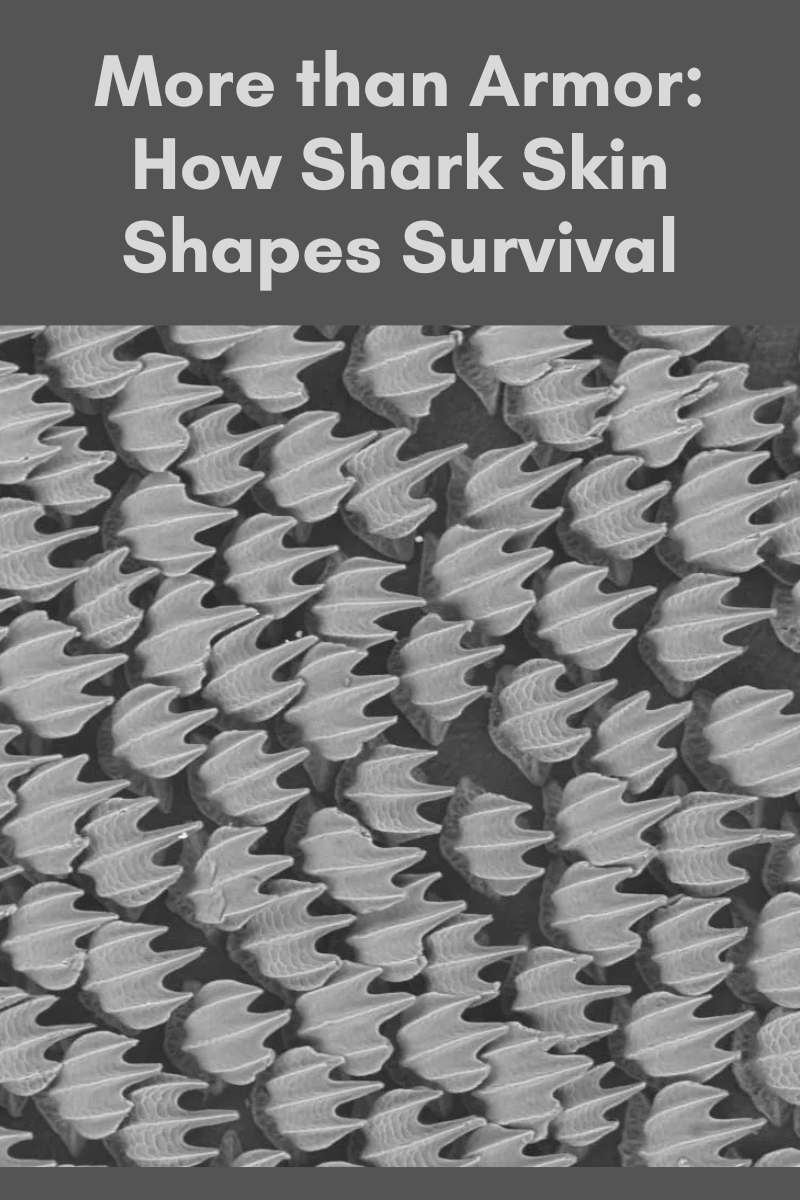
    Have you ever wondered why, if you touch a shark from head to fin, it feels smooth—but from fin to head, it’s skin is rough like sandpaper? Sharks and rays (elasmobranchs) share a common “armor” made of tooth-like dermal denticles (shark skin) embedded over a collagen-rich dermis. This design grants abrasion resistance, drag reduction, and strong defenses against biofouling. And they heal fast!

    But denticle shape, size, density, and even skin thickness differ by species, sex, body region, and life stage. Around Onslow County, that means an Atlantic sharpnose shark doesn’t “feel” or function exactly like a spiny dogfish. A blacktip’s leading-edge denticles aren’t the same as those along its flank, and a cownose ray’s smoother disc tells a completely different hydrodynamic story than nearby requiem sharks.

    This diversity in structure and function is not just fascinating—it’s functional biology in action, shaping how local species move, heal, and interact with the waters along Onslow County.

    What all elasmobranch skin has in common

    Dermal denticles (placoid scales)

    Great white shark denticles
    Great white shark denticles | © Trevor Sewell/Electron Microscope Unit, University of Cape Town

    Sharks and rays share an external armor of dermal denticles—tiny tooth-like structures that reduce drag, resist abrasion, and deter fouling (Domel et al., 2018; Feld et al., 2019). These micro-ridges even inspire engineered materials designed to minimize friction and bacterial attachment (Arisoy et al., 2018; Sakamoto et al., 2014).

    A collagen-rich dermis

    Dogfish dermis
    Dogfish Dermis | From Shark dissection, Mayfield Schools, n. d. https://www.mayfieldschools.org/Downloads/sharkdissection%20%281%29.pdf

    Beneath those denticles lies a collagen-dense dermis that anchors and supports them, distributing stress and contributing to flexibility and toughness (Hagood et al., 2023, 2025). 

    Rapid wound healing

    Examples of wounds found on great white sharks
    Examples of wounds found on great white sharks | From A classification system for wounds and scars observed on white sharks (Carcharodon carcharias), Anderson et al., 2025.

    Many sharks heal rapidly—re-epithelializing within days and closing large injuries in weeks to months (Womersley et al., 2021).

    Where shark skin differs: species, sex, body region & ontogeny

    Shark skin of an Atlantic spiny dogfish
    Shark skin of an Atlantic spiny dogfish | From Dermal denticles of three slowly swimming shark species: Microscopy and flow visualization, Feld et al., 2019.

    Species differences.
    Denticle shape, ridge count, and spacing vary by ecology. Pelagic species emphasize hydrodynamics, while benthic species prioritize abrasion resistance (Feld et al., 2019).

    Body-region mosaics.
    Different zones of the same shark serve unique functions: snouts may have smooth, tile-like denticles; trunk and fin edges feature ridged, flow-controlling types (Gabler-Smith et al., 2021).

    Sexual dimorphism and mechanical variation.
    Hagood et al. (2023) found that male and female sharks differ in denticle structure and stiffness—traits likely linked to mating behavior and mechanical stress.

    Ontogenetic and ecomorphological changes.
    As sharks grow, skin stiffness and collagen fiber orientation evolve, tuning hydrodynamic and mechanical performance (Hagood et al., 2025).

    Sharks vs. rays (and skates): same toolkit, different emphasis

    Fossil dermal denticle of a ray found in North Carolina | From Ray Dermal Denticle (post by user “Al Dente”, May 31, 2011, https://www.thefossilforum.com/topic/21344-ray-dermal-denticle/

    Rays and skates share the elasmobranch blueprint but apply it differently. Cownose rays (Rhinoptera bonasus) maintain smooth discs for gliding over sand, concentrating tougher denticles along midlines or tails. Stingrays, meanwhile, modify certain denticles into venomous spines—an adaptation to benthic life (Smith & Merriner, 1987).

    Mucus: the invisible modifier

    Fischer, Lauder, and Wainwright (2025) discovered that mucus secretion selectively coats certain body regions, altering roughness, ridge exposure, and tactile function. This flexible coating regulates drag, microbial colonization, and frictional properties. Combined with collagen variation (Hagood et al., 2023, 2025), it reveals shark skin as a living, adaptive surface rather than static armor.

    Mucus being collected from blacktip reef sharks | By Mauvis Gore

    Local lens: Onslow County species & mucus implications

    • Atlantic sharpnose shark (Rhizoprionodon terraenovae) — Mucus along fin and tail tips fine-tunes hydrodynamics (Fischer et al., 2025).
    • Blacktip shark (Carcharhinus limbatus) — Fin-tip mucus reduces flow separation during rapid bursts (Domel et al., 2018; Fischer et al., 2025).
    • Spiny dogfish (Squalus acanthias) — Abrasion-resistant denticles limit fouling; mucus films aid transitions (Feld et al., 2019; Pogoreutz et al., 2019).
    • Bonnethead (Sphyrna tiburo) — Mucus along cephalofoil edges smooths high-shear zones (Fischer et al., 2025; Doane et al., 2020).
    • Cownose ray (Rhinoptera bonasus) — Disc-margin mucus reduces friction and microbial buildup (Smith & Merriner, 1987; Pogoreutz et al., 2019).

    Microflow around denticles: visualizing eddies and recirculation

    Feld et al. (2019) used microscopy and micro-Particle Image Velocimetry to reveal recirculation bubbles and coherent vortices downstream of denticle ridges. Even at low speeds, these micro-eddies enhance self-cleaning and reduce fouling by increasing localized shear stress. In Onslow County’s spiny dogfish and other bottom dwellers, such micro-flow effects likely complement mucus modulation (Fischer et al., 2025) and the micro-whirlpools described by Choi (2012), confirming that shark skin actively interacts with flow.

    Microstructure and biomimetic insights

    Gabler-Smith et al. (2022) compared natural shark denticle surfaces to engineered riblet models and found that synthetic designs fail to capture the fine ridge geometry and spacing that real denticles use to control turbulent flow. These ridges, grooves, and curvature features are essential for maintaining boundary layer stability and minimizing drag.

    Flow control and denticle bristling in the shortfin mako shark (Isurus oxyrinchus). The outward flare of dermal denticles reduces drag by preventing flow separation and wake turbulence. |
    From “The speedy secret of shark skin,” by A. W. Lang, 2020, Physics Today, 73(4), 62–63. (2020).

    Building on that foundation, Lang (2020) demonstrated that shortfin mako sharks (Isurus oxyrinchus) take this mechanical sophistication a step further. Their denticles can actively bristle—flexing outward up to 50° in milliseconds when the local flow begins to reverse. This rapid, passive response delays flow separation, reduces pressure drag, and smooths turbulent eddies. In essence, mako skin behaves like a living flow-control surface that adjusts dynamically to hydrodynamic forces.

    Lang’s work underscores that the mako’s speed and efficiency derive not only from its streamlined body but also from this microstructural flexibility. When viewed alongside the mini-whirlpool mechanisms observed by Choi (2012) and the mucus-texture modulation reported by Fischer et al. (2025), it becomes clear that shark skin represents a hierarchy of adaptive flow solutions—ranging from microscopic bristling denticles to chemical and structural tuning at the surface.

    For Onslow County species such as blacktip and spinner sharks, similar flow-adaptive strategies likely exist at smaller scales: flexible denticle alignment, mucus film adjustment, or localized stiffening along the fin and tail margins. Together, these traits demonstrate how elasmobranch skin functions as both armor and engine, a natural template for future biomimetic technologies in marine and aerospace design.

    Mini whirlpools and flexible flow control

    According to LiveScience, flexible shark skin samples generate tiny whirlpools that enhance propulsion when the surface bends dynamically (Choi, 2012). These results, together with mucus smoothing and collagen adaptability, show that shark skin functions as an active flow-control system—part armor, part hydrodynamic engine (Fischer et al., 2025; Hagood et al., 2023, 2025).

    Interfacing skin, gills, and chemical exposure

    Fish gills actively metabolize dissolved substances. Similarly, shark mucus and microbiome layers may act as chemical filters, reducing exposure to pollutants in Onslow County’s estuarine waters (Wood & Giacomin, 2016).

    Conservation and historical context: denticles as time capsules

    Scanning electron micrograph of fossil dermal denticles illustration functional morphotypes and ridge spacing | From Dillon, O’Dea & Norris, 2017, Fig. 2.

    Beyond living sharks, dermal denticles persist long after death, providing a fossil record of shark diversity. Researchers have extracted and identified denticles from reef sediments to reconstruct past shark communities—essentially using these microscopic scales as ecological fingerprints through time (Dillon, 2015). Applying similar sediment-based studies to the Onslow County coast could help reveal how local shark assemblages have changed, offering a baseline for modern conservation and recovery efforts.

    Functional synergy in Onslow County sharks

    FunctionBiological BasisExample in Onslow County Species
    Drag reduction & flow controlDenticle ridges, mucus overlays, and flexible flow (Domel et al., 2018; Fischer et al., 2025; Choi, 2012)Blacktip & sharpnose sharks
    Mechanical resilienceCollagen and denticle variation (Hagood et al., 2023, 2025)Juvenile vs. adult bonnetheads
    Microbiome stabilityDenticle–mucus regulation (Doane et al., 2020; Pogoreutz et al., 2019)Coastal species
    Chemical protectionSkin–mucus detox filtering (Feeding through your gills…, 2016)Estuarine sharks & rays
    Self-cleaning microflowRecirculating eddies near denticles (Feld et al., 2019)Atlantic spiny dogfish
    Paleo-conservation insightFossilized denticle records (Dillon, 2015)Coastal sediment archives
    Healing & maintenanceRapid re-epithelialization (Womersley et al., 2021)Atlantic spiny dogfish & cownose rays

    References

    Anderson, S. D., Kanive, P. E., Chapple, T. K., Andrzejaczek, S., Block, B. A., & Jorgensen, S. J. (2025). A classification system for wounds and scars observed on white sharks (Carcharodon carcharias). Frontiers in Marine Science, 12, Article 1520348. https://doi.org/10.3389/fmars.2025.1520348

    Arisoy, F. D., Gurkan, U. A., Yagci, B. B., Calamak, S., Dokmeci, M. R., & Demirci, U. (2018). Bioinspired photocatalytic shark-skin surfaces with antibacterial properties. Scientific Reports, 8, 16363. https://doi.org/10.1038/s41598-018-34334-1 

    Choi, C. Q. (2012, February 21). Sharks’ scales create tiny whirlpools for speedy swimming. LiveScience. https://www.livescience.com/18385-shark-skin-mini-whirlpools.html

    Dillon, E. (2015, October 9). Shark skin sleuthing. Save Our Seas Foundation. https://saveourseas.com/update/shark-skinsleuthing/

    Dillon, E. M., O’Dea, A., & Norris, R. D. (2017). Dermal denticles as a tool to reconstruct shark communities. Marine Ecology Progress Series, 566, 117–134. https://doi.org/10.3354/meps12018

    Doane, M. P., Haggerty, J. M., Kacev, D., Papudeshi, B., & Dinsdale, E. A. (2020). The skin microbiome of elasmobranchs follows phylosymbiosis, but in teleost fishes, the microbiomes converge. Microbiome, 8(1), 123. https://doi.org/10.1186/s40168-020-00840-x 

    Domel, A. G., Weaver, J. C., Haj-Hossein, I., Wang, Z., Bertoldi, K., Lauder, G. V., & Vaziri, A. (2018). Shark skin-inspired designs that improve aerodynamic performance. Journal of the Royal Society Interface, 15(140), 20170828. https://doi.org/10.1098/rsif.2017.0828 

    Wood, C., Giacomin, M. (2016) Feeding through your gills and turning a toxicant into a solution. Journal of Experimental Biology, 219(20), 3218–3228. https://doi.org/10.1242/jeb.145625 

    Feld, K., Kolborg, A. N., Nyborg, C. M., Salewski, M., Steffensen, J. F., & Berg-Sørensen, K. (2019). Dermal denticles of three slowly swimming shark species: Microscopy and flow visualization. Biomimetics, 4(2), 38. https://doi.org/10.3390/biomimetics4020038 

    Fischer, M. J., Lauder, G. V., & Wainwright, D. K. (2025). Slippery and smooth shark skin: How mucus transforms surface texture. Journal of Morphology, 286(4), e70046. https://doi.org/10.1002/jmor.70046 

    Gabler-Smith, M. K., Lauder, G. V., et al. (2022). Ridges and riblets: Shark skin surfaces versus biomimetic models. Frontiers in Marine Science, 9, 975062. https://doi.org/10.3389/fmars.2022.975062 

    Gabler-Smith, M. K., Staab, K. L., & Motta, P. J. (2021). Dermal denticle diversity in sharks: Novel patterns on the interbranchial skin. Biology Letters, 17(12), 20210349. https://doi.org/10.1098/rsbl.2021.0349 

    Hagood, M. E., Motta, P. J., Staab, K. L., & Porter, M. E. (2023). Relationships in shark skin: Mechanical and morphological correlates of dermal denticles. Integrative and Comparative Biology, 63(6), 1154–1166. https://doi.org/10.1093/icb/icad085 

    Hagood, M. E., Wainwright, D. K., Motta, P. J., & Vaziri, A. (2025). Ecomorphology and ontogeny modulate the mechanical properties of shark skin. Journal of Experimental Zoology Part B: Molecular and Developmental Evolution. Advance online publication. https://doi.org/10.1016/j.jcz.2025.xxxxxx 

    Lang, A. W. (2020, April). The speedy secret of shark skin. Physics Today, 73(4), 62–63. https://digital.physicstoday.org/physicstoday/april_2020/MobilePagedArticle.action?articleId=1575067

    Pogoreutz, C., Yakob, L., Zhang, Y., Al-Saoudi, N. H., Olsson, A., El-Sherbiny, M., … Hajdu, E. (2019). Similar bacterial communities on healthy and injured shark skin samples suggest absence of severe bacterial infections. Animal Microbiome, 1, 11. https://doi.org/10.1186/s42523-019-0011-5 

    Sakamoto, A., Oikawa, K., & Yamaguchi, M. (2014). Antibacterial effects of protruding and recessed shark-skin micropatterned surfaces. Biofouling, 30(5), 593–602. https://doi.org/10.1080/08927014.2014.930720 

    Smith, J. W., & Merriner, J. V. (1987). Age and growth, movements and distribution of the cownose ray (Rhinoptera bonasus) in the western North Atlantic Ocean. Environmental Biology of Fishes, 20, 233–242. https://doi.org/10.1007/BF00004913 

    Womersley, F., Rohner, C. A., Gibbons, M. J., Richardson, A. J., & Jaine, F. R. A. (2021). Wound-healing capabilities of whale sharks (Rhincodon typus). Conservation Physiology, 9(1), coaa137. https://doi.org/10.1093/conphys/coaa137

  • Flat-Finned Neighbors: Rays and Skates Along Topsail & New River

    Flat-Finned Neighbors: Rays and Skates Along Topsail & New River

    If you love watching for fins in Onslow County, remember: not every fin belongs to a shark. Sharks, rays, skates, and sawfishes are all elasmobranchs—cartilaginous fishes with skeletons of flexible cartilage instead of bone. Along our beaches and in the New River estuary, you’ll most often meet rays and skates, the sharks’ closest cousins. Below are the species you’re most likely to spot, when they show up, what they eat, who eats them, their environmental preferences, and their conservation status.

    Quick ID: Ray vs. Skate

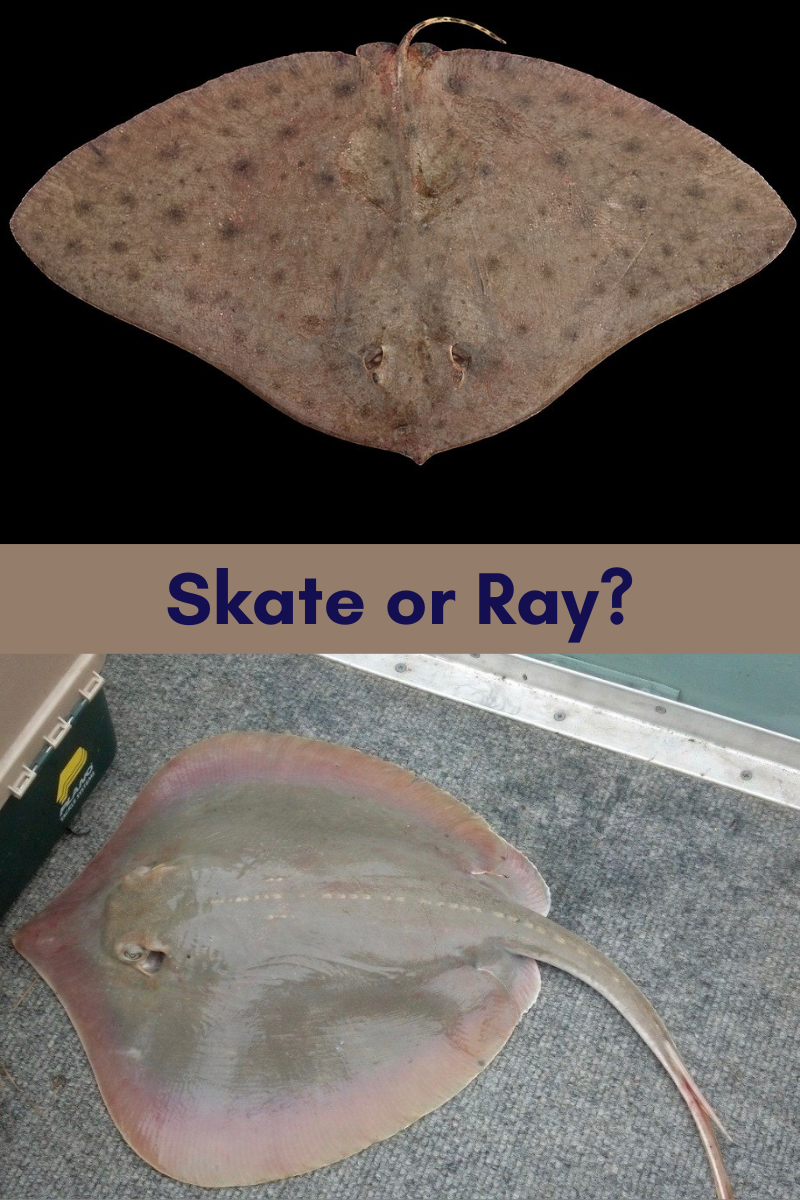
    • Rays generally have a whip-like tail; many (not all) have a venomous spine.
    • Skates lack a stinging spine and often have small dorsal fins near the tail tip.
    • Both glide over sand flats, sounds, and estuary mouths where they vacuum up clams, crabs, and small fishes.
    skates and ray anatomical differences
    Credit: Florida Museum

    Atlantic Stingray (Hypanus sabinus) — Our year-round neighbor in the estuary

    Small, spade-shaped, and sand-colored, the Atlantic stingray frequents shallow, warm, and often brackish waters, including the lower New River and surf zones off Topsail. It’s one of the most euryhaline elasmobranchs (tolerant of a wide salinity range), which is why folks see them from tidal creeks to nearshore surf (Johnson & Snelson, 1996).

    When to look: Late spring through fall in very shallow water on warm days (watch for “flying” jumps as they evade predators or parasites).

    Give them space: Shuffle your feet in the shallows to avoid accidental tail-spine contact.

    Diet (Prey): Worms, amphipods, small crustaceans, and mollusks, dug up from the sandy bottom.
    Predators: Large sharks (bull, hammerhead), some large fish (groupers, snappers), and wading birds preying on juveniles.

    Conservation status:

    • IUCN: Least Concern.
    • U.S. Status: Not protected under ESA or CITES; not managed in fisheries.
      Note: Stable populations, though freshwater groups sometimes show reproductive decline tied to water quality.
    hypanus sabinus

    Cownose Ray (Rhinoptera bonasus) — The bronze “wings” of summer

    Bronze-backed and wing-tipped, cownose rays cruise past Topsail in late spring and summer, sometimes in tight schools. Large multi-year telemetry studies show cownose rays migrate seasonally along the Atlantic coast, using mid-Atlantic estuaries for pupping and mating, then overwintering off central Florida (Ogburn et al., 2018).

    Local note: Schools moving along Onslow County beaches are most common mid- to late summer, especially on calm, clear mornings.

    Diet (Prey): Hard-shelled bivalves (clams, oysters, scallops) and crabs, crushed with strong dental plates.
    Predators: Large sharks such as sandbar, bull, and tiger sharks.

    Conservation status:

    • IUCN: Vulnerable.
    • U.S. Status: Not federally protected; some states (e.g., Maryland) have moratoria on killing contests.

    Note: At risk due to low reproductive rates, heavy schooling, and targeted culling in parts of its range.

    Rhinoptera bonasus

    Butterfly Ray (Genus Gymnura) — Rare, paper-thin glider

    Two butterfly rays—smooth butterfly ray and spiny butterfly ray—occur only sporadically here, near the northern edge of their ranges. Long-term sampling in Onslow Bay recorded both species mostly April–November, usually as young individuals (Schwartz, 2011).

    Where to look: Quiet sandy flats adjacent to inlets during warm months—rare sightings, treat them as a bonus.

    Diet (Prey): Small benthic fishes, shrimp, and crabs.
    Predators: Large sharks, particularly sandbar and hammerhead.

    Conservation status:

    • IUCN: Endangered (spiny butterfly ray).
    • U.S. Status: Not listed under ESA or CITES.

    Note: Populations declining globally; extremely rare in NC, where records are incidental.

    Gymnura species

    Clearnose Skate (Raja eglanteria) — The subtle, spotted skate

    Clearnose skates favor our nearshore sandy bottom habitats and show up all year, with peak catches outside the hottest months. In a recent year-round analysis of the North Carolina nearshore elasmobranch community, clearnose skates were among the most abundant species and were often juveniles, highlighting how our inner shelf provides important habitat (Roskar et al., 2024).

    Local tip: Anglers bottom-fishing near the bar or just off the beach encounter skates more often in the cooler seasons.

    Diet (Prey): Worms, amphipods, squid, and small fishes suctioned from the sand.
    Predators: Large sharks (sandbar, sand tiger, smooth dogfish) and occasionally other large rays or skates.

    Conservation status:

    • IUCN: Least Concern.
    • U.S. Status: Not protected individually, but included in the Northeast Skate Complex Fishery Management Plan, from Maine to Cape Hatteras, NC.

    Note: Common, often caught as bycatch; no special protections beyond fishery quotas.

    Raja eglanteria

    Mermaid’s Purses & Season Guide

    Elasmobranch egg cases—often called “mermaid’s purses”—sometimes wash up on our beaches in Onslow County. They are protective capsules laid by skates (relatives of sharks and rays). Each capsule once held a developing embryo. If you find one, it will most likely be an egg casing of a clearnose skate.

    Rays and stingrays (Atlantic stingray, cownose ray, butterfly rays) give birth to live pups—so their egg cases will never be found.
    Skates (like clearnose skate) are oviparous and the main source of egg cases on our shores.

    Clearnose skate egg casing or mermaid's purse

    Seasonal Timing in Onslow County

    SpeciesEgg Case SeasonWhat to Expect on Beaches
    Clearnose SkateSpring–Summer (Apr–Jul)Freshly laid egg cases in spring; more likely to wash ashore in late spring/early summer.
    Little Skate (rare in Onslow)Spring (Apr–May) & Fall (Oct–Dec)Occasionally reported; smaller cases than clearnose.
    Atlantic Stingray, Cownose Ray, Butterfly RaysNoneLive-bearers (no egg cases).

    Environmental Preferences: Temperature & Salinity

    The presence of rays and skates in Onslow County shifts with water temperature and salinity. These factors determine when species move inshore, offshore, or migrate seasonally.

    SpeciesTemperature PreferenceSalinity ToleranceSeasonal Pattern in Onslow Co.
    Atlantic Stingray15–30 °C (59–86 °F); prefers warm shallowsFreshwater → marine (highly euryhaline)Common spring–fall in estuary & surf
    Cownose Ray20–30 °C (68–86 °F)Marine & brackish; avoids freshwaterPeaks summer (Jun–Sep) in schools
    Butterfly Rays20–30 °C (68–86 °F)Marine & estuarineRare, Apr–Nov in warm surf/inlets
    Clearnose Skate10–25 °C (50–77 °F); cooler monthsMostly marine; avoids low salinityMost common fall–spring nearshore
    Smalltooth Sawfish>20 °C (68 °F); cold-sensitiveMarine & brackish estuariesHistorically summer visitor; now extirpated locally

    A seasonal cast: What rotates through Onslow waters and when?

    Multiple studies show our coast hosts a seasonally shifting elasmobranch assemblage—from warm-season rays nearshore to cool-season species on the inner shelf—driven largely by temperature. While many surveys historically emphasized sharks, batoids (rays & skates) make up a large fraction of biomass on our continental shelf, and Onslow’s inner shelf and estuary mouths act as corridors and nurseries through the year (Roskar et al., 2024).

    What about sawfish?

    Smalltooth sawfish (Pristis pectinata)—a ray with a chainsaw-like rostrum—is the most likely sawfish historically near NC, with a U.S. range that once extended to North Carolina. Today, it’s critically endangered and largely restricted to Florida, with only rare Northern reports (Brame et al., 2019).

    Diet (Prey): Small schooling fishes (mullets, herrings) and crustaceans, stunned or stirred up with its saw-like snout.
    Predators: Juveniles preyed on by large sharks; adults have few natural predators.If you ever encounter one, do not handle—it is federally protected.

    Pristis pectinata

    Conservation & Ecology Summary Table

    SpeciesIUCN StatusU.S. StatusPrey (Diet)Predators
    Atlantic Stingray (H. sabinus)Least ConcernNot protectedWorms, crustaceans, mollusksSharks, large fish, birds (juveniles)
    Cownose Ray (R. bonasus)VulnerableNot federally listedClams, oysters, scallops, crabsSharks (bull, tiger, sandbar)
    Clearnose Skate (R. eglanteria)Least ConcernManaged in Northeast Skate FMPWorms, amphipods, squid, small fishSharks, rays, humans (bycatch)
    Spiny Butterfly Ray (G. altavela)EndangeredNo U.S. federal listingSmall fish, shrimp, crabsSharks
    Smalltooth Sawfish (P. pectinata)Critically EndangeredESA Endangered; CITES Appendix ISmall fishes, crustaceansSharks (juveniles); few as adults

    How our community can help

    • Observe & report: Photograph rays, skates, or egg cases (from a safe distance) and note date, location, water conditions.
    • Respect nursery areas: Summer shallows often host juveniles; avoid disturbing resting rays.
    • Support clean water projects: Healthy estuary bottoms = healthy benthic prey = healthier ray & skate populations.

    References

    Brame, A. B., Wiley, T., Carlson, J., Fordham, S., Musick, J., & Grubbs, R. D. (2019). Biology, ecology, and status of the smalltooth sawfish Pristis pectinata in the USA. Endangered Species Research, 39, 9–23. https://doi.org/10.3354/esr00947

    Johnson, M. R., & Snelson, F. F., Jr. (1996). Reproductive life history of the Atlantic stingray, Dasyatis sabina (Pisces, Dasyatidae), in the freshwater St. Johns River, Florida. Bulletin of Marine Science, 59(1), 74–88.

    Ogburn, M. B., Bangley, C. W., Aguilar, R., Fisher, R. A., Curran, M. C., Webb, S. F., & Hines, A. H. (2018). Migratory connectivity and philopatry of cownose rays Rhinoptera bonasus along the Atlantic coast, USA. Marine Ecology Progress Series, 602, 197–211. https://doi.org/10.3354/meps12686

    Roskar, G., Morley, J. W., & Buckel, J. A. (2024). Seasonality and relative abundance within an elasmobranch assemblage near a major biogeographic divide. PLOS ONE, 19(6), e0300697. https://doi.org/10.1371/journal.pone.0300697

    Schwartz, F. J. (2011). Butterfly rays (Gymnuridae) of North Carolina. Journal of the North Carolina Academy of Science, 127(4), 275–284.

    Sulikowski, J. A., Williams, L. J., Kneebone, J., & Tsang, P. C. W. (2022). Rangewide population structure of the clearnose skate Raja eglanteria. Transactions of the American Fisheries Society, 151(2), 143–155. https://doi.org/10.1002/tafs.10351

    NOAA Fisheries. (n.d.). Smalltooth Sawfish (Pristis pectinata). Retrieved 2025, from https://www.fisheries.noaa.gov/species/smalltooth-sawfish

  • Shark Watch: Meet the Seasonal Visitors to Onslow County’s Coast

    Atlantic blacktip sharks | Credit: iStock

    North Carolina’s coastline is home to a surprisingly rich and dynamic marine ecosystem — and sharks are among its most vital (and misunderstood) residents. In Onslow County, from the inlets around Sneads Ferry to the open waters off Topsail Island, over a dozen species of sharks migrate, feed, or even give birth throughout the year.

    But which sharks are here, and when? Let’s dive in.

    Why Sharks Visit Onslow County

    The waters off Onslow County are part of a critical marine highway where warm Gulf Stream currents mix with nutrient-rich coastal waters. This convergence creates a perfect buffet for migrating predators like sharks, especially in spring through early fall.

    The area also includes estuaries, inlets, and sandbars — ideal habitats for young sharks and mothers giving birth. Some species pass through, while others stay for an entire season.

    Seasonal Visitors: A Month-by-Month Guide

    SeasonCommon Shark SpeciesNotes
    Spring (March-May)Blacktip, spinner, Atlantic sharpnoseBlacktips often arrive first. Spinner sharks can be seen leaping nearshore.
    Summer (June-August)Sandbar, bull, dusky, hammerhead, tigerHigh diversity and activity. Shark pupping peaks in estuarine waters.
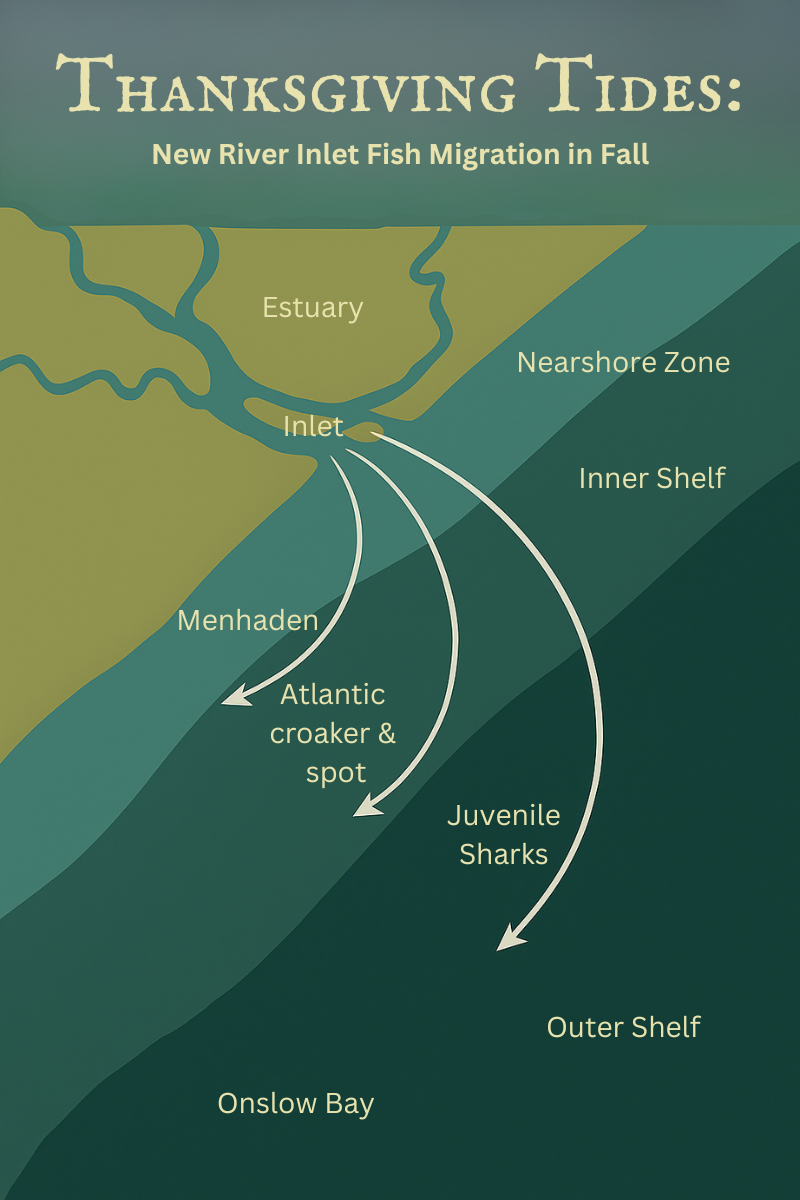
    Fall (September-November)Blacktip, scalloped hammerhead, sand tigerJuveniles migrate out, adults fatten up before heading south.
    Winter (December-February)Occasional Sandbar or Atlantic sping dogfishMost large sharks migrate south or deeper offshore.

    Shark Spotlights

    • Blacktip sharks – Fast and social (in packs), often seen inshore during spring and fall around large schools of fish.
    • Sandbar sharks – One of the most common summer sharks, easily misidentified as a dusky shark, sand tiger shark or bull shark.
    • Scalloped hammerheads – Occasionally observed near deeper channels and wrecks.
    • Atlantic spiny dogfish – A cold-season visitor, small and harmless mesopredator.

    Safety Note: Are They Dangerous?

    Sharks in Onslow County are not aggressive toward humans and play a crucial role in ocean health. Most sightings are brief and harmless. That said, avoid swimming near fishing piers or schools of baitfish, especially at dawn or dusk, and between fishers casting from the shore..

    Why It Matters

    Understanding seasonal shark activity helps:

    • Local fishermen avoid bycatch
    • Researchers track species health and migration
    • Beachgoers feel informed and safeResearchers track species health and migration
    • Conservationists protect nurseries and feeding grounds

    Want to Help?

    Have you seen a shark or need help with identification? You can report sightings or photos by posting or emailing me with your questions and to support my independent research. Follow our Instagram and Facebook pages to stay informed, ask questions, or learn how to participate in future citizen science efforts.