
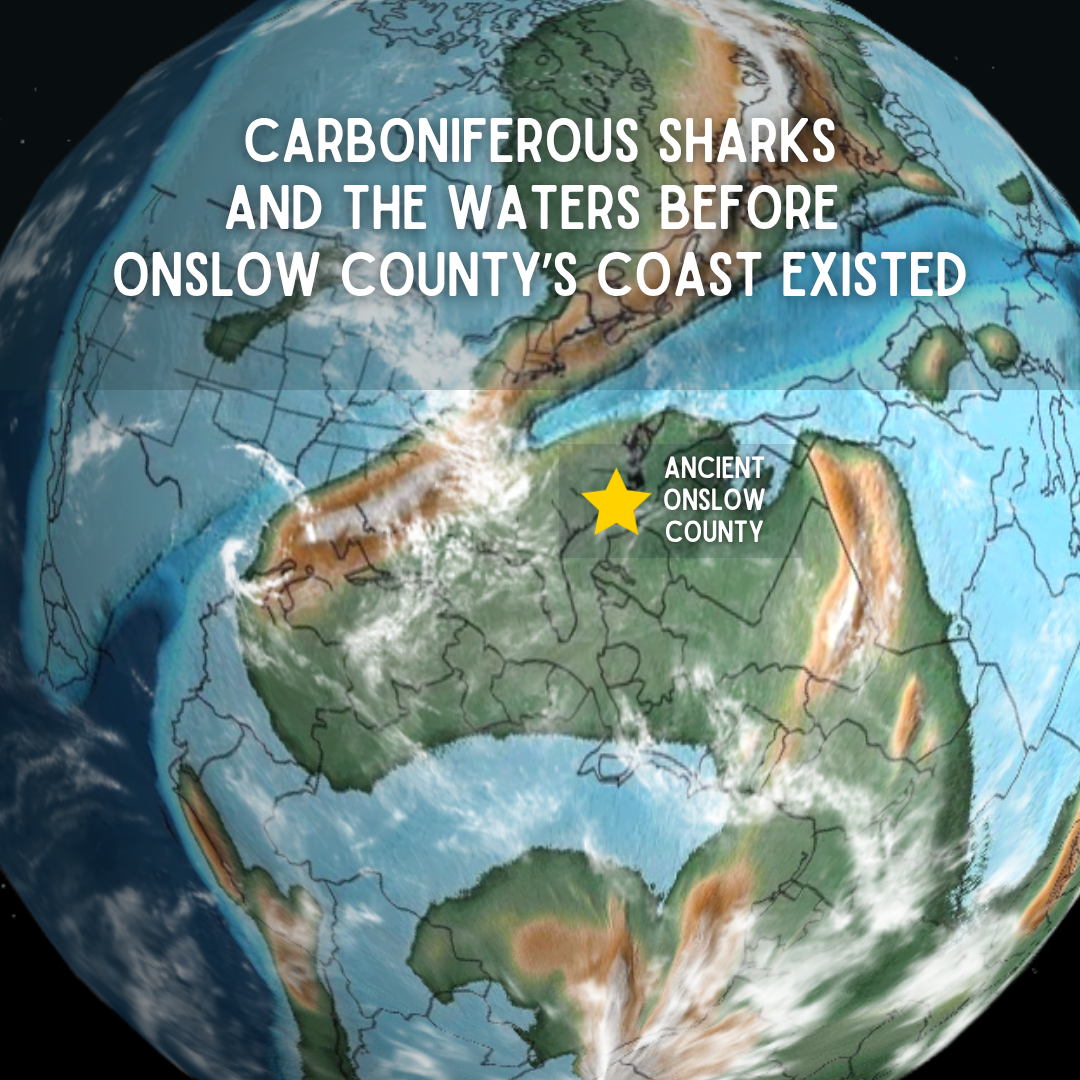
Onslow County, 400–300 Million Years Ago
There is a way to stand along the edges of Onslow County today—at the mouth of a tidal creek, or along the quieter margins of the Intracoastal Waterway—and imagine that the water is deeper than it looks.
Not just deeper in depth, but deeper in time.
Because if you follow this coastline back far enough—not 66 million years this time, but further, into the long stretch between the Devonian and the Carboniferous—you arrive at a coast that isn’t quite a coast yet. A place where the boundary between land and sea is still being negotiated, where forests creep toward water that breathes differently, and where sharks are not yet what we expect them to be.
But they are already here.
A Coast Without Familiar Edges
If you tried to stand in Onslow County during the Devonian, you wouldn’t just fail to recognize the shoreline. You wouldn’t be at the coast at all.

The land that is now eastern North Carolina was part of a shifting interior—positioned within a landscape that would eventually assemble into Pangaea (Blakey, 2008; Scotese & Scotese, 2001). The true coastline—the open margin of ocean—lay far to the west of here, closer to where Idaho, Nevada, and New Mexico sit today (Blakey, 2008).
What existed here instead was something quieter—low-lying terrain, broad basins, and shallow inland seas that advanced and retreated over long stretches of time. Water did not always connect cleanly to the open ocean, but instead lingered, pooled, and shifted with climate and sediment (Gibling, 2006; Scotese & Scotese, 2001).
It was not the edge of a continent. It was part of its interior.
Before the Mountains Took Shape
The landscape above that water would have felt just as unfamiliar.
The Appalachian Mountains and the Blue Ridge Mountains—so fixed on the western horizon today—had not yet taken the form we recognize. They were in the process of becoming.
During this span of time, continental collisions were building what would eventually become those mountains, particularly during the Alleghanian orogeny (Hatcher, 2010). But what existed then was not a continuous, weathered range.
It was movement—land rising in places and wearing down in others, sediment carried outward by rivers that did not yet follow the paths we know now, and material constantly redistributed into the lowlands and shallow waters that spread across this region (Hatcher, 2010).

The mountains we see today are not simply old. They are the worn-down remains of something much larger that was being built—and rebuilt—during this time.
Why That Matters to the Water
When the coastline sits far to the west, and the mountains are still forming, the water behaves differently.
There is no sharp boundary between land and sea.
Instead, water spreads. It slows. It lingers across wide, low-gradient terrain, carrying sediment from unstable landscapes and organic material from the earliest forests, shifting not just with tides, but with longer changes in climate and sea level (Gibling, 2006; Montañez & Poulsen, 2013).
The difference between land and water is not a line—it is a gradient. And it is within that gradient that the earliest sharks begin to take shape.
What It Would Feel Like
If you tried to compare those waters to something familiar, no single place along the coast today quite fits.
Parts of it would feel like the quieter stretches of Stump Sound—broad, shallow, and protected, where wind matters as much as tide. Other parts would behave more like the edges of the New River—not the defined channel, but the places where water spreads, slows, and loses direction. And in places, especially where early forests pressed into saturated ground, it would feel closer to the margins of a tidal creek near Soundside Park when the tide pulls back and the ground softens underfoot.

But today, those environments are contained. A sound is separated from the ocean. A river is confined to a channel. A marsh has edges you can point to.
Back then, those boundaries did not hold.
Take the sound, remove the barrier islands, let the river lose its banks, and let the marsh expand until it has no clear edge. And then let all of it move.
The First Experiments in Being a Shark
The sharks that moved through these waters in the Devonian are not yet what we would recognize. They are early attempts.
Some are slender and built for movement through shallow systems. Others carry structures that do not persist—spines, fin placements, body shapes that feel unfamiliar when compared to modern forms (Benton, 2015; Long, 1995).
What defines them is not their outward appearance, but their underlying design—cartilage instead of bone, teeth that are replaced over time, and bodies capable of flexing through environments that do not remain stable (Maisey, 2012; Nelson et al., 2016).

They are not yet dominant. But they are learning how to exist in a system that does not stay still.
The Carboniferous: A Different Kind of Abundance
By the Carboniferous, the land has changed, and with it, the water.
Dense forests now cover much of the lowlands—early plants spreading root systems into saturated ground, slowing water and trapping sediment. Organic material builds. Oxygen levels shift. Nutrients move differently through these systems (Berner, 2006; DiMichele & Phillips, 1996; Greb et al., 2006; Montañez & Poulsen, 2013).
The water becomes more complex. And sharks expand into that complexity.

Why It’s Called the Golden Age of Sharks
The Carboniferous is often called the “Golden Age of Sharks,” not because they resembled the sharks we know today, but because of how many different forms existed at once (Kriwet et al., 2008; Maisey, 2012; Zangerl, 2004).
Across these inland seas and shifting waters, shark lineages spread into a wide range of roles. Some moved through low-oxygen environments where other fish struggled, others fed along the bottom in nutrient-rich systems shaped by decaying plant life, and many remained tied to edges—places where conditions changed from one stretch of water to the next (Berner, 2009; Kriwet et al., 2008).
They were not the only animals present. But they were widespread within these systems—not as a single dominant form, but as a group capable of adjusting to instability.
What Those Sharks Actually Were
Many of the sharks of this time belong to groups that no longer exist.
Forms like Stethacanthus moved through these waters with structures unlike anything seen today (Coates et al., 2017; Lund, 1984). Others, like Cladoselache, carried more familiar outlines but lacked features that define modern sharks (Long, 1995).


Some of these forms hint at what sharks would become. Cladoselache, for example, moved through open water with a streamlined body, but without many of the specialized feeding structures seen in later sharks. Others moved in very different directions. Stethacanthus carried a dorsal structure unlike anything in modern species, while smaller forms like Falcatus show how varied these early sharks could be in both shape and behavior (Coates et al., 2017; Kriwet et al., 2008; Long, 1995; Lund, 1984; Maisey, 2012; Zangerl, 2004).

These were not variations on a single design. They were separate attempts—some built for open water, others tied to the bottom, others adapted to conditions that no longer exist in the same way.
Some lineages would persist. Many would not. What existed here was not a single path forward, but multiple directions being tested at once (Kriwet et al., 2008).
When the System Broke
Near the end of this long span of time, the system shifted in a way that few lineages could withstand.
The Permian-Triassic extinction event removed the vast majority of marine life. Entire ecological structures collapsed. Conditions changed faster than most organisms could adapt (Benton & Twitchett, 2003; Erwin, 1994).
Many of these early shark forms disappeared here. But not all of them.
What Endured
The sharks that persist are not the ones that dominated. They are the ones that adapted.
Lineages capable of moving between conditions—between oxygen levels, salinity, and shifting environments—remain functional when others cannot (Friedman & Sallan, 2012; Sallan & Coates, 2010). What carried forward was not a specific form, but a set of traits. Cartilage instead of bone allowed for flexibility and efficiency. Teeth that could be replaced continuously made it possible to feed in environments where wear and breakage were constant. And a tolerance for changing conditions—shifting oxygen levels, salinity, and water clarity—allowed some lineages to remain viable while others collapsed (Compagno, 2001; Nelson et al., 2016).
Some branches of these early sharks disappeared entirely, leaving no direct descendants. Others split into lineages that still exist today, including the ancestors of modern sharks and their relatives, as well as the chimaeras that occupy deeper waters.
The sharks in Onslow County today—like the blacktip shark and Atlantic sharpnose shark—do not resemble those early forms. But they carry the same strategy: the ability to exist within change.
Why You Won’t Find Them on the Beach
Walk the shoreline here, and you will find shark teeth—but they will not come from these sharks.
The sediments that preserve the fossils along this coast are far younger—deposited long after these early systems disappeared. The layers tied to the Devonian and Carboniferous are buried deep, altered, or located far from the modern shoreline (Benton, 2015; Riggs et al., 2011).
So while these sharks moved through environments tied to this place, their record does not wash up at your feet.
What Lies Beneath This Coast
What makes this harder to see is that the ground beneath Onslow County does not begin where this story does.
The surface you stand on—the sand, the marsh, the shallow sediments along the edge of the sound—is relatively young. Much of it has been laid down within the last few million years, reshaped repeatedly by rising and falling seas, storms, and shifting barrier islands (Riggs et al., 2011).
The record of this deeper past is still here—but it is buried.
Beneath the Coastal Plain of North Carolina, older layers extend downward—sediments, rock, and altered material that tie this region back to those earlier systems. Some of those layers have been compressed, heated, or eroded over time as the Appalachian Mountains formed and wore down, redistributing material across the landscape (Hatcher, 2010; Riggs et al., 2011).

What remains accessible at the surface is not the full history. It is the most recent version of it.
That is why the fossils you find along the beaches of Onslow County come from much younger deposits—reworked layers that have been lifted, eroded, and carried into the shoreline environment by waves and currents (Riggs et al., 2011).
The deeper record—the Devonian, the Carboniferous, the time when these early sharks moved through inland waters tied to this place—remains below.
Present—but out of reach.
What the Coast Kept
What remains is not the animal itself. It is the design.
The durability of teeth. The flexibility of cartilage. The ability to move through environments that do not remain constant (Compagno, 2001; Nelson et al., 2016).
The Carboniferous did not leave you the fossil. It left you the reason sharks are still here to make them.
The Coast Before the Coast
If you stand along the water in Onslow County now, the landscape feels defined. Channels hold their shape. Barrier islands mark the edge. Tides follow patterns that can be anticipated.
But beneath that stability is a history of movement.
There was a time when this place was not a coastline, but part of something broader—when the water spread instead of being held, and when the land itself was still assembling.
And in that shifting space, sharks learned something that would outlast nearly everything around them.
Not how to dominate a stable system.
But how to remain when stability disappears.
References
Able, K., Manderson, J., & Studholme, A. (1999). Habitat quality for shallow water fishes in an urban estuary:the effects of man-made structures on growth. Marine Ecology Progress Series, 187, 227-235. https://doi.org/10.3354/meps187227
Aller, R. C. (1982). The effects of Macrobenthos on chemical properties of marine sediment and overlying water. Topics in Geobiology, 53-102. https://doi.org/10.1007/978-1-4757-1317-6_2
Barbier, E. B. (2012). Progress and challenges in valuing coastal and marine ecosystem services. Review of Environmental Economics and Policy, 6(1), 1-19. https://doi.org/10.1093/reep/rer017
Benton, M. J. (2015). Vertebrate palaeontology (4th ed.). Wiley-Blackwell.
Benton, M. J., & Twitchett, R. J. (2003). How to kill (almost) all life: The end-Permian extinction event. Trends in Ecology & Evolution, 18(7), 358-365. https://doi.org/10.1016/s0169-5347(03)00093-4
Berner, R. A. (2006). Geocarbsulf: A combined model for Phanerozoic atmospheric O2 and CO2. Geochimica et Cosmochimica Acta, 70(23), 5653-5664. https://doi.org/10.1016/j.gca.2005.11.032
Berner, R. A. (2009). Phanerozoic atmospheric oxygen: New results using the GEOCARBSULF model. American Journal of Science, 309(7), 603-606. https://doi.org/10.2475/07.2009.03
Bilkovic, D., Isdell, R., Stanhope, D., Angstadt, K., Havens, K., & Chambers, R. (2021). Nursery habitat use by juvenile blue crabs in created and natural marshes. Ecological Engineering, 170(106333). https://doi.org/10.1016/j.ecoleng.2021.106333
Blakey, R. C. (2008). Gondwana paleogeography from assembly to breakup—A 500 m.y. Odyssey. Special Paper 441: Resolving the Late Paleozoic Ice Age in Time and Space, 1-28. https://doi.org/10.1130/2008.2441(01)
Chmura, G. L., Anisfeld, S. C., Cahoon, D. R., & Lynch, J. C. (2003). Global carbon sequestration in tidal, saline wetland soils. Global Biogeochemical Cycles, 17(4). https://doi.org/10.1029/2002gb001917
Coates, M. I., Gess, R. W., Finarelli, J. A., Criswell, K. E., & Tietjen, K. (2017). A symmoriiform chondrichthyan braincase and the origin of chimaeroid fishes. Nature, 541(7636), 208-211. https://doi.org/10.1038/nature20806
Compagno, L. J., & Food and Agriculture Organization of the United Nations. (2001). Sharks of the world: An annotated and illustrated catalogue of shark species known to date (2nd ed.). Food & Agriculture Org.
DiMichele, W. A., & Phillips, T. L. (1996). Climate change, plant extinctions and vegetational recovery during the middle-late pennsylvanian transition: The case of tropical peat-forming environments in North America. Geological Society, London, Special Publications, 102(1), 201-221. https://doi.org/10.1144/gsl.sp.1996.001.01.14
Erwin, D. H. (1994). The Permo–Triassic extinction. Nature, 367(6460), 231-236. https://doi.org/10.1038/367231a0
Fenchel, T. M., & Riedl, R. J. (1970). The sulfide system: A new biotic community underneath the oxidized layer of marine sand bottoms. Marine Biology, 7(3), 255-268. https://doi.org/10.1007/bf00367496
Folk, R. L. (1980). Petrology of sedimentary rocks (2nd ed.). Hemphill Publishing Company.
Friedman, M., & Sallan, L. C. (2012). Five hundred million years of extinction and recovery: A Phanerozoic survey of large‐scale diversity patterns in fishes. Palaeontology, 55(4), 707-742. https://doi.org/10.1111/j.1475-4983.2012.01165.x
Gibling, M. R. (2006). Width and thickness of fluvial channel bodies and Valley fills in the geological record: A literature compilation and classification. Journal of Sedimentary Research, 76(5), 731-770. https://doi.org/10.2110/jsr.2006.060
Greb, S. F., DiMichele, W. A., & Gastaldo, R. A. (2006). Evolution and importance of wetlands in earth history. Wetlands through Time. https://doi.org/10.1130/2006.2399(01)
Hatcher, R. D. (2010). The Appalachian orogen: A brief summary. From Rodinia to Pangea: The Lithotectonic Record of the Appalachian Region. https://doi.org/10.1130/2010.1206(01)
Jørgensen, B. B., & Nelson, D. C. (2004). Sulfide oxidation in marine sediments: Geochemistry meets microbiology. Sulfur Biogeochemistry – Past and Present. https://doi.org/10.1130/0-8137-2379-5.63
Kasten, S., & Jørgensen, B. B. (2000). Sulfate Reduction in Marine Sediments. In Marine Geochemistry (pp. 263-264). Springer, Berlin, Heidelberg.
https://doi.org/10.1007/978-3-662-04242-7_8
Kriwet, J., Kiessling, W., & Klug, S. (2008). Diversification trajectories and evolutionary life-history traits in early sharks and batoids. Proceedings of the Royal Society B: Biological Sciences, 276(1658), 945-951. https://doi.org/10.1098/rspb.2008.1441
Long, J. A. (1995). The rise of fishes: 500 million years of evolution.
Lund, R. (1984). On the spines of the Stethacanthidae (Chondrichthyes), with a description of a new genus from the Mississippian bear gulch limestone. Geobios, 17(3), 281-295. https://doi.org/10.1016/s0016-6995(84)80095-9
Maisey, J. G. (2012). What is an ‘elasmobranch’? The impact of palaeontology in understanding elasmobranch phylogeny and evolution. Journal of Fish Biology, 80(5), 918-951. https://doi.org/10.1111/j.1095-8649.2012.03245.x
McCave, I. N. (1976). Organism-Sediment Relationships. In The Benthic Boundary Layer (pp. 273-295). Plenum Press.
Montañez, I. P., & Poulsen, C. J. (2013). The late Paleozoic ice age: An evolving paradigm. Annual Review of Earth and Planetary Sciences, 41(1), 629-656. https://doi.org/10.1146/annurev.earth.031208.100118
Nelson, J. S., Grande, T. C., & Wilson, M. V. (2016). Fishes of the world (5th ed.). John Wiley & Sons.
Odum, E. P. (1980). The status of three ecosystem-level hypotheses regarding salt marsh estuaries: Tidal subsidy, outwelling, and detritus-based food chains. Estuarine Perspectives, 485-495. https://doi.org/10.1016/b978-0-12-404060-1.50045-9
Pilkey, O. H., Rice, T. M., & Neal, W. J. (2014). How to read a North Carolina beach: Bubble holes, Barking sands, and rippled Runnels. UNC Press Books.
Riggs, S. R., Ames, D. V., & Dawkins, K. R. (2008). Coastal processes and conflicts: North Carolina’s Outer Banks: A curriculum for middle and high school students (NCU-E-08-002). NOAA Oceanic and Atmospheric Research; Sea Grant. https://repository.library.noaa.gov/view/noaa/46454/noaa_46454_DS1.pdf
Riggs, S. R., Ames, D. V., Culver, S. J., & Mallinson, D. J. (2011). The battle for North Carolina’s coast: Evolutionary history, present crisis, and vision for the future. UNC Press Books.
Rimmer, J., Blight, A., Chocholek, M., & Paterson, D. (2025). Response of natural estuarine Microphytobenthic Biofilms to multiple anthropogenic stressors. Environmental Pollution, 387(127285). https://doi.org/10.1016/j.envpol.2025.127285
Sallan, L. C., & Coates, M. I. (2010). End-Devonian extinction and a bottleneck in the early evolution of modern jawed vertebrates. Proceedings of the National Academy of Sciences, 107(22), 10131-10135. https://doi.org/10.1073/pnas.0914000107
Scotese, C. R., & Scotese, R. J. (2001). Atlas of earth history. Paleomap Project.
Zangerl, R. (2004). Handbook of Paleoichthyology: Chondrichthyes. – 1. Paleozoic elasmobranchii / by Rainer Zangerl. Vol. 3a. Lubrecht & Cramer.