Tag: marine life Onslow County

  • Fish That Break the Rules: Unusual Anatomy Along the Edge of Onslow County

    Fish That Break the Rules: Unusual Anatomy Along the Edge of Onslow County

    Where Expectations Begin to Slip

    There are stretches of shoreline in Onslow County where the water looks simple.

    A low wind flattens the surface just beyond the breakers. The sand underfoot is firm, packed by a falling tide. Small schools of baitfish turn in unison at the edge of visibility, their bodies catching light and then disappearing again as if nothing had moved at all.

    From here, fish seem predictable. They swim. They are streamlined. They slip through water in ways that feel consistent, almost mechanical.

    A school of juvenile fish swim in the Surf City sound. | Photo credit: A. Mitchell
    A school of juvenile fish swim in the Surf City sound. | Photo credit: A. Mitchell

    But that impression doesn’t hold for long.

    A few steps into the surf, something crunches beneath your heel—a shell, or what remains of one.. Offshore, a shape drifts that doesn’t seem built for movement at all. In the shallows, something settles to the bottom and then, impossibly, walks.

    The closer you look, the more the pattern breaks apart. Along this stretch of coast—from the swash zone to the deeper water of Onslow Bay—some fish are not built like fish are “supposed” to be.

    And once you notice them, the rules start to feel less like rules at all.

    Teeth built for stone: Sheepshead

    The rule broken: fish are supposed to have simple teeth

    On calm mornings near New River Inlet, when the tide is just beginning to push in, the water around pilings and rock edges clears enough to see movement below the surface. Dark vertical bands appear and disappear as fish turn sideways to feed, their bodies angled tightly against pilings and rock.

    If you get a close look—often only when one is caught—you notice the teeth.

    Flat. Squared. Set in rows that look more like something borrowed from a mammal than a fish.

    Sheepshead fish have mammal-like teeth. | Photo credit: Jeannette's PIer
    Sheepshead fish have mammal-like teeth used for scraping and crushing hard shells and barnacles. | Photo credit: Jeannette’s PIer

    The sheepshead (Archosargus probatocephalus) feeds primarily on hard-shelled organisms—barnacles, oysters, mussels, and crabs attached to pilings, jetties, and natural hardbottom (Sedberry, 1987). These prey items are abundant in estuarine and nearshore environments where salinity fluctuates and structure concentrates life.

    Instead of pointed, uniform teeth, sheepshead possess incisiform front teeth for scraping and strong molariform teeth set further back for crushing (Deang et al., 2018; Hernandez & Motta, 1997). Bite force measurements and stomach content analyses show they are capable of breaking calcareous shells that would resist most coastal fishes (Hernandez & Motta, 1997).

    They are most active in waters typically ranging from 60–80°F (15–27°C), often within just a few feet of structure in depths from less than a meter to roughly 10 meters (Sedberry, 1987).

    Fish are often imagined as generalized swimmers feeding on soft prey. But along the Onslow coast, hard surfaces—oyster beds, submerged debris, pilings—create entire microhabitats built on calcium carbonate (Grabowski & Peterson, 2007).

    Sheepshead are not exceptions to the system; they are shaped by it. Their teeth are a direct response to a landscape where food remains locked inside a shell.

    Most fish don’t have teeth like this because most environments don’t require it. Here, where geology and biology meet in layers of shell and structure, the rule changes.

    The fish that walks: Bluespotted and Northern searobin

    The rule broken: fish move by swimming

    On a falling tide along the edges of Topsail Island, the water pulls thin over the sand flats. What remains is a shifting surface—ripples, shadows, and the occasional sudden burst of motion.

    Then something moves without swimming.

    It doesn’t dart or glide. It advances in short, deliberate steps, stopping and starting again, as if testing the ground before each movement.

    For a moment, it looks wrong—like something moving through air instead of water.

    The bluespotted searobin (Prionotus roseus) and the Northern searobin (Prionotus carolinus) do not rely on their fins for propulsion in the way most fish do. Instead, three detached rays from each pectoral fin extend downward, contacting the bottom and supporting the body as it moves. These rays function both as supports and as sensory structures, probing the sediment and detecting chemical cues—effectively allowing the fish to “taste” the seafloor as it moves (Bardach & Case, 1965).

    Across these shallow flats, often just inches to a few feet deep, the water warms into the upper 60s and 70s as the tide recedes. Prey is rarely exposed. Worms, small crustaceans, and buried mollusks remain hidden beneath the surface. Vision alone is not enough here. The searobin moves slowly, stepping and pausing, tracing the bottom until something beneath the sand gives itself away.

    Movement in water is usually about efficiency—minimizing drag, maximizing speed.

    But the seafloor is a different environment entirely.

    Here, visibility narrows, prey disappears beneath the surface, and swimming can carry you past what you’re trying to find. Walking—slow, deliberate, sensory-driven—becomes the better strategy.

    Most fish don’t have “legs” because most fish don’t live where walking is more useful than swimming. Along the shallow bottoms of Onslow waters, this rule no longer applies.

    The fish that swells: Northern puffer

    The rule broken: fish don’t change shape

    In late summer, when the water just beyond the breakers settles into the upper 70s, small shapes begin to move just offshore—slow, almost indifferent to the motion around them.

    One drifts closer than expected, rounded in a way that doesn’t quite match the others. It hovers, turning slightly, its movement controlled but unhurried.

    Then, without warning, the body changes.

    It expands outward, the outline swelling until the fish no longer resembles something built to move through water at all.

    The Northern puffer (Sphoeroides maculatus) does this by rapidly drawing water into a highly elastic stomach, a process that allows the body to expand far beyond its resting shape (Brainerd, 1994). Without rigid skeletal constraints like ribs or pelvic bones, that expansion can happen quickly, transforming the fish into something difficult for a predator to grasp or swallow.

    A northern pufferfish skeleton is made up of spiny modified scales (not bones) that expand like a balloon when threatended. | Photo credit: The Fossil Forum
    A Northern pufferfish skeleton is made up of spiny modified scales (not bones) that expand like a balloon when threatended. | Photo credit: The Fossil Forum

    In these nearshore waters—where predators move quickly and encounters happen at close range—there is little time to outrun what’s coming. Most fish rely on speed to escape. This one changes shape instead.

    Speed isn’t part of the solution here.

    The fish that locks itself in place: Gray triggerfish

    The rule broken: fish don’t anchor themselves

    Farther offshore, where the bottom begins to break into scattered hardbottom and reef patches, movement slows in a different way.

    Shapes hold just above the structure, adjusting position in small increments, never straying far from the surface below them.

    When disturbed, they don’t flee into open water.

    They turn downward.

    The gray triggerfish (Balistes capriscus) moves into crevices and tight spaces within the structure, where a set of dorsal spines can be raised and locked into place. The first spine lifts, and a smaller second spine holds it there—an arrangement that gives the fish its name and allows it to anchor itself firmly in place (Tyler, 1980; Lobel, 1980).

    Its body is built for this kind of movement: deep and laterally compressed, with tough, abrasive skin and strong incisor-like teeth capable of breaking into hard-shelled prey (Tyler, 1980; Lobel, 1980). These are not features meant for speed. They are features meant for contact—pressing into structure, resisting removal, holding position when movement would fail.

    In waters often 50–120 feet deep off Onslow County, where reefs and wrecks break the seafloor into pockets and edges, escape doesn’t always mean distance (Bellwood et al., 2004).

    Sometimes it means holding ground.

    Most fish survive by staying in motion.

    This one survives by becoming fixed in place, turning the structure around it into part of its defense.

    Light written into skin: Atlantic midshipman

    The rule broken: fish don’t carry light in their skin

    On warm summer nights near quiet stretches of marsh and inlet edges, the water sometimes carries sound before anything else. A low, continuous hum. It’s easy to miss unless you stop moving.

    The Atlantic midshipman (Porichthys plectrodon) produces that sound through specialized sonic muscles vibrating against the swim bladder, creating a sustained hum that can carry through shallow coastal water (Sisneros, 2009; Bass & McKibben, 2003).

    If you listen carefully during a quiet evening, the sound of a male midshipman trying to court a female might be heard. | Audio credit: SanctoSound – Integrated Ocean Observing System (IOOS)

    Along the sides of the body and across the head are rows of small organs—photophores—set into the skin, giving the fish its name and marking it as something unusual among coastal species found in these waters (Schwartz, 2013). When seen out of the water, those rows catch the light in a very particular way—small, round points that flash gold in direct sunlight, spaced with a regularity that makes them look almost set into the surface, like buttons fixed into the skin.

    The Atlantic midshipman has photophores that dazzle when out of the water, and used in seeing in darkened burrows and structures in limited light. | Photo credit: North American Native Fishes Association
    The Atlantic midshipman has photophores that dazzle when out of the water, and used in seeing in darkened burrows and structures in limited light. | Photo credit: North American Native Fishes Association

    Midshipman inhabit shallow coastal environments, often in burrows or beneath structure along muddy or sandy bottoms, typically in depths less than 20 meters.

    Light in fish is often associated with deeper water, where darkness is constant and illumination becomes necessary (Haddock et al., 2010). But along the Onslow coast, those conditions can exist in smaller, shifting pockets. Light narrows quickly with depth, suspended sediment moves with the tide, and visibility can collapse even in water shallow enough to stand in.

    Not all fish in these waters experience the bottom the same way. A flounder rests exposed on the sand, relying on camouflage and stillness. The midshipman, by contrast, spends much of its time within burrows, beneath structure, or pressed close to the substrate, where light is already limited and often disappears entirely.

    In those spaces, the rules of visibility begin to resemble something closer to deeper water, even though the surface is only a few feet above.

    The presence of photophores here does not follow the pattern most people expect.

    Not all light comes from above.

    The deep blade: Long-snouted lancetfish

    The rule broken: fish are dense, muscular swimmers

    From the beach, the horizon feels like a boundary—beyond the sandbars, beyond the nearshore currents—about two miles out, where the surface lifts just enough to hide what comes after. But beyond that line, the water doesn’t simply continue. It changes.

    Depth increases quickly. Layers begin to form. Light fades long before the bottom is reached.

    And in those deeper waters off Onslow Bay, some fish are not built to chase anything at all.

    The long-nosed lancetfish lives in the middle depths of the ocean where body density is less desirable for a drifting fish. | Photo credit: ML – some rights reserved (CC BY-NC)
    The long-nosed lancetfish lives in the middle depths of the ocean where body density is less desirable for a drifting fish. | Photo credit: ML – some rights reserved (CC BY-NC)

    The long-snouted lancetfish (Alepisaurus ferox) lives in the midwater column, often hundreds of meters below the surface. Its body is long and thin, almost blade-like, with muscle reduced and tissue that is less dense than most active predators, appearing almost soft in the water (Drazen & Seibel, 2007).

    It does not move with the steady, powered swimming most fish rely on. Instead, it drifts, adjusting position and taking prey as it comes within reach. Stomach analyses show a wide range of prey—fish, squid, and even other lancetfish—suggesting opportunism rather than pursuit (Kubota & Uyeno, 1970).

    In these deeper layers, energy becomes harder to acquire and more costly to use.

    Building and maintaining dense muscle comes at a cost. Chasing prey demands more of it (Sutton, 2013).

    Here, that balance shifts.

    The lancetfish represents a different solution—one that reduces the cost of movement and relies instead on encounter.

    Most fish are built to swim.

    This one is built to wait.

    The armored survivor: Atlantic sturgeon

    The rule broken: fish are supposed to have scales

    In cooler months, when water temperatures drop into the 50s and 60s, large shapes move along the bottom of estuaries and nearshore waters.

    They do not flash or turn sharply. They move steadily, close to the sediment.

    At times, that movement reaches the surface. A back breaks through, arcing briefly before slipping under again, the shape unfamiliar enough that it doesn’t immediately read as a fish.

    The Atlantic sturgeon (Acipenser oxyrinchus oxyrinchus) retains an older form—rows of bony scutes instead of the flexible scales seen in most fishes (Bemis et al., 1997). Along the underside, a protrusible mouth extends downward, drawing in prey from the bottom through suction rather than pursuit (ASSRT, 2007; Bemis et al., 1997).

    An anadromous fish, they move between river systems and coastal waters, passing through estuaries and along the nearshore edge, often in depths ranging from shallow channels to over 100 feet offshore (Dunton et al., 2015; ASSRT, 2007).

    This design is not new. It has persisted for tens of millions of years, carried forward through changing coastlines, shifting sea levels, and the rise of entirely different groups of fishes (Bemis et al., 1997).

    Atlantic sturgeon have a bony structure that has remained relatively unchanged for millions of years. | Photo credits: mdadswell – some rights reserved (CC BY-NC) (left); Steven McGrath – some rights reserved (CC BY-NC-ND) (right)

    It works because the conditions it responds to have never fully disappeared.

    Along the bottom, prey remains buried. Sediment still shifts with current and tide. Feeding still depends on contact more than speed. Armor still protects a body that cannot easily maneuver out of danger.

    For a long time, these fish seemed to fade from local waters. In Onslow County, encounters became rare enough to feel like absence. But populations have persisted elsewhere, and in nearby systems like the Cape Fear River, they are being observed again with increasing frequency—moving through channels, returning to spawning grounds, reappearing in places where they had not been seen in years (Dunton et al., 2015; ASSRT, 2007).

    Their range has shifted before. It may be shifting again.

    What remains constant is the need for connection—between river and ocean, between spawning grounds and feeding habitat.

    This fish does not depend on a single place. It depends on the continuity between them.

    Not all designs are meant to change. Some persist because the system they belong to still exists.

    The drifting giant: Ocean sunfish

    The rule broken: fish are supposed to be shaped for swimming

    Occasionally, especially in warmer months when currents shift, something appears offshore that barely seems to move at all.

    A large, flattened body. A fin breaking the surface. Then another, held there longer than expected.

    It drifts more than it swims.

    At times, it lingers there, tilted at the surface, absorbing the sun before slipping back beneath the water.

    The ocean sunfish (Mola mola) is one of the heaviest bony fish, reaching weights over 1,000 kg. Its body is truncated, lacking a true caudal fin, and propulsion is achieved through synchronized movements of dorsal and anal fins (Pope et al., 2010; Watanabe et al., 2009).

    After diving into colder, deeper water, sunfish often return to the surface, where this slow, drifting posture allows their body temperature to rise again (Watanabe et al., 2009). Prolonged time at the surface can leave the skin visibly altered—shifting from darker grey to lighter tones, sometimes appearing pale or pinkened under sustained exposure.

    Sunfish often inhabit offshore waters but can approach nearshore areas following currents and prey, particularly gelatinous organisms like jellyfish (Cartamil & Lowe, 2004).

    By most expectations, this body plan shouldn’t work.

    But it does—because efficiency, here, takes a different form. It is about buoyancy, drift, and feeding on abundant, slow-moving prey.

    In a system where jellyfish blooms are seasonal and sometimes dense, a fish shaped like this becomes not an anomaly, but a specialist.

    Answers to a layered environment

    From the shoreline, the water still looks simple.

    Small waves rise and fall. Baitfish turn and vanish. The surface holds its shape.

    But beneath that surface, the rules have already begun to shift.

    Fish move through these waters in ways that don’t match what we expect—crushing shell, stepping across the bottom, changing shape, holding themselves in place, carrying structures that catch light, drifting where others would swim, or moving through forms shaped long before this coastline took its present shape.

    What appears, from the beach, to be a single environment is something else entirely. It is layered—sand, structure, depth, temperature, light—each one asking something different of the animals that live within it.

    And the fish that seem unusual are not exceptions.

    They are answers.

    A layered system, at New River Inlet, seen from the surface. | Photo credit: A. Mitchell
    A layered system, at New River Inlet, seen from the surface. | Photo credit: A. Mitchell

    References

    Atlantic Sturgeon Status Review Team. (1998). Status review of Atlantic sturgeon (Acipenser Oxyrinchus Oxyrinchus). U.S. Fish and Wildlife Service. https://books.google.com/books?id=ee5MhnuurDMC&dq=+Status+review+of+Atlantic+sturgeon+(Acipenser+oxyrinchus+oxyrinchus)

    Bardach, J. E., & Case, J. (1965). Sensory capabilities of the modified fins of squirrel hake (Urophycis chuss) and Searobins (Prionotus carolinus and P. evolans). Copeia, 1965(2), 194. https://doi.org/10.2307/1440724

    Bellwood, D. R., Hughes, T. P., Folke, C., & Nyström, M. (2004). Confronting the coral reef crisis. Nature, 429(6994), 827-833. https://doi.org/10.1038/nature02691

    Bemis, W. E., Findeis, E. K., & Grande, L. (1997). An overview of Acipenseriformes. Developments in Environmental Biology of Fishes, 48, 25-71. https://doi.org/10.1007/0-306-46854-9_4

    Blake, R. W. (2004). Fish functional design and swimming performance. Journal of Fish Biology, 65(5), 1193-1222. https://doi.org/10.1111/j.0022-1112.2004.00568.x

    Brainerd, E. L. (1994). Pufferfish inflation: Functional morphology of postcranial structures in Diodon holocanthus (Tetraodontiformes). Journal of Morphology, 220(3), 243-261. https://doi.org/10.1002/jmor.1052200304

    Cartamil, D., & Lowe, C. (2004). Diel movement patterns of ocean sunfish mola mola off Southern California. Marine Ecology Progress Series, 266, 245-253. https://doi.org/10.3354/meps266245

    Deang, J., Persons, A., Oppedal, A., Rhee, H., Moser, R., & Horstemeyer, M. (2018). Structure, property, and function of sheepshead (Archosargus probatocephalus) teeth. Archives of Oral Biology, 89, 1-8. https://doi.org/10.1016/j.archoralbio.2018.01.013

    Drazen, J. C., & Seibel, B. A. (2007). Depth‐related trends in metabolism of benthic and benthopelagic deep‐sea fishes. Limnology and Oceanography, 52(5), 2306-2316. https://doi.org/10.4319/lo.2007.52.5.2306

    Dunton, K. J., Jordaan, A., Conover, D. O., McKown, K. A., Bonacci, L. A., & Frisk, M. G. (2015). Marine distribution and habitat use of Atlantic sturgeon in New York lead to fisheries interactions and Bycatch. Marine and Coastal Fisheries, 7(1), 18-32. https://doi.org/10.1080/19425120.2014.986348

    Fernandez, L. P., & Motta, P. J. (1997). Trophic consequences of differential performance: Ontogeny of oral jaw‐crushing performance in the sheepshead, Archosargus probatocephalus (Teleostei, sparidae). Journal of Zoology, 243(4), 737-756. https://doi.org/10.1111/j.1469-7998.1997.tb01973.x

    Grabowski, J. H., & Peterson, C. H. (2007). Restoring oyster reefs to recover ecosystem services. Theoretical Ecology Series, 4, 281-298. https://doi.org/10.1016/s1875-306x(07)80017-7

    Haddock, S. H., Moline, M. A., & Case, J. F. (2010). Bioluminescence in the Sea. Annual Review of Marine Science, 2, 443-493. https://doi.org/10.1146/annurev-marine-120308-081028

    McIver, E. L., Marchaterre, M. A., Rice, A. N., & Bass, A. H. (2014). Novel underwater soundscape: Acoustic repertoire of plainfin midshipman fish. Journal of Experimental Biology. https://doi.org/10.1242/jeb.102772

    Mensinger, A. F., & Case, J. F. (1990). Luminescent properties of deep sea fish. Journal of Experimental Marine Biology and Ecology, 144(1), 1-15. https://doi.org/10.1016/0022-0981(90)90015-5

    Petersen, J. C., & Ramsay, J. B. (2020). Walking on chains: The morphology and mechanics behind the fin ray derived limbs of sea-robins. Journal of Experimental Biology. https://doi.org/10.1242/jeb.227140

    Peterson, D. L., Bain, M. B., & Haley, N. (2000). Evidence of declining recruitment of Atlantic sturgeon in the Hudson River. North American Journal of Fisheries Management, 20(1), 231-238. https://doi.org/10.1577/1548-8675(2000)020<0231:eodroa>2.0.co;2

    Pope, E. C., Hays, G. C., Thys, T. M., Doyle, T. K., Sims, D. W., Queiroz, N., Hobson, V. J., Kubicek, L., & Houghton, J. D. (2010). The biology and ecology of the ocean sunfish mola mola: A review of current knowledge and future research perspectives. Reviews in Fish Biology and Fisheries, 20(4), 471-487. https://doi.org/10.1007/s11160-009-9155-9

    Schwartz, F. J. (2013). Atlantic midshipman, Porichthys plectrodon, in North Carolina. Journal of the North Carolina Academy of Science, 129(3), 111-114. https://doi.org/10.7572/2167-5880-129.3.111

    Sedberry, G. R. (1987). Feeding habits of Sheepshead, Archosargus probatocephalus, in offshore reef habitats of the southeastern continental shelf. Northeast Gulf Science, 9(1). https://doi.org/10.18785/negs.0901.03

    Sisneros, J. A. (2009). Adaptive hearing in the vocal plainfin midshipman fish: Getting in tune for the breeding season and implications for acoustic communication. Integrative Zoology, 4(1), 33-42. https://doi.org/10.1111/j.1749-4877.2008.00133.x

    Snelgrove, P. V. (1999). Getting to the bottom of marine biodiversity: Sedimentary habitats. BioScience, 49(2), 129. https://doi.org/10.2307/1313538

    Sutton, T. T. (2013). Vertical ecology of the pelagic ocean: Classical patterns and new perspectives. Journal of Fish Biology, 83(6), 1508-1527. https://doi.org/10.1111/jfb.12263

    Tyler, J. C. (1980). Osteology, phylogeny, and higher classification of the fishes of the order plectognathi (Tetraodontiformes) (434). U.S. Dept. of Commerce, National Oceanic and Atmospheric Administration, National Marine Fisheries Service. https://10.5962/bhl.title.63022
  • When the Water Softens: The First Jellies of Onslow County

    When the Water Softens: The First Jellies of Onslow County

    Jellyfish of Onslow County

    Several species of jellyfish appear along the waters of Onslow County, North Carolina as the coastal ecosystem shifts from winter toward spring. Moon jellies, comb jellies, sea nettles, and cannonball jellyfish all move through these waters at different times of year, responding to temperature, tides, and the seasonal return of plankton (Purcell et al., 2007; Lucas et al., 2012; Cloern & Jassby, 2010).

    At the Edge of Winter

    Late winter salt marsh with tan spartina grass and calm tidal creek in coastal North Carolina.
    Late winter along the estuarine marshes of Onslow County. Marsh grasses remain the color of dried straw while the coastal ecosystem waits for spring. | Photo credit: M. Mitchell

    In late February along the Intracoastal Waterway, the coast exists in a kind of suspension. The marsh grasses behind Topsail Island are still the color of dried straw, their green not yet returned. The wind carries more memory than warmth, and the water — though brighter in the lengthening light — remains clear in the way cold water often is, revealing sandy bottom, oyster shell, and shadow without the haze of summer plankton.

    Nothing looks abundant. Nothing appears urgent. The shoreline feels patient.

    If you lean over a dock and allow your eyes to adjust, the surface begins to resolve into layers. What first appears empty reveals movement — a faint pulse beneath the water, nearly invisible unless sunlight strikes at the right angle. A small translucent bell, no wider than your palm, opens and closes in a steady rhythm while the current carries it sideways through the creek.

    The first jellies of the season are easy to miss.

    They are small.
    They are clear.
    And they belong to the quiet phase of the coastal year.

    The Water Before Summer

    Calm estuarine water surface beside a dock in early spring.
    Early spring estuarine water along the coast often appears clear and quiet as plankton populations begin rebuilding after winter. | Photo credit: A. Mitchell

    Early spring water along the southern North Carolina coast often carries a glass-like quality. Plankton populations are rebuilding after winter. Suspended sediments have settled during calmer stretches. Against that clarity, the earliest gelatinous drifters seem almost designed to disappear.

    Standing along the docks and creeks of Onslow County, most of what we notice are the drifting bells moving slowly through the water.

    But the life of a jellyfish does not begin there.

    How a Jellyfish Begins

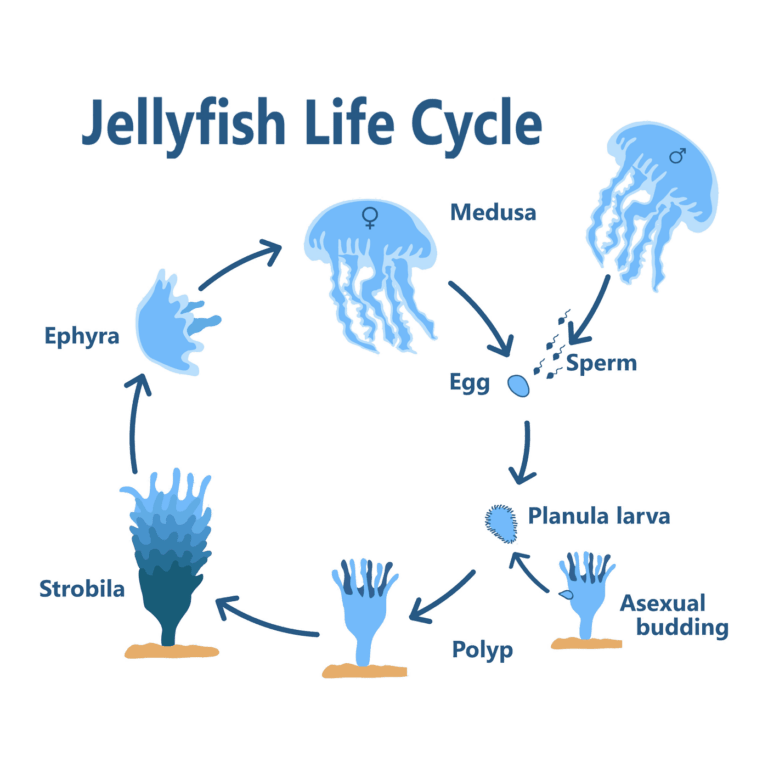
    The jellyfish most people recognize — the drifting bell, the trailing tentacles — is only one phase of a much longer life cycle.

    Diagram of the jellyfish life cycle showing egg, planula larva, polyp, strobilation, ephyra, and adult medusa stages.
    Generalized life cycle of a true jellyfish. Many species begin as microscopic larvae that settle into tiny polyps attached to submerged surfaces before releasing young jellyfish into the water column. | Graphic credit: Key West Aquarium

    Most true jellyfish begin as fertilized eggs released into the water column. Each egg develops into a tiny, free-swimming larva called a planula. There are many planulae in the water at once, but each one is a single organism, smaller than a grain of sand, carried by currents you would never notice from the surface.

    Within a few days — sometimes less than a week, depending on temperature — a planula settles onto a hard surface. It may attach to the underside of a dock piling, the rough edge of an oyster shell, a shaded bridge support, or even a shell resting quietly in the mud. Once attached, it transforms into a polyp (Lucas et al., 2012).

    In this stage it does not resemble a jellyfish at all. It is small — often only a few millimeters tall — no larger than a grain of rice. If you could flip that piling into the sunlight in February, you would not see a jellyfish.

    You would see something that looked more like a pale freckle against the wood.

    And yet, that freckle holds potential.

    The polyp may remain in that form for months. Anchored beneath docks and along oyster beds, it feeds on microscopic prey drifting past and survives the colder stretch of winter water (Purcell, 2012).

    That freckle — that rice-sized polyp — does not always remain alone.

    In some species of true jellyfish, the polyp stage can reproduce asexually, forming small copies of itself along the same piling or oyster shell (Purcell, 2012).

    When spring begins to soften the creek and temperatures rise, the polyp changes again. In a process known as strobilation, its body reorganizes into stacked segments (Purcell et al., 2007; Lucas et al., 2012). One by one, those segments separate into the water as tiny juvenile jellyfish called ephyrae (Purcell et al., 2007).

    Newly released ephyrae — juvenile jellyfish — pulsing through the water after separating from the polyp stage during strobilation.

    As the ephyra develops, its arms fill in and smooth into a rounded bell. It becomes the drifting medusa we recognize along docks, tidal creeks, and open shoreline.

    As the ephyra develops, its arms fill in and smooth into a rounded bell. It becomes the drifting medusa we recognize along docks, tidal creeks, and open shoreline.

    If you step away from the dock and look toward the darker center of the creek, the pattern shifts without breaking. Not every gelatinous drifter begins life attached to wood or shell. Comb jellies live their entire lives suspended in open water, developing and reproducing where freshwater flowing downriver meets saltwater moving inland on the tide (Purcell et al., 2001).

    What can seem like separate coastal experiences — the pale freckle beneath a dock, the first small jellies of spring, the sudden sting beneath a swimsuit — are phases of the same unfolding life cycle.

    A Life Without a Brain

    Watch a jellyfish long enough drifting beneath a dock or through the calm water of a tidal creek in Onslow County, and the question eventually arises.

    What is directing it?

    The bell contracts. The animal pulses forward. Tentacles drift outward and close around passing prey. The movement appears deliberate, almost rhythmic, as though some quiet decision were being made.

    And yet, jellyfish have no brain.

    Instead, their bodies are organized around a diffuse network of nerve cells known as a nerve net. Sensory information travels across this web of neurons distributed throughout the bell and tentacles — more like signals moving along a strand of Christmas lights, where each bulb responds along the line, rather than a single switch controlling everything at once (Mackie & Meech, 1995).

    Moon jellyfish pulsing through the water. Jellyfish lack a centralized brain; instead, a diffuse nerve net distributed throughout the bell coordinates their movement and responses to the surrounding water.

    Along the margin of the bell, specialized sensory structures known as rhopalia help them sense orientation and balance in the water column. In a way, they function a bit like the balance sensor in a phone that knows when the screen should rotate (Garm et al., 2006; Skogh et al., 2006).

    None of these signals pass through a central command center.

    Instead, the entire body participates in sensing the surrounding water.

    The current shifts.
    Light filters through the surface.
    Something brushes against the tentacles.

    And the jelly responds.

    Moon Jellies: The Quiet Pulsers Near Structure

    A moon jelly drifting beneath a dock in early spring may be only a few inches across. Its bell is nearly colorless, soft at the edges, its body so transparent that it seems less like an animal and more like a moving lens in the water.

    What often gives it away are four faint circles inside the bell — pale rings that resemble small moons suspended within the jelly. Those structures are reproductive organs, and they are the feature that gives the species its common name.

    Moon jellyfish (Aurelia aurita), a jellyfish of Onslow County, on wet sand showing four horseshoe-shaped gonads inside the bell.
    Moon jellyfish (Aurelia aurita) along the shoreline. The four horseshoe-shaped structures visible inside the bell are reproductive organs — the feature that gives the species its “moon jelly” name. | Photo credit: oosty, iNaturalist

    Around the margin of the bell hang delicate, hair-fine tentacles. They are far shorter and less conspicuous than the trailing threads of sea nettles that appear later in the summer.

    Earlier in its life it exists as a tiny polyp attached beneath docks and oyster shells — the same pale “freckles” that persist quietly through the winter on the shaded structures below the waterline.

    As the water slowly warms into the upper 40s and 50s °F (8–13°C), those anchored moon jelly polyps begin releasing young jellyfish into the creek in a process scientists call strobilation (Purcell et al., 2007; Purcell, 2012).

    As these young jellies drift through the creek, their bells pulse slowly against the current. The water around them carries clouds of microscopic life — copepods and other plankton rebuilding after winter — and whatever brushes the tentacles becomes food (Lucas et al., 2012; Cloern & Jassby, 2010).

    Their tentacles do carry stinging cells, called nematocysts, like microscopic harpoons built to capture animals far smaller than we are. For most people, those harpoons are too small to penetrate the outer layer of human skin.

    A swimmer may brush past a moon jelly without feeling anything at all.

    Comb Jellies: The Invisible Drifters of Open Water

    Comb jellies — ctenophores such as Mnemiopsis leidyi — are even more elusive.

    They lack stinging cells and instead capture prey with sticky cells (Purcell et al., 2001). Their bodies are almost entirely transparent. What gives them away are rows of tiny beating cilia that catch the light and flash briefly like moving prisms.

    In darkness, some comb jellies can also produce brief flashes of bioluminescent light when disturbed, though along the creeks of Onslow County what we usually notice are the shifting rainbows created as sunlight bends through their beating cilia.

    Transparent comb jelly (ctenophore) drifting in blue water.
    Comb jelly (ctenophore) drifting in the water column. Unlike true jellyfish, comb jellies lack stinging cells and capture prey using sticky cells. | Photo credit: A. Mitchell

    Unlike moon jellies that may first appear near docks and pilings, comb jellies are often more noticeable in slightly deeper portions of tidal creeks and open estuary as spring advances (Purcell et al., 2001).

    From the dock, they can be invisible.

    But scoop a bucket of water in late spring or early summer and the illusion changes. What looked like empty creek water suddenly fills with small gelatinous spheres — clear, bead-like forms tumbling gently against one another, not unlike the soft water beads children play with, often called Orbeez.

    In a net, they resemble scattered jelly stones.

    They have been there all along.

    The difference is scale and perspective.

    Sea Lice: The Unseen Larvae of Warm Days

    By late spring another gelatinous presence begins to make itself known, though most people never see the organism responsible.

    On calm, warm days along the beach, swimmers sometimes step from the water with a faint prickling sensation along their skin. The irritation may begin around the ankles, between the toes, or beneath a swimsuit where fabric presses against the body. Hours later a rash can appear.

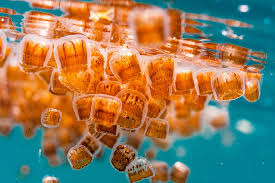
    Locally this irritation is often called “sea lice,” though the name is misleading. They are not lice at all. The sensation comes from microscopic cnidarians — most commonly the larval stages of the thimble jellyfish (Linuche unguiculata), though larvae of certain sea anemones can produce the same reaction (Segura-Puertas et al., 2001; Wong et al., 1994).

    Cluster of thimble jellyfish (Linuche unguiculata) showing small orange bells in shallow ocean water.
    Thimble jellyfish (Linuche unguiculata). The microscopic larval stages of this tiny jellyfish are the most common cause of the irritation known as “sea lice,” or seabather’s eruption. | Photo credit: Foued Kaddachi

    At this stage the animals are nearly invisible, drifting in the surface water. Waves and gentle onshore currents can concentrate them along the shoreline, the same shallow areas where swimmers enter the water, children play in the surf, and beachgoers wade while searching for shells.

    When these larvae become trapped against the skin — beneath fabric or pressed between toes and folds of skin — the same microscopic harpoons, or nematocysts, used to capture prey can inject a tiny amount of venom when triggered (Wong et al., 1994).

    Most people recognize the sudden prickling sensation immediately. In the hours that follow, the irritation can intensify into a fiery rash — a reaction known medically as seabather’s eruption. Relief usually begins by rinsing the skin with fresh water after leaving the ocean and applying cold compresses to calm the irritation (Wong et al., 1994).

    Few people ever see the organism responsible.

    As the Season Deepens

    Spring along the coast rarely arrives all at once. It unfolds in stages — water warming by degrees, plankton building slowly in the creeks and sounds, and the community of gelatinous drifters shifting with those changes.

    The nearly invisible jellies of early spring give way to species that are easier to see, easier to avoid, and sometimes easier to feel.

    Sea Nettles: The Summer Drifters of Brackish Water

    Atlantic sea nettle jellyfish drifting in green estuarine water.
    Atlantic sea nettle (Chrysaora quinquecirrha) drifting just beneath the surface of a coastal creek. | Photo credit: A. Mitchell

    By late spring and early summer, the Atlantic sea nettle (Chrysaora quinquecirrha) begins appearing more frequently in the creeks and sounds of Onslow County.

    Their bells carry warm amber tones, and long tentacles trail behind them like threads drifting through the tide.

    Sea nettles favor the brackish mixing zones of the estuary where freshwater flowing down the New River blends with saltwater entering through the inlets. As plankton populations increase with warming water, sea nettles follow the food supply into tidal creeks and quieter sounds (Lucas et al., 2012).

    Unlike moon jellies, their nematocysts can penetrate human skin, producing the sharp sting swimmers learn to recognize.

    Cannonball Jellies: The Offshore Drifters

    Cannonball jellyfish (Stomolophus meleagris) held by hand along a coastal shoreline.
    Cannonball jellyfish (Stomolophus meleagris) found along the shoreline in Surf City, NC. Many individuals washing ashore are no longer alive once they lose the buoyant support of seawater. | Photo credit: A. Mitchell

    Farther offshore another species sometimes appears — the cannonball jellyfish (Stomolophus meleagris).

    Their rounded bells give them the appearance of pale drifting mushrooms or underwater buoys.

    They often gather in offshore waters where ocean currents concentrate plankton (Graham et al., 2003). Storms and onshore winds can push them toward the beaches of Onslow County, where they sometimes appear along the wrack line.

    Many stranded individuals are no longer alive. Their gelatinous bodies collapse quickly once they leave the buoyant support of seawater.

    Beyond the breakers, however, they may still be drifting quietly through deeper currents.

    An Older Pattern Beneath the Surface

    It is easy to think of jellyfish as modern phenomena — summer nuisances or passing curiosities.

    Yet their lineage stretches back more than 500 million years, predating vertebrates and surviving multiple mass extinctions (Cartwright et al., 2007).

    Composite image showing fossil jellyfish impressions alongside modern jellyfish, illustrating the long evolutionary history of jellyfish in the ocean.
    Fossil impressions of ancient jellyfish alongside modern jellyfish. Soft-bodied animals like jellyfish rarely fossilize, but when preserved they reveal that jellyfish-like organisms have existed in Earth’s oceans for hundreds of millions of years. | Image credit: Fossil photo by B. Lieberman. Cunina photo by K. Raskoff, copyright.

    Long before barrier islands formed and migrated, eastern North Carolina lay beneath shallow marine waters.

    Soft-bodied drifters pulsed through plankton-rich seas above what would eventually become Onslow County.

    The small jelly beneath a dock in March is not something new.

    It is continuity.

    Returning to the Shoreline

    Stand again at the edge of the sound as winter begins to loosen its hold on the coast.

    The air is softer now. Ospreys circle overhead. Marsh grass prepares to green.

    Beneath the surface, the water is changing too — warming slowly, plankton returning, currents carrying new life through the estuary.

    A small bell pulses quietly past the pilings. Nearby, comb jellies flash faint rainbows when the light strikes them just right. Somewhere beyond sight, larvae drift through the tide.

    None of it announces itself.

    But if you lean over the water long enough in early spring, you can watch the system beginning again.

    Shallow coastal water with algae growing on sandy bottom in early spring.
    Early spring in the S. Topsail Island sound. Beneath the surface, plankton, drifting larvae, and young marine life begin to return with the warming water. | Photo credit: M. Mitchell

    References

    Cartwright, P., Halgedahl, S. L., Hendricks, J. R., Jarrard, R. D., Marques, A. C., Collins, A. G., & Lieberman, B. S. (2007). Exceptionally preserved jellyfishes from the Middle Cambrian. PLoS ONE, 2(10), e1121. https://doi.org/10.1371/journal.pone.0001121

    Cloern, J. E., & Jassby, A. D. (2009). Patterns and scales of phytoplankton variability in estuarine–coastal ecosystems. Estuaries and Coasts, 33(2), 230-241. https://doi.org/10.1007/s12237-009-9195-3

    Garm, A., Ekström, P., Boudes, M., & Nilsson, D. (2006). Rhopalia are integrated parts of the central nervous system in box jellyfish. Cell and Tissue Research, 325(2), 333-343. https://doi.org/10.1007/s00441-005-0134-8

    Graham, W. M. (2001). Size-based prey selectivity and dietary shifts in the jellyfish, Aurelia aurita. Journal of Plankton Research, 23(1), 67-74. https://doi.org/10.1093/plankt/23.1.67

    Graham, W. M., Pagès, F., & Hamner, W. M. (2001). A physical context for gelatinous zooplankton aggregations: A review. Jellyfish Blooms: Ecological and Societal Importance, 199-212. https://doi.org/10.1007/978-94-010-0722-1_16

    Lucas, C. H., Graham, W. M., & Widmer, C. (2012). Jellyfish life histories: Role of polyps in forming and maintaining Scyphomedusa populations. Advances in Marine Biology, 133-196. https://doi.org/10.1016/b978-0-12-394282-1.00003-x

    Mackie, G. O., & Meech, R. W. (1995). Central circuitry in the jellyfish Aglantha Digitale: I. The relay system. Journal of Experimental Biology, 198(11), 2261-2270. https://doi.org/10.1242/jeb.198.11.2261

    Mackie, G. O., & Meech, R. W. (1995). Central circuitry in the jellyfish Aglantha Digitale: II. The ring giant and carrier systems. Journal of Experimental Biology, 198(11), 2271-2278. https://doi.org/10.1242/jeb.198.11.2271

    Purcell, J. E. (2012). Jellyfish and ctenophore blooms coincide with human proliferations and environmental perturbations. Annual Review of Marine Science, 4(1), 209-235. https://doi.org/10.1146/annurev-marine-120709-142751

    Purcell, J. E., Shiganova, T. A., Decker, M. B., & Houde, E. D. (2001). The ctenophore Mnemiopsis in native and exotic habitats: U.S. estuaries versus the Black Sea basin. Hydrobiologia, 451, 145-176. https://link.springer.com/article/10.1023/A:1011826618539

    Purcell, J., Uye, S., & Lo, W. (2007). Anthropogenic causes of jellyfish blooms and their direct consequences for humans: A review. Marine Ecology Progress Series, 350, 153-174. https://doi.org/10.3354/meps07093

    Segura-Puertas, L., Ramos, M. E., Aramburo, C., Heimer de la Cotera, E. P., & Burnett, J. W. (2001). One Linuche mystery solved: All 3 stages of the coronate scyphomedusa Linuche unguiculata cause seabather’s eruption. Journal of the American Academy of Dermatology, 44(4), 624-628. https://doi.org/10.1067/mjd.2001.112345

    Skogh, C., Garm, A., Nilsson, D., & Ekström, P. (2006). Bilaterally symmetrical rhopalial nervous system of the box jellyfish Tripedalia cystophora. Journal of Morphology, 267(12), 1391-1405. https://doi.org/10.1002/jmor.10472

    Wong, D. E., Meinking, T. L., Rosen, L. B., Taplin, D., Hogan, D. J., & Burnett, J. W. (1994). Seabather’s eruption: Clinical, histologic, and immunologic features. Journal of American Academy of Dermatology, 30(3), 399-406. https://www.jaad.org/article/S0190-9622(94)70046-X/abstract